Lecture  13
General Circulation
Jet stream
El Nino and La Nina
1
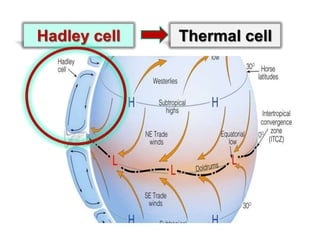
Hadley cell

Thermal cell
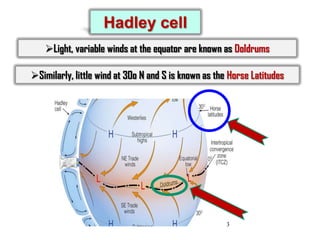
Hadley cell
Light, variable winds at the equator are known as Doldrums
Similarly, little wind at 30o N and S is known as the Horse Latitudes

3
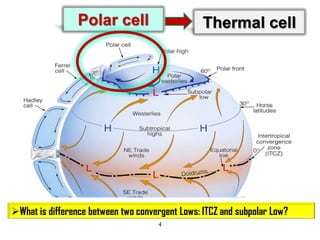
Polar cell

Thermal cell

What is difference between two convergent Lows: ITCZ and subpolar Low?
4
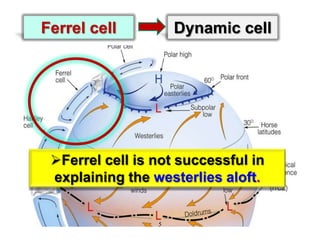
Ferrel cell

Dynamic cell

Ferrel cell is not successful in
explaining the westerlies aloft.

5
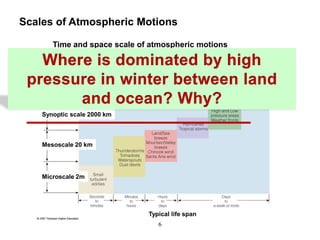
Scales of Atmospheric Motions
Time and space scale of atmospheric motions
Typical size

Global scale 5000 km

Synoptic scale 2000 km

Mesoscale 20 km

Microscale 2m

Typical life span
6
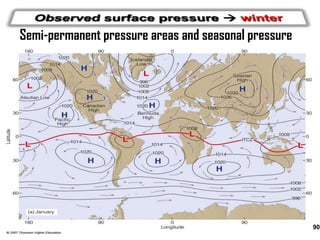
Semi-permanent pressure areas and seasonal pressure
areas

7

Fig. 7-26, p. 190
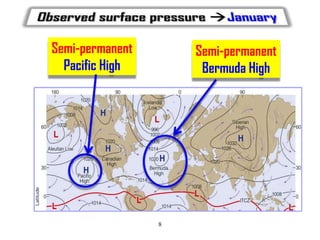
Semi-permanent
Pacific High

Semi-permanent
Bermuda High

8
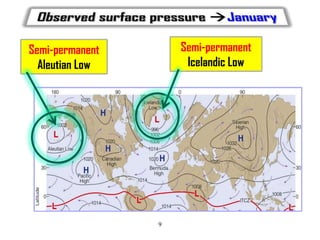
Semi-permanent
Icelandic Low

Semi-permanent
Aleutian Low

9
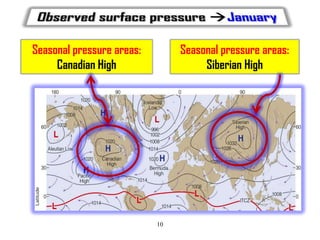
Seasonal pressure areas:
Canadian High

Seasonal pressure areas:
Siberian High

10
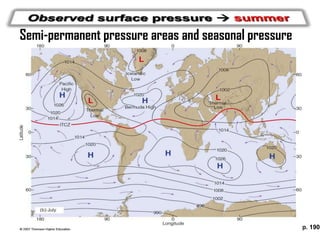
Semi-permanent pressure areas and seasonal pressure
areas

11

Fig. 7-26, p. 190
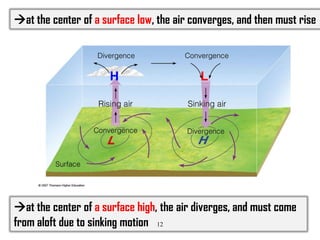
at the center of a surface low, the air converges, and then must rise

H

L

at the center of a surface high, the air diverges, and must come
from aloft due to sinking motion 12
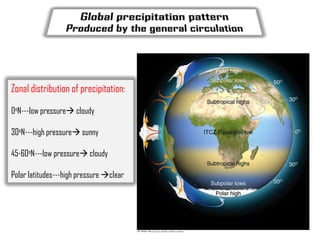
Zonal distribution of precipitation:
0oN---low pressure cloudy
30oN---high pressure sunny
45-60oN---low pressure cloudy
Polar latitudes---high pressure clear

13
Weather associated with
The Pacific and Bermuda Highs

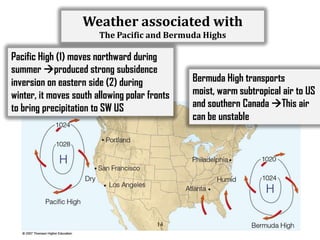
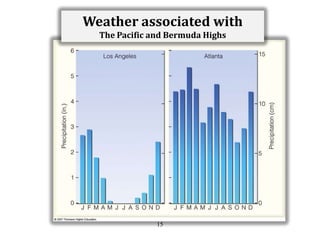
Pacific High (1) moves northward during
summer produced strong subsidence
inversion on eastern side (2) during
winter, it moves south allowing polar fronts
to bring precipitation to SW US

14

Bermuda High transports
moist, warm subtropical air to US
and southern Canada This air
can be unstable
Weather associated with
The Pacific and Bermuda Highs

15
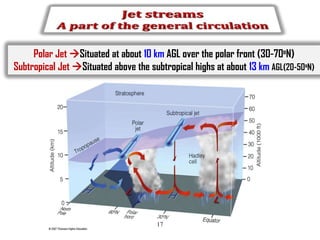
Jet Steams
Polar Jet Situated at about 10 km AGL over the polar front (30-70oN)
Subtropical Jet Situated above the subtropical highs at about 13 km AGL(20-50oN)

17
18

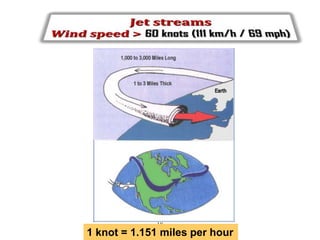
1 knot = 1.151 miles per hour




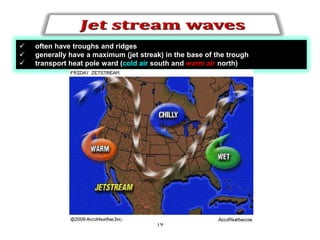
often have troughs and ridges
generally have a maximum (jet streak) in the base of the trough
transport heat pole ward (cold air south and warm air north)

19
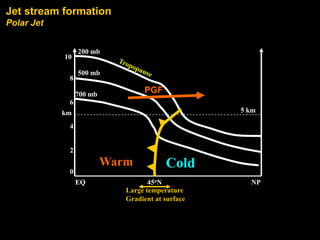
Jet stream formation
Polar Jet

10

8

200 mb
500 mb

PGF

700 mb
6

5 km

km
4
2

Warm

Cold

0
EQ

45oN
Large temperature
Gradient at surface

20

NP
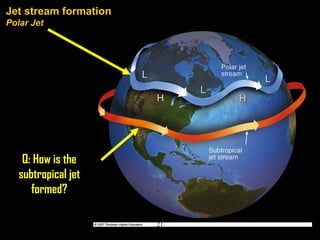
Jet stream formation
Polar Jet

Q: How is the
subtropical jet
formed?
21
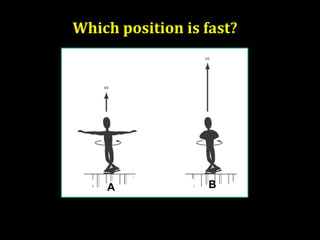
Which position is fast?

B

A

22
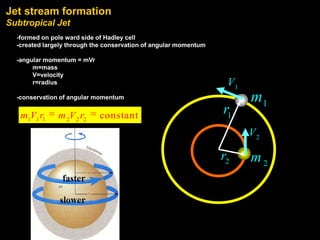
Jet stream formation
Subtropical Jet
-formed on pole ward side of Hadley cell
-created largely through the conservation of angular momentum
-angular momentum = mVr
m=mass
V=velocity
r=radius

V1

-conservation of angular momentum

m1V1 r1

m 2V 2 r2

constant

r1

m1
V2

r2

m2

23
El Nino and La Nina
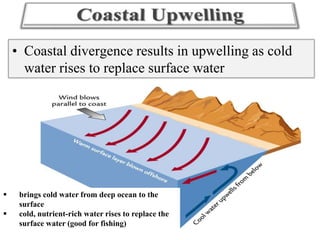
• Coastal divergence results in upwelling as cold
water rises to replace surface water




brings cold water from deep ocean to the
surface
cold, nutrient-rich water rises to replace the
surface water (good for fishing)
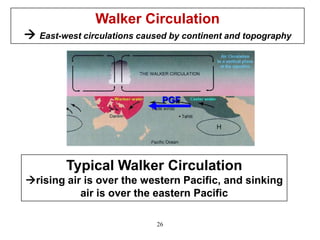
Walker Circulation
 East-west circulations caused by continent and topography

PGF

Typical Walker Circulation
rising air is over the western Pacific, and sinking
air is over the eastern Pacific
26
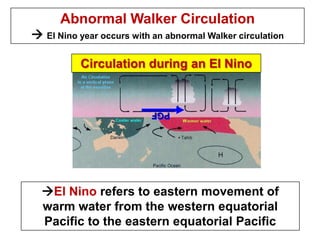
Abnormal Walker Circulation
 El Nino year occurs with an abnormal Walker circulation

Circulation during an El Nino

PGF

El Nino refers to eastern movement of
warm water from the western equatorial
Pacific to the eastern equatorial Pacific
27
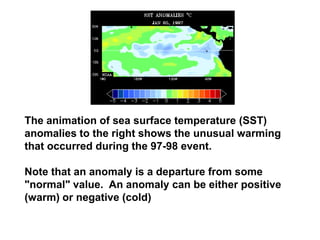
The animation of sea surface temperature (SST)
anomalies to the right shows the unusual warming
that occurred during the 97-98 event.
Note that an anomaly is a departure from some
"normal" value. An anomaly can be either positive
(warm) or negative (cold)
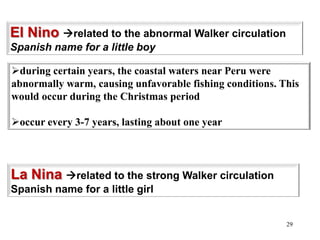
El Nino related to the abnormal Walker circulation
Spanish name for a little boy
during certain years, the coastal waters near Peru were
abnormally warm, causing unfavorable fishing conditions. This
would occur during the Christmas period
occur every 3-7 years, lasting about one year

La Nina related to the strong Walker circulation
Spanish name for a little girl

29
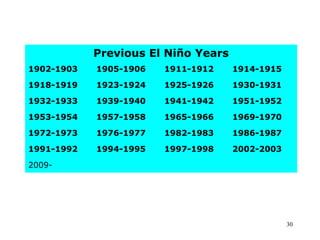
Previous El Niño Years
1902-1903

1905-1906

1911-1912

1914-1915

1918-1919

1923-1924

1925-1926

1930-1931

1932-1933

1939-1940

1941-1942

1951-1952

1953-1954

1957-1958

1965-1966

1969-1970

1972-1973

1976-1977

1982-1983

1986-1987

1991-1992

1994-1995

1997-1998

2002-2003

2009-

30
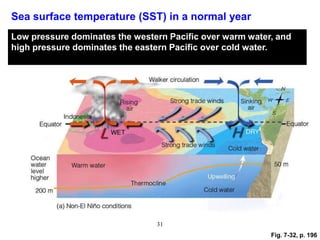
Sea surface temperature (SST) in a normal year
Low pressure dominates the western Pacific over warm water, and
high pressure dominates the eastern Pacific over cold water.

31
Fig. 7-32, p. 196
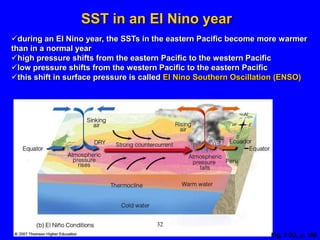
SST in an El Nino year
during an El Nino year, the SSTs in the eastern Pacific become more warmer
than in a normal year
high pressure shifts from the eastern Pacific to the western Pacific
low pressure shifts from the western Pacific to the eastern Pacific
this shift in surface pressure is called El Nino Southern Oscillation (ENSO)

32
Fig. 7-32, p. 196
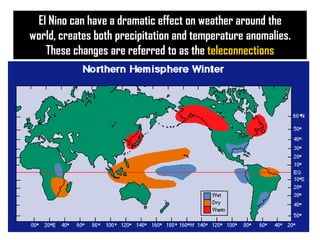
El Nino can have a dramatic effect on weather around the
world, creates both precipitation and temperature anomalies.
These changes are referred to as the teleconnections

33
ONI
Oceanic Nino Index
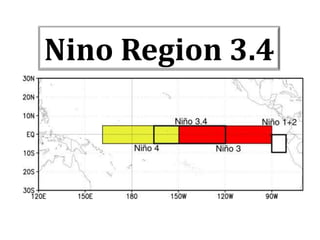
Nino Region 3.4
Oceanic Niño Index (ONI)
• The ONI is based on SST departures from average in the
Niño 3.4 region, and is a principal measure for
monitoring, assessing, and predicting ENSO.
• Defined as the three-month running-mean SST departures
in the Niño 3.4 region. Departures are based on a set of
improved homogeneous historical SST analyses
(Extended Reconstructed SST – ERSST.v3b). The SST
reconstruction methodology is described in Smith et
al., 2008, J. Climate, vol. 21, 2283-2296.)
• NOAA’s operational definitions of El Niño and La Niña are
keyed to the ONI index.
NOAA Operational Definitions for
El Niño and La Niña
El Niño: characterized by a positive ONI greater than or
equal to +0.5 C.
La Niña: characterized by a negative ONI less than or
equal to -0.5 C.
By historical standards, to be classified as a full-fledged
El Niño or La Niña episode, these thresholds must be
exceeded for a period of at least 5 consecutive
overlapping 3-month seasons.
CPC considers El Niño or La Niña conditions to occur when the
monthly Niño3.4 OISST departures meet or exceed +/- 0.5°C along
with consistent atmospheric features. These anomalies must also
be forecasted to persist for 3 consecutive months.
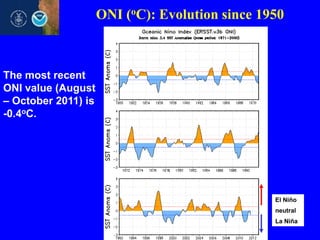
ONI (oC): Evolution since 1950

The most recent
ONI value (August
– October 2011) is
-0.4oC.

El Niño
neutral
La Niña

Lecture13 oct23-bb(1)

  • 1.
    Lecture  13 GeneralCirculation Jet stream El Nino and La Nina 1
  • 2.
  • 3.
    Hadley cell Light, variablewinds at the equator are known as Doldrums Similarly, little wind at 30o N and S is known as the Horse Latitudes 3
  • 4.
    Polar cell Thermal cell Whatis difference between two convergent Lows: ITCZ and subpolar Low? 4
  • 5.
    Ferrel cell Dynamic cell Ferrelcell is not successful in explaining the westerlies aloft. 5
  • 6.
    Scales of AtmosphericMotions Time and space scale of atmospheric motions Typical size Global scale 5000 km Synoptic scale 2000 km Mesoscale 20 km Microscale 2m Typical life span 6
  • 7.
    Semi-permanent pressure areasand seasonal pressure areas 7 Fig. 7-26, p. 190
  • 8.
  • 9.
  • 10.
    Seasonal pressure areas: CanadianHigh Seasonal pressure areas: Siberian High 10
  • 11.
    Semi-permanent pressure areasand seasonal pressure areas 11 Fig. 7-26, p. 190
  • 12.
    at the centerof a surface low, the air converges, and then must rise H L at the center of a surface high, the air diverges, and must come from aloft due to sinking motion 12
  • 13.
    Zonal distribution ofprecipitation: 0oN---low pressure cloudy 30oN---high pressure sunny 45-60oN---low pressure cloudy Polar latitudes---high pressure clear 13
  • 14.
    Weather associated with ThePacific and Bermuda Highs Pacific High (1) moves northward during summer produced strong subsidence inversion on eastern side (2) during winter, it moves south allowing polar fronts to bring precipitation to SW US 14 Bermuda High transports moist, warm subtropical air to US and southern Canada This air can be unstable
  • 15.
    Weather associated with ThePacific and Bermuda Highs 15
  • 16.
  • 17.
    Polar Jet Situatedat about 10 km AGL over the polar front (30-70oN) Subtropical Jet Situated above the subtropical highs at about 13 km AGL(20-50oN) 17
  • 18.
    18 1 knot =1.151 miles per hour
  • 19.
       often have troughsand ridges generally have a maximum (jet streak) in the base of the trough transport heat pole ward (cold air south and warm air north) 19
  • 20.
    Jet stream formation PolarJet 10 8 200 mb 500 mb PGF 700 mb 6 5 km km 4 2 Warm Cold 0 EQ 45oN Large temperature Gradient at surface 20 NP
  • 21.
    Jet stream formation PolarJet Q: How is the subtropical jet formed? 21
  • 22.
    Which position isfast? B A 22
  • 23.
    Jet stream formation SubtropicalJet -formed on pole ward side of Hadley cell -created largely through the conservation of angular momentum -angular momentum = mVr m=mass V=velocity r=radius V1 -conservation of angular momentum m1V1 r1 m 2V 2 r2 constant r1 m1 V2 r2 m2 23
  • 24.
    El Nino andLa Nina
  • 25.
    • Coastal divergenceresults in upwelling as cold water rises to replace surface water   brings cold water from deep ocean to the surface cold, nutrient-rich water rises to replace the surface water (good for fishing)
  • 26.
    Walker Circulation  East-westcirculations caused by continent and topography PGF Typical Walker Circulation rising air is over the western Pacific, and sinking air is over the eastern Pacific 26
  • 27.
    Abnormal Walker Circulation El Nino year occurs with an abnormal Walker circulation Circulation during an El Nino PGF El Nino refers to eastern movement of warm water from the western equatorial Pacific to the eastern equatorial Pacific 27
  • 28.
    The animation ofsea surface temperature (SST) anomalies to the right shows the unusual warming that occurred during the 97-98 event. Note that an anomaly is a departure from some "normal" value. An anomaly can be either positive (warm) or negative (cold)
  • 29.
    El Nino relatedto the abnormal Walker circulation Spanish name for a little boy during certain years, the coastal waters near Peru were abnormally warm, causing unfavorable fishing conditions. This would occur during the Christmas period occur every 3-7 years, lasting about one year La Nina related to the strong Walker circulation Spanish name for a little girl 29
  • 30.
    Previous El NiñoYears 1902-1903 1905-1906 1911-1912 1914-1915 1918-1919 1923-1924 1925-1926 1930-1931 1932-1933 1939-1940 1941-1942 1951-1952 1953-1954 1957-1958 1965-1966 1969-1970 1972-1973 1976-1977 1982-1983 1986-1987 1991-1992 1994-1995 1997-1998 2002-2003 2009- 30
  • 31.
    Sea surface temperature(SST) in a normal year Low pressure dominates the western Pacific over warm water, and high pressure dominates the eastern Pacific over cold water. 31 Fig. 7-32, p. 196
  • 32.
    SST in anEl Nino year during an El Nino year, the SSTs in the eastern Pacific become more warmer than in a normal year high pressure shifts from the eastern Pacific to the western Pacific low pressure shifts from the western Pacific to the eastern Pacific this shift in surface pressure is called El Nino Southern Oscillation (ENSO) 32 Fig. 7-32, p. 196
  • 33.
    El Nino canhave a dramatic effect on weather around the world, creates both precipitation and temperature anomalies. These changes are referred to as the teleconnections 33
  • 34.
  • 35.
  • 36.
    Oceanic Niño Index(ONI) • The ONI is based on SST departures from average in the Niño 3.4 region, and is a principal measure for monitoring, assessing, and predicting ENSO. • Defined as the three-month running-mean SST departures in the Niño 3.4 region. Departures are based on a set of improved homogeneous historical SST analyses (Extended Reconstructed SST – ERSST.v3b). The SST reconstruction methodology is described in Smith et al., 2008, J. Climate, vol. 21, 2283-2296.) • NOAA’s operational definitions of El Niño and La Niña are keyed to the ONI index.
  • 37.
    NOAA Operational Definitionsfor El Niño and La Niña El Niño: characterized by a positive ONI greater than or equal to +0.5 C. La Niña: characterized by a negative ONI less than or equal to -0.5 C. By historical standards, to be classified as a full-fledged El Niño or La Niña episode, these thresholds must be exceeded for a period of at least 5 consecutive overlapping 3-month seasons. CPC considers El Niño or La Niña conditions to occur when the monthly Niño3.4 OISST departures meet or exceed +/- 0.5°C along with consistent atmospheric features. These anomalies must also be forecasted to persist for 3 consecutive months.
  • 38.
    ONI (oC): Evolutionsince 1950 The most recent ONI value (August – October 2011) is -0.4oC. El Niño neutral La Niña