1
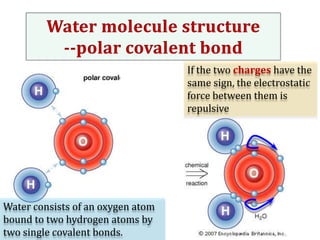
If the two charges have the
same sign, the electrostatic
force between them is
repulsive

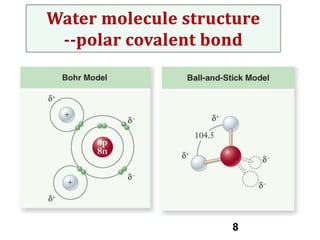
Water consists of an oxygen atom
bound to two hydrogen atoms by
two single covalent bonds.
8
9
Covalent bond
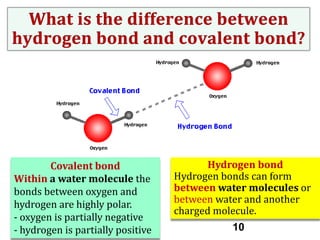
Within a water molecule the
bonds between oxygen and
hydrogen are highly polar.
- oxygen is partially negative
- hydrogen is partially positive

Hydrogen bond
Hydrogen bonds can form
between water molecules or
between water and another
charged molecule.
10
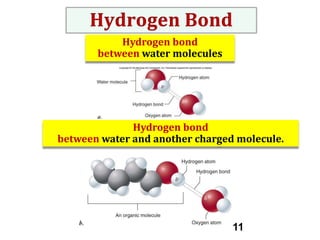
Hydrogen bond
between water molecules

Hydrogen bond
between water and another charged molecule.

11
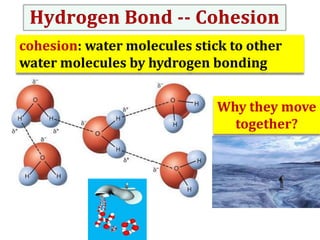
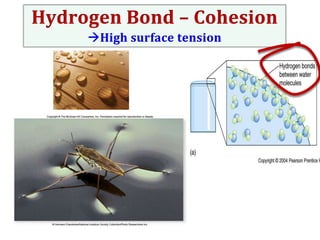
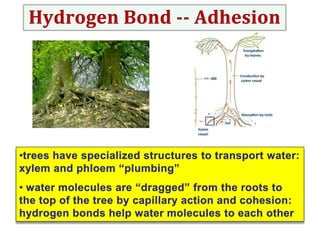
cohesion: water molecules stick to other
water molecules by hydrogen bonding
Why they move
together?
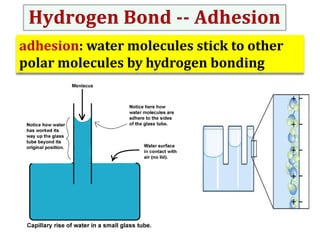
adhesion: water molecules stick to other
polar molecules by hydrogen bonding
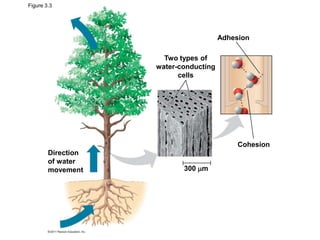
Figure 3.3

Adhesion
Two types of
water-conducting
cells

Cohesion

Direction
of water
movement

300 m
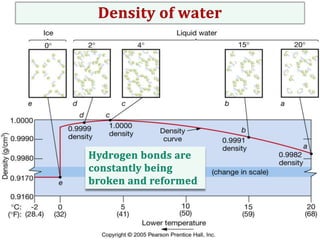
The formation of ice in
freshwater:
Lecture21 dec2-bb
Lecture21 dec2-bb
Lecture21 dec2-bb
Lecture21 dec2-bb

Lecture21 dec2-bb

  • 1.
  • 7.
    If the twocharges have the same sign, the electrostatic force between them is repulsive Water consists of an oxygen atom bound to two hydrogen atoms by two single covalent bonds.
  • 8.
  • 9.
  • 10.
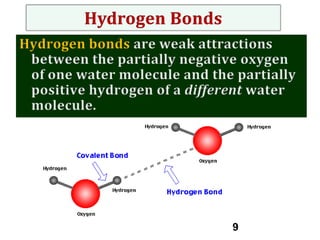
    Covalent bond Within awater molecule the bonds between oxygen and hydrogen are highly polar. - oxygen is partially negative - hydrogen is partially positive Hydrogen bond Hydrogen bonds can form between water molecules or between water and another charged molecule. 10
  • 11.
    Hydrogen bond between watermolecules Hydrogen bond between water and another charged molecule. 11
  • 12.
    cohesion: water moleculesstick to other water molecules by hydrogen bonding Why they move together?
  • 14.
    adhesion: water moleculesstick to other polar molecules by hydrogen bonding
  • 15.
    Figure 3.3 Adhesion Two typesof water-conducting cells Cohesion Direction of water movement 300 m
  • 19.
    The formation ofice in freshwater: