Lecture  14
Air Mass
Fronts
1
Air Masses
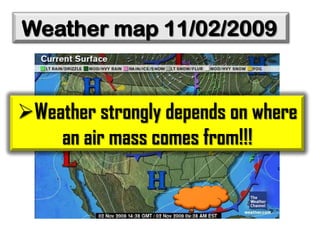
Weather map 11/02/2009

Weather strongly depends on where
an air mass comes from!!!
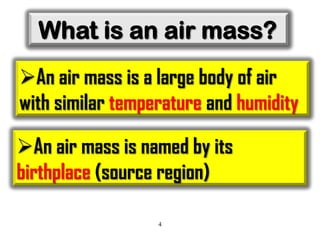
What is an air mass?
An air mass is a large body of air
with similar temperature and humidity
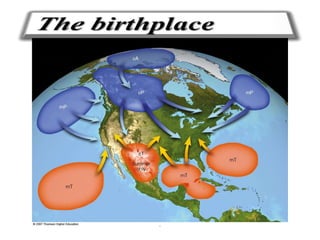
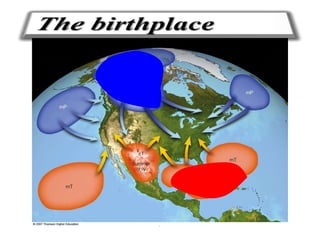
An air mass is named by its
birthplace (source region)
4
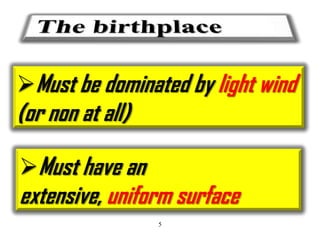
Must be dominated by light wind

(or non at all)

Must have an

extensive, uniform surface
5
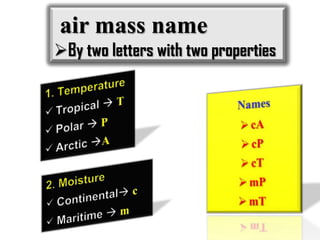
air mass name
By two letters with two properties
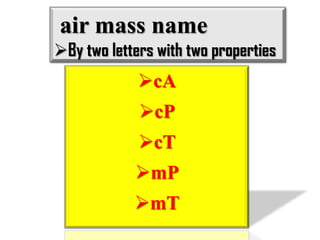
air mass name
By two letters with two properties

cA
cP
cT
mP
mT
8
9
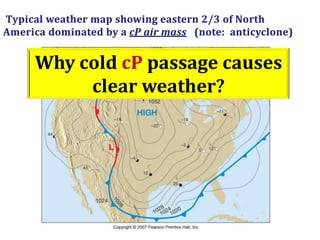
Why cold cP passage causes
clear weather?
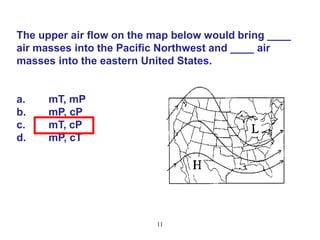
The upper air flow on the map below would bring ____
air masses into the Pacific Northwest and ____ air
masses into the eastern United States.

a.
b.
c.
d.

mT, mP
mP, cP
mT, cP
mP, cT

11
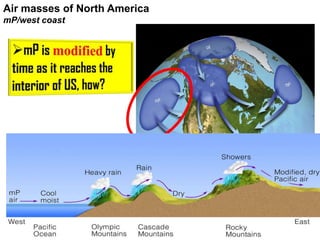
Air masses of North America
mP/west coast

12
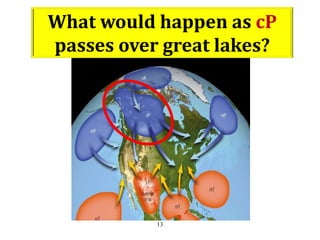
What would happen as cP
passes over great lakes?

13
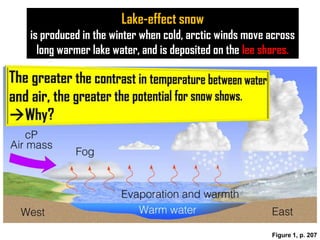
Lake-effect snow
is produced in the winter when cold, arctic winds move across
long warmer lake water, and is deposited on the lee shores.

Figure 1, p. 207
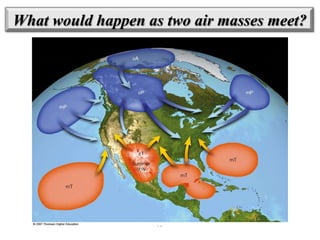
What would happen as two air masses meet?

15
Fronts
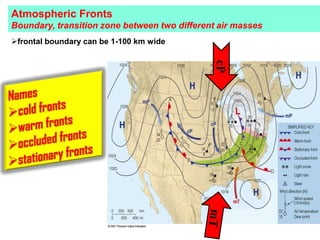
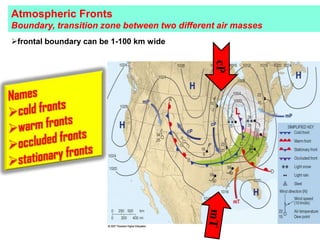
Atmospheric Fronts
Boundary, transition zone between two different air masses
frontal boundary can be 1-100 km wide

cP

17
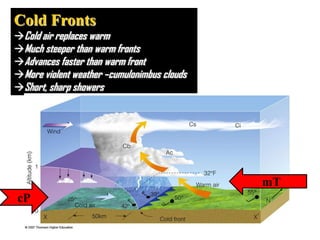
Cold Fronts

Cold air replaces warm
Much steeper than warm fronts
Advances faster than warm front
More violent weather –cumulonimbus clouds
Short, sharp showers

mT
cP
18
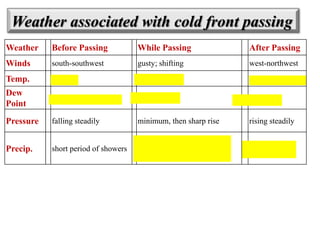
Weather associated with cold front passing
Weather

Before Passing

While Passing

After Passing

Winds

south-southwest

gusty; shifting

west-northwest

Temp.

warm

sudden drop

steadily dropping

Dew
Point

high; remains steady

sharp drop

lowering

Pressure

falling steadily

minimum, then sharp rise

rising steadily

Precip.

short period of showers

heavy rains, sometimes with
hail, thunder and lightning

showers then
clearing
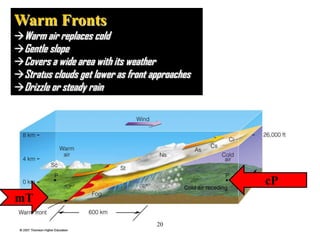
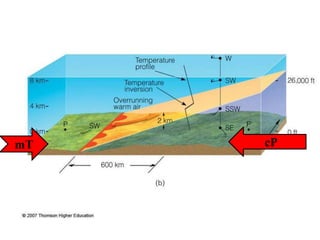
Warm Fronts

Warm air replaces cold
Gentle slope
Covers a wide area with its weather
Stratus clouds get lower as front approaches
Drizzle or steady rain

cP
mT
20
mT

cP
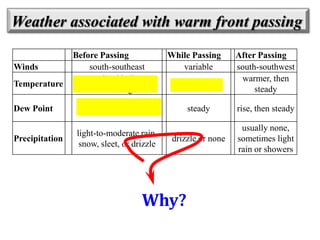
Weather associated with warm front passing
Winds
Temperature
Dew Point
Precipitation

Before Passing
south-southeast
cool-cold, slow
warming

While Passing
variable
steady rise

steady rise

After Passing
south-southwest
warmer, then
steady

steady

light-to-moderate rain,
snow, sleet, or drizzle

rise, then steady

drizzle or none

usually none,
sometimes light
rain or showers

Why?
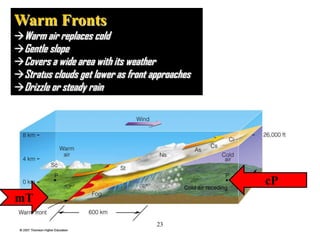
Warm Fronts

Warm air replaces cold
Gentle slope
Covers a wide area with its weather
Stratus clouds get lower as front approaches
Drizzle or steady rain

cP
mT
23
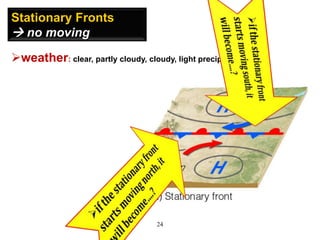
Stationary Fronts
 no moving
weather: clear, partly cloudy, cloudy, light precipitation

24
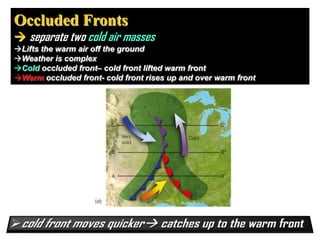
Occluded Fronts

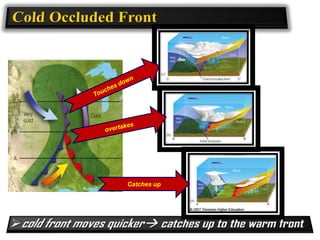
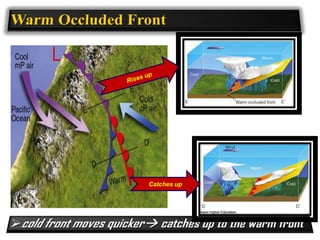
 separate two cold air masses
Lifts the warm air off the ground
Weather is complex
Cold occluded front– cold front lifted warm front
Warm occluded front- cold front rises up and over warm front

25
Catches up

26
Catches up

27
Atmospheric Fronts
Boundary, transition zone between two different air masses
frontal boundary can be 1-100 km wide

cP

28
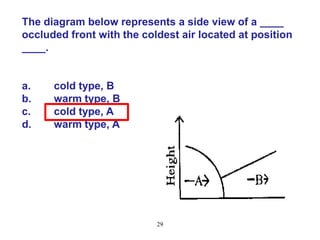
The diagram below represents a side view of a ____
occluded front with the coldest air located at position
____.

a.
b.
c.
d.

cold type, B
warm type, B
cold type, A
warm type, A

29
Review Questions
1.
2.
3.
4.
5.
6.
7.
8.

9.
10.
11.
12.
13.
14.
15.

What is an air mass?
What and where are good source regions for air masses?
How are air masses classified?
What are the characteristics of the air masses that commonly affect weather over the U.S.?
How can air masses be modified?
What are the fundamental, physical processes involved with generating lake effect snows?
What is a front?
What are the types of fronts? How are they analyzed (what symbol) on a surface weather
map?
What are the characteristics of each kind of front?
What is observed during frontal passage for each kind of front?
Why is the weather at LA much drier than at Atlanta?
What are the two jet streams and how are they created?
What is the Walker circulation?
What is El Nino? How often does it occur?
How do pressure, precipitation, SSTs and ocean currents change in the equatorial pacific
during an El Nino event?
30

Lecture14 oct28-bb

  • 1.
    Lecture  14 AirMass Fronts 1
  • 2.
  • 3.
    Weather map 11/02/2009 Weatherstrongly depends on where an air mass comes from!!!
  • 4.
    What is anair mass? An air mass is a large body of air with similar temperature and humidity An air mass is named by its birthplace (source region) 4
  • 5.
    Must be dominatedby light wind (or non at all) Must have an extensive, uniform surface 5
  • 6.
    air mass name Bytwo letters with two properties
  • 7.
    air mass name Bytwo letters with two properties cA cP cT mP mT
  • 8.
  • 9.
  • 10.
    Why cold cPpassage causes clear weather?
  • 11.
    The upper airflow on the map below would bring ____ air masses into the Pacific Northwest and ____ air masses into the eastern United States. a. b. c. d. mT, mP mP, cP mT, cP mP, cT 11
  • 12.
    Air masses ofNorth America mP/west coast 12
  • 13.
    What would happenas cP passes over great lakes? 13
  • 14.
    Lake-effect snow is producedin the winter when cold, arctic winds move across long warmer lake water, and is deposited on the lee shores. Figure 1, p. 207
  • 15.
    What would happenas two air masses meet? 15
  • 16.
  • 17.
    Atmospheric Fronts Boundary, transitionzone between two different air masses frontal boundary can be 1-100 km wide cP 17
  • 18.
    Cold Fronts Cold airreplaces warm Much steeper than warm fronts Advances faster than warm front More violent weather –cumulonimbus clouds Short, sharp showers mT cP 18
  • 19.
    Weather associated withcold front passing Weather Before Passing While Passing After Passing Winds south-southwest gusty; shifting west-northwest Temp. warm sudden drop steadily dropping Dew Point high; remains steady sharp drop lowering Pressure falling steadily minimum, then sharp rise rising steadily Precip. short period of showers heavy rains, sometimes with hail, thunder and lightning showers then clearing
  • 20.
    Warm Fronts Warm airreplaces cold Gentle slope Covers a wide area with its weather Stratus clouds get lower as front approaches Drizzle or steady rain cP mT 20
  • 21.
  • 22.
    Weather associated withwarm front passing Winds Temperature Dew Point Precipitation Before Passing south-southeast cool-cold, slow warming While Passing variable steady rise steady rise After Passing south-southwest warmer, then steady steady light-to-moderate rain, snow, sleet, or drizzle rise, then steady drizzle or none usually none, sometimes light rain or showers Why?
  • 23.
    Warm Fronts Warm airreplaces cold Gentle slope Covers a wide area with its weather Stratus clouds get lower as front approaches Drizzle or steady rain cP mT 23
  • 24.
    Stationary Fronts  nomoving weather: clear, partly cloudy, cloudy, light precipitation 24
  • 25.
    Occluded Fronts  separatetwo cold air masses Lifts the warm air off the ground Weather is complex Cold occluded front– cold front lifted warm front Warm occluded front- cold front rises up and over warm front 25
  • 26.
  • 27.
  • 28.
    Atmospheric Fronts Boundary, transitionzone between two different air masses frontal boundary can be 1-100 km wide cP 28
  • 29.
    The diagram belowrepresents a side view of a ____ occluded front with the coldest air located at position ____. a. b. c. d. cold type, B warm type, B cold type, A warm type, A 29
  • 30.
    Review Questions 1. 2. 3. 4. 5. 6. 7. 8. 9. 10. 11. 12. 13. 14. 15. What isan air mass? What and where are good source regions for air masses? How are air masses classified? What are the characteristics of the air masses that commonly affect weather over the U.S.? How can air masses be modified? What are the fundamental, physical processes involved with generating lake effect snows? What is a front? What are the types of fronts? How are they analyzed (what symbol) on a surface weather map? What are the characteristics of each kind of front? What is observed during frontal passage for each kind of front? Why is the weather at LA much drier than at Atlanta? What are the two jet streams and how are they created? What is the Walker circulation? What is El Nino? How often does it occur? How do pressure, precipitation, SSTs and ocean currents change in the equatorial pacific during an El Nino event? 30