Complex	
  Stresses	
  
Dr	
  Alessandro	
  Palmeri	
  
<A.Palmeri@lboro.ac.uk>	
  
Teaching	
  schedule	
  
Week Lecture 1 Staff Lecture 2 Staff Tutorial Staff
1 Beam Shear Stresses 1 A P Beam Shear Stresses 2 A P --- ---
2 Shear centres A P Basic Concepts J E-R Shear Centre A P
3 Principle of Virtual
forces
J E-R Indeterminate Structures J E-R Virtual Forces J E-R
4 The Compatibility
Method
J E-R Examples J E-R Virtual Forces J E-R
5 Examples J E-R Moment Distribution -
Basics
J E-R Comp. Method J E-R
6 The Hardy Cross
Method
J E-R Fixed End Moments J E-R Comp. Method J E-R
7 Examples J E-R Non Sway Frames J E-R Mom. Dist J E-R
8 Column Stability 1 A P Sway Frames J E-R Mom. Dist J E-R
9 Column Stability 2 A P Unsymmetric Bending 1 A P Colum Stability A P
10 Unsymmetric Bending 2 A P Complex Stress/Strain A P Unsymmetric
Bending
A P
11 Complex Stress/Strain A P Complex Stress/Strain A P Complex
Stress/Strain
A P
Christmas
Holiday
12 Revision
13
14 Exams
15
2	
  
MoAvaAons	
  (1/5)	
  
•  Failure	
  of	
  structures	
  is	
  oJen	
  the	
  result	
  of	
  different	
  
stresses	
  acAng	
  together	
  at	
  the	
  same	
  locaAon	
  
•  This	
  is	
  the	
  case,	
  for	
  instance,	
  of:	
  
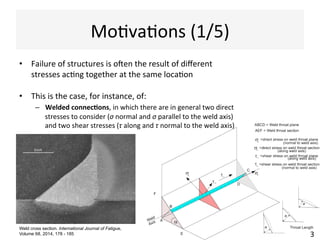
–  Welded	
  connec)ons,	
  in	
  which	
  there	
  are	
  in	
  general	
  two	
  direct	
  
stresses	
  to	
  consider	
  (σ	
  normal	
  and	
  σ	
  parallel	
  to	
  the	
  weld	
  axis)	
  
and	
  two	
  shear	
  stresses	
  (τ	
  along	
  and	
  τ	
  normal	
  to	
  the	
  weld	
  axis)	


3	
  
Weld cross section. International Journal of Fatigue,
Volume 68, 2014, 178 - 185
MoAvaAons	
  (2/5)	
  
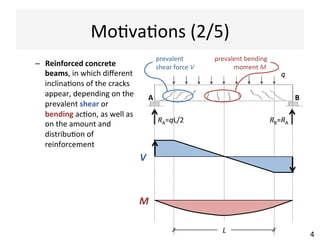
–  Reinforced	
  concrete	
  
beams,	
  in	
  which	
  different	
  
inclinaAons	
  of	
  the	
  cracks	
  
appear,	
  depending	
  on	
  the	
  
prevalent	
  shear	
  or	
  
bending	
  acAon,	
  as	
  well	
  as	
  
on	
  the	
  amount	
  and	
  
distribuAon	
  of	
  
reinforcement	


4	
  
RA=qL/2	
   RB=RA	
  
B	
  
q	
  
A	
  
L	
  
V	
  
M
prevalent	
  
shear	
  force	
  V	
  
prevalent	
  bending	
  
moment	
  M	
  
MoAvaAons	
  (3/5)	
  
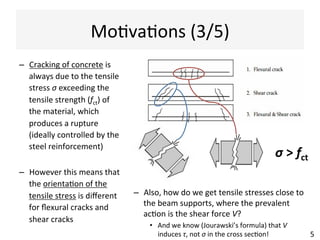
–  Cracking	
  of	
  concrete	
  is	
  
always	
  due	
  to	
  the	
  tensile	
  
stress	
  σ	
  exceeding	
  the	
  
tensile	
  strength	
  (fct)	
  of	
  
the	
  material,	
  which	
  
produces	
  a	
  rupture	
  
(ideally	
  controlled	
  by	
  the	
  
steel	
  reinforcement)	
  
–  However	
  this	
  means	
  that	
  
the	
  orientaAon	
  of	
  the	
  
tensile	
  stress	
  is	
  different	
  
for	
  flexural	
  cracks	
  and	
  
shear	
  cracks	
  
5	
  
–  Also,	
  how	
  do	
  we	
  get	
  tensile	
  stresses	
  close	
  to	
  
the	
  beam	
  supports,	
  where	
  the	
  prevalent	
  
acAon	
  is	
  the	
  shear	
  force	
  V?	
  
•  And	
  we	
  know	
  (Zhuravskii’s	
  formula)	
  that	
  V	
  
induces	
  τ,	
  not	
  σ	
  in	
  the	
  cross	
  secAon!	
  
σ	
  >	
  fct	
  
MoAvaAons	
  (4/5)	
  
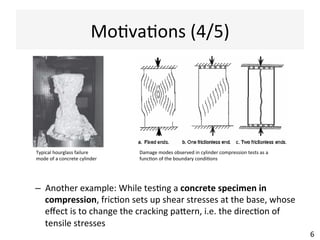
–  Another	
  example:	
  While	
  tesAng	
  a	
  concrete	
  specimen	
  in	
  
compression,	
  fricAon	
  sets	
  up	
  shear	
  stresses	
  at	
  the	
  base,	
  whose	
  
effect	
  is	
  to	
  change	
  the	
  cracking	
  paern,	
  i.e.	
  the	
  direcAon	
  of	
  
tensile	
  stresses	
  
6	
  
Damage	
  modes	
  observed	
  in	
  cylinder	
  compression	
  tests	
  as	
  a	
  
funcAon	
  of	
  the	
  boundary	
  condiAons	
  
Typical	
  hourglass	
  failure	
  
mode	
  of	
  a	
  concrete	
  cylinder	
  	
  
MoAvaAons	
  (5/5)	
  
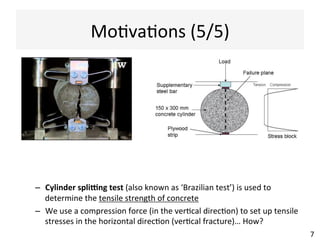
–  Cylinder	
  spli;ng	
  test	
  (also	
  known	
  as	
  ‘Brazilian	
  test’)	
  is	
  used	
  to	
  
determine	
  the	
  tensile	
  strength	
  of	
  concrete	
  
–  We	
  use	
  a	
  compression	
  force	
  (in	
  the	
  verAcal	
  direcAon)	
  to	
  set	
  up	
  tensile	
  
stresses	
  in	
  the	
  horizontal	
  direcAon	
  (verAcal	
  fracture)…	
  How?	
  
7	
  
Learning	
  Outcomes	
  
When	
  we	
  have	
  completed	
  this	
  unit	
  (2	
  lectures	
  +	
  1	
  
tutorial),	
  you	
  should	
  be	
  able	
  to:	
  
•  Use	
  the	
  Mohr’s	
  circle	
  to	
  determine:	
  
–  principal	
  stresses,	
  and	
  their	
  direcAons;	
  
–  maximum	
  shear	
  stress,	
  and	
  the	
  inclinaAon	
  of	
  the	
  
planes	
  where	
  it	
  occurs;	
  
–  normal	
  stress	
  and	
  shear	
  stress	
  in	
  any	
  inclined	
  plane	
  
•  Only	
  the	
  case	
  of	
  plane	
  stress	
  will	
  be	
  considered,	
  
i.e.	
  no	
  out-­‐of-­‐plane	
  stresses	
  
8	
  
Further	
  reading	
  
•  R	
  C	
  Hibbeler,	
  “Mechanics	
  of	
  Materials”,	
  8th	
  
Ed,	
  PrenAce	
  Hall	
  –	
  Chapter	
  9	
  on	
  “Stress	
  
TransformaAon”	
  
•  T	
  H	
  G	
  Megson,	
  “Structural	
  and	
  Stress	
  
Analysis”,	
  2nd	
  Ed,	
  Elsevier	
  –	
  Chapter	
  14	
  on	
  
“Complex	
  Stress	
  and	
  Strain”	
  (eBook)	
  
9	
  
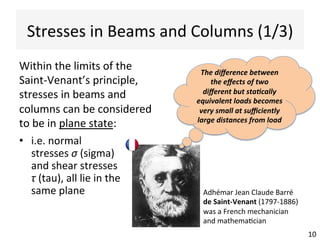
Stresses	
  in	
  Beams	
  and	
  Columns	
  (1/3)	
  	
  
Within	
  the	
  limits	
  of	
  the	
  
Saint-­‐Venant’s	
  principle,	
  
stresses	
  in	
  beams	
  and	
  
columns	
  can	
  be	
  considered	
  
to	
  be	
  in	
  plane	
  state:	


10	
  
The	
  difference	
  between	
  
the	
  effects	
  of	
  two	
  
different	
  but	
  sta6cally	
  
equivalent	
  loads	
  becomes	
  
very	
  small	
  at	
  suciently	
  
large	
  distances	
  from	
  load	
  
AdhĂŠmar	
  Jean	
  Claude	
  BarrÊ	
  
de	
  Saint-­‐Venant	
  (1797-­‐1886)	
  
was	
  a	
  French	
  mechanician	
  
and	
  mathemaAcian	
  
•  i.e.	
  normal	
  
stresses	
  σ	
  (sigma)	
  
and	
  shear	
  stresses	
  
τ	
  (tau),	
  all	
  lie	
  in	
  the	
  
same	
  plane	
  
Stresses	
  in	
  Beams	
  and	
  Columns	
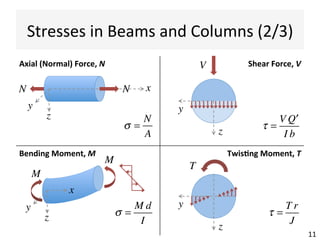
  (2/3)	
  	
  
11	
  
Axial	
  (Normal)	
  Force,	
  N	
   Shear	
  Force,	
  V	
  
Bending	
  Moment,	
  M	
   Twis)ng	
  Moment,	
  T	
  
σ =
N
A
N N x
y
z
τ =
V ′Q
I b
V
y
z
σ =
M d
I
M
x
y
z
M
τ =
T r
J
T
y
z
Stresses	
  in	
  Beams	
  and	
  Columns	
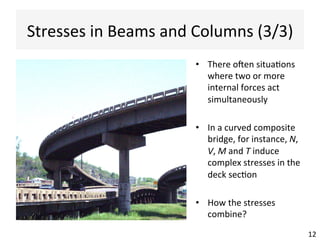
  (3/3)	
  	
  
12	
  
•  There	
  oJen	
  situaAons	
  
where	
  two	
  or	
  more	
  
internal	
  forces	
  act	
  
simultaneously	
  
•  In	
  a	
  curved	
  composite	
  
bridge,	
  for	
  instance,	
  N,	
  
V,	
  M	
  and	
  T	
  induce	
  
complex	
  stresses	
  in	
  the	
  
deck	
  secAon	
  
•  How	
  the	
  stresses	
  
combine?	
  
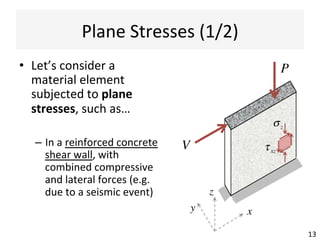
Plane	
  Stresses	
  (1/2)	
  
13	
  
•  Let’s	
  consider	
  a	
  
material	
  element	
  
subjected	
  to	
  plane	
  
stresses,	
  such	
  as…	
  
–  In	
  a	
  reinforced	
  concrete	
  
shear	
  wall,	
  with	
  
combined	
  compressive	
  
and	
  lateral	
  forces	
  (e.g.	
  
due	
  to	
  a	
  seismic	
  event)	
  
V
P
xy
z
σz
τxz
Plane	
  Stresses	
  (2/2)	
  
14	
  
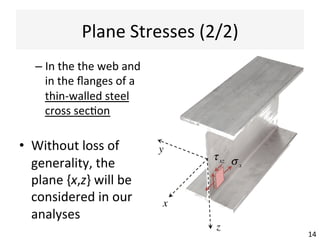
– In	
  the	
  the	
  web	
  and	
  
in	
  the	
  flanges	
  of	
  a	
  
thin-­‐walled	
  steel	
  
cross	
  secAon	
  
•  Without	
  loss	
  of	
  
generality,	
  the	
  
plane	
  {x,z}	
  will	
  be	
  
considered	
  in	
  our	
  
analyses	
  	
  
x
y
z
τxz σ x
ConstrucAon	
  of	
  the	
  Mohr’s	
  Circle	
  (1/7)	
  
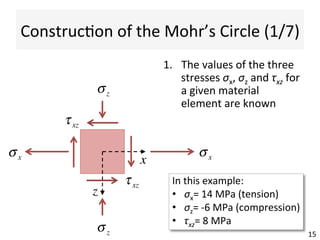
1.  The	
  values	
  of	
  the	
  three	
  
stresses	
  σx,	
  σz	
  and	
  τxz	
  for	
  
a	
  given	
  material	
  
element	
  are	
  known	
  
15	
  
x
z
σxσx
σz
σz
τxz
τxz In	
  this	
  example:	
  
•  σx=	
  14	
  MPa	
  (tension)	
  
•  σz=	
  -­‐6	
  MPa	
  (compression)	
  
•  τxz=	
  8	
  MPa	
  
ConstrucAon	
  of	
  the	
  Mohr’s	
  Circle	
  (2/7)	
  
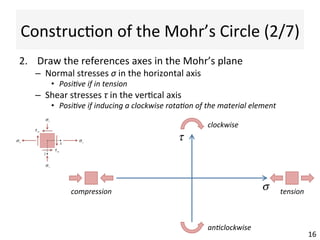
2.  Draw	
  the	
  references	
  axes	
  in	
  the	
  Mohr’s	
  plane	
  
–  Normal	
  stresses	
  σ	
  in	
  the	
  horizontal	
  axis	
  
•  Posi2ve	
  if	
  in	
  tension	
  
–  Shear	
  stresses	
  τ	
  in	
  the	
  verAcal	
  axis	
  
•  Posi2ve	
  if	
  inducing	
  a	
  clockwise	
  rota2on	
  of	
  the	
  material	
  element	
  
16	
  
x
z
σxσx
σz
σz
τxz
τxz
σ
τ
tension	
  compression	
  
clockwise	
  
an2clockwise	
  
σ
τ
tension'compression'
clockwise'
an0clockwise'
ConstrucAon	
  of	
  the	
  Mohr’s	
  Circle	
  (3/7)	
  
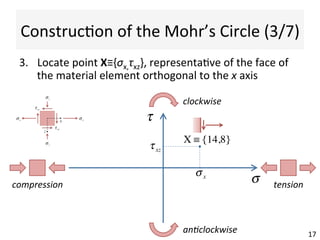
3.  Locate	
  point	
  X≡{σx,τxz},	
  representaAve	
  of	
  the	
  face	
  of	
  
the	
  material	
  element	
  orthogonal	
  to	
  the	
  x	
  axis	
  
17	
  
x
z
σxσx
σz
σz
τxz
τxz
X ≡ {14,8}
σx
τxz
σ
τ
tension'compression'
clockwise'
an0clockwise'
ConstrucAon	
  of	
  the	
  Mohr’s	
  Circle	
  (4/7)	
  
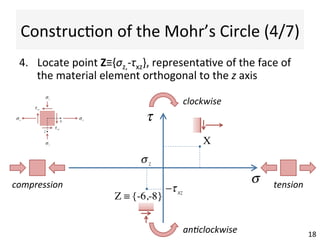
4.  Locate	
  point	
  Z≡{σz,-­‐τxz},	
  representaAve	
  of	
  the	
  face	
  of	
  
the	
  material	
  element	
  orthogonal	
  to	
  the	
  z	
  axis	
  
18	
  
x
z
σxσx
σz
σz
τxz
τxz
X
Z ≡ {-6,-8}
σz
−τxz
ConstrucAon	
  of	
  the	
  Mohr’s	
  Circle	
  (5/7)	
  
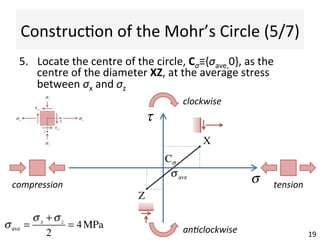
5.  Locate	
  the	
  centre	
  of	
  the	
  circle,	
  Cσ≡{σave,0},	
  as	
  the	
  
centre	
  of	
  the	
  diameter	
  XZ,	
  at	
  the	
  average	
  stress	
  
between	
  σx	
  and	
  σz	
  
σ
τ
tension'compression'
clockwise'
an0clockwise'
Z
19	
  
x
z
σxσx
σz
σz
τxz
τxz
X
Cσ
σave
σave =
σx +σz
2
= 4MPa
ConstrucAon	
  of	
  the	
  Mohr’s	
  Circle	
  (6/7)	
  
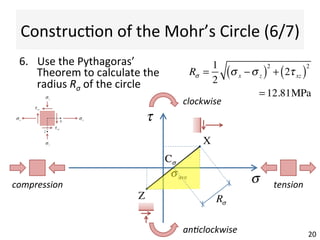
6.  Use	
  the	
  Pythagoras’	
  
Theorem	
  to	
  calculate	
  the	
  
radius	
  Rσ	
  of	
  the	
  circle	
  
σ
τ
tension'compression'
clockwise'
an0clockwise'
Z
20	
  
x
z
σxσx
σz
σz
τxz
τxz
X
Cσ
σave
Rσ =
1
2
σ x −σz( )2
+ 2τxz( )2
= 12.81MPa
`	
  
Rσ
ConstrucAon	
  of	
  the	
  Mohr’s	
  Circle	
  (7/7)	
  
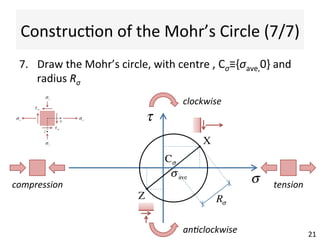
7.  Draw	
  the	
  Mohr’s	
  circle,	
  with	
  centre	
  ,	
  Cσ≡{σave,0}	
  and	
  
radius	
  Rσ	
  
σ
τ
tension'compression'
clockwise'
an0clockwise'
Z
21	
  
x
z
σxσx
σz
σz
τxz
τxz
X
Cσ
σave
Rσ
ProperAes	
  of	
  the	
  Mohr’s	
  Circle	
  (1/4)	
  
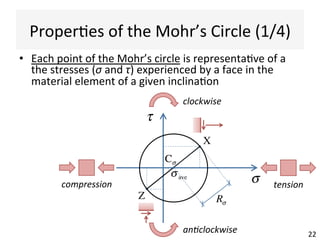
•  Each	
  point	
  of	
  the	
  Mohr’s	
  circle	
  is	
  representaAve	
  of	
  a	
  
the	
  stresses	
  (σ	
  and	
  τ)	
  experienced	
  by	
  a	
  face	
  in	
  the	
  
material	
  element	
  of	
  a	
  given	
  inclinaAon	
  	
  
σ
τ
tension'compression'
clockwise'
an0clockwise'
Z
X
Cσ
σave
Rσ
22	
  
compression*
ProperAes	
  of	
  the	
  Mohr’s	
  Circle	
  (2/4)	
  
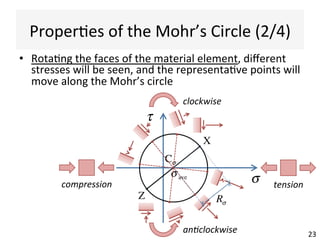
•  RotaAng	
  the	
  faces	
  of	
  the	
  material	
  element,	
  different	
  
stresses	
  will	
  be	
  seen,	
  and	
  the	
  representaAve	
  points	
  will	
  
move	
  along	
  the	
  Mohr’s	
  circle	
  
σ
τ
tension'compression'
clockwise'
an0clockwise'
Z
X
Cσ
σave
23	
  
compression*
Rσ
ProperAes	
  of	
  the	
  Mohr’s	
  Circle	
  (3/4)	
  
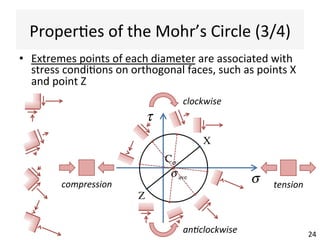
•  Extremes	
  points	
  of	
  each	
  diameter	
  are	
  associated	
  with	
  
stress	
  condiAons	
  on	
  orthogonal	
  faces,	
  such	
  as	
  points	
  X	
  
and	
  point	
  Z	
  
σ
τ
tension'compression'
clockwise'
an0clockwise'
Cσ
σave
Z
X
24	
  
compression*
ProperAes	
  of	
  the	
  Mohr’s	
  Circle	
  (4/4)	
  
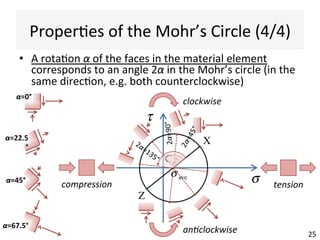
•  A	
  rotaAon	
  ι	
  of	
  the	
  faces	
  in	
  the	
  material	
  element	
  
corresponds	
  to	
  an	
  angle	
  2ι	
  in	
  the	
  Mohr’s	
  circle	
  (in	
  the	
  
same	
  direcAon,	
  e.g.	
  both	
  counterclockwise)	
  
σ
τ
tension'compression'
clockwise'
an0clockwise'
Cσ
σave
Z
X
25	
  
compression*
ι=0°	
  
Îą=22.5
°	
  
ι=45°	
  
2ι=90°	
  
ι=67.5°	
  
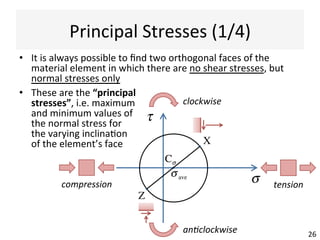
Principal	
  Stresses	
  (1/4)	
  
•  It	
  is	
  always	
  possible	
  to	
  nd	
  two	
  orthogonal	
  faces	
  of	
  the	
  
material	
  element	
  in	
  which	
  there	
  are	
  no	
  shear	
  stresses,	
  but	
  
normal	
  stresses	
  only	
  
σ
τ
tension'compression'
clockwise'
an0clockwise'
Cσ
σave
Z
X
26	
  
compression*
•  These	
  are	
  the	
  “principal	
  
stresses”,	
  i.e.	
  maximum	
  
and	
  minimum	
  values	
  of	
  
the	
  normal	
  stress	
  for	
  
the	
  varying	
  inclinaAon	
  
of	
  the	
  element’s	
  face	
  
Principal	
  Stresses	
  (2/4)	
  
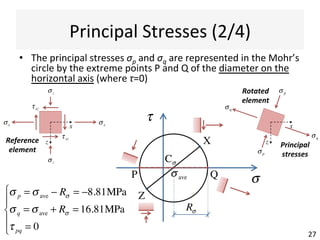
•  The	
  principal	
  stresses	
  σp	
  and	
  σq	
  are	
  represented	
  in	
  the	
  Mohr’s	
  
circle	
  by	
  the	
  extreme	
  points	
  P	
  and	
  Q	
  of	
  the	
  diameter	
  on	
  the	
  
horizontal	
  axis	
  (where	
  τ=0)	
  
σ
τ
tension'compression'
clockwise'
an0clockwise'
Cσ
σave
Z
X
27	
  
P Q
σ p = σave − Rσ = −8.81MPa
σq = σave + Rσ = 16.81MPa
τ pq = 0
⎧
⎨
⎪
⎊
⎪
Rσ
x
z
σxσx
σz
σz
τxz
τxz
x
z
σq
σq
σ p
σ p
Reference	
  
element	
  
Rotated	
  
element	
  
Principal	
  
stresses	
  
Principal	
  Stresses	
  (3/4)	
  
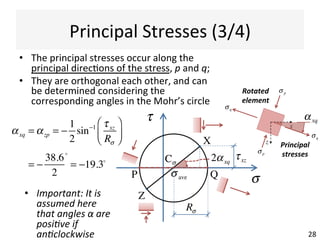
•  The	
  principal	
  stresses	
  occur	
  along	
  the	
  
principal	
  direcAons	
  of	
  the	
  stress,	
  p	
  and	
  q;	
  
•  They	
  are	
  orthogonal	
  each	
  other,	
  and	
  can	
  
be	
  determined	
  considering	
  the	
  
corresponding	
  angles	
  in	
  the	
  Mohr’s	
  circle	
  
σ
τ
tension'compression'
clockwise'
an0clockwise'
Cσ
σave
Z
X
28	
  
P Q
Rσ
x
z
σq
σq
σ p
σ pRotated	
  
element	
  
Principal	
  
stresses	
  
αxq = αzp = −
1
2
sin−1 τxz
Rσ
⎛
⎝⎜
⎞
⎠⎟
= −
38.6
2

= −19.3
Îąxq
2Îąxq
τxz
•  Important:	
  It	
  is	
  
assumed	
  here	
  
that	
  angles	
  ι	
  are	
  
posi2ve	
  if	
  
an2clockwise
Principal	
  Stresses	
  (4/4)	
  
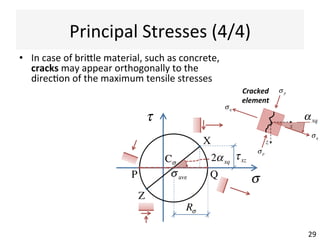
•  In	
  case	
  of	
  brile	
  material,	
  such	
  as	
  concrete,	
  
cracks	
  may	
  appear	
  orthogonally	
  to	
  the	
  
direcAon	
  of	
  the	
  maximum	
  tensile	
  stresses	
  
σ
τ
tension'compression'
clockwise'
an0clockwise'
Cσ
σave
Z
X
29	
  
P Q
Rσ
x
z
σq
σq
σ p
σ pCracked	
  
element	
  
Îąxq
2Îąxq
τxz
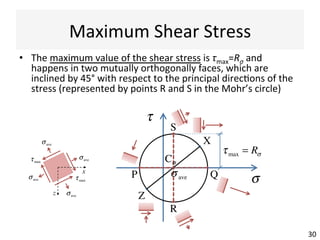
Maximum	
  Shear	
  Stress	
  
•  The	
  maximum	
  value	
  of	
  the	
  shear	
  stress	
  is	
  τmax=Rσ	
  and	
  
happens	
  in	
  two	
  mutually	
  orthogonally	
  faces,	
  which	
  are	
  
inclined	
  by	
  45°	
  with	
  respect	
  to	
  the	
  principal	
  direcAons	
  of	
  the	
  
stress	
  (represented	
  by	
  points	
  R	
  and	
  S	
  in	
  the	
  Mohr’s	
  circle)	
  
σ
τ
tension'compression'
clockwise'
an0clockwise'
Z
X
30	
  
P Q
τmax = Rσ
Cσ
σave
R
S
x
z
σave
σave
σave
σave
τmax
τmax
Stresses	
  on	
  an	
  Arbitrary	
  Inclined	
  Face	
  
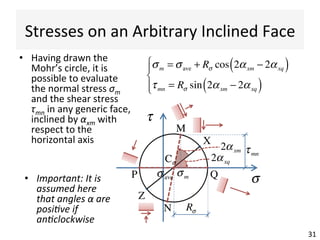
•  Having	
  drawn	
  the	
  
Mohr’s	
  circle,	
  it	
  is	
  
possible	
  to	
  evaluate	
  
the	
  normal	
  stress	
  σm	
  	
  
and	
  the	
  shear	
  stress	
  
τmn	
  in	
  any	
  generic	
  face,	
  
inclined	
  by	
  ιxm	
  with	
  
respect	
  to	
  the	
  
horizontal	
  axis	
  
σ
τ
tension'compression'
clockwise'
an0clockwise'
Z
X
31	
  
P Q
Rσ
2Îąxq
τmn
Cσ
σave
M
N
σm
2Îąxm
σm = σave + Rσ cos 2αxm − 2αxq( )
τmn = Rσ sin 2αxm − 2αxq( )
⎧
⎨
⎪
⎩⎪
•  Important:	
  It	
  is	
  
assumed	
  here	
  
that	
  angles	
  ι	
  are	
  
posi2ve	
  if	
  
an2clockwise	
  
Key	
  Learning	
  Points	
  
1.  Normal	
  stresses	
  and	
  shear	
  stresses	
  acAng	
  on	
  a	
  given	
  
material	
  element	
  change	
  their	
  values	
  depending	
  on	
  the	
  
inclinaAon	
  of	
  the	
  elementary	
  area	
  being	
  considered	
  
2.  The	
  Mohr’s	
  circle	
  allows	
  evaluaAng	
  
–  The	
  extreme	
  values	
  of	
  the	
  normal	
  stress	
  σp	
  and	
  σq	
  
–  The	
  extreme	
  value	
  of	
  the	
  shear	
  stress	
  τmax	
  
–  The	
  inclinaAon	
  of	
  the	
  faces	
  where	
  such	
  values	
  are	
  seen	
  
–  The	
  stresses	
  σm	
  and	
  τmn	
  for	
  an	
  arbitrary	
  inclinaAon	


32	
  

Complex stresses (2nd year)

  • 1.
    Complex  Stresses   Dr  Alessandro  Palmeri   <A.Palmeri@lboro.ac.uk>  
  • 2.
    Teaching  schedule   WeekLecture 1 Staff Lecture 2 Staff Tutorial Staff 1 Beam Shear Stresses 1 A P Beam Shear Stresses 2 A P --- --- 2 Shear centres A P Basic Concepts J E-R Shear Centre A P 3 Principle of Virtual forces J E-R Indeterminate Structures J E-R Virtual Forces J E-R 4 The Compatibility Method J E-R Examples J E-R Virtual Forces J E-R 5 Examples J E-R Moment Distribution - Basics J E-R Comp. Method J E-R 6 The Hardy Cross Method J E-R Fixed End Moments J E-R Comp. Method J E-R 7 Examples J E-R Non Sway Frames J E-R Mom. Dist J E-R 8 Column Stability 1 A P Sway Frames J E-R Mom. Dist J E-R 9 Column Stability 2 A P Unsymmetric Bending 1 A P Colum Stability A P 10 Unsymmetric Bending 2 A P Complex Stress/Strain A P Unsymmetric Bending A P 11 Complex Stress/Strain A P Complex Stress/Strain A P Complex Stress/Strain A P Christmas Holiday 12 Revision 13 14 Exams 15 2  
  • 3.
    MoAvaAons  (1/5)   • Failure  of  structures  is  oJen  the  result  of  different   stresses  acAng  together  at  the  same  locaAon   •  This  is  the  case,  for  instance,  of:   –  Welded  connec)ons,  in  which  there  are  in  general  two  direct   stresses  to  consider  (σ  normal  and  σ  parallel  to  the  weld  axis)   and  two  shear  stresses  (τ  along  and  τ  normal  to  the  weld  axis)       3   Weld cross section. International Journal of Fatigue, Volume 68, 2014, 178 - 185
  • 4.
    MoAvaAons  (2/5)   – Reinforced  concrete   beams,  in  which  different   inclinaAons  of  the  cracks   appear,  depending  on  the   prevalent  shear  or   bending  acAon,  as  well  as   on  the  amount  and   distribuAon  of   reinforcement       4   RA=qL/2   RB=RA   B   q   A   L   V   M prevalent   shear  force  V   prevalent  bending   moment  M  
  • 5.
    MoAvaAons  (3/5)   – Cracking  of  concrete  is   always  due  to  the  tensile   stress  σ  exceeding  the   tensile  strength  (fct)  of   the  material,  which   produces  a  rupture   (ideally  controlled  by  the   steel  reinforcement)   –  However  this  means  that   the  orientaAon  of  the   tensile  stress  is  different   for  flexural  cracks  and   shear  cracks   5   –  Also,  how  do  we  get  tensile  stresses  close  to   the  beam  supports,  where  the  prevalent   acAon  is  the  shear  force  V?   •  And  we  know  (Zhuravskii’s  formula)  that  V   induces  τ,  not  σ  in  the  cross  secAon!   σ  >  fct  
  • 6.
    MoAvaAons  (4/5)   – Another  example:  While  tesAng  a  concrete  specimen  in   compression,  fricAon  sets  up  shear  stresses  at  the  base,  whose   effect  is  to  change  the  cracking  paern,  i.e.  the  direcAon  of   tensile  stresses   6   Damage  modes  observed  in  cylinder  compression  tests  as  a   funcAon  of  the  boundary  condiAons   Typical  hourglass  failure   mode  of  a  concrete  cylinder    
  • 7.
    MoAvaAons  (5/5)   – Cylinder  spli;ng  test  (also  known  as  ‘Brazilian  test’)  is  used  to   determine  the  tensile  strength  of  concrete   –  We  use  a  compression  force  (in  the  verAcal  direcAon)  to  set  up  tensile   stresses  in  the  horizontal  direcAon  (verAcal  fracture)…  How?   7  
  • 8.
    Learning  Outcomes   When  we  have  completed  this  unit  (2  lectures  +  1   tutorial),  you  should  be  able  to:   •  Use  the  Mohr’s  circle  to  determine:   –  principal  stresses,  and  their  direcAons;   –  maximum  shear  stress,  and  the  inclinaAon  of  the   planes  where  it  occurs;   –  normal  stress  and  shear  stress  in  any  inclined  plane   •  Only  the  case  of  plane  stress  will  be  considered,   i.e.  no  out-­‐of-­‐plane  stresses   8  
  • 9.
    Further  reading   • R  C  Hibbeler,  “Mechanics  of  Materials”,  8th   Ed,  PrenAce  Hall  –  Chapter  9  on  “Stress   TransformaAon”   •  T  H  G  Megson,  “Structural  and  Stress   Analysis”,  2nd  Ed,  Elsevier  –  Chapter  14  on   “Complex  Stress  and  Strain”  (eBook)   9  
  • 10.
    Stresses  in  Beams  and  Columns  (1/3)     Within  the  limits  of  the   Saint-­‐Venant’s  principle,   stresses  in  beams  and   columns  can  be  considered   to  be  in  plane  state:     10   The  difference  between   the  effects  of  two   different  but  sta6cally   equivalent  loads  becomes   very  small  at  sufficiently   large  distances  from  load   Adhémar  Jean  Claude  Barré   de  Saint-­‐Venant  (1797-­‐1886)   was  a  French  mechanician   and  mathemaAcian   •  i.e.  normal   stresses  σ  (sigma)   and  shear  stresses   τ  (tau),  all  lie  in  the   same  plane  
  • 11.
    Stresses  in  Beams  and  Columns  (2/3)     11   Axial  (Normal)  Force,  N   Shear  Force,  V   Bending  Moment,  M   Twis)ng  Moment,  T   σ = N A N N x y z τ = V ′Q I b V y z σ = M d I M x y z M τ = T r J T y z
  • 12.
    Stresses  in  Beams  and  Columns  (3/3)     12   •  There  oJen  situaAons   where  two  or  more   internal  forces  act   simultaneously   •  In  a  curved  composite   bridge,  for  instance,  N,   V,  M  and  T  induce   complex  stresses  in  the   deck  secAon   •  How  the  stresses   combine?  
  • 13.
    Plane  Stresses  (1/2)   13   •  Let’s  consider  a   material  element   subjected  to  plane   stresses,  such  as…   –  In  a  reinforced  concrete   shear  wall,  with   combined  compressive   and  lateral  forces  (e.g.   due  to  a  seismic  event)   V P xy z σz τxz
  • 14.
    Plane  Stresses  (2/2)   14   – In  the  the  web  and   in  the  flanges  of  a   thin-­‐walled  steel   cross  secAon   •  Without  loss  of   generality,  the   plane  {x,z}  will  be   considered  in  our   analyses     x y z τxz σ x
  • 15.
    ConstrucAon  of  the  Mohr’s  Circle  (1/7)   1.  The  values  of  the  three   stresses  σx,  σz  and  τxz  for   a  given  material   element  are  known   15   x z σxσx σz σz τxz τxz In  this  example:   •  σx=  14  MPa  (tension)   •  σz=  -­‐6  MPa  (compression)   •  τxz=  8  MPa  
  • 16.
    ConstrucAon  of  the  Mohr’s  Circle  (2/7)   2.  Draw  the  references  axes  in  the  Mohr’s  plane   –  Normal  stresses  σ  in  the  horizontal  axis   •  Posi2ve  if  in  tension   –  Shear  stresses  τ  in  the  verAcal  axis   •  Posi2ve  if  inducing  a  clockwise  rota2on  of  the  material  element   16   x z σxσx σz σz τxz τxz σ τ tension  compression   clockwise   an2clockwise  
  • 17.
    σ τ tension'compression' clockwise' an0clockwise' ConstrucAon  of  the  Mohr’s  Circle  (3/7)   3.  Locate  point  X≡{σx,τxz},  representaAve  of  the  face  of   the  material  element  orthogonal  to  the  x  axis   17   x z σxσx σz σz τxz τxz X ≡ {14,8} σx τxz
  • 18.
    σ τ tension'compression' clockwise' an0clockwise' ConstrucAon  of  the  Mohr’s  Circle  (4/7)   4.  Locate  point  Z≡{σz,-­‐τxz},  representaAve  of  the  face  of   the  material  element  orthogonal  to  the  z  axis   18   x z σxσx σz σz τxz τxz X Z ≡ {-6,-8} σz −τxz
  • 19.
    ConstrucAon  of  the  Mohr’s  Circle  (5/7)   5.  Locate  the  centre  of  the  circle,  Cσ≡{σave,0},  as  the   centre  of  the  diameter  XZ,  at  the  average  stress   between  σx  and  σz   σ τ tension'compression' clockwise' an0clockwise' Z 19   x z σxσx σz σz τxz τxz X Cσ σave σave = σx +σz 2 = 4MPa
  • 20.
    ConstrucAon  of  the  Mohr’s  Circle  (6/7)   6.  Use  the  Pythagoras’   Theorem  to  calculate  the   radius  Rσ  of  the  circle   σ τ tension'compression' clockwise' an0clockwise' Z 20   x z σxσx σz σz τxz τxz X Cσ σave Rσ = 1 2 σ x −σz( )2 + 2τxz( )2 = 12.81MPa `   Rσ
  • 21.
    ConstrucAon  of  the  Mohr’s  Circle  (7/7)   7.  Draw  the  Mohr’s  circle,  with  centre  ,  Cσ≡{σave,0}  and   radius  Rσ   σ τ tension'compression' clockwise' an0clockwise' Z 21   x z σxσx σz σz τxz τxz X Cσ σave Rσ
  • 22.
    ProperAes  of  the  Mohr’s  Circle  (1/4)   •  Each  point  of  the  Mohr’s  circle  is  representaAve  of  a   the  stresses  (σ  and  τ)  experienced  by  a  face  in  the   material  element  of  a  given  inclinaAon     σ τ tension'compression' clockwise' an0clockwise' Z X Cσ σave Rσ 22   compression*
  • 23.
    ProperAes  of  the  Mohr’s  Circle  (2/4)   •  RotaAng  the  faces  of  the  material  element,  different   stresses  will  be  seen,  and  the  representaAve  points  will   move  along  the  Mohr’s  circle   σ τ tension'compression' clockwise' an0clockwise' Z X Cσ σave 23   compression* Rσ
  • 24.
    ProperAes  of  the  Mohr’s  Circle  (3/4)   •  Extremes  points  of  each  diameter  are  associated  with   stress  condiAons  on  orthogonal  faces,  such  as  points  X   and  point  Z   σ τ tension'compression' clockwise' an0clockwise' Cσ σave Z X 24   compression*
  • 25.
    ProperAes  of  the  Mohr’s  Circle  (4/4)   •  A  rotaAon  α  of  the  faces  in  the  material  element   corresponds  to  an  angle  2α  in  the  Mohr’s  circle  (in  the   same  direcAon,  e.g.  both  counterclockwise)   σ τ tension'compression' clockwise' an0clockwise' Cσ σave Z X 25   compression* α=0°   α=22.5 °   α=45°   2α=90°   α=67.5°  
  • 26.
    Principal  Stresses  (1/4)   •  It  is  always  possible  to  find  two  orthogonal  faces  of  the   material  element  in  which  there  are  no  shear  stresses,  but   normal  stresses  only   σ τ tension'compression' clockwise' an0clockwise' Cσ σave Z X 26   compression* •  These  are  the  “principal   stresses”,  i.e.  maximum   and  minimum  values  of   the  normal  stress  for   the  varying  inclinaAon   of  the  element’s  face  
  • 27.
    Principal  Stresses  (2/4)   •  The  principal  stresses  σp  and  σq  are  represented  in  the  Mohr’s   circle  by  the  extreme  points  P  and  Q  of  the  diameter  on  the   horizontal  axis  (where  τ=0)   σ τ tension'compression' clockwise' an0clockwise' Cσ σave Z X 27   P Q σ p = σave − Rσ = −8.81MPa σq = σave + Rσ = 16.81MPa τ pq = 0 ⎧ ⎨ ⎪ ⎩ ⎪ Rσ x z σxσx σz σz τxz τxz x z σq σq σ p σ p Reference   element   Rotated   element   Principal   stresses  
  • 28.
    Principal  Stresses  (3/4)   •  The  principal  stresses  occur  along  the   principal  direcAons  of  the  stress,  p  and  q;   •  They  are  orthogonal  each  other,  and  can   be  determined  considering  the   corresponding  angles  in  the  Mohr’s  circle   σ τ tension'compression' clockwise' an0clockwise' Cσ σave Z X 28   P Q Rσ x z σq σq σ p σ pRotated   element   Principal   stresses   αxq = αzp = − 1 2 sin−1 τxz Rσ ⎛ ⎝⎜ ⎞ ⎠⎟ = − 38.6 2  = −19.3 αxq 2αxq τxz •  Important:  It  is   assumed  here   that  angles  α  are   posi2ve  if   an2clockwise
  • 29.
    Principal  Stresses  (4/4)   •  In  case  of  brile  material,  such  as  concrete,   cracks  may  appear  orthogonally  to  the   direcAon  of  the  maximum  tensile  stresses   σ τ tension'compression' clockwise' an0clockwise' Cσ σave Z X 29   P Q Rσ x z σq σq σ p σ pCracked   element   αxq 2αxq τxz
  • 30.
    Maximum  Shear  Stress   •  The  maximum  value  of  the  shear  stress  is  τmax=Rσ  and   happens  in  two  mutually  orthogonally  faces,  which  are   inclined  by  45°  with  respect  to  the  principal  direcAons  of  the   stress  (represented  by  points  R  and  S  in  the  Mohr’s  circle)   σ τ tension'compression' clockwise' an0clockwise' Z X 30   P Q τmax = Rσ Cσ σave R S x z σave σave σave σave τmax τmax
  • 31.
    Stresses  on  an  Arbitrary  Inclined  Face   •  Having  drawn  the   Mohr’s  circle,  it  is   possible  to  evaluate   the  normal  stress  σm     and  the  shear  stress   τmn  in  any  generic  face,   inclined  by  αxm  with   respect  to  the   horizontal  axis   σ τ tension'compression' clockwise' an0clockwise' Z X 31   P Q Rσ 2αxq τmn Cσ σave M N σm 2αxm σm = σave + Rσ cos 2αxm − 2αxq( ) τmn = Rσ sin 2αxm − 2αxq( ) ⎧ ⎨ ⎪ ⎩⎪ •  Important:  It  is   assumed  here   that  angles  α  are   posi2ve  if   an2clockwise  
  • 32.
    Key  Learning  Points   1.  Normal  stresses  and  shear  stresses  acAng  on  a  given   material  element  change  their  values  depending  on  the   inclinaAon  of  the  elementary  area  being  considered   2.  The  Mohr’s  circle  allows  evaluaAng   –  The  extreme  values  of  the  normal  stress  σp  and  σq   –  The  extreme  value  of  the  shear  stress  τmax   –  The  inclinaAon  of  the  faces  where  such  values  are  seen   –  The  stresses  σm  and  τmn  for  an  arbitrary  inclinaAon     32 Â