Subject:Subject: Machine Design and Industrial Drafting (2141907)Machine Design and Industrial Drafting (2141907)
Chapter: Design Of Beams And ColumnsChapter: Design Of Beams And Columns
Department Mechanical Engineering
Name of Subject Teacher
Dr. Divyang Patel
Team MembersTeam Members
Name Enrollment Number
Vinay PatelVinay Patel 170990119014170990119014
Dhananjay PatelDhananjay Patel 170990119015170990119015
Dhyey ShuklaDhyey Shukla 170990119016170990119016
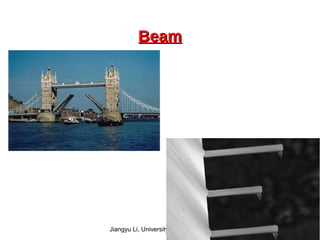
BeamBeam
Jiangyu Li, University of Washington
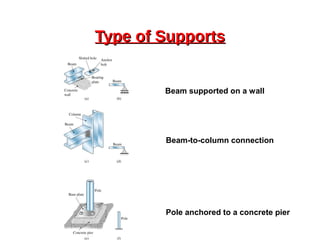
Type of SupportsType of Supports
Beam supported on a wall
Beam-to-column connection
Pole anchored to a concrete pier
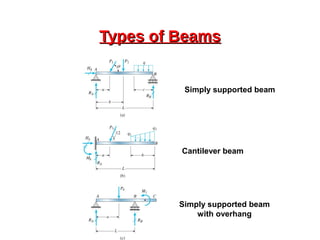
Types of BeamsTypes of Beams
Simply supported beam
Cantilever beam
Simply supported beam
with overhang
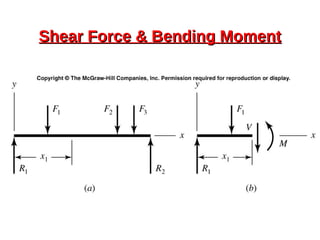
Shear Force & Bending MomentShear Force & Bending Moment
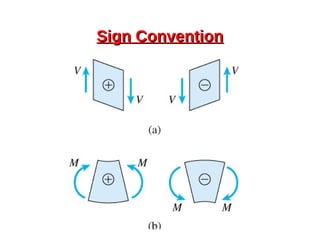
Sign ConventionSign Convention
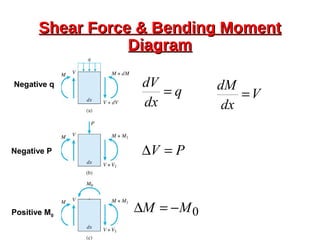
Shear Force & Bending MomentShear Force & Bending Moment
DiagramDiagram
q
dx
dV
= V
dx
dM
=
PV =∆
0MM −=∆
Negative q
Negative P
Positive M0
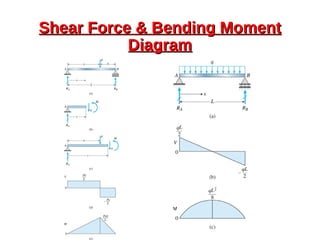
Shear Force & Bending MomentShear Force & Bending Moment
DiagramDiagram
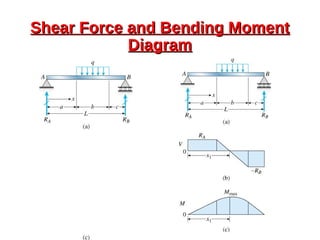
Shear Force and Bending MomentShear Force and Bending Moment
DiagramDiagram
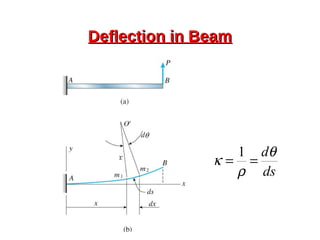
Deflection in BeamDeflection in Beam
ds
dθ
ρ
κ ==
1
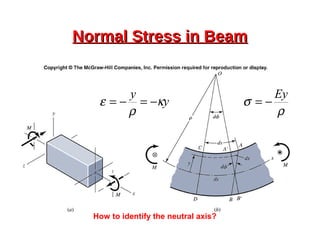
Normal Stress in BeamNormal Stress in Beam
y
y
κ
ρ
ε −=−=
ρ
σ
Ey
−=
How to identify the neutral axis?
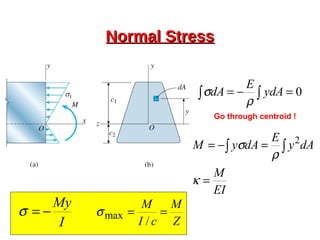
Normal StressNormal Stress
0=−= ∫∫ ydA
E
dA
ρ
σ
I
My
−=σ
Z
M
cI
M
==
/
maxσ
EI
M
dAy
E
dAyM
=
=−= ∫∫
κ
ρ
σ 2
Go through centroid !
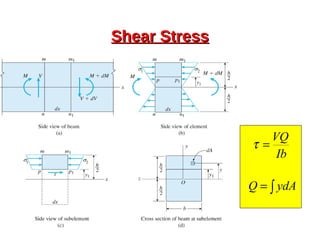
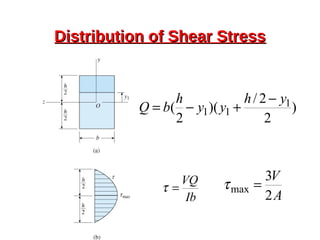
Shear StressShear Stress
Ib
VQ
=τ
∫= ydAQ
Distribution of Shear StressDistribution of Shear Stress
Ib
VQ
=τ
)
2
2/
)(
2
( 1
11
yh
yy
h
bQ
−
+−=
A
V
2
3
max =τ
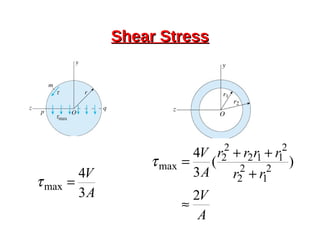
Shear StressShear Stress
A
V
3
4
max =τ
A
V
rr
rrrr
A
V
2
)(
3
4
2
1
2
2
2
112
2
2
max
≈
+
++
=τ
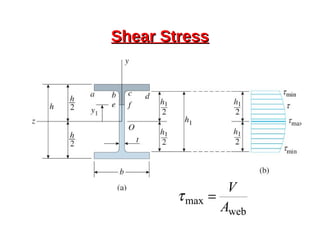
Shear StressShear Stress
web
max
A
V
=τ
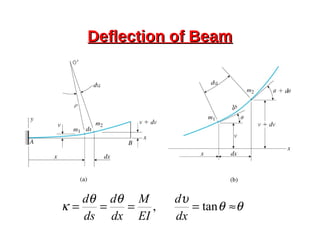
Deflection of BeamDeflection of Beam
θθ
υθθ
κ ≈==== tan,
dx
d
EI
M
dx
d
ds
d
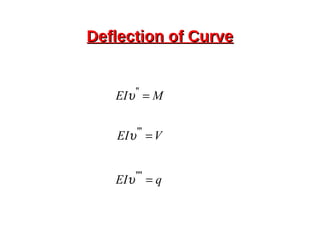
Deflection of CurveDeflection of Curve
MEI =''
υ
VEI ='''
υ
qEI =''''
υ
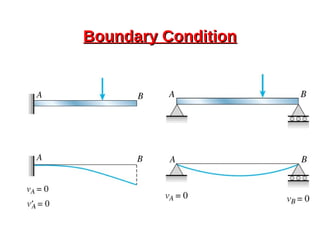
Boundary ConditionBoundary Condition
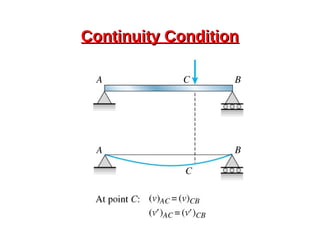
Continuity ConditionContinuity Condition
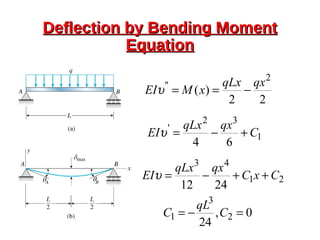
Deflection by Bending MomentDeflection by Bending Moment
EquationEquation
22
)(
2
'' qxqLx
xMEI −==υ
1
32
'
64
C
qxqLx
EI +−=υ
21
43
2412
CxC
qxqLx
EI ++−=υ
0,
24
2
3
1 =−= C
qL
C
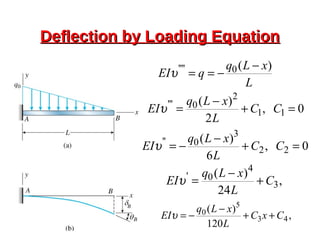
Deflection by Loading EquationDeflection by Loading Equation
L
xLq
qEI
)(0'''' −
−==υ
0,
2
)(
11
2
0'''
=+
−
= CC
L
xLq
EIυ
0,
6
)(
22
3
0''
=+
−
−= CC
L
xLq
EIυ
,
24
)(
3
4
0'
C
L
xLq
EI +
−
=υ
,
120
)(
43
5
0 CxC
L
xLq
EI ++
−
−=υ
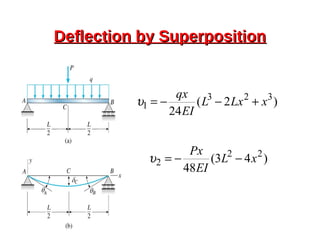
Deflection by SuperpositionDeflection by Superposition
)2(
24
323
1 xLxL
EI
qx
+−−=υ
)43(
48
22
2 xL
EI
Px
−−=υ
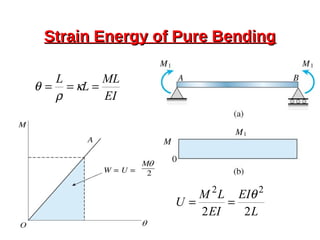
Strain Energy of Pure BendingStrain Energy of Pure Bending
EI
ML
L
L
=== κ
ρ
θ
L
EI
EI
LM
U
22
22
θ
==
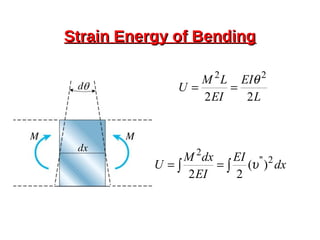
Strain Energy of BendingStrain Energy of Bending
L
EI
EI
LM
U
22
22
θ
==
∫∫ == dx
EI
EI
dxM
U 2''
2
)(
22
υ
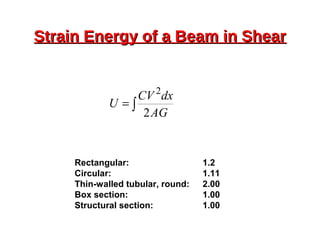
Strain Energy of a Beam in ShearStrain Energy of a Beam in Shear
∫=
AG
dxCV
U
2
2
Rectangular: 1.2
Circular: 1.11
Thin-walled tubular, round: 2.00
Box section: 1.00
Structural section: 1.00
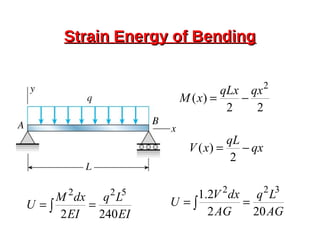
Strain Energy of BendingStrain Energy of Bending
22
)(
2
qxqLx
xM −=
EI
Lq
EI
dxM
U
2402
522
== ∫
qx
qL
xV −=
2
)(
AG
Lq
AG
dxV
U
202
2.1 322
== ∫
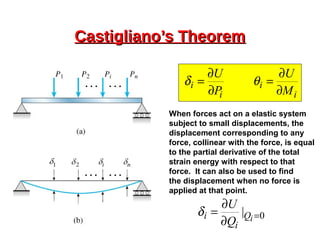
Castigliano’s TheoremCastigliano’s Theorem
i
i
P
U
∂
∂
=δ
When forces act on a elastic system
subject to small displacements, the
displacement corresponding to any
force, collinear with the force, is equal
to the partial derivative of the total
strain energy with respect to that
force. It can also be used to find
the displacement when no force is
applied at that point.
i
i
M
U
∂
∂
=θ
0| =
∂
∂
= iQ
i
i
Q
U
δ
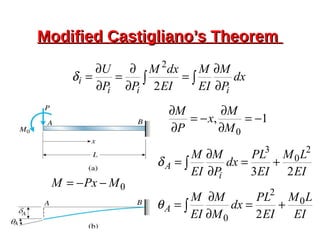
Modified Castigliano’s TheoremModified Castigliano’s Theorem
∫∫ ∂
∂
=
∂
∂
=
∂
∂
= dx
P
M
EI
M
EI
dxM
PP
U
iii
i
2
2
δ
0MPxM −−=
1,
0
−=
∂
∂
−=
∂
∂
M
M
x
P
M
EI
LM
EI
PL
dx
P
M
EI
M
i
A
23
2
0
3
+=
∂
∂
= ∫δ
EI
LM
EI
PL
dx
M
M
EI
M
A
0
2
0 2
+=
∂
∂
= ∫θ
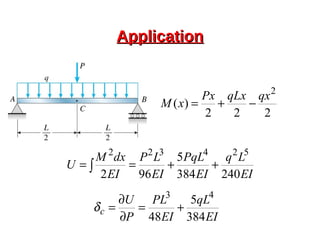
ApplicationApplication
222
)(
2
qxqLxPx
xM −+=
EI
Lq
EI
PqL
EI
LP
EI
dxM
U
240384
5
962
524322
++== ∫
EI
qL
EI
PL
P
U
c
384
5
48
43
+=
∂
∂
=δ
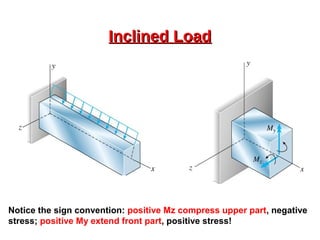
Inclined LoadInclined Load
Notice the sign convention: positive Mz compress upper part, negative
stress; positive My extend front part, positive stress!
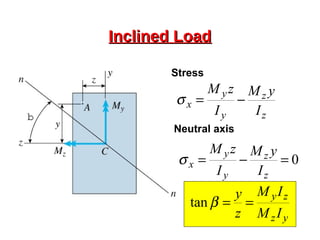
Inclined LoadInclined Load
z
z
y
y
x
I
yM
I
zM
−=σ
Stress
Neutral axis
0=−=
z
z
y
y
x
I
yM
I
zM
σ
yz
zy
IM
IM
z
y
==βtan
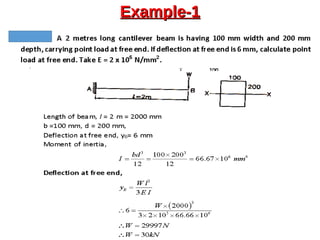
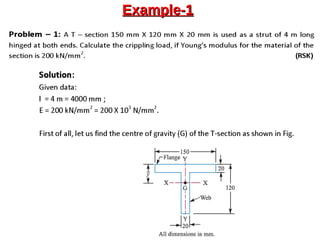
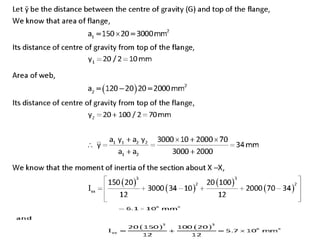
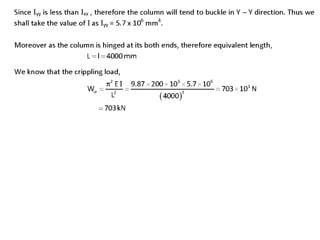
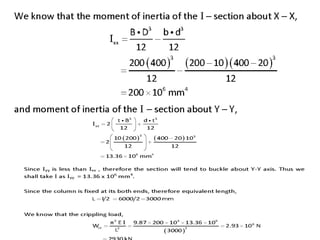
Example-1Example-1
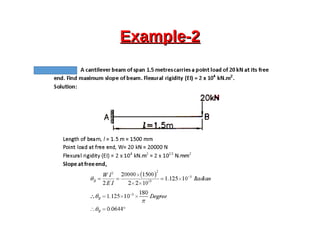
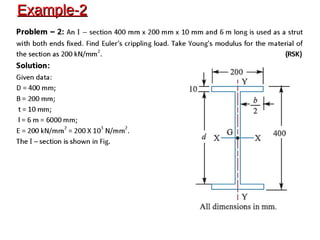
Example-2Example-2
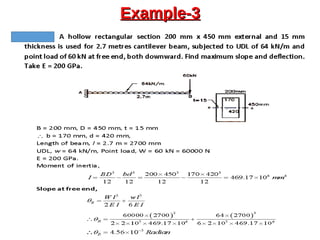
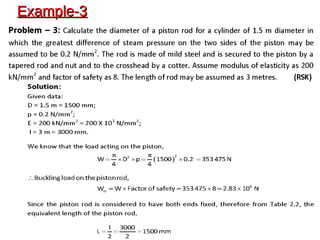
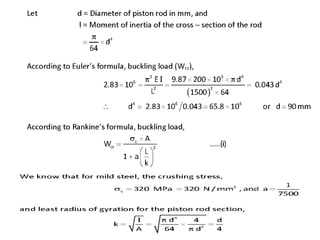
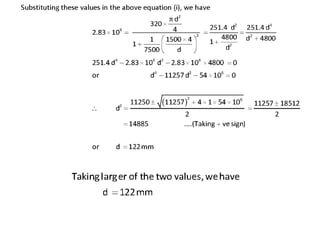
Example-3Example-3
Design Of ColumnDesign Of Column
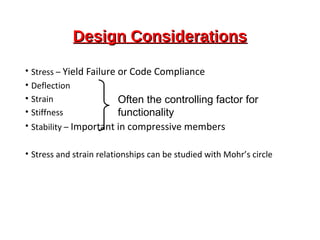
Design ConsiderationsDesign Considerations
• Stress – Yield Failure or Code Compliance
• Deflection
• Strain
• Stiffness
• Stability – Important in compressive members
• Stress and strain relationships can be studied with Mohr’s circle
Often the controlling factor for
functionality
Deflection [Everything’s a Spring]Deflection [Everything’s a Spring]
• When loads are applied, we have deflection
• Depends on
• Type of loading
• Tension
• Compression
• Bending
• Torsion
• Cross-section of member
• Comparable to pushing on a spring
• We can calculate the amount of beam deflection by
various methods
SuperpositionSuperposition
• Determine effects of individual loads separately and
add the results [see examples 4-2,3,4]
• Tables are useful – see A-9
• May be applied if
• Each effect is linearly related to the load that produces it
• A load does not create a condition that affects the result of
another load
• Deformations resulting from any specific load are not large
enough to appreciably alter the geometric relations of the
parts of the structural system
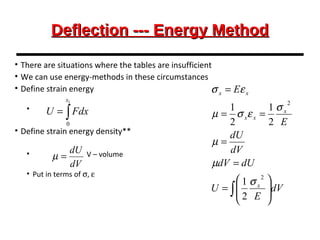
Deflection --- Energy MethodDeflection --- Energy Method
• There are situations where the tables are insufficient
• We can use energy-methods in these circumstances
• Define strain energy
•
• Define strain energy density**
• V – volume
• Put in terms of σ, ε
∫=
1
0
x
FdxU
dV
dU
=µ
∫ 







=
=
=
==
=
dV
E
U
dUdV
dV
dU
E
E
x
x
xx
xx
2
2
2
1
2
1
2
1
σ
µ
µ
σ
εσµ
εσ
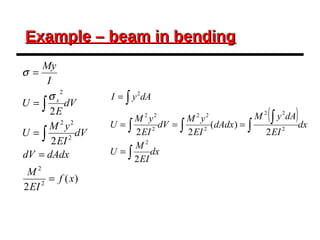
Example – beam in bendingExample – beam in bending
)(
2
2
2
2
2
2
22
2
xf
EI
M
dAdxdV
dV
EI
yM
U
dV
E
U
I
My
x
=
=
=
=
=
∫
∫
σ
σ
( )
dx
EI
M
U
dx
EI
dAyM
dAdx
EI
yM
dV
EI
yM
U
dAyI
∫
∫
∫
∫∫
∫
=
===
=
2
2
)(
22
2
2
22
2
22
2
22
2
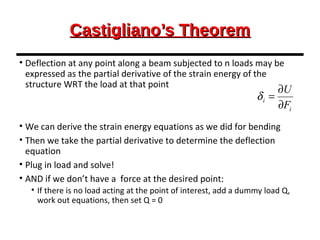
Castigliano’s TheoremCastigliano’s Theorem
• Deflection at any point along a beam subjected to n loads may be
expressed as the partial derivative of the strain energy of the
structure WRT the load at that point
• We can derive the strain energy equations as we did for bending
• Then we take the partial derivative to determine the deflection
equation
• Plug in load and solve!
• AND if we don’t have a force at the desired point:
• If there is no load acting at the point of interest, add a dummy load Q,
work out equations, then set Q = 0
i
i
F
U
∂
∂
=δ
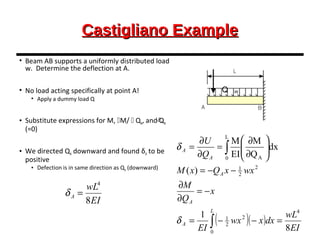
Castigliano ExampleCastigliano Example
• Beam AB supports a uniformly distributed load
w. Determine the deflection at A.
• No load acting specifically at point A!
• Apply a dummy load Q
• Substitute expressions for M, M/  QA, and QA
(=0)
• We directed QA downward and found δA to be
positive
• Defection is in same direction as QA (downward)
Q
EI
wL
A
8
4
=δ
( )( )
EI
wL
dxxwx
EI
x
Q
M
wxxQxM
Q
U
L
A
A
A
A
A
8
1
)(
dx
Q
M
EI
M
4
0
2
2
1
2
2
1
A
L
0
=−−=
−=
∂
∂
−−=






∂
∂
=
∂
∂
=
∫
∫
δ
δ
Aδ
StabilityStability
•Up until now, 2 primary concerns
• Strength of a structure
• It’s ability to support a specified load without
experiencing excessive stress
• Ability of a structure to support a specified load
without undergoing unacceptable deformations
•Now, look at STABILITY of the structure
• It’s ability to support a load without undergoing a
sudden change in configuration
Material
failure
BucklingBuckling
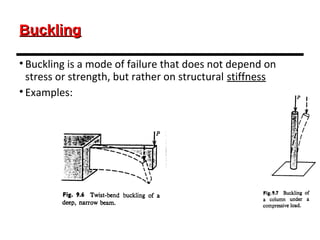
• Buckling is a mode of failure that does not depend on
stress or strength, but rather on structural stiffness
• Examples:
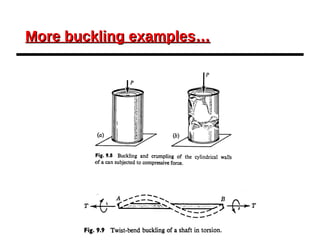
More buckling examples…More buckling examples…
BucklingBuckling
• The most common problem involving buckling is the design
of columns
• Compression members
• The analysis of an element in buckling involves establishing a
differential equation(s) for beam deformation and finding
the solution to the ODE, then determining which solutions
are stable
• Euler solved this problem for columns
Euler Column FormulaEuler Column Formula
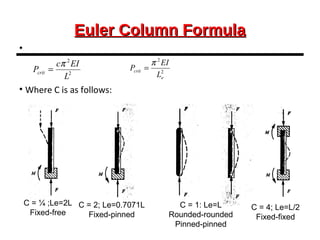
•
• Where C is as follows:
2
2
L
EIc
Pcrit
π
=
C = ¼ ;Le=2L
Fixed-free
C = 2; Le=0.7071L
Fixed-pinned
C = 1: Le=L
Rounded-rounded
Pinned-pinned
C = 4; Le=L/2
Fixed-fixed
2
2
e
crit
L
EI
P
π
=
BucklingBuckling
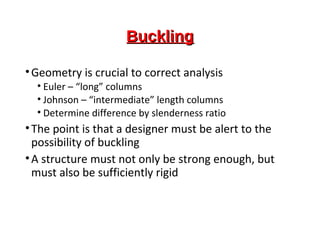
•Geometry is crucial to correct analysis
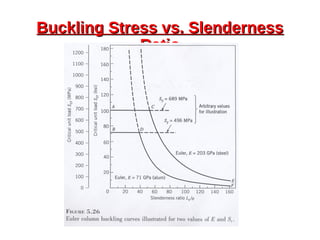
• Euler – “long” columns
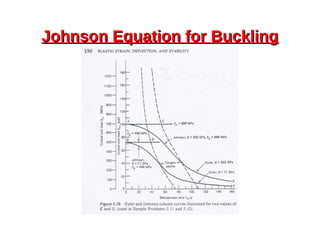
• Johnson – “intermediate” length columns
• Determine difference by slenderness ratio
•The point is that a designer must be alert to the
possibility of buckling
•A structure must not only be strong enough, but
must also be sufficiently rigid
Buckling Stress vs. SlendernessBuckling Stress vs. Slenderness

RatioRatio
Johnson Equation for BucklingJohnson Equation for Buckling
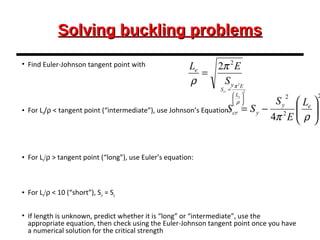
Solving buckling problemsSolving buckling problems
• Find Euler-Johnson tangent point with
• For Le/ρ < tangent point (“intermediate”), use Johnson’s Equation:
• For Le/ρ > tangent point (“long”), use Euler’s equation:
• For Le/ρ < 10 (“short”), Scr = Sy
• If length is unknown, predict whether it is “long” or “intermediate”, use the
appropriate equation, then check using the Euler-Johnson tangent point once you have
a numerical solution for the critical strength
2
2






=
ρ
π
e
cr
L
E
S
y
e
S
EL 2
2π
ρ
=
2
2
2
4 





−=
ρπ
ey
ycr
L
E
S
SS
Special Buckling CasesSpecial Buckling Cases
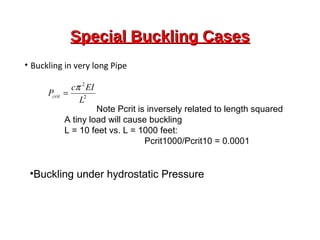
• Buckling in very long Pipe
2
2
L
EIc
Pcrit
π
=
Note Pcrit is inversely related to length squared
A tiny load will cause buckling
L = 10 feet vs. L = 1000 feet:
Pcrit1000/Pcrit10 = 0.0001
•Buckling under hydrostatic Pressure
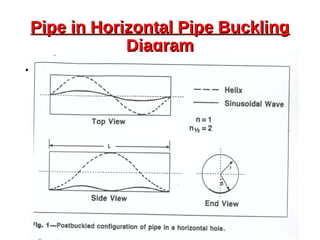
Pipe in Horizontal Pipe BucklingPipe in Horizontal Pipe Buckling
DiagramDiagram
•
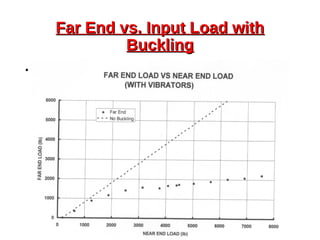
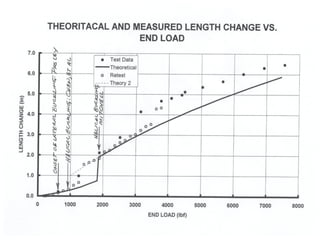
Far End vs. Input Load withFar End vs. Input Load with
BucklingBuckling
•
•
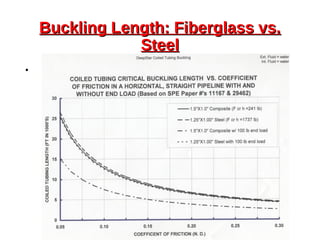
Buckling Length: Fiberglass vs.Buckling Length: Fiberglass vs.
SteelSteel
•
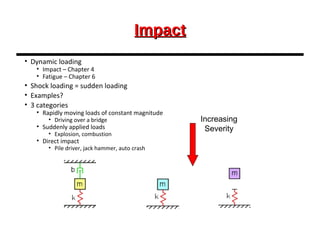
ImpactImpact
• Dynamic loading
• Impact – Chapter 4
• Fatigue – Chapter 6
• Shock loading = sudden loading
• Examples?
• 3 categories
• Rapidly moving loads of constant magnitude
• Driving over a bridge
• Suddenly applied loads
• Explosion, combustion
• Direct impact
• Pile driver, jack hammer, auto crash
Increasing
Severity
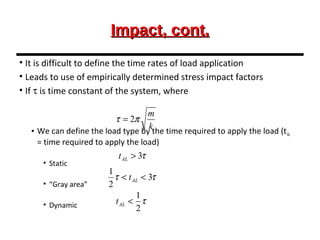
Impact, cont.Impact, cont.
• It is difficult to define the time rates of load application
• Leads to use of empirically determined stress impact factors
• If τ is time constant of the system, where
• We can define the load type by the time required to apply the load (tAL
= time required to apply the load)
• Static
• “Gray area”
• Dynamic
k
m
πτ 2=
τ3>ALt
ττ 3
2
1
<< ALt
τ
2
1
<ALt
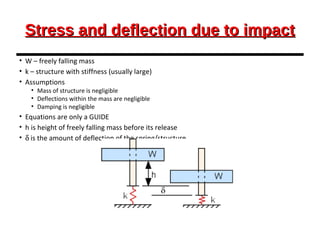
Stress and deflection due to impactStress and deflection due to impact
• W – freely falling mass
• k – structure with stiffness (usually large)
• Assumptions
• Mass of structure is negligible
• Deflections within the mass are negligible
• Damping is negligible
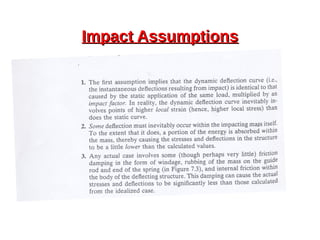
• Equations are only a GUIDE
• h is height of freely falling mass before its release
• δ is the amount of deflection of the spring/structure
Impact AssumptionsImpact Assumptions
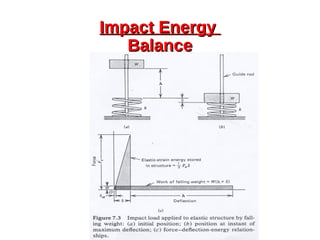
Impact EnergyImpact Energy
BalanceBalance
Energy balanceEnergy balance
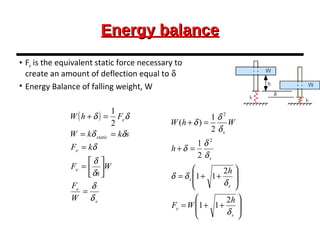
• Fe is the equivalent static force necessary to
create an amount of deflection equal to δ
• Energy Balance of falling weight, W
( )
s
e
e
e
static
e
W
F
W
s
F
kF
skkW
FhW
δ
δ
δ
δ
δ
δδ
δδ
=




=
=
==
=+
2
1








++=








++=
=+
=+
s
e
s
s
s
s
h
WF
h
h
WhW
δ
δ
δδ
δ
δ
δ
δ
δ
δ
2
11
2
11
2
1
2
1
)(
2
2
Impact, cont.
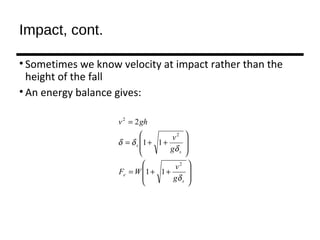
• Sometimes we know velocity at impact rather than the
height of the fall
• An energy balance gives:








++=








++=
=
s
e
s
s
g
v
WF
g
v
ghv
δ
δ
δδ
2
2
2
11
11
2
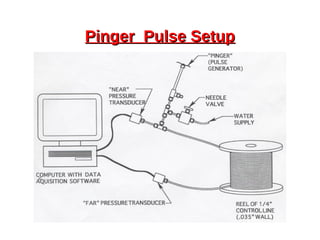
Pinger Pulse SetupPinger Pulse Setup
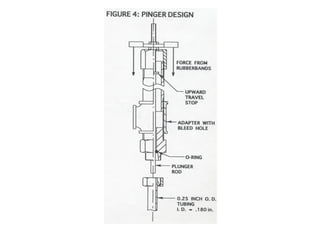
PingerPinger
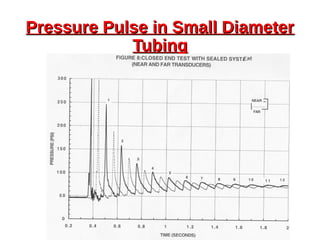
Pressure Pulse in Small DiameterPressure Pulse in Small Diameter
TubingTubing
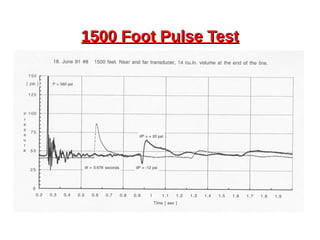
1500 Foot Pulse Test1500 Foot Pulse Test
Example-1Example-1
Example-2Example-2
Jiangyu Li, University of Washington
Example-3Example-3
Jiangyu Li, University of Washington
Questions and Suggestions are
Welcome
ThankThank
YouYou

Beams And Columns

  • 1.
    Subject:Subject: Machine Designand Industrial Drafting (2141907)Machine Design and Industrial Drafting (2141907) Chapter: Design Of Beams And ColumnsChapter: Design Of Beams And Columns Department Mechanical Engineering Name of Subject Teacher Dr. Divyang Patel
  • 2.
    Team MembersTeam Members NameEnrollment Number Vinay PatelVinay Patel 170990119014170990119014 Dhananjay PatelDhananjay Patel 170990119015170990119015 Dhyey ShuklaDhyey Shukla 170990119016170990119016
  • 3.
  • 4.
    Type of SupportsTypeof Supports Beam supported on a wall Beam-to-column connection Pole anchored to a concrete pier
  • 5.
    Types of BeamsTypesof Beams Simply supported beam Cantilever beam Simply supported beam with overhang
  • 6.
    Shear Force &Bending MomentShear Force & Bending Moment
  • 7.
  • 8.
    Shear Force &Bending MomentShear Force & Bending Moment DiagramDiagram q dx dV = V dx dM = PV =∆ 0MM −=∆ Negative q Negative P Positive M0
  • 9.
    Shear Force &Bending MomentShear Force & Bending Moment DiagramDiagram
  • 10.
    Shear Force andBending MomentShear Force and Bending Moment DiagramDiagram
  • 11.
    Deflection in BeamDeflectionin Beam ds dθ ρ κ == 1
  • 12.
    Normal Stress inBeamNormal Stress in Beam y y κ ρ ε −=−= ρ σ Ey −= How to identify the neutral axis?
  • 13.
    Normal StressNormal Stress 0=−=∫∫ ydA E dA ρ σ I My −=σ Z M cI M == / maxσ EI M dAy E dAyM = =−= ∫∫ κ ρ σ 2 Go through centroid !
  • 14.
  • 15.
    Distribution of ShearStressDistribution of Shear Stress Ib VQ =τ ) 2 2/ )( 2 ( 1 11 yh yy h bQ − +−= A V 2 3 max =τ
  • 16.
    Shear StressShear Stress A V 3 4 max=τ A V rr rrrr A V 2 )( 3 4 2 1 2 2 2 112 2 2 max ≈ + ++ =τ
  • 17.
  • 18.
    Deflection of BeamDeflectionof Beam θθ υθθ κ ≈==== tan, dx d EI M dx d ds d
  • 19.
    Deflection of CurveDeflectionof Curve MEI ='' υ VEI =''' υ qEI ='''' υ
  • 20.
  • 21.
  • 22.
    Deflection by BendingMomentDeflection by Bending Moment EquationEquation 22 )( 2 '' qxqLx xMEI −==υ 1 32 ' 64 C qxqLx EI +−=υ 21 43 2412 CxC qxqLx EI ++−=υ 0, 24 2 3 1 =−= C qL C
  • 23.
    Deflection by LoadingEquationDeflection by Loading Equation L xLq qEI )(0'''' − −==υ 0, 2 )( 11 2 0''' =+ − = CC L xLq EIυ 0, 6 )( 22 3 0'' =+ − −= CC L xLq EIυ , 24 )( 3 4 0' C L xLq EI + − =υ , 120 )( 43 5 0 CxC L xLq EI ++ − −=υ
  • 24.
    Deflection by SuperpositionDeflectionby Superposition )2( 24 323 1 xLxL EI qx +−−=υ )43( 48 22 2 xL EI Px −−=υ
  • 25.
    Strain Energy ofPure BendingStrain Energy of Pure Bending EI ML L L === κ ρ θ L EI EI LM U 22 22 θ ==
  • 26.
    Strain Energy ofBendingStrain Energy of Bending L EI EI LM U 22 22 θ == ∫∫ == dx EI EI dxM U 2'' 2 )( 22 υ
  • 27.
    Strain Energy ofa Beam in ShearStrain Energy of a Beam in Shear ∫= AG dxCV U 2 2 Rectangular: 1.2 Circular: 1.11 Thin-walled tubular, round: 2.00 Box section: 1.00 Structural section: 1.00
  • 28.
    Strain Energy ofBendingStrain Energy of Bending 22 )( 2 qxqLx xM −= EI Lq EI dxM U 2402 522 == ∫ qx qL xV −= 2 )( AG Lq AG dxV U 202 2.1 322 == ∫
  • 29.
    Castigliano’s TheoremCastigliano’s Theorem i i P U ∂ ∂ =δ Whenforces act on a elastic system subject to small displacements, the displacement corresponding to any force, collinear with the force, is equal to the partial derivative of the total strain energy with respect to that force. It can also be used to find the displacement when no force is applied at that point. i i M U ∂ ∂ =θ 0| = ∂ ∂ = iQ i i Q U δ
  • 30.
    Modified Castigliano’s TheoremModifiedCastigliano’s Theorem ∫∫ ∂ ∂ = ∂ ∂ = ∂ ∂ = dx P M EI M EI dxM PP U iii i 2 2 δ 0MPxM −−= 1, 0 −= ∂ ∂ −= ∂ ∂ M M x P M EI LM EI PL dx P M EI M i A 23 2 0 3 += ∂ ∂ = ∫δ EI LM EI PL dx M M EI M A 0 2 0 2 += ∂ ∂ = ∫θ
  • 31.
  • 32.
    Inclined LoadInclined Load Noticethe sign convention: positive Mz compress upper part, negative stress; positive My extend front part, positive stress!
  • 33.
    Inclined LoadInclined Load z z y y x I yM I zM −=σ Stress Neutralaxis 0=−= z z y y x I yM I zM σ yz zy IM IM z y ==βtan
  • 34.
  • 35.
  • 36.
  • 38.
  • 39.
    Design ConsiderationsDesign Considerations •Stress – Yield Failure or Code Compliance • Deflection • Strain • Stiffness • Stability – Important in compressive members • Stress and strain relationships can be studied with Mohr’s circle Often the controlling factor for functionality
  • 40.
    Deflection [Everything’s aSpring]Deflection [Everything’s a Spring] • When loads are applied, we have deflection • Depends on • Type of loading • Tension • Compression • Bending • Torsion • Cross-section of member • Comparable to pushing on a spring • We can calculate the amount of beam deflection by various methods
  • 41.
    SuperpositionSuperposition • Determine effectsof individual loads separately and add the results [see examples 4-2,3,4] • Tables are useful – see A-9 • May be applied if • Each effect is linearly related to the load that produces it • A load does not create a condition that affects the result of another load • Deformations resulting from any specific load are not large enough to appreciably alter the geometric relations of the parts of the structural system
  • 42.
    Deflection --- EnergyMethodDeflection --- Energy Method • There are situations where the tables are insufficient • We can use energy-methods in these circumstances • Define strain energy • • Define strain energy density** • V – volume • Put in terms of σ, ε ∫= 1 0 x FdxU dV dU =µ ∫         = = = == = dV E U dUdV dV dU E E x x xx xx 2 2 2 1 2 1 2 1 σ µ µ σ εσµ εσ
  • 43.
    Example – beamin bendingExample – beam in bending )( 2 2 2 2 2 2 22 2 xf EI M dAdxdV dV EI yM U dV E U I My x = = = = = ∫ ∫ σ σ ( ) dx EI M U dx EI dAyM dAdx EI yM dV EI yM U dAyI ∫ ∫ ∫ ∫∫ ∫ = === = 2 2 )( 22 2 2 22 2 22 2 22 2
  • 44.
    Castigliano’s TheoremCastigliano’s Theorem •Deflection at any point along a beam subjected to n loads may be expressed as the partial derivative of the strain energy of the structure WRT the load at that point • We can derive the strain energy equations as we did for bending • Then we take the partial derivative to determine the deflection equation • Plug in load and solve! • AND if we don’t have a force at the desired point: • If there is no load acting at the point of interest, add a dummy load Q, work out equations, then set Q = 0 i i F U ∂ ∂ =δ
  • 45.
    Castigliano ExampleCastigliano Example •Beam AB supports a uniformly distributed load w. Determine the deflection at A. • No load acting specifically at point A! • Apply a dummy load Q • Substitute expressions for M, M/  QA, and QA (=0) • We directed QA downward and found δA to be positive • Defection is in same direction as QA (downward) Q EI wL A 8 4 =δ ( )( ) EI wL dxxwx EI x Q M wxxQxM Q U L A A A A A 8 1 )( dx Q M EI M 4 0 2 2 1 2 2 1 A L 0 =−−= −= ∂ ∂ −−=       ∂ ∂ = ∂ ∂ = ∫ ∫ δ δ Aδ
  • 46.
    StabilityStability •Up until now,2 primary concerns • Strength of a structure • It’s ability to support a specified load without experiencing excessive stress • Ability of a structure to support a specified load without undergoing unacceptable deformations •Now, look at STABILITY of the structure • It’s ability to support a load without undergoing a sudden change in configuration Material failure
  • 47.
    BucklingBuckling • Buckling isa mode of failure that does not depend on stress or strength, but rather on structural stiffness • Examples:
  • 48.
    More buckling examples…Morebuckling examples…
  • 49.
    BucklingBuckling • The mostcommon problem involving buckling is the design of columns • Compression members • The analysis of an element in buckling involves establishing a differential equation(s) for beam deformation and finding the solution to the ODE, then determining which solutions are stable • Euler solved this problem for columns
  • 50.
    Euler Column FormulaEulerColumn Formula • • Where C is as follows: 2 2 L EIc Pcrit π = C = ¼ ;Le=2L Fixed-free C = 2; Le=0.7071L Fixed-pinned C = 1: Le=L Rounded-rounded Pinned-pinned C = 4; Le=L/2 Fixed-fixed 2 2 e crit L EI P π =
  • 51.
    BucklingBuckling •Geometry is crucialto correct analysis • Euler – “long” columns • Johnson – “intermediate” length columns • Determine difference by slenderness ratio •The point is that a designer must be alert to the possibility of buckling •A structure must not only be strong enough, but must also be sufficiently rigid
  • 52.
    Buckling Stress vs.SlendernessBuckling Stress vs. Slenderness RatioRatio
  • 53.
    Johnson Equation forBucklingJohnson Equation for Buckling
  • 54.
    Solving buckling problemsSolvingbuckling problems • Find Euler-Johnson tangent point with • For Le/ρ < tangent point (“intermediate”), use Johnson’s Equation: • For Le/ρ > tangent point (“long”), use Euler’s equation: • For Le/ρ < 10 (“short”), Scr = Sy • If length is unknown, predict whether it is “long” or “intermediate”, use the appropriate equation, then check using the Euler-Johnson tangent point once you have a numerical solution for the critical strength 2 2       = ρ π e cr L E S y e S EL 2 2π ρ = 2 2 2 4       −= ρπ ey ycr L E S SS
  • 55.
    Special Buckling CasesSpecialBuckling Cases • Buckling in very long Pipe 2 2 L EIc Pcrit π = Note Pcrit is inversely related to length squared A tiny load will cause buckling L = 10 feet vs. L = 1000 feet: Pcrit1000/Pcrit10 = 0.0001 •Buckling under hydrostatic Pressure
  • 56.
    Pipe in HorizontalPipe BucklingPipe in Horizontal Pipe Buckling DiagramDiagram •
  • 57.
    Far End vs.Input Load withFar End vs. Input Load with BucklingBuckling •
  • 58.
  • 59.
    Buckling Length: Fiberglassvs.Buckling Length: Fiberglass vs. SteelSteel •
  • 60.
    ImpactImpact • Dynamic loading •Impact – Chapter 4 • Fatigue – Chapter 6 • Shock loading = sudden loading • Examples? • 3 categories • Rapidly moving loads of constant magnitude • Driving over a bridge • Suddenly applied loads • Explosion, combustion • Direct impact • Pile driver, jack hammer, auto crash Increasing Severity
  • 61.
    Impact, cont.Impact, cont. •It is difficult to define the time rates of load application • Leads to use of empirically determined stress impact factors • If τ is time constant of the system, where • We can define the load type by the time required to apply the load (tAL = time required to apply the load) • Static • “Gray area” • Dynamic k m πτ 2= τ3>ALt ττ 3 2 1 << ALt τ 2 1 <ALt
  • 62.
    Stress and deflectiondue to impactStress and deflection due to impact • W – freely falling mass • k – structure with stiffness (usually large) • Assumptions • Mass of structure is negligible • Deflections within the mass are negligible • Damping is negligible • Equations are only a GUIDE • h is height of freely falling mass before its release • δ is the amount of deflection of the spring/structure
  • 63.
  • 64.
  • 65.
    Energy balanceEnergy balance •Fe is the equivalent static force necessary to create an amount of deflection equal to δ • Energy Balance of falling weight, W ( ) s e e e static e W F W s F kF skkW FhW δ δ δ δ δ δδ δδ =     = = == =+ 2 1         ++=         ++= =+ =+ s e s s s s h WF h h WhW δ δ δδ δ δ δ δ δ δ 2 11 2 11 2 1 2 1 )( 2 2
  • 66.
    Impact, cont. • Sometimeswe know velocity at impact rather than the height of the fall • An energy balance gives:         ++=         ++= = s e s s g v WF g v ghv δ δ δδ 2 2 2 11 11 2
  • 67.
  • 68.
  • 69.
    Pressure Pulse inSmall DiameterPressure Pulse in Small Diameter TubingTubing
  • 70.
    1500 Foot PulseTest1500 Foot Pulse Test
  • 71.
  • 74.
  • 75.
  • 76.
  • 77.
  • 79.
    Questions and Suggestionsare Welcome ThankThank YouYou