Seman&c	
  Analysis	
  in	
  Language	
  Technology	
  
http://stp.lingfil.uu.se/~santinim/sais/2016/sais_2016.htm 


Semantic Role Labelling


Marina	
  San(ni	
  
san$nim@stp.lingfil.uu.se	


Department	
  of	
  Linguis(cs	
  and	
  Philology	
  
Uppsala	
  University,	
  Uppsala,	
  Sweden	


Spring	
  2016	
  
	
   1	
  
Previous	
  Lecture	
  (I)	
  
•  Intelligent	
  systems/applica(ons	
  should	
  ”understand”	
  
natural	
  language	
  and	
  act.	
  	
  
•  They	
  must	
  understand	
  the	
  meaning,	
  ie	
  create	
  a	
  link	
  
between	
  words	
  and	
  the	
  world	
  
•  In	
  order	
  to	
  do	
  so:	
  
•  formalize	
  meaning	
  	
  representa(on	
  	
  
•  check	
  against	
  facts	
  in	
  the	
  world	
  
•  make	
  inferences	
  (reasoning)	
  
2	
  
LOGIC	
  
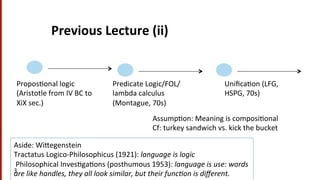
Previous	
  Lecture	
  (ii)	
  
3	
  
Propos(onal	
  logic	
  
(Aristotle	
  from	
  IV	
  BC	
  to	
  
XiX	
  sec.)	
  
Predicate	
  Logic/FOL/
lambda	
  calculus	
  
(Montague,	
  70s)	
  
Unifica(on	
  (LFG,	
  
HSPG,	
  70s)	
  
Assump(on:	
  Meaning	
  is	
  composi(onal	
  	
  
Cf:	
  turkey	
  sandwich	
  vs.	
  kick	
  the	
  bucket	
  
Aside:	
  WiYegenstein	
  
Tractatus	
  Logico-­‐Philosophicus	
  (1921):	
  language	
  is	
  logic	
  
	
  Philosophical	
  Inves(ga(ons	
  (posthumous	
  1953):	
  language	
  is	
  use:	
  words	
  
are	
  like	
  handles,	
  they	
  all	
  look	
  similar,	
  but	
  their	
  func8on	
  is	
  different.	
  
Previous	
  Lecture	
  (iii)	
  
•  Natural	
  Language	
  is	
  not	
  only	
  LOGIC	
  
•  Logical	
  grammars	
  and	
  composi(onality	
  	
  are	
  not	
  enough	
  
•  Speaker’s	
  knowledge	
  about	
  the	
  world	
  can	
  hardly	
  be	
  packed	
  in	
  a	
  KB	
  
•  There	
  are	
  pa?erns	
  of	
  use	
  and	
  reasoning	
  that	
  cannot	
  be	
  accouted	
  for	
  by	
  
logic	
  
•  unique	
  insights	
  given	
  by	
  large	
  corpora/resources	
  of	
  linguis$c	
  evidence	
  4	
  
Logic	
  is	
  beau(ful,	
  but…	
  it	
  is	
  top-­‐down:	
  you	
  
must	
  know	
  in	
  advance	
  what	
  is	
  ”well-­‐formed”…	
  
cf	
  the	
  language	
  used	
  in	
  the	
  social	
  networks:	
  is	
  
it	
  well-­‐formed	
  and	
  predictable?	
  	
  
Semantic Role
Labeling
Acknowledgements:	
  
Most	
  slides	
  borrowed	
  from:	
  
Speech	
  and	
  Language	
  Processing	
  (3rd	
  ed.	
  drac)	
  
Dan	
  Jurafsky	
  and	
  James	
  H.	
  Mar(n	
  
Original	
  version	
  by	
  J&M	
  can	
  be	
  found	
  here:	
  	
  
hYps://web.stanford.edu/~jurafsky/slp3/slides/22_SRL.pdf	
  
hYps://web.stanford.edu/~jurafsky/slp3/slides/22_select.pdf	
  	
  
Other	
  slides	
  inspired	
  by	
  many	
  …	


Semantic Role
Labeling
Introduc(on	
  
Ques$on	
  1	
  
•  What	
  is	
  a	
  seman(c	
  role	
  (nlp	
  course,	
  seman(cs	
  course)	
  
7	
  
Seman$c	
  Role	
  Labeling	
  
Applications
 Question & answer systems
Who did what to whom at where?
The police officer detained the suspect at the scene of the crime
ARG0 ARG2 AM-locV
Agent	
   Theme	
  Predicate	
   Loca(on	
  
Can	
  we	
  figure	
  out	
  that	
  these	
  have	
  the	
  
same	
  meaning?	
  
•  XYZ	
  corpora(on	
  bought	
  the	
  stock.	
  
•  They	
  sold	
  the	
  stock	
  to	
  XYZ	
  corpora(on.	
  
•  The	
  stock	
  was	
  bought	
  by	
  XYZ	
  corpora(on.	
  
•  The	
  purchase	
  of	
  the	
  stock	
  by	
  XYZ	
  
corpora(on...	
  	
  
•  The	
  stock	
  purchase	
  by	
  XYZ	
  corpora(on...	
  	
  
9	
  
A	
  Shallow	
  Seman$c	
  Representa$on:	
  
Seman$c	
  Roles	
  
•  Predicates	
  (bought,	
  sold,	
  purchase)	
  represent	
  an	
  event	
  
•  Seman$c	
  roles	
  express	
  the	
  abstract	
  role	
  that	
  arguments	
  of	
  
a	
  predicate	
  can	
  take	
  in	
  the	
  event	
  
10	
  
buyer	
   proto-­‐agent	
  agent	
  
More	
  specific	
   More	
  general	
  
Answer	
  1:	
  
•  Seman(c	
  roles	
  are	
  representa(ons	
  that	
  express	
  the	
  abstrat	
  role	
  
that	
  arguments	
  of	
  a	
  predicate	
  can	
  take	
  in	
  an	
  event.	
  
11	
  
Semantic Role
Labeling
Seman(c	
  Roles	
  
GePng	
  to	
  seman$c	
  roles	
  
Neo-­‐Davidsonian	
  event	
  representa(on:	


Sasha	
  broke	
  the	
  window	
  
Pat	
  opened	
  the	
  door	


Subjects	
  of	
  break	
  and	
  open:	
  Breaker	
  and	
  Opener	
  
Deep	
  roles	
  specific	
  to	
  each	
  event	
  (breaking,	
  opening)	
  
Hard	
  to	
  reason	
  about	
  them	
  for	
  NLU	
  applica(ons	
  like	
  QA	
  
1
3	
  
GOAL The destination of an object of a transfer event
Figure 22.1 Some commonly used thematic roles with their definitions.
(22.1) Sasha broke the window.
(22.2) Pat opened the door.
A neo-Davidsonian event representation of these two sentences w
9e,x,y Breaking(e)^Breaker(e,Sasha)
^BrokenThing(e,y)^Window(y)
9e,x,y Opening(e)^Opener(e,Pat)
^OpenedThing(e,y)^Door(y)
In this representation, the roles of the subjects of the verbs break
Breaker and Opener respectively. These deep roles are specific to eachdeep roles
ing events have Breakers, Opening events have Openers, and so on.
If we are going to be able to answer questions, perform inferen
further kinds of natural language understanding of these events, we’ll
Thema$c	
  roles	
  
•  Breaker	
  and	
  Opener	
  have	
  something	
  in	
  common!	
  
•  Voli(onal	
  actors	
  
•  Ocen	
  animate	
  
•  Direct	
  causal	
  responsibility	
  for	
  their	
  events	
  
•  Thema(c	
  roles	
  are	
  a	
  way	
  to	
  capture	
  this	
  seman(c	
  commonality	
  
between	
  Breakers	
  and	
  Openers.	
  	
  
•  They	
  are	
  both	
  AGENTS.	
  	
  
•  The	
  BrokenThing	
  and	
  OpenedThing,	
  are	
  THEMES.	
  
•  prototypically	
  inanimate	
  objects	
  affected	
  in	
  some	
  way	
  by	
  the	
  ac(on	
  14	
  
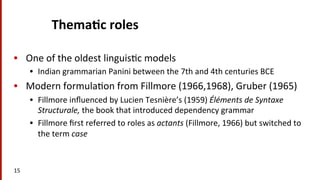
Thema$c	
  roles	
  
•  One	
  of	
  the	
  oldest	
  linguis(c	
  models	
  
•  Indian	
  grammarian	
  Panini	
  between	
  the	
  7th	
  and	
  4th	
  centuries	
  BCE	
  	
  
•  Modern	
  formula(on	
  from	
  Fillmore	
  (1966,1968),	
  Gruber	
  (1965)	
  
•  Fillmore	
  influenced	
  by	
  Lucien	
  Tesnière’s	
  (1959)	
  Éléments	
  de	
  Syntaxe	
  
Structurale,	
  the	
  book	
  that	
  introduced	
  dependency	
  grammar	
  
•  Fillmore	
  first	
  referred	
  to	
  roles	
  as	
  actants	
  (Fillmore,	
  1966)	
  but	
  switched	
  to	
  
the	
  term	
  case	
  
15	
  
Thema$c	
  roles	
  
•  A	
  typical	
  set:	
  
16	
  
R 22 • SEMANTIC ROLE LABELING
Thematic Role Definition
AGENT The volitional causer of an event
EXPERIENCER The experiencer of an event
FORCE The non-volitional causer of the event
THEME The participant most directly affected by an event
RESULT The end product of an event
CONTENT The proposition or content of a propositional event
INSTRUMENT An instrument used in an event
BENEFICIARY The beneficiary of an event
SOURCE The origin of the object of a transfer event
GOAL The destination of an object of a transfer event
Figure 22.1 Some commonly used thematic roles with their definitions.
(22.1) Sasha broke the window.
(22.2) Pat opened the door.
22.2 • DIATHESIS ALTERNATIONS 3
Thematic Role Example
AGENT The waiter spilled the soup.
EXPERIENCER John has a headache.
FORCE The wind blows debris from the mall into our yards.
THEME Only after Benjamin Franklin broke the ice...
RESULT The city built a regulation-size baseball diamond...
CONTENT Mona asked “You met Mary Ann at a supermarket?”
INSTRUMENT He poached catfish, stunning them with a shocking device...
BENEFICIARY Whenever Ann Callahan makes hotel reservations for her boss...
SOURCE I flew in from Boston.
GOAL I drove to Portland.
Figure 22.2 Some prototypical examples of various thematic roles.
22.2 Diathesis Alternations
The main reason computational systems use semantic roles is to act as a shallow
Thema$c	
  grid,	
  case	
  frame,	
  θ-­‐grid	
  
earlier examples, if a document says that Company A acquired Company B, we’d
like to know that this answers the query Was Company B acquired? despite the fact
that the two sentences have very different surface syntax. Similarly, this shallow
semantics might act as a useful intermediate language in machine translation.
Semantic roles thus help generalize over different surface realizations of pred-
icate arguments. For example, while the AGENT is often realized as the subject of
the sentence, in other cases the THEME can be the subject. Consider these possible
realizations of the thematic arguments of the verb break:
(22.3) John
AGENT
broke the window.
THEME
(22.4) John
AGENT
broke the window
THEME
with a rock.
INSTRUMENT
(22.5) The rock
INSTRUMENT
broke the window.
THEME
(22.6) The window
THEME
broke.
(22.7) The window
THEME
was broken by John.
AGENT
These examples suggest that break has (at least) the possible arguments AGENT,17	
  
thematic grid, case frame, θ-grid
Break:
AGENT, THEME, INSTRUMENT.
AGENT THEME
(22.4) John
AGENT
broke the window
THEME
with a rock.
INSTRUMENT
(22.5) The rock
INSTRUMENT
broke the window.
THEME
(22.6) The window
THEME
broke.
(22.7) The window
THEME
was broken by John.
AGENT
These examples suggest that break has (at least) the possible a
THEME, and INSTRUMENT. The set of thematic role arguments
often called the thematic grid, q-grid, or case frame. We canthematic grid
case frame (among others) the following possibilities for the realization of t
break:
AGENT/Subject, THEME/Object
AGENT/Subject, THEME/Object, INSTRUMENT/PPwith
INSTRUMENT/Subject, THEME/Object
THEME/Subject
It turns out that many verbs allow their thematic roles to be
syntactic positions. For example, verbs like give can realize the
arguments in two different ways:
Example	
  usages	
  of	
  “break”	
  
Some	
  realiza(ons:	
  
Diathesis	
  alterna$ons	
  (or	
  verb	
  alterna$on)	
  
Da$ve	
  alterna$on:	
  par(cular	
  seman(c	
  classes	
  of	
  verbs,	
  “verbs	
  of	
  future	
  
having”	
  (advance,	
  allocate,	
  offer,	
  owe),	
  “send	
  verbs”	
  (forward,	
  hand,	
  mail),	
  
“verbs	
  of	
  throwing”	
  (kick,	
  pass,	
  throw),	
  etc.	
  
Levin	
  (1993):	
  47	
  seman(c	
  classes	
  (“Levin	
  classes”)	
  for	
  3100	
  English	
  verbs	
  and	
  
alterna(ons.	
  In	
  online	
  resource	
  VerbNet.	
  
18	
  
MANTIC ROLE LABELING
a. Doris
AGENT
gave the book
THEME
to Cary.
GOAL
b. Doris
AGENT
gave Cary
GOAL
the book.
THEME
multiple argument structure realizations (the fact that break can take AGENT,
NT, or THEME as subject, and give can realize its THEME and GOAL in
) are called verb alternations or diathesis alternations. The alternation
above for give, the dative alternation, seems to occur with particular se-
ses of verbs, including “verbs of future having” (advance, allocate, offer,
d verbs” (forward, hand, mail), “verbs of throwing” (kick, pass, throw),
Break: AGENT, INSTRUMENT, or THEME as
subject
Give: THEME and GOAL in either order
	
  
dī-­‐ˈa-­‐thə-­‐səs	
  :	
  	
  hYp://www.wordhippo.com/what-­‐is/how-­‐do-­‐you-­‐pronounce-­‐the-­‐word/diathesis.html	
  	
  
hYps://www.youtube.com/watch?v=x7NVanW_uRc	
  	
  //	
  hYps://www.youtube.com/watch?v=2qbwUqhcaiU	
  	
  
Problems	
  with	
  Thema$c	
  Roles	
  
Hard	
  to	
  create	
  standard	
  set	
  of	
  roles	
  or	
  formally	
  define	
  them	
  
Ocen	
  roles	
  need	
  to	
  be	
  fragmented	
  to	
  be	
  defined.	
  
Levin	
  and	
  Rappaport	
  Hovav	
  (2015):	
  two	
  kinds	
  of	
  INSTRUMENTS	
  
intermediary	
  instruments	
  that	
  can	
  appear	
  as	
  subjects	
  	
  
The	
  cook	
  opened	
  the	
  jar	
  with	
  the	
  new	
  gadget.	
  	
  
The	
  new	
  gadget	
  opened	
  the	
  jar.	
  	
  
enabling	
  instruments	
  that	
  cannot	
  
Shelly	
  ate	
  the	
  sliced	
  banana	
  with	
  a	
  fork.	
  	
  
*The	
  fork	
  ate	
  the	
  sliced	
  banana.	
  	
  
19	
  
Alterna$ves	
  to	
  thema$c	
  roles	
  
1.  Fewer	
  roles:	
  generalized	
  seman(c	
  roles,	
  defined	
  as	
  
prototypes	
  (Dowty	
  1991)	
  
PROTO-­‐AGENT	
  	
  
PROTO-­‐PATIENT	


2.  More	
  roles:	
  Define	
  roles	
  specific	
  to	
  a	
  group	
  of	
  predicates	
  
20	
  
FrameNet	
  
PropBank	
  
What	
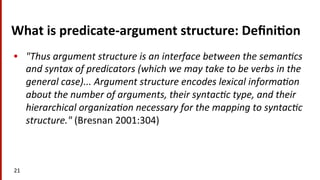
  is	
  predicate-­‐argument	
  structure:	
  Defini$on	
  
•  "Thus	
  argument	
  structure	
  is	
  an	
  interface	
  between	
  the	
  seman8cs	
  
and	
  syntax	
  of	
  predicators	
  (which	
  we	
  may	
  take	
  to	
  be	
  verbs	
  in	
  the	
  
general	
  case)...	
  Argument	
  structure	
  encodes	
  lexical	
  informa8on	
  
about	
  the	
  number	
  of	
  arguments,	
  their	
  syntac8c	
  type,	
  and	
  their	
  
hierarchical	
  organiza8on	
  necessary	
  for	
  the	
  mapping	
  to	
  syntac8c	
  
structure."	
  (Bresnan	
  2001:304)	
  
21	
  
What’s	
  a	
  predicate-­‐argument	
  structure	
  
•  A	
  predicate	
  and	
  its	
  arguments	
  form	
  a	
  predicate-­‐argument	
  
structure.	
  	
  
•  An	
  argument	
  is	
  an	
  expression	
  that	
  helps	
  complete	
  the	
  meaning	
  
of	
  a	
  predicate	
  
•  Most	
  predicates	
  take	
  one,	
  two,	
  or	
  three	
  arguments.	
  	
  
22	
  
In	
  other	
  words…	


•  Argument	
  structure	
  (valency/valence)	
  is	
  the	
  study	
  of	
  the	
  arguments	
  
taken	
  by	
  expressions.	
  	
  
•  An	
  expression	
  taking	
  an	
  argument	
  is	
  called	
  a	
  predicate	
  (it	
  can	
  be	
  a	
  
verb,	
  but	
  also	
  a	
  noun	
  etc.	
  see	
  NounBank)	
  
•  A	
  predicate	
  (eg	
  a	
  verb)	
  takes	
  a	
  number	
  of	
  arguments.	
  
•  An	
  argument	
  can	
  itself	
  be	
  an	
  predicate.	
  
•  Seman$c	
  roles	
  are	
  descrip$ons	
  of	
  the	
  seman$c	
  rela$on	
  between	
  
predicate	
  and	
  its	
  arguments.	
  	
  
•  Gramma(cal	
  rela(ons	
  are	
  descrip(ons	
  of	
  the	
  syntac(c	
  proper(es	
  of	
  
an	
  argument	
  
•  (thx	
  to	
  Andrew	
  McIn(re)	
  23	
  
Elements	
  of	
  the	
  argument	
  structure	
  
•  An	
  argument	
  structure	
  typically	
  indicates:	
  
•  the	
  number	
  of	
  arguments	
  a	
  lexical	
  item	
  takes,	
  	
  
•  their	
  syntac(c	
  expression,	
  	
  
•  their	
  seman(c	
  rela(on	
  to	
  this	
  lexical	
  item	


Beth	
  Levin	
  (Oxford	
  Bibliography	
  	
  
(hYp://www.oxfordbibliographies.com/view/document/obo-­‐9780199772810/obo-­‐9780199772810-­‐0099.xml	
  )	
  
24	
  
Lexical	
  level	
  
•  Argument	
  structure	
  is	
  a	
  lexical	
  level	
  of	
  informa(on	
  in	
  that	
  it	
  
ignores	
  syntac(c-­‐func(on-­‐changing	
  opera(ons	
  such	
  as	
  
passiviza(on.	
  	
  
25	
  
The	
  following	
  examples	
  have	
  different	
  surface-­‐syntac(c	
  gramma(cal	
  rela(ons,	
  
but	
  the	
  same	
  argument	
  structure:	
  	
  
open	
  can	
  take	
  3	
  arguments,	
  which	
  in	
  terms	
  of	
  seman(c	
  roles:	
  agent,	
  theme	
  and	
  
instrument	
  
(i) 	
  John	
  opened	
  Bill's	
  door	
  (with	
  his	
  key)	
  
	
  John's	
  key	
  opened	
  Bill's	
  door	
  
	
  Bill's	
  door	
  opened	
  
	
  Bill's	
  door	
  was	
  opened	
  (by	
  John)	
  
(ii)	
  	
  a:	
  	
  OPEN(John 	
  door 	
  key)	


  | 	
  	
  |	


  |	


  Agent 	
  Theme	
  Instrument	
  
•  	


  b:	
  	
  OPEN	


  <Ag,	
  Th,	
  Instr>	
  26	
  
In	
  summary:	
  	
  
•  Argument	
  structure	
  is	
  generally	
  seen	
  as	
  intermediate	
  between	
  
seman(c-­‐role	
  structure	
  and	
  syntac(c-­‐func(on	
  structure.	
  	
  
27	
  
Arguments	
  and	
  Adjuncts/Modifiers	
  	
  
•  Arguments	
  must	
  be	
  dis(nguished	
  from	
  adjuncts.	
  While	
  a	
  
predicate	
  needs	
  its	
  arguments	
  to	
  complete	
  its	
  meaning,	
  the	
  
adjuncts	
  that	
  appear	
  with	
  a	
  predicate	
  are	
  op(onal;	
  they	
  are	
  not	
  
necessary	
  to	
  complete	
  the	
  meaning	
  of	
  the	
  predicate	
  (wikipedia).	
  
•  Jill	
  really	
  likes	
  Jack.	
  
•  Jill	
  likes	
  Jack	
  most	
  of	
  the	
  $me.	
  
•  Jill	
  likes	
  Jack	
  when	
  the	
  sun	
  shines.	
  
•  Jill	
  likes	
  Jack	
  because	
  he's	
  friendly.	
  28	
  
Semantic Role
Labeling
The	
  Proposi(on	
  Bank	
  
(PropBank)	
  
PropBank	
  
•  Palmer,	
  Martha,	
  Daniel	
  Gildea,	
  and	
  Paul	
  Kingsbury.	
  2005.	
  The	
  
Proposi(on	
  Bank:	
  An	
  Annotated	
  Corpus	
  of	
  Seman(c	
  Roles.	
  
Computa8onal	
  Linguis8cs,	
  31(1):71–106	
  	
  
30	
  
PropBank	
  Roles	
  
Proto-­‐Agent	
  
•  Voli(onal	
  involvement	
  in	
  event	
  or	
  state	
  
•  Sen(ence	
  (and/or	
  percep(on)	
  
•  Causes	
  an	
  event	
  or	
  change	
  of	
  state	
  in	
  another	
  par(cipant	
  	
  
•  Movement	
  (rela(ve	
  to	
  posi(on	
  of	
  another	
  par(cipant)	
  
Proto-­‐Pa(ent	
  
•  Undergoes	
  change	
  of	
  state	
  
•  Causally	
  affected	
  by	
  another	
  par(cipant	
  
•  Sta(onary	
  rela(ve	
  to	
  movement	
  of	
  another	
  par(cipant	
  
	
  31	
  
Following Dowty 1991
PropBank	
  Roles	
  
•  Following	
  Dowty	
  1991	
  
•  Role	
  defini(ons	
  determined	
  verb	
  by	
  verb,	
  with	
  respect	
  to	
  the	
  other	
  roles	
  	
  
•  Seman(c	
  roles	
  in	
  PropBank	
  are	
  thus	
  verb-­‐sense	
  specific.	
  
•  Each	
  verb	
  sense	
  has	
  numbered	
  argument:	
  Arg0,	
  Arg1,	
  Arg2,…	
  
Arg0:	
  PROTO-­‐AGENT	
  
Arg1:	
  PROTO-­‐PATIENT	
  
Arg2:	
  usually:	
  benefac(ve,	
  instrument,	
  aYribute,	
  or	
  end	
  state	
  
Arg3:	
  usually:	
  start	
  point,	
  benefac(ve,	
  instrument,	
  or	
  aYribute	
  
Arg4	
  the	
  end	
  point	
  
(Arg2-­‐Arg5	
  are	
  not	
  really	
  that	
  consistent,	
  causes	
  a	
  problem	
  for	
  labeling)	
  32	
  
PropBank	
  Frame	
  Files	
  
33	
  
definitions.
(22.11) agree.01
Arg0: Agreer
Arg1: Proposition
Arg2: Other entity agreeing
Ex1: [Arg0 The group] agreed [Arg1 it wouldn’t make an offer].
Ex2: [ArgM-TMP Usually] [Arg0 John] agrees [Arg2 with Mary]
[Arg1 on everything].
(22.12) fall.01
Arg1: Logical subject, patient, thing falling
Arg2: Extent, amount fallen
Arg3: start point
Arg4: end point, end state of arg1
Ex1: [Arg1 Sales] fell [Arg4 to $25 million] [Arg3 from $27 million].
Ex2: [Arg1 The average junk bond] fell [Arg2 by 4.2%].
(22.11) agree.01
Arg0: Agreer
Arg1: Proposition
Arg2: Other entity agreeing
Ex1: [Arg0 The group] agreed [Arg1 it wouldn’t make an offer].
Ex2: [ArgM-TMP Usually] [Arg0 John] agrees [Arg2 with Mary]
[Arg1 on everything].
(22.12) fall.01
Arg1: Logical subject, patient, thing falling
Arg2: Extent, amount fallen
Arg3: start point
Arg4: end point, end state of arg1
Ex1: [Arg1 Sales] fell [Arg4 to $25 million] [Arg3 from $27 million].
Ex2: [Arg1 The average junk bond] fell [Arg2 by 4.2%].
???:	
  what	
  is	
  a	
  word	
  
sense?	
  Examples?	
  
Advantage	
  of	
  a	
  ProbBank	
  Labeling	
  The PropBank semantic roles can be useful in recovering shallow
formation about verbal arguments. Consider the verb increase:
(22.13) increase.01 “go up incrementally”
Arg0: causer of increase
Arg1: thing increasing
Arg2: amount increased by, EXT, or MNR
Arg3: start point
Arg4: end point
A PropBank semantic role labeling would allow us to infer the c
the event structures of the following three examples, that is, that in
Fruit Co. is the AGENT and the price of bananas is the THEME, despi
surface forms.
(22.14) [Arg0 Big Fruit Co. ] increased [Arg1 the price of bananas].34	
  
The PropBank semantic roles can be useful in recovering shallow semantic in-
formation about verbal arguments. Consider the verb increase:
(22.13) increase.01 “go up incrementally”
Arg0: causer of increase
Arg1: thing increasing
Arg2: amount increased by, EXT, or MNR
Arg3: start point
Arg4: end point
A PropBank semantic role labeling would allow us to infer the commonality in
the event structures of the following three examples, that is, that in each case Big
Fruit Co. is the AGENT and the price of bananas is the THEME, despite the differing
surface forms.
(22.14) [Arg0 Big Fruit Co. ] increased [Arg1 the price of bananas].
(22.15) [Arg1 The price of bananas] was increased again [Arg0 by Big Fruit Co. ]
(22.16) [Arg1 The price of bananas] increased [Arg2 5%].
This	
  would	
  allow	
  us	
  to	
  see	
  the	
  commonali(es	
  in	
  these	
  3	
  sentences:	
  
Modifiers	
  or	
  adjuncts	
  of	
  the	
  predicate:	
  
Arg-­‐M	
  
Arg1 Arg2
PropBank also has a number of non-numbered arguments called ArgMs, (ArgM-
TMP, ArgM-LOC, etc) which represent modification or adjunct meanings. These are
relatively stable across predicates, so aren’t listed with each frame file. Data labeled
with these modifiers can be helpful in training systems to detect temporal, location,
or directional modification across predicates. Some of the ArgM’s include:
TMP when? yesterday evening, now
LOC where? at the museum, in San Francisco
DIR where to/from? down, to Bangkok
MNR how? clearly, with much enthusiasm
PRP/CAU why? because ... , in response to the ruling
REC themselves, each other
ADV miscellaneous
PRD secondary predication ...ate the meat raw
While PropBank focuses on verbs, a related project, NomBank (Meyers et al.,
2004) adds annotations to noun predicates. For example the noun agreement in
Apple’s agreement with IBM would be labeled with Apple as the Arg0 and IBM as
the Arg2. This allows semantic role labelers to assign labels to arguments of both35	
  
ArgM-
Plus	
  nouns	
  and	
  light	
  verbs	
  English Noun and LVC annotation
!  Example Noun: Decision
!  Roleset:Arg0: decider,Arg1: decision…
!  “…[yourARG0] [decisionREL]
[to say look I don't want to go through this anymoreARG1]”
!  Example within an LVC: Make a decision
!  “…[the PresidentARG0] [madeREL-LVB]
the [fundamentally correctARGM-ADJ]
[decisionREL] [to get on offenseARG1]”
36	
   Slide	
  from	
  Palmer	
  2013	
  
Ques$ons	
  2	
  
•  Which	
  LT-­‐based	
  applica(ons	
  can	
  benefit	
  from	
  the	
  kind	
  of	
  
abstrac(on	
  provided	
  by	
  seman(c	
  role	
  annota(on?	
  
•  Why?	
  
37	
  
As	
  2:	
  
•  Ques(on	
  answering	
  
•  Informa(on	
  extrac(on	
  
•  Machine	
  translate	
  
•  NL	
  understanding	
  
•  […]	
  
•  Because	
  	
  sema(c	
  roles	
  allow	
  us	
  to	
  capture	
  the	
  seman(c	
  
commonalites	
  underlying	
  different	
  surface	
  syntac(c	
  
representa(ons.	
  38	
  
Semantic Role
Labeling
FrameNet	
  
Capturing	
  descrip$ons	
  of	
  the	
  same	
  event	
  
by	
  different	
  nouns/verbs	
  
While making inferences about the semantic commonalities across different sen-
tences with increase is useful, it would be even more useful if we could make such
inferences in many more situations, across different verbs, and also between verbs
and nouns. For example, we’d like to extract the similarity among these three sen-
tences:
(22.17) [Arg1 The price of bananas] increased [Arg2 5%].
(22.18) [Arg1 The price of bananas] rose [Arg2 5%].
(22.19) There has been a [Arg2 5%] rise [Arg1 in the price of bananas].
Note that the second example uses the different verb rise, and the third example
uses the noun rather than the verb rise. We’d like a system to recognize that the
40	
  
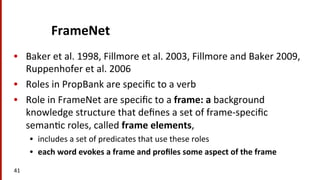
FrameNet	
  
•  Baker	
  et	
  al.	
  1998,	
  Fillmore	
  et	
  al.	
  2003,	
  Fillmore	
  and	
  Baker	
  2009,	
  
Ruppenhofer	
  et	
  al.	
  2006	
  	
  
•  Roles	
  in	
  PropBank	
  are	
  specific	
  to	
  a	
  verb	
  
•  Role	
  in	
  FrameNet	
  are	
  specific	
  to	
  a	
  frame:	
  a	
  background	
  
knowledge	
  structure	
  that	
  defines	
  a	
  set	
  of	
  frame-­‐specific	
  
seman(c	
  roles,	
  called	
  frame	
  elements,	
  	
  
•  includes	
  a	
  set	
  of	
  predicates	
  that	
  use	
  these	
  roles	
  
•  each	
  word	
  evokes	
  a	
  frame	
  and	
  profiles	
  some	
  aspect	
  of	
  the	
  frame	
  
41	
  
The	
  “Change	
  posi$on	
  on	
  a	
  scale”	
  Frame	
  
This	
  frame	
  consists	
  of	
  words	
  that	
  indicate	
  the	
  change	
  of	
  an	
  ITEM’s	
  
posi(on	
  on	
  a	
  scale	
  (the	
  ATTRIBUTE)	
  from	
  a	
  star(ng	
  point	
  (INITIAL	
  
VALUE)	
  to	
  an	
  end	
  point	
  (FINAL	
  VALUE)	
  
42	
  
sentences.
For example, the change position on a scale frame is defined as follows:
This frame consists of words that indicate the change of an Item’s posi-
tion on a scale (the Attribute) from a starting point (Initial value) to an
end point (Final value).
Some of the semantic roles (frame elements) in the frame are defined as in
Fig. 22.3. Note that these are separated into core roles, which are frame specific, andCore roles
non-core roles, which are more like the Arg-M arguments in PropBank, expressedNon-core roles
more general properties of time, location, and so on.
Here are some example sentences:
(22.20) [ITEM Oil] rose [ATTRIBUTE in price] [DIFFERENCE by 2%].
(22.21) [ITEM It] has increased [FINAL STATE to having them 1 day a month].
(22.22) [ITEM Microsoft shares] fell [FINAL VALUE to 7 5/8].
(22.23) [ITEM Colon cancer incidence] fell [DIFFERENCE by 50%] [GROUP among
men].
(22.24) a steady increase [INITIAL VALUE from 9.5] [FINAL VALUE to 14.3] [ITEM
in dividends]
(22.25) a [DIFFERENCE 5%] [ITEM dividend] increase...
The	
  “Change	
  posi$on	
  on	
  a	
  scale”	
  Frame	
  
he GROUP in which an ITEM changes the value of an
TTRIBUTE in a specified way.
me elements in the change position on a scale frame from the FrameNe
al., 2006).
VERBS: dwindle move soar escalation shift
advance edge mushroom swell explosion tumble
climb explode plummet swing fall
decline fall reach triple fluctuation ADVERBS:
decrease fluctuate rise tumble gain increasingly
diminish gain rocket growth
dip grow shift NOUNS: hike
double increase skyrocket decline increase
drop jump slide decrease rise
43	
  
8 CHAPTER 22 • SEMANTIC ROLE LABELING
Core Roles
ATTRIBUTE The ATTRIBUTE is a scalar property that the ITEM possesses.
DIFFERENCE The distance by which an ITEM changes its position on the scale.
FINAL STATE A description that presents the ITEM’s state after the change in the ATTRIBUTE’s
value as an independent predication.
FINAL VALUE The position on the scale where the ITEM ends up.
INITIAL STATE A description that presents the ITEM’s state before the change in the AT-
TRIBUTE’s value as an independent predication.
INITIAL VALUE The initial position on the scale from which the ITEM moves away.
ITEM The entity that has a position on the scale.
VALUE RANGE A portion of the scale, typically identified by its end points, along which the
values of the ATTRIBUTE fluctuate.
Some Non-Core Roles
DURATION The length of time over which the change takes place.
SPEED The rate of change of the VALUE.
GROUP The GROUP in which an ITEM changes the value of an
ATTRIBUTE in a specified way.44	
  
The	
  “Change	
  posi$on	
  on	
  a	
  scale”	
  Frame	
  
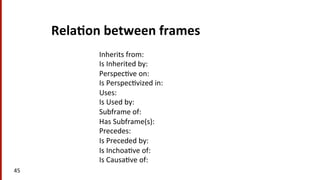
Rela$on	
  between	
  frames	
  
Inherits	
  from:	
  	
  
Is	
  Inherited	
  by:	
  
Perspec(ve	
  on:	
  	
  
Is	
  Perspec(vized	
  in:	
  	
  
Uses:	
  	
  
Is	
  Used	
  by:	
  	
  
Subframe	
  of:	
  	
  
Has	
  Subframe(s):	
  	
  
Precedes:	
  	
  
Is	
  Preceded	
  by:	
  	
  
Is	
  Inchoa(ve	
  of:	
  	
  
Is	
  Causa(ve	
  of:	
  
45	
  
Rela$on	
  between	
  frames:	
  what	
  is	
  the	
  implica$on?	
  
46	
  
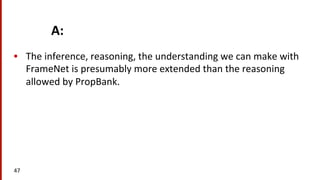
A:	
  
•  The	
  inference,	
  reasoning,	
  the	
  understanding	
  we	
  can	
  make	
  with	
  
FrameNet	
  is	
  presumably	
  more	
  extended	
  than	
  the	
  reasoning	
  
allowed	
  by	
  PropBank.	
  
47	
  
Semantic Role
Labeling
Seman(c	
  Role	
  Labeling	
  
Algorithm	
  
Seman$c	
  role	
  labeling	
  (SRL)	
  	
  
•  The	
  task	
  of	
  AUTOMATICALLY	
  finding	
  the	
  seman(c	
  roles	
  of	
  each	
  
argument	
  of	
  each	
  predicate	
  in	
  a	
  sentence.	
  
•  FrameNet	
  versus	
  PropBank:	
  
49	
  
22.6 • SEMANTIC ROLE LABELING 9
Recall that the difference between these two models of semantic roles is that
FrameNet (22.27) employs many frame-specific frame elements as roles, while Prop-
Bank (22.28) uses a smaller number of numbered argument labels that can be inter-
preted as verb-specific labels, along with the more general ARGM labels. Some
examples:
(22.27)
[You] can’t [blame] [the program] [for being unable to identify it]
COGNIZER TARGET EVALUEE REASON
(22.28)
[The San Francisco Examiner] issued [a special edition] [yesterday]
ARG0 TARGET ARG1 ARGM-TMP
A simplified semantic role labeling algorithm is sketched in Fig. 22.4. While
there are a large number of algorithms, many of them use some version of the steps
in this algorithm.
History	
  
•  Seman(c	
  roles	
  as	
  a	
  intermediate	
  seman(cs,	
  used	
  early	
  in	
  
•  machine	
  transla(on	
  (Wilks,	
  1973)	
  
•  ques(on-­‐answering	
  (Hendrix	
  et	
  al.,	
  1973)	
  
•  spoken-­‐language	
  understanding	
  (Nash-­‐Webber,	
  1975)	
  
•  dialogue	
  systems	
  (Bobrow	
  et	
  al.,	
  1977)	
  
•  Early	
  SRL	
  systems	
  
Simmons	
  1973,	
  Marcus	
  1980:	
  	
  
•  parser	
  followed	
  by	
  hand-­‐wriYen	
  rules	
  for	
  each	
  verb	
  
•  dic(onaries	
  with	
  verb-­‐specific	
  case	
  frames	
  (Levin	
  1977)	
  	
  
50	
  
Why	
  Seman$c	
  Role	
  Labeling	
  
•  A	
  useful	
  shallow	
  seman(c	
  representa(on	
  
•  Improves	
  NLP	
  tasks	
  like:	
  
•  ques(on	
  answering	
  	
  
Shen	
  and	
  Lapata	
  2007,	
  Surdeanu	
  et	
  al.	
  2011	
  
•  machine	
  transla(on	
  	
  
Liu	
  and	
  Gildea	
  2010,	
  Lo	
  et	
  al.	
  2013	
  
51	
  
How	
  do	
  we	
  decide	
  what	
  is	
  a	
  predicate	
  
•  If	
  we’re	
  just	
  doing	
  PropBank	
  verbs	
  
•  Choose	
  all	
  verbs	
  
•  If	
  we’re	
  doing	
  FrameNet	
  (verbs,	
  nouns,	
  adjec(ves)	
  
•  Choose	
  every	
  word	
  that	
  was	
  labeled	
  as	
  a	
  target	
  in	
  training	
  data	
  
52	
  
Seman$c	
  Role	
  Labeling:	
  typical	
  set	
  of	
  basic	
  feature	
  
(example)	
  10 CHAPTER 22 • SEMANTIC ROLE LABELING
S
NP-SBJ = ARG0 VP
DT NNP NNP NNP
The San Francisco Examiner
VBD = TARGET NP = ARG1 PP-TMP = ARGM-TMP
issued DT JJ NN IN NP
a special edition around NN NP-TMP
noon yesterday
Figure 22.5 Parse tree for a PropBank sentence, showing the PropBank argument labels. The dotted line53	
  
1.  Predicate:	
  issued	
  
2.  Phrase	
  type:	
  NP,	
  etc.	
  	
  
3.  […]	
  
Features	
  
Headword	
  of	
  cons(tuent	
  
Examiner	
  
Headword	
  POS	
  
NNP	
  
Voice	
  of	
  the	
  clause	
  
Ac(ve	
  
Subcategoriza(on	
  of	
  pred	
  
VP	
  -­‐>	
  VBD	
  NP	
  PP	
  
54	
  
S
NP-SBJ = ARG0 VP
DT NNP NNP NNP
The San Francisco Examiner
VBD = TARGET NP = ARG1 PP-TMP = ARGM-TMP
issued DT JJ NN IN NP
a special edition around NN NP-TMP
noon yesterday
Figure 22.5 Parse tree for a PropBank sentence, showing the PropBank argument labels. The dotted line
shows the path feature NP"S#VP#VBD for ARG0, the NP-SBJ constituent The San Francisco Examiner.
• The headword of the constituent, Examiner. The headword of a constituent
can be computed with standard head rules, such as those given in Chapter 11
in Fig. ??. Certain headwords (e.g., pronouns) place strong constraints on the
possible semantic roles they are likely to fill.
• The headword part of speech of the constituent, NNP.
• The path in the parse tree from the constituent to the predicate. This path is
marked by the dotted line in Fig. 22.5. Following Gildea and Jurafsky (2000),
we can use a simple linear representation of the path, NP"S#VP#VBD. " and
# represent upward and downward movement in the tree, respectively. The
path is very useful as a compact representation of many kinds of grammatical
Named	
  En(ty	
  type	
  of	
  cons(t	
  
ORGANIZATION	
  
First	
  and	
  last	
  words	
  of	
  cons(t	
  
The,	
  Examiner	
  
Linear	
  posi(on,clause	
  re:	
  predicate	
  
Path	
  Feature	
  
Path	
  in	
  the	
  parse	
  tree	
  from	
  the	
  cons(tuent	
  to	
  the	
  predicate:	
  a	
  
compact	
  and	
  “linear”	
  representa(on	
  of	
  the	
  rela(onship	
  between	
  
the	
  cons(tuents	
  and	
  the	
  predicate.	
  	
  
55	
  
10 CHAPTER 22 • SEMANTIC ROLE LABELING
S
NP-SBJ = ARG0 VP
DT NNP NNP NNP
The San Francisco Examiner
VBD = TARGET NP = ARG1 PP-TMP = ARGM-TMP
issued DT JJ NN IN NP
a special edition around NN NP-TMP
noon yesterday
, NNP.
o the predicate. This path is
Gildea and Jurafsky (2000),
path, NP"S#VP#VBD. " and
n the tree, respectively. The
f many kinds of grammatical
d the predicate.
appears, in this case, active
end to have strongly different
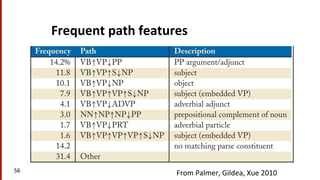
Frequent	
  path	
  features	
  
The most common values of the path feature, along with interpretations, are shown in Ta-
ble 3.1.
Table 3.1: Most frequent values of path feature in the training data.
Frequency Path Description
14.2% VB↑VP↓PP PP argument/adjunct
11.8 VB↑VP↑S↓NP subject
10.1 VB↑VP↓NP object
7.9 VB↑VP↑VP↑S↓NP subject (embedded VP)
4.1 VB↑VP↓ADVP adverbial adjunct
3.0 NN↑NP↑NP↓PP prepositional complement of noun
1.7 VB↑VP↓PRT adverbial particle
1.6 VB↑VP↑VP↑VP↑S↓NP subject (embedded VP)
14.2 no matching parse constituent
31.4 Other
56	
   From	
  Palmer,	
  Gildea,	
  Xue	
  2010	
  
Final	
  feature	
  vector…	
  
•  …	
  or	
  the	
  argument:	
  “The	
  San	
  Francisco	
  Examiner”,	
  	
  
•  Arg0,	
  [issued,	
  NP,	
  Examiner,	
  NNP,	
  ac8ve,	
  before,	
  VPàNP	
  PP,	
  ORG,	
  
The,	
  Examiner,	


  ]	
  
•  Other	
  features	
  could	
  be	
  used	
  as	
  well	
  
•  sets	
  of	
  n-­‐grams	
  inside	
  the	
  cons(tuent	
  
•  other	
  path	
  features	
  
•  the	
  upward	
  or	
  downward	
  halves	
  
•  whether	
  par(cular	
  nodes	
  occur	
  in	
  the	
  path	
  	
  57	
  
d rules, such as those given in Chapter 11
pronouns) place strong constraints on the
ely to fill.
he constituent, NNP.
constituent to the predicate. This path is
.5. Following Gildea and Jurafsky (2000),
tation of the path, NP"S#VP#VBD. " and
movement in the tree, respectively. The
resentation of many kinds of grammatical
constituent and the predicate.
he constituent appears, in this case, active
e sentences tend to have strongly different
e form than do active ones.
1.  Predicate	
  
2.  Phrase	
  type	
  
3.  Headword	
  
4.  Headword	
  POS	
  
5.  Voice	
  
6.  Linear	
  posi(on	
  (with	
  
respect	
  to	
  the	
  prdicate	
  
7.  Subcategoriza(on	
  of	
  the	
  
predicate	
  
8.  Named	
  en(ty	
  
9.  The	
  first	
  word	
  and	
  the	
  
last	
  word	
  
10.  The	
  path	
  
S
NP-SBJ = ARG0 VP
DT NNP NNP NNP
The San Francisco Examiner
VBD = TARGET NP = ARG1 PP-TMP = ARGM-TMP
issued DT JJ NN IN NP
a special edition around NN NP-TMP
noon yesterday
Figure 22.5 Parse tree for a PropBank sentence, showing the PropBank argument labels. The dotted line
shows the path feature NP"S#VP#VBD for ARG0, the NP-SBJ constituent The San Francisco Examiner.
• The headword of the constituent, Examiner. The headword of a constituent
can be computed with standard head rules, such as those given in Chapter 11
in Fig. ??. Certain headwords (e.g., pronouns) place strong constraints on the
possible semantic roles they are likely to fill.
• The headword part of speech of the constituent, NNP.
• The path in the parse tree from the constituent to the predicate. This path is
marked by the dotted line in Fig. 22.5. Following Gildea and Jurafsky (2000),
we can use a simple linear representation of the path, NP"S#VP#VBD. " and
# represent upward and downward movement in the tree, respectively. The
path is very useful as a compact representation of many kinds of grammatical
function relationships between the constituent and the predicate.
• The voice of the clause in which the constituent appears, in this case, active
(as contrasted with passive). Passive sentences tend to have strongly different
linkings of semantic roles to surface form than do active ones.
• The binary linear position of the constituent with respect to the predicate,
either before or after.
• The subcategorization of the predicate, the set of expected arguments that
appear in the verb phrase. We can extract this information by using the phrase-
structure rule that expands the immediate parent of the predicate; VP ! VBD
NP PP for the predicate in Fig. 22.5.
• The named entity type of the constituent.
• The first words and the last word of the constituent.
The following feature vector thus represents the first NP in our example (recall
that most observations will have the value NONE rather than, for example, ARG0,
since most constituents in the parse tree will not bear a semantic role):
ARG0: [issued, NP, Examiner, NNP, NP"S#VP#VBD, active, before, VP ! NP PP,
ORG, The, Examiner]
Other features are often used in addition, such as sets of n-grams inside the
Not	
  just	
  verbs:	
  NomBank	
  	
  
S
¨
¨¨
¨
¨¨
r
rr
r
rr
NP
(ARG0)
¨¨¨
rrr
NNP
Ben
NNP
Bernanke
VP
¨
¨¨
¨¨
r
rr
rr
VBD
was
VP
¨¨
¨¨¨
rr
rrr
VBN
(Support)
nominated
PP
¨¨
¨¨¨
rr
rrr
IN
as
NP
¨
¨¨¨
r
rrr
NP
(ARG1)

€€€
Greenspan ’s
NN
predicate
replacement
2004) experimen
tem developed us
ually selected nom
Penn Chinese Tr
their system is no
3 Model train
We treat the Nom
sification problem
argument identifi
tion. During the
58	
  
Meyers	
  et	
  al.	
  2004	
  
Figure	
  from	
  Jiang	
  and	
  Ng	
  2006	
  
Addi$onal	
  Issues	
  for	
  nouns	
  
•  Features:	
  
•  Nominaliza(on	
  lexicon	
  (employmentà	
  employ)	
  
•  Morphological	
  stem	
  
•  Healthcare,	
  Medicate	
  à	
  care	
  
•  Different	
  posi(ons	
  
•  Most	
  arguments	
  of	
  nominal	
  predicates	
  occur	
  inside	
  the	
  NP	
  
•  Others	
  are	
  introduced	
  by	
  support	
  verbs	
  
•  Especially	
  light	
  verbs	
  	
  “X	
  made	
  an	
  argument”,	
  “Y	
  took	
  a	
  nap”	


59	
  
Selectional
Restrictions
Selec$onal	
  Restric$ons	
  
Consider	
  the	
  two	
  interpreta(ons	
  of:	
  
	
  I	
  want	
  to	
  eat	
  someplace	
  nearby.	
  	
  
a)  sensible: 	
  	
  
Eat	
  is	
  intransi(ve	
  and	
  “someplace	
  nearby”	
  is	
  a	
  loca(on	
  adjunct	
  
b)  Speaker	
  is	
  Godzilla:	
  a	
  monster	
  that	
  likes	
  ea(ng	
  buildings!!!	


  Eat	
  is	
  transi(ve	
  and	
  “someplace	
  nearby”	
  is	
  a	
  direct	
  object	
  
How	
  do	
  we	
  know	
  speaker	
  didn’t	
  mean	
  b)	
  	
  ?	
  
	
  Because	
  the	
  THEME	
  of	
  ea(ng	
  tends	
  to	
  be	
  something	
  edible	
  
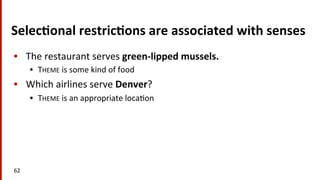
61	
  
Selec$onal	
  restric$ons	
  are	
  associated	
  with	
  senses	
  
•  The	
  restaurant	
  serves	
  green-­‐lipped	
  mussels.	
  	
  
•  THEME	
  is	
  some	
  kind	
  of	
  food	
  
•  Which	
  airlines	
  serve	
  Denver?	
  	
  
•  THEME	
  is	
  an	
  appropriate	
  loca(on	
  
62	
  
Selec$onal	
  restric$ons	
  vary	
  in	
  specificity	
  
I	
  ocen	
  ask	
  the	
  musicians	
  to	
  imagine	
  a	
  tennis	
  game.	
  
To	
  diagonalize	
  a	
  matrix	
  is	
  to	
  find	
  its	
  eigenvalues.	
  	
  
Radon	
  is	
  an	
  odorless	
  gas	
  that	
  can’t	
  be	
  detected	
  by	
  human	
  senses.	
  	
  
63	
  
Represen$ng	
  selec$onal	
  restric$ons	
  
t consists of a single variable that stands for the event, a predicat
f event, and variables and relations for the event roles. Ignoring t
ctures and using thematic roles rather than deep event roles, the
on of a verb like eat might look like the following:
9e,x,y Eating(e)^Agent(e,x)^Theme(e,y)
representation, all we know about y, the filler of the THEME ro
iated with an Eating event through the Theme relation. To sti
l restriction that y must be something edible, we simply add a ne
:
9e,x,y Eating(e)^Agent(e,x)^Theme(e,y)^EdibleThing(y)64	
  
ntribution of a verb like eat might look like the following:
9e,x,y Eating(e)^Agent(e,x)^Theme(e,y)
th this representation, all we know about y, the filler of the THEME role, is th
s associated with an Eating event through the Theme relation. To stipulate t
ectional restriction that y must be something edible, we simply add a new term
t effect:
9e,x,y Eating(e)^Agent(e,x)^Theme(e,y)^EdibleThing(y)
= dish
= nutriment, nourishment, nutrition...
= food, nutrient
= substance
= matter
= physical entity
= entity
Figure 22.6 Evidence from WordNet that hamburgers are edible.
When a phrase like ate a hamburger is encountered, a semantic analyzer can
form the following kind of representation:
9e,x,y Eating(e)^Eater(e,x)^Theme(e,y)^EdibleThing(y)^Hamburger(y)
This representation is perfectly reasonable since the membership of y in the category
Hamburger is consistent with its membership in the category EdibleThing, assuming
Instead	
  of	
  represen(ng	
  “eat”	
  as:	
  
Just	
  add:	
  
And	
  “eat	
  a	
  hamburger”	
  becomes	
  
But	
  this	
  assumes	
  we	
  have	
  a	
  large	
  knowledge	
  base	
  of	
  facts	
  
about	
  edible	
  things	
  and	
  hamburgers	
  and	
  whatnot.	
  
Let’s	
  use	
  WordNet	
  synsets	
  to	
  specify	
  
selec$onal	
  restric$ons	
  
•  The	
  THEME	
  of	
  eat	
  must	
  be	
  WordNet	
  synset	
  {food,	
  nutrient}	
  	
  
“any	
  substance	
  that	
  can	
  be	
  metabolized	
  by	
  an	
  animal	
  to	
  give	
  energy	
  and	
  build	
  8ssue”	
  
•  Similarly	
  
THEME	
  of	
  imagine:	
  synset	
  {en(ty}	
  
THEME	
  of	
  liY:	
  synset	
  {physical	
  en(ty}	
  
THEME	
  of	
  diagonalize:	
  synset	
  {matrix}	
  	
  
•  This	
  allows	
  
imagine	
  a	
  hamburger	
  	
  and	
  	
  liY	
  a	
  hamburger,	
  	
  
•  Correctly	
  rules	
  out	
  	
  
diagonalize	
  a	
  hamburger.	
  	
  65	
  
Semantic Role
Labeling
Conclusions	
  
Seman$c	
  Roles	
  
•  Seman$c	
  roles	
  are	
  abstract	
  representa$ons	
  of	
  the	
  role	
  that	
  an	
  
argument	
  plays	
  in	
  the	
  event	
  described	
  by	
  the	
  predicate.	
  
•  Thema(c	
  roles	
  are	
  a	
  model	
  of	
  seman(c	
  roles	
  based	
  on	
  a	
  single	
  
finite	
  list	
  of	
  roles.	
  	
  
•  Other	
  seman(c	
  role	
  models	
  include:	
  	
  
•  per-­‐verb	
  seman(c	
  role	
  lists	
  and	
  proto-­‐agent/proto-­‐pa(ent,	
  both	
  are	
  
implemented	
  in	
  PropBank;	
  
•  per-­‐frame	
  role	
  lists,	
  implementd	
  in	
  FrameNet.	
  
67	
  
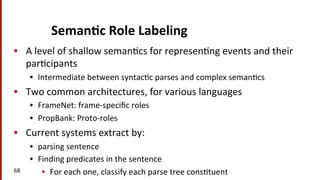
Seman$c	
  Role	
  Labeling	
  
•  A	
  level	
  of	
  shallow	
  seman(cs	
  for	
  represen(ng	
  events	
  and	
  their	
  
par(cipants	
  
•  Intermediate	
  between	
  syntac(c	
  parses	
  and	
  complex	
  seman(cs	
  
•  Two	
  common	
  architectures,	
  for	
  various	
  languages	
  
•  FrameNet:	
  frame-­‐specific	
  roles	
  
•  PropBank:	
  Proto-­‐roles	
  
•  Current	
  systems	
  extract	
  by:	
  	
  
•  parsing	
  sentence	
  
•  Finding	
  predicates	
  in	
  the	
  sentence	
  
•  For	
  each	
  one,	
  classify	
  each	
  parse	
  tree	
  cons(tuent	
  68	
  
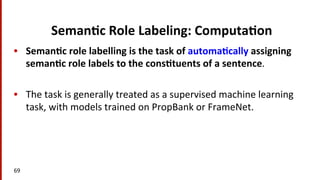
Seman$c	
  Role	
  Labeling:	
  Computa$on	
  
•  Seman$c	
  role	
  labelling	
  is	
  the	
  task	
  of	
  automa$cally	
  assigning	
  
seman$c	
  role	
  labels	
  to	
  the	
  cons$tuents	
  of	
  a	
  sentence.	
  
•  The	
  task	
  is	
  generally	
  treated	
  as	
  a	
  supervised	
  machine	
  learning	
  
task,	
  with	
  models	
  trained	
  on	
  PropBank	
  or	
  FrameNet.	
  	
  
69	
  
Selec$onal	
  Restric$ons	
  
•  Seman(c	
  selec(onal	
  restric(ons	
  allow	
  words	
  to	
  seman(c	
  
constraints	
  on	
  the	
  seman(c	
  proper(es	
  of	
  their	
  argument	
  words.	
  
•  Help	
  stem	
  ambiguity	
  	
  
70	
  
How	
  is	
  *meaning*	
  handled	
  in	
  Seman$c-­‐Based	
  LT-­‐
Applica$ons	
  (1)	
  
•  Seman(c	
  Role	
  Labelling/Predicate-­‐Argument	
  Structure	
  (???)	
  
Current	
  trend	
  
•  ???	
  à	
  a)	
  crea(on	
  of	
  annotated	
  resources	
  (PropBank,	
  FrameNet,	
  
etc.);	
  b)	
  use	
  of	
  supervised	
  machine	
  learning:	
  classifiers	
  are	
  
trained	
  on	
  annotated	
  resources,	
  such	
  as	
  PropBank	
  and	
  
FrameNet.	
  	
  
Lecture	
  2:	
  Computa(onal	
  Seman(cs	
  71	
  
Reminder:	
  Glossary	
  Entries	
  
•  Which	
  concepts/terms	
  are	
  the	
  most	
  salient	
  in	
  this	
  lecture?	
  
•  Add	
  them	
  up	
  to	
  your	
  Glossary	
  …	
  
Lecture	
  2:	
  Computa(onal	
  Seman(cs	
  72	
  
The	
  End	


Lecture	
  2:	
  Computa(onal	
  Seman(cs	
  73	
  

Semantic Role Labeling

  • 1.
    Seman&c  Analysis  in  Language  Technology   http://stp.lingfil.uu.se/~santinim/sais/2016/sais_2016.htm 
 
 Semantic Role Labelling
 Marina  San(ni   san$nim@stp.lingfil.uu.se     Department  of  Linguis(cs  and  Philology   Uppsala  University,  Uppsala,  Sweden     Spring  2016     1  
  • 2.
    Previous  Lecture  (I)   •  Intelligent  systems/applica(ons  should  ”understand”   natural  language  and  act.     •  They  must  understand  the  meaning,  ie  create  a  link   between  words  and  the  world   •  In  order  to  do  so:   •  formalize  meaning    representa(on     •  check  against  facts  in  the  world   •  make  inferences  (reasoning)   2   LOGIC  
  • 3.
    Previous  Lecture  (ii)   3   Propos(onal  logic   (Aristotle  from  IV  BC  to   XiX  sec.)   Predicate  Logic/FOL/ lambda  calculus   (Montague,  70s)   Unifica(on  (LFG,   HSPG,  70s)   Assump(on:  Meaning  is  composi(onal     Cf:  turkey  sandwich  vs.  kick  the  bucket   Aside:  WiYegenstein   Tractatus  Logico-­‐Philosophicus  (1921):  language  is  logic    Philosophical  Inves(ga(ons  (posthumous  1953):  language  is  use:  words   are  like  handles,  they  all  look  similar,  but  their  func8on  is  different.  
  • 4.
    Previous  Lecture  (iii)   •  Natural  Language  is  not  only  LOGIC   •  Logical  grammars  and  composi(onality    are  not  enough   •  Speaker’s  knowledge  about  the  world  can  hardly  be  packed  in  a  KB   •  There  are  pa?erns  of  use  and  reasoning  that  cannot  be  accouted  for  by   logic   •  unique  insights  given  by  large  corpora/resources  of  linguis$c  evidence  4   Logic  is  beau(ful,  but…  it  is  top-­‐down:  you   must  know  in  advance  what  is  ”well-­‐formed”…   cf  the  language  used  in  the  social  networks:  is   it  well-­‐formed  and  predictable?    
  • 5.
    Semantic Role Labeling Acknowledgements:   Most  slides  borrowed  from:   Speech  and  Language  Processing  (3rd  ed.  drac)   Dan  Jurafsky  and  James  H.  Mar(n   Original  version  by  J&M  can  be  found  here:     hYps://web.stanford.edu/~jurafsky/slp3/slides/22_SRL.pdf   hYps://web.stanford.edu/~jurafsky/slp3/slides/22_select.pdf     Other  slides  inspired  by  many  …    
  • 6.
  • 7.
    Ques$on  1   • What  is  a  seman(c  role  (nlp  course,  seman(cs  course)   7  
  • 8.
    Seman$c  Role  Labeling   Applications  Question & answer systems Who did what to whom at where? The police officer detained the suspect at the scene of the crime ARG0 ARG2 AM-locV Agent   Theme  Predicate   Loca(on  
  • 9.
    Can  we  figure  out  that  these  have  the   same  meaning?   •  XYZ  corpora(on  bought  the  stock.   •  They  sold  the  stock  to  XYZ  corpora(on.   •  The  stock  was  bought  by  XYZ  corpora(on.   •  The  purchase  of  the  stock  by  XYZ   corpora(on...     •  The  stock  purchase  by  XYZ  corpora(on...     9  
  • 10.
    A  Shallow  Seman$c  Representa$on:   Seman$c  Roles   •  Predicates  (bought,  sold,  purchase)  represent  an  event   •  Seman$c  roles  express  the  abstract  role  that  arguments  of   a  predicate  can  take  in  the  event   10   buyer   proto-­‐agent  agent   More  specific   More  general  
  • 11.
    Answer  1:   • Seman(c  roles  are  representa(ons  that  express  the  abstrat  role   that  arguments  of  a  predicate  can  take  in  an  event.   11  
  • 12.
  • 13.
    GePng  to  seman$c  roles   Neo-­‐Davidsonian  event  representa(on:     Sasha  broke  the  window   Pat  opened  the  door     Subjects  of  break  and  open:  Breaker  and  Opener   Deep  roles  specific  to  each  event  (breaking,  opening)   Hard  to  reason  about  them  for  NLU  applica(ons  like  QA   1 3   GOAL The destination of an object of a transfer event Figure 22.1 Some commonly used thematic roles with their definitions. (22.1) Sasha broke the window. (22.2) Pat opened the door. A neo-Davidsonian event representation of these two sentences w 9e,x,y Breaking(e)^Breaker(e,Sasha) ^BrokenThing(e,y)^Window(y) 9e,x,y Opening(e)^Opener(e,Pat) ^OpenedThing(e,y)^Door(y) In this representation, the roles of the subjects of the verbs break Breaker and Opener respectively. These deep roles are specific to eachdeep roles ing events have Breakers, Opening events have Openers, and so on. If we are going to be able to answer questions, perform inferen further kinds of natural language understanding of these events, we’ll
  • 14.
    Thema$c  roles   • Breaker  and  Opener  have  something  in  common!   •  Voli(onal  actors   •  Ocen  animate   •  Direct  causal  responsibility  for  their  events   •  Thema(c  roles  are  a  way  to  capture  this  seman(c  commonality   between  Breakers  and  Openers.     •  They  are  both  AGENTS.     •  The  BrokenThing  and  OpenedThing,  are  THEMES.   •  prototypically  inanimate  objects  affected  in  some  way  by  the  ac(on  14  
  • 15.
    Thema$c  roles   • One  of  the  oldest  linguis(c  models   •  Indian  grammarian  Panini  between  the  7th  and  4th  centuries  BCE     •  Modern  formula(on  from  Fillmore  (1966,1968),  Gruber  (1965)   •  Fillmore  influenced  by  Lucien  Tesnière’s  (1959)  Éléments  de  Syntaxe   Structurale,  the  book  that  introduced  dependency  grammar   •  Fillmore  first  referred  to  roles  as  actants  (Fillmore,  1966)  but  switched  to   the  term  case   15  
  • 16.
    Thema$c  roles   • A  typical  set:   16   R 22 • SEMANTIC ROLE LABELING Thematic Role Definition AGENT The volitional causer of an event EXPERIENCER The experiencer of an event FORCE The non-volitional causer of the event THEME The participant most directly affected by an event RESULT The end product of an event CONTENT The proposition or content of a propositional event INSTRUMENT An instrument used in an event BENEFICIARY The beneficiary of an event SOURCE The origin of the object of a transfer event GOAL The destination of an object of a transfer event Figure 22.1 Some commonly used thematic roles with their definitions. (22.1) Sasha broke the window. (22.2) Pat opened the door. 22.2 • DIATHESIS ALTERNATIONS 3 Thematic Role Example AGENT The waiter spilled the soup. EXPERIENCER John has a headache. FORCE The wind blows debris from the mall into our yards. THEME Only after Benjamin Franklin broke the ice... RESULT The city built a regulation-size baseball diamond... CONTENT Mona asked “You met Mary Ann at a supermarket?” INSTRUMENT He poached catfish, stunning them with a shocking device... BENEFICIARY Whenever Ann Callahan makes hotel reservations for her boss... SOURCE I flew in from Boston. GOAL I drove to Portland. Figure 22.2 Some prototypical examples of various thematic roles. 22.2 Diathesis Alternations The main reason computational systems use semantic roles is to act as a shallow
  • 17.
    Thema$c  grid,  case  frame,  θ-­‐grid   earlier examples, if a document says that Company A acquired Company B, we’d like to know that this answers the query Was Company B acquired? despite the fact that the two sentences have very different surface syntax. Similarly, this shallow semantics might act as a useful intermediate language in machine translation. Semantic roles thus help generalize over different surface realizations of pred- icate arguments. For example, while the AGENT is often realized as the subject of the sentence, in other cases the THEME can be the subject. Consider these possible realizations of the thematic arguments of the verb break: (22.3) John AGENT broke the window. THEME (22.4) John AGENT broke the window THEME with a rock. INSTRUMENT (22.5) The rock INSTRUMENT broke the window. THEME (22.6) The window THEME broke. (22.7) The window THEME was broken by John. AGENT These examples suggest that break has (at least) the possible arguments AGENT,17   thematic grid, case frame, θ-grid Break: AGENT, THEME, INSTRUMENT. AGENT THEME (22.4) John AGENT broke the window THEME with a rock. INSTRUMENT (22.5) The rock INSTRUMENT broke the window. THEME (22.6) The window THEME broke. (22.7) The window THEME was broken by John. AGENT These examples suggest that break has (at least) the possible a THEME, and INSTRUMENT. The set of thematic role arguments often called the thematic grid, q-grid, or case frame. We canthematic grid case frame (among others) the following possibilities for the realization of t break: AGENT/Subject, THEME/Object AGENT/Subject, THEME/Object, INSTRUMENT/PPwith INSTRUMENT/Subject, THEME/Object THEME/Subject It turns out that many verbs allow their thematic roles to be syntactic positions. For example, verbs like give can realize the arguments in two different ways: Example  usages  of  “break”   Some  realiza(ons:  
  • 18.
    Diathesis  alterna$ons  (or  verb  alterna$on)   Da$ve  alterna$on:  par(cular  seman(c  classes  of  verbs,  “verbs  of  future   having”  (advance,  allocate,  offer,  owe),  “send  verbs”  (forward,  hand,  mail),   “verbs  of  throwing”  (kick,  pass,  throw),  etc.   Levin  (1993):  47  seman(c  classes  (“Levin  classes”)  for  3100  English  verbs  and   alterna(ons.  In  online  resource  VerbNet.   18   MANTIC ROLE LABELING a. Doris AGENT gave the book THEME to Cary. GOAL b. Doris AGENT gave Cary GOAL the book. THEME multiple argument structure realizations (the fact that break can take AGENT, NT, or THEME as subject, and give can realize its THEME and GOAL in ) are called verb alternations or diathesis alternations. The alternation above for give, the dative alternation, seems to occur with particular se- ses of verbs, including “verbs of future having” (advance, allocate, offer, d verbs” (forward, hand, mail), “verbs of throwing” (kick, pass, throw), Break: AGENT, INSTRUMENT, or THEME as subject Give: THEME and GOAL in either order   dī-­‐ˈa-­‐thə-­‐səs  :    hYp://www.wordhippo.com/what-­‐is/how-­‐do-­‐you-­‐pronounce-­‐the-­‐word/diathesis.html     hYps://www.youtube.com/watch?v=x7NVanW_uRc    //  hYps://www.youtube.com/watch?v=2qbwUqhcaiU    
  • 19.
    Problems  with  Thema$c  Roles   Hard  to  create  standard  set  of  roles  or  formally  define  them   Ocen  roles  need  to  be  fragmented  to  be  defined.   Levin  and  Rappaport  Hovav  (2015):  two  kinds  of  INSTRUMENTS   intermediary  instruments  that  can  appear  as  subjects     The  cook  opened  the  jar  with  the  new  gadget.     The  new  gadget  opened  the  jar.     enabling  instruments  that  cannot   Shelly  ate  the  sliced  banana  with  a  fork.     *The  fork  ate  the  sliced  banana.     19  
  • 20.
    Alterna$ves  to  thema$c  roles   1.  Fewer  roles:  generalized  seman(c  roles,  defined  as   prototypes  (Dowty  1991)   PROTO-­‐AGENT     PROTO-­‐PATIENT       2.  More  roles:  Define  roles  specific  to  a  group  of  predicates   20   FrameNet   PropBank  
  • 21.
    What  is  predicate-­‐argument  structure:  Defini$on   •  "Thus  argument  structure  is  an  interface  between  the  seman8cs   and  syntax  of  predicators  (which  we  may  take  to  be  verbs  in  the   general  case)...  Argument  structure  encodes  lexical  informa8on   about  the  number  of  arguments,  their  syntac8c  type,  and  their   hierarchical  organiza8on  necessary  for  the  mapping  to  syntac8c   structure."  (Bresnan  2001:304)   21  
  • 22.
    What’s  a  predicate-­‐argument  structure   •  A  predicate  and  its  arguments  form  a  predicate-­‐argument   structure.     •  An  argument  is  an  expression  that  helps  complete  the  meaning   of  a  predicate   •  Most  predicates  take  one,  two,  or  three  arguments.     22  
  • 23.
    In  other  words…     •  Argument  structure  (valency/valence)  is  the  study  of  the  arguments   taken  by  expressions.     •  An  expression  taking  an  argument  is  called  a  predicate  (it  can  be  a   verb,  but  also  a  noun  etc.  see  NounBank)   •  A  predicate  (eg  a  verb)  takes  a  number  of  arguments.   •  An  argument  can  itself  be  an  predicate.   •  Seman$c  roles  are  descrip$ons  of  the  seman$c  rela$on  between   predicate  and  its  arguments.     •  Gramma(cal  rela(ons  are  descrip(ons  of  the  syntac(c  proper(es  of   an  argument   •  (thx  to  Andrew  McIn(re)  23  
  • 24.
    Elements  of  the  argument  structure   •  An  argument  structure  typically  indicates:   •  the  number  of  arguments  a  lexical  item  takes,     •  their  syntac(c  expression,     •  their  seman(c  rela(on  to  this  lexical  item     Beth  Levin  (Oxford  Bibliography     (hYp://www.oxfordbibliographies.com/view/document/obo-­‐9780199772810/obo-­‐9780199772810-­‐0099.xml  )   24  
  • 25.
    Lexical  level   • Argument  structure  is  a  lexical  level  of  informa(on  in  that  it   ignores  syntac(c-­‐func(on-­‐changing  opera(ons  such  as   passiviza(on.     25  
  • 26.
    The  following  examples  have  different  surface-­‐syntac(c  gramma(cal  rela(ons,   but  the  same  argument  structure:     open  can  take  3  arguments,  which  in  terms  of  seman(c  roles:  agent,  theme  and   instrument   (i)  John  opened  Bill's  door  (with  his  key)    John's  key  opened  Bill's  door    Bill's  door  opened    Bill's  door  was  opened  (by  John)   (ii)    a:    OPEN(John  door  key)                          |    |              |      Agent  Theme  Instrument   •             b:    OPEN                <Ag,  Th,  Instr>  26  
  • 27.
    In  summary:     •  Argument  structure  is  generally  seen  as  intermediate  between   seman(c-­‐role  structure  and  syntac(c-­‐func(on  structure.     27  
  • 28.
    Arguments  and  Adjuncts/Modifiers     •  Arguments  must  be  dis(nguished  from  adjuncts.  While  a   predicate  needs  its  arguments  to  complete  its  meaning,  the   adjuncts  that  appear  with  a  predicate  are  op(onal;  they  are  not   necessary  to  complete  the  meaning  of  the  predicate  (wikipedia).   •  Jill  really  likes  Jack.   •  Jill  likes  Jack  most  of  the  $me.   •  Jill  likes  Jack  when  the  sun  shines.   •  Jill  likes  Jack  because  he's  friendly.  28  
  • 29.
  • 30.
    PropBank   •  Palmer,  Martha,  Daniel  Gildea,  and  Paul  Kingsbury.  2005.  The   Proposi(on  Bank:  An  Annotated  Corpus  of  Seman(c  Roles.   Computa8onal  Linguis8cs,  31(1):71–106     30  
  • 31.
    PropBank  Roles   Proto-­‐Agent   •  Voli(onal  involvement  in  event  or  state   •  Sen(ence  (and/or  percep(on)   •  Causes  an  event  or  change  of  state  in  another  par(cipant     •  Movement  (rela(ve  to  posi(on  of  another  par(cipant)   Proto-­‐Pa(ent   •  Undergoes  change  of  state   •  Causally  affected  by  another  par(cipant   •  Sta(onary  rela(ve  to  movement  of  another  par(cipant    31   Following Dowty 1991
  • 32.
    PropBank  Roles   • Following  Dowty  1991   •  Role  defini(ons  determined  verb  by  verb,  with  respect  to  the  other  roles     •  Seman(c  roles  in  PropBank  are  thus  verb-­‐sense  specific.   •  Each  verb  sense  has  numbered  argument:  Arg0,  Arg1,  Arg2,…   Arg0:  PROTO-­‐AGENT   Arg1:  PROTO-­‐PATIENT   Arg2:  usually:  benefac(ve,  instrument,  aYribute,  or  end  state   Arg3:  usually:  start  point,  benefac(ve,  instrument,  or  aYribute   Arg4  the  end  point   (Arg2-­‐Arg5  are  not  really  that  consistent,  causes  a  problem  for  labeling)  32  
  • 33.
    PropBank  Frame  Files   33   definitions. (22.11) agree.01 Arg0: Agreer Arg1: Proposition Arg2: Other entity agreeing Ex1: [Arg0 The group] agreed [Arg1 it wouldn’t make an offer]. Ex2: [ArgM-TMP Usually] [Arg0 John] agrees [Arg2 with Mary] [Arg1 on everything]. (22.12) fall.01 Arg1: Logical subject, patient, thing falling Arg2: Extent, amount fallen Arg3: start point Arg4: end point, end state of arg1 Ex1: [Arg1 Sales] fell [Arg4 to $25 million] [Arg3 from $27 million]. Ex2: [Arg1 The average junk bond] fell [Arg2 by 4.2%]. (22.11) agree.01 Arg0: Agreer Arg1: Proposition Arg2: Other entity agreeing Ex1: [Arg0 The group] agreed [Arg1 it wouldn’t make an offer]. Ex2: [ArgM-TMP Usually] [Arg0 John] agrees [Arg2 with Mary] [Arg1 on everything]. (22.12) fall.01 Arg1: Logical subject, patient, thing falling Arg2: Extent, amount fallen Arg3: start point Arg4: end point, end state of arg1 Ex1: [Arg1 Sales] fell [Arg4 to $25 million] [Arg3 from $27 million]. Ex2: [Arg1 The average junk bond] fell [Arg2 by 4.2%]. ???:  what  is  a  word   sense?  Examples?  
  • 34.
    Advantage  of  a  ProbBank  Labeling  The PropBank semantic roles can be useful in recovering shallow formation about verbal arguments. Consider the verb increase: (22.13) increase.01 “go up incrementally” Arg0: causer of increase Arg1: thing increasing Arg2: amount increased by, EXT, or MNR Arg3: start point Arg4: end point A PropBank semantic role labeling would allow us to infer the c the event structures of the following three examples, that is, that in Fruit Co. is the AGENT and the price of bananas is the THEME, despi surface forms. (22.14) [Arg0 Big Fruit Co. ] increased [Arg1 the price of bananas].34   The PropBank semantic roles can be useful in recovering shallow semantic in- formation about verbal arguments. Consider the verb increase: (22.13) increase.01 “go up incrementally” Arg0: causer of increase Arg1: thing increasing Arg2: amount increased by, EXT, or MNR Arg3: start point Arg4: end point A PropBank semantic role labeling would allow us to infer the commonality in the event structures of the following three examples, that is, that in each case Big Fruit Co. is the AGENT and the price of bananas is the THEME, despite the differing surface forms. (22.14) [Arg0 Big Fruit Co. ] increased [Arg1 the price of bananas]. (22.15) [Arg1 The price of bananas] was increased again [Arg0 by Big Fruit Co. ] (22.16) [Arg1 The price of bananas] increased [Arg2 5%]. This  would  allow  us  to  see  the  commonali(es  in  these  3  sentences:  
  • 35.
    Modifiers  or  adjuncts  of  the  predicate:   Arg-­‐M   Arg1 Arg2 PropBank also has a number of non-numbered arguments called ArgMs, (ArgM- TMP, ArgM-LOC, etc) which represent modification or adjunct meanings. These are relatively stable across predicates, so aren’t listed with each frame file. Data labeled with these modifiers can be helpful in training systems to detect temporal, location, or directional modification across predicates. Some of the ArgM’s include: TMP when? yesterday evening, now LOC where? at the museum, in San Francisco DIR where to/from? down, to Bangkok MNR how? clearly, with much enthusiasm PRP/CAU why? because ... , in response to the ruling REC themselves, each other ADV miscellaneous PRD secondary predication ...ate the meat raw While PropBank focuses on verbs, a related project, NomBank (Meyers et al., 2004) adds annotations to noun predicates. For example the noun agreement in Apple’s agreement with IBM would be labeled with Apple as the Arg0 and IBM as the Arg2. This allows semantic role labelers to assign labels to arguments of both35   ArgM-
  • 36.
    Plus  nouns  and  light  verbs  English Noun and LVC annotation !  Example Noun: Decision !  Roleset:Arg0: decider,Arg1: decision… !  “…[yourARG0] [decisionREL] [to say look I don't want to go through this anymoreARG1]” !  Example within an LVC: Make a decision !  “…[the PresidentARG0] [madeREL-LVB] the [fundamentally correctARGM-ADJ] [decisionREL] [to get on offenseARG1]” 36   Slide  from  Palmer  2013  
  • 37.
    Ques$ons  2   • Which  LT-­‐based  applica(ons  can  benefit  from  the  kind  of   abstrac(on  provided  by  seman(c  role  annota(on?   •  Why?   37  
  • 38.
    As  2:   • Ques(on  answering   •  Informa(on  extrac(on   •  Machine  translate   •  NL  understanding   •  […]   •  Because    sema(c  roles  allow  us  to  capture  the  seman(c   commonalites  underlying  different  surface  syntac(c   representa(ons.  38  
  • 39.
  • 40.
    Capturing  descrip$ons  of  the  same  event   by  different  nouns/verbs   While making inferences about the semantic commonalities across different sen- tences with increase is useful, it would be even more useful if we could make such inferences in many more situations, across different verbs, and also between verbs and nouns. For example, we’d like to extract the similarity among these three sen- tences: (22.17) [Arg1 The price of bananas] increased [Arg2 5%]. (22.18) [Arg1 The price of bananas] rose [Arg2 5%]. (22.19) There has been a [Arg2 5%] rise [Arg1 in the price of bananas]. Note that the second example uses the different verb rise, and the third example uses the noun rather than the verb rise. We’d like a system to recognize that the 40  
  • 41.
    FrameNet   •  Baker  et  al.  1998,  Fillmore  et  al.  2003,  Fillmore  and  Baker  2009,   Ruppenhofer  et  al.  2006     •  Roles  in  PropBank  are  specific  to  a  verb   •  Role  in  FrameNet  are  specific  to  a  frame:  a  background   knowledge  structure  that  defines  a  set  of  frame-­‐specific   seman(c  roles,  called  frame  elements,     •  includes  a  set  of  predicates  that  use  these  roles   •  each  word  evokes  a  frame  and  profiles  some  aspect  of  the  frame   41  
  • 42.
    The  “Change  posi$on  on  a  scale”  Frame   This  frame  consists  of  words  that  indicate  the  change  of  an  ITEM’s   posi(on  on  a  scale  (the  ATTRIBUTE)  from  a  star(ng  point  (INITIAL   VALUE)  to  an  end  point  (FINAL  VALUE)   42   sentences. For example, the change position on a scale frame is defined as follows: This frame consists of words that indicate the change of an Item’s posi- tion on a scale (the Attribute) from a starting point (Initial value) to an end point (Final value). Some of the semantic roles (frame elements) in the frame are defined as in Fig. 22.3. Note that these are separated into core roles, which are frame specific, andCore roles non-core roles, which are more like the Arg-M arguments in PropBank, expressedNon-core roles more general properties of time, location, and so on. Here are some example sentences: (22.20) [ITEM Oil] rose [ATTRIBUTE in price] [DIFFERENCE by 2%]. (22.21) [ITEM It] has increased [FINAL STATE to having them 1 day a month]. (22.22) [ITEM Microsoft shares] fell [FINAL VALUE to 7 5/8]. (22.23) [ITEM Colon cancer incidence] fell [DIFFERENCE by 50%] [GROUP among men]. (22.24) a steady increase [INITIAL VALUE from 9.5] [FINAL VALUE to 14.3] [ITEM in dividends] (22.25) a [DIFFERENCE 5%] [ITEM dividend] increase...
  • 43.
    The  “Change  posi$on  on  a  scale”  Frame   he GROUP in which an ITEM changes the value of an TTRIBUTE in a specified way. me elements in the change position on a scale frame from the FrameNe al., 2006). VERBS: dwindle move soar escalation shift advance edge mushroom swell explosion tumble climb explode plummet swing fall decline fall reach triple fluctuation ADVERBS: decrease fluctuate rise tumble gain increasingly diminish gain rocket growth dip grow shift NOUNS: hike double increase skyrocket decline increase drop jump slide decrease rise 43  
  • 44.
    8 CHAPTER 22• SEMANTIC ROLE LABELING Core Roles ATTRIBUTE The ATTRIBUTE is a scalar property that the ITEM possesses. DIFFERENCE The distance by which an ITEM changes its position on the scale. FINAL STATE A description that presents the ITEM’s state after the change in the ATTRIBUTE’s value as an independent predication. FINAL VALUE The position on the scale where the ITEM ends up. INITIAL STATE A description that presents the ITEM’s state before the change in the AT- TRIBUTE’s value as an independent predication. INITIAL VALUE The initial position on the scale from which the ITEM moves away. ITEM The entity that has a position on the scale. VALUE RANGE A portion of the scale, typically identified by its end points, along which the values of the ATTRIBUTE fluctuate. Some Non-Core Roles DURATION The length of time over which the change takes place. SPEED The rate of change of the VALUE. GROUP The GROUP in which an ITEM changes the value of an ATTRIBUTE in a specified way.44   The  “Change  posi$on  on  a  scale”  Frame  
  • 45.
    Rela$on  between  frames   Inherits  from:     Is  Inherited  by:   Perspec(ve  on:     Is  Perspec(vized  in:     Uses:     Is  Used  by:     Subframe  of:     Has  Subframe(s):     Precedes:     Is  Preceded  by:     Is  Inchoa(ve  of:     Is  Causa(ve  of:   45  
  • 46.
    Rela$on  between  frames:  what  is  the  implica$on?   46  
  • 47.
    A:   •  The  inference,  reasoning,  the  understanding  we  can  make  with   FrameNet  is  presumably  more  extended  than  the  reasoning   allowed  by  PropBank.   47  
  • 48.
    Semantic Role Labeling Seman(c  Role  Labeling   Algorithm  
  • 49.
    Seman$c  role  labeling  (SRL)     •  The  task  of  AUTOMATICALLY  finding  the  seman(c  roles  of  each   argument  of  each  predicate  in  a  sentence.   •  FrameNet  versus  PropBank:   49   22.6 • SEMANTIC ROLE LABELING 9 Recall that the difference between these two models of semantic roles is that FrameNet (22.27) employs many frame-specific frame elements as roles, while Prop- Bank (22.28) uses a smaller number of numbered argument labels that can be inter- preted as verb-specific labels, along with the more general ARGM labels. Some examples: (22.27) [You] can’t [blame] [the program] [for being unable to identify it] COGNIZER TARGET EVALUEE REASON (22.28) [The San Francisco Examiner] issued [a special edition] [yesterday] ARG0 TARGET ARG1 ARGM-TMP A simplified semantic role labeling algorithm is sketched in Fig. 22.4. While there are a large number of algorithms, many of them use some version of the steps in this algorithm.
  • 50.
    History   •  Seman(c  roles  as  a  intermediate  seman(cs,  used  early  in   •  machine  transla(on  (Wilks,  1973)   •  ques(on-­‐answering  (Hendrix  et  al.,  1973)   •  spoken-­‐language  understanding  (Nash-­‐Webber,  1975)   •  dialogue  systems  (Bobrow  et  al.,  1977)   •  Early  SRL  systems   Simmons  1973,  Marcus  1980:     •  parser  followed  by  hand-­‐wriYen  rules  for  each  verb   •  dic(onaries  with  verb-­‐specific  case  frames  (Levin  1977)     50  
  • 51.
    Why  Seman$c  Role  Labeling   •  A  useful  shallow  seman(c  representa(on   •  Improves  NLP  tasks  like:   •  ques(on  answering     Shen  and  Lapata  2007,  Surdeanu  et  al.  2011   •  machine  transla(on     Liu  and  Gildea  2010,  Lo  et  al.  2013   51  
  • 52.
    How  do  we  decide  what  is  a  predicate   •  If  we’re  just  doing  PropBank  verbs   •  Choose  all  verbs   •  If  we’re  doing  FrameNet  (verbs,  nouns,  adjec(ves)   •  Choose  every  word  that  was  labeled  as  a  target  in  training  data   52  
  • 53.
    Seman$c  Role  Labeling:  typical  set  of  basic  feature   (example)  10 CHAPTER 22 • SEMANTIC ROLE LABELING S NP-SBJ = ARG0 VP DT NNP NNP NNP The San Francisco Examiner VBD = TARGET NP = ARG1 PP-TMP = ARGM-TMP issued DT JJ NN IN NP a special edition around NN NP-TMP noon yesterday Figure 22.5 Parse tree for a PropBank sentence, showing the PropBank argument labels. The dotted line53   1.  Predicate:  issued   2.  Phrase  type:  NP,  etc.     3.  […]  
  • 54.
    Features   Headword  of  cons(tuent   Examiner   Headword  POS   NNP   Voice  of  the  clause   Ac(ve   Subcategoriza(on  of  pred   VP  -­‐>  VBD  NP  PP   54   S NP-SBJ = ARG0 VP DT NNP NNP NNP The San Francisco Examiner VBD = TARGET NP = ARG1 PP-TMP = ARGM-TMP issued DT JJ NN IN NP a special edition around NN NP-TMP noon yesterday Figure 22.5 Parse tree for a PropBank sentence, showing the PropBank argument labels. The dotted line shows the path feature NP"S#VP#VBD for ARG0, the NP-SBJ constituent The San Francisco Examiner. • The headword of the constituent, Examiner. The headword of a constituent can be computed with standard head rules, such as those given in Chapter 11 in Fig. ??. Certain headwords (e.g., pronouns) place strong constraints on the possible semantic roles they are likely to fill. • The headword part of speech of the constituent, NNP. • The path in the parse tree from the constituent to the predicate. This path is marked by the dotted line in Fig. 22.5. Following Gildea and Jurafsky (2000), we can use a simple linear representation of the path, NP"S#VP#VBD. " and # represent upward and downward movement in the tree, respectively. The path is very useful as a compact representation of many kinds of grammatical Named  En(ty  type  of  cons(t   ORGANIZATION   First  and  last  words  of  cons(t   The,  Examiner   Linear  posi(on,clause  re:  predicate  
  • 55.
    Path  Feature   Path  in  the  parse  tree  from  the  cons(tuent  to  the  predicate:  a   compact  and  “linear”  representa(on  of  the  rela(onship  between   the  cons(tuents  and  the  predicate.     55   10 CHAPTER 22 • SEMANTIC ROLE LABELING S NP-SBJ = ARG0 VP DT NNP NNP NNP The San Francisco Examiner VBD = TARGET NP = ARG1 PP-TMP = ARGM-TMP issued DT JJ NN IN NP a special edition around NN NP-TMP noon yesterday , NNP. o the predicate. This path is Gildea and Jurafsky (2000), path, NP"S#VP#VBD. " and n the tree, respectively. The f many kinds of grammatical d the predicate. appears, in this case, active end to have strongly different
  • 56.
    Frequent  path  features   The most common values of the path feature, along with interpretations, are shown in Ta- ble 3.1. Table 3.1: Most frequent values of path feature in the training data. Frequency Path Description 14.2% VB↑VP↓PP PP argument/adjunct 11.8 VB↑VP↑S↓NP subject 10.1 VB↑VP↓NP object 7.9 VB↑VP↑VP↑S↓NP subject (embedded VP) 4.1 VB↑VP↓ADVP adverbial adjunct 3.0 NN↑NP↑NP↓PP prepositional complement of noun 1.7 VB↑VP↓PRT adverbial particle 1.6 VB↑VP↑VP↑VP↑S↓NP subject (embedded VP) 14.2 no matching parse constituent 31.4 Other 56   From  Palmer,  Gildea,  Xue  2010  
  • 57.
    Final  feature  vector…   •  …  or  the  argument:  “The  San  Francisco  Examiner”,     •  Arg0,  [issued,  NP,  Examiner,  NNP,  ac8ve,  before,  VPàNP  PP,  ORG,   The,  Examiner,                                                                ]   •  Other  features  could  be  used  as  well   •  sets  of  n-­‐grams  inside  the  cons(tuent   •  other  path  features   •  the  upward  or  downward  halves   •  whether  par(cular  nodes  occur  in  the  path    57   d rules, such as those given in Chapter 11 pronouns) place strong constraints on the ely to fill. he constituent, NNP. constituent to the predicate. This path is .5. Following Gildea and Jurafsky (2000), tation of the path, NP"S#VP#VBD. " and movement in the tree, respectively. The resentation of many kinds of grammatical constituent and the predicate. he constituent appears, in this case, active e sentences tend to have strongly different e form than do active ones. 1.  Predicate   2.  Phrase  type   3.  Headword   4.  Headword  POS   5.  Voice   6.  Linear  posi(on  (with   respect  to  the  prdicate   7.  Subcategoriza(on  of  the   predicate   8.  Named  en(ty   9.  The  first  word  and  the   last  word   10.  The  path   S NP-SBJ = ARG0 VP DT NNP NNP NNP The San Francisco Examiner VBD = TARGET NP = ARG1 PP-TMP = ARGM-TMP issued DT JJ NN IN NP a special edition around NN NP-TMP noon yesterday Figure 22.5 Parse tree for a PropBank sentence, showing the PropBank argument labels. The dotted line shows the path feature NP"S#VP#VBD for ARG0, the NP-SBJ constituent The San Francisco Examiner. • The headword of the constituent, Examiner. The headword of a constituent can be computed with standard head rules, such as those given in Chapter 11 in Fig. ??. Certain headwords (e.g., pronouns) place strong constraints on the possible semantic roles they are likely to fill. • The headword part of speech of the constituent, NNP. • The path in the parse tree from the constituent to the predicate. This path is marked by the dotted line in Fig. 22.5. Following Gildea and Jurafsky (2000), we can use a simple linear representation of the path, NP"S#VP#VBD. " and # represent upward and downward movement in the tree, respectively. The path is very useful as a compact representation of many kinds of grammatical function relationships between the constituent and the predicate. • The voice of the clause in which the constituent appears, in this case, active (as contrasted with passive). Passive sentences tend to have strongly different linkings of semantic roles to surface form than do active ones. • The binary linear position of the constituent with respect to the predicate, either before or after. • The subcategorization of the predicate, the set of expected arguments that appear in the verb phrase. We can extract this information by using the phrase- structure rule that expands the immediate parent of the predicate; VP ! VBD NP PP for the predicate in Fig. 22.5. • The named entity type of the constituent. • The first words and the last word of the constituent. The following feature vector thus represents the first NP in our example (recall that most observations will have the value NONE rather than, for example, ARG0, since most constituents in the parse tree will not bear a semantic role): ARG0: [issued, NP, Examiner, NNP, NP"S#VP#VBD, active, before, VP ! NP PP, ORG, The, Examiner] Other features are often used in addition, such as sets of n-grams inside the
  • 58.
    Not  just  verbs:  NomBank     S ¨ ¨¨ ¨ ¨¨ r rr r rr NP (ARG0) ¨¨¨ rrr NNP Ben NNP Bernanke VP ¨ ¨¨ ¨¨ r rr rr VBD was VP ¨¨ ¨¨¨ rr rrr VBN (Support) nominated PP ¨¨ ¨¨¨ rr rrr IN as NP ¨ ¨¨¨ r rrr NP (ARG1) €€€ Greenspan ’s NN predicate replacement 2004) experimen tem developed us ually selected nom Penn Chinese Tr their system is no 3 Model train We treat the Nom sification problem argument identifi tion. During the 58   Meyers  et  al.  2004   Figure  from  Jiang  and  Ng  2006  
  • 59.
    Addi$onal  Issues  for  nouns   •  Features:   •  Nominaliza(on  lexicon  (employmentà  employ)   •  Morphological  stem   •  Healthcare,  Medicate  à  care   •  Different  posi(ons   •  Most  arguments  of  nominal  predicates  occur  inside  the  NP   •  Others  are  introduced  by  support  verbs   •  Especially  light  verbs    “X  made  an  argument”,  “Y  took  a  nap”     59  
  • 60.
  • 61.
    Selec$onal  Restric$ons   Consider  the  two  interpreta(ons  of:    I  want  to  eat  someplace  nearby.     a)  sensible:     Eat  is  intransi(ve  and  “someplace  nearby”  is  a  loca(on  adjunct   b)  Speaker  is  Godzilla:  a  monster  that  likes  ea(ng  buildings!!!            Eat  is  transi(ve  and  “someplace  nearby”  is  a  direct  object   How  do  we  know  speaker  didn’t  mean  b)    ?    Because  the  THEME  of  ea(ng  tends  to  be  something  edible   61  
  • 62.
    Selec$onal  restric$ons  are  associated  with  senses   •  The  restaurant  serves  green-­‐lipped  mussels.     •  THEME  is  some  kind  of  food   •  Which  airlines  serve  Denver?     •  THEME  is  an  appropriate  loca(on   62  
  • 63.
    Selec$onal  restric$ons  vary  in  specificity   I  ocen  ask  the  musicians  to  imagine  a  tennis  game.   To  diagonalize  a  matrix  is  to  find  its  eigenvalues.     Radon  is  an  odorless  gas  that  can’t  be  detected  by  human  senses.     63  
  • 64.
    Represen$ng  selec$onal  restric$ons   t consists of a single variable that stands for the event, a predicat f event, and variables and relations for the event roles. Ignoring t ctures and using thematic roles rather than deep event roles, the on of a verb like eat might look like the following: 9e,x,y Eating(e)^Agent(e,x)^Theme(e,y) representation, all we know about y, the filler of the THEME ro iated with an Eating event through the Theme relation. To sti l restriction that y must be something edible, we simply add a ne : 9e,x,y Eating(e)^Agent(e,x)^Theme(e,y)^EdibleThing(y)64   ntribution of a verb like eat might look like the following: 9e,x,y Eating(e)^Agent(e,x)^Theme(e,y) th this representation, all we know about y, the filler of the THEME role, is th s associated with an Eating event through the Theme relation. To stipulate t ectional restriction that y must be something edible, we simply add a new term t effect: 9e,x,y Eating(e)^Agent(e,x)^Theme(e,y)^EdibleThing(y) = dish = nutriment, nourishment, nutrition... = food, nutrient = substance = matter = physical entity = entity Figure 22.6 Evidence from WordNet that hamburgers are edible. When a phrase like ate a hamburger is encountered, a semantic analyzer can form the following kind of representation: 9e,x,y Eating(e)^Eater(e,x)^Theme(e,y)^EdibleThing(y)^Hamburger(y) This representation is perfectly reasonable since the membership of y in the category Hamburger is consistent with its membership in the category EdibleThing, assuming Instead  of  represen(ng  “eat”  as:   Just  add:   And  “eat  a  hamburger”  becomes   But  this  assumes  we  have  a  large  knowledge  base  of  facts   about  edible  things  and  hamburgers  and  whatnot.  
  • 65.
    Let’s  use  WordNet  synsets  to  specify   selec$onal  restric$ons   •  The  THEME  of  eat  must  be  WordNet  synset  {food,  nutrient}     “any  substance  that  can  be  metabolized  by  an  animal  to  give  energy  and  build  8ssue”   •  Similarly   THEME  of  imagine:  synset  {en(ty}   THEME  of  liY:  synset  {physical  en(ty}   THEME  of  diagonalize:  synset  {matrix}     •  This  allows   imagine  a  hamburger    and    liY  a  hamburger,     •  Correctly  rules  out     diagonalize  a  hamburger.    65  
  • 66.
  • 67.
    Seman$c  Roles   • Seman$c  roles  are  abstract  representa$ons  of  the  role  that  an   argument  plays  in  the  event  described  by  the  predicate.   •  Thema(c  roles  are  a  model  of  seman(c  roles  based  on  a  single   finite  list  of  roles.     •  Other  seman(c  role  models  include:     •  per-­‐verb  seman(c  role  lists  and  proto-­‐agent/proto-­‐pa(ent,  both  are   implemented  in  PropBank;   •  per-­‐frame  role  lists,  implementd  in  FrameNet.   67  
  • 68.
    Seman$c  Role  Labeling   •  A  level  of  shallow  seman(cs  for  represen(ng  events  and  their   par(cipants   •  Intermediate  between  syntac(c  parses  and  complex  seman(cs   •  Two  common  architectures,  for  various  languages   •  FrameNet:  frame-­‐specific  roles   •  PropBank:  Proto-­‐roles   •  Current  systems  extract  by:     •  parsing  sentence   •  Finding  predicates  in  the  sentence   •  For  each  one,  classify  each  parse  tree  cons(tuent  68  
  • 69.
    Seman$c  Role  Labeling:  Computa$on   •  Seman$c  role  labelling  is  the  task  of  automa$cally  assigning   seman$c  role  labels  to  the  cons$tuents  of  a  sentence.   •  The  task  is  generally  treated  as  a  supervised  machine  learning   task,  with  models  trained  on  PropBank  or  FrameNet.     69  
  • 70.
    Selec$onal  Restric$ons   • Seman(c  selec(onal  restric(ons  allow  words  to  seman(c   constraints  on  the  seman(c  proper(es  of  their  argument  words.   •  Help  stem  ambiguity     70  
  • 71.
    How  is  *meaning*  handled  in  Seman$c-­‐Based  LT-­‐ Applica$ons  (1)   •  Seman(c  Role  Labelling/Predicate-­‐Argument  Structure  (???)   Current  trend   •  ???  à  a)  crea(on  of  annotated  resources  (PropBank,  FrameNet,   etc.);  b)  use  of  supervised  machine  learning:  classifiers  are   trained  on  annotated  resources,  such  as  PropBank  and   FrameNet.     Lecture  2:  Computa(onal  Seman(cs  71  
  • 72.
    Reminder:  Glossary  Entries   •  Which  concepts/terms  are  the  most  salient  in  this  lecture?   •  Add  them  up  to  your  Glossary  …   Lecture  2:  Computa(onal  Seman(cs  72  
  • 73.
    The  End       Lecture  2:  Computa(onal  Seman(cs  73