Download to read offline
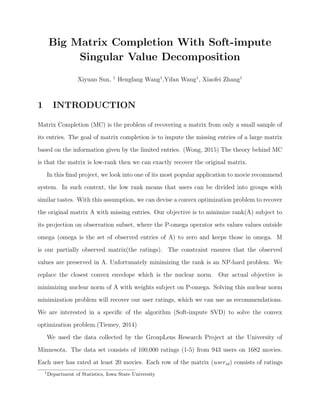

![When the matrix is sparse, larger problem can be solved but the computational cost depends
heavily upon the sparsity structure of the matrix. In general, one has to resort to indirect
iterative methods for calculating the leading singular vectors/values of a matrix.(Mazumder
et. al 2010)
We will use the PROPACK algorithm because of its low storage requirements, effective
flop count and its well documented MATLAB version. The algorithm for calculating the
truncated SVD for a matrix W. It becomes efficient if multiplication operations Wb1 and
W b2 (with b1 ∈ Rn
, b2 ∈ Rm
) can be done with minimal cost.(Mazumder et. al 2010)
Algorithm SOFT-IMPUTE requires repeated computation of a truncated SVD for a
matrix W. The cost of computing the truncated SVD will dependent upon the cost in the
operations Wb1 and W b2. The computational order of SOFT-IMPUTE and that of SVT is
the same. The computational cost of evaluating the truncated SVD (with rank r) is linear in
matrix dimensions. This justifies the large-scale computational feasibility of our algorithm.
In our small-scale experiments, we want to try some matrices with different sparsity
structure Numerical Experiments and Comparisons. We use the underlying model Zm×n =
Um×r ∗ Vr×n, where U and V are random matrices with standard normal Gaussian entries Ω
is uniformly random over the indices of the matrix with p% of missing entries these are the
models under which the coherence conditions hold true for the matrix completion problem
to be meaningful
The Training Error can be defined as
||Zold−Znew||2
F
||Zold||2
F
over the Ω set The fraction of the error
explained on the observed entries by the estimate relative to a zero estimate In different
scenarios, we change the dimension of the matrix (m,n) and missing rate p.
For SOFT-IMPUTE we consider a equi-spaced grid of 20 lambda in the range of
[λmin, λmax]. λmin is a full-rank solution of SOFT-IMPUTE. λmax is the zero solution. Here
we just simplified it to be from 1 to 20. (estimatedU , estimatedV ) were solved for over the
grid of λ values.
SOFT-IMPUTE was run untill a tolerance of 10−4
was achieved For every algorithm,
3](https://image.slidesharecdn.com/99e1cc4f-8112-4fa7-a877-c99e10b2c3d7-160810043054/85/Group-Project-3-320.jpg)






![mechanism in this method have no impact on the result. Every time, it achieves very similar
result. We also tried different tuning parameter in this method and find that it has very
little influence on the result.
References
Raymond K. W. and Thomas C.M. Lee (2015). Matrix Completion with Noisy Entries and
Outliers arXiv:0706.1234 [math.FA]
Hastie, T., Tibshirani, R., & Wainwright, M. (2015). Statistical Learning with Sparsity.
Mazumder, R., Hastie, T. and Tibshirani, R. (2010) Spectral regularization algorithms for
learning large incomplete matrices. Journal of Machine Learning Research, 11, 2287-
2322.
Tiemey, S. (2014, April 4). An Introduction to Matrix Completion. Retrieved May
2, 2016, from SJTRNY: http://sjtrny.com/posts/2014/4/4/an-introduction-to-matrix-
completion.html
15](https://image.slidesharecdn.com/99e1cc4f-8112-4fa7-a877-c99e10b2c3d7-160810043054/85/Group-Project-15-320.jpg)

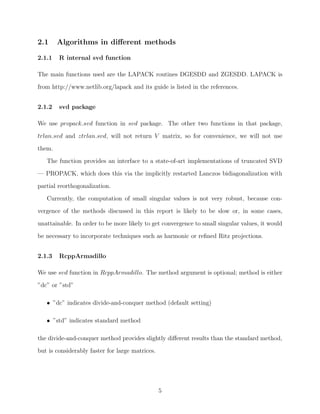
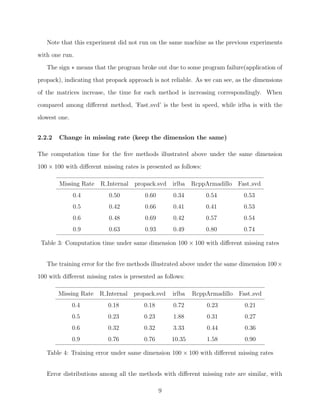
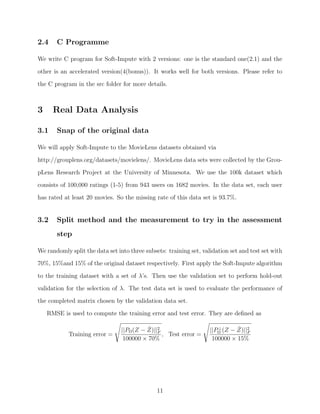
When comparing different methods for performing SVD in a matrix completion problem, the study found that the fast.svd method from the corpcor package was generally the most efficient, taking both computational time and accuracy into consideration. Across different matrix dimensions and missing data rates, fast.svd consistently had either the fastest runtime or was comparable to the fastest methods, while also having relatively low training error compared to other methods like irlba that had faster speeds but lower accuracy. When the matrix size was very small, the built-in R svd function performed best. But for larger matrices, fast.svd emerged as the best overall method.


