
Vishal Choudhary
vishalhim@yahoo.com
IOT –OPERATING SYSTEM
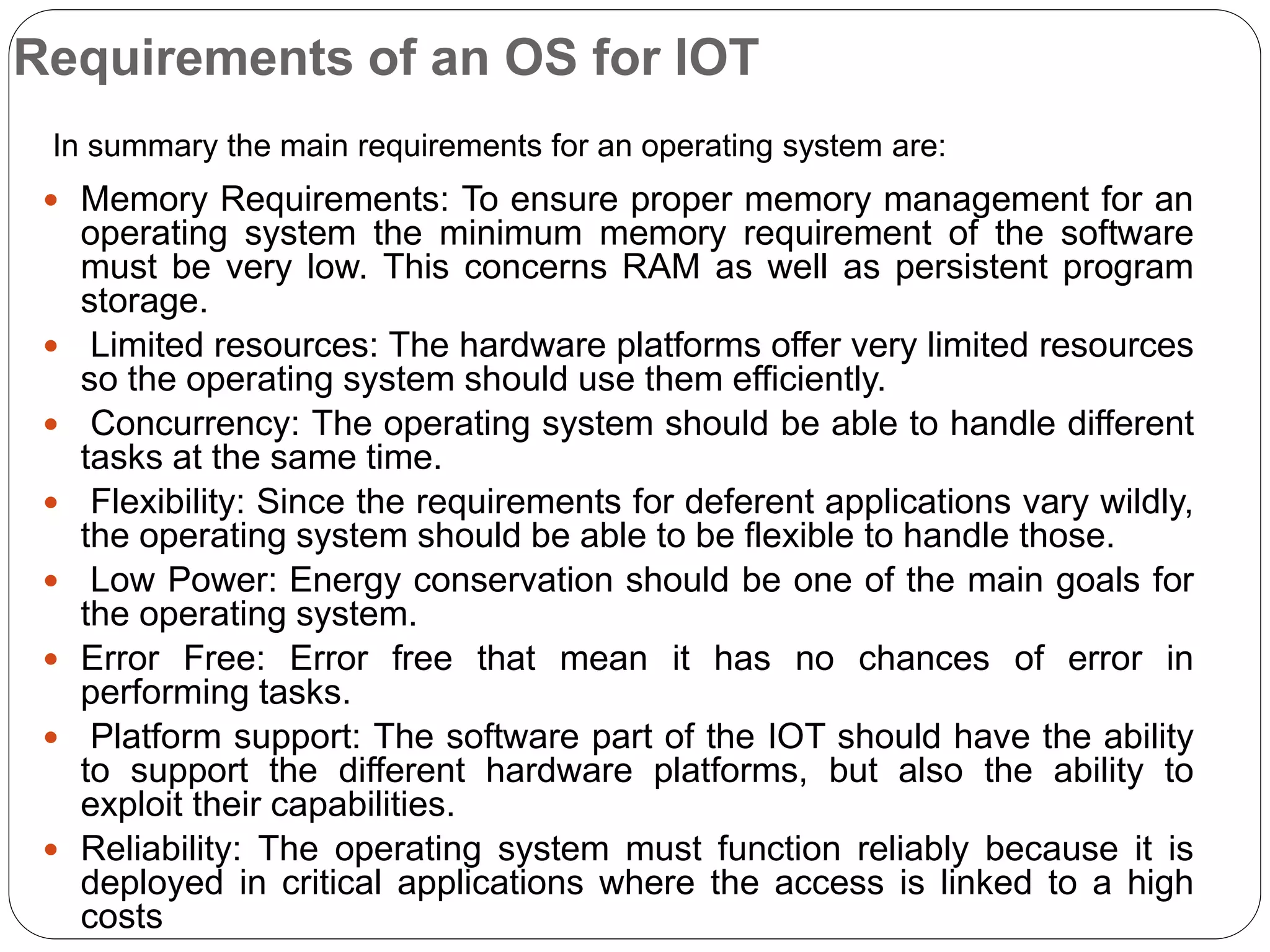
Requirements of an OS for IOT
 Memory Requirements: To ensure proper memory management for an
operating system the minimum memory requirement of the software
must be very low. This concerns RAM as well as persistent program
storage.
 Limited resources: The hardware platforms offer very limited resources
so the operating system should use them efficiently.
 Concurrency: The operating system should be able to handle different
tasks at the same time.
 Flexibility: Since the requirements for deferent applications vary wildly,
the operating system should be able to be flexible to handle those.
 Low Power: Energy conservation should be one of the main goals for
the operating system.
 Error Free: Error free that mean it has no chances of error in
performing tasks.
 Platform support: The software part of the IOT should have the ability
to support the different hardware platforms, but also the ability to
exploit their capabilities.
 Reliability: The operating system must function reliably because it is
deployed in critical applications where the access is linked to a high
costs
In summary the main requirements for an operating system are:
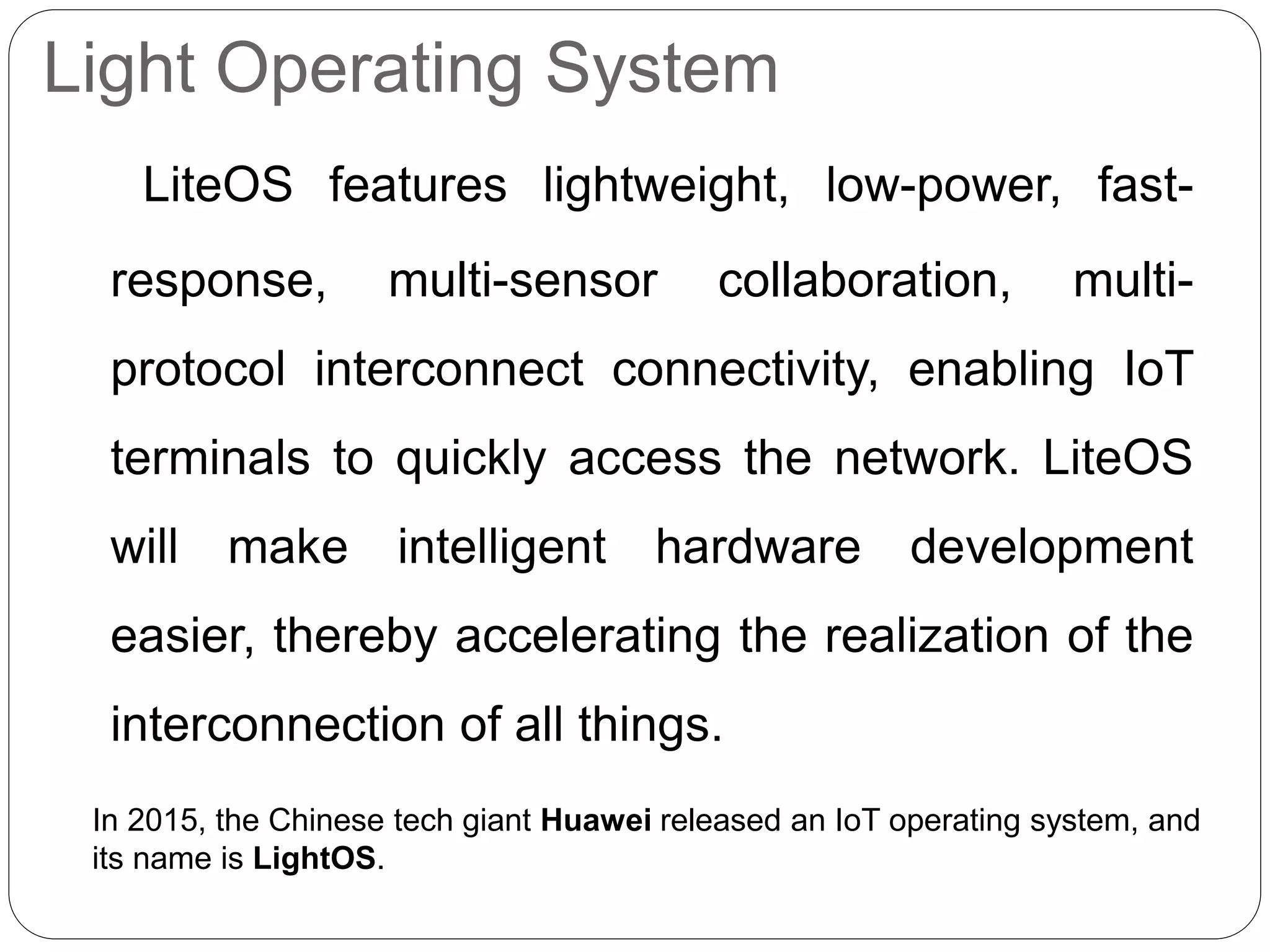
Light Operating System
LiteOS features lightweight, low-power, fast-
response, multi-sensor collaboration, multi-
protocol interconnect connectivity, enabling IoT
terminals to quickly access the network. LiteOS
will make intelligent hardware development
easier, thereby accelerating the realization of the
interconnection of all things.
In 2015, the Chinese tech giant Huawei released an IoT operating system, and
its name is LightOS.
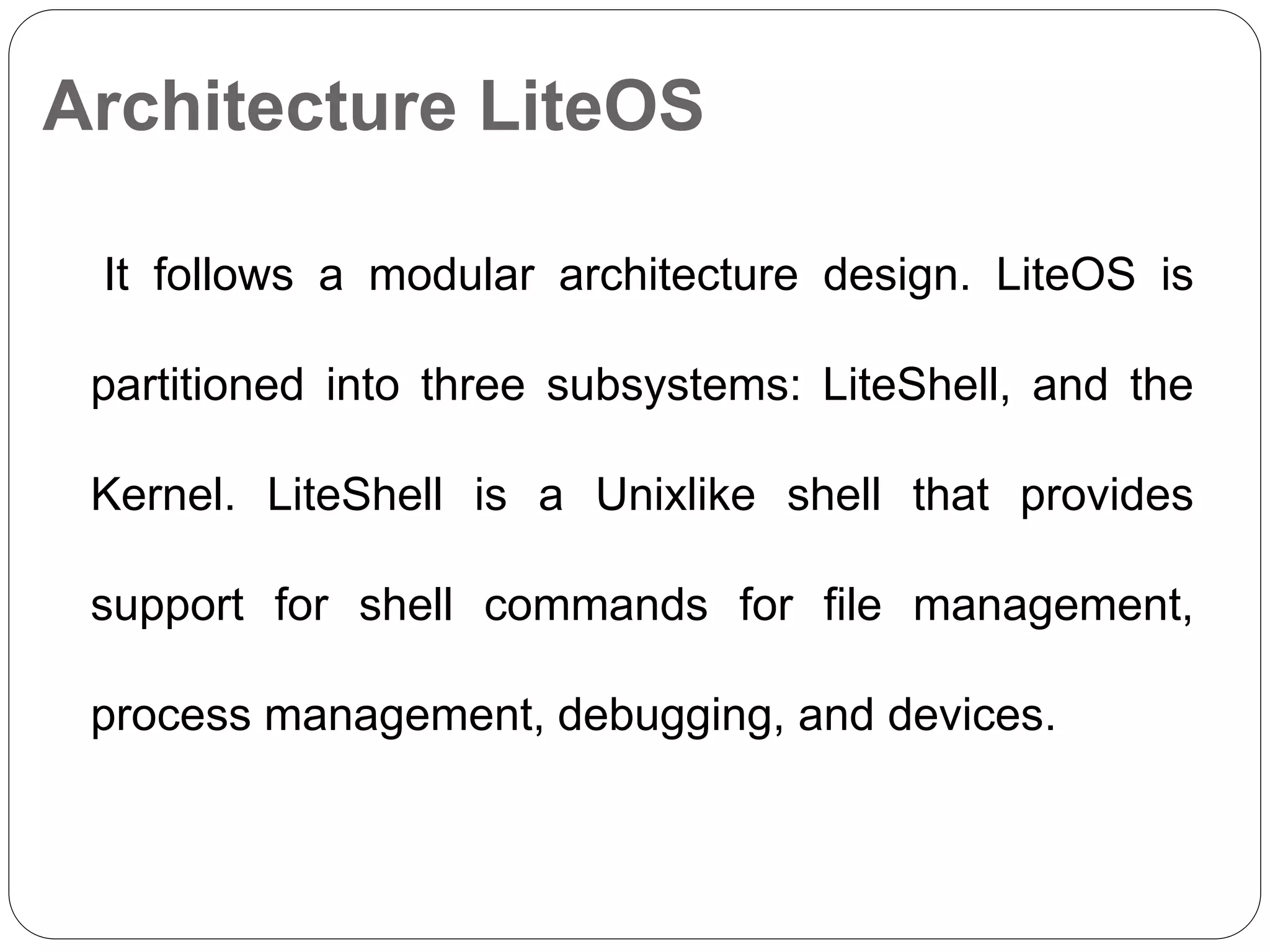
Architecture LiteOS
It follows a modular architecture design. LiteOS is
partitioned into three subsystems: LiteShell, and the
Kernel. LiteShell is a Unixlike shell that provides
support for shell commands for file management,
process management, debugging, and devices.
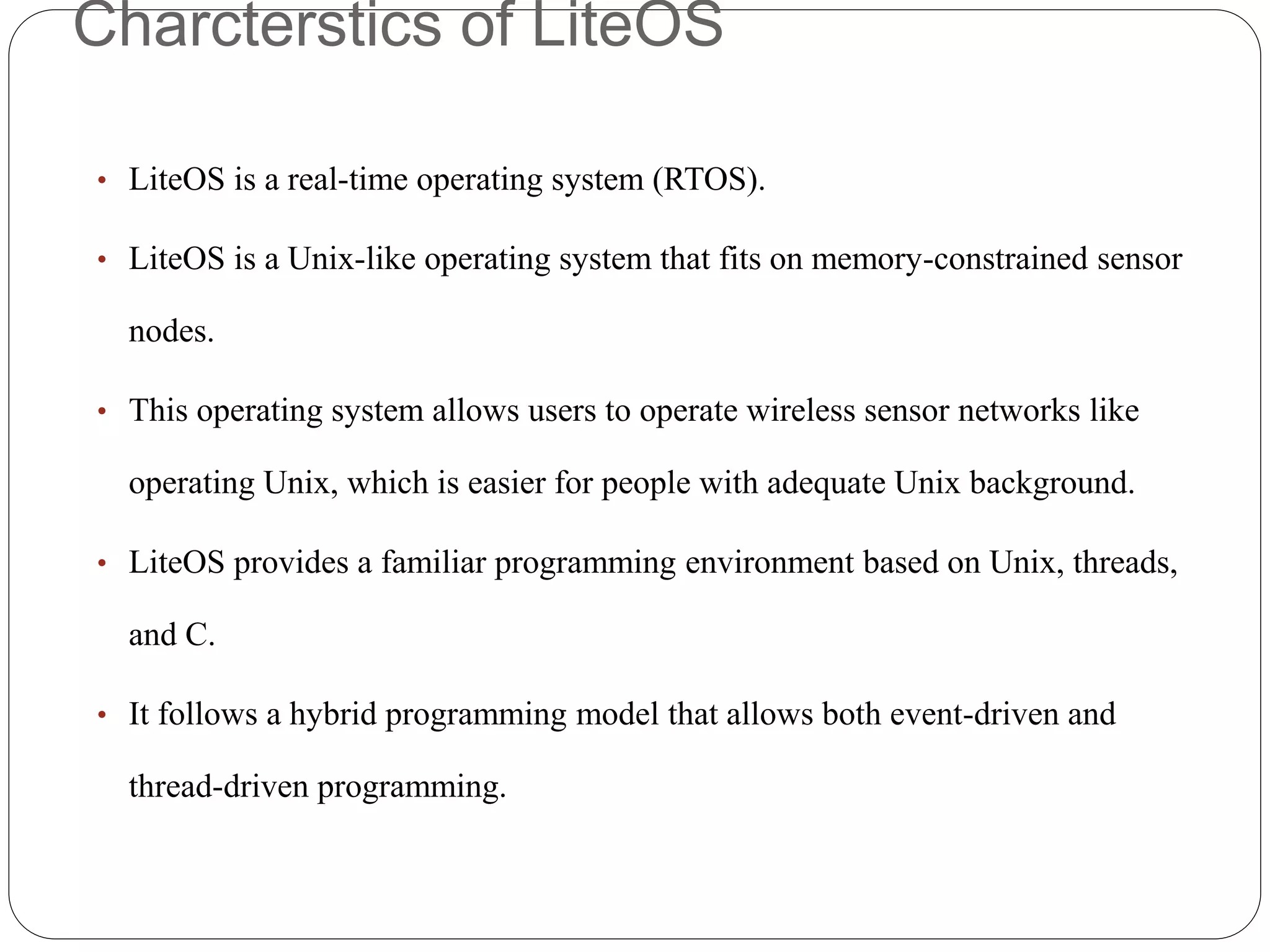
Charcterstics of LiteOS
• LiteOS is a real-time operating system (RTOS).
• LiteOS is a Unix-like operating system that fits on memory-constrained sensor
nodes.
• This operating system allows users to operate wireless sensor networks like
operating Unix, which is easier for people with adequate Unix background.
• LiteOS provides a familiar programming environment based on Unix, threads,
and C.
• It follows a hybrid programming model that allows both event-driven and
thread-driven programming.
Key features
 Lightweight, small kernel < 10KB
 Energy efficient
 Fast startup within milliseconds
 Support IoT, Wi-Fi, Ethernet, BLE, Zigbee and
other different IoT protocols
 Support access to different cloud platforms
Advantages
 Scheduling
LiteOS provides an implementation of Round Robin scheduling and
Prioritybased scheduling. Whenever a task is added to the ready
queue, the next task to be executed is chosen through prioritybased
scheduling. The tasks run to completion or until they request a
resource that is not currently available. When a task requires a
resource that is not available, the task enables interrupts and goes to
sleep mode.
 Memory Protection and Management Inside the kernel,
LiteOS supports dynamic memory allocation through the use of free
functions. User applications can use these APIs to allocate and de-
allocate memory at runtime. Dynamic memory grows in the opposite
direction of the LiteOS stack. The dynamic memory is allocated from
the unused area between the end of the kernel variables and the start
of the user application memory blocks. This allows adjusting the size
of dynamic memory as required by the application.
 Communication Protocol Support
 liteOS provides communication support in the form of files. LiteOS
creates a file corresponding to each device on the sensor node.
Similarly, it creates a file corresponding to the radio interface.
Whenever there is some data that needs to be sent, the data is placed
into the radio file and is afterward wirelessly transmitted. In the same
manner, whenever some data arrives at the node it is placed in the
RIOT OS
RIOT OS aims at bridging the gap we observed
between OS for WSNs and traditional full-fledged
OS currently running on Internet hosts. It is based
on design objectives including energy-efficiency,
small memory footprint, modularity, and uniform
API access, independent of the underlying
hardwareIt was initially developed by Freie Universität Berlin (FU Berlin)
. Advantages of the RIOT architecture
 High reliability
 developer-friendly API.
The modular microkernel structure of RIOT
makes it robust against bugs in single
components. Failures in the device driver or the
file system, for example, will not harm the whole
system. RIOT allows developers to create as
many threads as needed and distributed systems
can be easily implemented by using the kernel
message API. The amount of threads is only
limited by the available memory and stack size for
each thread, while the computational and
memory overhead is minimal.
RIOT emerged as a full microkernel architecture
that provides Multithreading and real-time
capabilities and, most importantly,
supports standard C and C++ programming
languages.RIOT IoT OS was designed to provide the
capabilities of a modern, full-fledged operating
system in a small form factor, including native
multithreading, hardware abstraction and dynamic
memory management.
RIOT supports most low-power IoT devices and
microcontroller architectures (32-bit, 16-bit, 8-bit).
RIOT aims to implement all relevant open
standards supporting an Internet of Things that is
connected, secure, durable & privacy-friendly.
which was originally developed for sensor networks
characteristics
 Ease to USE
 Wide architectural support
 Efficient power usage
 Static and dynamic memory allocation to a
process
Advantages RIOT
 It is an operating system designed for the particular requirements of Internet of
Things (IoT) scenarios. These requirements comprise a low memory footprint,
high energy efficiency, realtime capabilities, a modular and configurable
communication stack, and support for a wide range of low power devices.
 RIOT provides a microkernel, utilities like cryptographic libraries, data
structures (bloom filters, hash tables, priority queues), or a shell, different
network stacks, and support for various microcontrollers, radio drivers,
sensors, and configurations for entire platforms. There are no new
programming environments.,C or C++ can be used directly with existing tools
like gcc, etc, Less hardware dependent code, Supports 8,16 and 32bit
microcontroller platforms, Energy efficiency is maintained, Less interrupt
latency, so realtime capability is ensured, Multithreading is enabled .
Contiki OS
Contiki is an operating system for IoT that specifically
targets small IoT devices with limited memory, power,
bandwidth, and processing power. It uses a minimalist
design while still packing the common tools of modern
operating systems. It provides functionality for
management of programs, processes, resources,
memory, and communication.
Contiki only requires a few kilobytes to run, and
within a space of under 30KB, it fits its entire
operating system − a web browser, web server,
calculator, shell, telnet client, email client, and ftp. It
borrows from operating systems and development
strategies from decades ago, which easily exploited
equally small space.
Contiki supports several rich network stacks that
provides comprehensive set of features like IPv6,
6LoWPAN. Moreover, it also provides multiple
industry standard Medium Access Control (MAC)
such as Carrier Sense Multiple Access (CSMA) and
Time Slotted Channel Hopping (TSCH).
Architecture
Contiki is based on a modular architecture, with
respect to its kernel that follows the event driven
model, but it provides threading capabilities to
processes. The Contiki kernel includes a light event
scheduler that dispatches events to running
processes. The execution of the process is triggered
by events sent by the kernel to processes or by a
query mechanism.
Advantages:
 Internet Standards : Contiki provides powerful lowpower Internet communication.
Contiki supports fully standard IPv6 and IPv4, along with the recent lowpower
wireless standards: 6lowpan
 Rapid Development: With Contiki, development is easy and fast: Contiki applications
are written in standard C, with the Cooja simulator Contiki networks can be emulated
before burned into hardware, and Instant Contiki provides an entire development
environment in a single download.
 A Selection of Hardware : Contiki runs on a range of lowpower wireless devices,
many of which can be easily purchased online.
 Open Source Software: Contiki is open source software: it can be freely used both in
commercial and noncommercial systems and the full source code is available.
Disadvantages
 Scheduling : Contiki is an eventdriven OS, therefore it does
not employ any sophisticated scheduling algorithm. Events are
fired to the target application as they arrive. Contiki does not
support multicast. Therefore Contiki does not provide any
implementation of group management protocols such as the
Internet Group Management Protocol (ICMP), or Multicast
Listener Discovery (MLD) protocol
 Possibility of Real-Time support applications : Contiki does
not support deployment of realtime applications, So there is no
implementation of any realtime process scheduling algorithm in
this OS.
TinyOS
TinyOS is an open source, BSDlicensed (family of
permissive free software licenses) operating system
designed for lowpower wireless devices, such as
those used in sensor networks, ubiquitous computing,
personal area networks, smart buildings, and smart
meters.
Architecture
TinyOS follow a monolithic architecture based on a
combination of components, reducing the size of the code
needed to set it up. This is in line with the constraints of
Memories that are observed by sensor networks; however,
the TinyOS component library is particularly complete since
it includes network protocols, sensor drivers and acquisition
tools of data. All of these components can be used as they
are, they can also be adapted to a precise application.
Programming Model
The previous versions of TinyOS do not provide
multithreading support; building applications were
based on the eventdriven programming model.
TinyOS version 2.1 supports multithreading. and
these TinyOS threads are called TOS Threads
Advantages
 TinyOS is a system mainly developed and Supported by
the American University of Berkeley, which offers it in
download Under the BSD license and monitors it. Thus, all
the sources are Available for many physical targets.
 Based on eventdriven operation, TinyOS offers to the user
a precise management of the sensor's consumption and
makes it possible to adapt better to the Random nature of
wireless communication between physical interfaces.
 Energy management: TinyOS is designed to optimally
manage energy consumption: it puts the node into standby
when there are no tasks to perform, and thus allows the
deactivation of the radio device or its setting in ' Listening
only and low energy consumption (low power listening).
TinyOS also generates a small code, which decreases the
energy used to store the data in the RAM.
Disadvantages
 Support for Real-Time Applications
TinyOS does not support realtime application operations.
It provides a process planning algorithm based on
priorities, but once a process is scheduled to run to
completion. This may result in a missed deadline for a high
priority process that enters the Preparation queue once a
low priority process has been scheduled.
 TinyOS is not an operating system in the current sense. It
does not offer, for example, a notion of multitasking, users
or file system. There are no user mode and kernel mode
notions. In fact, TinyOS is a set of routines made available
to the programmer to simplify the development.
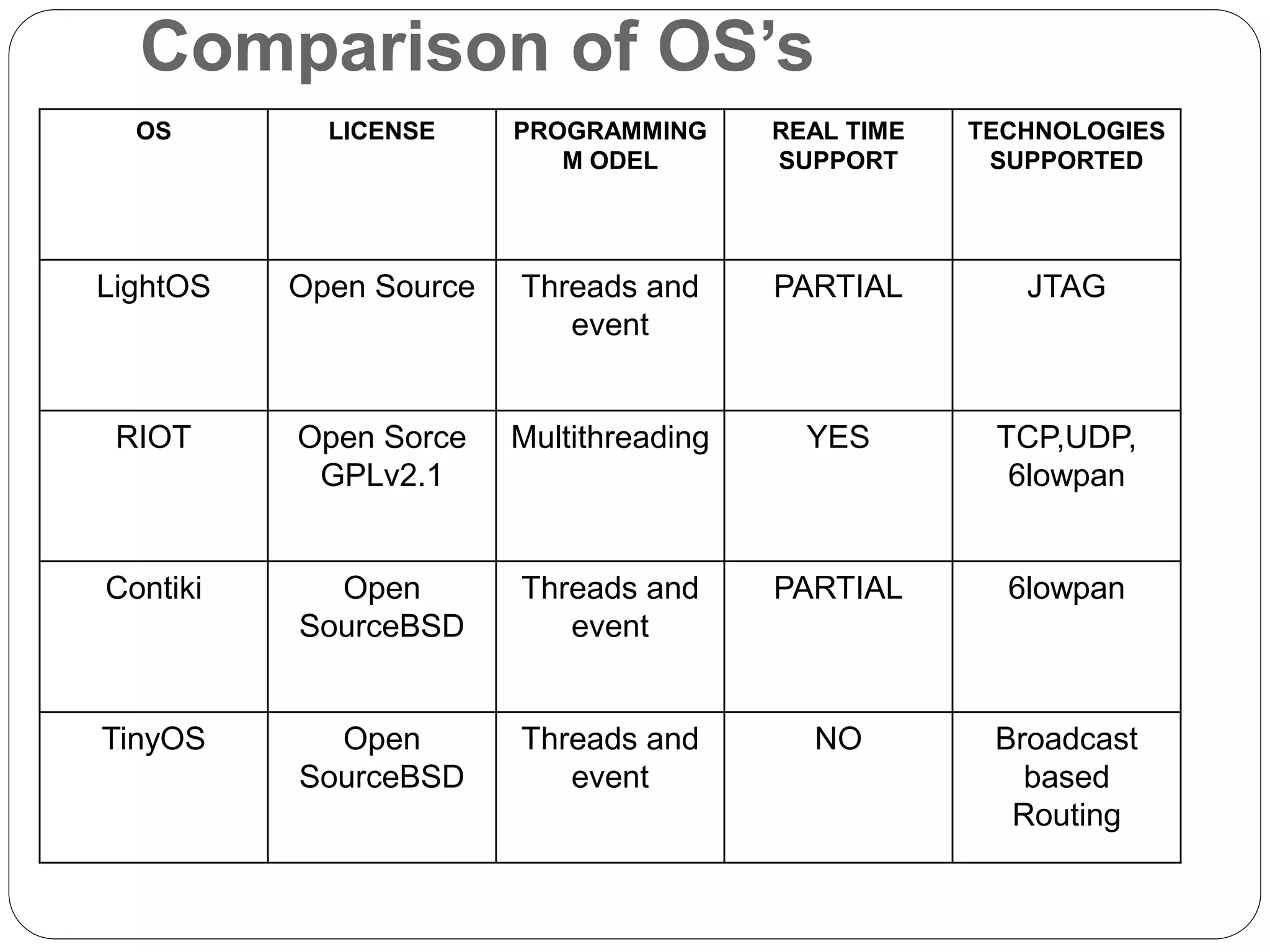
Comparison of IOT OS’S
the RIOT system supports the most communication
technologies over other systems, supports multi-
threading and realtime media with a GNU GPL
license, which allows the user several rights On a
computer program
1. The freedom to run the software for any purpose.
2. The freedom to study the functioning of a program
and to adapt it to its needs, which requires access to
source codes.
3. Freedom to redistribute copies.
4. The obligation to provide the community with
modified versions.
Comparison of OS’s
OS LICENSE PROGRAMMING
M ODEL
REAL TIME
SUPPORT
TECHNOLOGIES
SUPPORTED
LightOS Open Source Threads and
event
PARTIAL JTAG
RIOT Open Sorce
GPLv2.1
Multithreading YES TCP,UDP,
6lowpan
Contiki Open
SourceBSD
Threads and
event
PARTIAL 6lowpan
TinyOS Open
SourceBSD
Threads and
event
NO Broadcast
based
Routing

Lecture 9

  • 1.
  • 2.
    Requirements of anOS for IOT  Memory Requirements: To ensure proper memory management for an operating system the minimum memory requirement of the software must be very low. This concerns RAM as well as persistent program storage.  Limited resources: The hardware platforms offer very limited resources so the operating system should use them efficiently.  Concurrency: The operating system should be able to handle different tasks at the same time.  Flexibility: Since the requirements for deferent applications vary wildly, the operating system should be able to be flexible to handle those.  Low Power: Energy conservation should be one of the main goals for the operating system.  Error Free: Error free that mean it has no chances of error in performing tasks.  Platform support: The software part of the IOT should have the ability to support the different hardware platforms, but also the ability to exploit their capabilities.  Reliability: The operating system must function reliably because it is deployed in critical applications where the access is linked to a high costs In summary the main requirements for an operating system are:
  • 3.
    Light Operating System LiteOSfeatures lightweight, low-power, fast- response, multi-sensor collaboration, multi- protocol interconnect connectivity, enabling IoT terminals to quickly access the network. LiteOS will make intelligent hardware development easier, thereby accelerating the realization of the interconnection of all things. In 2015, the Chinese tech giant Huawei released an IoT operating system, and its name is LightOS.
  • 4.
    Architecture LiteOS It followsa modular architecture design. LiteOS is partitioned into three subsystems: LiteShell, and the Kernel. LiteShell is a Unixlike shell that provides support for shell commands for file management, process management, debugging, and devices.
  • 5.
    Charcterstics of LiteOS •LiteOS is a real-time operating system (RTOS). • LiteOS is a Unix-like operating system that fits on memory-constrained sensor nodes. • This operating system allows users to operate wireless sensor networks like operating Unix, which is easier for people with adequate Unix background. • LiteOS provides a familiar programming environment based on Unix, threads, and C. • It follows a hybrid programming model that allows both event-driven and thread-driven programming.
  • 6.
    Key features  Lightweight,small kernel < 10KB  Energy efficient  Fast startup within milliseconds  Support IoT, Wi-Fi, Ethernet, BLE, Zigbee and other different IoT protocols  Support access to different cloud platforms
  • 7.
    Advantages  Scheduling LiteOS providesan implementation of Round Robin scheduling and Prioritybased scheduling. Whenever a task is added to the ready queue, the next task to be executed is chosen through prioritybased scheduling. The tasks run to completion or until they request a resource that is not currently available. When a task requires a resource that is not available, the task enables interrupts and goes to sleep mode.  Memory Protection and Management Inside the kernel, LiteOS supports dynamic memory allocation through the use of free functions. User applications can use these APIs to allocate and de- allocate memory at runtime. Dynamic memory grows in the opposite direction of the LiteOS stack. The dynamic memory is allocated from the unused area between the end of the kernel variables and the start of the user application memory blocks. This allows adjusting the size of dynamic memory as required by the application.  Communication Protocol Support  liteOS provides communication support in the form of files. LiteOS creates a file corresponding to each device on the sensor node. Similarly, it creates a file corresponding to the radio interface. Whenever there is some data that needs to be sent, the data is placed into the radio file and is afterward wirelessly transmitted. In the same manner, whenever some data arrives at the node it is placed in the
  • 8.
    RIOT OS RIOT OSaims at bridging the gap we observed between OS for WSNs and traditional full-fledged OS currently running on Internet hosts. It is based on design objectives including energy-efficiency, small memory footprint, modularity, and uniform API access, independent of the underlying hardwareIt was initially developed by Freie Universität Berlin (FU Berlin)
  • 9.
    . Advantages ofthe RIOT architecture  High reliability  developer-friendly API. The modular microkernel structure of RIOT makes it robust against bugs in single components. Failures in the device driver or the file system, for example, will not harm the whole system. RIOT allows developers to create as many threads as needed and distributed systems can be easily implemented by using the kernel message API. The amount of threads is only limited by the available memory and stack size for each thread, while the computational and memory overhead is minimal.
  • 10.
    RIOT emerged asa full microkernel architecture that provides Multithreading and real-time capabilities and, most importantly, supports standard C and C++ programming languages.RIOT IoT OS was designed to provide the capabilities of a modern, full-fledged operating system in a small form factor, including native multithreading, hardware abstraction and dynamic memory management.
  • 11.
    RIOT supports mostlow-power IoT devices and microcontroller architectures (32-bit, 16-bit, 8-bit). RIOT aims to implement all relevant open standards supporting an Internet of Things that is connected, secure, durable & privacy-friendly. which was originally developed for sensor networks
  • 12.
    characteristics  Ease toUSE  Wide architectural support  Efficient power usage  Static and dynamic memory allocation to a process
  • 13.
    Advantages RIOT  Itis an operating system designed for the particular requirements of Internet of Things (IoT) scenarios. These requirements comprise a low memory footprint, high energy efficiency, realtime capabilities, a modular and configurable communication stack, and support for a wide range of low power devices.  RIOT provides a microkernel, utilities like cryptographic libraries, data structures (bloom filters, hash tables, priority queues), or a shell, different network stacks, and support for various microcontrollers, radio drivers, sensors, and configurations for entire platforms. There are no new programming environments.,C or C++ can be used directly with existing tools like gcc, etc, Less hardware dependent code, Supports 8,16 and 32bit microcontroller platforms, Energy efficiency is maintained, Less interrupt latency, so realtime capability is ensured, Multithreading is enabled .
  • 14.
    Contiki OS Contiki isan operating system for IoT that specifically targets small IoT devices with limited memory, power, bandwidth, and processing power. It uses a minimalist design while still packing the common tools of modern operating systems. It provides functionality for management of programs, processes, resources, memory, and communication.
  • 15.
    Contiki only requiresa few kilobytes to run, and within a space of under 30KB, it fits its entire operating system − a web browser, web server, calculator, shell, telnet client, email client, and ftp. It borrows from operating systems and development strategies from decades ago, which easily exploited equally small space.
  • 16.
    Contiki supports severalrich network stacks that provides comprehensive set of features like IPv6, 6LoWPAN. Moreover, it also provides multiple industry standard Medium Access Control (MAC) such as Carrier Sense Multiple Access (CSMA) and Time Slotted Channel Hopping (TSCH).
  • 17.
    Architecture Contiki is basedon a modular architecture, with respect to its kernel that follows the event driven model, but it provides threading capabilities to processes. The Contiki kernel includes a light event scheduler that dispatches events to running processes. The execution of the process is triggered by events sent by the kernel to processes or by a query mechanism.
  • 18.
    Advantages:  Internet Standards: Contiki provides powerful lowpower Internet communication. Contiki supports fully standard IPv6 and IPv4, along with the recent lowpower wireless standards: 6lowpan  Rapid Development: With Contiki, development is easy and fast: Contiki applications are written in standard C, with the Cooja simulator Contiki networks can be emulated before burned into hardware, and Instant Contiki provides an entire development environment in a single download.  A Selection of Hardware : Contiki runs on a range of lowpower wireless devices, many of which can be easily purchased online.  Open Source Software: Contiki is open source software: it can be freely used both in commercial and noncommercial systems and the full source code is available.
  • 19.
    Disadvantages  Scheduling :Contiki is an eventdriven OS, therefore it does not employ any sophisticated scheduling algorithm. Events are fired to the target application as they arrive. Contiki does not support multicast. Therefore Contiki does not provide any implementation of group management protocols such as the Internet Group Management Protocol (ICMP), or Multicast Listener Discovery (MLD) protocol  Possibility of Real-Time support applications : Contiki does not support deployment of realtime applications, So there is no implementation of any realtime process scheduling algorithm in this OS.
  • 20.
    TinyOS TinyOS is anopen source, BSDlicensed (family of permissive free software licenses) operating system designed for lowpower wireless devices, such as those used in sensor networks, ubiquitous computing, personal area networks, smart buildings, and smart meters.
  • 21.
    Architecture TinyOS follow amonolithic architecture based on a combination of components, reducing the size of the code needed to set it up. This is in line with the constraints of Memories that are observed by sensor networks; however, the TinyOS component library is particularly complete since it includes network protocols, sensor drivers and acquisition tools of data. All of these components can be used as they are, they can also be adapted to a precise application.
  • 22.
    Programming Model The previousversions of TinyOS do not provide multithreading support; building applications were based on the eventdriven programming model. TinyOS version 2.1 supports multithreading. and these TinyOS threads are called TOS Threads
  • 23.
    Advantages  TinyOS isa system mainly developed and Supported by the American University of Berkeley, which offers it in download Under the BSD license and monitors it. Thus, all the sources are Available for many physical targets.  Based on eventdriven operation, TinyOS offers to the user a precise management of the sensor's consumption and makes it possible to adapt better to the Random nature of wireless communication between physical interfaces.  Energy management: TinyOS is designed to optimally manage energy consumption: it puts the node into standby when there are no tasks to perform, and thus allows the deactivation of the radio device or its setting in ' Listening only and low energy consumption (low power listening). TinyOS also generates a small code, which decreases the energy used to store the data in the RAM.
  • 24.
    Disadvantages  Support forReal-Time Applications TinyOS does not support realtime application operations. It provides a process planning algorithm based on priorities, but once a process is scheduled to run to completion. This may result in a missed deadline for a high priority process that enters the Preparation queue once a low priority process has been scheduled.  TinyOS is not an operating system in the current sense. It does not offer, for example, a notion of multitasking, users or file system. There are no user mode and kernel mode notions. In fact, TinyOS is a set of routines made available to the programmer to simplify the development.
  • 25.
    Comparison of IOTOS’S the RIOT system supports the most communication technologies over other systems, supports multi- threading and realtime media with a GNU GPL license, which allows the user several rights On a computer program 1. The freedom to run the software for any purpose. 2. The freedom to study the functioning of a program and to adapt it to its needs, which requires access to source codes. 3. Freedom to redistribute copies. 4. The obligation to provide the community with modified versions.
  • 26.
    Comparison of OS’s OSLICENSE PROGRAMMING M ODEL REAL TIME SUPPORT TECHNOLOGIES SUPPORTED LightOS Open Source Threads and event PARTIAL JTAG RIOT Open Sorce GPLv2.1 Multithreading YES TCP,UDP, 6lowpan Contiki Open SourceBSD Threads and event PARTIAL 6lowpan TinyOS Open SourceBSD Threads and event NO Broadcast based Routing