S.VARUN
M.Tech[EST]
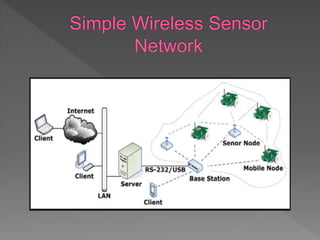
 A System Architecture is a combination of
different hardware & software components or
modules which enable exchange of data
between the client & server (or) sender &
receiver.
 The structure and organization of a computing
system, as a set of functional modules and their
interactions.
 Node Intervals
 Interaction of Nodes
 It presents the possible abstraction levels in a
single node.
 Operating systems, the simplest approach,
provide basic system functionality including a
uniform way of accessing the hardware.
 The two main sets of functionalities, namely
low-level functionalities, including tasks
corresponding to physical, link, routing and
transport layers.
 The high-level functionalities are coordination
and support, clustering, timing and localization,
addressing, lookup, collaboration, failure
detection and security.
 In a data-centric approach, the execution is
controlled by the data.
 For example, on the basis of the type of
incoming data, the appropriate function is called
which is able to handle this type.
 Sensor network scenarios are said to be data-
centric.
 A service is a well-defined and self-contained
function that does not depend on the context or
the state of other services.
 The service is executed on the explicit request
of a caller, who has to know the interface of the
service. A response is returned after the
completion of the service.
 An operating system (OS) is system software that
manages compute
hardware and software resources and provides
common services for computer programs.
 The different operating systems for COs,unlike
general purpose desktop operating systems such
as Windows or Linux, these operating systems run
on devices that are designed for special-purpose
tasks.
 The main tasks of these operating systems is to
provide an abstract interface to the underlying
hardware and to schedule system resources.
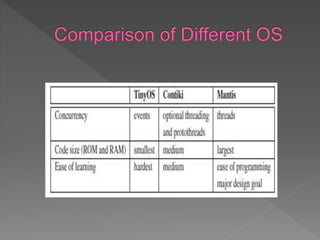
 The three operating systems used in WSN
namely TinyOS,Contiki, and Mantis.
 TinyOS does not provide any multithreading
 Contiki provides multithreading as a library for
those applications that explicitly require it.
 Mantis is a layered multithreaded operating
system.
 Microsoft Windows is the most common
operating system for desktop computers.
 Windows XP Embedded is a modular cut-down
version of XP that allows the designer to choose
the modules to be used.
 Since Linux is open source, anyone can
customize Linux to his/her PDA, Palmtop or
other mobile or embedded device.
 RTLinux (Real-time Linux), an extension of the
Linux kernel that provides real-time entities.
 uClinux, a scaled-down Linux version for
system without a memory mapping unit.
 Montavista Linux with Linux distributions for
ARM, MIPS.
 The Palm OS is specifically designed for PDAs
featuring a small screen, with less processing
power than desktop PCs and limited memory.
 In Palm OS, the kernel is responsible for thread
scheduling, handling hardware interrupts and
other low-level management tasks.
 Although Palm-applications are single-
threadded, the kernel itself uses multiple
threads.
 Symbian OS is a robust multi-tasking operating
system, designed specifically for wireless
environments and the constraints of mobile
phones.
 The core kernel’s size is less than 200 KB. The
OS has support for handling low memory
situations and a power management model.
 Symbian OS runs on fast, low-power, low-cost
CPU cores such as ARM processors.
 In contrast to Windows XP Embedded,
Windows CE has a different codebase than
Windows XP. Windows CE is particularly
designed for small hand-held devices.
 Windows CE is a multitasking operating system
allowing multiple applications or processes to
run within the system simultaneously.
 According to Microsoft, the code size is 200 KB
without graphics, but the code size increases
dramatically when graphics and networking are
included.
 eCos has extensive configuration possibilities
and can be scaled up from a few hundred bytes
in size to hundreds of KB.
 eCos provides features such as pre-emptable
tasks with multiple priority levels, low latency-
interrupt handling.
 It is a Unix-like operating system with real-time
properties, and is the most prominent example
of a successful micro-kernel design.
 The micro-kernel is surrounded by cooperating
processes that provide higher-level services
such as inter-process and low-level networking
communication
 QNX is designed for systems running x86,
MIPS, PowerPC or ARM CPUs.
 XMK (eXtreme Minimal Kernel) is an open-
source real-time kernel designed to fit very
small micro-controllers, yet be scalable up to
larger systems.
 A minimal kernel configuration requires only
340 bytes of ROM and 18 bytes of RAM.
 TinyOS is an operating system specially
designed for the constraints and requirements
of WSNs.
 It is currently the most widely used system for
academic research in the area of sensor
networks.
 TinyOS is available for several platforms.
 Scheduling Hierarchy
 Concurrency
 Programming
 Dynamic Reprogramming
S.VARUN
M.Tech[EST]

Wireless Sensor System Architecture

  • 1.
  • 2.
     A SystemArchitecture is a combination of different hardware & software components or modules which enable exchange of data between the client & server (or) sender & receiver.
  • 4.
     The structureand organization of a computing system, as a set of functional modules and their interactions.  Node Intervals  Interaction of Nodes
  • 5.
     It presentsthe possible abstraction levels in a single node.  Operating systems, the simplest approach, provide basic system functionality including a uniform way of accessing the hardware.
  • 6.
     The twomain sets of functionalities, namely low-level functionalities, including tasks corresponding to physical, link, routing and transport layers.  The high-level functionalities are coordination and support, clustering, timing and localization, addressing, lookup, collaboration, failure detection and security.
  • 7.
     In adata-centric approach, the execution is controlled by the data.  For example, on the basis of the type of incoming data, the appropriate function is called which is able to handle this type.  Sensor network scenarios are said to be data- centric.
  • 8.
     A serviceis a well-defined and self-contained function that does not depend on the context or the state of other services.  The service is executed on the explicit request of a caller, who has to know the interface of the service. A response is returned after the completion of the service.
  • 9.
     An operatingsystem (OS) is system software that manages compute hardware and software resources and provides common services for computer programs.  The different operating systems for COs,unlike general purpose desktop operating systems such as Windows or Linux, these operating systems run on devices that are designed for special-purpose tasks.
  • 10.
     The maintasks of these operating systems is to provide an abstract interface to the underlying hardware and to schedule system resources.  The three operating systems used in WSN namely TinyOS,Contiki, and Mantis.  TinyOS does not provide any multithreading  Contiki provides multithreading as a library for those applications that explicitly require it.  Mantis is a layered multithreaded operating system.
  • 11.
     Microsoft Windowsis the most common operating system for desktop computers.  Windows XP Embedded is a modular cut-down version of XP that allows the designer to choose the modules to be used.
  • 12.
     Since Linuxis open source, anyone can customize Linux to his/her PDA, Palmtop or other mobile or embedded device.  RTLinux (Real-time Linux), an extension of the Linux kernel that provides real-time entities.  uClinux, a scaled-down Linux version for system without a memory mapping unit.  Montavista Linux with Linux distributions for ARM, MIPS.
  • 13.
     The PalmOS is specifically designed for PDAs featuring a small screen, with less processing power than desktop PCs and limited memory.  In Palm OS, the kernel is responsible for thread scheduling, handling hardware interrupts and other low-level management tasks.  Although Palm-applications are single- threadded, the kernel itself uses multiple threads.
  • 14.
     Symbian OSis a robust multi-tasking operating system, designed specifically for wireless environments and the constraints of mobile phones.  The core kernel’s size is less than 200 KB. The OS has support for handling low memory situations and a power management model.  Symbian OS runs on fast, low-power, low-cost CPU cores such as ARM processors.
  • 15.
     In contrastto Windows XP Embedded, Windows CE has a different codebase than Windows XP. Windows CE is particularly designed for small hand-held devices.  Windows CE is a multitasking operating system allowing multiple applications or processes to run within the system simultaneously.  According to Microsoft, the code size is 200 KB without graphics, but the code size increases dramatically when graphics and networking are included.
  • 16.
     eCos hasextensive configuration possibilities and can be scaled up from a few hundred bytes in size to hundreds of KB.  eCos provides features such as pre-emptable tasks with multiple priority levels, low latency- interrupt handling.
  • 17.
     It isa Unix-like operating system with real-time properties, and is the most prominent example of a successful micro-kernel design.  The micro-kernel is surrounded by cooperating processes that provide higher-level services such as inter-process and low-level networking communication  QNX is designed for systems running x86, MIPS, PowerPC or ARM CPUs.
  • 18.
     XMK (eXtremeMinimal Kernel) is an open- source real-time kernel designed to fit very small micro-controllers, yet be scalable up to larger systems.  A minimal kernel configuration requires only 340 bytes of ROM and 18 bytes of RAM.
  • 19.
     TinyOS isan operating system specially designed for the constraints and requirements of WSNs.  It is currently the most widely used system for academic research in the area of sensor networks.  TinyOS is available for several platforms.
  • 20.
     Scheduling Hierarchy Concurrency  Programming  Dynamic Reprogramming
  • 22.