CLOUD OF THINGS
(IoT + Cloud Computing)
IOT and CLOUD COMPUTING integration is referred to as
Cloud of things in this paper. IoT’s and cloud computing
integration is not that simple and bears some key issues.
Those key issues along with their respective potential
solutions have been highlighted in this paper.
Introduction
2
 IoT, the term first introduced by Kevin Ashton in 1998, is
a
future of Internet and ubiquitous computing .
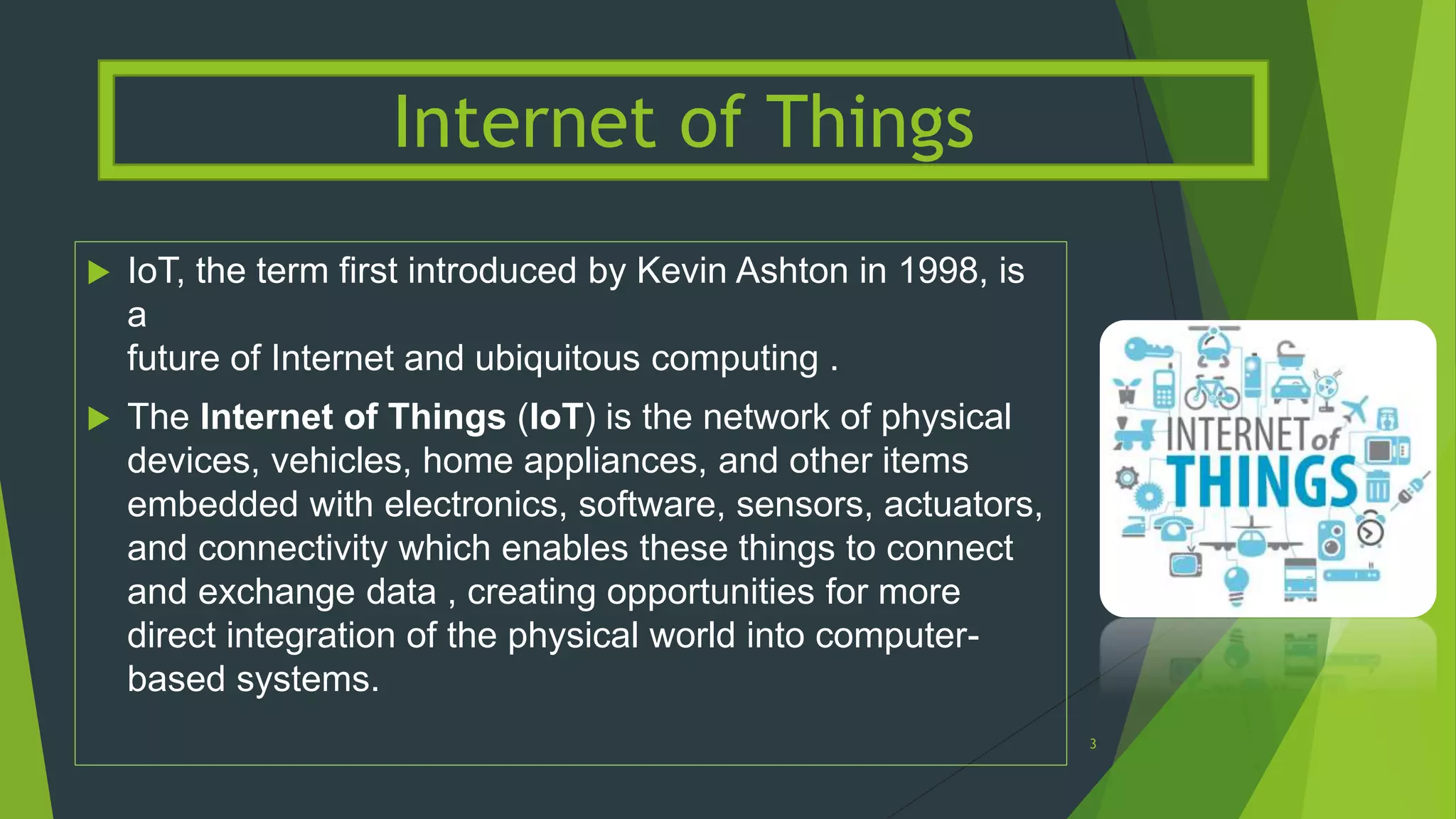
 The Internet of Things (IoT) is the network of physical
devices, vehicles, home appliances, and other items
embedded with electronics, software, sensors, actuators,
and connectivity which enables these things to connect
and exchange data , creating opportunities for more
direct integration of the physical world into computer-
based systems.
Internet of Things
3
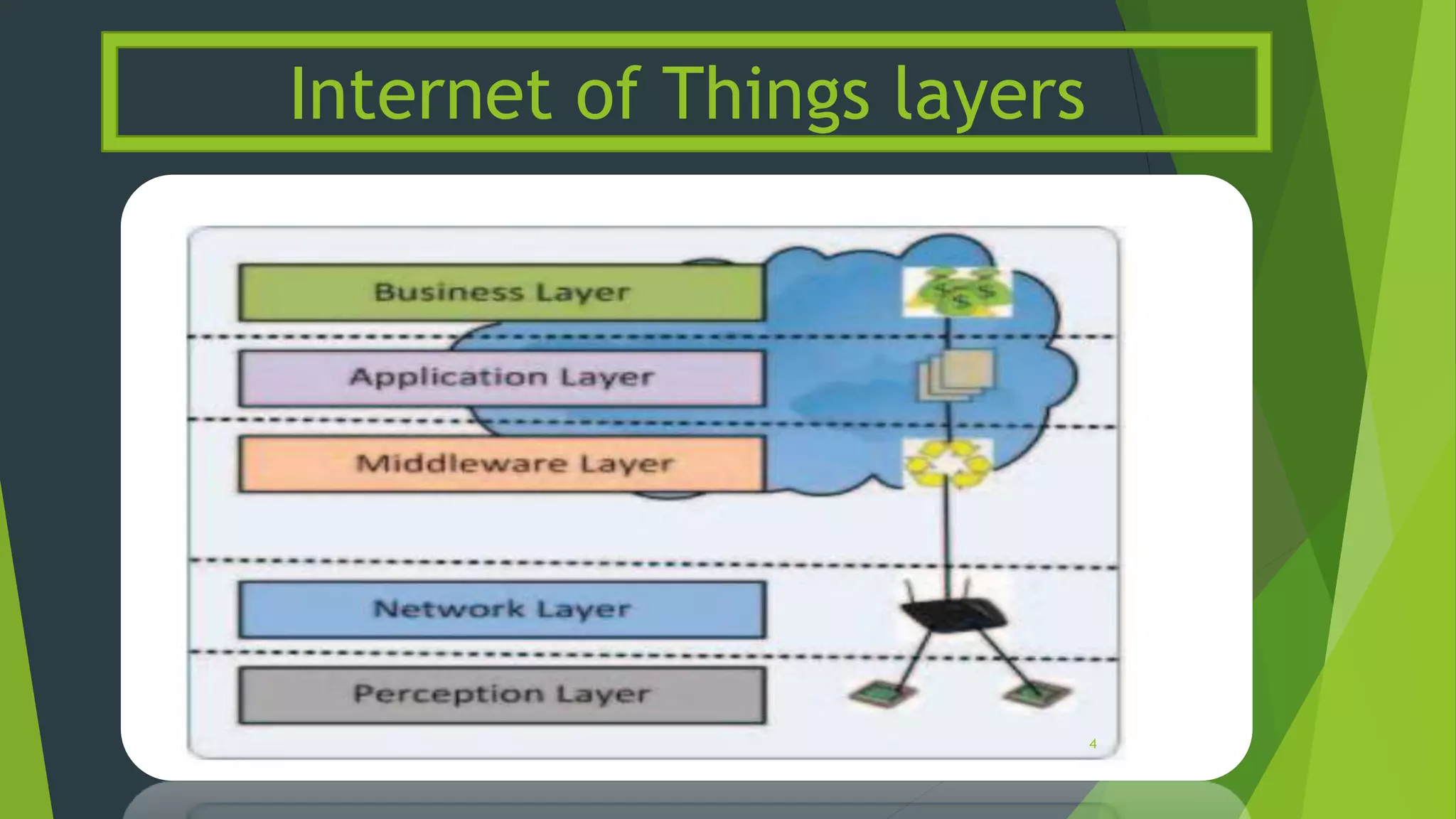
Internet of Things layers
4
Cloud computing, the recent trend in IT, takes
computing from desktop to the whole World Wide
Web and yet, the user doesn’t need to worry about
maintenance and managing all the resources. User
has to bear only the cost of usage of service(s),
which is called, pay-as-you-use, in cloud computing
terms.
Cloud Computing
5
provides four categories of services,
namely:
Software as a Service (SaaS),
Platform as a Service
(PaaS), Networks as a Service (NaaS)
Cloud Computing
6
 Connected devices have reached 9 billion and are expected to
grow more rapidly and reach 24 billion by 2020 .
 Since, number of connected devices is rapidly increasing .
Storing that data locally and temporarily will not be possible
any more .
 Data must not only be processed to form information and
further, to form knowledge, but it should be made a mean of
wisdom for the user.
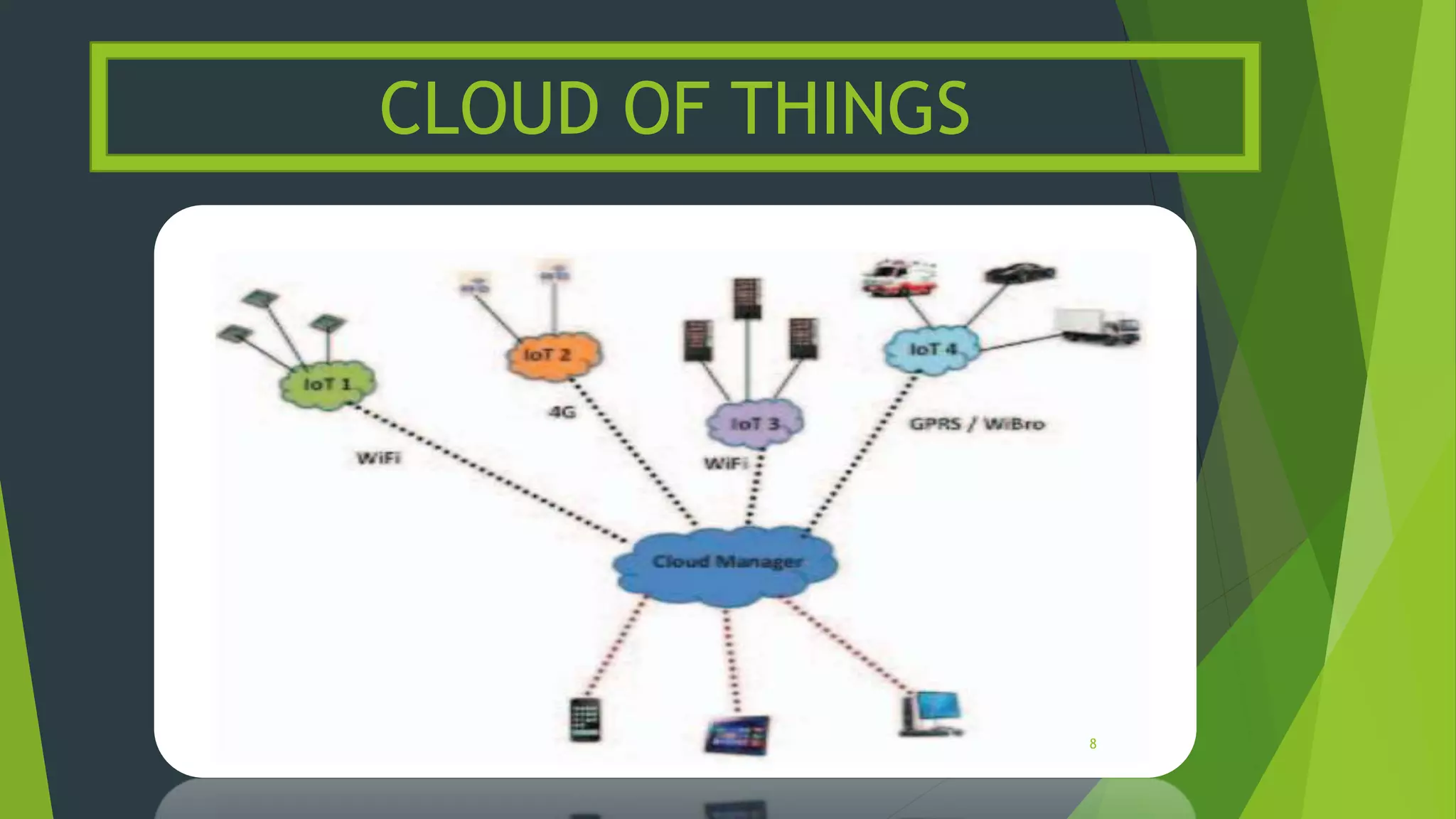
 IoT and cloud computing working in integration makes a new
paradigm, which we have termed here as Cloud of Things.
CLOUD OF THINGS
7
CLOUD OF THINGS
8
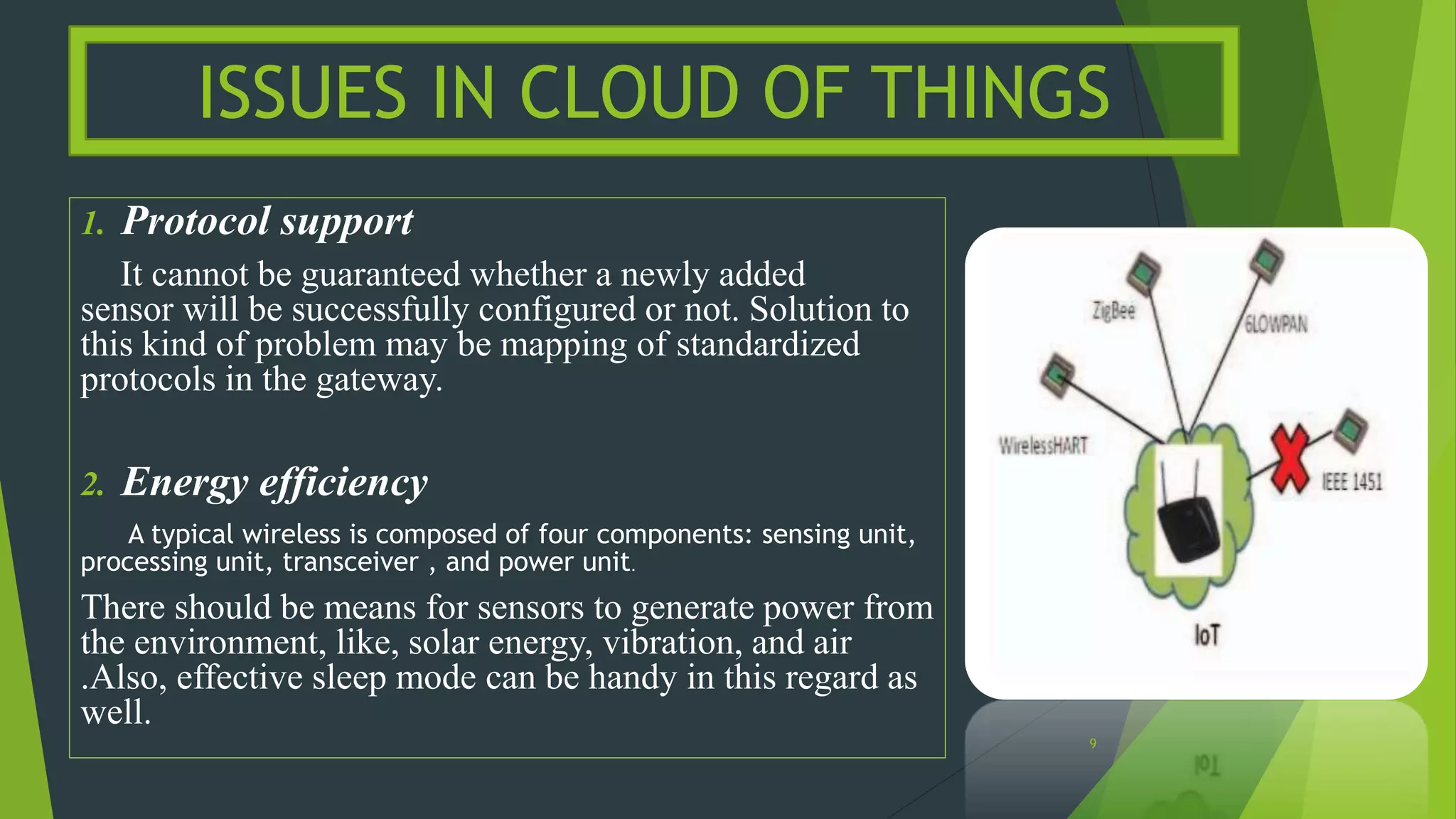
1. Protocol support
It cannot be guaranteed whether a newly added
sensor will be successfully configured or not. Solution to
this kind of problem may be mapping of standardized
protocols in the gateway.
2. Energy efficiency
A typical wireless is composed of four components: sensing unit,
processing unit, transceiver , and power unit.
There should be means for sensors to generate power from
the environment, like, solar energy, vibration, and air
.Also, effective sleep mode can be handy in this regard as
well.
ISSUES IN CLOUD OF THINGS
9
3. Resource allocation
Depending upon the sensor and the purpose for
which sensor is being used, the type, amount, and
frequency of data generation, resource allocation has to
be mapped.
4. Identity management
When objects are becoming part of Internet (IoT),
they also need a unique identification. Since IPv6
address space is believed to be enough to support even
this kind of ubiquitous networking, assigning IPv6
addresses can be a more than reasonable way in this
regard.
ISSUES IN CLOUD OF THINGS
10
5. IPv6 deployment
IPv6 is to be used for the identification of communicating
objects, then formal deployment of IPv6 would also be an issue.
Studies focusing on IPv4-IPv6 coexistence and smooth
transitioning towards IPv6 must be considered for this problem.
6. Service discovery
With Cloud of Things, the cloud manager or broker has the
responsibility to discover new services for the users. In IoT, any
object can become part of it at any moment and can leave the IoT
at any moment. It would be an issue to discover new services and
their status and update the service advertisement accordingly.
ISSUES IN CLOUD OF THINGS
11
7. Quality of Service provisioning
Depending upon the type of data and its urgency
to be sent to the sync node, QoS must be supported .
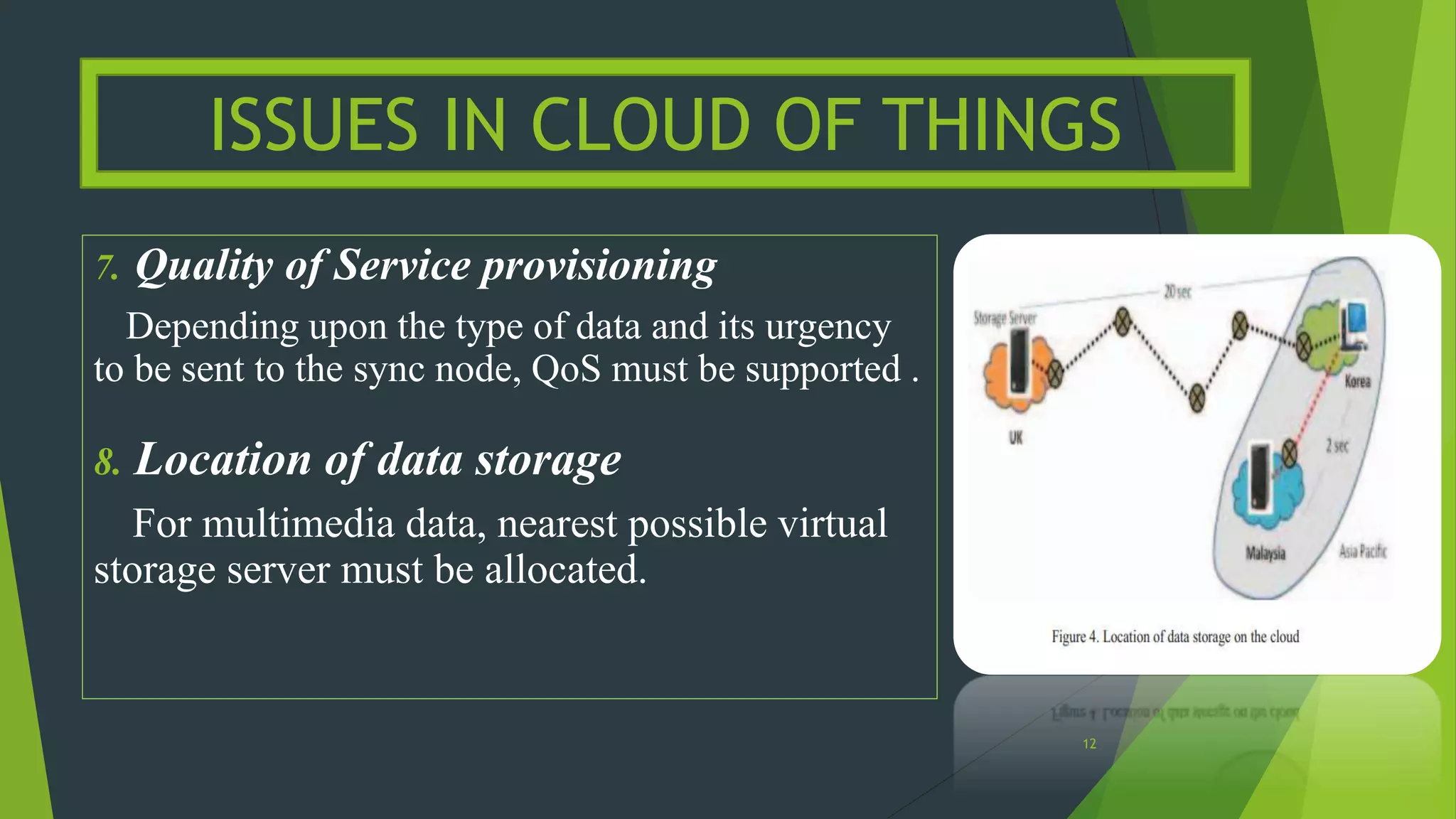
8. Location of data storage
For multimedia data, nearest possible virtual
storage server must be allocated.
ISSUES IN CLOUD OF THINGS
12
9. Security and privacy
Sensitive or private data must also be stored
in a virtual storage server located inside the
user’s country or trusted geographical domain.
This can be a friendly country as well .
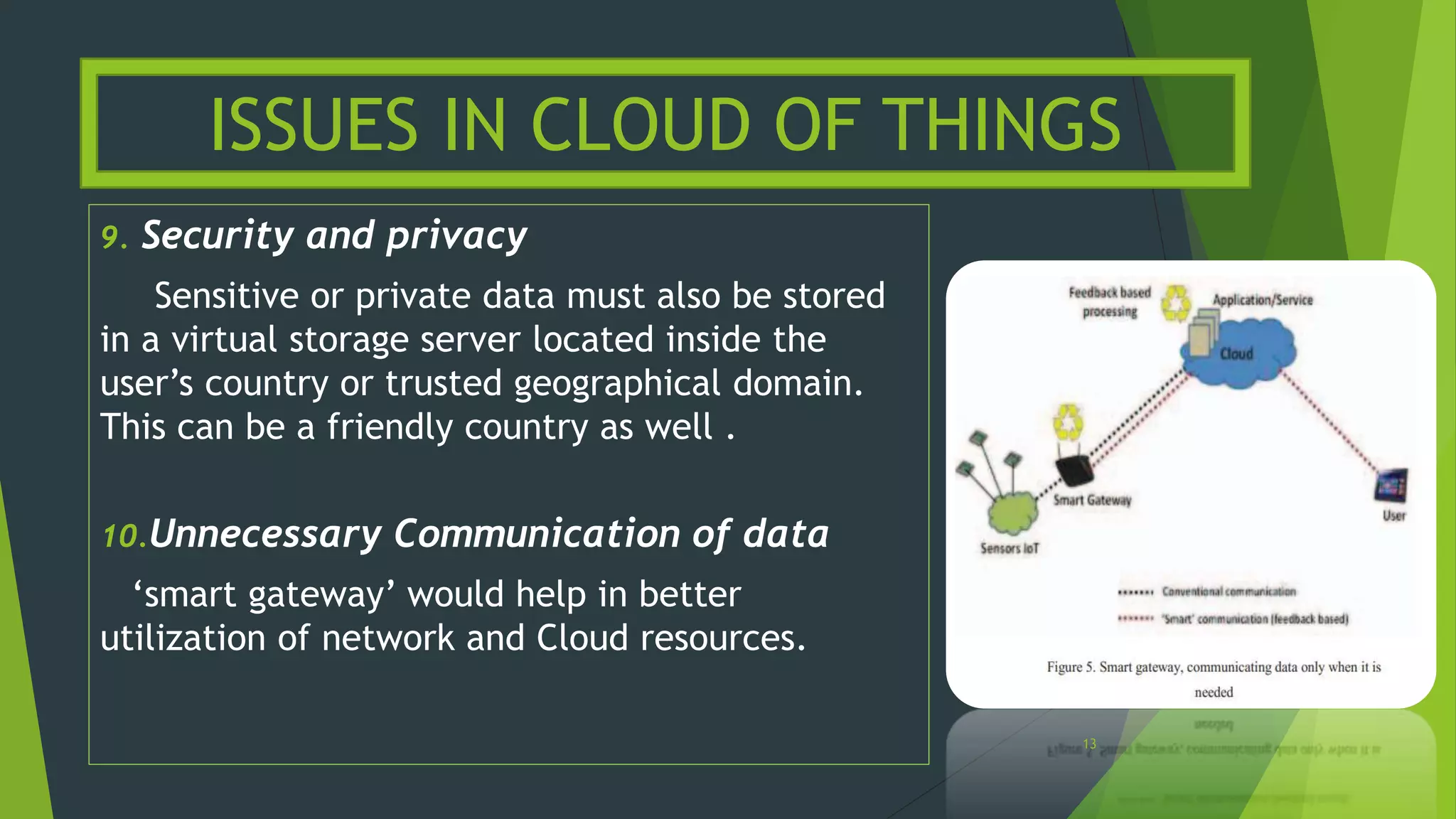
10.Unnecessary Communication of data
‘smart gateway’ would help in better
utilization of network and Cloud resources.
ISSUES IN CLOUD OF THINGS
13
 This integration or working in coordination, termed here
as Cloud of Things (CoT), involves some key challenges as
well, which have been discussed in this paper.
 More study on the impact of these issues, specially,
keeping in view the type of IoT and type of service being
provided, can be done in the future.
 Some of the data being generated by a specific IoT may
require special type of storage and Momentarily, the data
may not be required.
CONCLUSION AND FUTURE WORK
14
[1] Yen-Kuang Chen, “Challenges and Opportunities of Internet of Things”,in the proceedings of 17th Asia and South
Pacific Design Automation Conference, , 30 Jan. – 02 Feb., 2012, Santa Clara, CA, USA.
[2] Miao Wu et. al., “Research on the architecture of Internet of things”, in the proceedings of 3rd International
Conference on Advanced Computer Theory and Engineering, 20-22 August, 2012,Beijing, China,
[3] Gerd Kortuem, Fahim Kawsar, Daniel Fitton, and Vasughi Sundramoorthi, “Smart Objects and Building Blocks of
Internet of Things”, IEEE Internet Computing Journal, volume 14, issue 1, pp. 44- 51, Jan.-Feb., 2010
[4] Rafiullah Khan, Sarmad Ullah Khan, Rifaqat Zaheer, and Shahid Khan, “Future Internet: The Internet of Things
Architecture,Possible Applications and Key Challenges”, in the proceedings of 10th International Conference on
Frontiers of Information Technology, Islamabad, Pakistan, 17-19 December, 2012.
[5] Dieter Uckelamann, Mark Harrison, and Floria Michahelles, “Architecting the Internet of Things,” Springer-
Verlag Berlin Heidelberg, 2011.
[6] Shuai Zhang et. al., “Cloud Computing Research and Development Trend”, in the proceedings of International
Conference on Future Networks, 22-24 Jan., 2010, Sanya, China.
[7] W Ma et. al., “The Survey and Research on Application of Cloud Computing”, in the proceedings of 7th
International Conference on Computerl Science and Education, 02-04 November, 2012, Wuyishan Mountain, China.
[8] Y. Jadeja, et. al., “Cloud Computing - Concepts, Architecture and Challenges”, in the proceedings of
International Conference on Computing Electronics and Electrical Technologies, 21-22 March, 2012, Nagercoil,
India.
[9] Minqi Zhou et. al., “Services in the Cloud Computing Era: A Survey”, in the proceedings of 4th International
Universal Communications Symposium, 18-19 October, 2010, Beijing, China.
Used References
15
Thank You
16

Cloud of things (IoT + Cloud Computing)

  • 1.
    CLOUD OF THINGS (IoT+ Cloud Computing)
  • 2.
    IOT and CLOUDCOMPUTING integration is referred to as Cloud of things in this paper. IoT’s and cloud computing integration is not that simple and bears some key issues. Those key issues along with their respective potential solutions have been highlighted in this paper. Introduction 2
  • 3.
     IoT, theterm first introduced by Kevin Ashton in 1998, is a future of Internet and ubiquitous computing .  The Internet of Things (IoT) is the network of physical devices, vehicles, home appliances, and other items embedded with electronics, software, sensors, actuators, and connectivity which enables these things to connect and exchange data , creating opportunities for more direct integration of the physical world into computer- based systems. Internet of Things 3
  • 4.
  • 5.
    Cloud computing, therecent trend in IT, takes computing from desktop to the whole World Wide Web and yet, the user doesn’t need to worry about maintenance and managing all the resources. User has to bear only the cost of usage of service(s), which is called, pay-as-you-use, in cloud computing terms. Cloud Computing 5
  • 6.
    provides four categoriesof services, namely: Software as a Service (SaaS), Platform as a Service (PaaS), Networks as a Service (NaaS) Cloud Computing 6
  • 7.
     Connected deviceshave reached 9 billion and are expected to grow more rapidly and reach 24 billion by 2020 .  Since, number of connected devices is rapidly increasing . Storing that data locally and temporarily will not be possible any more .  Data must not only be processed to form information and further, to form knowledge, but it should be made a mean of wisdom for the user.  IoT and cloud computing working in integration makes a new paradigm, which we have termed here as Cloud of Things. CLOUD OF THINGS 7
  • 8.
  • 9.
    1. Protocol support Itcannot be guaranteed whether a newly added sensor will be successfully configured or not. Solution to this kind of problem may be mapping of standardized protocols in the gateway. 2. Energy efficiency A typical wireless is composed of four components: sensing unit, processing unit, transceiver , and power unit. There should be means for sensors to generate power from the environment, like, solar energy, vibration, and air .Also, effective sleep mode can be handy in this regard as well. ISSUES IN CLOUD OF THINGS 9
  • 10.
    3. Resource allocation Dependingupon the sensor and the purpose for which sensor is being used, the type, amount, and frequency of data generation, resource allocation has to be mapped. 4. Identity management When objects are becoming part of Internet (IoT), they also need a unique identification. Since IPv6 address space is believed to be enough to support even this kind of ubiquitous networking, assigning IPv6 addresses can be a more than reasonable way in this regard. ISSUES IN CLOUD OF THINGS 10
  • 11.
    5. IPv6 deployment IPv6is to be used for the identification of communicating objects, then formal deployment of IPv6 would also be an issue. Studies focusing on IPv4-IPv6 coexistence and smooth transitioning towards IPv6 must be considered for this problem. 6. Service discovery With Cloud of Things, the cloud manager or broker has the responsibility to discover new services for the users. In IoT, any object can become part of it at any moment and can leave the IoT at any moment. It would be an issue to discover new services and their status and update the service advertisement accordingly. ISSUES IN CLOUD OF THINGS 11
  • 12.
    7. Quality ofService provisioning Depending upon the type of data and its urgency to be sent to the sync node, QoS must be supported . 8. Location of data storage For multimedia data, nearest possible virtual storage server must be allocated. ISSUES IN CLOUD OF THINGS 12
  • 13.
    9. Security andprivacy Sensitive or private data must also be stored in a virtual storage server located inside the user’s country or trusted geographical domain. This can be a friendly country as well . 10.Unnecessary Communication of data ‘smart gateway’ would help in better utilization of network and Cloud resources. ISSUES IN CLOUD OF THINGS 13
  • 14.
     This integrationor working in coordination, termed here as Cloud of Things (CoT), involves some key challenges as well, which have been discussed in this paper.  More study on the impact of these issues, specially, keeping in view the type of IoT and type of service being provided, can be done in the future.  Some of the data being generated by a specific IoT may require special type of storage and Momentarily, the data may not be required. CONCLUSION AND FUTURE WORK 14
  • 15.
    [1] Yen-Kuang Chen,“Challenges and Opportunities of Internet of Things”,in the proceedings of 17th Asia and South Pacific Design Automation Conference, , 30 Jan. – 02 Feb., 2012, Santa Clara, CA, USA. [2] Miao Wu et. al., “Research on the architecture of Internet of things”, in the proceedings of 3rd International Conference on Advanced Computer Theory and Engineering, 20-22 August, 2012,Beijing, China, [3] Gerd Kortuem, Fahim Kawsar, Daniel Fitton, and Vasughi Sundramoorthi, “Smart Objects and Building Blocks of Internet of Things”, IEEE Internet Computing Journal, volume 14, issue 1, pp. 44- 51, Jan.-Feb., 2010 [4] Rafiullah Khan, Sarmad Ullah Khan, Rifaqat Zaheer, and Shahid Khan, “Future Internet: The Internet of Things Architecture,Possible Applications and Key Challenges”, in the proceedings of 10th International Conference on Frontiers of Information Technology, Islamabad, Pakistan, 17-19 December, 2012. [5] Dieter Uckelamann, Mark Harrison, and Floria Michahelles, “Architecting the Internet of Things,” Springer- Verlag Berlin Heidelberg, 2011. [6] Shuai Zhang et. al., “Cloud Computing Research and Development Trend”, in the proceedings of International Conference on Future Networks, 22-24 Jan., 2010, Sanya, China. [7] W Ma et. al., “The Survey and Research on Application of Cloud Computing”, in the proceedings of 7th International Conference on Computerl Science and Education, 02-04 November, 2012, Wuyishan Mountain, China. [8] Y. Jadeja, et. al., “Cloud Computing - Concepts, Architecture and Challenges”, in the proceedings of International Conference on Computing Electronics and Electrical Technologies, 21-22 March, 2012, Nagercoil, India. [9] Minqi Zhou et. al., “Services in the Cloud Computing Era: A Survey”, in the proceedings of 4th International Universal Communications Symposium, 18-19 October, 2010, Beijing, China. Used References 15
  • 16.