C S E 4 1 2 – B I G DATA & I OT
T E A M M E M B E R S
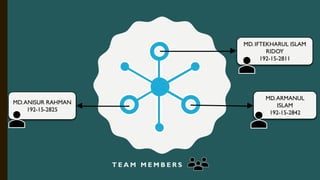
MD. IFTEKHARUL ISLAM
RIDOY
192-15-2811
MD.ANISUR RAHMAN
192-15-2825
MD.ARMANUL
ISLAM
192-15-2842
CONTENTS
1)IOT
2)IOT COMMUNICATION MODELS
3)IOT PROTOCOLS
4)APPLICATIONS
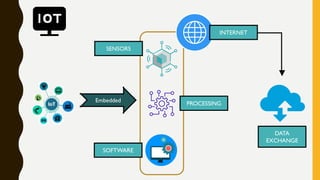
Embedded
SENSORS
PROCESSING
SOFTWARE
INTERNET
DATA
EXCHANGE
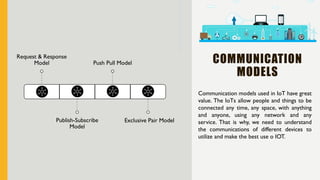
Request & Response
Model
Publish-Subscribe
Model
Push Pull Model COMMUNICATION
MODELS
Exclusive Pair Model
Communication models used in IoT have great
value. The IoTs allow people and things to be
connected any time, any space, with anything
and anyone, using any network and any
service. That is why, we need to understand
the communications of different devices to
utilize and make the best use o IOT.
REQUEST & RESPONSE MODEL
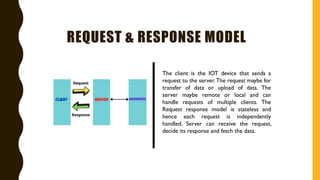
The client is the IOT device that sends a
request to the server. The request maybe for
transfer of data or upload of data. The
server maybe remote or local and can
handle requests of multiple clients. The
Request response model is stateless and
hence each request is independently
handled. Server can receive the request,
decide its response and fetch the data.
PUBLISH SUBSCRIBE MODEL
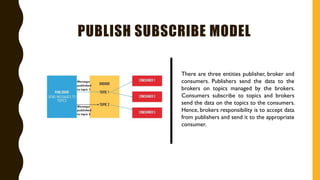
There are three entities publisher, broker and
consumers. Publishers send the data to the
brokers on topics managed by the brokers.
Consumers subscribe to topics and brokers
send the data on the topics to the consumers.
Hence, brokers responsibility is to accept data
from publishers and send it to the appropriate
consumer.
PUSH PULL MODEL
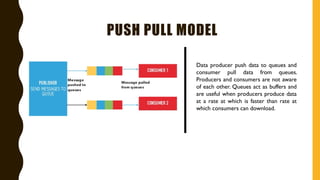
Data producer push data to queues and
consumer pull data from queues.
Producers and consumers are not aware
of each other. Queues act as buffers and
are useful when producers produce data
at a rate at which is faster than rate at
which consumers can download.
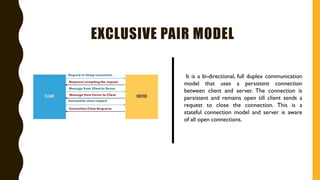
EXCLUSIVE PAIR MODEL
It is a bi-directional, full duplex communication
model that uses a persistent connection
between client and server. The connection is
persistent and remains open till client sends a
request to close the connection. This is a
stateful connection model and server is aware
of all open connections.
What is Iot protocol?
Single devices like smartphones and personal computers also use network protocols for communication.
But general protocols that are used by these personal devices might not meet specific requirements like
bandwidth, latency, and range of IoT-based solutions. Hence, a few improved versions of existing
protocols and some new IoT protocols are evolved to meet the requirements of IoT devices.
IoT protocols and standards are broadly classified into two separate categories.
These are:
1. IoT data protocols (Presentation / Application layers)
2. Network protocols for IoT (Datalink / Physical layers)
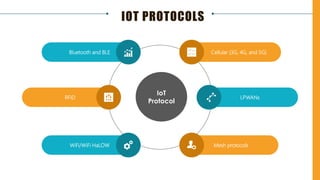
IOT PROTOCOLS
IoT
Protocol
Cellular (3G, 4G, and 5G)
LPWANs
Mesh protocols
Bluetooth and BLE
RFID
WiFi/WiFi HaLOW
IOT PROTOCOLS
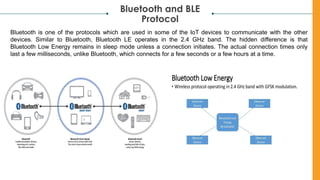
Bluetooth and BLE
Protocol
Bluetooth is one of the protocols which are used in some of the IoT devices to communicate with the other
devices. Similar to Bluetooth, Bluetooth LE operates in the 2.4 GHz band. The hidden difference is that
Bluetooth Low Energy remains in sleep mode unless a connection initiates. The actual connection times only
last a few milliseconds, unlike Bluetooth, which connects for a few seconds or a few hours at a time.
Cellular IoT uses cellular networks to connect
physical devices to the Internet. This connection
enables these devices to transmit and receive data,
making them part of the “Internet of Things” (IoT).
Cellular IoT is the most popular type of IoT
connectivity, primarily because it: Provides excellent
coverage. IoT can connect via 2G, 3G,4G, or 5G
networks. Depending on the needs of the IoT device
and application, there are primarily two types of
Cellular IoT connections, namely, LTE-M and NB-
IoT which are the recent IoT specific variables. 2G
and 3G are no longer used for mobile connectivity.
Cellular Protocol
LPWANs Protocol
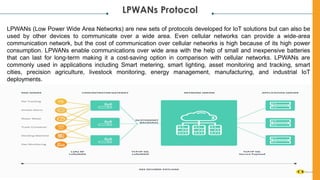
LPWANs (Low Power Wide Area Networks) are new sets of protocols developed for IoT solutions but can also be
used by other devices to communicate over a wide area. Even cellular networks can provide a wide-area
communication network, but the cost of communication over cellular networks is high because of its high power
consumption. LPWANs enable communications over wide area with the help of small and inexpensive batteries
that can last for long-term making it a cost-saving option in comparison with cellular networks. LPWANs are
commonly used in applications including Smart metering, smart lighting, asset monitoring and tracking, smart
cities, precision agriculture, livestock monitoring, energy management, manufacturing, and industrial IoT
deployments.
Mesh protocols
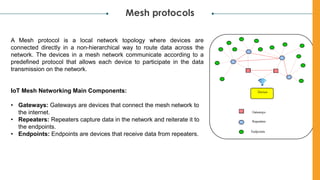
A Mesh protocol is a local network topology where devices are
connected directly in a non-hierarchical way to route data across the
network. The devices in a mesh network communicate according to a
predefined protocol that allows each device to participate in the data
transmission on the network.
IoT Mesh Networking Main Components:
• Gateways: Gateways are devices that connect the mesh network to
the internet.
• Repeaters: Repeaters capture data in the network and reiterate it to
the endpoints.
• Endpoints: Endpoints are devices that receive data from repeaters.
Wifi/ Wifi HaLow
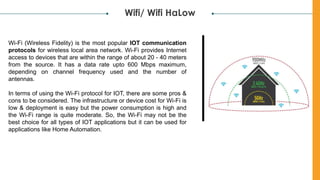
Wi-Fi (Wireless Fidelity) is the most popular IOT communication
protocols for wireless local area network. Wi-Fi provides Internet
access to devices that are within the range of about 20 - 40 meters
from the source. It has a data rate upto 600 Mbps maximum,
depending on channel frequency used and the number of
antennas.
In terms of using the Wi-Fi protocol for IOT, there are some pros &
cons to be considered. The infrastructure or device cost for Wi-Fi is
low & deployment is easy but the power consumption is high and
the Wi-Fi range is quite moderate. So, the Wi-Fi may not be the
best choice for all types of IOT applications but it can be used for
applications like Home Automation.
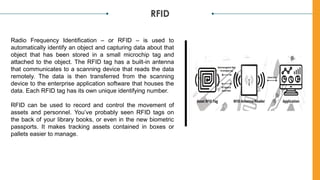
RFID
Radio Frequency Identification – or RFID – is used to
automatically identify an object and capturing data about that
object that has been stored in a small microchip tag and
attached to the object. The RFID tag has a built-in antenna
that communicates to a scanning device that reads the data
remotely. The data is then transferred from the scanning
device to the enterprise application software that houses the
data. Each RFID tag has its own unique identifying number.
RFID can be used to record and control the movement of
assets and personnel. You’ve probably seen RFID tags on
the back of your library books, or even in the new biometric
passports. It makes tracking assets contained in boxes or
pallets easier to manage.
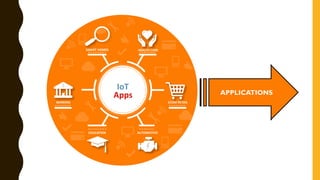
APPLICATIONS
THANK YOU
“IoT-Coming soon in a "THING" near you.”
― Syed Sharukh

IOT and its communication models and protocols.pdf

  • 1.
    C S E4 1 2 – B I G DATA & I OT
  • 2.
    T E AM M E M B E R S MD. IFTEKHARUL ISLAM RIDOY 192-15-2811 MD.ANISUR RAHMAN 192-15-2825 MD.ARMANUL ISLAM 192-15-2842
  • 3.
  • 4.
  • 5.
    Request & Response Model Publish-Subscribe Model PushPull Model COMMUNICATION MODELS Exclusive Pair Model Communication models used in IoT have great value. The IoTs allow people and things to be connected any time, any space, with anything and anyone, using any network and any service. That is why, we need to understand the communications of different devices to utilize and make the best use o IOT.
  • 6.
    REQUEST & RESPONSEMODEL The client is the IOT device that sends a request to the server. The request maybe for transfer of data or upload of data. The server maybe remote or local and can handle requests of multiple clients. The Request response model is stateless and hence each request is independently handled. Server can receive the request, decide its response and fetch the data.
  • 7.
    PUBLISH SUBSCRIBE MODEL Thereare three entities publisher, broker and consumers. Publishers send the data to the brokers on topics managed by the brokers. Consumers subscribe to topics and brokers send the data on the topics to the consumers. Hence, brokers responsibility is to accept data from publishers and send it to the appropriate consumer.
  • 8.
    PUSH PULL MODEL Dataproducer push data to queues and consumer pull data from queues. Producers and consumers are not aware of each other. Queues act as buffers and are useful when producers produce data at a rate at which is faster than rate at which consumers can download.
  • 9.
    EXCLUSIVE PAIR MODEL Itis a bi-directional, full duplex communication model that uses a persistent connection between client and server. The connection is persistent and remains open till client sends a request to close the connection. This is a stateful connection model and server is aware of all open connections.
  • 10.
    What is Iotprotocol? Single devices like smartphones and personal computers also use network protocols for communication. But general protocols that are used by these personal devices might not meet specific requirements like bandwidth, latency, and range of IoT-based solutions. Hence, a few improved versions of existing protocols and some new IoT protocols are evolved to meet the requirements of IoT devices. IoT protocols and standards are broadly classified into two separate categories. These are: 1. IoT data protocols (Presentation / Application layers) 2. Network protocols for IoT (Datalink / Physical layers) IOT PROTOCOLS
  • 11.
    IoT Protocol Cellular (3G, 4G,and 5G) LPWANs Mesh protocols Bluetooth and BLE RFID WiFi/WiFi HaLOW IOT PROTOCOLS
  • 12.
    Bluetooth and BLE Protocol Bluetoothis one of the protocols which are used in some of the IoT devices to communicate with the other devices. Similar to Bluetooth, Bluetooth LE operates in the 2.4 GHz band. The hidden difference is that Bluetooth Low Energy remains in sleep mode unless a connection initiates. The actual connection times only last a few milliseconds, unlike Bluetooth, which connects for a few seconds or a few hours at a time.
  • 13.
    Cellular IoT usescellular networks to connect physical devices to the Internet. This connection enables these devices to transmit and receive data, making them part of the “Internet of Things” (IoT). Cellular IoT is the most popular type of IoT connectivity, primarily because it: Provides excellent coverage. IoT can connect via 2G, 3G,4G, or 5G networks. Depending on the needs of the IoT device and application, there are primarily two types of Cellular IoT connections, namely, LTE-M and NB- IoT which are the recent IoT specific variables. 2G and 3G are no longer used for mobile connectivity. Cellular Protocol
  • 14.
    LPWANs Protocol LPWANs (LowPower Wide Area Networks) are new sets of protocols developed for IoT solutions but can also be used by other devices to communicate over a wide area. Even cellular networks can provide a wide-area communication network, but the cost of communication over cellular networks is high because of its high power consumption. LPWANs enable communications over wide area with the help of small and inexpensive batteries that can last for long-term making it a cost-saving option in comparison with cellular networks. LPWANs are commonly used in applications including Smart metering, smart lighting, asset monitoring and tracking, smart cities, precision agriculture, livestock monitoring, energy management, manufacturing, and industrial IoT deployments.
  • 15.
    Mesh protocols A Meshprotocol is a local network topology where devices are connected directly in a non-hierarchical way to route data across the network. The devices in a mesh network communicate according to a predefined protocol that allows each device to participate in the data transmission on the network. IoT Mesh Networking Main Components: • Gateways: Gateways are devices that connect the mesh network to the internet. • Repeaters: Repeaters capture data in the network and reiterate it to the endpoints. • Endpoints: Endpoints are devices that receive data from repeaters.
  • 16.
    Wifi/ Wifi HaLow Wi-Fi(Wireless Fidelity) is the most popular IOT communication protocols for wireless local area network. Wi-Fi provides Internet access to devices that are within the range of about 20 - 40 meters from the source. It has a data rate upto 600 Mbps maximum, depending on channel frequency used and the number of antennas. In terms of using the Wi-Fi protocol for IOT, there are some pros & cons to be considered. The infrastructure or device cost for Wi-Fi is low & deployment is easy but the power consumption is high and the Wi-Fi range is quite moderate. So, the Wi-Fi may not be the best choice for all types of IOT applications but it can be used for applications like Home Automation.
  • 17.
    RFID Radio Frequency Identification– or RFID – is used to automatically identify an object and capturing data about that object that has been stored in a small microchip tag and attached to the object. The RFID tag has a built-in antenna that communicates to a scanning device that reads the data remotely. The data is then transferred from the scanning device to the enterprise application software that houses the data. Each RFID tag has its own unique identifying number. RFID can be used to record and control the movement of assets and personnel. You’ve probably seen RFID tags on the back of your library books, or even in the new biometric passports. It makes tracking assets contained in boxes or pallets easier to manage.
  • 18.
  • 19.
    THANK YOU “IoT-Coming soonin a "THING" near you.” ― Syed Sharukh