Circuit TheoremsCircuit Theorems Eastern Mediterranean UniversityEastern Mediterranean University
11
Circuit Theorems
Mustafa Kemal Uyguroğlu
Chap. 4 Circuit TheoremsChap. 4 Circuit Theorems
Introduction
Linearity property
Superposition
Source transformations
Thevenin’s theorem
Norton’s theorem
Maximum power transfer
Circuit TheoremsCircuit Theorems 22EEasternastern MMediterraneanediterranean UUniversityniversity
4.1 Introduction4.1 Introduction
Circuit TheoremsCircuit Theorems 33
A large
complex circuits
A large
complex circuits
Simplify
circuit analysis
Simplify
circuit analysis
Circuit TheoremsCircuit Theorems
‧Thevenin’s theorem Norton theorem‧
‧Circuit linearity Superposition‧
‧source transformation max. power transfer‧
‧Thevenin’s theorem Norton theorem‧
‧Circuit linearity Superposition‧
‧source transformation max. power transfer‧
EEasternastern MMediterraneanediterranean UUniversityniversity
4.2 Linearity4.2 Linearity PPropertyroperty
Circuit TheoremsCircuit Theorems 44
Homogeneity property (Scaling)
iRvi =→
kiRkvki =→
Additivity property
Rivi 222 =→
Rivi 111 =→
21212121 )( vvRiRiRiiii +=+=+→+
EEasternastern MMediterraneanediterranean UUniversityniversity
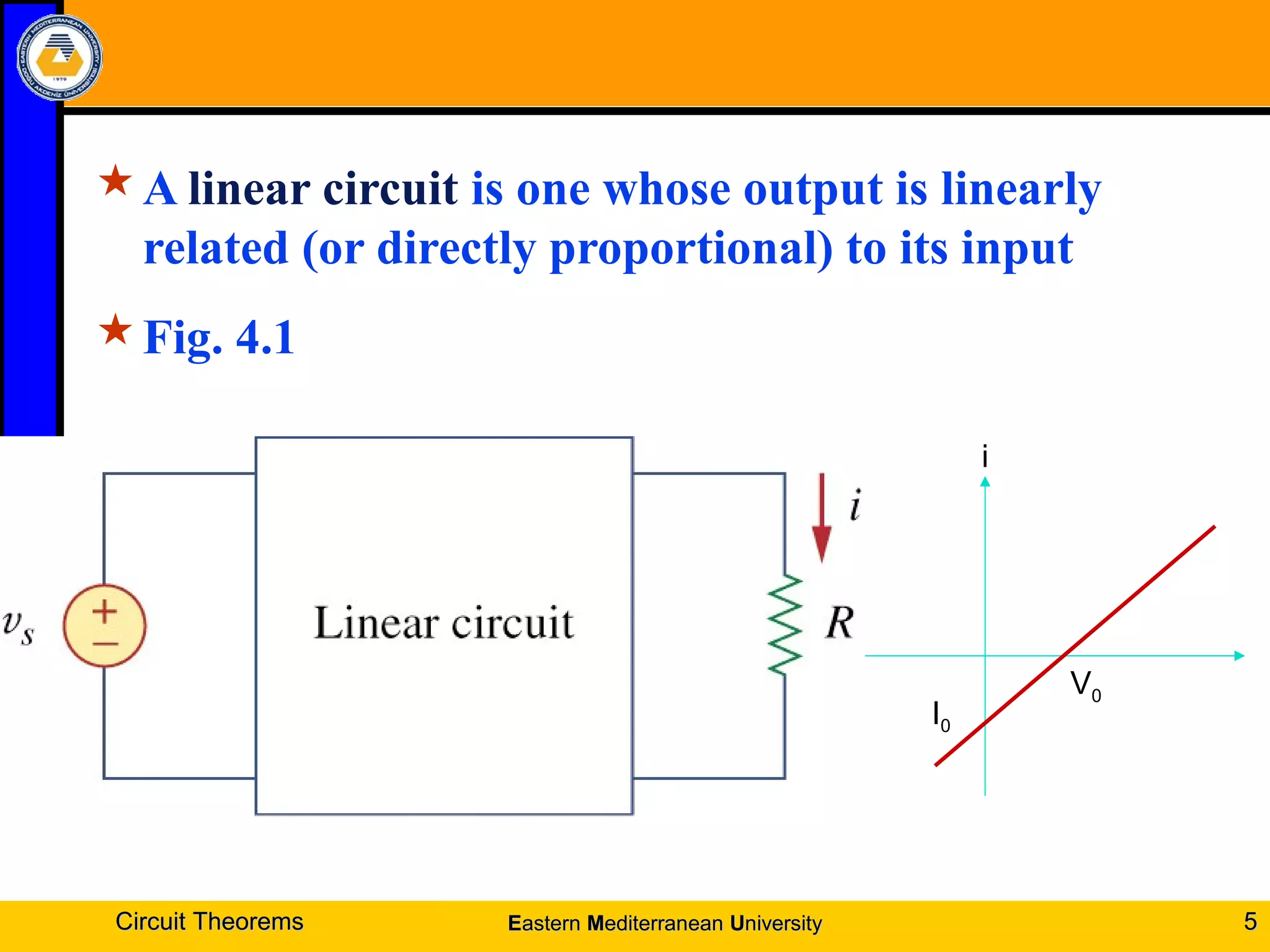
A linear circuit is one whose output is linearly
related (or directly proportional) to its input
Fig. 4.1
Circuit TheoremsCircuit Theorems 55
V0
I0
i
EEasternastern MMediterraneanediterranean UUniversityniversity
Linear circuit consist of
● linear elements
● linear dependent sources
● independent sources

Circuit TheoremsCircuit Theorems 66
mA1mV5
A2.0V1
A2V10
=←=
=→=
=→=
iv
iv
iv
s
s
s
nonlinear
R
v
Rip :
2
2
==
EEasternastern MMediterraneanediterranean UUniversityniversity
Example 4.1Example 4.1
For the circuit in fig 4.2 find I0 when vs=12V and
vs=24V.
Circuit TheoremsCircuit Theorems 77EEasternastern MMediterraneanediterranean UUniversityniversity
Example 4.1Example 4.1
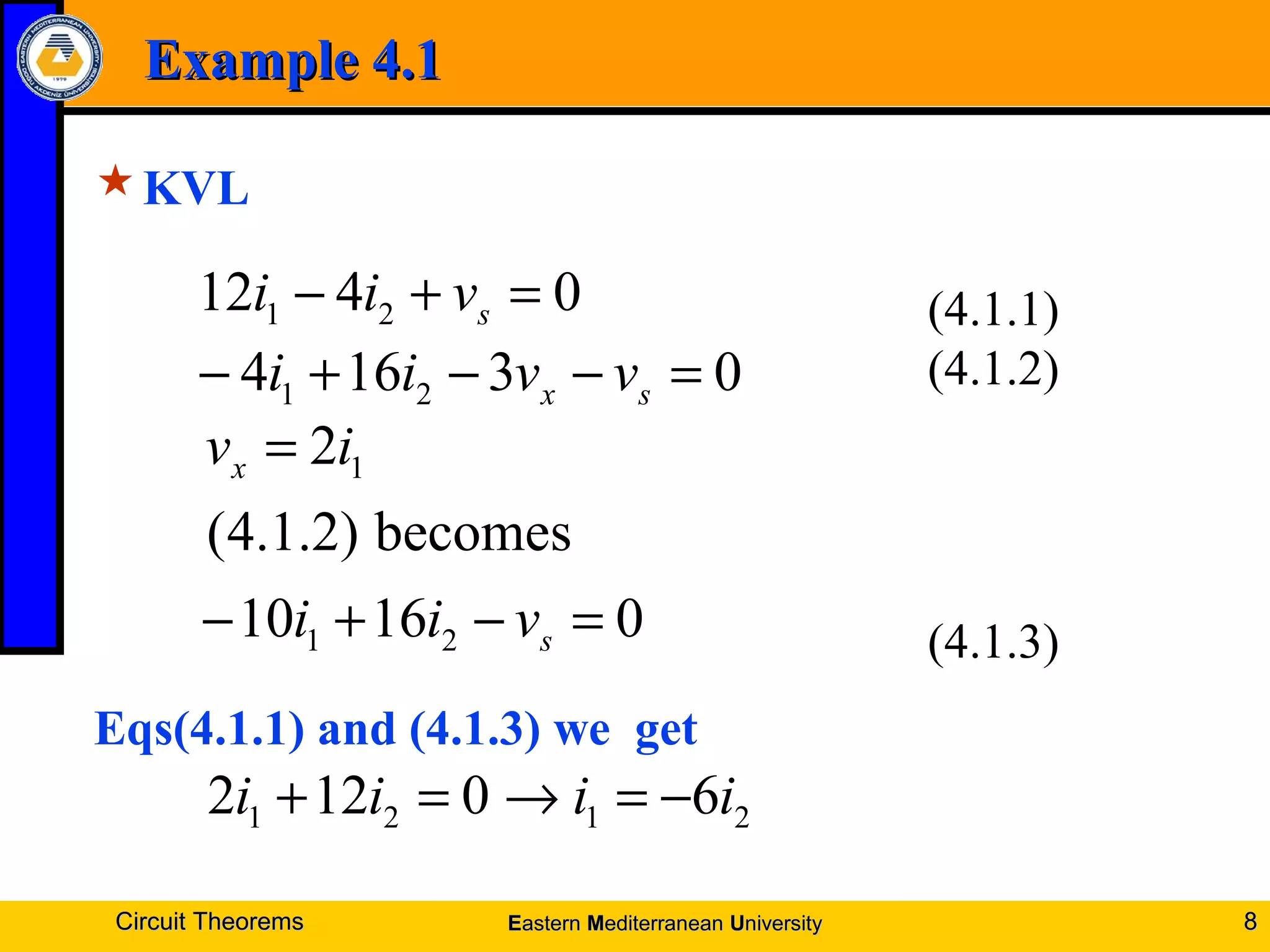
KVL
Eqs(4.1.1) and (4.1.3) we get
Circuit TheoremsCircuit Theorems 88
0412 21 =+− svii
03164 21 =−−+− sx vvii
12ivx =
becomes)2.1.4(
01610 21 =−+− svii
(4.1.1)
(4.1.2)
(4.1.3)
2121 60122 iiii −=→=+
EEasternastern MMediterraneanediterranean UUniversityniversity
Example 4.1Example 4.1
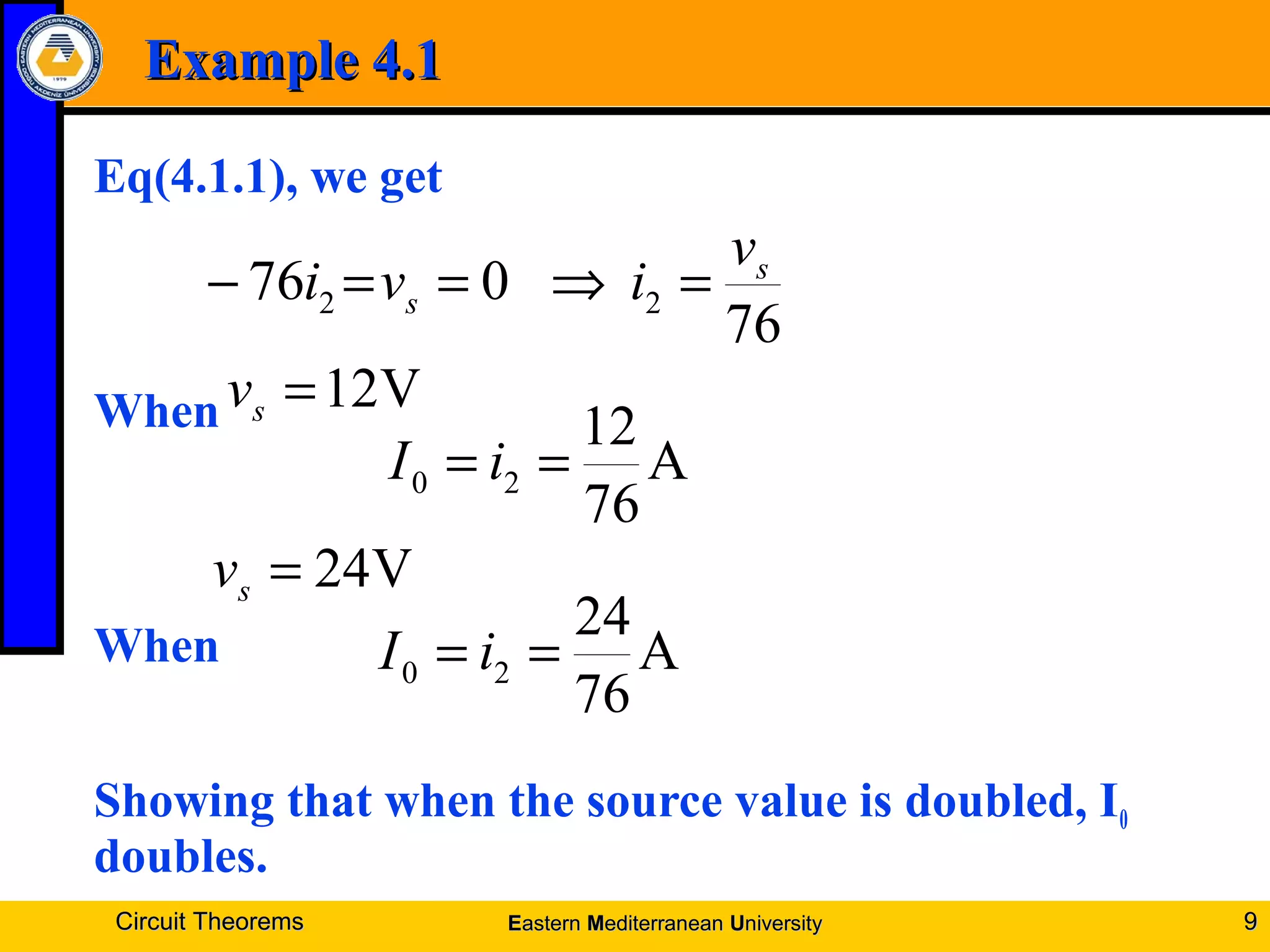
Eq(4.1.1), we get
When
When
Showing that when the source value is doubled, I0
doubles.
Circuit TheoremsCircuit Theorems 99
76
076 22
s
s
v
ivi =⇒==−
A
76
12
20 == iI
V12=sv
A
76
24
20 == iI
V24=sv
EEasternastern MMediterraneanediterranean UUniversityniversity
Example 4.2Example 4.2
Assume I0 = 1 A and use linearity to find the actual
value of I0 in the circuit in fig 4.4.
Circuit TheoremsCircuit Theorems 1010EEasternastern MMediterraneanediterranean UUniversityniversity
Example 4.2Example 4.2
Circuit TheoremsCircuit Theorems 1111
A,24/
V8)53(thenA,1If
11
010
==
=+==
vI
IvI
A3012 =+= III
A2
7
,V14682 2
3212 ===+=+=
V
IIVV
⇒=+= A5234 III A5=SI
A510 =→= SIAI
A15A30 =←= SII
EEasternastern MMediterraneanediterranean UUniversityniversity
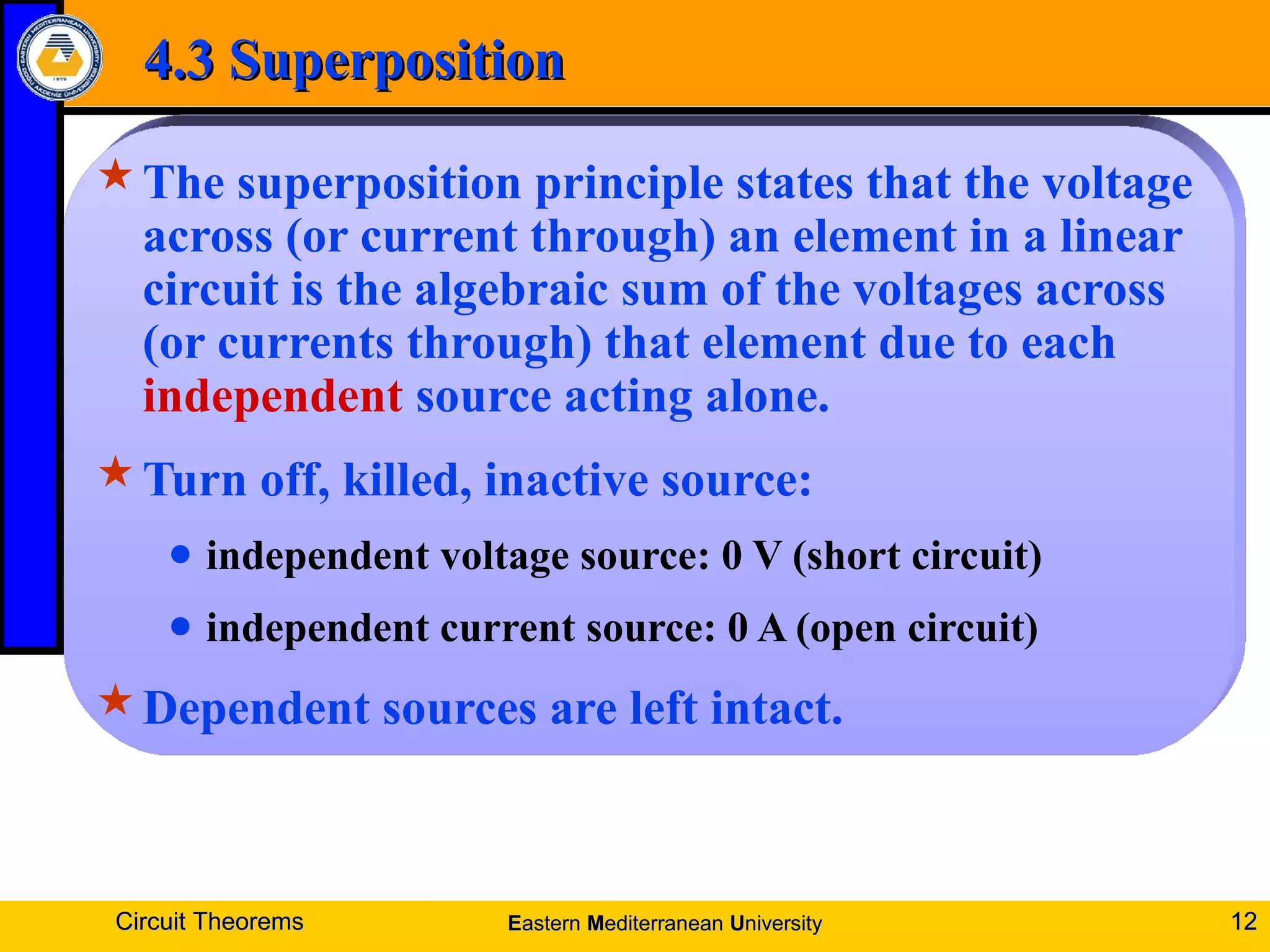
4.3 Superposition4.3 Superposition
The superposition principle states that the voltage
across (or current through) an element in a linear
circuit is the algebraic sum of the voltages across
(or currents through) that element due to each
independent source acting alone.
Turn off, killed, inactive source:
● independent voltage source: 0 V (short circuit)
● independent current source: 0 A (open circuit)
Dependent sources are left intact.
Circuit TheoremsCircuit Theorems 1212EEasternastern MMediterraneanediterranean UUniversityniversity
 Steps to apply superposition principle:
1. Turn off all independent sources except one source.
Find the output (voltage or current) due to that active
source using nodal or mesh analysis.
2. Repeat step 1 for each of the other independent
sources.
3. Find the total contribution by adding algebraically all
the contributions due to the independent sources.
Circuit TheoremsCircuit Theorems 1313EEasternastern MMediterraneanediterranean UUniversityniversity
How to turn off independent sourcesHow to turn off independent sources
Turn off voltages sources = short voltage sources;
make it equal to zero voltage
Turn off current sources = open current sources;
make it equal to zero current
Circuit TheoremsCircuit Theorems 1414EEasternastern MMediterraneanediterranean UUniversityniversity
Superposition involves more work but simpler
circuits.
Superposition is not applicable to the effect on
power.
Circuit TheoremsCircuit Theorems 1515EEasternastern MMediterraneanediterranean UUniversityniversity
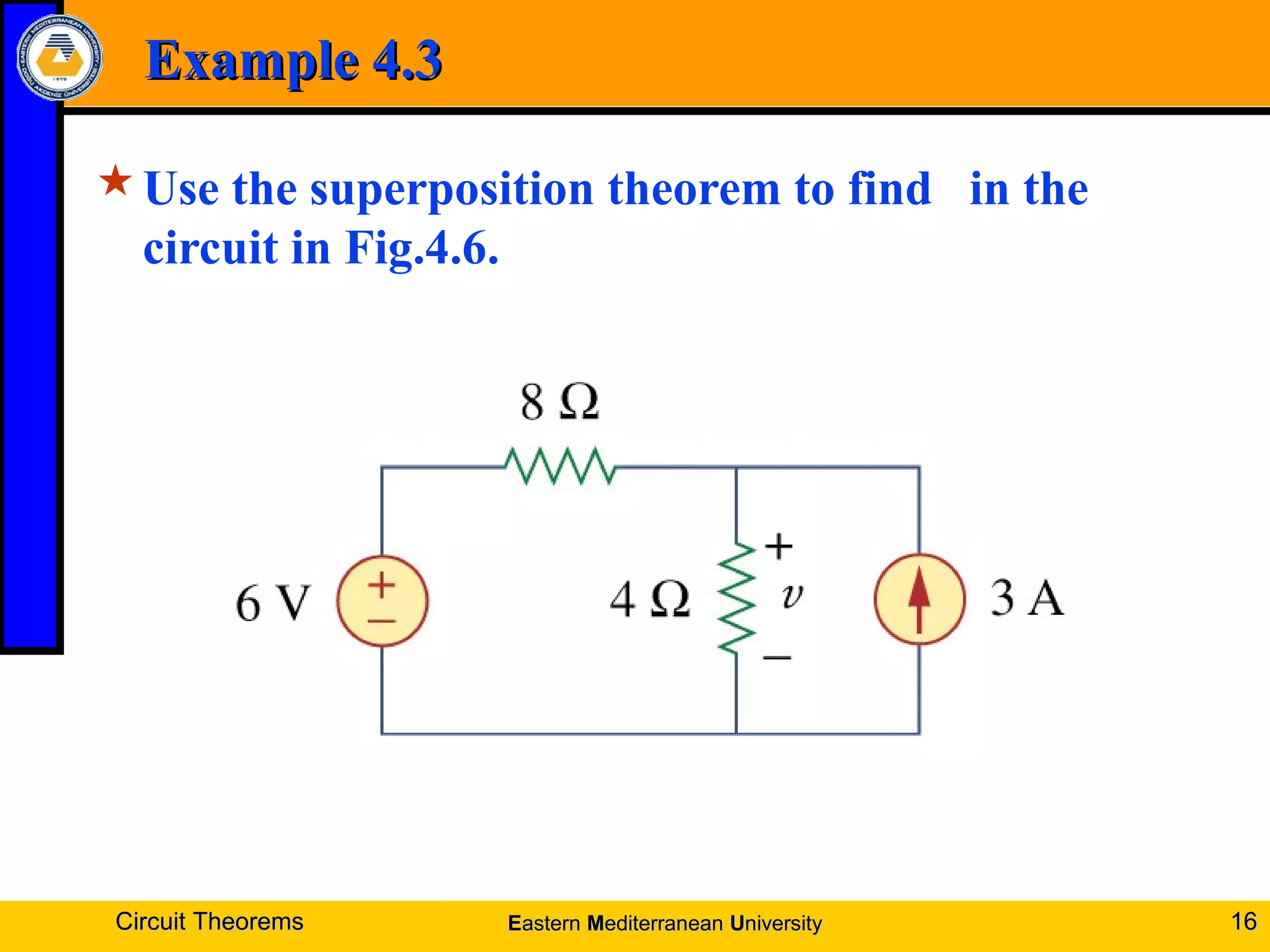
Example 4.3Example 4.3
Use the superposition theorem to find in the
circuit in Fig.4.6.
Circuit TheoremsCircuit Theorems 1616EEasternastern MMediterraneanediterranean UUniversityniversity
Example 4.3Example 4.3
Since there are two sources,
let
Voltage division to get
Current division, to get
Hence
And we find
Circuit TheoremsCircuit Theorems 1717
21 VVV +=
V2)6(
84
4
1 =
+
=V
A2)3(
84
8
3 =
+
=i
V84 32 == iv
V108221 =+=+= vvv
EEasternastern MMediterraneanediterranean UUniversityniversity
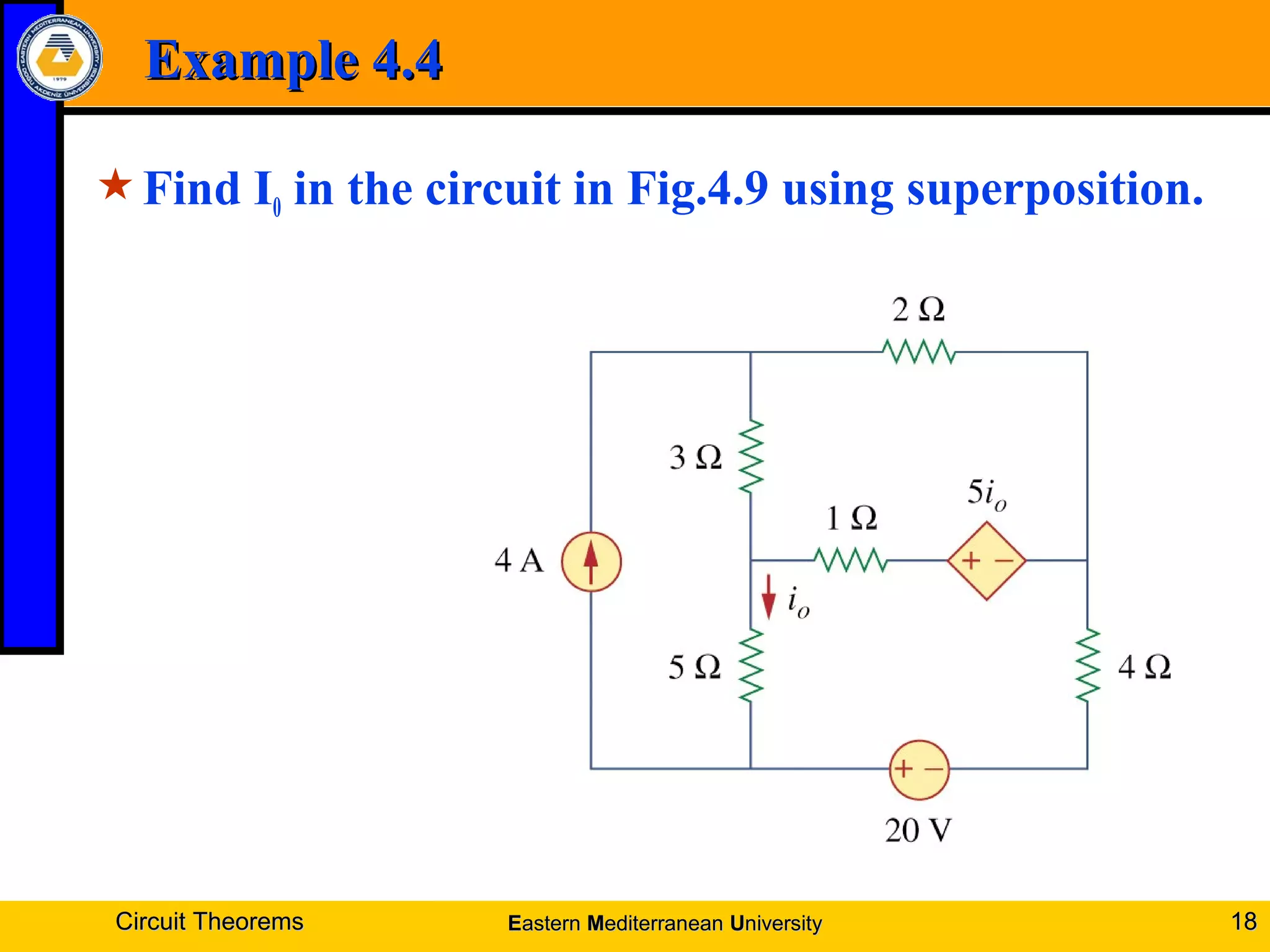
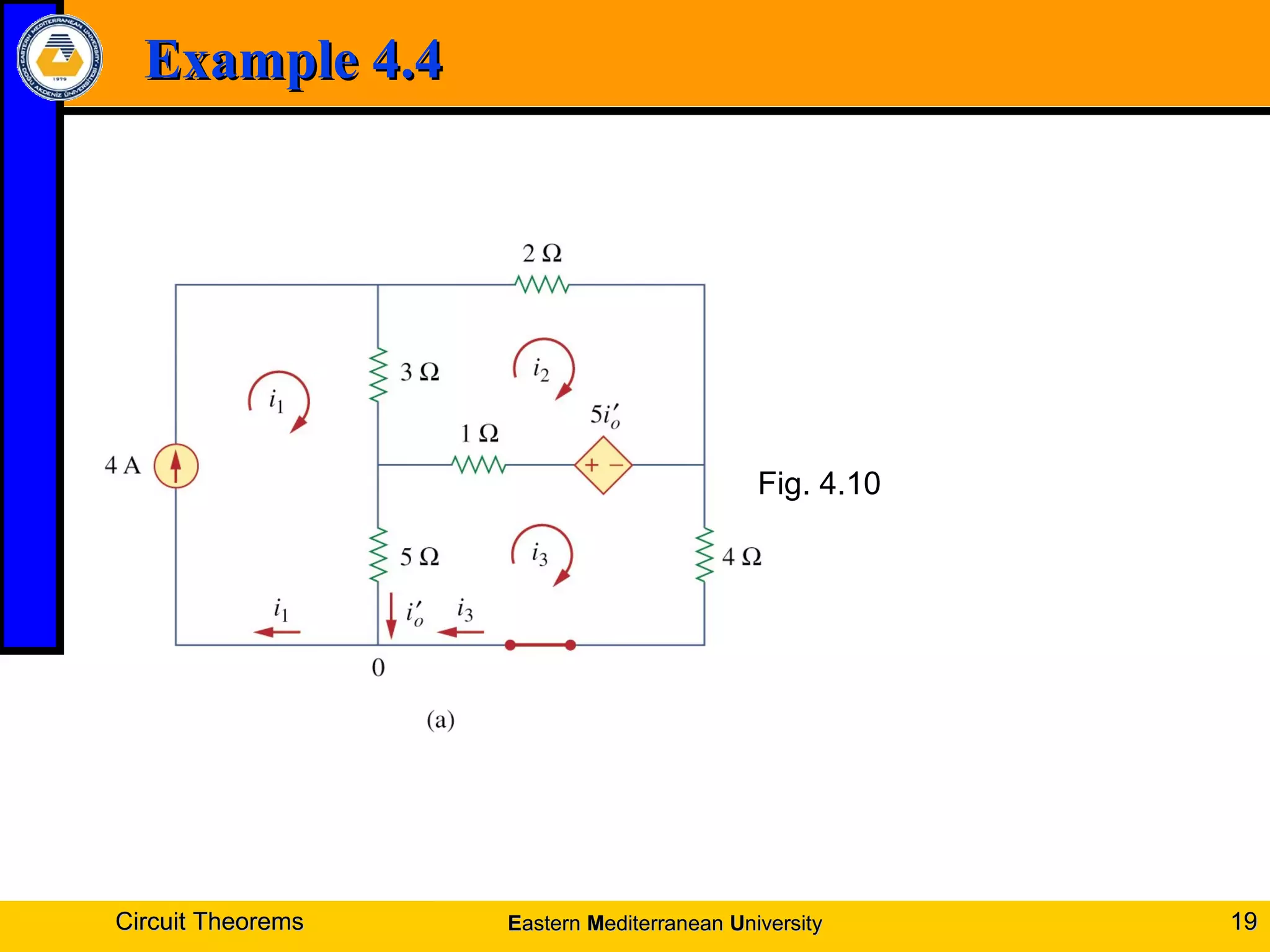
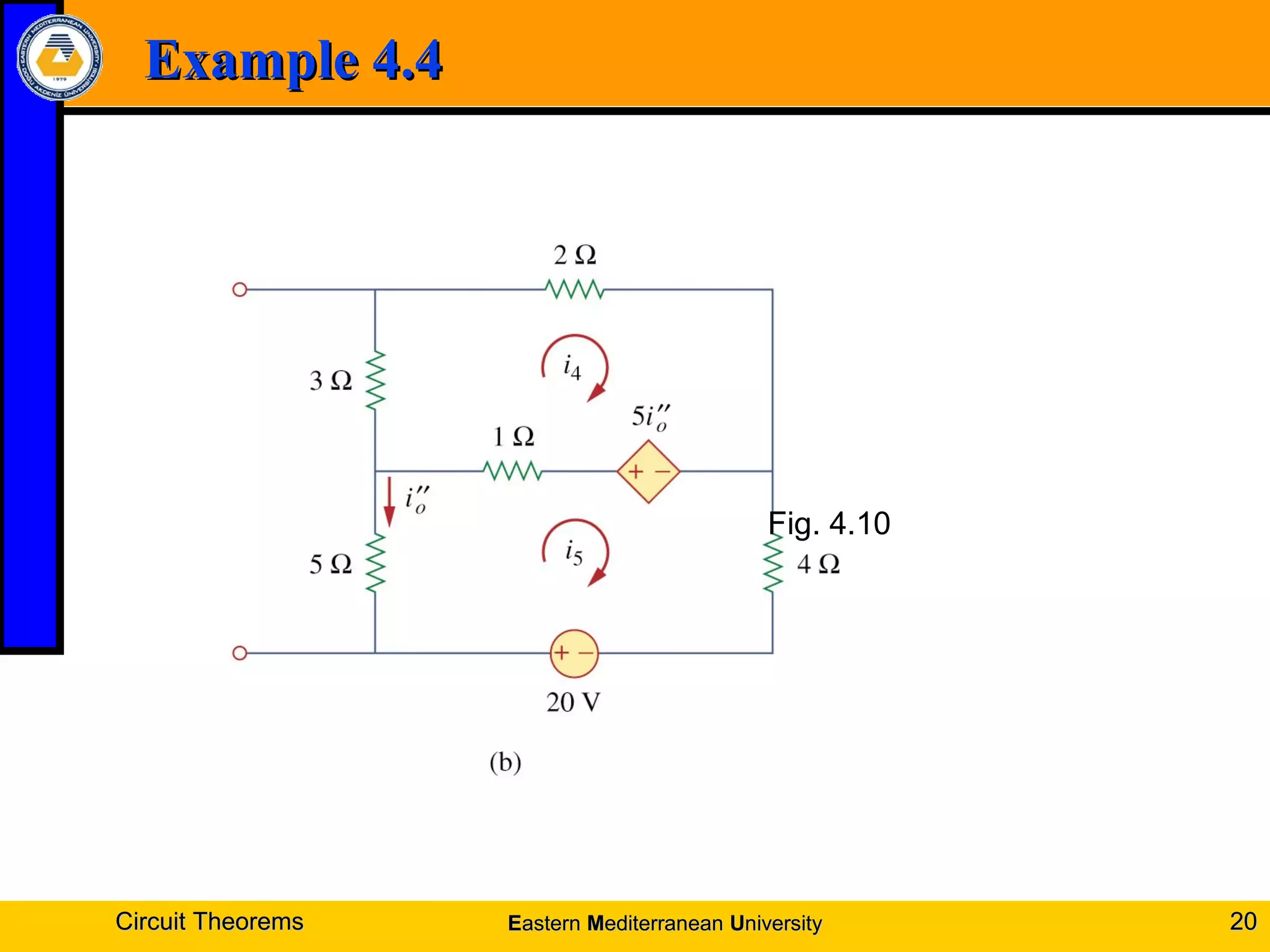
Example 4.4Example 4.4
Find I0 in the circuit in Fig.4.9 using superposition.
Circuit TheoremsCircuit Theorems 1818EEasternastern MMediterraneanediterranean UUniversityniversity
Example 4.4Example 4.4
Circuit TheoremsCircuit Theorems 1919
Fig. 4.10
EEasternastern MMediterraneanediterranean UUniversityniversity
Example 4.4Example 4.4
Circuit TheoremsCircuit Theorems 2020
Fig. 4.10
EEasternastern MMediterraneanediterranean UUniversityniversity
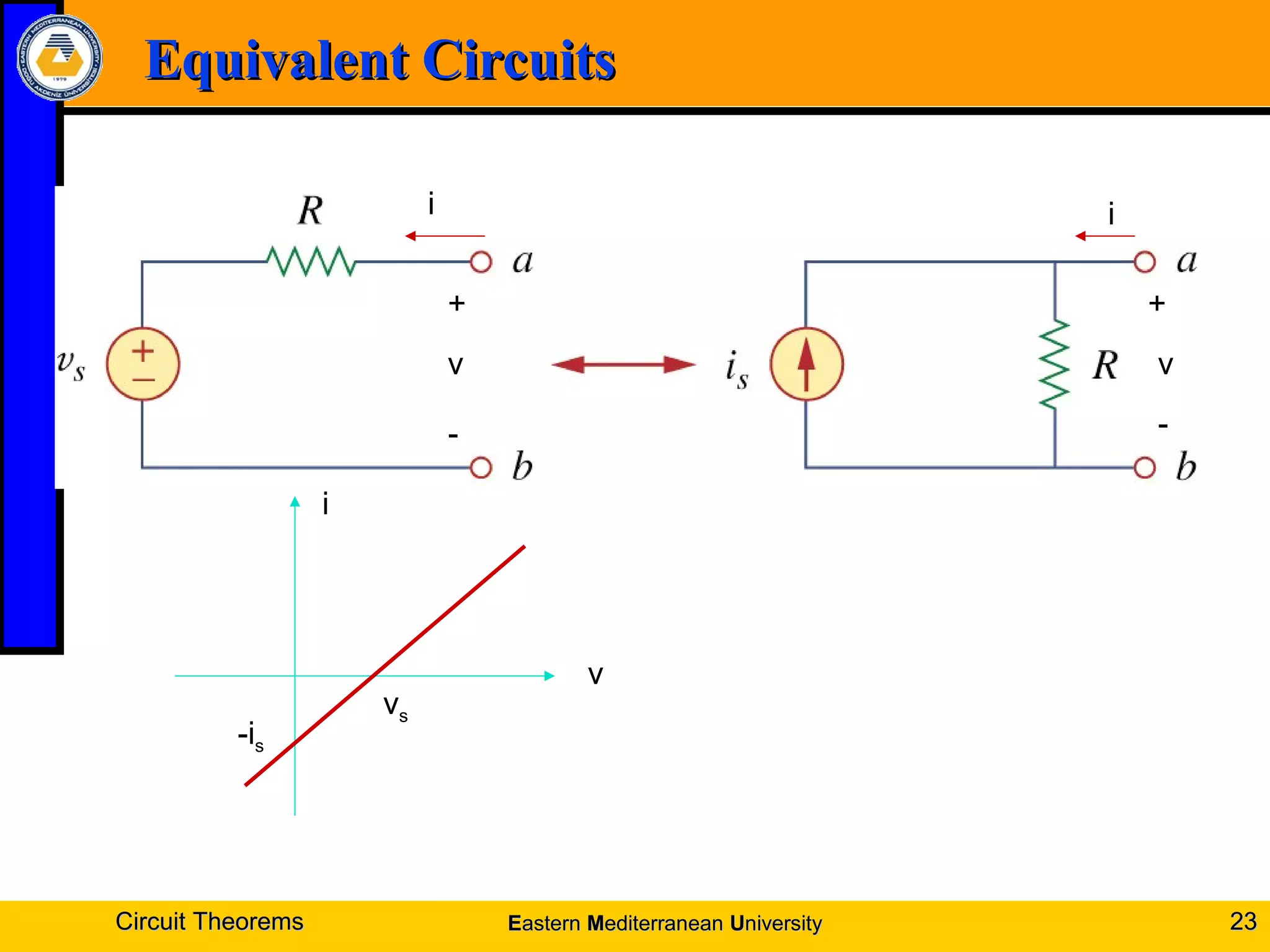
4.5 Source Transformation4.5 Source Transformation
A source transformation is the process of replacing
a voltage source vs in series with a resistor R by a
current source is in parallel with a resistor R, or
vice versa
Circuit TheoremsCircuit Theorems 2121EEasternastern MMediterraneanediterranean UUniversityniversity
Fig. 4.15 & 4.16Fig. 4.15 & 4.16
R
v
iRiv s
sss == or
Circuit TheoremsCircuit Theorems 2222EEasternastern MMediterraneanediterranean UUniversityniversity
Equivalent CircuitsEquivalent Circuits
R
v
R
v
i
viRv
s
s
−=
+=
Circuit TheoremsCircuit Theorems 2323
i i
++
--
vv
v
i
vs
-is
EEasternastern MMediterraneanediterranean UUniversityniversity
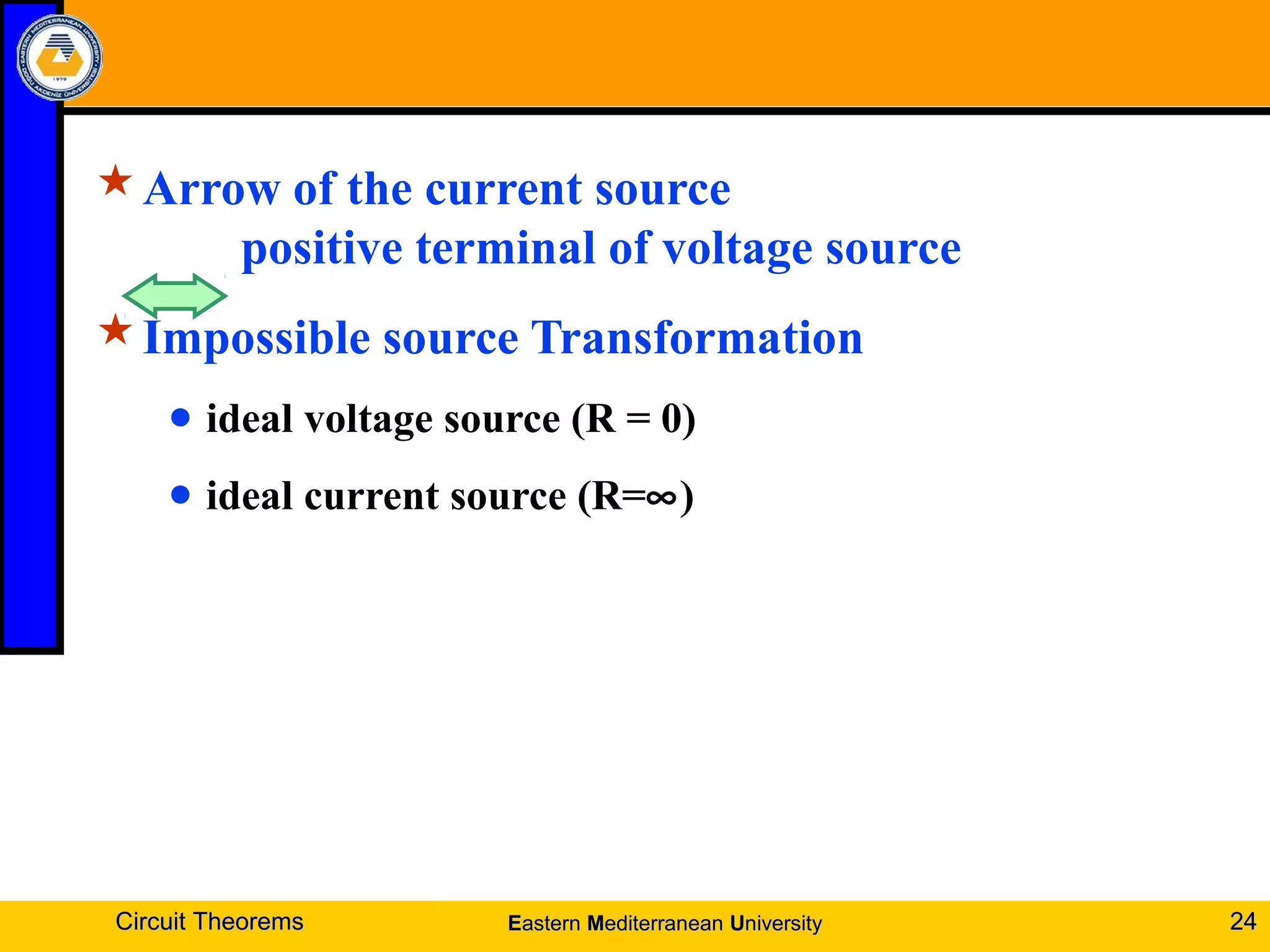
Arrow of the current source
positive terminal of voltage source
Impossible source Transformation
● ideal voltage source (R = 0)
● ideal current source (R=∞)
Circuit TheoremsCircuit Theorems 2424EEasternastern MMediterraneanediterranean UUniversityniversity
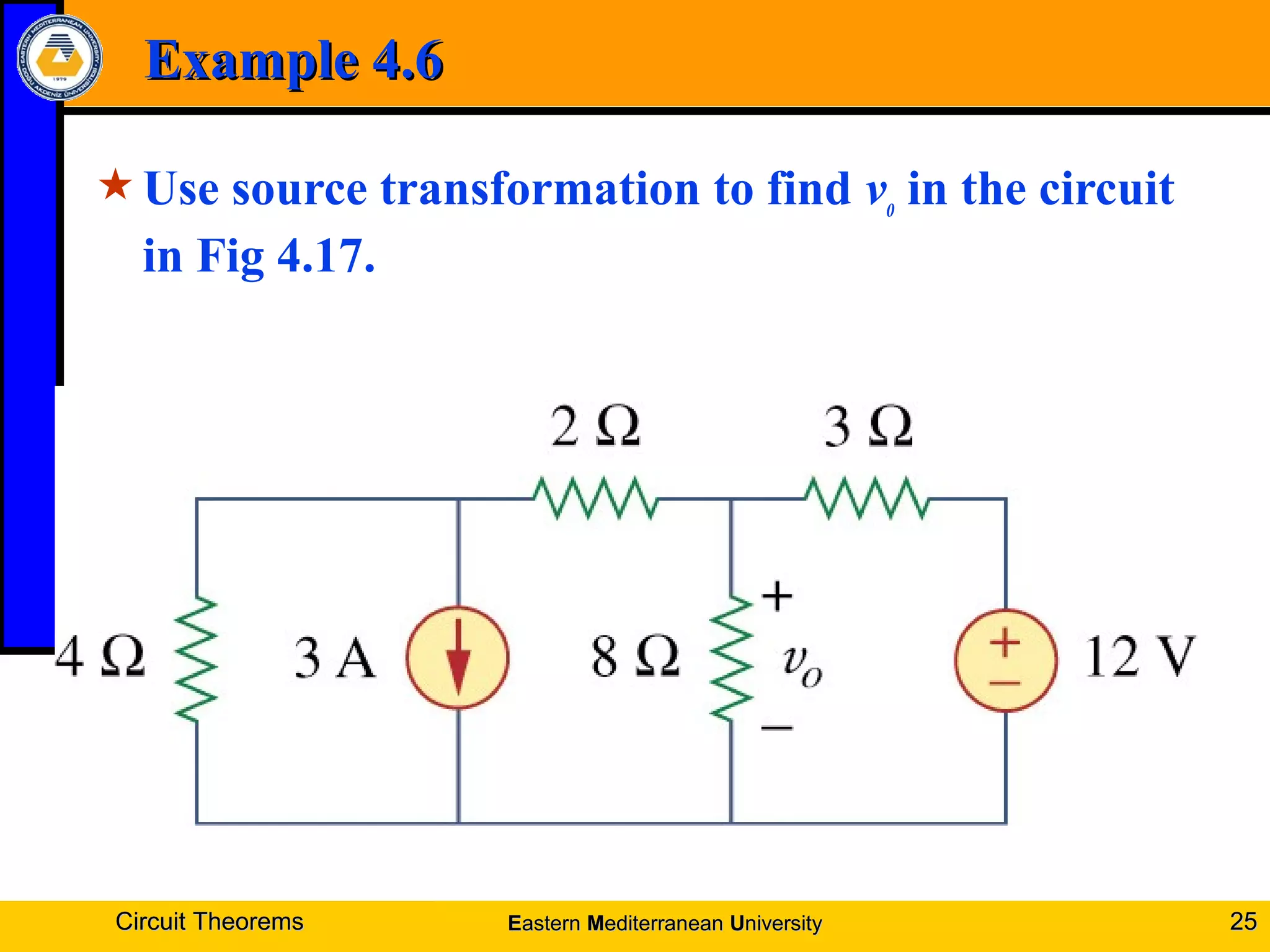
Example 4.6Example 4.6
Use source transformation to find vo in the circuit
in Fig 4.17.
Circuit TheoremsCircuit Theorems 2525EEasternastern MMediterraneanediterranean UUniversityniversity
Example 4.6Example 4.6
Circuit TheoremsCircuit Theorems 2626
Fig 4.18
EEasternastern MMediterraneanediterranean UUniversityniversity
Example 4.6Example 4.6
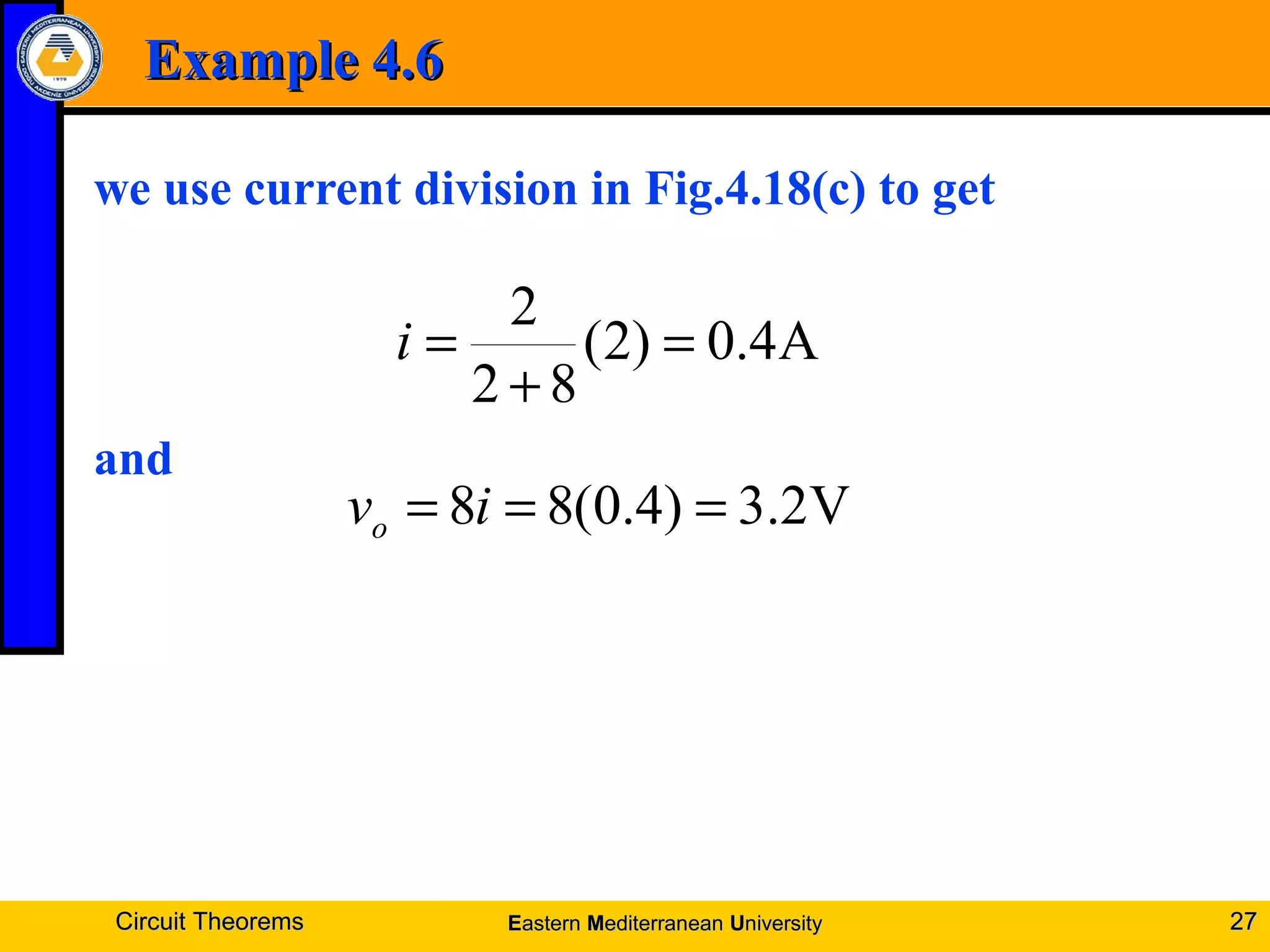
we use current division in Fig.4.18(c) to get
and
Circuit TheoremsCircuit Theorems 2727
A4.0)2(
82
2
=
+
=i
V2.3)4.0(88 === ivo
EEasternastern MMediterraneanediterranean UUniversityniversity
Example 4.7Example 4.7
Find vx in Fig.4.20 using source transformation
Circuit TheoremsCircuit Theorems 2828EEasternastern MMediterraneanediterranean UUniversityniversity
Example 4.7Example 4.7
Applying KVL around the loop in Fig 4.21(b) gives
(4.7.1)
Appling KVL to the loop containing only the 3V
voltage source, the resistor, and vx yields
(4.7.2)
Circuit TheoremsCircuit Theorems 2929
01853 =+++− xvi
Ω1
ivvi xx −=⇒=++− 3013
EEasternastern MMediterraneanediterranean UUniversityniversity
Example 4.7Example 4.7
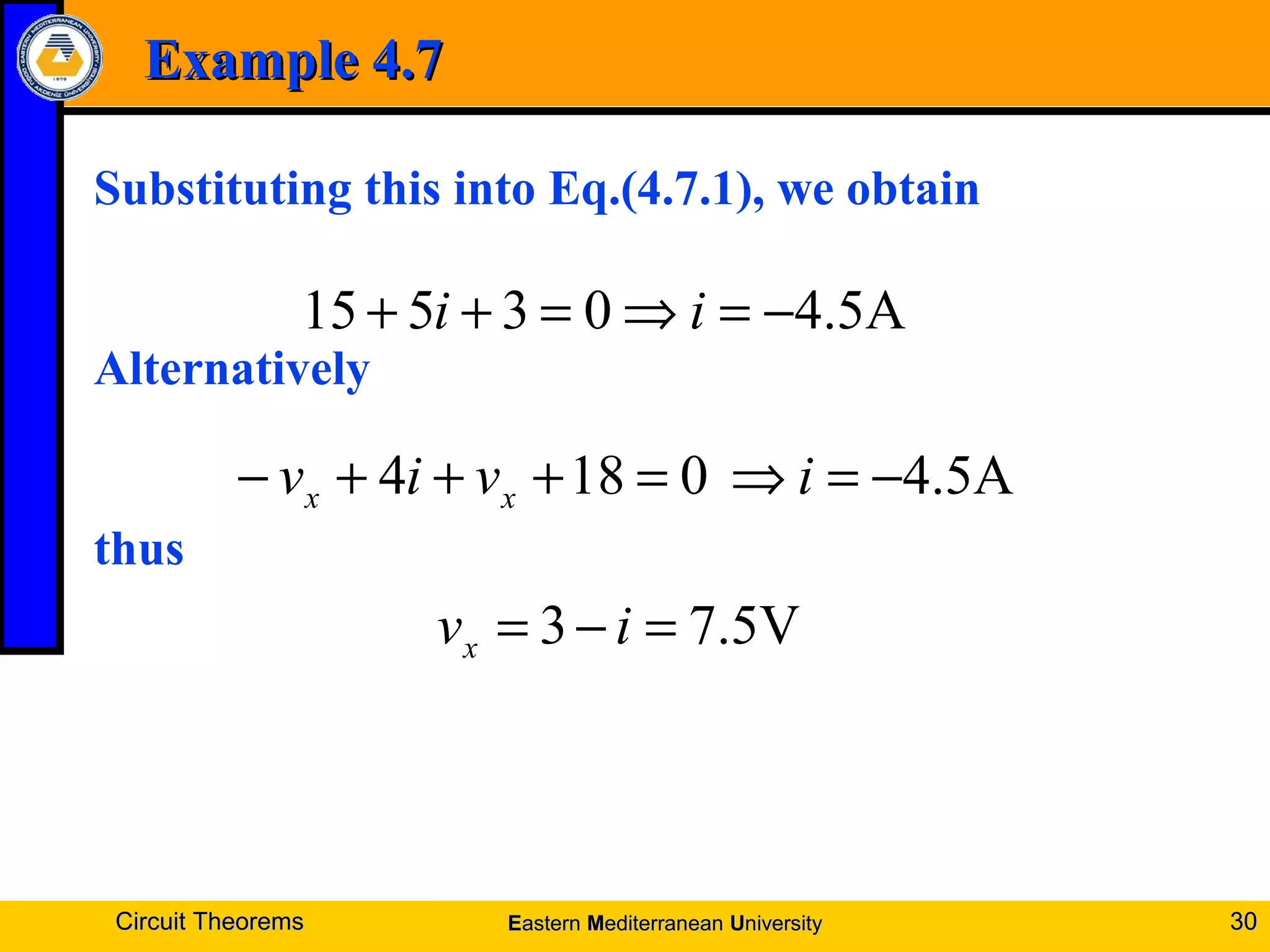
Substituting this into Eq.(4.7.1), we obtain
Alternatively
thus
Circuit TheoremsCircuit Theorems 3030
A5.403515 −=⇒=++ ii
A5.40184 −=⇒=+++− iviv xx
V5.73 =−= ivx
EEasternastern MMediterraneanediterranean UUniversityniversity
4.5 Thevenin’s Theorem4.5 Thevenin’s Theorem
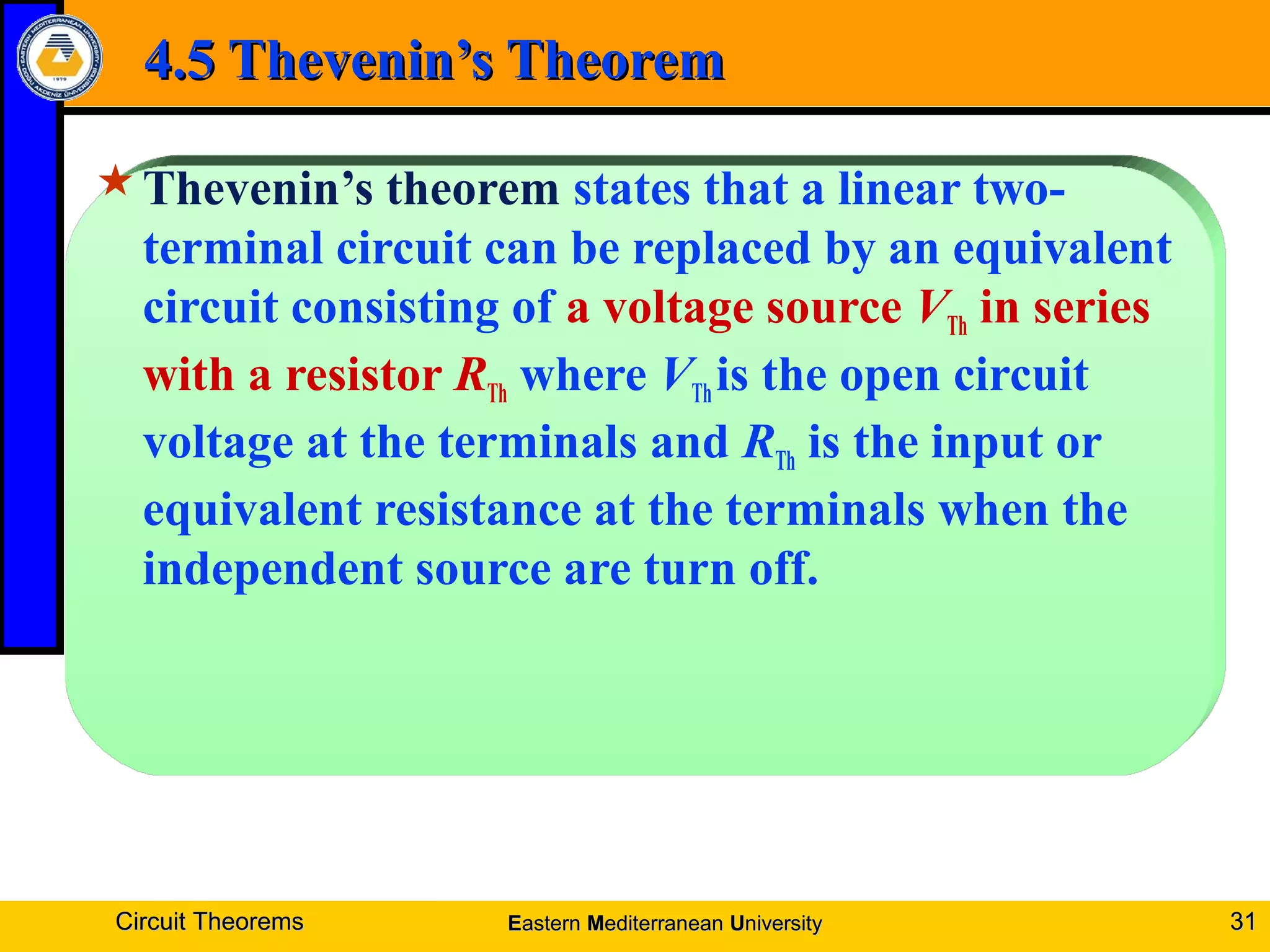
Thevenin’s theorem states that a linear two-
terminal circuit can be replaced by an equivalent
circuit consisting of a voltage source VTh in series
with a resistor RTh where VThis the open circuit
voltage at the terminals and RTh is the input or
equivalent resistance at the terminals when the
independent source are turn off.
Circuit TheoremsCircuit Theorems 3131EEasternastern MMediterraneanediterranean UUniversityniversity
Property of Linear CircuitsProperty of Linear Circuits
Circuit TheoremsCircuit Theorems 3232
i
v
v
i
Any two-terminal
Linear Circuits
+
-
Vth
Isc
Slope=1/Rth
EEasternastern MMediterraneanediterranean UUniversityniversity
Fig. 4.23Fig. 4.23
Circuit TheoremsCircuit Theorems 3333EEasternastern MMediterraneanediterranean UUniversityniversity
How to Find Thevenin’s VoltageHow to Find Thevenin’s Voltage
Equivalent circuit: same voltage-current relation at
the terminals.

Circuit TheoremsCircuit Theorems 3434
:Th ocvV = ba −atltagecircuit voopen
EEasternastern MMediterraneanediterranean UUniversityniversity
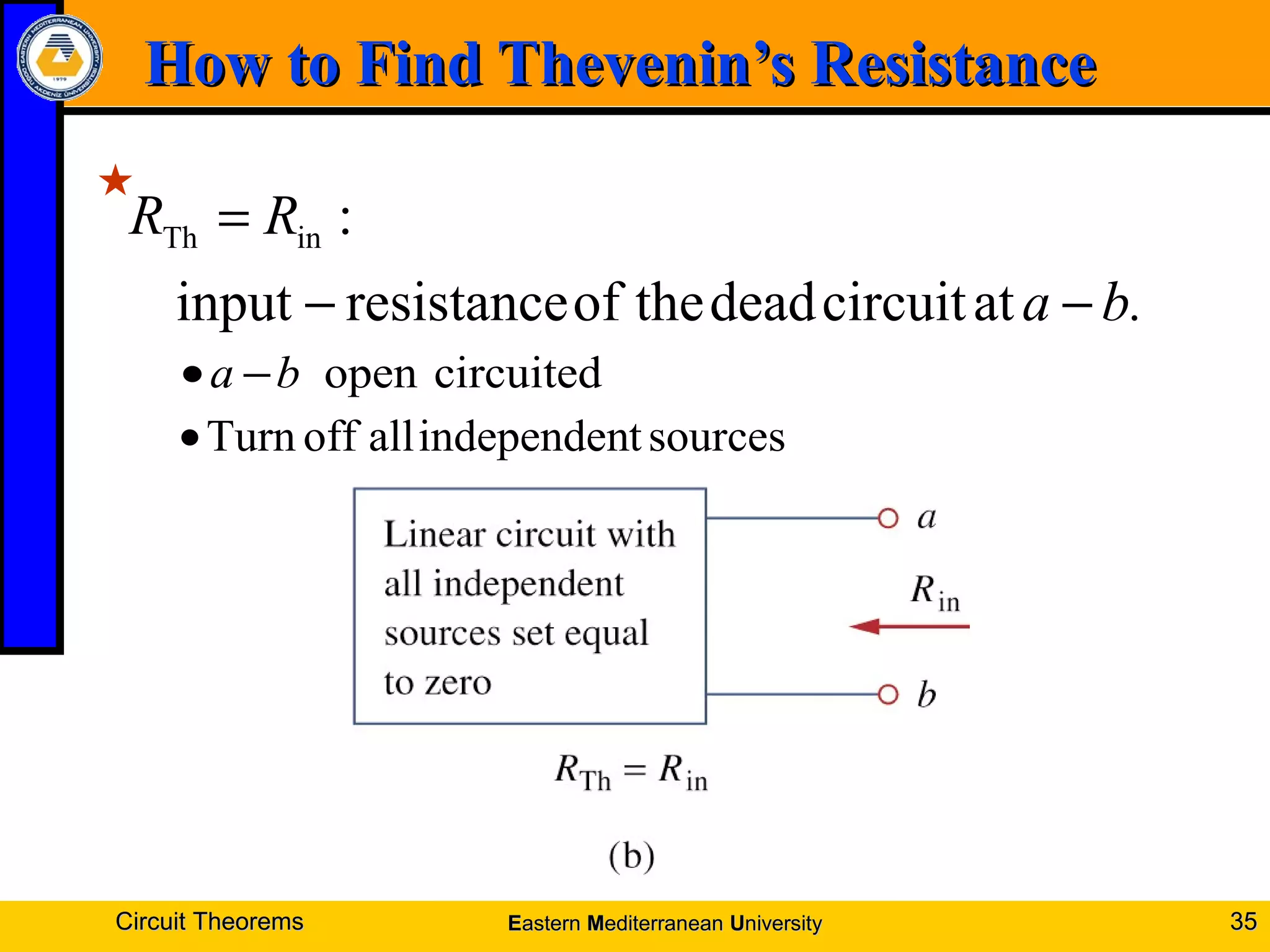
How to Find Thevenin’s ResistanceHow to Find Thevenin’s Resistance

Circuit TheoremsCircuit Theorems 3535
:inTh RR =
b.a −− atcircuitdeadtheofresistanceinput
circuitedopenba −•
sourcestindependenalloffTurn•
EEasternastern MMediterraneanediterranean UUniversityniversity
CASE 1
 If the network has no dependent sources:
● Turn off all independent source.
● RTH: can be obtained via simplification of either parallel
or series connection seen from a-b
Circuit TheoremsCircuit Theorems 3636EEasternastern MMediterraneanediterranean UUniversityniversity
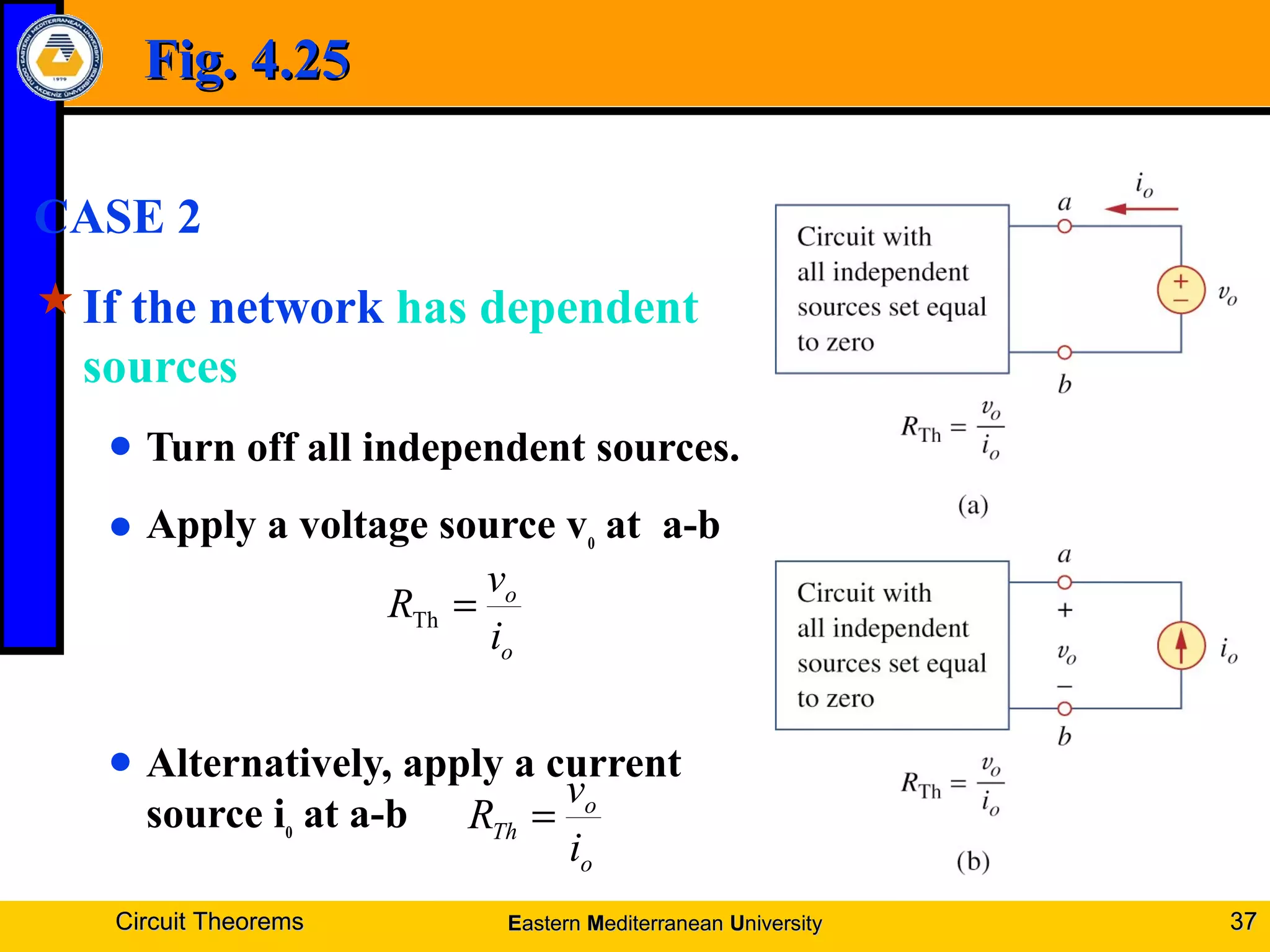
Fig. 4.25Fig. 4.25
CASE 2
If the network has dependent
sources
● Turn off all independent sources.
● Apply a voltage source vo at a-b
● Alternatively, apply a current
source io at a-b
Circuit TheoremsCircuit Theorems 3737
o
o
i
v
R =Th
o
o
Th
i
v
R =
EEasternastern MMediterraneanediterranean UUniversityniversity
The Thevenin’s resistance may be negative,
indicating that the circuit has ability providing
power
Circuit TheoremsCircuit Theorems 3838EEasternastern MMediterraneanediterranean UUniversityniversity
Fig. 4.26Fig. 4.26
Simplified circuit
Voltage divider
Circuit TheoremsCircuit Theorems 3939
L
L
RR
V
I
+
=
Th
Th
Th
Th
V
RR
R
IRV
L
L
LLL
+
==
EEasternastern MMediterraneanediterranean UUniversityniversity
Example 4.8Example 4.8
Find the Thevenin’s equivalent circuit of the circuit
shown in Fig 4.27, to the left of the terminals a-b.
Then find the current through RL = 6,16,and 36 Ω.
Circuit TheoremsCircuit Theorems 4040EEasternastern MMediterraneanediterranean UUniversityniversity
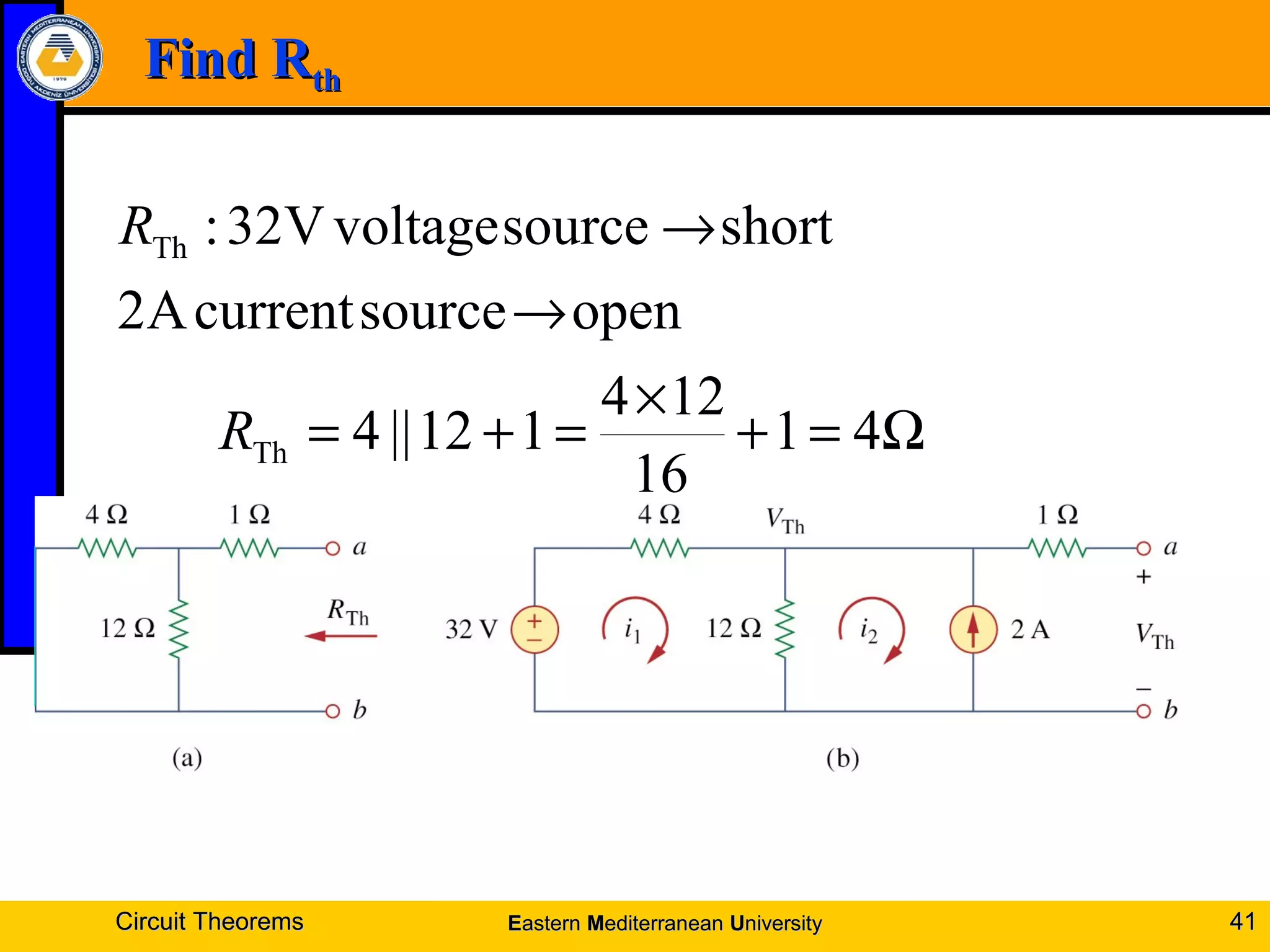
Find RFind Rthth
Circuit TheoremsCircuit Theorems 4141
shortsourcevoltageV32:Th →R
opensourcecurrentA2 →
Ω=+
×
=+= 41
16
124
112||4ThR
EEasternastern MMediterraneanediterranean UUniversityniversity
Find VFind Vthth
Circuit TheoremsCircuit Theorems 4242
analysisMesh)1(
:ThV
A2,0)(12432 2211 −==−++− iiii
A5.01 =∴i
V30)0.25.0(12)(12 21Th =+=−= iiV
AnalysisNodalely,Alternativ)2(
12/24/)32( ThTh VV =+−
V30Th =∴V
EEasternastern MMediterraneanediterranean UUniversityniversity
Example 4.8Example 4.8
Circuit TheoremsCircuit Theorems 4343Fig. 4.29
transformsourceely,Alternativ)3(
V3024396
12
2
4
32
THTHTH
THTH
=⇒=+−
=+
−
VVV
VV
EEasternastern MMediterraneanediterranean UUniversityniversity
Example 4.8Example 4.8
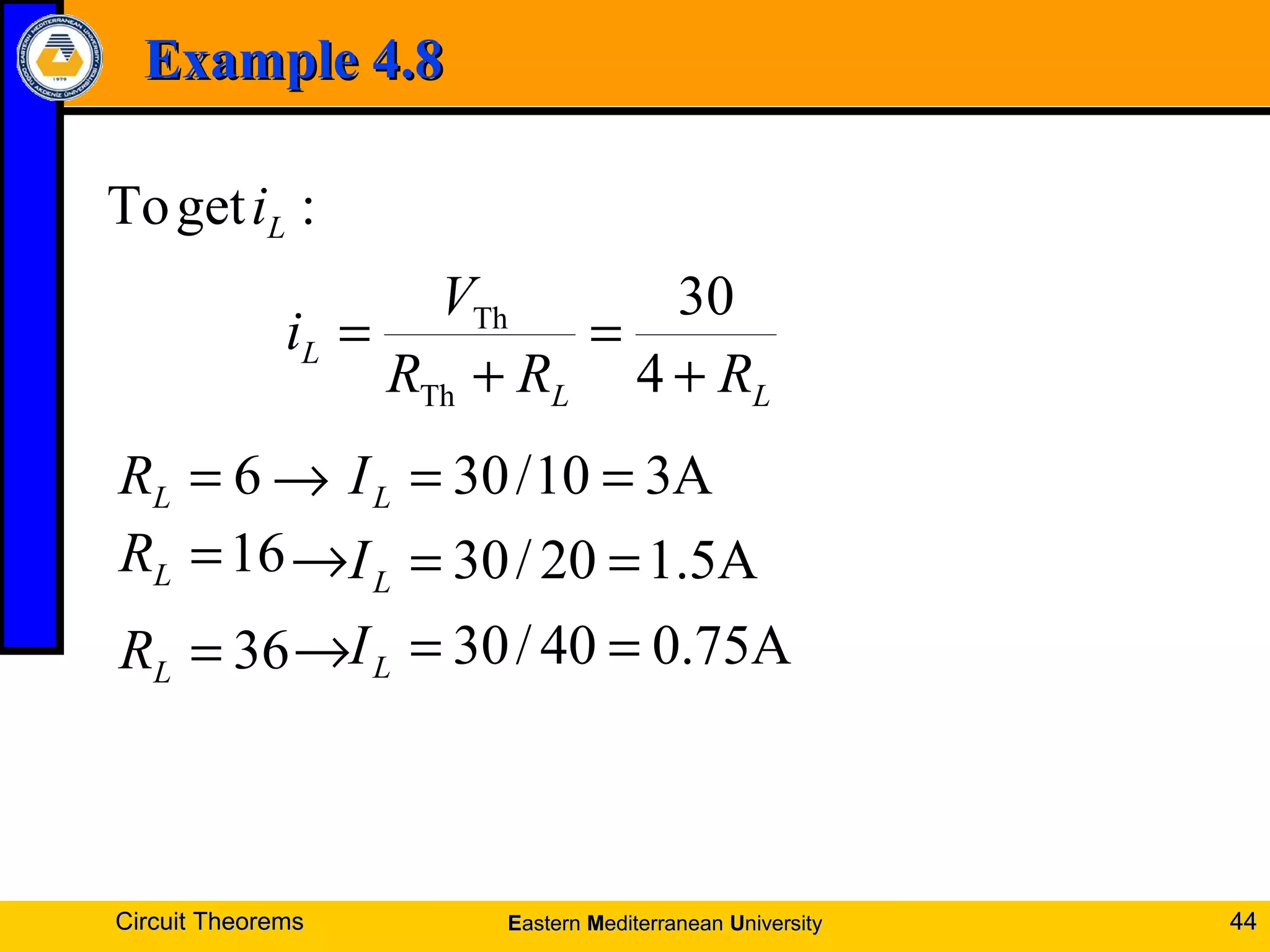
Circuit TheoremsCircuit Theorems 4444
:getTo Li
LL
L
RRR
V
i
+
=
+
=
4
30
Th
Th
6=LR A310/30 ==LI
16=LR A5.120/30 ==LI
A75.040/30 ==LI36=LR
→
→
→
EEasternastern MMediterraneanediterranean UUniversityniversity
Example 4.9Example 4.9
Find the Thevenin’s equivalent of the circuit in Fig.
4.31 at terminals a-b.
Circuit TheoremsCircuit Theorems 4545EEasternastern MMediterraneanediterranean UUniversityniversity
Example 4.9Example 4.9
(independent + dependent source case)
Circuit TheoremsCircuit Theorems 4646
Fig(a):findTo ThR
0sourcetindependen →
intact→sourcedependent
,V1=ov
oo
o
ii
v
R
1
Th ==
EEasternastern MMediterraneanediterranean UUniversityniversity
Example 4.9Example 4.9
For loop 1,
Circuit TheoremsCircuit Theorems 4747
2121 or0)(22 iiviiv xx −==−+−
214But iivi x −==−
21 3ii −=∴
EEasternastern MMediterraneanediterranean UUniversityniversity
Example 4.9Example 4.9
Circuit TheoremsCircuit Theorems 4848
:3and2Loop
0)(6)(24 32122 =−+−+ iiiii
012)(6 323 =++− iii
givesequationstheseSolving
.A6/13 −=i
A
6
1
But 3 =−= iio
Ω==∴ 6
1
Th
oi
V
R
EEasternastern MMediterraneanediterranean UUniversityniversity
Example 4.9Example 4.9
Circuit TheoremsCircuit Theorems 4949
⇒=−+− 0)(22 23 iivx
51 =i
Fig(b):getTo ThV
23 iivx −=
analysisMesh
⇒=+−+− 06)(2)(4 21212 iiiii 02412 312 =−− iii
.3/102 =∴i
V206 2Th === ivV oc
xvii =− )(4But 21
EEasternastern MMediterraneanediterranean UUniversityniversity
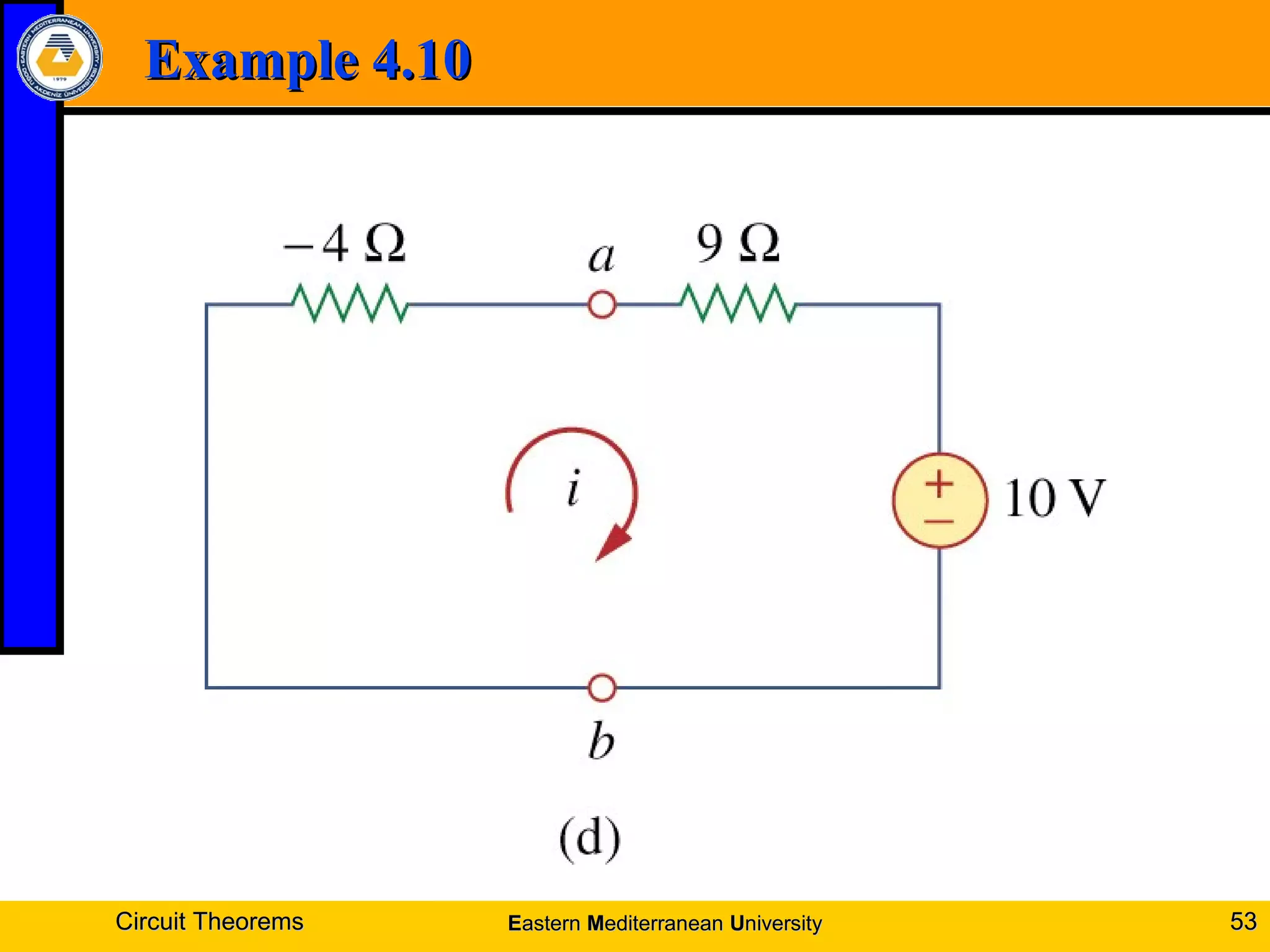
Example 4.10Example 4.10
Determine the Thevenin’s
equivalent circuit in
Fig.4.35(a).
Solution
Circuit TheoremsCircuit Theorems 5050
)caseonlysourcedependent(
o
o
i
v
R =Th0Th =V
:anaysisNodal
4/2 oxxo viii +=+
EEasternastern MMediterraneanediterranean UUniversityniversity
Example 4.10Example 4.10
Circuit TheoremsCircuit Theorems 5151
22
0 oo
x
vv
i −=
−
=But
4424
oooo
xo
vvvv
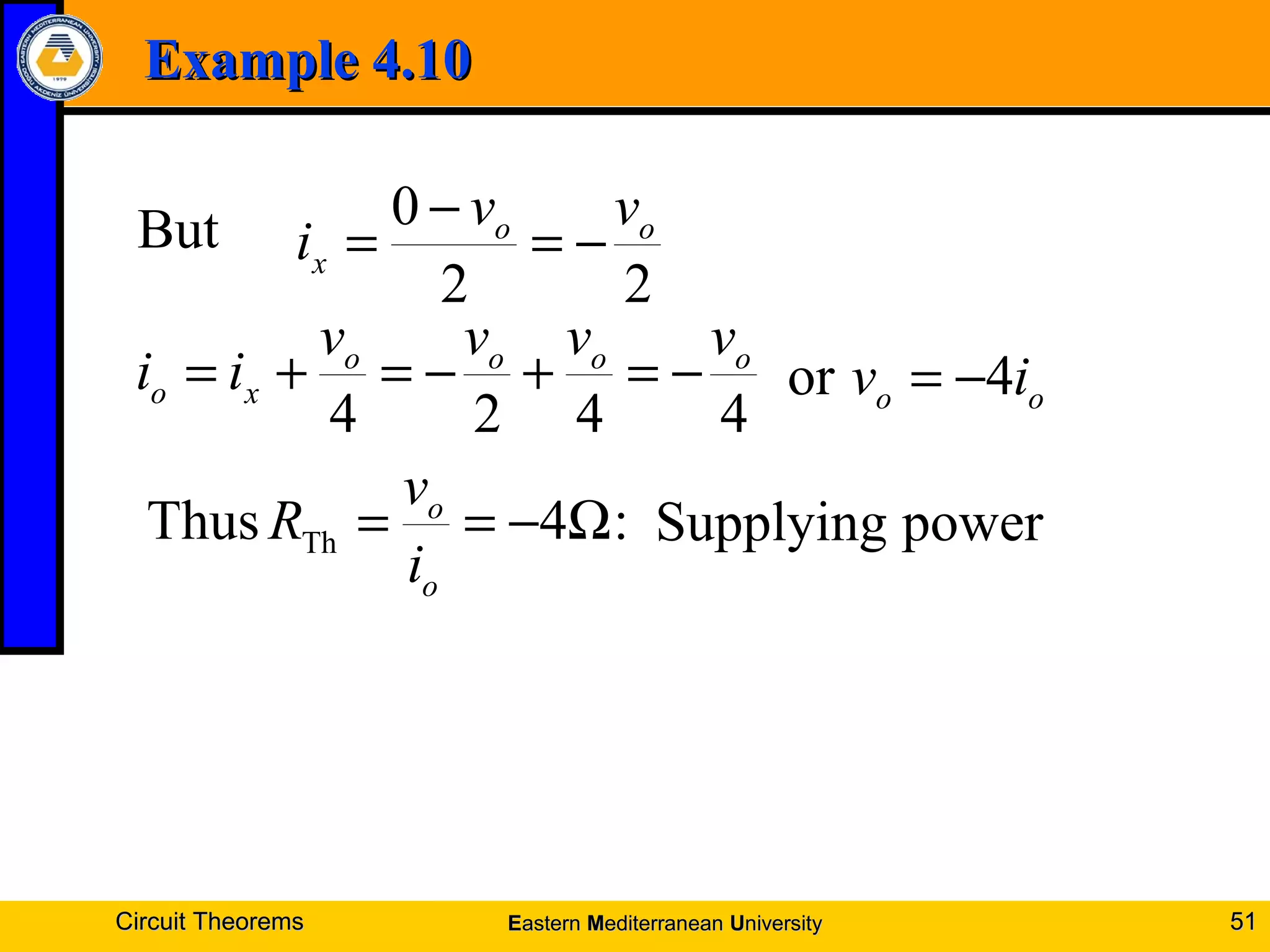
ii −=+−=+= oo iv 4or −=
:4Thus Th Ω−==
o
o
i
v
R powerSupplying
EEasternastern MMediterraneanediterranean UUniversityniversity
Example 4.10Example 4.10
Circuit TheoremsCircuit Theorems 5252EEasternastern MMediterraneanediterranean UUniversityniversity
Example 4.10Example 4.10
Circuit TheoremsCircuit Theorems 5353EEasternastern MMediterraneanediterranean UUniversityniversity
4.64.6 Norton’s TheoremNorton’s Theorem
Norton’s theorem states that a linear two-terminal
circuit can be replaced by equivalent circuit
consisting of a current source IN in parallel with a
resistor RN where IN is the short-circuit current
through the terminals and RN is the input or
equivalent resistance at the terminals when the
independent source are turn off.
Circuit TheoremsCircuit Theorems 5454EEasternastern MMediterraneanediterranean UUniversityniversity
Fig. 4.37Fig. 4.37
Circuit TheoremsCircuit Theorems 5555
v
i
Vth
-IN
Slope=1/RN
EEasternastern MMediterraneanediterranean UUniversityniversity
How to Find Norton CurrentHow to Find Norton Current
Thevenin and Norton
resistances are equal:
Short circuit current
from a to b :
Circuit TheoremsCircuit Theorems 5656
ThRRN =
Th
Th
R
V
iI scN ==
EEasternastern MMediterraneanediterranean UUniversityniversity
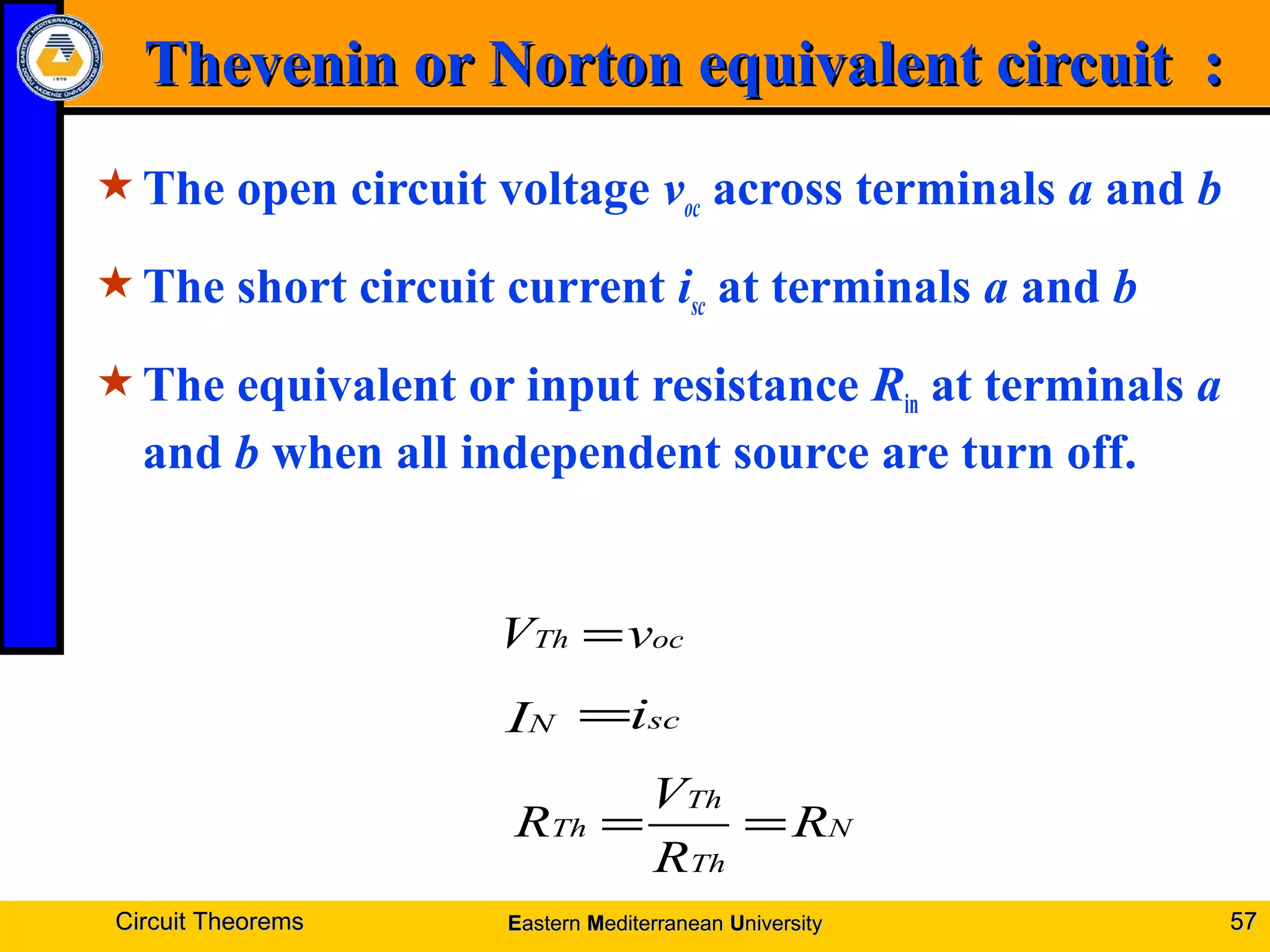
Thevenin or Norton equivalent circuit :Thevenin or Norton equivalent circuit :
The open circuit voltage voc across terminals a and b
The short circuit current isc at terminals a and b
The equivalent or input resistance Rin at terminals a
and b when all independent source are turn off.
Circuit TheoremsCircuit Theorems 5757
ocTh vV =
NI
Th
Th N
Th
V
R R
R
= =
= sci
EEasternastern MMediterraneanediterranean UUniversityniversity
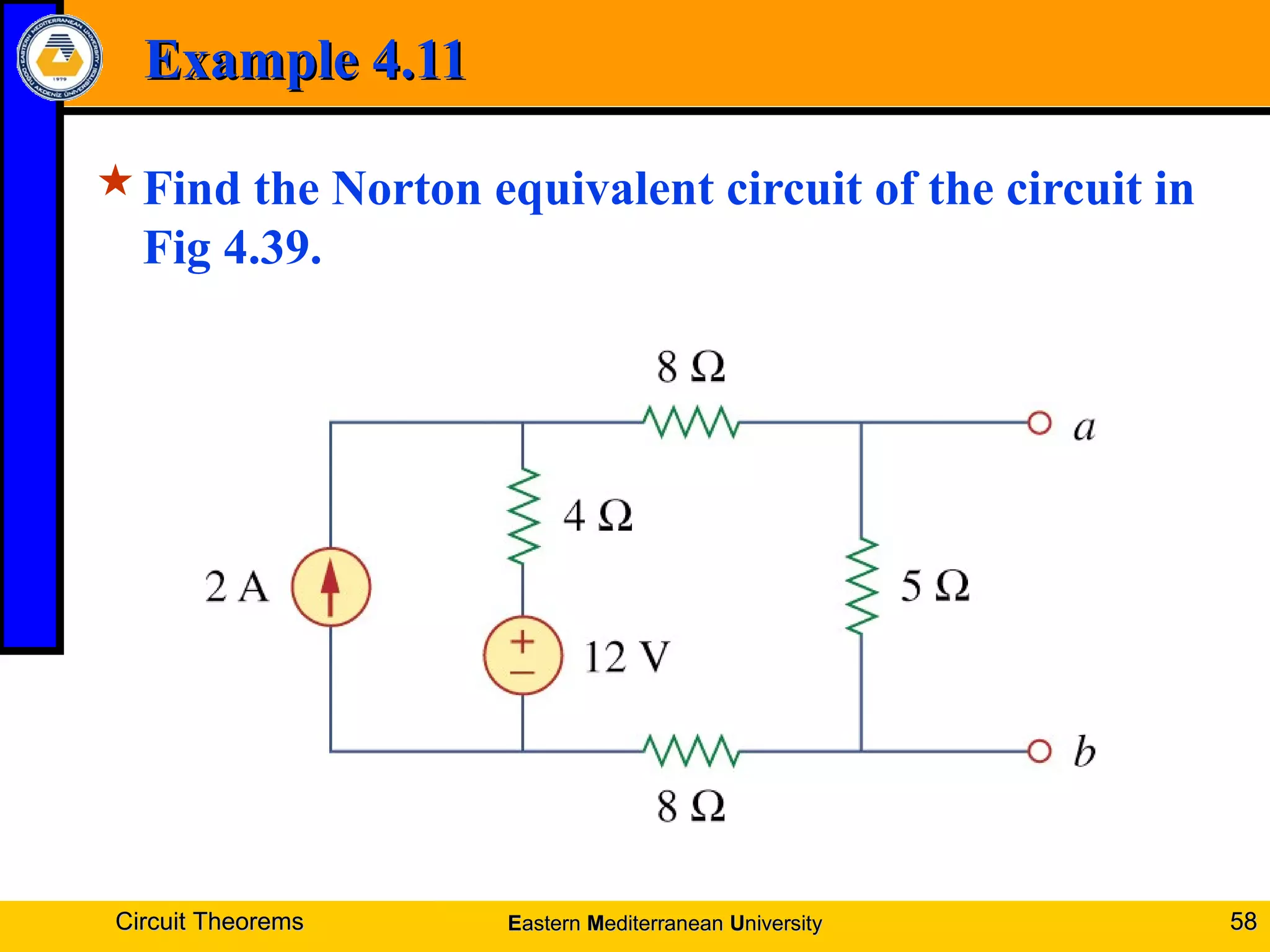
Example 4.11Example 4.11
Find the Norton equivalent circuit of the circuit in
Fig 4.39.
Circuit TheoremsCircuit Theorems 5858EEasternastern MMediterraneanediterranean UUniversityniversity
Example 4.11Example 4.11
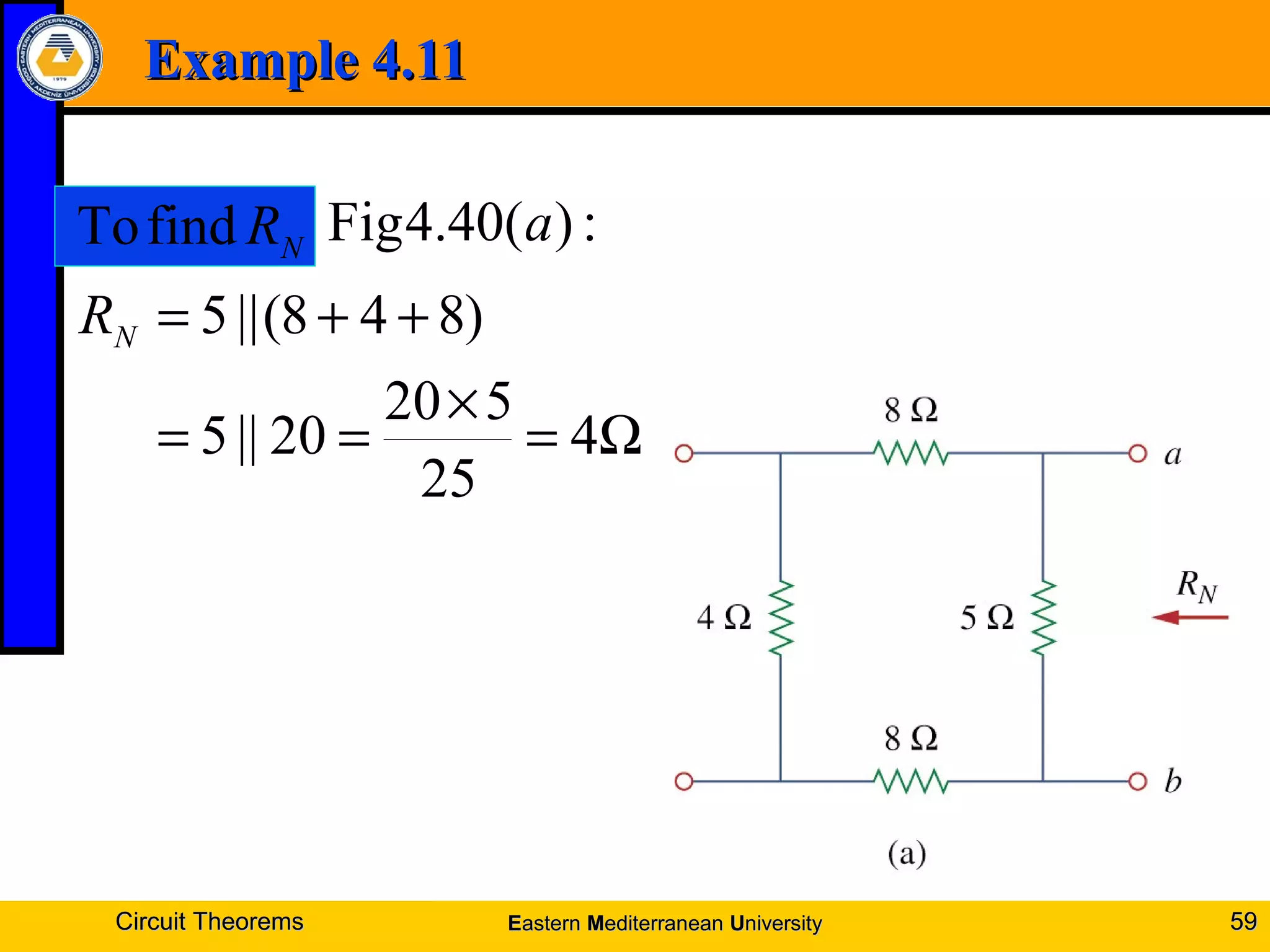
Circuit TheoremsCircuit Theorems 5959
:)(40.4Fig a
Ω=
×
==
++=
4
25
520
20||5
)848(||5NR
NRfindTo
EEasternastern MMediterraneanediterranean UUniversityniversity
Example 4.11Example 4.11
Circuit TheoremsCircuit Theorems 6060
NifindTo
.andterminalscircuitshort ba−
))(40.4.Fig( b
:Mesh 0420,A2 2121 =−−= iiii
Nsc Iii === A12
EEasternastern MMediterraneanediterranean UUniversityniversity
Example 4.11Example 4.11
Circuit TheoremsCircuit Theorems 6161
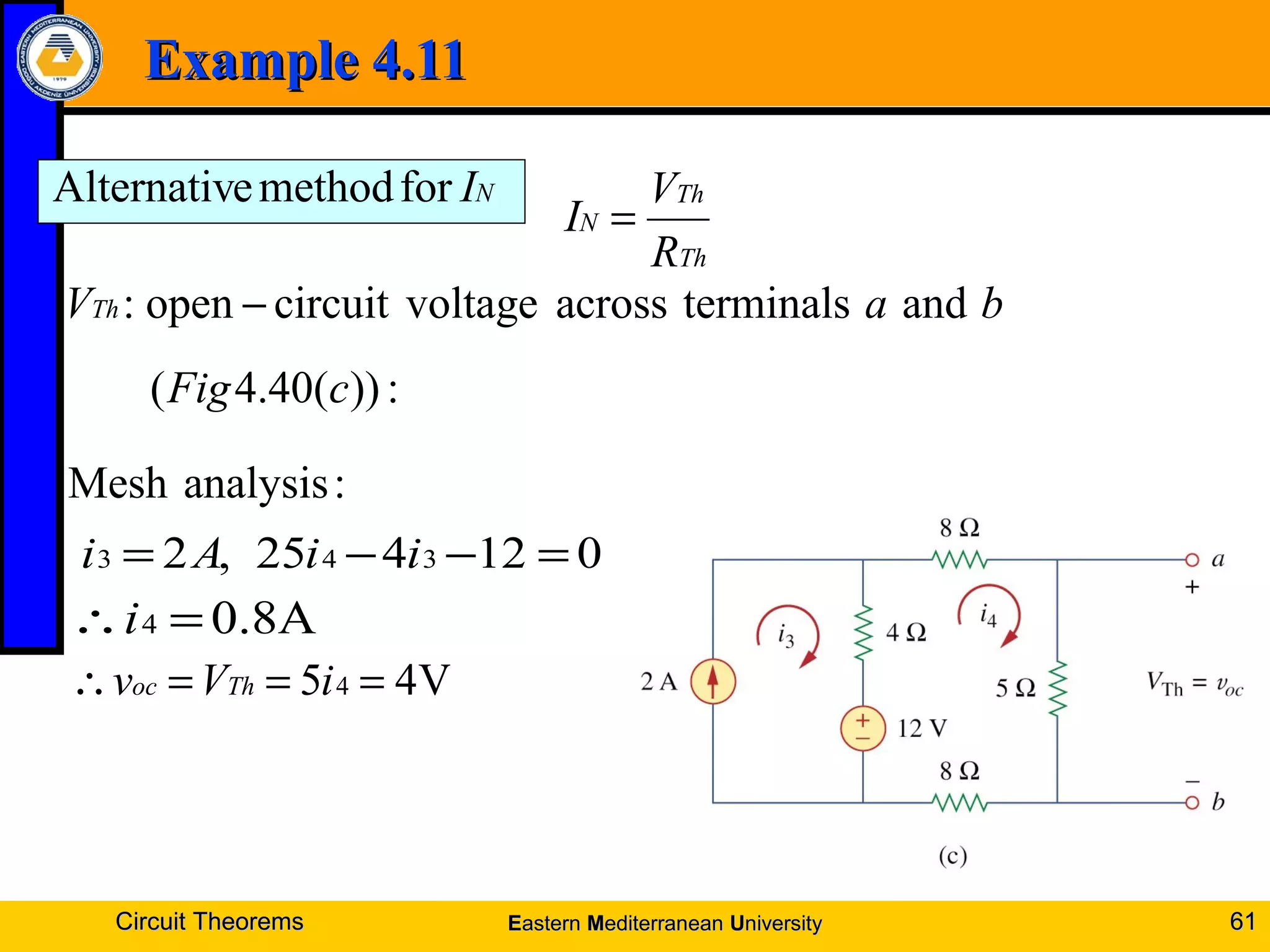
NIformethodeAlternativ
Th
Th
N
R
V
I =
voltagecircuitopen: −ThV ba and
:))(40.4( cFig
:analysisMesh
012425,2 343 =−−= iiAi
A8.04 =∴i
terminalsacross
V45 4 ===∴ iVv Thoc
EEasternastern MMediterraneanediterranean UUniversityniversity
Example 4.11Example 4.11
Circuit TheoremsCircuit Theorems 6262
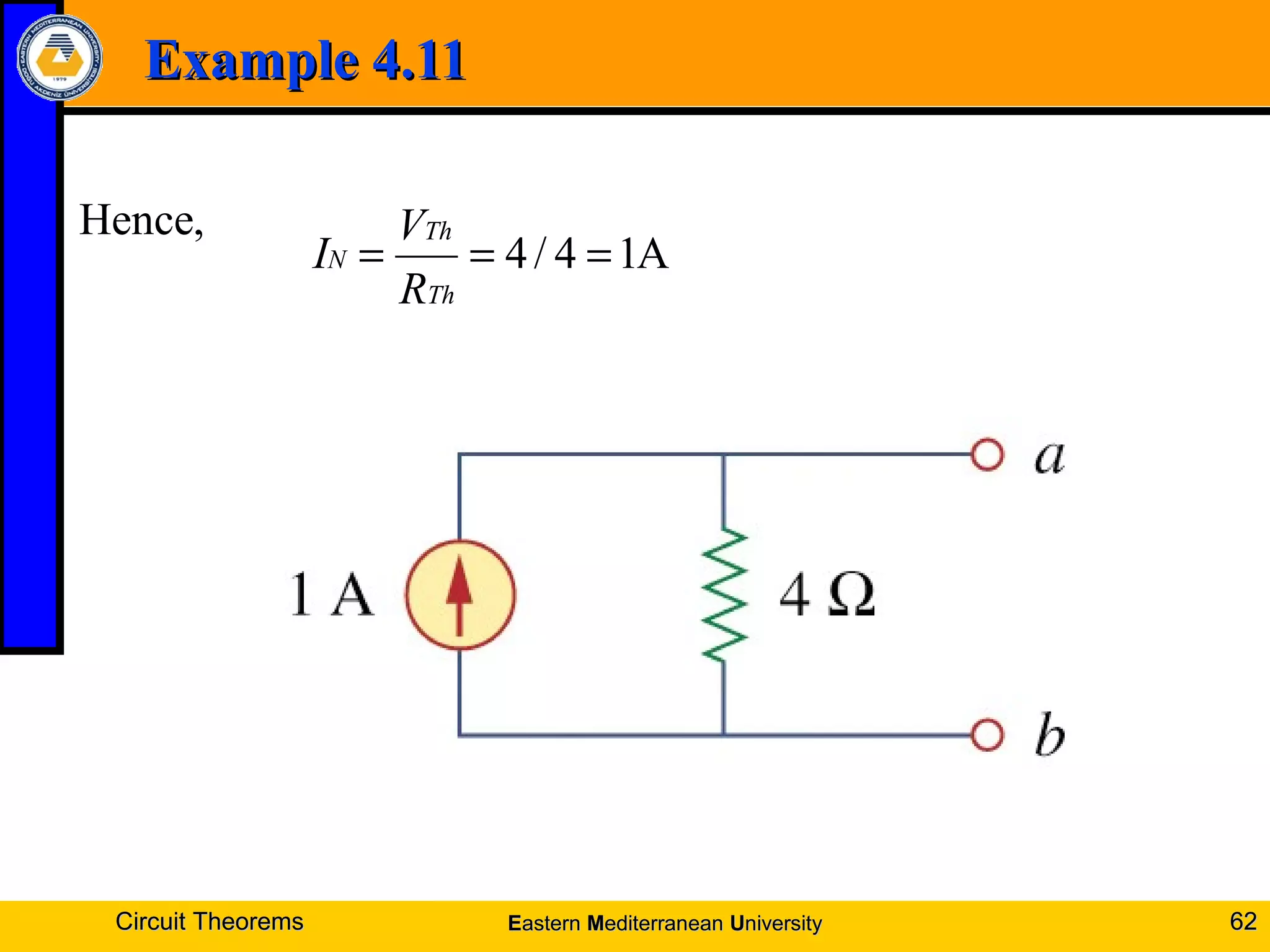
,Hence
A14/4 ===
Th
Th
N
R
V
I
EEasternastern MMediterraneanediterranean UUniversityniversity
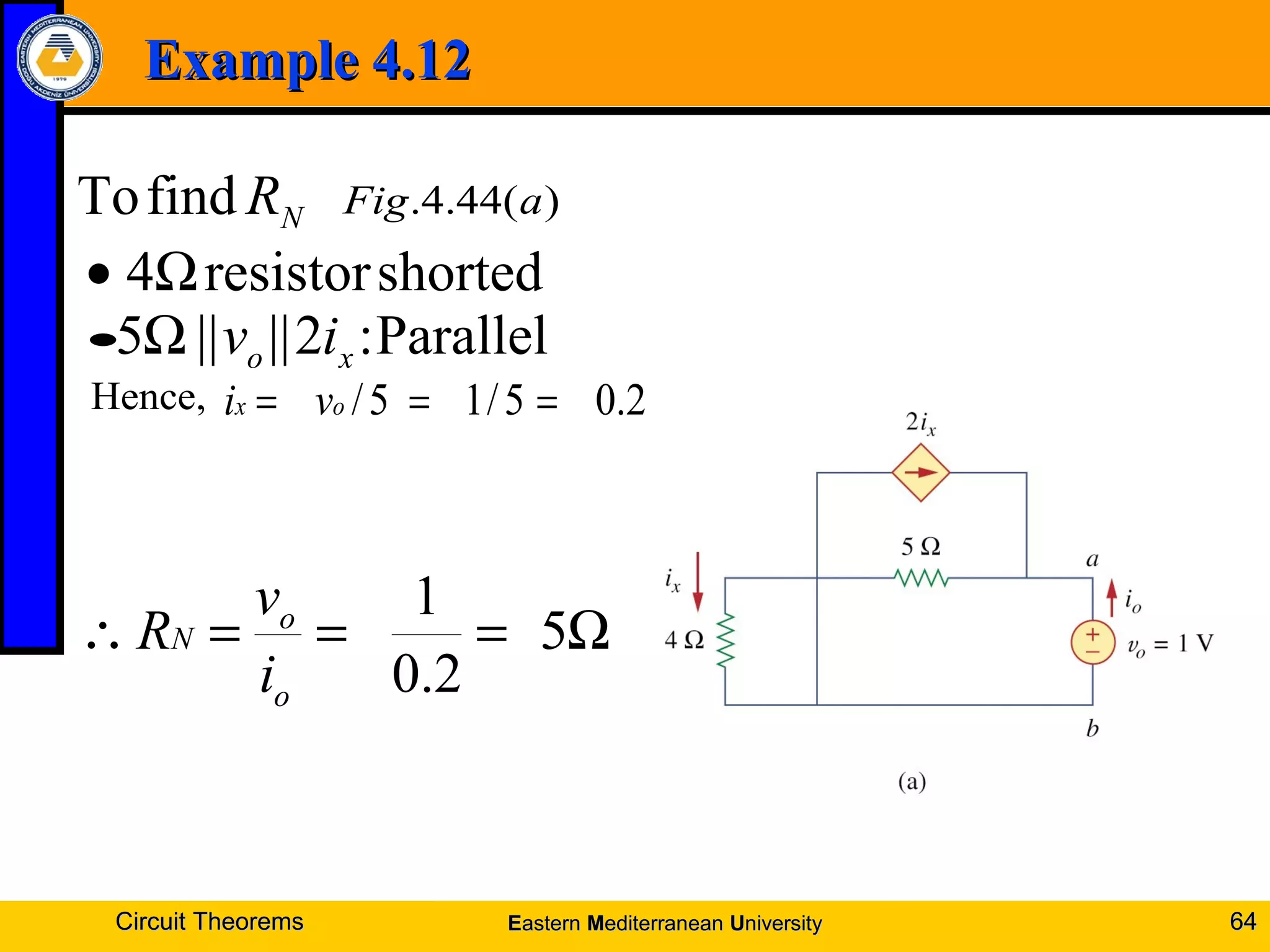
Example 4.12Example 4.12
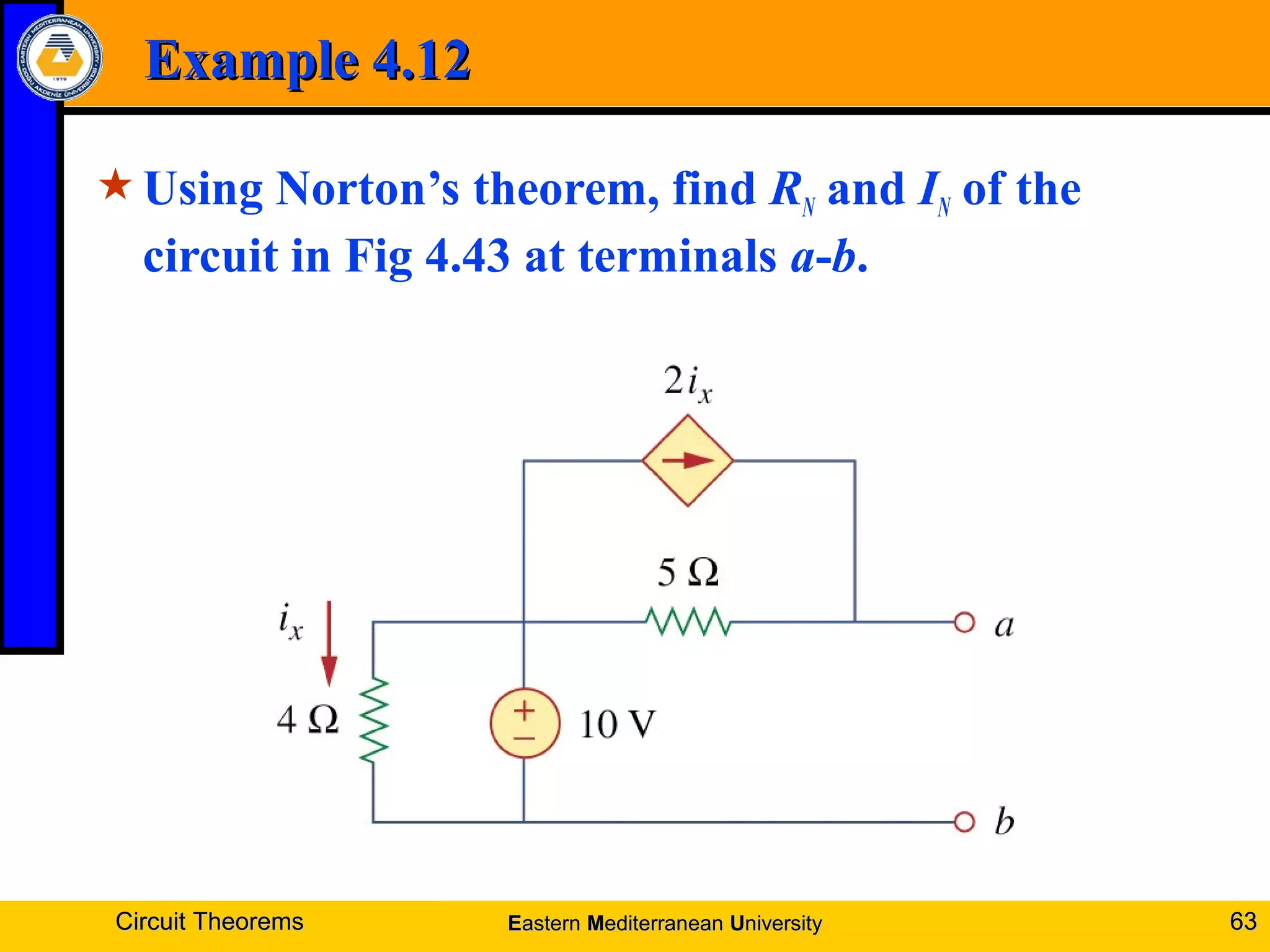
Using Norton’s theorem, find RN and IN of the
circuit in Fig 4.43 at terminals a-b.
Circuit TheoremsCircuit Theorems 6363EEasternastern MMediterraneanediterranean UUniversityniversity
Example 4.12Example 4.12
Circuit TheoremsCircuit Theorems 6464
NRfindTo )(44.4. aFig
shortedresistor4Ω•
Parallel:2||||5 xo ivΩ
Hence, 2.05/15/ === ox vi
•
Ω===∴ 5
2.0
1
o
o
N
i
v
R
EEasternastern MMediterraneanediterranean UUniversityniversity
Example 4.12Example 4.12
Circuit TheoremsCircuit Theorems 6565
NIfindTo )(44.4. bFig
xiv 2||5||10||4 ΩΩ• Parallel:
.5A,2
4
010
=
−
=xi
A72(2.5)
5
10
2 =+=+= xxsc iii
7A=∴ NI
EEasternastern MMediterraneanediterranean UUniversityniversity
4.8 Maximum Power Trandfer4.8 Maximum Power Trandfer
Circuit TheoremsCircuit Theorems 6666
LL R
RR
V
Rip
2
LTH
TH2






+
==
Fig 4.48
EEasternastern MMediterraneanediterranean UUniversityniversity
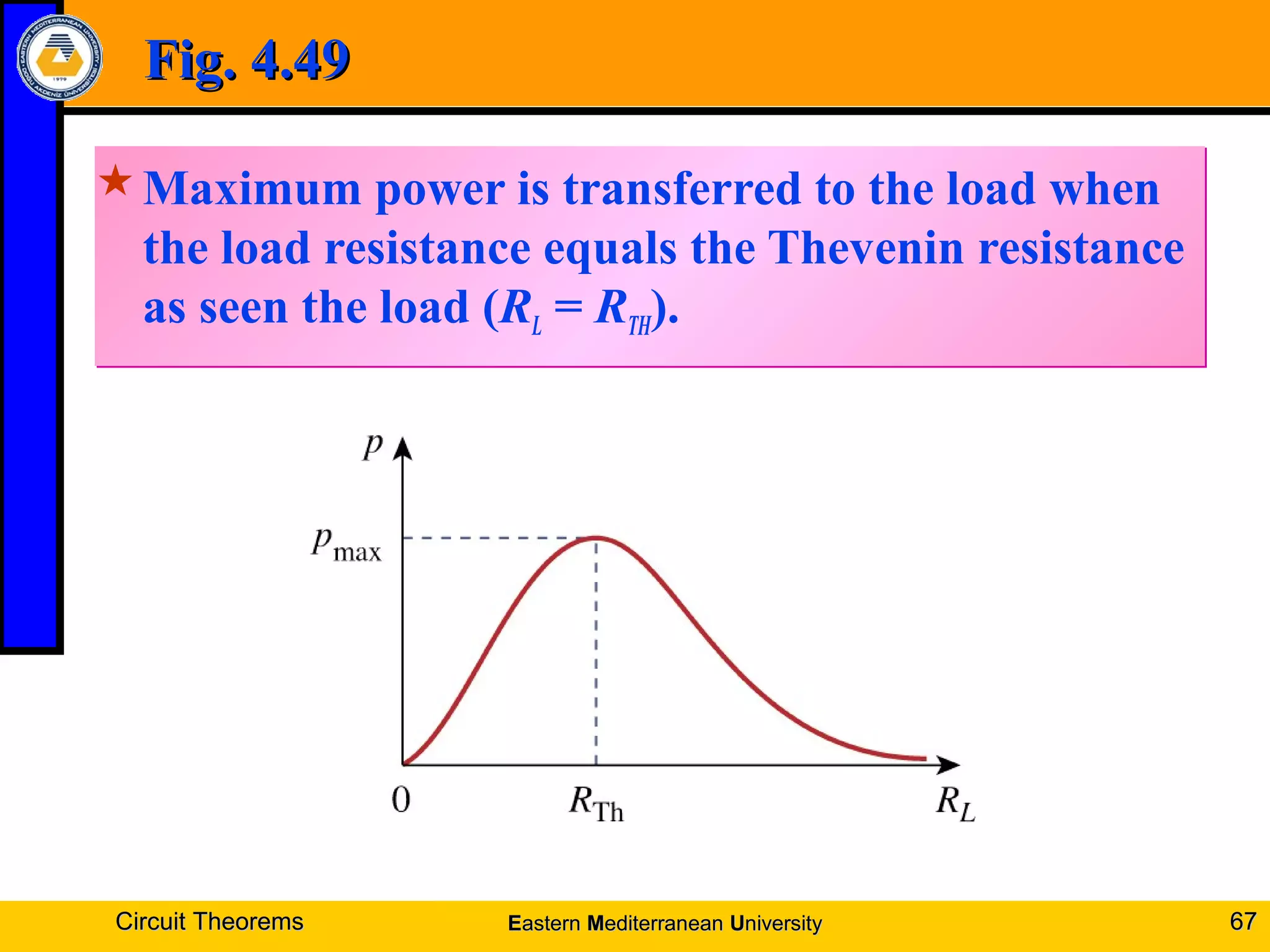
Fig. 4.49Fig. 4.49
Maximum power is transferred to the load when
the load resistance equals the Thevenin resistance
as seen the load (RL = RTH).
Circuit TheoremsCircuit Theorems 6767EEasternastern MMediterraneanediterranean UUniversityniversity
Circuit TheoremsCircuit Theorems 6868
TH
TH
THL
LTHLLTH
LTH
LLTH
TH
LTH
LTHLLTH
TH
L
R
V
p
RR
RRRRR
RR
RRR
V
RR
RRRRR
V
dR
dp
4
)()2(0
0
)(
)2(
)(
)(2)(
2
max
3
2
4
2
2
=
=
−=−+=
=





+
−+
=






+
+−+
=
EEasternastern MMediterraneanediterranean UUniversityniversity
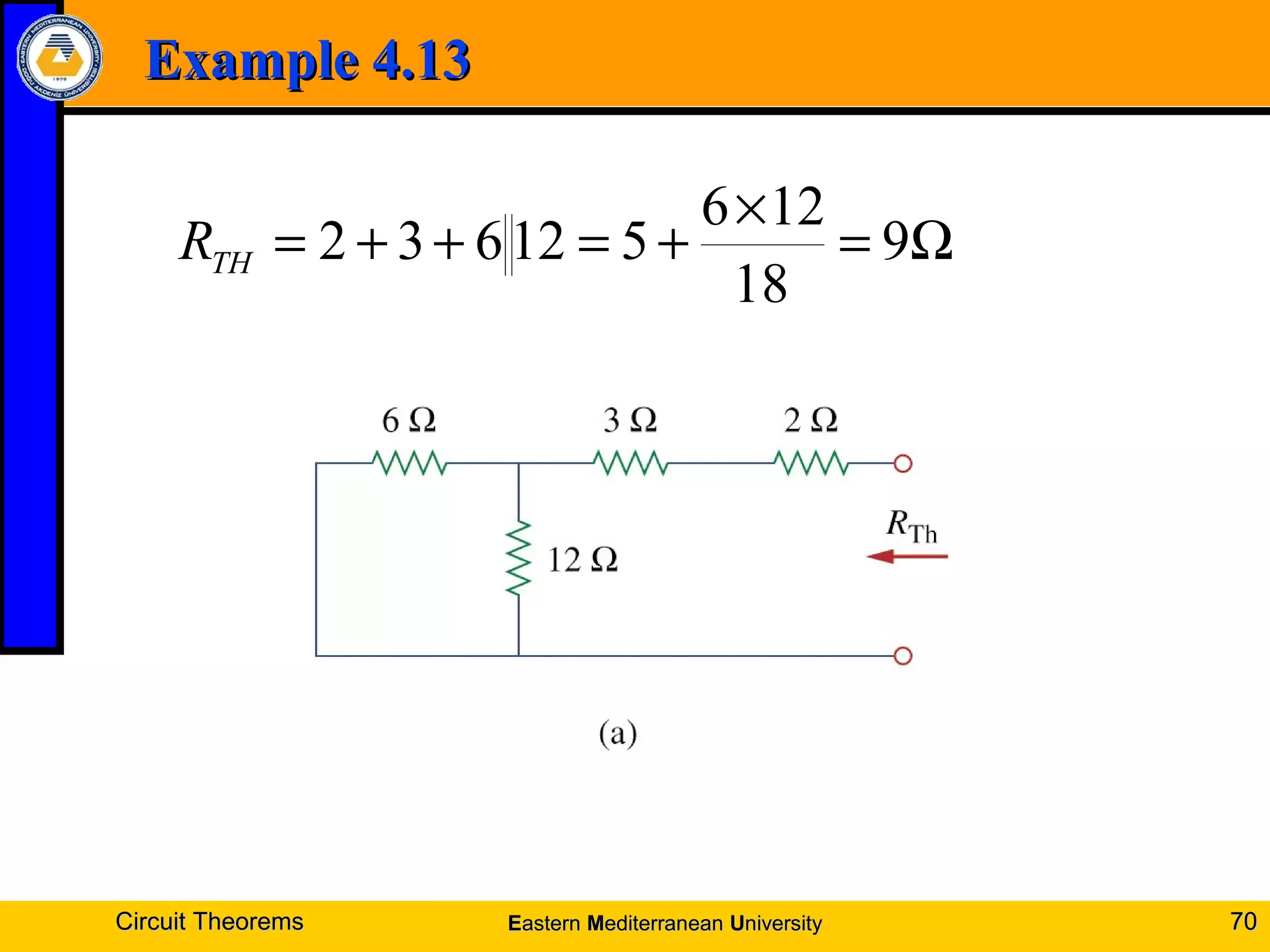
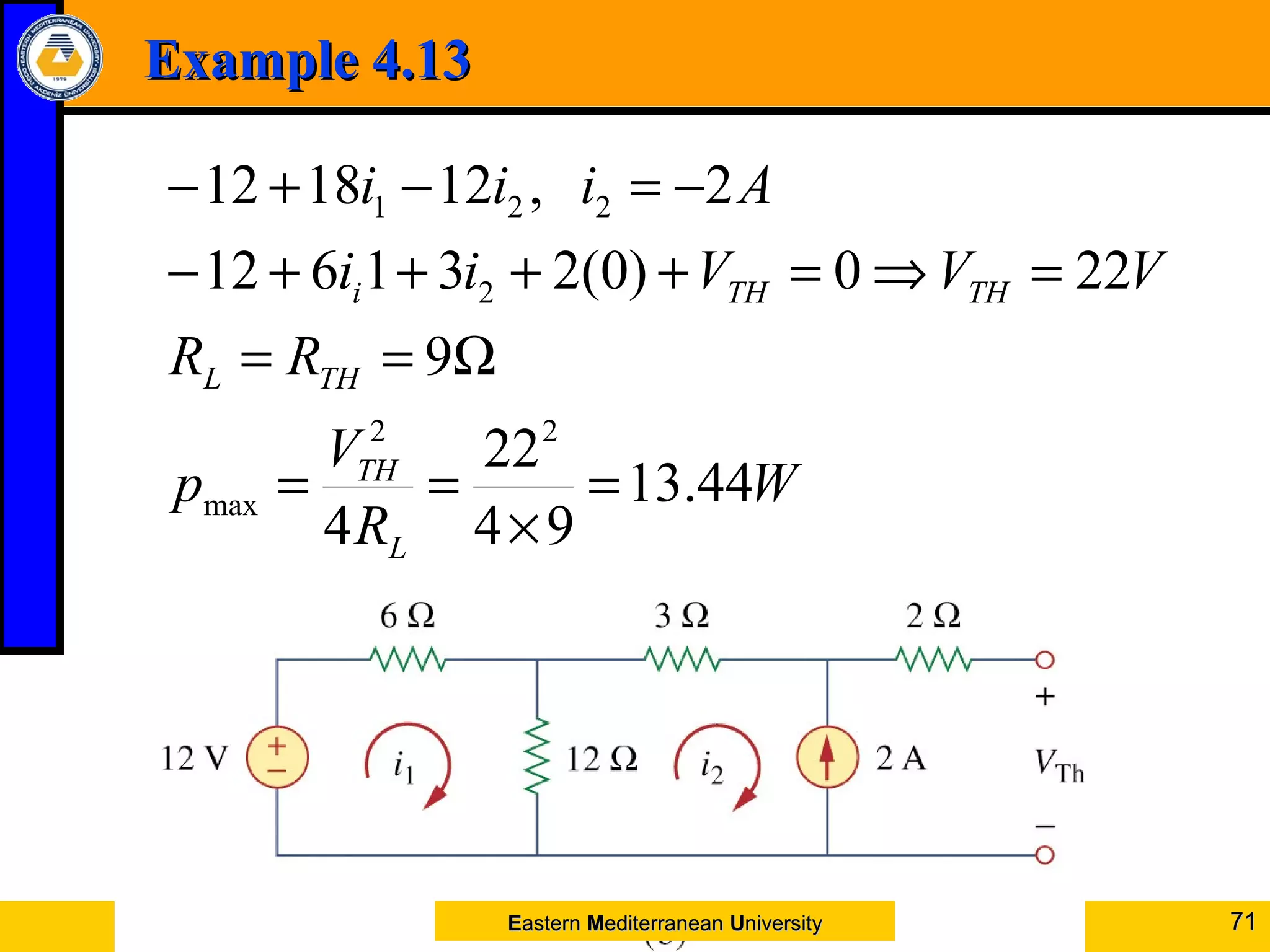
Example 4.13Example 4.13
Find the value of RL for maximum power transfer
in the circuit of Fig. 4.50. Find the maximum
power.
Circuit TheoremsCircuit Theorems 6969EEasternastern MMediterraneanediterranean UUniversityniversity
Example 4.13Example 4.13
Circuit TheoremsCircuit Theorems 7070
Ω=
×
+=++= 9
18
126
512632THR
EEasternastern MMediterraneanediterranean UUniversityniversity
Example 4.13Example 4.13
Circuit TheoremsCircuit Theorems 7171
W
R
V
p
RR
VVVii
Aiii
L
TH
THL
THTHi
44.13
94
22
4
9
220)0(231612
2,121812
22
max
2
221
=
×
==
Ω==
=⇒=++++−
−=−+−
EEasternastern MMediterraneanediterranean UUniversityniversity
Homework ProblemsHomework Problems
Problems 6, 10, 21, 28, 33, 40, 47, 52, 71
Circuit TheoremsCircuit Theorems 7272EEasternastern MMediterraneanediterranean UUniversityniversity

Chap4

  • 1.
    Circuit TheoremsCircuit TheoremsEastern Mediterranean UniversityEastern Mediterranean University 11 Circuit Theorems Mustafa Kemal Uyguroğlu
  • 2.
    Chap. 4 CircuitTheoremsChap. 4 Circuit Theorems Introduction Linearity property Superposition Source transformations Thevenin’s theorem Norton’s theorem Maximum power transfer Circuit TheoremsCircuit Theorems 22EEasternastern MMediterraneanediterranean UUniversityniversity
  • 3.
    4.1 Introduction4.1 Introduction CircuitTheoremsCircuit Theorems 33 A large complex circuits A large complex circuits Simplify circuit analysis Simplify circuit analysis Circuit TheoremsCircuit Theorems ‧Thevenin’s theorem Norton theorem‧ ‧Circuit linearity Superposition‧ ‧source transformation max. power transfer‧ ‧Thevenin’s theorem Norton theorem‧ ‧Circuit linearity Superposition‧ ‧source transformation max. power transfer‧ EEasternastern MMediterraneanediterranean UUniversityniversity
  • 4.
    4.2 Linearity4.2 LinearityPPropertyroperty Circuit TheoremsCircuit Theorems 44 Homogeneity property (Scaling) iRvi =→ kiRkvki =→ Additivity property Rivi 222 =→ Rivi 111 =→ 21212121 )( vvRiRiRiiii +=+=+→+ EEasternastern MMediterraneanediterranean UUniversityniversity
  • 5.
    A linear circuitis one whose output is linearly related (or directly proportional) to its input Fig. 4.1 Circuit TheoremsCircuit Theorems 55 V0 I0 i EEasternastern MMediterraneanediterranean UUniversityniversity
  • 6.
    Linear circuit consistof ● linear elements ● linear dependent sources ● independent sources  Circuit TheoremsCircuit Theorems 66 mA1mV5 A2.0V1 A2V10 =←= =→= =→= iv iv iv s s s nonlinear R v Rip : 2 2 == EEasternastern MMediterraneanediterranean UUniversityniversity
  • 7.
    Example 4.1Example 4.1 Forthe circuit in fig 4.2 find I0 when vs=12V and vs=24V. Circuit TheoremsCircuit Theorems 77EEasternastern MMediterraneanediterranean UUniversityniversity
  • 8.
    Example 4.1Example 4.1 KVL Eqs(4.1.1)and (4.1.3) we get Circuit TheoremsCircuit Theorems 88 0412 21 =+− svii 03164 21 =−−+− sx vvii 12ivx = becomes)2.1.4( 01610 21 =−+− svii (4.1.1) (4.1.2) (4.1.3) 2121 60122 iiii −=→=+ EEasternastern MMediterraneanediterranean UUniversityniversity
  • 9.
    Example 4.1Example 4.1 Eq(4.1.1),we get When When Showing that when the source value is doubled, I0 doubles. Circuit TheoremsCircuit Theorems 99 76 076 22 s s v ivi =⇒==− A 76 12 20 == iI V12=sv A 76 24 20 == iI V24=sv EEasternastern MMediterraneanediterranean UUniversityniversity
  • 10.
    Example 4.2Example 4.2 AssumeI0 = 1 A and use linearity to find the actual value of I0 in the circuit in fig 4.4. Circuit TheoremsCircuit Theorems 1010EEasternastern MMediterraneanediterranean UUniversityniversity
  • 11.
    Example 4.2Example 4.2 CircuitTheoremsCircuit Theorems 1111 A,24/ V8)53(thenA,1If 11 010 == =+== vI IvI A3012 =+= III A2 7 ,V14682 2 3212 ===+=+= V IIVV ⇒=+= A5234 III A5=SI A510 =→= SIAI A15A30 =←= SII EEasternastern MMediterraneanediterranean UUniversityniversity
  • 12.
    4.3 Superposition4.3 Superposition Thesuperposition principle states that the voltage across (or current through) an element in a linear circuit is the algebraic sum of the voltages across (or currents through) that element due to each independent source acting alone. Turn off, killed, inactive source: ● independent voltage source: 0 V (short circuit) ● independent current source: 0 A (open circuit) Dependent sources are left intact. Circuit TheoremsCircuit Theorems 1212EEasternastern MMediterraneanediterranean UUniversityniversity
  • 13.
     Steps toapply superposition principle: 1. Turn off all independent sources except one source. Find the output (voltage or current) due to that active source using nodal or mesh analysis. 2. Repeat step 1 for each of the other independent sources. 3. Find the total contribution by adding algebraically all the contributions due to the independent sources. Circuit TheoremsCircuit Theorems 1313EEasternastern MMediterraneanediterranean UUniversityniversity
  • 14.
    How to turnoff independent sourcesHow to turn off independent sources Turn off voltages sources = short voltage sources; make it equal to zero voltage Turn off current sources = open current sources; make it equal to zero current Circuit TheoremsCircuit Theorems 1414EEasternastern MMediterraneanediterranean UUniversityniversity
  • 15.
    Superposition involves morework but simpler circuits. Superposition is not applicable to the effect on power. Circuit TheoremsCircuit Theorems 1515EEasternastern MMediterraneanediterranean UUniversityniversity
  • 16.
    Example 4.3Example 4.3 Usethe superposition theorem to find in the circuit in Fig.4.6. Circuit TheoremsCircuit Theorems 1616EEasternastern MMediterraneanediterranean UUniversityniversity
  • 17.
    Example 4.3Example 4.3 Sincethere are two sources, let Voltage division to get Current division, to get Hence And we find Circuit TheoremsCircuit Theorems 1717 21 VVV += V2)6( 84 4 1 = + =V A2)3( 84 8 3 = + =i V84 32 == iv V108221 =+=+= vvv EEasternastern MMediterraneanediterranean UUniversityniversity
  • 18.
    Example 4.4Example 4.4 FindI0 in the circuit in Fig.4.9 using superposition. Circuit TheoremsCircuit Theorems 1818EEasternastern MMediterraneanediterranean UUniversityniversity
  • 19.
    Example 4.4Example 4.4 CircuitTheoremsCircuit Theorems 1919 Fig. 4.10 EEasternastern MMediterraneanediterranean UUniversityniversity
  • 20.
    Example 4.4Example 4.4 CircuitTheoremsCircuit Theorems 2020 Fig. 4.10 EEasternastern MMediterraneanediterranean UUniversityniversity
  • 21.
    4.5 Source Transformation4.5Source Transformation A source transformation is the process of replacing a voltage source vs in series with a resistor R by a current source is in parallel with a resistor R, or vice versa Circuit TheoremsCircuit Theorems 2121EEasternastern MMediterraneanediterranean UUniversityniversity
  • 22.
    Fig. 4.15 &4.16Fig. 4.15 & 4.16 R v iRiv s sss == or Circuit TheoremsCircuit Theorems 2222EEasternastern MMediterraneanediterranean UUniversityniversity
  • 23.
    Equivalent CircuitsEquivalent Circuits R v R v i viRv s s −= += CircuitTheoremsCircuit Theorems 2323 i i ++ -- vv v i vs -is EEasternastern MMediterraneanediterranean UUniversityniversity
  • 24.
    Arrow of thecurrent source positive terminal of voltage source Impossible source Transformation ● ideal voltage source (R = 0) ● ideal current source (R=∞) Circuit TheoremsCircuit Theorems 2424EEasternastern MMediterraneanediterranean UUniversityniversity
  • 25.
    Example 4.6Example 4.6 Usesource transformation to find vo in the circuit in Fig 4.17. Circuit TheoremsCircuit Theorems 2525EEasternastern MMediterraneanediterranean UUniversityniversity
  • 26.
    Example 4.6Example 4.6 CircuitTheoremsCircuit Theorems 2626 Fig 4.18 EEasternastern MMediterraneanediterranean UUniversityniversity
  • 27.
    Example 4.6Example 4.6 weuse current division in Fig.4.18(c) to get and Circuit TheoremsCircuit Theorems 2727 A4.0)2( 82 2 = + =i V2.3)4.0(88 === ivo EEasternastern MMediterraneanediterranean UUniversityniversity
  • 28.
    Example 4.7Example 4.7 Findvx in Fig.4.20 using source transformation Circuit TheoremsCircuit Theorems 2828EEasternastern MMediterraneanediterranean UUniversityniversity
  • 29.
    Example 4.7Example 4.7 ApplyingKVL around the loop in Fig 4.21(b) gives (4.7.1) Appling KVL to the loop containing only the 3V voltage source, the resistor, and vx yields (4.7.2) Circuit TheoremsCircuit Theorems 2929 01853 =+++− xvi Ω1 ivvi xx −=⇒=++− 3013 EEasternastern MMediterraneanediterranean UUniversityniversity
  • 30.
    Example 4.7Example 4.7 Substitutingthis into Eq.(4.7.1), we obtain Alternatively thus Circuit TheoremsCircuit Theorems 3030 A5.403515 −=⇒=++ ii A5.40184 −=⇒=+++− iviv xx V5.73 =−= ivx EEasternastern MMediterraneanediterranean UUniversityniversity
  • 31.
    4.5 Thevenin’s Theorem4.5Thevenin’s Theorem Thevenin’s theorem states that a linear two- terminal circuit can be replaced by an equivalent circuit consisting of a voltage source VTh in series with a resistor RTh where VThis the open circuit voltage at the terminals and RTh is the input or equivalent resistance at the terminals when the independent source are turn off. Circuit TheoremsCircuit Theorems 3131EEasternastern MMediterraneanediterranean UUniversityniversity
  • 32.
    Property of LinearCircuitsProperty of Linear Circuits Circuit TheoremsCircuit Theorems 3232 i v v i Any two-terminal Linear Circuits + - Vth Isc Slope=1/Rth EEasternastern MMediterraneanediterranean UUniversityniversity
  • 33.
    Fig. 4.23Fig. 4.23 CircuitTheoremsCircuit Theorems 3333EEasternastern MMediterraneanediterranean UUniversityniversity
  • 34.
    How to FindThevenin’s VoltageHow to Find Thevenin’s Voltage Equivalent circuit: same voltage-current relation at the terminals.  Circuit TheoremsCircuit Theorems 3434 :Th ocvV = ba −atltagecircuit voopen EEasternastern MMediterraneanediterranean UUniversityniversity
  • 35.
    How to FindThevenin’s ResistanceHow to Find Thevenin’s Resistance  Circuit TheoremsCircuit Theorems 3535 :inTh RR = b.a −− atcircuitdeadtheofresistanceinput circuitedopenba −• sourcestindependenalloffTurn• EEasternastern MMediterraneanediterranean UUniversityniversity
  • 36.
    CASE 1  Ifthe network has no dependent sources: ● Turn off all independent source. ● RTH: can be obtained via simplification of either parallel or series connection seen from a-b Circuit TheoremsCircuit Theorems 3636EEasternastern MMediterraneanediterranean UUniversityniversity
  • 37.
    Fig. 4.25Fig. 4.25 CASE2 If the network has dependent sources ● Turn off all independent sources. ● Apply a voltage source vo at a-b ● Alternatively, apply a current source io at a-b Circuit TheoremsCircuit Theorems 3737 o o i v R =Th o o Th i v R = EEasternastern MMediterraneanediterranean UUniversityniversity
  • 38.
    The Thevenin’s resistancemay be negative, indicating that the circuit has ability providing power Circuit TheoremsCircuit Theorems 3838EEasternastern MMediterraneanediterranean UUniversityniversity
  • 39.
    Fig. 4.26Fig. 4.26 Simplifiedcircuit Voltage divider Circuit TheoremsCircuit Theorems 3939 L L RR V I + = Th Th Th Th V RR R IRV L L LLL + == EEasternastern MMediterraneanediterranean UUniversityniversity
  • 40.
    Example 4.8Example 4.8 Findthe Thevenin’s equivalent circuit of the circuit shown in Fig 4.27, to the left of the terminals a-b. Then find the current through RL = 6,16,and 36 Ω. Circuit TheoremsCircuit Theorems 4040EEasternastern MMediterraneanediterranean UUniversityniversity
  • 41.
    Find RFind Rthth CircuitTheoremsCircuit Theorems 4141 shortsourcevoltageV32:Th →R opensourcecurrentA2 → Ω=+ × =+= 41 16 124 112||4ThR EEasternastern MMediterraneanediterranean UUniversityniversity
  • 42.
    Find VFind Vthth CircuitTheoremsCircuit Theorems 4242 analysisMesh)1( :ThV A2,0)(12432 2211 −==−++− iiii A5.01 =∴i V30)0.25.0(12)(12 21Th =+=−= iiV AnalysisNodalely,Alternativ)2( 12/24/)32( ThTh VV =+− V30Th =∴V EEasternastern MMediterraneanediterranean UUniversityniversity
  • 43.
    Example 4.8Example 4.8 CircuitTheoremsCircuit Theorems 4343Fig. 4.29 transformsourceely,Alternativ)3( V3024396 12 2 4 32 THTHTH THTH =⇒=+− =+ − VVV VV EEasternastern MMediterraneanediterranean UUniversityniversity
  • 44.
    Example 4.8Example 4.8 CircuitTheoremsCircuit Theorems 4444 :getTo Li LL L RRR V i + = + = 4 30 Th Th 6=LR A310/30 ==LI 16=LR A5.120/30 ==LI A75.040/30 ==LI36=LR → → → EEasternastern MMediterraneanediterranean UUniversityniversity
  • 45.
    Example 4.9Example 4.9 Findthe Thevenin’s equivalent of the circuit in Fig. 4.31 at terminals a-b. Circuit TheoremsCircuit Theorems 4545EEasternastern MMediterraneanediterranean UUniversityniversity
  • 46.
    Example 4.9Example 4.9 (independent+ dependent source case) Circuit TheoremsCircuit Theorems 4646 Fig(a):findTo ThR 0sourcetindependen → intact→sourcedependent ,V1=ov oo o ii v R 1 Th == EEasternastern MMediterraneanediterranean UUniversityniversity
  • 47.
    Example 4.9Example 4.9 Forloop 1, Circuit TheoremsCircuit Theorems 4747 2121 or0)(22 iiviiv xx −==−+− 214But iivi x −==− 21 3ii −=∴ EEasternastern MMediterraneanediterranean UUniversityniversity
  • 48.
    Example 4.9Example 4.9 CircuitTheoremsCircuit Theorems 4848 :3and2Loop 0)(6)(24 32122 =−+−+ iiiii 012)(6 323 =++− iii givesequationstheseSolving .A6/13 −=i A 6 1 But 3 =−= iio Ω==∴ 6 1 Th oi V R EEasternastern MMediterraneanediterranean UUniversityniversity
  • 49.
    Example 4.9Example 4.9 CircuitTheoremsCircuit Theorems 4949 ⇒=−+− 0)(22 23 iivx 51 =i Fig(b):getTo ThV 23 iivx −= analysisMesh ⇒=+−+− 06)(2)(4 21212 iiiii 02412 312 =−− iii .3/102 =∴i V206 2Th === ivV oc xvii =− )(4But 21 EEasternastern MMediterraneanediterranean UUniversityniversity
  • 50.
    Example 4.10Example 4.10 Determinethe Thevenin’s equivalent circuit in Fig.4.35(a). Solution Circuit TheoremsCircuit Theorems 5050 )caseonlysourcedependent( o o i v R =Th0Th =V :anaysisNodal 4/2 oxxo viii +=+ EEasternastern MMediterraneanediterranean UUniversityniversity
  • 51.
    Example 4.10Example 4.10 CircuitTheoremsCircuit Theorems 5151 22 0 oo x vv i −= − =But 4424 oooo xo vvvv ii −=+−=+= oo iv 4or −= :4Thus Th Ω−== o o i v R powerSupplying EEasternastern MMediterraneanediterranean UUniversityniversity
  • 52.
    Example 4.10Example 4.10 CircuitTheoremsCircuit Theorems 5252EEasternastern MMediterraneanediterranean UUniversityniversity
  • 53.
    Example 4.10Example 4.10 CircuitTheoremsCircuit Theorems 5353EEasternastern MMediterraneanediterranean UUniversityniversity
  • 54.
    4.64.6 Norton’s TheoremNorton’sTheorem Norton’s theorem states that a linear two-terminal circuit can be replaced by equivalent circuit consisting of a current source IN in parallel with a resistor RN where IN is the short-circuit current through the terminals and RN is the input or equivalent resistance at the terminals when the independent source are turn off. Circuit TheoremsCircuit Theorems 5454EEasternastern MMediterraneanediterranean UUniversityniversity
  • 55.
    Fig. 4.37Fig. 4.37 CircuitTheoremsCircuit Theorems 5555 v i Vth -IN Slope=1/RN EEasternastern MMediterraneanediterranean UUniversityniversity
  • 56.
    How to FindNorton CurrentHow to Find Norton Current Thevenin and Norton resistances are equal: Short circuit current from a to b : Circuit TheoremsCircuit Theorems 5656 ThRRN = Th Th R V iI scN == EEasternastern MMediterraneanediterranean UUniversityniversity
  • 57.
    Thevenin or Nortonequivalent circuit :Thevenin or Norton equivalent circuit : The open circuit voltage voc across terminals a and b The short circuit current isc at terminals a and b The equivalent or input resistance Rin at terminals a and b when all independent source are turn off. Circuit TheoremsCircuit Theorems 5757 ocTh vV = NI Th Th N Th V R R R = = = sci EEasternastern MMediterraneanediterranean UUniversityniversity
  • 58.
    Example 4.11Example 4.11 Findthe Norton equivalent circuit of the circuit in Fig 4.39. Circuit TheoremsCircuit Theorems 5858EEasternastern MMediterraneanediterranean UUniversityniversity
  • 59.
    Example 4.11Example 4.11 CircuitTheoremsCircuit Theorems 5959 :)(40.4Fig a Ω= × == ++= 4 25 520 20||5 )848(||5NR NRfindTo EEasternastern MMediterraneanediterranean UUniversityniversity
  • 60.
    Example 4.11Example 4.11 CircuitTheoremsCircuit Theorems 6060 NifindTo .andterminalscircuitshort ba− ))(40.4.Fig( b :Mesh 0420,A2 2121 =−−= iiii Nsc Iii === A12 EEasternastern MMediterraneanediterranean UUniversityniversity
  • 61.
    Example 4.11Example 4.11 CircuitTheoremsCircuit Theorems 6161 NIformethodeAlternativ Th Th N R V I = voltagecircuitopen: −ThV ba and :))(40.4( cFig :analysisMesh 012425,2 343 =−−= iiAi A8.04 =∴i terminalsacross V45 4 ===∴ iVv Thoc EEasternastern MMediterraneanediterranean UUniversityniversity
  • 62.
    Example 4.11Example 4.11 CircuitTheoremsCircuit Theorems 6262 ,Hence A14/4 === Th Th N R V I EEasternastern MMediterraneanediterranean UUniversityniversity
  • 63.
    Example 4.12Example 4.12 UsingNorton’s theorem, find RN and IN of the circuit in Fig 4.43 at terminals a-b. Circuit TheoremsCircuit Theorems 6363EEasternastern MMediterraneanediterranean UUniversityniversity
  • 64.
    Example 4.12Example 4.12 CircuitTheoremsCircuit Theorems 6464 NRfindTo )(44.4. aFig shortedresistor4Ω• Parallel:2||||5 xo ivΩ Hence, 2.05/15/ === ox vi • Ω===∴ 5 2.0 1 o o N i v R EEasternastern MMediterraneanediterranean UUniversityniversity
  • 65.
    Example 4.12Example 4.12 CircuitTheoremsCircuit Theorems 6565 NIfindTo )(44.4. bFig xiv 2||5||10||4 ΩΩ• Parallel: .5A,2 4 010 = − =xi A72(2.5) 5 10 2 =+=+= xxsc iii 7A=∴ NI EEasternastern MMediterraneanediterranean UUniversityniversity
  • 66.
    4.8 Maximum PowerTrandfer4.8 Maximum Power Trandfer Circuit TheoremsCircuit Theorems 6666 LL R RR V Rip 2 LTH TH2       + == Fig 4.48 EEasternastern MMediterraneanediterranean UUniversityniversity
  • 67.
    Fig. 4.49Fig. 4.49 Maximumpower is transferred to the load when the load resistance equals the Thevenin resistance as seen the load (RL = RTH). Circuit TheoremsCircuit Theorems 6767EEasternastern MMediterraneanediterranean UUniversityniversity
  • 68.
    Circuit TheoremsCircuit Theorems6868 TH TH THL LTHLLTH LTH LLTH TH LTH LTHLLTH TH L R V p RR RRRRR RR RRR V RR RRRRR V dR dp 4 )()2(0 0 )( )2( )( )(2)( 2 max 3 2 4 2 2 = = −=−+= =      + −+ =       + +−+ = EEasternastern MMediterraneanediterranean UUniversityniversity
  • 69.
    Example 4.13Example 4.13 Findthe value of RL for maximum power transfer in the circuit of Fig. 4.50. Find the maximum power. Circuit TheoremsCircuit Theorems 6969EEasternastern MMediterraneanediterranean UUniversityniversity
  • 70.
    Example 4.13Example 4.13 CircuitTheoremsCircuit Theorems 7070 Ω= × +=++= 9 18 126 512632THR EEasternastern MMediterraneanediterranean UUniversityniversity
  • 71.
    Example 4.13Example 4.13 CircuitTheoremsCircuit Theorems 7171 W R V p RR VVVii Aiii L TH THL THTHi 44.13 94 22 4 9 220)0(231612 2,121812 22 max 2 221 = × == Ω== =⇒=++++− −=−+− EEasternastern MMediterraneanediterranean UUniversityniversity
  • 72.
    Homework ProblemsHomework Problems Problems6, 10, 21, 28, 33, 40, 47, 52, 71 Circuit TheoremsCircuit Theorems 7272EEasternastern MMediterraneanediterranean UUniversityniversity