Volcanic Hazards

A2 Geography
Objectives
• To explain why such a wide range of
  volcanic hazards exist.
The Easy Bit
• Definitions
• VOLCANO – Main landform comprising of
  surface accumulations of rock and debris
  developed from the molten rock (Magma)
• ERUPTIONS – The main events
  associated with rising magma. This leads
  to the discharge of hot water, outpouring of
  lavas, explosive gas and debris, torrential
  rain, flooding, landslides and earthquakes
Threats to Humans
• Risk equation.
• As we settle in more vulnerable places the
  more vulnerable we become to hazards.
• Our VULNERABILI|TY is often dictated by
  our ability to COPE with the hazard.
• Our exposure to the hazard becomes the
  RISK we face.
Key Point
• It is the combination of human values and
  vulnerability that converts volcanic
  phenomena into hazards.
Types of volcanic activity
          • Primary - Determined by eruptive
            behaviour
                   • Ejected pyroclastic material
                   • Pyroclastic flows
                   • Lava flows

    Pyroclastic flows                 Lava flows

Mixture of Ash, rock and      Magma that’s lost its
gas                           volatiles
Can travel upto 100km/h for   Damages property but
70km                          moves much more slowly
300 – 370 C                   Cools quickly
Geology
    • Chemical composition can determine lava
      type:
    • Iron rich, silica poor are basaltic – have
      low viscosity so flow quickly and cool
      slowly
    • Silica rich, iron poor – Andesitic lavas are
      Rhyolitic, viscous and cool quickly


     BASALTIC = flow quickly cool slowly
ANDESITIC = viscous, flow slower and cool quicker
Secondary Hazards
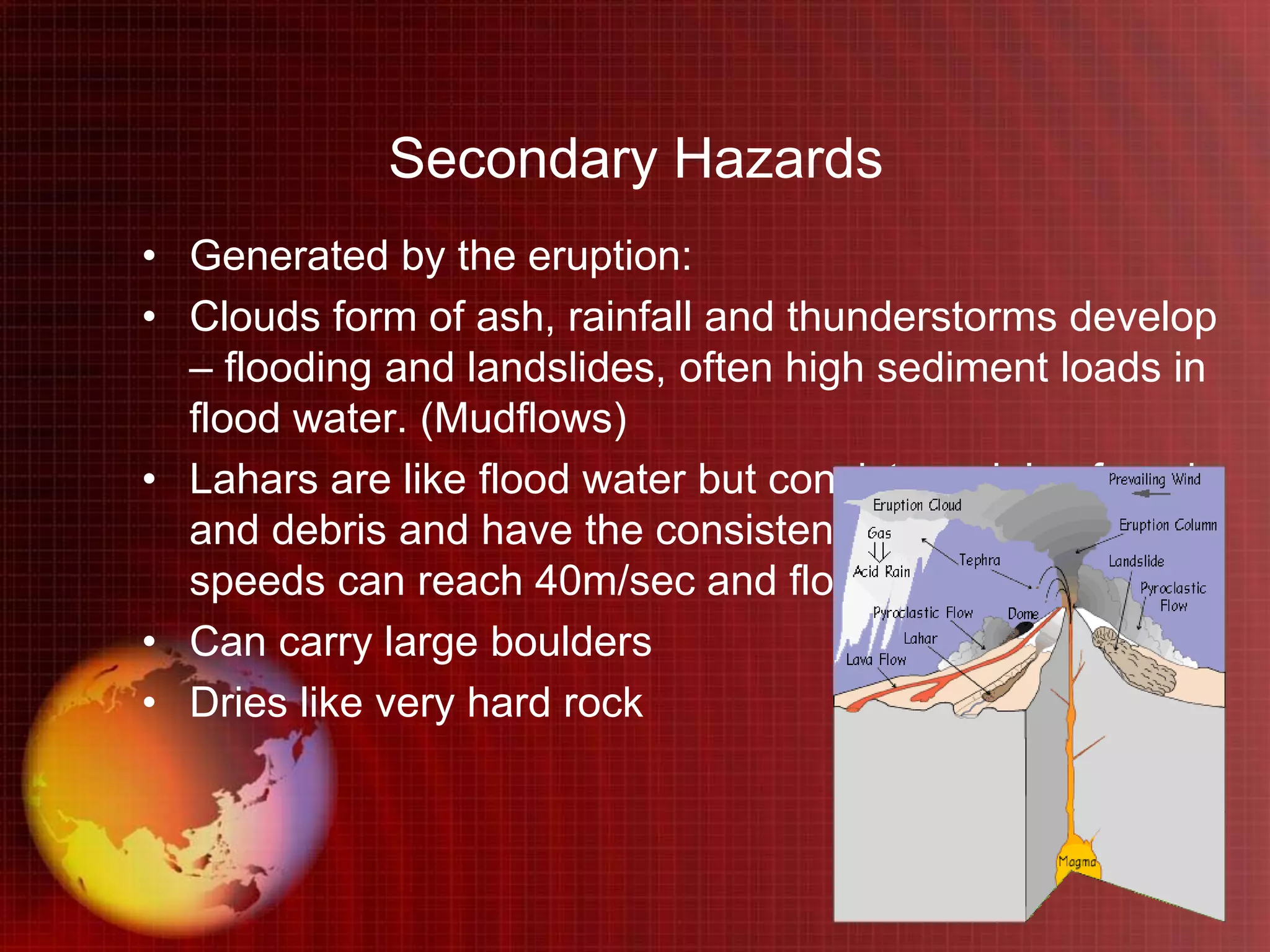
• Generated by the eruption:
• Clouds form of ash, rainfall and thunderstorms develop
  – flooding and landslides, often high sediment loads in
  flood water. (Mudflows)
• Lahars are like flood water but consists mainly of mud
  and debris and have the consistency of wet concrete
  speeds can reach 40m/sec and flow for 300km
• Can carry large boulders
• Dries like very hard rock
Eruption induced Melting of ice
caps
• Can result in major flooding
• Particularly associated with Iceland
• Melting of ice cap on the Nevado del Ruiz
  volcano, Columbia in 1985 caused
  mudfloods killing 23,000 people
Tsunami Generation
• Discharges of oceanic volcanoes can
  cause tsunami waves which can engulf
  coastal areas Krakatau (1883) caused
  35m high waves killing 36,000 people on
  nearby islands
Other Hazards
• Gas Discharges – pose little danger
  except for explosions.
• CO2 can be released and can, since
  heavier than air be released from waters
  causing it to hug the ground and cause
  death to nearby inhabitants
Doming
• Upward movement of magma used to
  forecast eruptions.
• Pronounced upward movement of land
  caused over 400,000 people to be
  evacuated and 100,000 permanently
  rehoused near Naples Italy during the
  1980’s
KEY POINT
• The combination of hazards varies
  between volcanoes as well as within each
  eruption
What are the Global Significance
            of Volcanic Hazards
• Discuss

• Homework

• Discuss the degree to which the theory of plate
  tectonics is supported by the distribution of volcanic
  and seismic activity across the globe

• Marked out of 40
• Typed with front sheet
• Full bibliography

Lecture 1 volcanic hazards

  • 1.
  • 2.
    Objectives • To explainwhy such a wide range of volcanic hazards exist.
  • 3.
    The Easy Bit •Definitions • VOLCANO – Main landform comprising of surface accumulations of rock and debris developed from the molten rock (Magma) • ERUPTIONS – The main events associated with rising magma. This leads to the discharge of hot water, outpouring of lavas, explosive gas and debris, torrential rain, flooding, landslides and earthquakes
  • 4.
    Threats to Humans •Risk equation. • As we settle in more vulnerable places the more vulnerable we become to hazards. • Our VULNERABILI|TY is often dictated by our ability to COPE with the hazard. • Our exposure to the hazard becomes the RISK we face.
  • 5.
    Key Point • Itis the combination of human values and vulnerability that converts volcanic phenomena into hazards.
  • 6.
    Types of volcanicactivity • Primary - Determined by eruptive behaviour • Ejected pyroclastic material • Pyroclastic flows • Lava flows Pyroclastic flows Lava flows Mixture of Ash, rock and Magma that’s lost its gas volatiles Can travel upto 100km/h for Damages property but 70km moves much more slowly 300 – 370 C Cools quickly
  • 7.
    Geology • Chemical composition can determine lava type: • Iron rich, silica poor are basaltic – have low viscosity so flow quickly and cool slowly • Silica rich, iron poor – Andesitic lavas are Rhyolitic, viscous and cool quickly BASALTIC = flow quickly cool slowly ANDESITIC = viscous, flow slower and cool quicker
  • 8.
    Secondary Hazards • Generatedby the eruption: • Clouds form of ash, rainfall and thunderstorms develop – flooding and landslides, often high sediment loads in flood water. (Mudflows) • Lahars are like flood water but consists mainly of mud and debris and have the consistency of wet concrete speeds can reach 40m/sec and flow for 300km • Can carry large boulders • Dries like very hard rock
  • 9.
    Eruption induced Meltingof ice caps • Can result in major flooding • Particularly associated with Iceland • Melting of ice cap on the Nevado del Ruiz volcano, Columbia in 1985 caused mudfloods killing 23,000 people
  • 10.
    Tsunami Generation • Dischargesof oceanic volcanoes can cause tsunami waves which can engulf coastal areas Krakatau (1883) caused 35m high waves killing 36,000 people on nearby islands
  • 11.
    Other Hazards • GasDischarges – pose little danger except for explosions. • CO2 can be released and can, since heavier than air be released from waters causing it to hug the ground and cause death to nearby inhabitants
  • 12.
    Doming • Upward movementof magma used to forecast eruptions. • Pronounced upward movement of land caused over 400,000 people to be evacuated and 100,000 permanently rehoused near Naples Italy during the 1980’s
  • 13.
    KEY POINT • Thecombination of hazards varies between volcanoes as well as within each eruption
  • 14.
    What are theGlobal Significance of Volcanic Hazards • Discuss • Homework • Discuss the degree to which the theory of plate tectonics is supported by the distribution of volcanic and seismic activity across the globe • Marked out of 40 • Typed with front sheet • Full bibliography