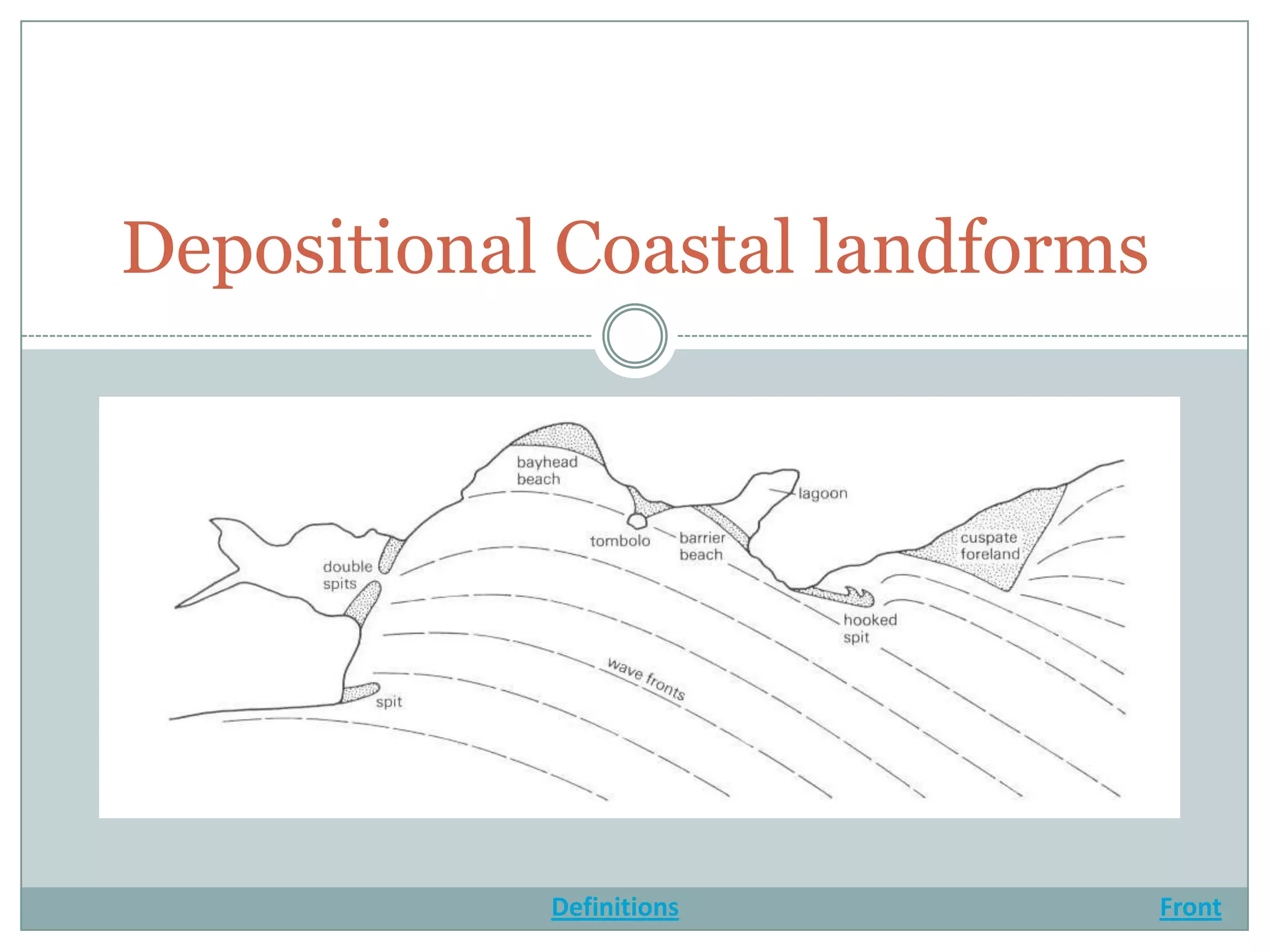
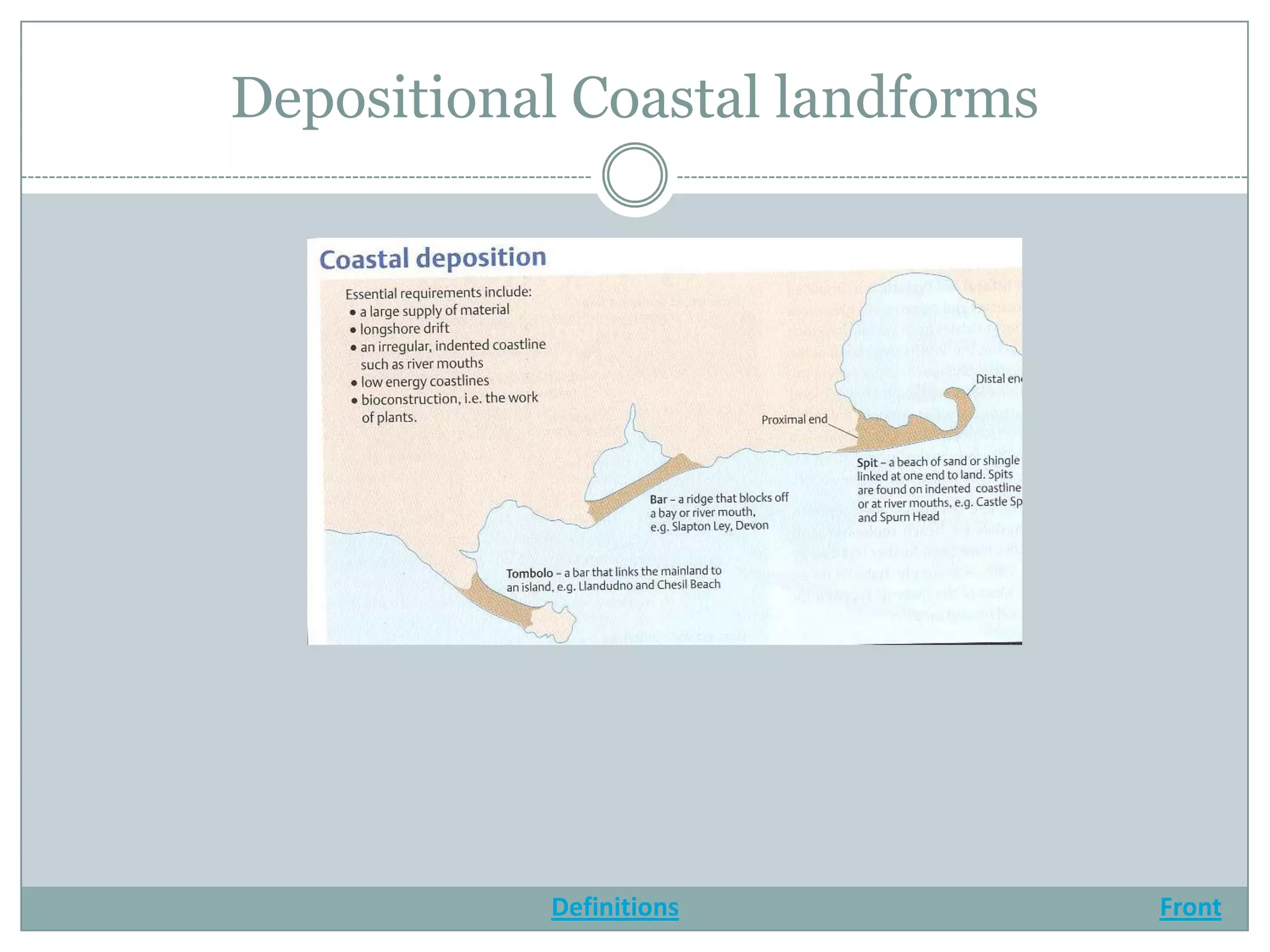
Depositional Coastal landforms


            Definitions          Front
Depositional Coastal landforms


           Definitions           Front
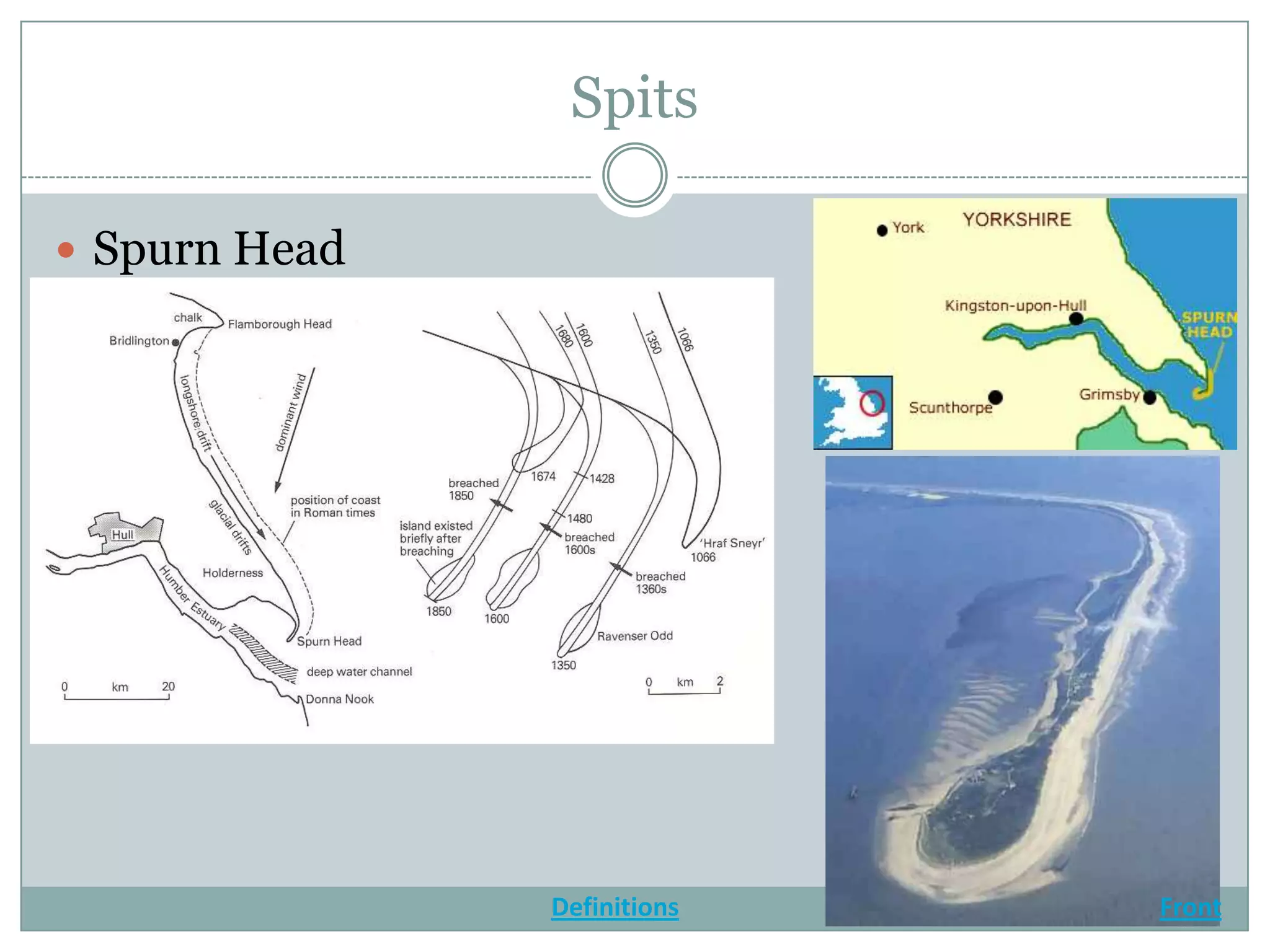
Spits

 Spurn Head


               Definitions   Front
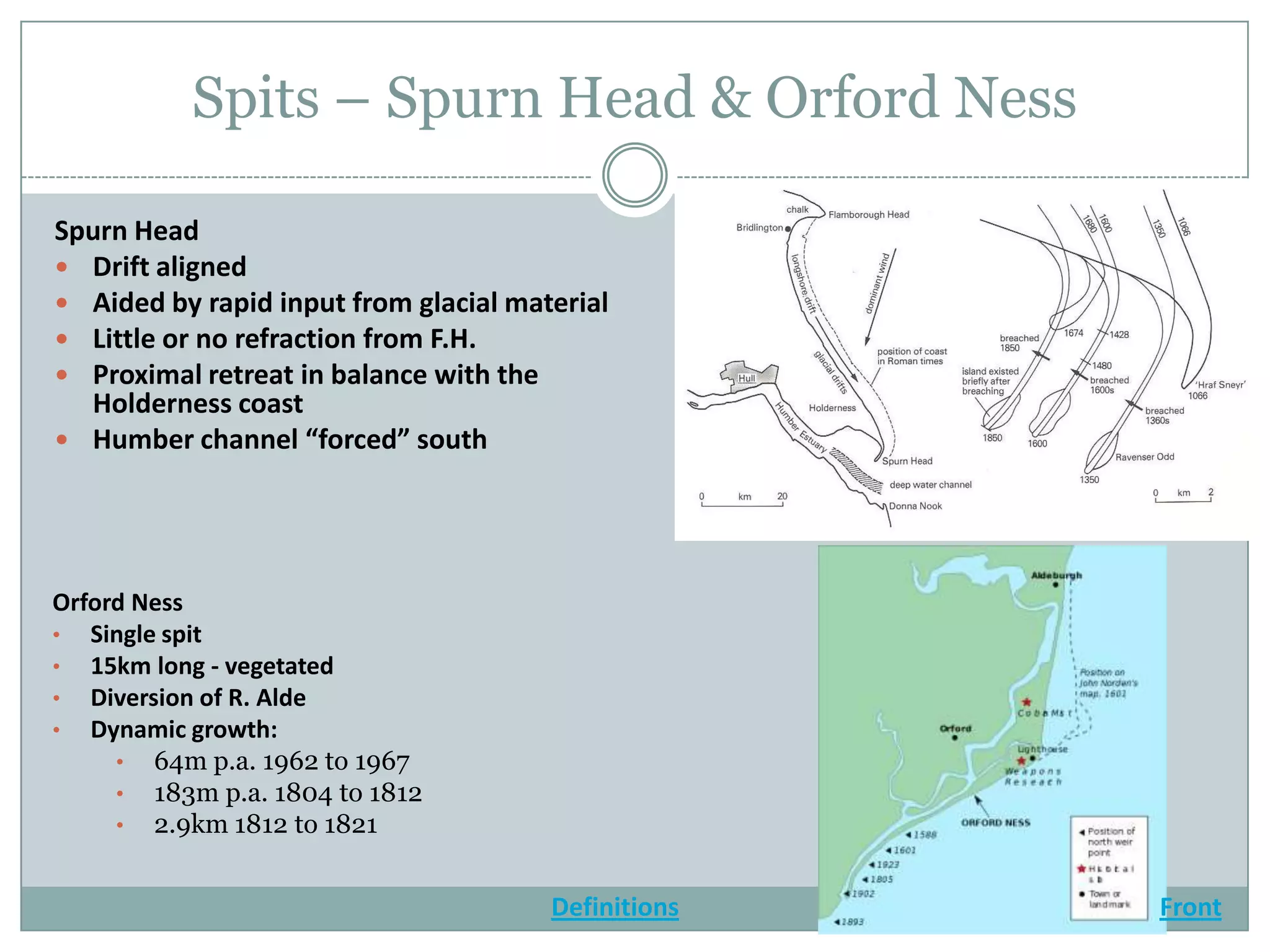
Spits – Spurn Head & Orford Ness

Spurn Head
 Drift aligned
 Aided by rapid input from glacial material
 Little or no refraction from F.H.
 Proximal retreat in balance with the
  Holderness coast
 Humber channel “forced” south


Orford Ness
• Single spit
• 15km long - vegetated
• Diversion of R. Alde
• Dynamic growth:
     • 64m p.a. 1962 to 1967
     • 183m p.a. 1804 to 1812
     • 2.9km 1812 to 1821


                                       Definitions   Front
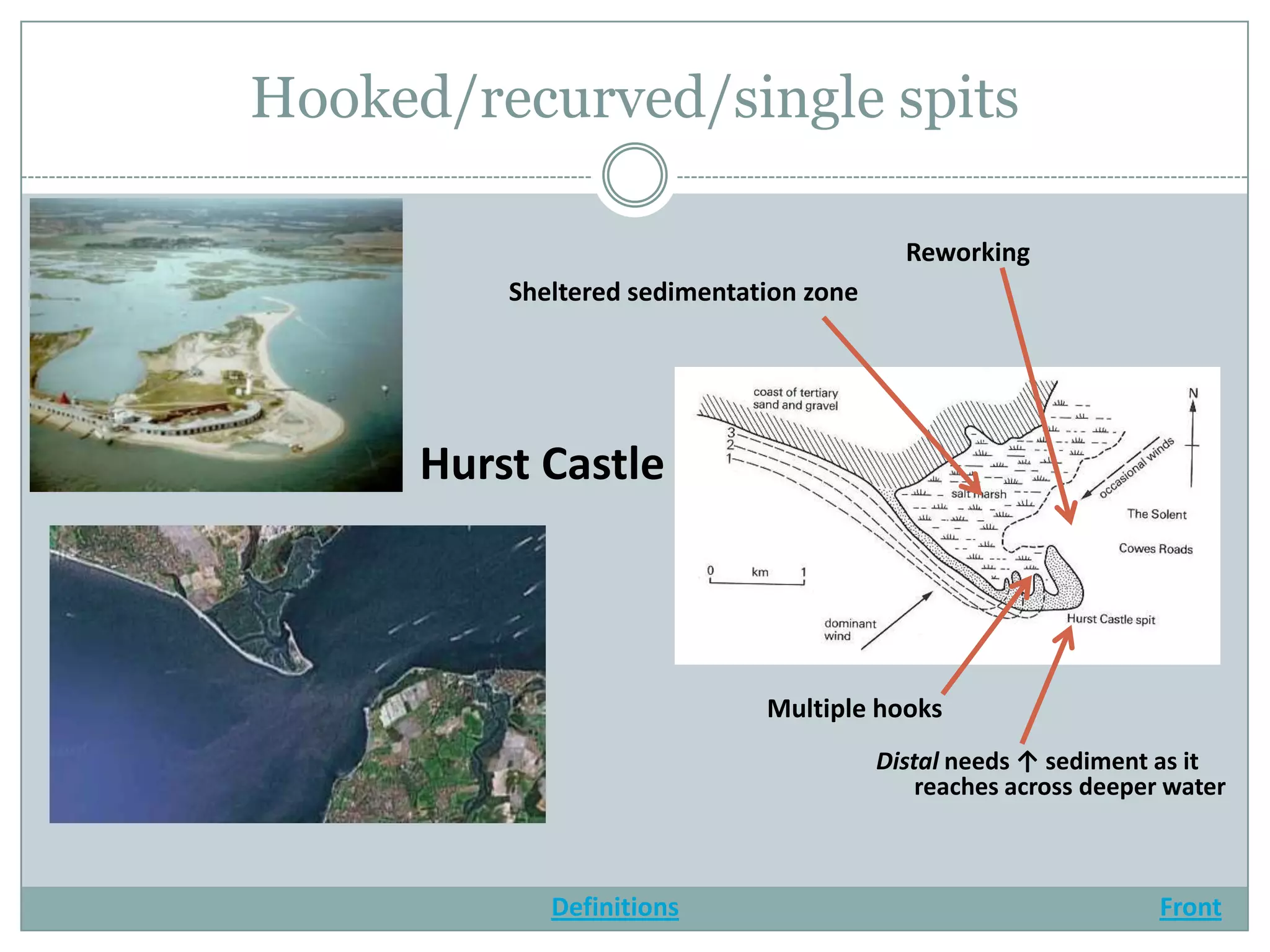
Hooked/recurved/single spits

                                           Reworking
          Sheltered sedimentation zone


      Hurst Castle


                              Multiple hooks
                                         Distal needs ↑ sediment as it
                                             reaches across deeper water


             Definitions                                          Front
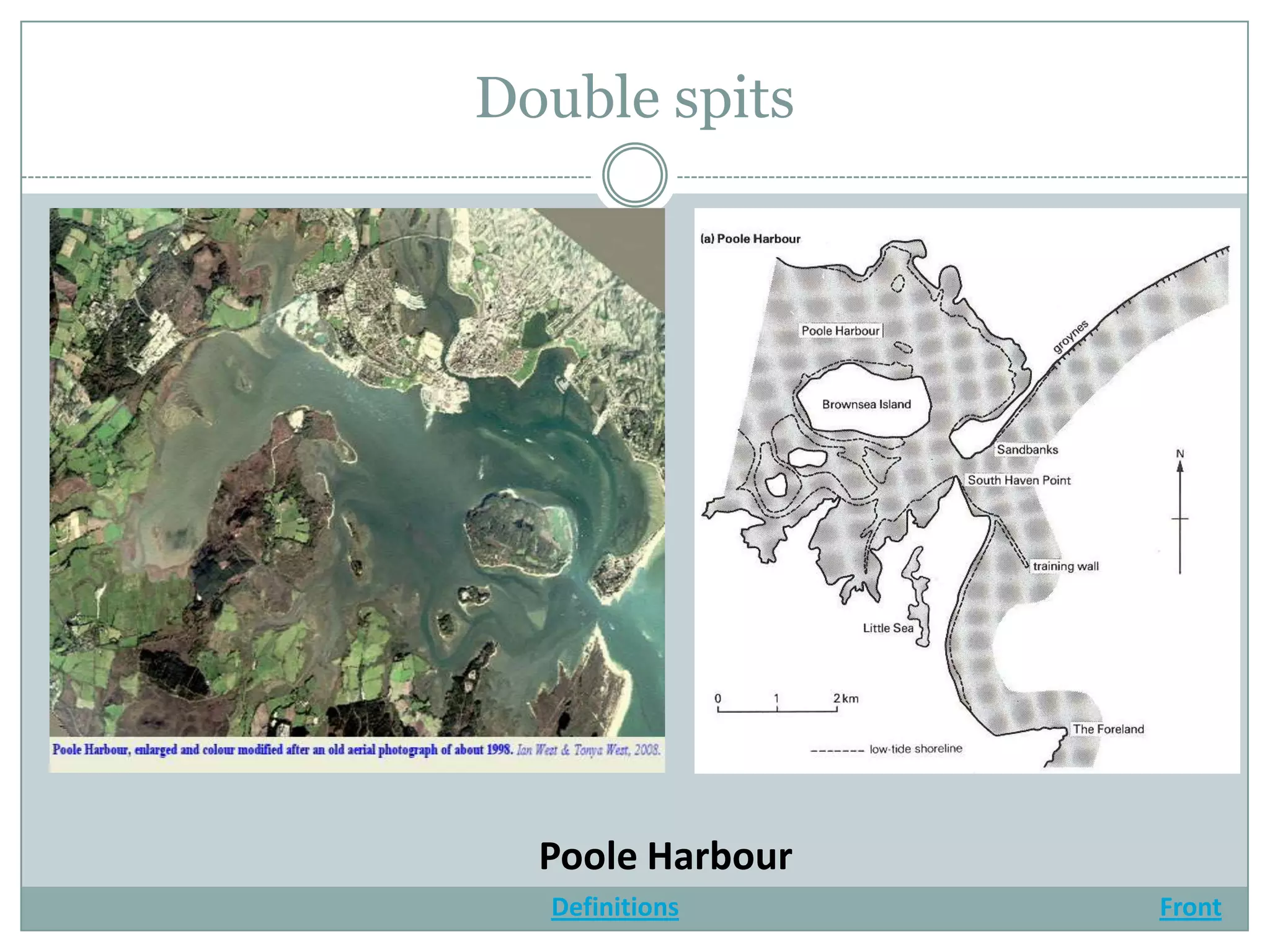
Double spits


  Poole Harbour
  Definitions     Front
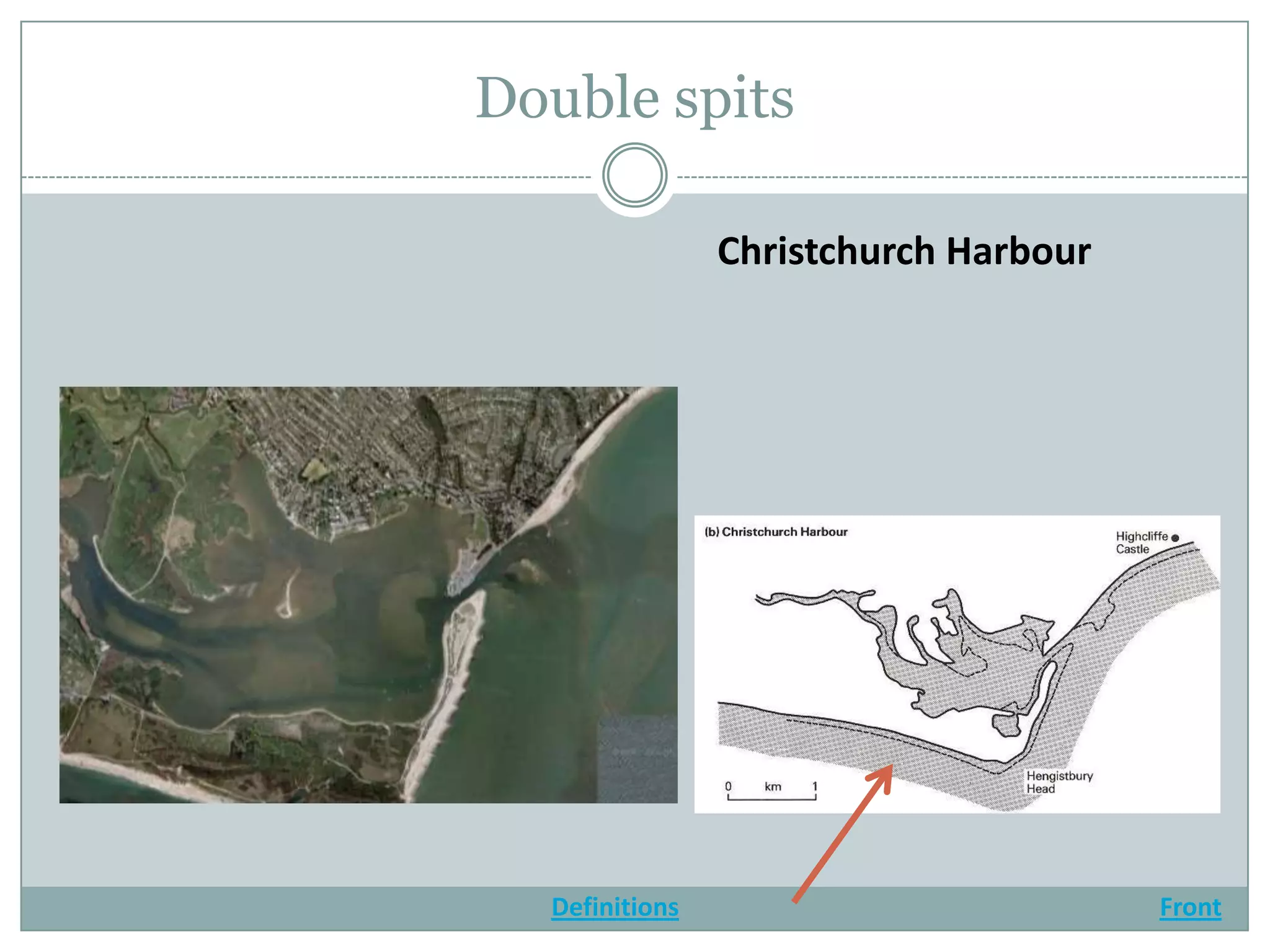
Double spits

                Christchurch Harbour


  Definitions                          Front
Double spits

Poole Harbour                                       Christchurch Harbour
 1785 channel outflow                               1880 spit extenison from
  through “Little Sea”                                south to north almost to
 By 1875 entrance migrated
                                                      Highcliffe Castle
     Managed to maintain channel                    1886 & 1935 spit breach by
                                                      easterly storm
 Migration due to off shore
                                                     Theory?
  bar inshore migrating
                                                         Northern spit is remnant
                                                           of bar?


      PH = swash aligned, CH = drift aligned


                                      Definitions                                Front
Barrier beaches

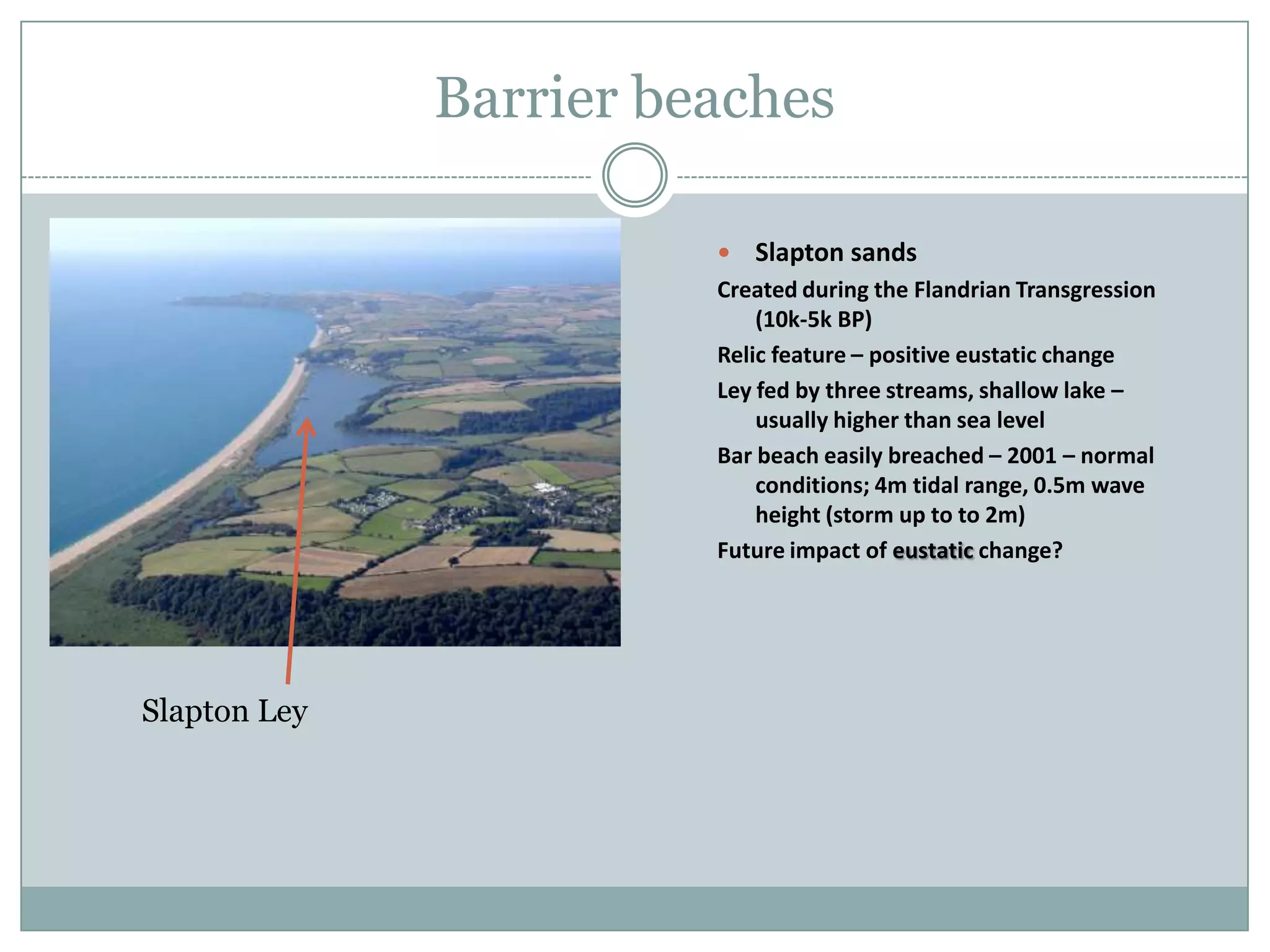
                           Slapton sands
                        Created during the Flandrian Transgression
                            (10k-5k BP)
                        Relic feature – positive eustatic change
                        Ley fed by three streams, shallow lake –
                            usually higher than sea level
                        Bar beach easily breached – 2001 – normal
                            conditions; 4m tidal range, 0.5m wave
                            height (storm up to to 2m)
                        Future impact of eustatic change?


Slapton Ley
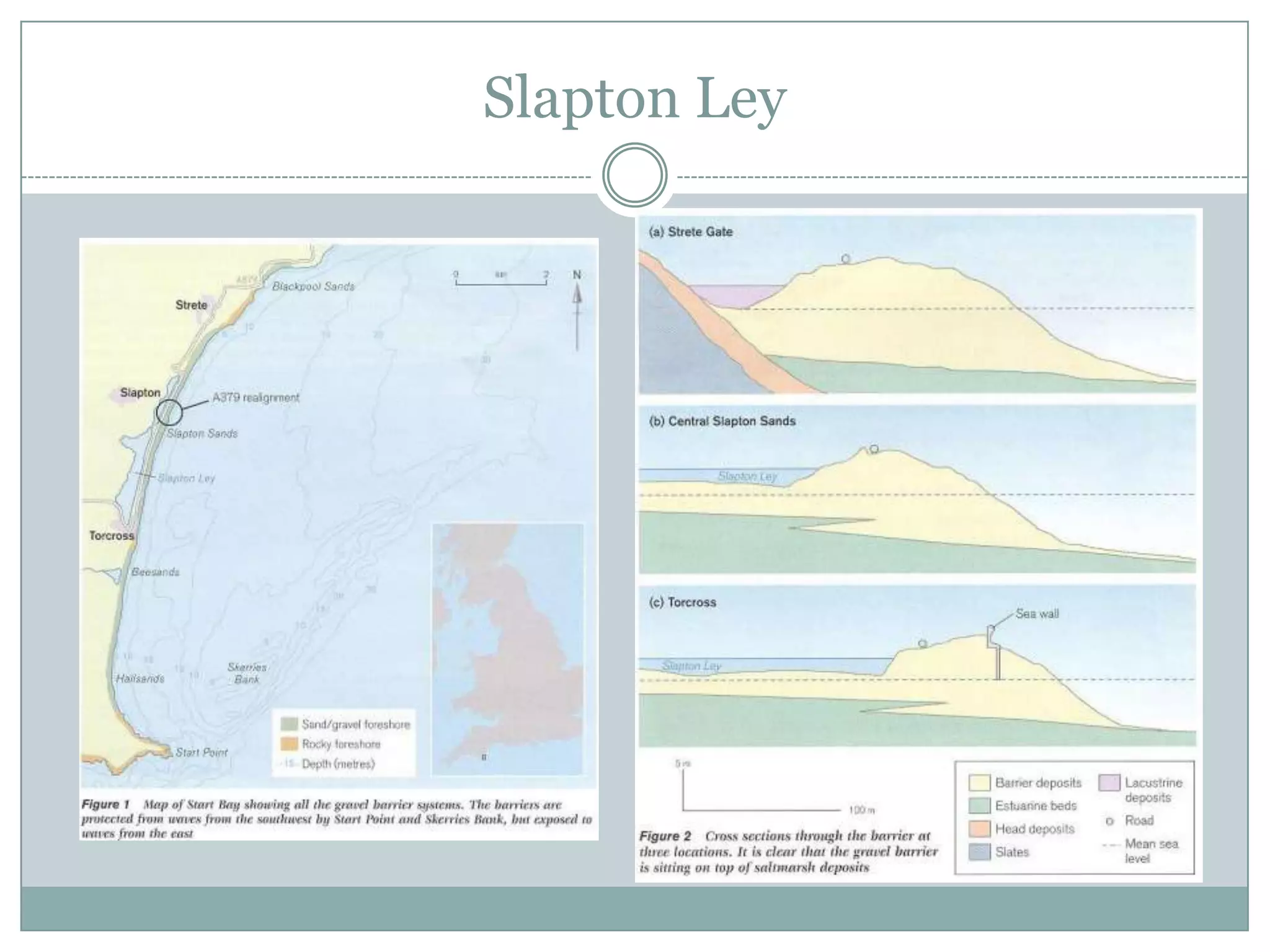
Slapton Ley
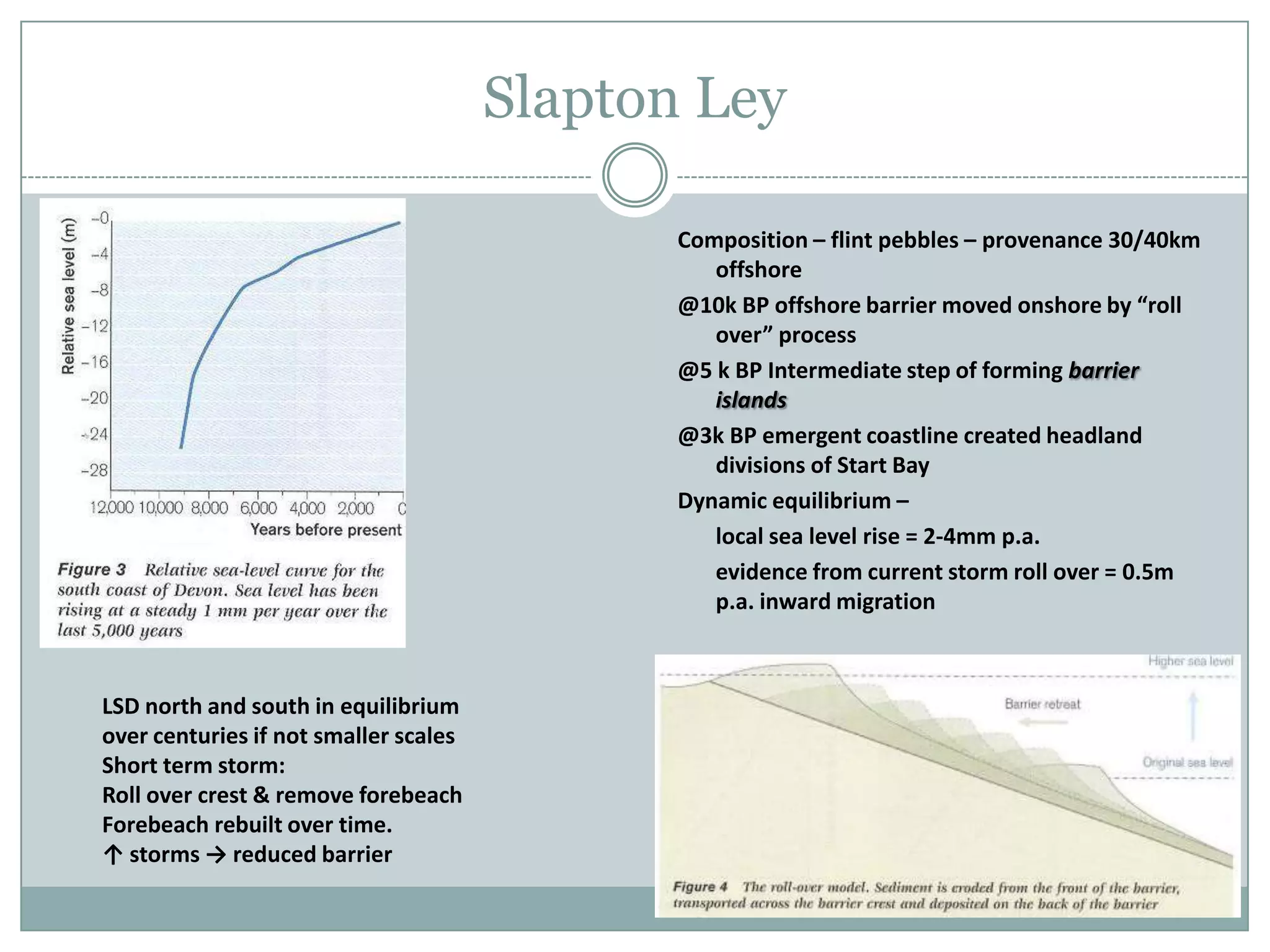
Slapton Ley

                                              Composition – flint pebbles – provenance 30/40km
                                                 offshore
                                              @10k BP offshore barrier moved onshore by “roll
                                                 over” process
                                              @5 k BP Intermediate step of forming barrier
                                                 islands
                                              @3k BP emergent coastline created headland
                                                 divisions of Start Bay
                                              Dynamic equilibrium –
                                                 local sea level rise = 2-4mm p.a.
                                                 evidence from current storm roll over = 0.5m
                                                 p.a. inward migration


LSD north and south in equilibrium
over centuries if not smaller scales
Short term storm:
Roll over crest & remove forebeach
Forebeach rebuilt over time.
↑ storms → reduced barrier
Definitions

Swash aligned beaches        ;           Drift aligned beaches;
                                         Some beaches show oblique
   ·Smoothly curving concave             alignments to the dominant wave
   beaches.                              fronts.
   · Beach face is orientated parallel   Usually occurs where the beach
   to the fronts of the dominant         gradient is steep and the wavelength
   waves.                                is short.
   · Beaches which face the waves        This is because the crest breaks at
   are termed swash aligned.             different times along the beach.


Spits;                                         Spits II;
e.g. Spurn Head, Holderness,                   As spits build further in to deeper     Barrier beaches
Yorkshire.                                     water, they require more sediment to    Beach which stretches across from
Dominant waves push material along             build above the HWM. The waves          one embayment to the other, and
the coast in longshore drift. Coast            have greater energy to attack the       encloses a lagoon behind it
turns inwards, and the material                distal end, turning it inwards.         , e.g. Slapton sands, Cornwall.
continues to be deposited in line with         Sometimes, the curves are due to the    Feature is swash aligned, and has
the coastal trend. Finer materials are         changing of the predominant wind        probably been driven landwards
deposited in the sheltered side of the         direction to another, causing           from the offshore zone.
spit. Marshes can build up, and this           waves, and thus deposition to occur
forces the river to the other side of the      an a different angle. These recurves
estuary.                                       are sheltered by the spit and become
                                               prominent features, e.g. Hurst Castle
                                               Spit, The Solent.
                                                                                                                           Front

Depositional coastal landforms

  • 1.
  • 2.
  • 3.
    Spits  Spurn Head Definitions Front
  • 4.
    Spits – SpurnHead & Orford Ness Spurn Head  Drift aligned  Aided by rapid input from glacial material  Little or no refraction from F.H.  Proximal retreat in balance with the Holderness coast  Humber channel “forced” south Orford Ness • Single spit • 15km long - vegetated • Diversion of R. Alde • Dynamic growth: • 64m p.a. 1962 to 1967 • 183m p.a. 1804 to 1812 • 2.9km 1812 to 1821 Definitions Front
  • 5.
    Hooked/recurved/single spits Reworking Sheltered sedimentation zone Hurst Castle Multiple hooks Distal needs ↑ sediment as it reaches across deeper water Definitions Front
  • 6.
    Double spits Poole Harbour Definitions Front
  • 7.
    Double spits Christchurch Harbour Definitions Front
  • 8.
    Double spits Poole Harbour Christchurch Harbour  1785 channel outflow  1880 spit extenison from through “Little Sea” south to north almost to  By 1875 entrance migrated Highcliffe Castle  Managed to maintain channel  1886 & 1935 spit breach by easterly storm  Migration due to off shore  Theory? bar inshore migrating  Northern spit is remnant of bar? PH = swash aligned, CH = drift aligned Definitions Front
  • 9.
    Barrier beaches  Slapton sands Created during the Flandrian Transgression (10k-5k BP) Relic feature – positive eustatic change Ley fed by three streams, shallow lake – usually higher than sea level Bar beach easily breached – 2001 – normal conditions; 4m tidal range, 0.5m wave height (storm up to to 2m) Future impact of eustatic change? Slapton Ley
  • 10.
  • 11.
    Slapton Ley Composition – flint pebbles – provenance 30/40km offshore @10k BP offshore barrier moved onshore by “roll over” process @5 k BP Intermediate step of forming barrier islands @3k BP emergent coastline created headland divisions of Start Bay Dynamic equilibrium – local sea level rise = 2-4mm p.a. evidence from current storm roll over = 0.5m p.a. inward migration LSD north and south in equilibrium over centuries if not smaller scales Short term storm: Roll over crest & remove forebeach Forebeach rebuilt over time. ↑ storms → reduced barrier
  • 12.
    Definitions Swash aligned beaches ; Drift aligned beaches; Some beaches show oblique ·Smoothly curving concave alignments to the dominant wave beaches. fronts. · Beach face is orientated parallel Usually occurs where the beach to the fronts of the dominant gradient is steep and the wavelength waves. is short. · Beaches which face the waves This is because the crest breaks at are termed swash aligned. different times along the beach. Spits; Spits II; e.g. Spurn Head, Holderness, As spits build further in to deeper Barrier beaches Yorkshire. water, they require more sediment to Beach which stretches across from Dominant waves push material along build above the HWM. The waves one embayment to the other, and the coast in longshore drift. Coast have greater energy to attack the encloses a lagoon behind it turns inwards, and the material distal end, turning it inwards. , e.g. Slapton sands, Cornwall. continues to be deposited in line with Sometimes, the curves are due to the Feature is swash aligned, and has the coastal trend. Finer materials are changing of the predominant wind probably been driven landwards deposited in the sheltered side of the direction to another, causing from the offshore zone. spit. Marshes can build up, and this waves, and thus deposition to occur forces the river to the other side of the an a different angle. These recurves estuary. are sheltered by the spit and become prominent features, e.g. Hurst Castle Spit, The Solent. Front