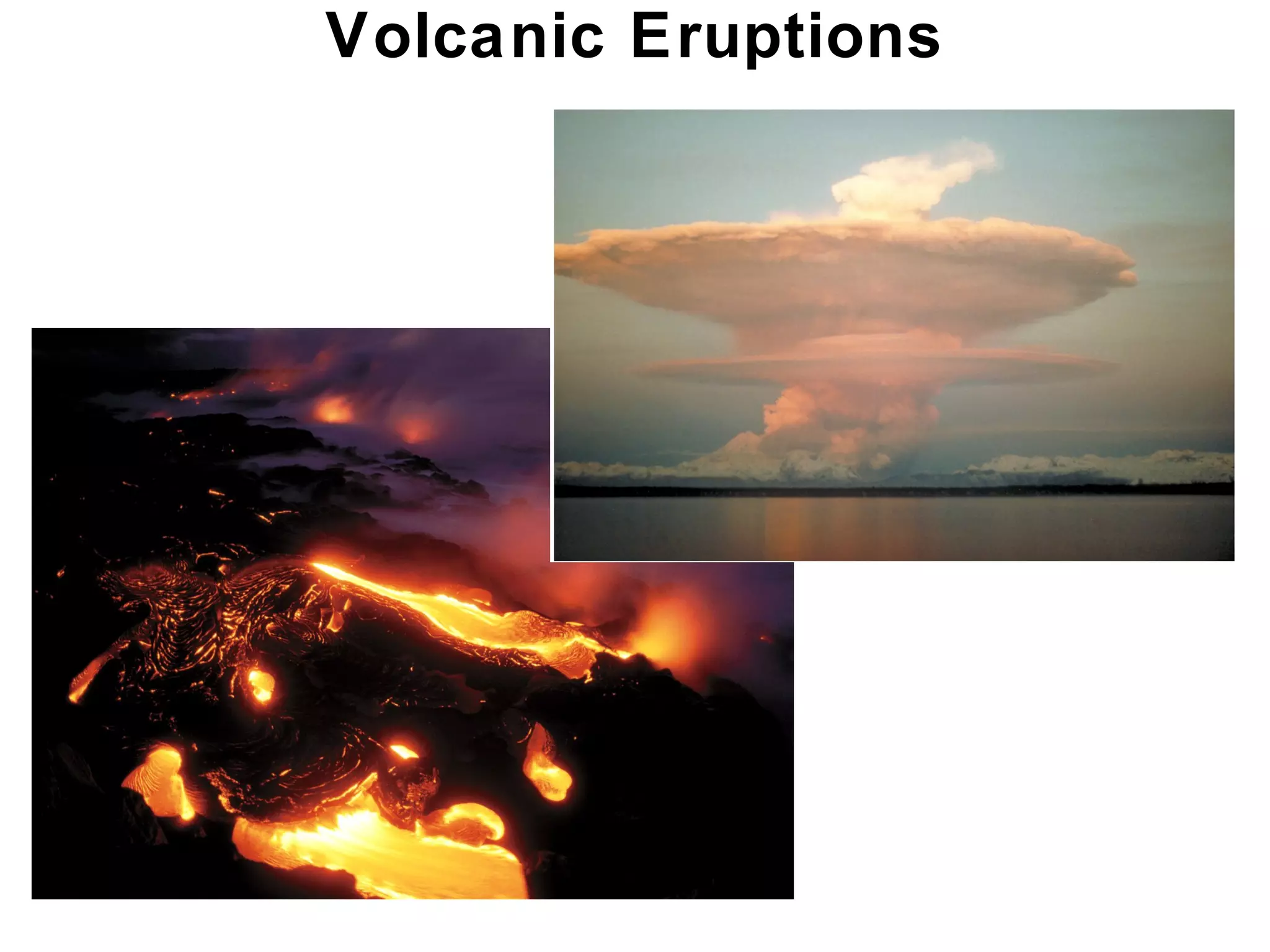
Volcanic Eruptions


                     Chapter 9
Outline
• Volcanoes
   -Basics & an example

• Eruptions and their products
   -3 major types, lava flows and composition
   -Basaltic flows: types, columnar jointing, pillows
   -Andesitic and rhyolitic flows
   -Pyroclastics, lahars, and volcanic gas

• Architecture of a volcano
   -Magma chamber, vents, craters, calderas

• Volcanoes
   -Shapes, sizes, types
   -Eruption styles and tectonic settings
   -Volcanic hazards
                                                        Chapter 9 9
                                                         Chapter
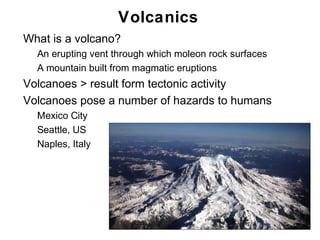
Volcanics
•   What is a volcano?
    •   An erupting vent through which moleon rock surfaces
    •   A mountain built from magmatic eruptions
•   Volcanoes > result form tectonic activity
•   Volcanoes pose a number of hazards to humans
    •   Mexico City
    •   Seattle, US
    •   Naples, Italy


                                                              Chapter 9
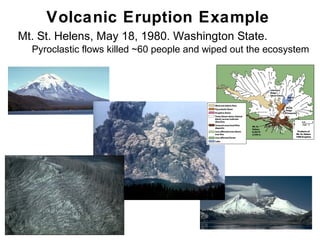
Volcanic Eruption Example
•   Mt. St. Helens, May 18, 1980. Washington State.
    •   Pyroclastic flows killed ~60 people and wiped out the ecosystem


                                                                  Chapter 9
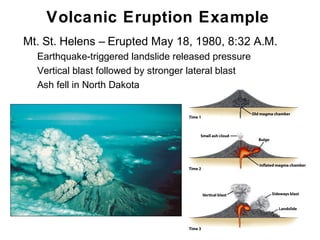
Volcanic Eruption Example
•   Mt. St. Helens – Erupted May 18, 1980, 8:32 A.M.
    •   Earthquake-triggered landslide released pressure
    •   Vertical blast followed by stronger lateral blast
    •   Ash fell in North Dakota


                                                            Chapter 9
Outline
• Volcanoes
   -Basics & an example

• Eruptions and their products
   -3 major types, lava flows and composition
   -Basaltic flows: types, columnar jointing, pillows
   -Andesitic and rhyolitic flows
   -Pyroclastics, lahars, and volcanic gas

• Architecture of a volcano
   -Magma chamber, vents, craters, calderas

• Volcanoes
   -Shapes, sizes, types
   -Eruption styles and tectonic settings
   -Volcanic hazards
                                                        Chapter 9 9
                                                         Chapter
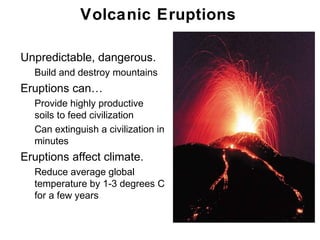
Volcanic Eruptions

•   Unpredictable, dangerous.
    •   Build and destroy mountains
•   Eruptions can…
    •   Provide highly productive
        soils to feed civilization
    •   Can extinguish a civilization in
        minutes
•   Eruptions affect climate.
    •   Reduce average global
        temperature by 1-3 degrees C
        for a few years


                                           Chapter 9
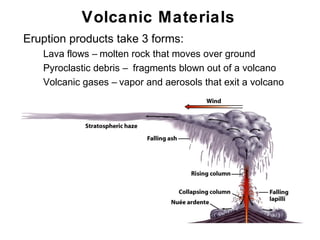
Volcanic Materials
•   Eruption products take 3 forms:
    1.   Lava flows – molten rock that moves over ground
    2.   Pyroclastic debris – fragments blown out of a volcano
    3.   Volcanic gases – vapor and aerosols that exit a volcano


                                                                   Chapter 9
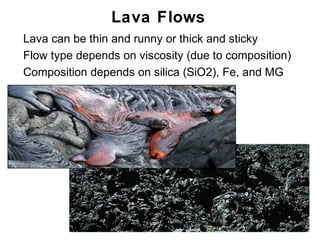
Lava Flows
•   Lava can be thin and runny or thick and sticky
•   Flow type depends on viscosity (due to composition)
•   Composition depends on silica (SiO2), Fe, and MG


                                                      Chapter 9
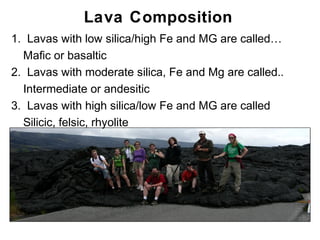
Lava Composition
1. Lavas with low silica/high Fe and MG are called…
  Mafic or basaltic
2. Lavas with moderate silica, Fe and Mg are called..
  Intermediate or andesitic
3. Lavas with high silica/low Fe and MG are called
  Silicic, felsic, rhyolite


                                                        Chapter 9
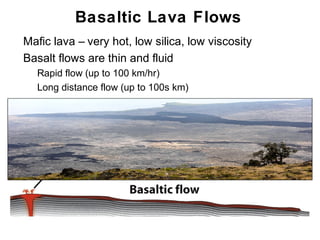
Basaltic Lava Flows
•   Mafic lava – very hot, low silica, low viscosity
•   Basalt flows are thin and fluid
    •   Rapid flow (up to 100 km/hr)
    •   Long distance flow (up to 100s km)


                                                       Chapter 9
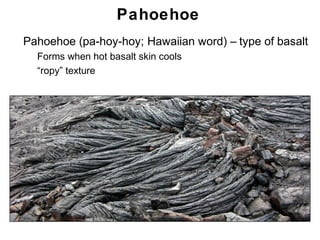
Pahoehoe
•   Pahoehoe (pa-hoy-hoy; Hawaiian word) – type of basalt
    •   Forms when hot basalt skin cools
    •   “ropy” texture


                                                     Chapter 9
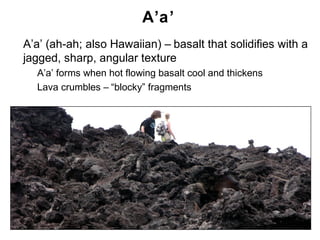
A’a’
•   A’a’ (ah-ah; also Hawaiian) – basalt that solidifies with a
    jagged, sharp, angular texture
    •   A’a’ forms when hot flowing basalt cool and thickens
    •   Lava crumbles – “blocky” fragments


                                                               Chapter 9
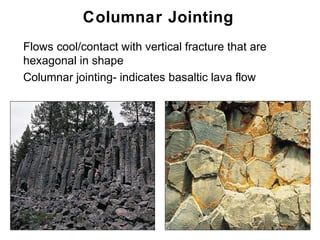
Columnar Jointing
•   Flows cool/contact with vertical fracture that are
    hexagonal in shape
•   Columnar jointing- indicates basaltic lava flow


                                                         Chapter 9
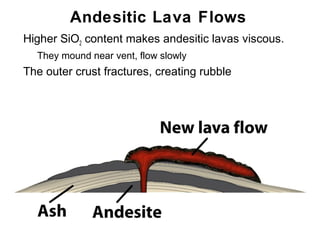
Andesitic Lava Flows
•   Higher SiO2 content makes andesitic lavas viscous.
    •   They mound near vent, flow slowly
•   The outer crust fractures, creating rubble


                                                         Chapter 9
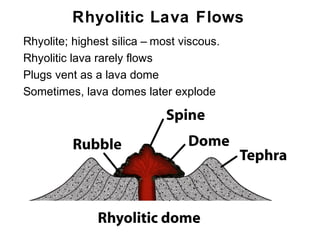
Rhyolitic Lava Flows
•   Rhyolite; highest silica – most viscous.
•   Rhyolitic lava rarely flows
•   Plugs vent as a lava dome
•   Sometimes, lava domes later explode


                                               Chapter 9
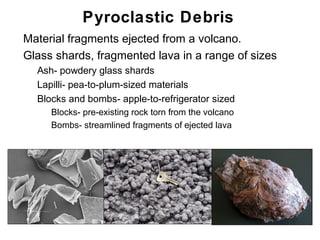
Pyroclastic Debris
•   Material fragments ejected from a volcano.
•   Glass shards, fragmented lava in a range of sizes
    •   Ash- powdery glass shards
    •   Lapilli- pea-to-plum-sized materials
    •   Blocks and bombs- apple-to-refrigerator sized
         • Blocks- pre-existing rock torn from the volcano
         • Bombs- streamlined fragments of ejected lava


                                                             Chapter 9
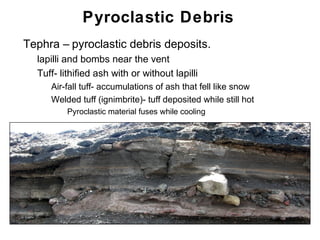
Pyroclastic Debris
•   Tephra – pyroclastic debris deposits.
    •   lapilli and bombs near the vent
    •   Tuff- lithified ash with or without lapilli
         • Air-fall tuff- accumulations of ash that fell like snow
         • Welded tuff (ignimbrite)- tuff deposited while still hot
             • Pyroclastic material fuses while cooling


                                                                      Chapter 9
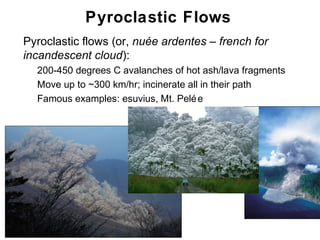
Pyroclastic Flows
•   Pyroclastic flows (or, nuée ardentes – french for
    incandescent cloud):
    •   200-450 degrees C avalanches of hot ash/lava fragments
    •   Move up to ~300 km/hr; incinerate all in their path
    •   Famous examples: esuvius, Mt. Pelé e


                                                                 Chapter 9
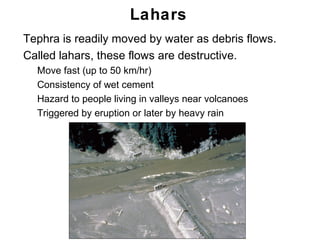
Lahars
•   Tephra is readily moved by water as debris flows.
•   Called lahars, these flows are destructive.
    •   Move fast (up to 50 km/hr)
    •   Consistency of wet cement
    •   Hazard to people living in valleys near volcanoes
    •   Triggered by eruption or later by heavy rain


                                                            Chapter 9
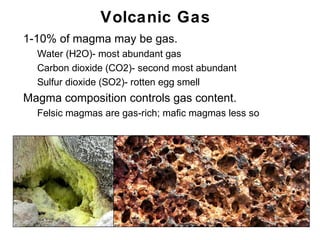
Volcanic Gas
•   1-10% of magma may be gas.
    •   Water (H2O)- most abundant gas
    •   Carbon dioxide (CO2)- second most abundant
    •   Sulfur dioxide (SO2)- rotten egg smell
•   Magma composition controls gas content.
    •   Felsic magmas are gas-rich; mafic magmas less so


                                                           Chapter 9
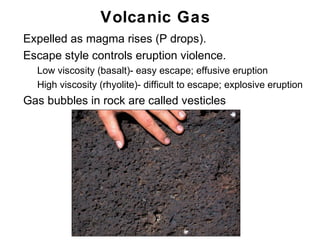
Volcanic Gas
•   Expelled as magma rises (P drops).
•   Escape style controls eruption violence.
    •   Low viscosity (basalt)- easy escape; effusive eruption
    •   High viscosity (rhyolite)- difficult to escape; explosive eruption
•   Gas bubbles in rock are called vesticles


                                                                       Chapter 9
Outline
• Volcanoes
   -Basics & an example

• Eruptions and their products
   -3 major types, lava flows and composition
   -Basaltic flows: types, columnar jointing, pillows
   -Andesitic and rhyolitic flows
   -Pyroclastics, lahars, and volcanic gas

• Architecture of a volcano
   -Magma chamber, vents, craters, calderas

• Volcanoes
   -Shapes, sizes, types
   -Eruption styles and tectonic settings
   -Volcanic hazards
                                                        Chapter 9 9
                                                         Chapter
Volcanic Architecture
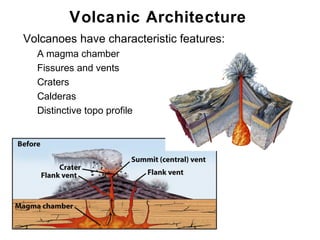
•   Volcanoes have characteristic features:
    •   A magma chamber
    •   Fissures and vents
    •   Craters
    •   Calderas
    •   Distinctive topo profile


                                              Chapter 9
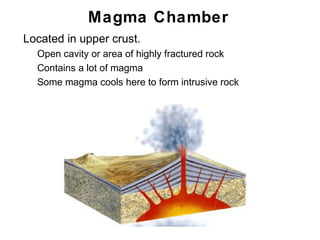
Magma Chamber
•   Located in upper crust.
    •   Open cavity or area of highly fractured rock
    •   Contains a lot of magma
    •   Some magma cools here to form intrusive rock


                                                       Chapter 9
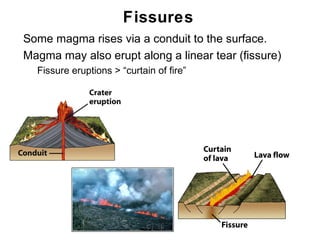
Fissures
•   Some magma rises via a conduit to the surface.
•   Magma may also erupt along a linear tear (fissure)
    •   Fissure eruptions > “curtain of fire”


                                                         Chapter 9
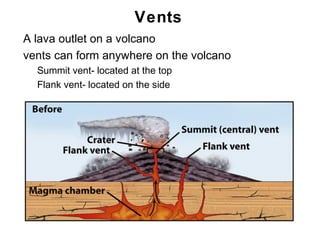
Vents
•   A lava outlet on a volcano
•   vents can form anywhere on the volcano
    •   Summit vent- located at the top
    •   Flank vent- located on the side


                                             Chapter 9
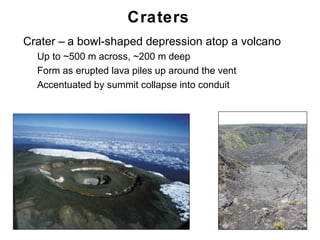
Craters
•   Crater – a bowl-shaped depression atop a volcano
    •   Up to ~500 m across, ~200 m deep
    •   Form as erupted lava piles up around the vent
    •   Accentuated by summit collapse into conduit


                                                        Chapter 9
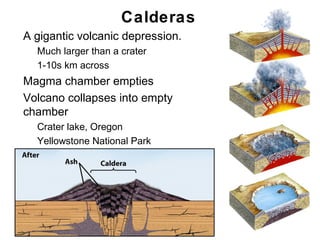
Calderas
•   A gigantic volcanic depression.
    •   Much larger than a crater
    •   1-10s km across
•   Magma chamber empties
•   Volcano collapses into empty
    chamber
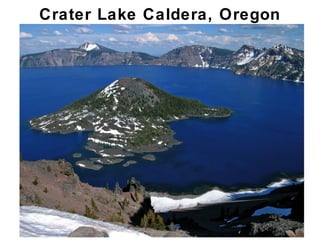
    •   Crater lake, Oregon
    •   Yellowstone National Park


                                      Chapter 9
Crater Lake Caldera, Oregon


                              Chapter 9
Outline
• Volcanoes
   -Basics & an example

• Eruptions and their products
   -3 major types, lava flows and composition
   -Basaltic flows: types, columnar jointing, pillows
   -Andesitic and rhyolitic flows
   -Pyroclastics, lahars, and volcanic gas

• Architecture of a volcano
   -Magma chamber, vents, craters, calderas

• Volcanoes
   -Shapes, sizes, types
   -Eruption styles and tectonic settings
   -Volcanic hazards
                                                        Chapter 9 9
                                                         Chapter
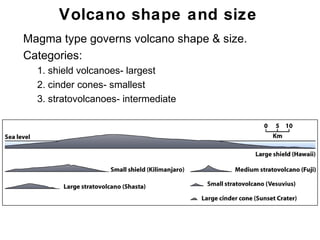
Volcano shape and size
•   Magma type governs volcano shape & size.
•   Categories:
    •   1. shield volcanoes- largest
    •   2. cinder cones- smallest
    •   3. stratovolcanoes- intermediate


                                               Chapter 9
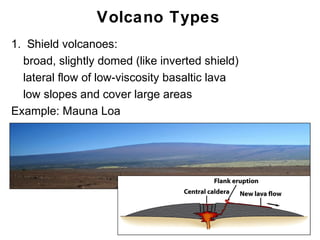
Volcano Types
1. Shield volcanoes:
  broad, slightly domed (like inverted shield)
  lateral flow of low-viscosity basaltic lava
  low slopes and cover large areas
Example: Mauna Loa


                                                 Chapter 9
Volcano Types
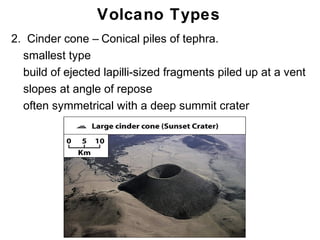
2. Cinder cone – Conical piles of tephra.
  smallest type
  build of ejected lapilli-sized fragments piled up at a vent
  slopes at angle of repose
  often symmetrical with a deep summit crater


                                                         Chapter 9
Volcano Types
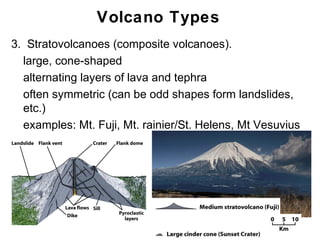
3. Stratovolcanoes (composite volcanoes).
  large, cone-shaped
  alternating layers of lava and tephra
  often symmetric (can be odd shapes form landslides,
  etc.)
  examples: Mt. Fuji, Mt. rainier/St. Helens, Mt Vesuvius


                                                       Chapter 9
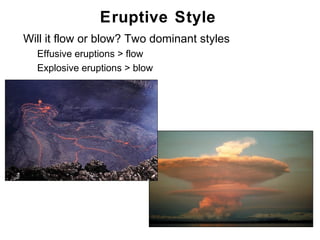
Eruptive Style
•   Will it flow or blow? Two dominant styles
    •   Effusive eruptions > flow
    •   Explosive eruptions > blow


                                                Chapter 9
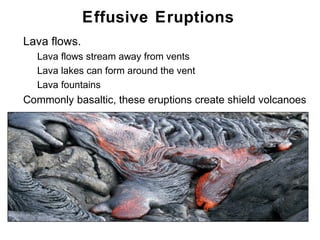
Effusive Eruptions
•   Lava flows.
    •   Lava flows stream away from vents
    •   Lava lakes can form around the vent
    •   Lava fountains
•   Commonly basaltic, these eruptions create shield volcanoes


                                                          Chapter 9
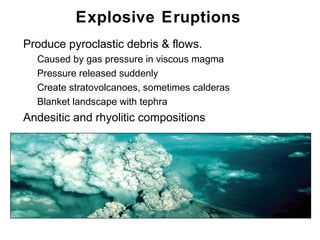
Explosive Eruptions
•   Produce pyroclastic debris & flows.
    •   Caused by gas pressure in viscous magma
    •   Pressure released suddenly
    •   Create stratovolcanoes, sometimes calderas
    •   Blanket landscape with tephra
•   Andesitic and rhyolitic compositions


                                                     Chapter 9
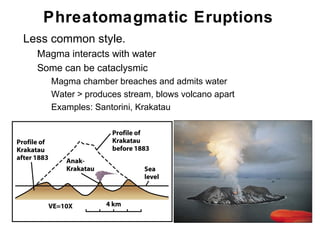
Phreatomagmatic Eruptions
•   Less common style.
    •   Magma interacts with water
    •   Some can be cataclysmic
         • Magma chamber breaches and admits water
         • Water > produces stream, blows volcano apart
         • Examples: Santorini, Krakatau


                                                          Chapter 9
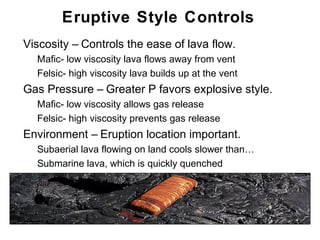
Eruptive Style Controls
•   Viscosity – Controls the ease of lava flow.
    •   Mafic- low viscosity lava flows away from vent
    •   Felsic- high viscosity lava builds up at the vent
•   Gas Pressure – Greater P favors explosive style.
    •   Mafic- low viscosity allows gas release
    •   Felsic- high viscosity prevents gas release
•   Environment – Eruption location important.
    •   Subaerial lava flowing on land cools slower than…
    •   Submarine lava, which is quickly quenched


                                                            Chapter 9
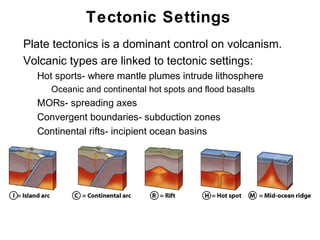
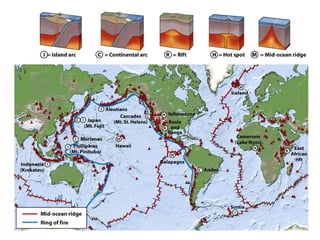
Tectonic Settings
•   Plate tectonics is a dominant control on volcanism.
•   Volcanic types are linked to tectonic settings:
    •   Hot sports- where mantle plumes intrude lithosphere
         • Oceanic and continental hot spots and flood basalts
    •   MORs- spreading axes
    •   Convergent boundaries- subduction zones
    •   Continental rifts- incipient ocean basins


                                                                 Chapter 9
Chapter 9
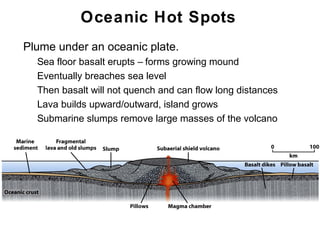
Oceanic Hot Spots
•   Plume under an oceanic plate.
    •   Sea floor basalt erupts – forms growing mound
    •   Eventually breaches sea level
    •   Then basalt will not quench and can flow long distances
    •   Lava builds upward/outward, island grows
    •   Submarine slumps remove large masses of the volcano


                                                                  Chapter 9
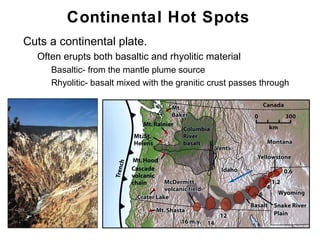
Continental Hot Spots
•   Cuts a continental plate.
    •   Often erupts both basaltic and rhyolitic material
         • Basaltic- from the mantle plume source
         • Rhyolitic- basalt mixed with the granitic crust passes through


                                                                            Chapter 9
Continental Hot Spots
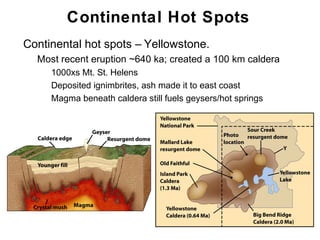
•   Continental hot spots – Yellowstone.
    •   Most recent eruption ~640 ka; created a 100 km caldera
         • 1000xs Mt. St. Helens
         • Deposited ignimbrites, ash made it to east coast
         • Magma beneath caldera still fuels geysers/hot springs


                                                                   Chapter 9
Continental Hot Spots
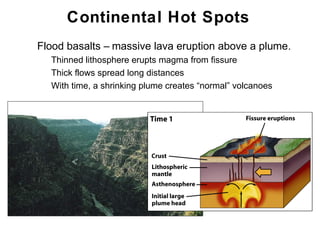
•   Flood basalts – massive lava eruption above a plume.
     • Thinned lithosphere erupts magma from fissure
     • Thick flows spread long distances
     • With time, a shrinking plume creates “normal” volcanoes


                                                                 Chapter 9
Iceland: unique location
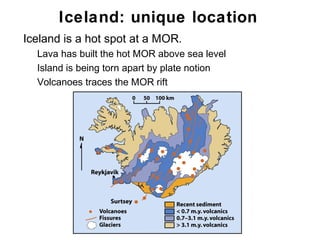
•   Iceland is a hot spot at a MOR.
    •   Lava has built the hot MOR above sea level
    •   Island is being torn apart by plate notion
    •   Volcanoes traces the MOR rift


                                                     Chapter 9
Convergent Boundaries
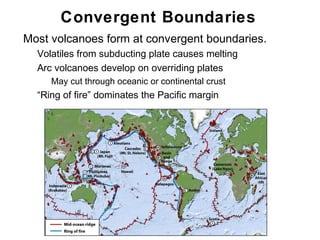
•   Most volcanoes form at convergent boundaries.
    •   Volatiles from subducting plate causes melting
    •   Arc volcanoes develop on overriding plates
         • May cut through oceanic or continental crust
    •   “Ring of fire” dominates the Pacific margin


                                                          Chapter 9
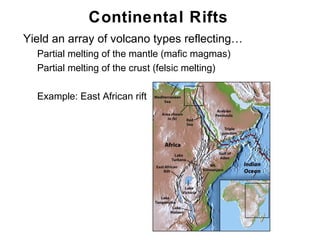
Continental Rifts
•   Yield an array of volcano types reflecting…
    •   Partial melting of the mantle (mafic magmas)
    •   Partial melting of the crust (felsic melting)

    •   Example: East African rift


                                                        Chapter 9
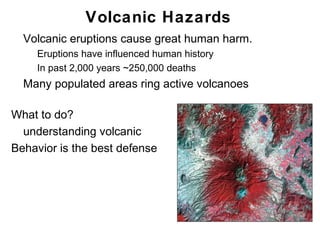
Volcanic Hazards
•   Volcanic eruptions cause great human harm.
    •   Eruptions have influenced human history
    •   In past 2,000 years ~250,000 deaths
•   Many populated areas ring active volcanoes

What to do?
  understanding volcanic
Behavior is the best defense


                                                  Chapter 9
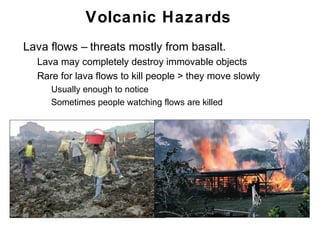
Volcanic Hazards
•   Lava flows – threats mostly from basalt.
    •   Lava may completely destroy immovable objects
    •   Rare for lava flows to kill people > they move slowly
         • Usually enough to notice
         • Sometimes people watching flows are killed


                                                                Chapter 9
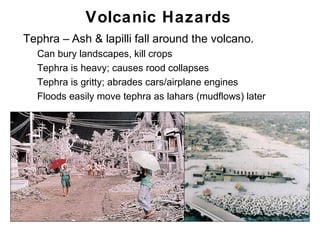
Volcanic Hazards
•   Tephra – Ash & lapilli fall around the volcano.
    •   Can bury landscapes, kill crops
    •   Tephra is heavy; causes rood collapses
    •   Tephra is gritty; abrades cars/airplane engines
    •   Floods easily move tephra as lahars (mudflows) later


                                                               Chapter 9
Volcanic Hazards
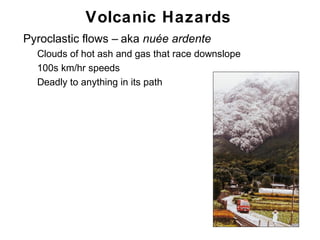
•   Pyroclastic flows – aka nuée ardente
    •   Clouds of hot ash and gas that race downslope
    •   100s km/hr speeds
    •   Deadly to anything in its path


                                                        Chapter 9
Volcanic Hazards
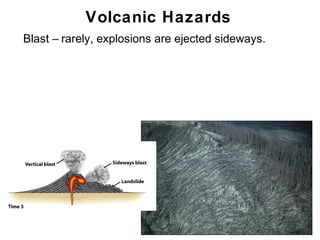
•   Blast – rarely, explosions are ejected sideways.


                                                       Chapter 9
Volcanic Hazards
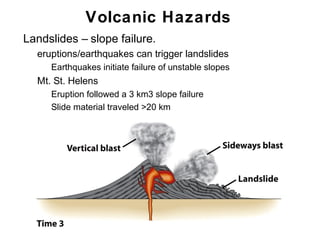
•   Landslides – slope failure.
    •   eruptions/earthquakes can trigger landslides
         • Earthquakes initiate failure of unstable slopes
    •   Mt. St. Helens
         • Eruption followed a 3 km3 slope failure
         • Slide material traveled >20 km


                                                             Chapter 9
Volcanic Hazards
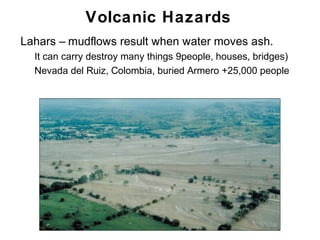
•   Lahars – mudflows result when water moves ash.
    •   It can carry destroy many things 9people, houses, bridges)
    •   Nevada del Ruiz, Colombia, buried Armero +25,000 people


                                                                     Chapter 9
Volcanic Hazards
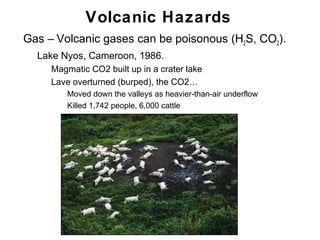
•   Gas – Volcanic gases can be poisonous (H2S, CO2).
    •   Lake Nyos, Cameroon, 1986.
         • Magmatic CO2 built up in a crater lake
         • Lave overturned (burped), the CO2…
             • Moved down the valleys as heavier-than-air underflow
             • Killed 1,742 people, 6,000 cattle


                                                                      Chapter 9
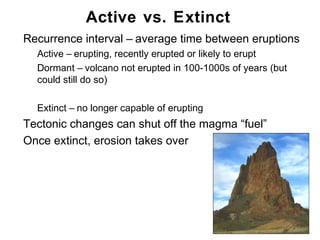
Active vs. Extinct
•   Recurrence interval – average time between eruptions
    •   Active – erupting, recently erupted or likely to erupt
    •   Dormant – volcano not erupted in 100-1000s of years (but
        could still do so)

    •   Extinct – no longer capable of erupting
•   Tectonic changes can shut off the magma “fuel”
•   Once extinct, erosion takes over


                                                                   Chapter 9
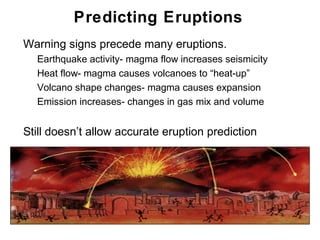
Predicting Eruptions
•   Warning signs precede many eruptions.
    •   Earthquake activity- magma flow increases seismicity
    •   Heat flow- magma causes volcanoes to “heat-up”
    •   Volcano shape changes- magma causes expansion
    •   Emission increases- changes in gas mix and volume

•   Still doesn’t allow accurate eruption prediction


                                                               Chapter 9
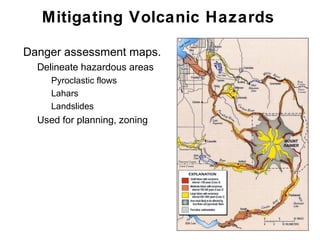
Mitigating Volcanic Hazards
•   Danger assessment maps.
    •   Delineate hazardous areas
         • Pyroclastic flows
         • Lahars
         • Landslides
    •   Used for planning, zoning


                                       Chapter 9
Mitigating Volcanic Hazards
•   Evacuation – moving those at high risk saves lives
    •   Mt. St. Helens- timey evacuation saved 100s
    •   Sometimes eruptions don’t occur, large expenses
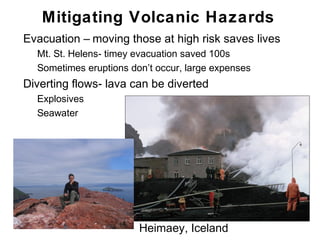
•   Diverting flows- lava can be diverted
    •   Explosives
    •   Seawater


                              Heimaey, Iceland            Chapter 9
Volcanoes and Climate
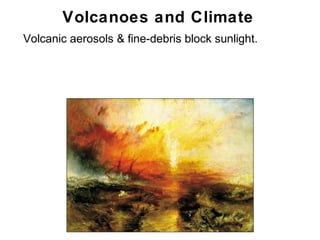
•   Volcanic aerosols & fine-debris block sunlight.


                                                      Chapter 9

Geology lecture 10

  • 1.
  • 2.
    Outline • Volcanoes -Basics & an example • Eruptions and their products -3 major types, lava flows and composition -Basaltic flows: types, columnar jointing, pillows -Andesitic and rhyolitic flows -Pyroclastics, lahars, and volcanic gas • Architecture of a volcano -Magma chamber, vents, craters, calderas • Volcanoes -Shapes, sizes, types -Eruption styles and tectonic settings -Volcanic hazards Chapter 9 9 Chapter
  • 3.
    Volcanics • What is a volcano? • An erupting vent through which moleon rock surfaces • A mountain built from magmatic eruptions • Volcanoes > result form tectonic activity • Volcanoes pose a number of hazards to humans • Mexico City • Seattle, US • Naples, Italy Chapter 9
  • 4.
    Volcanic Eruption Example • Mt. St. Helens, May 18, 1980. Washington State. • Pyroclastic flows killed ~60 people and wiped out the ecosystem Chapter 9
  • 5.
    Volcanic Eruption Example • Mt. St. Helens – Erupted May 18, 1980, 8:32 A.M. • Earthquake-triggered landslide released pressure • Vertical blast followed by stronger lateral blast • Ash fell in North Dakota Chapter 9
  • 6.
    Outline • Volcanoes -Basics & an example • Eruptions and their products -3 major types, lava flows and composition -Basaltic flows: types, columnar jointing, pillows -Andesitic and rhyolitic flows -Pyroclastics, lahars, and volcanic gas • Architecture of a volcano -Magma chamber, vents, craters, calderas • Volcanoes -Shapes, sizes, types -Eruption styles and tectonic settings -Volcanic hazards Chapter 9 9 Chapter
  • 7.
    Volcanic Eruptions • Unpredictable, dangerous. • Build and destroy mountains • Eruptions can… • Provide highly productive soils to feed civilization • Can extinguish a civilization in minutes • Eruptions affect climate. • Reduce average global temperature by 1-3 degrees C for a few years Chapter 9
  • 8.
    Volcanic Materials • Eruption products take 3 forms: 1. Lava flows – molten rock that moves over ground 2. Pyroclastic debris – fragments blown out of a volcano 3. Volcanic gases – vapor and aerosols that exit a volcano Chapter 9
  • 9.
    Lava Flows • Lava can be thin and runny or thick and sticky • Flow type depends on viscosity (due to composition) • Composition depends on silica (SiO2), Fe, and MG Chapter 9
  • 10.
    Lava Composition 1. Lavaswith low silica/high Fe and MG are called… Mafic or basaltic 2. Lavas with moderate silica, Fe and Mg are called.. Intermediate or andesitic 3. Lavas with high silica/low Fe and MG are called Silicic, felsic, rhyolite Chapter 9
  • 11.
    Basaltic Lava Flows • Mafic lava – very hot, low silica, low viscosity • Basalt flows are thin and fluid • Rapid flow (up to 100 km/hr) • Long distance flow (up to 100s km) Chapter 9
  • 12.
    Pahoehoe • Pahoehoe (pa-hoy-hoy; Hawaiian word) – type of basalt • Forms when hot basalt skin cools • “ropy” texture Chapter 9
  • 13.
    A’a’ • A’a’ (ah-ah; also Hawaiian) – basalt that solidifies with a jagged, sharp, angular texture • A’a’ forms when hot flowing basalt cool and thickens • Lava crumbles – “blocky” fragments Chapter 9
  • 14.
    Columnar Jointing • Flows cool/contact with vertical fracture that are hexagonal in shape • Columnar jointing- indicates basaltic lava flow Chapter 9
  • 15.
    Andesitic Lava Flows • Higher SiO2 content makes andesitic lavas viscous. • They mound near vent, flow slowly • The outer crust fractures, creating rubble Chapter 9
  • 16.
    Rhyolitic Lava Flows • Rhyolite; highest silica – most viscous. • Rhyolitic lava rarely flows • Plugs vent as a lava dome • Sometimes, lava domes later explode Chapter 9
  • 17.
    Pyroclastic Debris • Material fragments ejected from a volcano. • Glass shards, fragmented lava in a range of sizes • Ash- powdery glass shards • Lapilli- pea-to-plum-sized materials • Blocks and bombs- apple-to-refrigerator sized • Blocks- pre-existing rock torn from the volcano • Bombs- streamlined fragments of ejected lava Chapter 9
  • 18.
    Pyroclastic Debris • Tephra – pyroclastic debris deposits. • lapilli and bombs near the vent • Tuff- lithified ash with or without lapilli • Air-fall tuff- accumulations of ash that fell like snow • Welded tuff (ignimbrite)- tuff deposited while still hot • Pyroclastic material fuses while cooling Chapter 9
  • 19.
    Pyroclastic Flows • Pyroclastic flows (or, nuée ardentes – french for incandescent cloud): • 200-450 degrees C avalanches of hot ash/lava fragments • Move up to ~300 km/hr; incinerate all in their path • Famous examples: esuvius, Mt. Pelé e Chapter 9
  • 20.
    Lahars • Tephra is readily moved by water as debris flows. • Called lahars, these flows are destructive. • Move fast (up to 50 km/hr) • Consistency of wet cement • Hazard to people living in valleys near volcanoes • Triggered by eruption or later by heavy rain Chapter 9
  • 21.
    Volcanic Gas • 1-10% of magma may be gas. • Water (H2O)- most abundant gas • Carbon dioxide (CO2)- second most abundant • Sulfur dioxide (SO2)- rotten egg smell • Magma composition controls gas content. • Felsic magmas are gas-rich; mafic magmas less so Chapter 9
  • 22.
    Volcanic Gas • Expelled as magma rises (P drops). • Escape style controls eruption violence. • Low viscosity (basalt)- easy escape; effusive eruption • High viscosity (rhyolite)- difficult to escape; explosive eruption • Gas bubbles in rock are called vesticles Chapter 9
  • 23.
    Outline • Volcanoes -Basics & an example • Eruptions and their products -3 major types, lava flows and composition -Basaltic flows: types, columnar jointing, pillows -Andesitic and rhyolitic flows -Pyroclastics, lahars, and volcanic gas • Architecture of a volcano -Magma chamber, vents, craters, calderas • Volcanoes -Shapes, sizes, types -Eruption styles and tectonic settings -Volcanic hazards Chapter 9 9 Chapter
  • 24.
    Volcanic Architecture • Volcanoes have characteristic features: • A magma chamber • Fissures and vents • Craters • Calderas • Distinctive topo profile Chapter 9
  • 25.
    Magma Chamber • Located in upper crust. • Open cavity or area of highly fractured rock • Contains a lot of magma • Some magma cools here to form intrusive rock Chapter 9
  • 26.
    Fissures • Some magma rises via a conduit to the surface. • Magma may also erupt along a linear tear (fissure) • Fissure eruptions > “curtain of fire” Chapter 9
  • 27.
    Vents • A lava outlet on a volcano • vents can form anywhere on the volcano • Summit vent- located at the top • Flank vent- located on the side Chapter 9
  • 28.
    Craters • Crater – a bowl-shaped depression atop a volcano • Up to ~500 m across, ~200 m deep • Form as erupted lava piles up around the vent • Accentuated by summit collapse into conduit Chapter 9
  • 29.
    Calderas • A gigantic volcanic depression. • Much larger than a crater • 1-10s km across • Magma chamber empties • Volcano collapses into empty chamber • Crater lake, Oregon • Yellowstone National Park Chapter 9
  • 30.
    Crater Lake Caldera,Oregon Chapter 9
  • 31.
    Outline • Volcanoes -Basics & an example • Eruptions and their products -3 major types, lava flows and composition -Basaltic flows: types, columnar jointing, pillows -Andesitic and rhyolitic flows -Pyroclastics, lahars, and volcanic gas • Architecture of a volcano -Magma chamber, vents, craters, calderas • Volcanoes -Shapes, sizes, types -Eruption styles and tectonic settings -Volcanic hazards Chapter 9 9 Chapter
  • 32.
    Volcano shape andsize • Magma type governs volcano shape & size. • Categories: • 1. shield volcanoes- largest • 2. cinder cones- smallest • 3. stratovolcanoes- intermediate Chapter 9
  • 33.
    Volcano Types 1. Shieldvolcanoes: broad, slightly domed (like inverted shield) lateral flow of low-viscosity basaltic lava low slopes and cover large areas Example: Mauna Loa Chapter 9
  • 34.
    Volcano Types 2. Cindercone – Conical piles of tephra. smallest type build of ejected lapilli-sized fragments piled up at a vent slopes at angle of repose often symmetrical with a deep summit crater Chapter 9
  • 35.
    Volcano Types 3. Stratovolcanoes(composite volcanoes). large, cone-shaped alternating layers of lava and tephra often symmetric (can be odd shapes form landslides, etc.) examples: Mt. Fuji, Mt. rainier/St. Helens, Mt Vesuvius Chapter 9
  • 36.
    Eruptive Style • Will it flow or blow? Two dominant styles • Effusive eruptions > flow • Explosive eruptions > blow Chapter 9
  • 37.
    Effusive Eruptions • Lava flows. • Lava flows stream away from vents • Lava lakes can form around the vent • Lava fountains • Commonly basaltic, these eruptions create shield volcanoes Chapter 9
  • 38.
    Explosive Eruptions • Produce pyroclastic debris & flows. • Caused by gas pressure in viscous magma • Pressure released suddenly • Create stratovolcanoes, sometimes calderas • Blanket landscape with tephra • Andesitic and rhyolitic compositions Chapter 9
  • 39.
    Phreatomagmatic Eruptions • Less common style. • Magma interacts with water • Some can be cataclysmic • Magma chamber breaches and admits water • Water > produces stream, blows volcano apart • Examples: Santorini, Krakatau Chapter 9
  • 40.
    Eruptive Style Controls • Viscosity – Controls the ease of lava flow. • Mafic- low viscosity lava flows away from vent • Felsic- high viscosity lava builds up at the vent • Gas Pressure – Greater P favors explosive style. • Mafic- low viscosity allows gas release • Felsic- high viscosity prevents gas release • Environment – Eruption location important. • Subaerial lava flowing on land cools slower than… • Submarine lava, which is quickly quenched Chapter 9
  • 41.
    Tectonic Settings • Plate tectonics is a dominant control on volcanism. • Volcanic types are linked to tectonic settings: • Hot sports- where mantle plumes intrude lithosphere • Oceanic and continental hot spots and flood basalts • MORs- spreading axes • Convergent boundaries- subduction zones • Continental rifts- incipient ocean basins Chapter 9
  • 42.
  • 43.
    Oceanic Hot Spots • Plume under an oceanic plate. • Sea floor basalt erupts – forms growing mound • Eventually breaches sea level • Then basalt will not quench and can flow long distances • Lava builds upward/outward, island grows • Submarine slumps remove large masses of the volcano Chapter 9
  • 44.
    Continental Hot Spots • Cuts a continental plate. • Often erupts both basaltic and rhyolitic material • Basaltic- from the mantle plume source • Rhyolitic- basalt mixed with the granitic crust passes through Chapter 9
  • 45.
    Continental Hot Spots • Continental hot spots – Yellowstone. • Most recent eruption ~640 ka; created a 100 km caldera • 1000xs Mt. St. Helens • Deposited ignimbrites, ash made it to east coast • Magma beneath caldera still fuels geysers/hot springs Chapter 9
  • 46.
    Continental Hot Spots • Flood basalts – massive lava eruption above a plume. • Thinned lithosphere erupts magma from fissure • Thick flows spread long distances • With time, a shrinking plume creates “normal” volcanoes Chapter 9
  • 47.
    Iceland: unique location • Iceland is a hot spot at a MOR. • Lava has built the hot MOR above sea level • Island is being torn apart by plate notion • Volcanoes traces the MOR rift Chapter 9
  • 48.
    Convergent Boundaries • Most volcanoes form at convergent boundaries. • Volatiles from subducting plate causes melting • Arc volcanoes develop on overriding plates • May cut through oceanic or continental crust • “Ring of fire” dominates the Pacific margin Chapter 9
  • 49.
    Continental Rifts • Yield an array of volcano types reflecting… • Partial melting of the mantle (mafic magmas) • Partial melting of the crust (felsic melting) • Example: East African rift Chapter 9
  • 50.
    Volcanic Hazards • Volcanic eruptions cause great human harm. • Eruptions have influenced human history • In past 2,000 years ~250,000 deaths • Many populated areas ring active volcanoes What to do? understanding volcanic Behavior is the best defense Chapter 9
  • 51.
    Volcanic Hazards • Lava flows – threats mostly from basalt. • Lava may completely destroy immovable objects • Rare for lava flows to kill people > they move slowly • Usually enough to notice • Sometimes people watching flows are killed Chapter 9
  • 52.
    Volcanic Hazards • Tephra – Ash & lapilli fall around the volcano. • Can bury landscapes, kill crops • Tephra is heavy; causes rood collapses • Tephra is gritty; abrades cars/airplane engines • Floods easily move tephra as lahars (mudflows) later Chapter 9
  • 53.
    Volcanic Hazards • Pyroclastic flows – aka nuée ardente • Clouds of hot ash and gas that race downslope • 100s km/hr speeds • Deadly to anything in its path Chapter 9
  • 54.
    Volcanic Hazards • Blast – rarely, explosions are ejected sideways. Chapter 9
  • 55.
    Volcanic Hazards • Landslides – slope failure. • eruptions/earthquakes can trigger landslides • Earthquakes initiate failure of unstable slopes • Mt. St. Helens • Eruption followed a 3 km3 slope failure • Slide material traveled >20 km Chapter 9
  • 56.
    Volcanic Hazards • Lahars – mudflows result when water moves ash. • It can carry destroy many things 9people, houses, bridges) • Nevada del Ruiz, Colombia, buried Armero +25,000 people Chapter 9
  • 57.
    Volcanic Hazards • Gas – Volcanic gases can be poisonous (H2S, CO2). • Lake Nyos, Cameroon, 1986. • Magmatic CO2 built up in a crater lake • Lave overturned (burped), the CO2… • Moved down the valleys as heavier-than-air underflow • Killed 1,742 people, 6,000 cattle Chapter 9
  • 58.
    Active vs. Extinct • Recurrence interval – average time between eruptions • Active – erupting, recently erupted or likely to erupt • Dormant – volcano not erupted in 100-1000s of years (but could still do so) • Extinct – no longer capable of erupting • Tectonic changes can shut off the magma “fuel” • Once extinct, erosion takes over Chapter 9
  • 59.
    Predicting Eruptions • Warning signs precede many eruptions. • Earthquake activity- magma flow increases seismicity • Heat flow- magma causes volcanoes to “heat-up” • Volcano shape changes- magma causes expansion • Emission increases- changes in gas mix and volume • Still doesn’t allow accurate eruption prediction Chapter 9
  • 60.
    Mitigating Volcanic Hazards • Danger assessment maps. • Delineate hazardous areas • Pyroclastic flows • Lahars • Landslides • Used for planning, zoning Chapter 9
  • 61.
    Mitigating Volcanic Hazards • Evacuation – moving those at high risk saves lives • Mt. St. Helens- timey evacuation saved 100s • Sometimes eruptions don’t occur, large expenses • Diverting flows- lava can be diverted • Explosives • Seawater Heimaey, Iceland Chapter 9
  • 62.
    Volcanoes and Climate • Volcanic aerosols & fine-debris block sunlight. Chapter 9