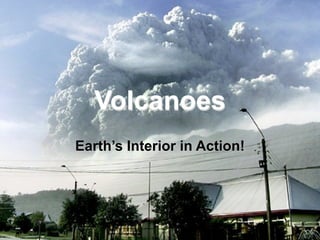
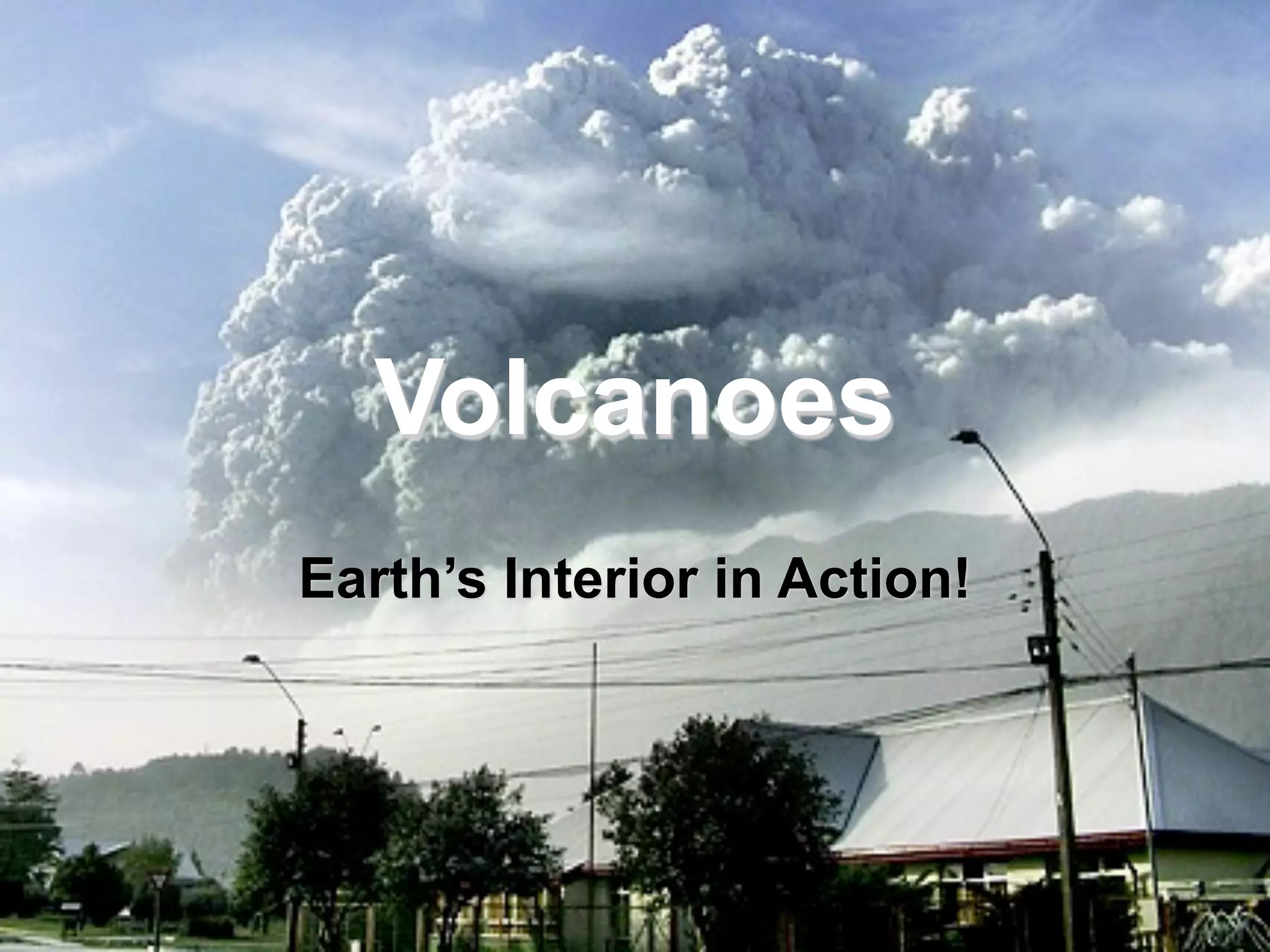
Volcanoes
Earth’s Interior in Action!
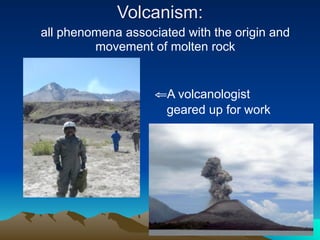
Volcanism:
all phenomena associated with the origin and
         movement of molten rock


                    ⇐A volcanologist
                     geared up for work
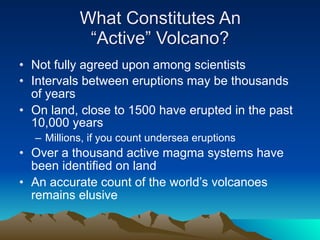
What Constitutes An
            “Active” Volcano?
• Not fully agreed upon among scientists
• Intervals between eruptions may be thousands
  of years
• On land, close to 1500 have erupted in the past
  10,000 years
  – Millions, if you count undersea eruptions
• Over a thousand active magma systems have
  been identified on land
• An accurate count of the world’s volcanoes
  remains elusive
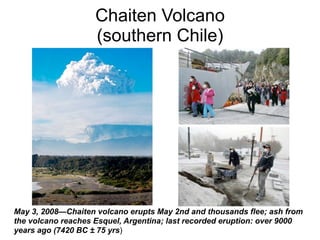
Chaiten Volcano
                    (southern Chile)


May 3, 2008—Chaiten volcano erupts May 2nd and thousands flee; ash from
the volcano reaches Esquel, Argentina; last recorded eruption: over 9000
years ago (7420 BC ± 75 yrs)
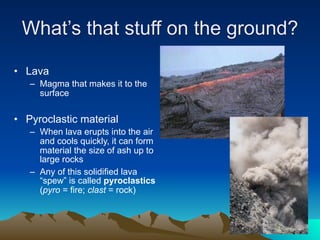
What’s that stuff on the ground?

• Lava
   – Magma that makes it to the
     surface


• Pyroclastic material
   – When lava erupts into the air
     and cools quickly, it can form
     material the size of ash up to
     large rocks
   – Any of this solidified lava
     “spew” is called pyroclastics
     (pyro = fire; clast = rock)
Eruptions
Eruptions
• Whether a volcanic eruption is explosive
  or mild depends on the type of magma
  chemistry that is involved.
Eruptions
• Whether a volcanic eruption is explosive
  or mild depends on the type of magma
  chemistry that is involved.
Eruptions
• Whether a volcanic eruption is explosive
  or mild depends on the type of magma
  chemistry that is involved.

  – Felsic = explosive
Eruptions
• Whether a volcanic eruption is explosive
  or mild depends on the type of magma
  chemistry that is involved.

  – Felsic = explosive
Eruptions
• Whether a volcanic eruption is explosive
  or mild depends on the type of magma
  chemistry that is involved.

  – Felsic = explosive

  – Mafic = mild
Structures Associated With
   Extrusive Volcanism
Structures Associated With
   Extrusive Volcanism
Structures Associated With
        Extrusive Volcanism

• Volcanic peaks
Structures Associated With
        Extrusive Volcanism

• Volcanic peaks
Structures Associated With
        Extrusive Volcanism

• Volcanic peaks

• Caldara
Structures Associated With
        Extrusive Volcanism

• Volcanic peaks

• Caldara
Structures Associated With
        Extrusive Volcanism

• Volcanic peaks

• Caldara

• Volcanic neck
Structures Associated With
        Extrusive Volcanism

• Volcanic peaks

• Caldara

• Volcanic neck
Structures Associated With
        Extrusive Volcanism

• Volcanic peaks

• Caldara

• Volcanic neck

• Flood basalt
Volcanic Peaks
Volcanic Peaks
• The type of peak that forms depends on
  the type of magma
Volcanic Peaks
• The type of peak that forms depends on
  the type of magma
  – Felsic
Volcanic Peaks
• The type of peak that forms depends on
  the type of magma
  – Felsic
     • Forms composite (strato) volcanoes
Volcanic Peaks
• The type of peak that forms depends on
  the type of magma
  – Felsic
     • Forms composite (strato) volcanoes
        – Magmas don’t flow far
Volcanic Peaks
• The type of peak that forms depends on
  the type of magma
  – Felsic
     • Forms composite (strato) volcanoes
        – Magmas don’t flow far
        – Tall, steep-sided cones
Volcanic Peaks
• The type of peak that forms depends on
  the type of magma
  – Felsic
     • Forms composite (strato) volcanoes
        – Magmas don’t flow far
        – Tall, steep-sided cones
  – Mafic
Volcanic Peaks
• The type of peak that forms depends on
  the type of magma
  – Felsic
     • Forms composite (strato) volcanoes
        – Magmas don’t flow far
        – Tall, steep-sided cones
  – Mafic
     • Forms shield volcanoes
Volcanic Peaks
• The type of peak that forms depends on
  the type of magma
  – Felsic
     • Forms composite (strato) volcanoes
        – Magmas don’t flow far
        – Tall, steep-sided cones
  – Mafic
     • Forms shield volcanoes
        – Magmas flow for long distances
Volcanic Peaks
• The type of peak that forms depends on
  the type of magma
  – Felsic
     • Forms composite (strato) volcanoes
        – Magmas don’t flow far
        – Tall, steep-sided cones
  – Mafic
     • Forms shield volcanoes
        – Magmas flow for long distances
        – Broad, gently-sloping cones
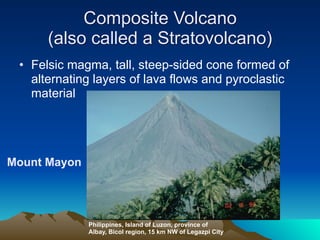
Composite Volcano
      (also called a Stratovolcano)
 • Felsic magma, tall, steep-sided cone formed of
   alternating layers of lava flows and pyroclastic
   material


Mount Mayon


              Philippines, Island of Luzon, province of
              Albay, Bicol region, 15 km NW of Legazpi City
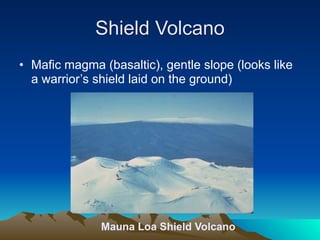
Shield Volcano
• Mafic magma (basaltic), gentle slope (looks like
  a warrior’s shield laid on the ground)


              Mauna Loa Shield Volcano
Other Types of Volcanic Peaks
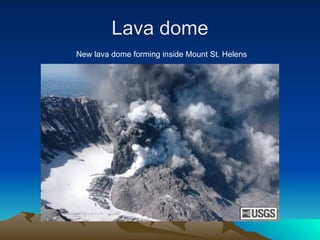
• Lava Dome—Formed from felsic magmas,
  like a bulge on the surface
Other Types of Volcanic Peaks
• Lava Dome—Formed from felsic magmas,
  like a bulge on the surface
  – Common where previous felsic eruptions have
    occurred
Other Types of Volcanic Peaks
• Lava Dome—Formed from felsic magmas,
  like a bulge on the surface
  – Common where previous felsic eruptions have
    occurred
  – Material not well fused together (easily eroded)
Lava dome
New lava dome forming inside Mount St. Helens
Other Types of Volcanic Peaks
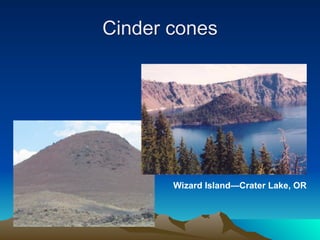
• Cinder Cone
  – Usually less than 150 ft. high
  – Associated with flood basalts and shield
    volcanoes
  – Frothy, (usually) mafic magma under high
    pressure at a narrow vent
  – Tephra rains around the vent, forming small,
    rounded volcanoes made of ash and cinders
Cinder cones


       Wizard Island—Crater Lake, OR
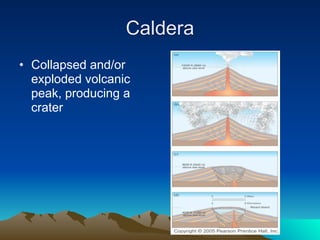
Caldera
• Collapsed and/or
  exploded volcanic
  peak, producing a
  crater
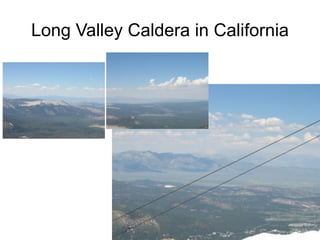
Long Valley Caldera in California
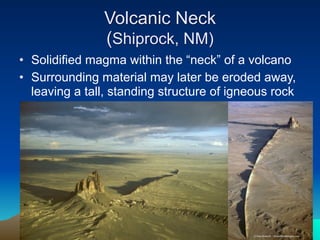
Volcanic Neck
               (Shiprock, NM)
• Solidified magma within the “neck” of a volcano
• Surrounding material may later be eroded away,
  leaving a tall, standing structure of igneous rock
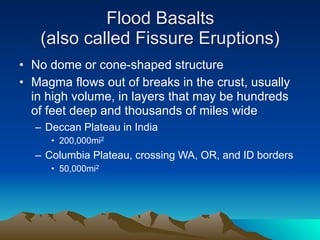
Flood Basalts
   (also called Fissure Eruptions)
• No dome or cone-shaped structure
• Magma flows out of breaks in the crust, usually
  in high volume, in layers that may be hundreds
  of feet deep and thousands of miles wide
  – Deccan Plateau in India
     • 200,000mi2
  – Columbia Plateau, crossing WA, OR, and ID borders
     • 50,000mi2
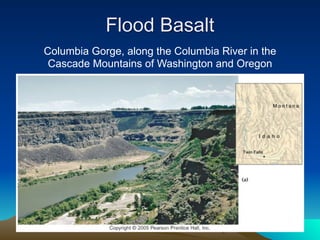
Flood Basalt
Columbia Gorge, along the Columbia River in the
 Cascade Mountains of Washington and Oregon
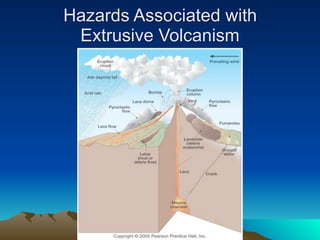
Hazards Associated with
 Extrusive Volcanism
Hazards Associated with
       Extrusive Volcanism

• Volcanic blast
Hazards Associated with
       Extrusive Volcanism

• Volcanic blast
• Earthquakes
Hazards Associated with
      Extrusive Volcanism

• Volcanic blast
• Earthquakes
• Avalanches and
  Debris Flows
Hazards Associated with
      Extrusive Volcanism

• Volcanic blast
• Earthquakes
• Avalanches and
  Debris Flows
• Mudflows and
  Lahars
Hazards Associated with
      Extrusive Volcanism

• Volcanic blast   • Eruption column
• Earthquakes        and ashfall
• Avalanches and
  Debris Flows
• Mudflows and
  Lahars
Hazards Associated with
      Extrusive Volcanism

• Volcanic blast   • Eruption column
• Earthquakes        and ashfall
• Avalanches and   • Pyroclastic flows
  Debris Flows
• Mudflows and
  Lahars
Hazards Associated with
      Extrusive Volcanism

• Volcanic blast   • Eruption column
• Earthquakes        and ashfall
• Avalanches and   • Pyroclastic flows
  Debris Flows     • Lava flows
• Mudflows and
  Lahars
Hazards Associated with
      Extrusive Volcanism

• Volcanic blast   • Eruption column
• Earthquakes        and ashfall
• Avalanches and   • Pyroclastic flows
  Debris Flows     • Lava flows
• Mudflows and     • Volcanic gases
  Lahars
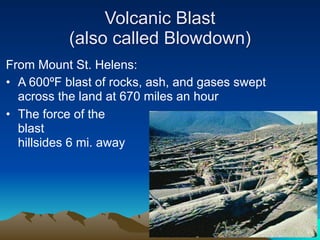
Volcanic Blast
           (also called Blowdown)
From Mount St. Helens:
• A 600ºF blast of rocks, ash, and gases swept
  across the land at 670 miles an hour
• The force of the
  blast                       stripped trees from
  hillsides 6 mi. away
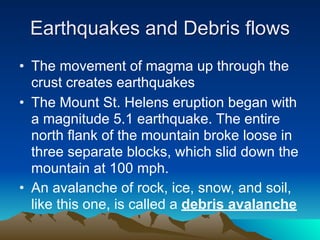
Earthquakes and Debris flows
• The movement of magma up through the
  crust creates earthquakes
• The Mount St. Helens eruption began with
  a magnitude 5.1 earthquake. The entire
  north flank of the mountain broke loose in
  three separate blocks, which slid down the
  mountain at 100 mph.
• An avalanche of rock, ice, snow, and soil,
  like this one, is called a debris avalanche
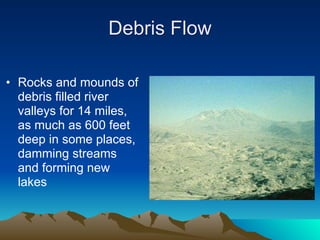
Debris Flow

• Rocks and mounds of
  debris filled river
  valleys for 14 miles,
  as much as 600 feet
  deep in some places,
  damming streams
  and forming new
  lakes
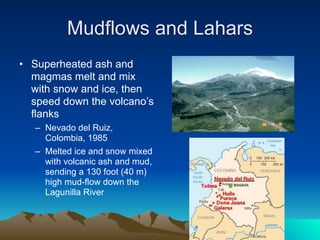
Mudflows and Lahars
• Superheated ash and
  magmas melt and mix
  with snow and ice, then
  speed down the volcano’s
  flanks
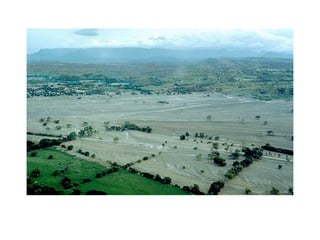
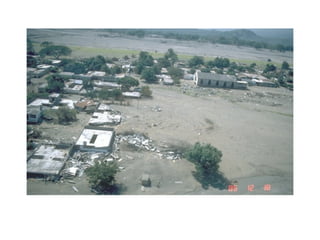
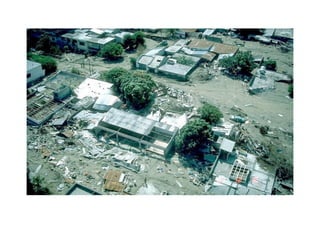
   – Nevado del Ruiz,
     Colombia, 1985
   – Melted ice and snow mixed
     with volcanic ash and mud,
     sending a 130 foot (40 m)
     high mud-flow down the
     Lagunilla River
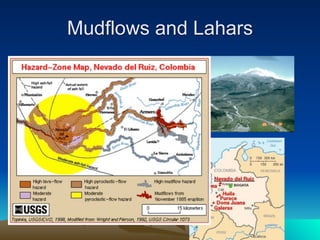
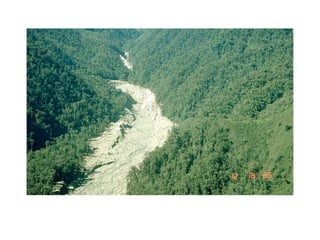
Mudflows and Lahars
• Superheated ash and
  magmas melt and mix
  with snow and ice, then
  speed down the volcano’s
  flanks
   – Nevado del Ruiz,
     Colombia, 1985
   – Melted ice and snow mixed
     with volcanic ash and mud,
     sending a 130 foot (40 m)
     high mud-flow down the
     Lagunilla River
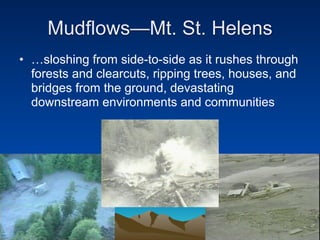
Mudflows—Mt. St. Helens
• …sloshing from side-to-side as it rushes through
  forests and clearcuts, ripping trees, houses, and
  bridges from the ground, devastating
  downstream environments and communities
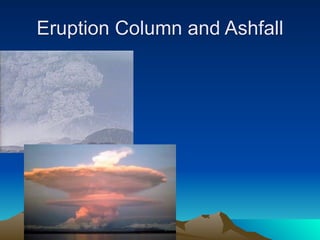
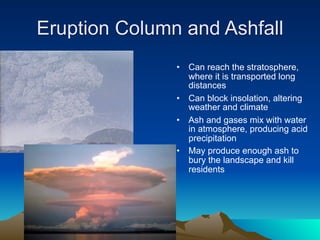
Eruption Column and Ashfall
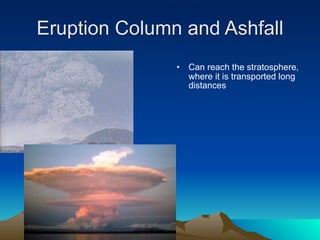
               •   Can reach the stratosphere,
                   where it is transported long
                   distances
Eruption Column and Ashfall
               •   Can reach the stratosphere,
                   where it is transported long
                   distances
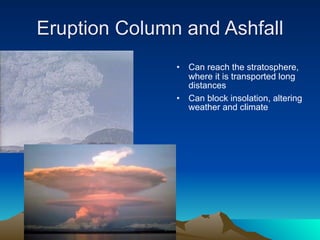
               •   Can block insolation, altering
                   weather and climate
Eruption Column and Ashfall
               •   Can reach the stratosphere,
                   where it is transported long
                   distances
               •   Can block insolation, altering
                   weather and climate
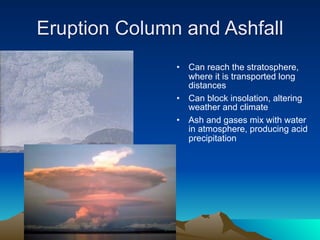
               •   Ash and gases mix with water
                   in atmosphere, producing acid
                   precipitation
Eruption Column and Ashfall
               •   Can reach the stratosphere,
                   where it is transported long
                   distances
               •   Can block insolation, altering
                   weather and climate
               •   Ash and gases mix with water
                   in atmosphere, producing acid
                   precipitation
               •   May produce enough ash to
                   bury the landscape and kill
                   residents
Eruption Column and Ashfall
               •   Can reach the stratosphere,
                   where it is transported long
                   distances
               •   Can block insolation, altering
                   weather and climate
               •   Ash and gases mix with water
                   in atmosphere, producing acid
                   precipitation
               •   May produce enough ash to
                   bury the landscape and kill
                   residents
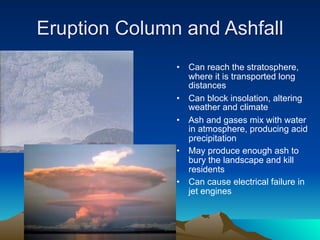
               •   Can cause electrical failure in
                   jet engines
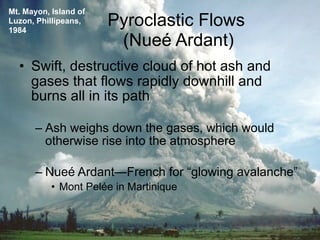
Mt. Mayon, Island of
Luzon, Phillipeans,
1984
                       Pyroclastic Flows
                        (Nueé Ardant)
  • Swift, destructive cloud of hot ash and
    gases that flows rapidly downhill and
    burns all in its path

      – Ash weighs down the gases, which would
        otherwise rise into the atmosphere

      – Nueé Ardant—French for “glowing avalanche”
           • Mont Pelée in Martinique
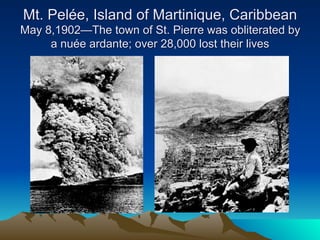
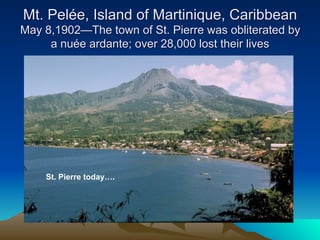
Mt. Pelée, Island of Martinique, Caribbean
May 8,1902—The town of St. Pierre was obliterated by
     a nuée ardante; over 28,000 lost their lives
Mt. Pelée, Island of Martinique, Caribbean
May 8,1902—The town of St. Pierre was obliterated by
     a nuée ardante; over 28,000 lost their lives


    St. Pierre today….
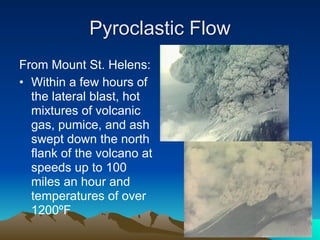
Pyroclastic Flow
From Mount St. Helens:
• Within a few hours of
  the lateral blast, hot
  mixtures of volcanic
  gas, pumice, and ash
  swept down the north
  flank of the volcano at
  speeds up to 100
  miles an hour and
  temperatures of over
  1200ºF
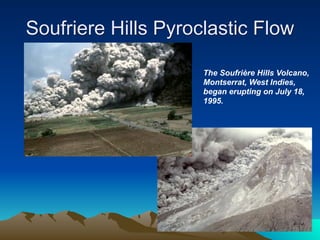
Soufriere Hills Pyroclastic Flow

                     The Soufrière Hills Volcano,
                     Montserrat, West Indies,
                     began erupting on July 18,
                     1995.
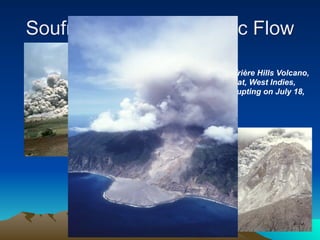
Soufriere Hills Pyroclastic Flow

                     The Soufrière Hills Volcano,
                     Montserrat, West Indies,
                     began erupting on July 18,
                     1995.
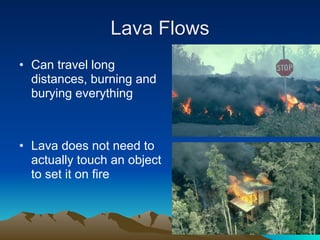
Lava Flows
• Can travel long
  distances, burning and
  burying everything


• Lava does not need to
  actually touch an object
  to set it on fire
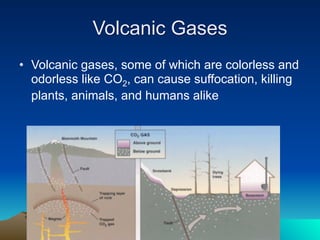
Volcanic Gases
• Volcanic gases, some of which are colorless and
  odorless like CO2, can cause suffocation, killing
  plants, animals, and humans alike
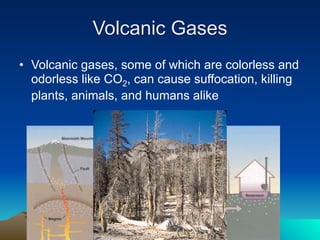
Volcanic Gases
• Volcanic gases, some of which are colorless and
  odorless like CO2, can cause suffocation, killing
  plants, animals, and humans alike
Volcanic Gases
• Such an incident happened at Mammoth
  Mountain in early 2006, where CO2
  emanating from faults at the edge of Long
  Valley Caldera killed one member of the
  local ski patrol
Volcanic Gases
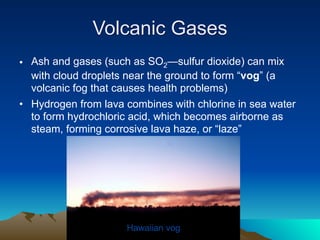
• Ash and gases (such as SO2—sulfur dioxide) can mix
  with cloud droplets near the ground to form “vog” (a
  volcanic fog that causes health problems)
• Hydrogen from lava combines with chlorine in sea water
  to form hydrochloric acid, which becomes airborne as
  steam, forming corrosive lava haze, or “laze”


                     Hawaiian vog
Hazards Associated with
 Extrusive Volcanism
Structures Associated With
        Intrusive Volcanism

• Pluton--a massive body of intrusive igneous
  rock which solidifies deeply within the crust

• Batholith              • Dike
• Laccolith              • Sill
• Stock                  • Vein
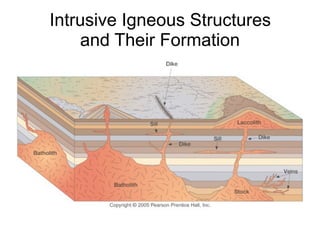
Intrusive Igneous Structures
    and Their Formation
Structures Associated With
           Intrusive Volcanism
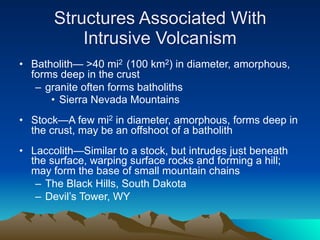
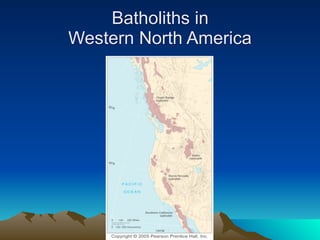
• Batholith— >40 mi2 (100 km2) in diameter, amorphous,
  forms deep in the crust
   – granite often forms batholiths
      • Sierra Nevada Mountains
• Stock—A few mi2 in diameter, amorphous, forms deep in
  the crust, may be an offshoot of a batholith
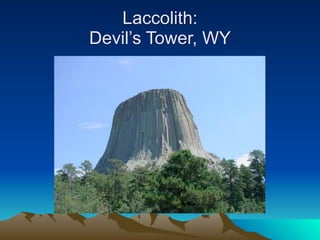
• Laccolith—Similar to a stock, but intrudes just beneath
  the surface, warping surface rocks and forming a hill;
  may form the base of small mountain chains
   – The Black Hills, South Dakota
   – Devil’s Tower, WY
Batholiths in
Western North America
Laccolith:
Devil’s Tower, WY
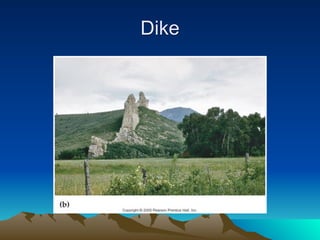
Dike

GEOG 100--Lecture 13--Volcanoes

  • 1.
  • 2.
    Volcanism: all phenomena associatedwith the origin and movement of molten rock ⇐A volcanologist geared up for work
  • 3.
    What Constitutes An “Active” Volcano? • Not fully agreed upon among scientists • Intervals between eruptions may be thousands of years • On land, close to 1500 have erupted in the past 10,000 years – Millions, if you count undersea eruptions • Over a thousand active magma systems have been identified on land • An accurate count of the world’s volcanoes remains elusive
  • 4.
    Chaiten Volcano (southern Chile) May 3, 2008—Chaiten volcano erupts May 2nd and thousands flee; ash from the volcano reaches Esquel, Argentina; last recorded eruption: over 9000 years ago (7420 BC ± 75 yrs)
  • 5.
    What’s that stuffon the ground? • Lava – Magma that makes it to the surface • Pyroclastic material – When lava erupts into the air and cools quickly, it can form material the size of ash up to large rocks – Any of this solidified lava “spew” is called pyroclastics (pyro = fire; clast = rock)
  • 6.
  • 7.
    Eruptions • Whether avolcanic eruption is explosive or mild depends on the type of magma chemistry that is involved.
  • 8.
    Eruptions • Whether avolcanic eruption is explosive or mild depends on the type of magma chemistry that is involved.
  • 9.
    Eruptions • Whether avolcanic eruption is explosive or mild depends on the type of magma chemistry that is involved. – Felsic = explosive
  • 10.
    Eruptions • Whether avolcanic eruption is explosive or mild depends on the type of magma chemistry that is involved. – Felsic = explosive
  • 11.
    Eruptions • Whether avolcanic eruption is explosive or mild depends on the type of magma chemistry that is involved. – Felsic = explosive – Mafic = mild
  • 12.
    Structures Associated With Extrusive Volcanism
  • 13.
    Structures Associated With Extrusive Volcanism
  • 14.
    Structures Associated With Extrusive Volcanism • Volcanic peaks
  • 15.
    Structures Associated With Extrusive Volcanism • Volcanic peaks
  • 16.
    Structures Associated With Extrusive Volcanism • Volcanic peaks • Caldara
  • 17.
    Structures Associated With Extrusive Volcanism • Volcanic peaks • Caldara
  • 18.
    Structures Associated With Extrusive Volcanism • Volcanic peaks • Caldara • Volcanic neck
  • 19.
    Structures Associated With Extrusive Volcanism • Volcanic peaks • Caldara • Volcanic neck
  • 20.
    Structures Associated With Extrusive Volcanism • Volcanic peaks • Caldara • Volcanic neck • Flood basalt
  • 21.
  • 22.
    Volcanic Peaks • Thetype of peak that forms depends on the type of magma
  • 23.
    Volcanic Peaks • Thetype of peak that forms depends on the type of magma – Felsic
  • 24.
    Volcanic Peaks • Thetype of peak that forms depends on the type of magma – Felsic • Forms composite (strato) volcanoes
  • 25.
    Volcanic Peaks • Thetype of peak that forms depends on the type of magma – Felsic • Forms composite (strato) volcanoes – Magmas don’t flow far
  • 26.
    Volcanic Peaks • Thetype of peak that forms depends on the type of magma – Felsic • Forms composite (strato) volcanoes – Magmas don’t flow far – Tall, steep-sided cones
  • 27.
    Volcanic Peaks • Thetype of peak that forms depends on the type of magma – Felsic • Forms composite (strato) volcanoes – Magmas don’t flow far – Tall, steep-sided cones – Mafic
  • 28.
    Volcanic Peaks • Thetype of peak that forms depends on the type of magma – Felsic • Forms composite (strato) volcanoes – Magmas don’t flow far – Tall, steep-sided cones – Mafic • Forms shield volcanoes
  • 29.
    Volcanic Peaks • Thetype of peak that forms depends on the type of magma – Felsic • Forms composite (strato) volcanoes – Magmas don’t flow far – Tall, steep-sided cones – Mafic • Forms shield volcanoes – Magmas flow for long distances
  • 30.
    Volcanic Peaks • Thetype of peak that forms depends on the type of magma – Felsic • Forms composite (strato) volcanoes – Magmas don’t flow far – Tall, steep-sided cones – Mafic • Forms shield volcanoes – Magmas flow for long distances – Broad, gently-sloping cones
  • 31.
    Composite Volcano (also called a Stratovolcano) • Felsic magma, tall, steep-sided cone formed of alternating layers of lava flows and pyroclastic material Mount Mayon Philippines, Island of Luzon, province of Albay, Bicol region, 15 km NW of Legazpi City
  • 32.
    Shield Volcano • Maficmagma (basaltic), gentle slope (looks like a warrior’s shield laid on the ground) Mauna Loa Shield Volcano
  • 33.
    Other Types ofVolcanic Peaks
  • 34.
    Other Types ofVolcanic Peaks • Lava Dome—Formed from felsic magmas, like a bulge on the surface
  • 35.
    Other Types ofVolcanic Peaks • Lava Dome—Formed from felsic magmas, like a bulge on the surface – Common where previous felsic eruptions have occurred
  • 36.
    Other Types ofVolcanic Peaks • Lava Dome—Formed from felsic magmas, like a bulge on the surface – Common where previous felsic eruptions have occurred – Material not well fused together (easily eroded)
  • 37.
    Lava dome New lavadome forming inside Mount St. Helens
  • 38.
    Other Types ofVolcanic Peaks • Cinder Cone – Usually less than 150 ft. high – Associated with flood basalts and shield volcanoes – Frothy, (usually) mafic magma under high pressure at a narrow vent – Tephra rains around the vent, forming small, rounded volcanoes made of ash and cinders
  • 39.
    Cinder cones Wizard Island—Crater Lake, OR
  • 40.
    Caldera • Collapsed and/or exploded volcanic peak, producing a crater
  • 41.
    Long Valley Calderain California
  • 42.
    Volcanic Neck (Shiprock, NM) • Solidified magma within the “neck” of a volcano • Surrounding material may later be eroded away, leaving a tall, standing structure of igneous rock
  • 43.
    Flood Basalts (also called Fissure Eruptions) • No dome or cone-shaped structure • Magma flows out of breaks in the crust, usually in high volume, in layers that may be hundreds of feet deep and thousands of miles wide – Deccan Plateau in India • 200,000mi2 – Columbia Plateau, crossing WA, OR, and ID borders • 50,000mi2
  • 44.
    Flood Basalt Columbia Gorge,along the Columbia River in the Cascade Mountains of Washington and Oregon
  • 45.
    Hazards Associated with Extrusive Volcanism
  • 46.
    Hazards Associated with Extrusive Volcanism • Volcanic blast
  • 47.
    Hazards Associated with Extrusive Volcanism • Volcanic blast • Earthquakes
  • 48.
    Hazards Associated with Extrusive Volcanism • Volcanic blast • Earthquakes • Avalanches and Debris Flows
  • 49.
    Hazards Associated with Extrusive Volcanism • Volcanic blast • Earthquakes • Avalanches and Debris Flows • Mudflows and Lahars
  • 50.
    Hazards Associated with Extrusive Volcanism • Volcanic blast • Eruption column • Earthquakes and ashfall • Avalanches and Debris Flows • Mudflows and Lahars
  • 51.
    Hazards Associated with Extrusive Volcanism • Volcanic blast • Eruption column • Earthquakes and ashfall • Avalanches and • Pyroclastic flows Debris Flows • Mudflows and Lahars
  • 52.
    Hazards Associated with Extrusive Volcanism • Volcanic blast • Eruption column • Earthquakes and ashfall • Avalanches and • Pyroclastic flows Debris Flows • Lava flows • Mudflows and Lahars
  • 53.
    Hazards Associated with Extrusive Volcanism • Volcanic blast • Eruption column • Earthquakes and ashfall • Avalanches and • Pyroclastic flows Debris Flows • Lava flows • Mudflows and • Volcanic gases Lahars
  • 54.
    Volcanic Blast (also called Blowdown) From Mount St. Helens: • A 600ºF blast of rocks, ash, and gases swept across the land at 670 miles an hour • The force of the blast stripped trees from hillsides 6 mi. away
  • 55.
    Earthquakes and Debrisflows • The movement of magma up through the crust creates earthquakes • The Mount St. Helens eruption began with a magnitude 5.1 earthquake. The entire north flank of the mountain broke loose in three separate blocks, which slid down the mountain at 100 mph. • An avalanche of rock, ice, snow, and soil, like this one, is called a debris avalanche
  • 56.
    Debris Flow • Rocksand mounds of debris filled river valleys for 14 miles, as much as 600 feet deep in some places, damming streams and forming new lakes
  • 57.
    Mudflows and Lahars •Superheated ash and magmas melt and mix with snow and ice, then speed down the volcano’s flanks – Nevado del Ruiz, Colombia, 1985 – Melted ice and snow mixed with volcanic ash and mud, sending a 130 foot (40 m) high mud-flow down the Lagunilla River
  • 58.
    Mudflows and Lahars •Superheated ash and magmas melt and mix with snow and ice, then speed down the volcano’s flanks – Nevado del Ruiz, Colombia, 1985 – Melted ice and snow mixed with volcanic ash and mud, sending a 130 foot (40 m) high mud-flow down the Lagunilla River
  • 63.
    Mudflows—Mt. St. Helens •…sloshing from side-to-side as it rushes through forests and clearcuts, ripping trees, houses, and bridges from the ground, devastating downstream environments and communities
  • 64.
  • 65.
    Eruption Column andAshfall • Can reach the stratosphere, where it is transported long distances
  • 66.
    Eruption Column andAshfall • Can reach the stratosphere, where it is transported long distances • Can block insolation, altering weather and climate
  • 67.
    Eruption Column andAshfall • Can reach the stratosphere, where it is transported long distances • Can block insolation, altering weather and climate • Ash and gases mix with water in atmosphere, producing acid precipitation
  • 68.
    Eruption Column andAshfall • Can reach the stratosphere, where it is transported long distances • Can block insolation, altering weather and climate • Ash and gases mix with water in atmosphere, producing acid precipitation • May produce enough ash to bury the landscape and kill residents
  • 69.
    Eruption Column andAshfall • Can reach the stratosphere, where it is transported long distances • Can block insolation, altering weather and climate • Ash and gases mix with water in atmosphere, producing acid precipitation • May produce enough ash to bury the landscape and kill residents • Can cause electrical failure in jet engines
  • 70.
    Mt. Mayon, Islandof Luzon, Phillipeans, 1984 Pyroclastic Flows (Nueé Ardant) • Swift, destructive cloud of hot ash and gases that flows rapidly downhill and burns all in its path – Ash weighs down the gases, which would otherwise rise into the atmosphere – Nueé Ardant—French for “glowing avalanche” • Mont Pelée in Martinique
  • 71.
    Mt. Pelée, Islandof Martinique, Caribbean May 8,1902—The town of St. Pierre was obliterated by a nuée ardante; over 28,000 lost their lives
  • 72.
    Mt. Pelée, Islandof Martinique, Caribbean May 8,1902—The town of St. Pierre was obliterated by a nuée ardante; over 28,000 lost their lives St. Pierre today….
  • 73.
    Pyroclastic Flow From MountSt. Helens: • Within a few hours of the lateral blast, hot mixtures of volcanic gas, pumice, and ash swept down the north flank of the volcano at speeds up to 100 miles an hour and temperatures of over 1200ºF
  • 74.
    Soufriere Hills PyroclasticFlow The Soufrière Hills Volcano, Montserrat, West Indies, began erupting on July 18, 1995.
  • 75.
    Soufriere Hills PyroclasticFlow The Soufrière Hills Volcano, Montserrat, West Indies, began erupting on July 18, 1995.
  • 76.
    Lava Flows • Cantravel long distances, burning and burying everything • Lava does not need to actually touch an object to set it on fire
  • 77.
    Volcanic Gases • Volcanicgases, some of which are colorless and odorless like CO2, can cause suffocation, killing plants, animals, and humans alike
  • 78.
    Volcanic Gases • Volcanicgases, some of which are colorless and odorless like CO2, can cause suffocation, killing plants, animals, and humans alike
  • 79.
    Volcanic Gases • Suchan incident happened at Mammoth Mountain in early 2006, where CO2 emanating from faults at the edge of Long Valley Caldera killed one member of the local ski patrol
  • 80.
    Volcanic Gases • Ashand gases (such as SO2—sulfur dioxide) can mix with cloud droplets near the ground to form “vog” (a volcanic fog that causes health problems) • Hydrogen from lava combines with chlorine in sea water to form hydrochloric acid, which becomes airborne as steam, forming corrosive lava haze, or “laze” Hawaiian vog
  • 81.
    Hazards Associated with Extrusive Volcanism
  • 82.
    Structures Associated With Intrusive Volcanism • Pluton--a massive body of intrusive igneous rock which solidifies deeply within the crust • Batholith • Dike • Laccolith • Sill • Stock • Vein
  • 83.
    Intrusive Igneous Structures and Their Formation
  • 84.
    Structures Associated With Intrusive Volcanism • Batholith— >40 mi2 (100 km2) in diameter, amorphous, forms deep in the crust – granite often forms batholiths • Sierra Nevada Mountains • Stock—A few mi2 in diameter, amorphous, forms deep in the crust, may be an offshoot of a batholith • Laccolith—Similar to a stock, but intrudes just beneath the surface, warping surface rocks and forming a hill; may form the base of small mountain chains – The Black Hills, South Dakota – Devil’s Tower, WY
  • 85.
  • 86.
  • 87.