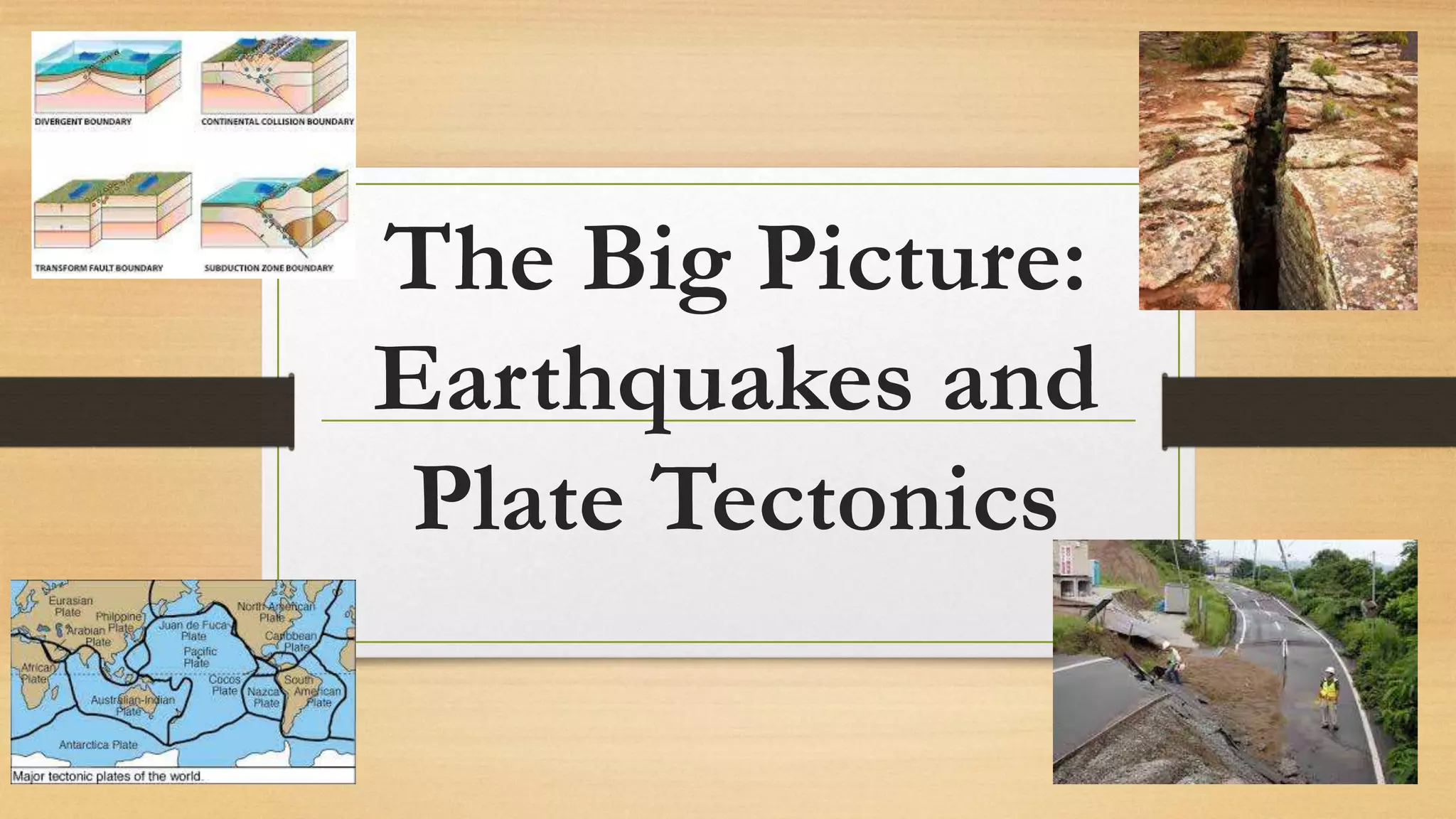
The Big Picture:
Earthquakes and
Plate Tectonics
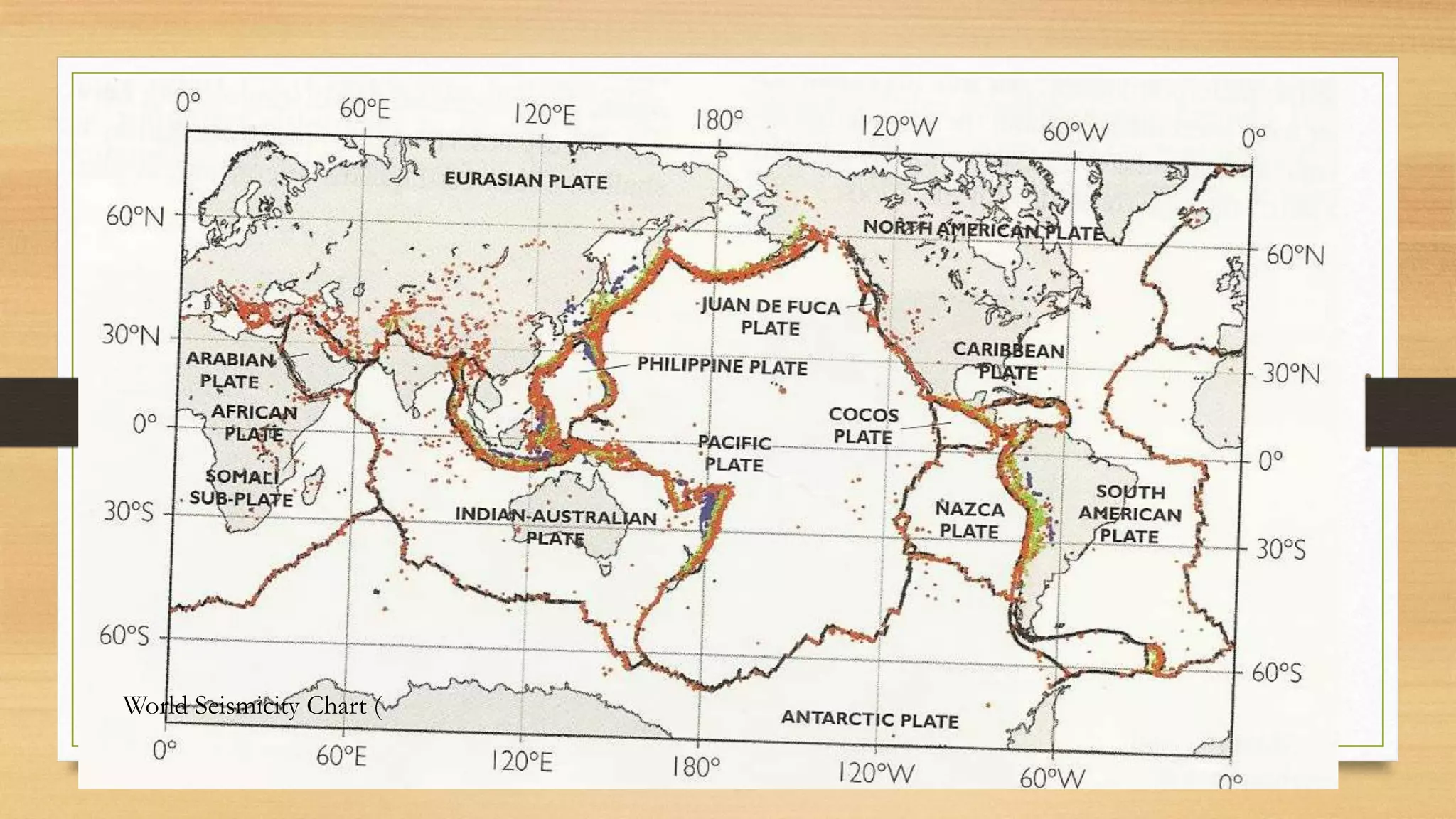
World Seismicity Chart (
Earthquake Belts at Plate Boundaries
Belts- a geographic zone on the Earth’s surface along which most
earthquake activity occurs
Ring of Fire- one of the best known belts surrounds the Pacific
Ocean
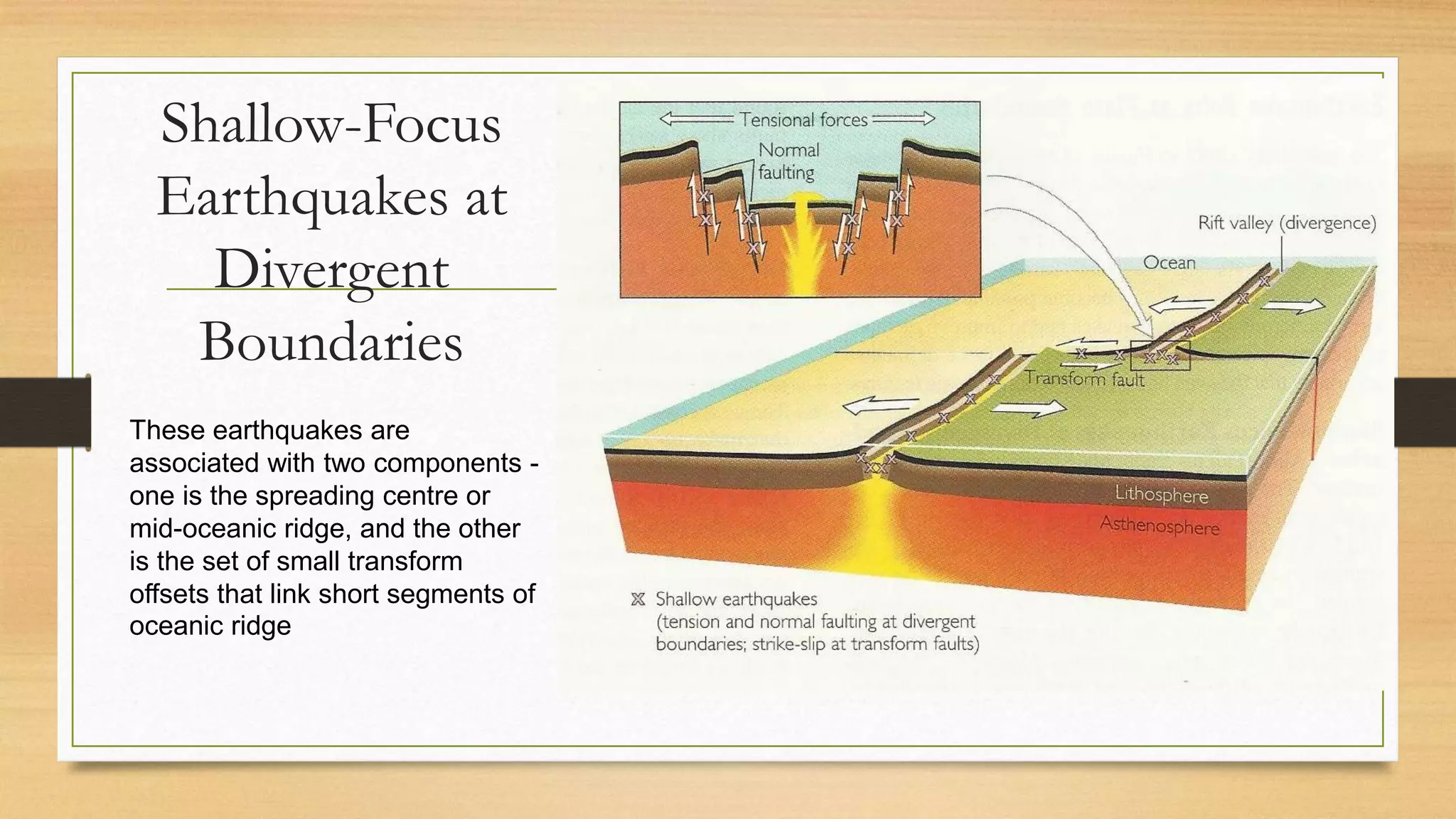
Shallow-Focus Earthquakes at Divergent Boundaries
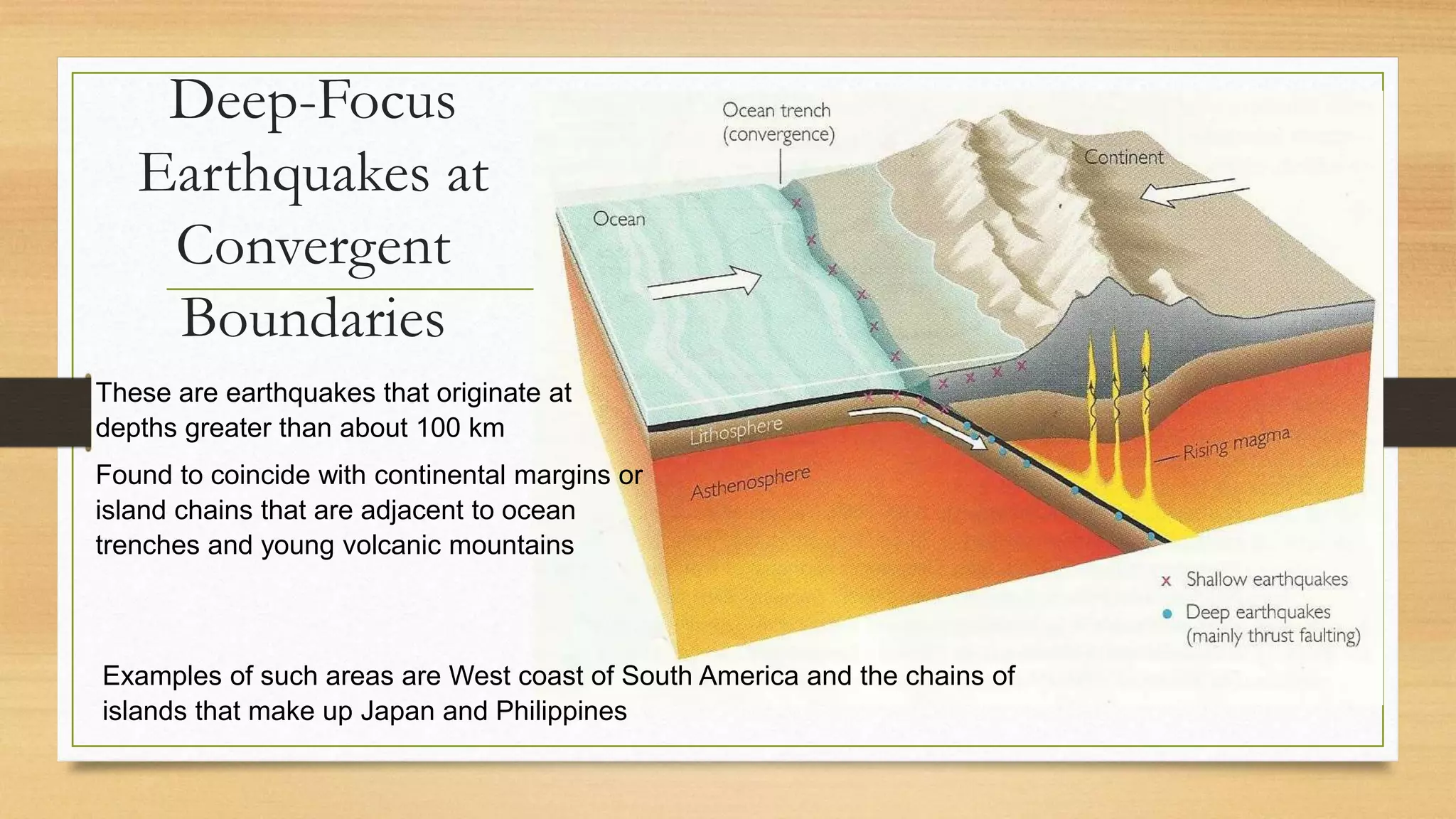
Deep-Focus Earthquakes at Convergent Boumdaries
Shallow Focus Earthquakes within Plates
Shallow-Focus
Earthquakes at
Divergent
Boundaries
These earthquakes are
associated with two components -
one is the spreading centre or
mid-oceanic ridge, and the other
is the set of small transform
offsets that link short segments of
oceanic ridge
Deep-Focus
Earthquakes at
Convergent
Boundaries
These are earthquakes that originate at
depths greater than about 100 km
Found to coincide with continental margins or
island chains that are adjacent to ocean
trenches and young volcanic mountains
Examples of such areas are West coast of South America and the chains of
islands that make up Japan and Philippines
Shallow-Focus Earthquakes within Plates
Earthquake Destructiveness
 Each year 800 000 little tremors that
are not felt by humans are not recorded
by instruments around the world
 100 earthquakes occur each year with
Richter magnitude between 6 and 7
 Once every 5 to 10 years great
earthquakes occur with a Richter
magnitude exceeding 8
 Destructive earthquakes are even more
frequent in Japan than in California
How Earthquakes Cause
Their Damage?
Ground vibrations
Fires ignited by ruptured gas lines or downed electrical power lines
Power seismic waves also take their toll on land forms and
underlying soils
 Avalanches
 Liquefaction
Tsunami
• sea wave that is triggered by undersea event such as an earthquake
or landslide or eruption of an oceanic volcano
• Popularly known as tidal waves
• It travels across the ocean at speeds of up to 800 km per hour and
form walls of water that can be higher than 20 m when they reach the
coast
Generation of a tsunami by fault movements caused by an earthquake
on the seafloor.
Tsunamis in Japan
Mitigating the Destructiveness of
Earthquake
*Earthquake Protection Program
provides a basis for organizing local earthquake
protection programs consonant with the degree of danger
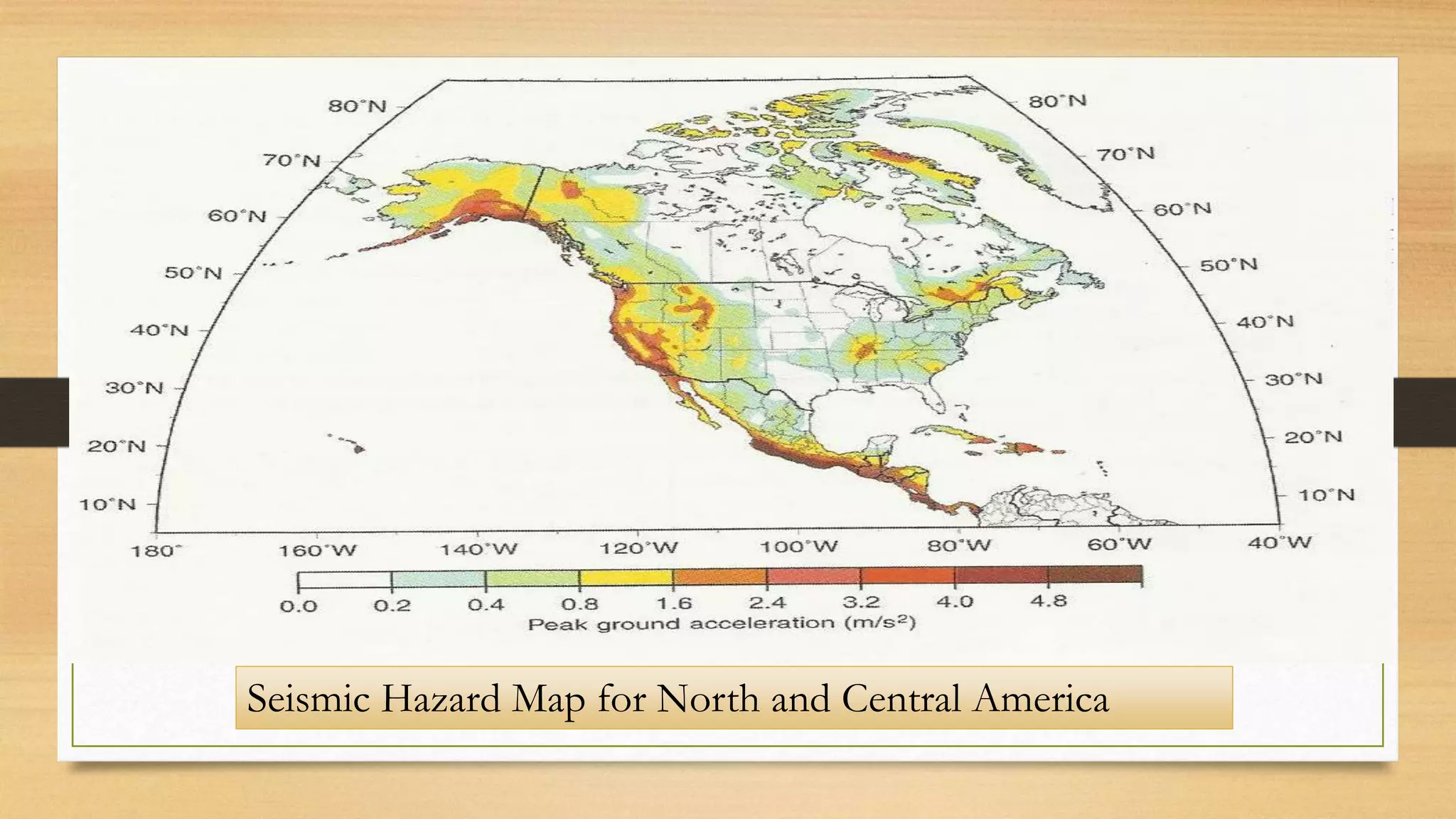
Seismic-risk Map
Seismic Hazard Map for North and Central America
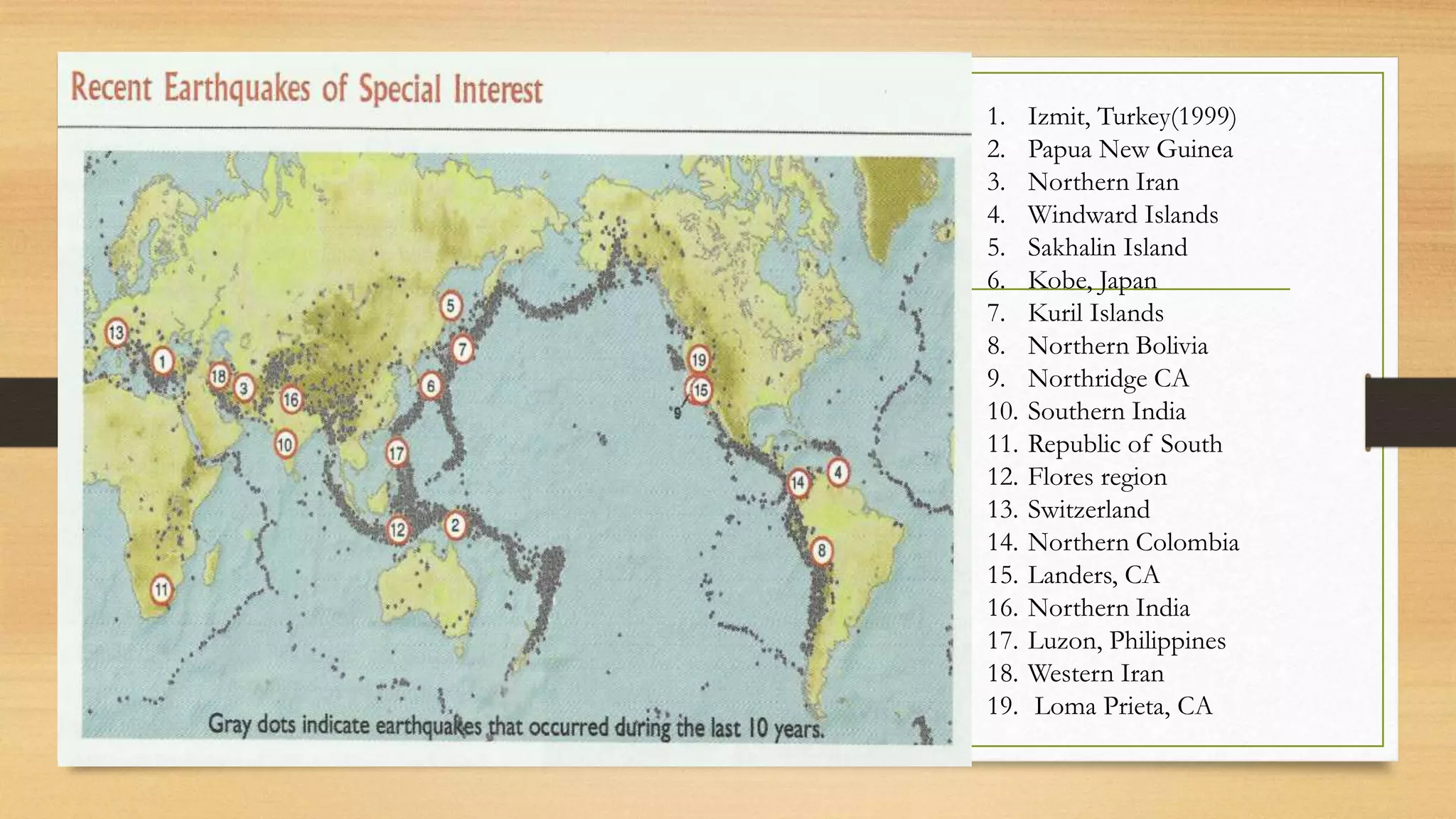
1. Izmit, Turkey(1999)
2. Papua New Guinea
3. Northern Iran
4. Windward Islands
5. Sakhalin Island
6. Kobe, Japan
7. Kuril Islands
8. Northern Bolivia
9. Northridge CA
10. Southern India
11. Republic of South
12. Flores region
13. Switzerland
14. Northern Colombia
15. Landers, CA
16. Northern India
17. Luzon, Philippines
18. Western Iran
19. Loma Prieta, CA
Housing tracts constructed in recent years
within the San Andreas fault zone, San
Francisco Peninsula
*These are the possible premonitory indicators being examined by some
scientists:
• A rapid tilting of the ground or other forms of surface deformation
• An unusual aseismic slip on a fault
• An episode of stretching of the crust across fault
• Changes in the physical properties of rock in the vicinity of a fault
• Changes in the level of water in wells
• An usual increase in the frequency of smaller earthquakes in a region before a
main shock
Early-Warning Indicators
Seismic gap
a segment of an active fault known to produce significant
earthquakes, that has not slipped in an unusually long time when
compared with other segments along the same structure
Seismic gap hypothesis/theory
states that, over long periods of time, the displacement on any
segment must be equal to that experienced by all the other parts of
the fault.[1] Any large and longstanding gap is therefore considered
to be the fault segment most likely to suffer future earthquakes.
*Worrisome Developments
Exploring Earth’s Interior
Exploring the Interior with Seismic Waves
• Any differences detected for different paths can be used to infer the
properties of materials the waves have been encountered along these
paths
• A boundary between two materials, some of the waves bounce off
and others are transmitted into the second material
• There are waves bend or refract when cross the boundary between
two materials
Two beams of light enter the
bowl of water from the top
Paths of Seismic Waves in the Earth
• Shadow Zone
A zone where no P wave reaches the surface between 105° and 142°.
Discovery of it led geologists to surmise that the Earth has a core made
up of a material different from than that of overlying mantle.
*Waves traveling through the Earth
The pattern of P-wave paths through earth’s interior The larger S-wave shadow zone
*Waves traveling through the Earth
• PcP wave- bounces off the core; used to
determine the depth of the core
• SS wave- S waves that reflect back into the Earth
• PKP wave- P waves that penetrate the outer core
• PKIP wave- P wave that penetrate the inner core
*Waves reflected in the Earth
Composition and
Structure of the
Interior
Changes in P- and S- wave velocities
with depth in the Earth reveal the
sequence of layers that make up
Earth’s interior
*The Crust
• It varies in thickness- thin under oceans (about 5 km), thicker under
continents ( about 40 km) and thickest under high mountains ( ranging up to
65 km).
• P waves move through crustal rocks at about 6-7 km per second
Mohorovicic discontinuity (Moho)
• Discovered by seismologist
Yugoslav in 1909 .The boundary
between the crust and mantle
Principle of Isostasy
• The idea that continents are less dense than the mantle and float on it
*The Mantle
It is mainly made up of olivine and pyroxene, the two silicates of magnesium
and iron
• lithosphere- outermost zone, is a slab up to 100 km thick in which the
continents are embedded tectonic plates are large fragments of the
lithosphere . S waves pas through easily without being absorbed
• asthenosphere- zone of weakness; a partially fluid solid .It rises close to the
surface at mid-ocean ridges where plates separate and is found at depths up
to about 100 km and ends at a about 200 km where the velocity of S waves
increases to a value that fits that of solid peridotite.
• From about 200 to 400 km, the velocity of S waves increases gradually with
depth
• About 400 km below the surface waves increases rapidly
• In the region from 450 to 650 km, properties change little as depth increases
• Near 670 km, the velocity increases again
• From 700 km to the core at a depth of 2900 km, changes little in
composition and crystal structure with depth
• *The Core
• It is 2900 km from the surface
• P waves that penetrate to depths of 5100 km suddenly speed up, a discovery made by a
Danish seismologist, Inge Lehman
• Composition of the core derived from astronomical data, and seismological data
• To be consistent with the that the core is made up material that sank during the initial
formation and differentiation of the Earth, geologists searched for the substances that were
dense
• Because the core contains one- third of Earth’s mass, geologists considered substances that
were abundant in the universe
• Geologists concluded that Earth’s core is composed mostly of iron, molten
in the inner core and solid in the inner core

Earthquake belts and Plate Tectonics

  • 1.
    The Big Picture: Earthquakesand Plate Tectonics
  • 2.
  • 3.
    Earthquake Belts atPlate Boundaries Belts- a geographic zone on the Earth’s surface along which most earthquake activity occurs Ring of Fire- one of the best known belts surrounds the Pacific Ocean Shallow-Focus Earthquakes at Divergent Boundaries Deep-Focus Earthquakes at Convergent Boumdaries Shallow Focus Earthquakes within Plates
  • 4.
    Shallow-Focus Earthquakes at Divergent Boundaries These earthquakesare associated with two components - one is the spreading centre or mid-oceanic ridge, and the other is the set of small transform offsets that link short segments of oceanic ridge
  • 5.
    Deep-Focus Earthquakes at Convergent Boundaries These areearthquakes that originate at depths greater than about 100 km Found to coincide with continental margins or island chains that are adjacent to ocean trenches and young volcanic mountains Examples of such areas are West coast of South America and the chains of islands that make up Japan and Philippines
  • 6.
  • 7.
    Earthquake Destructiveness  Eachyear 800 000 little tremors that are not felt by humans are not recorded by instruments around the world  100 earthquakes occur each year with Richter magnitude between 6 and 7  Once every 5 to 10 years great earthquakes occur with a Richter magnitude exceeding 8  Destructive earthquakes are even more frequent in Japan than in California
  • 8.
  • 9.
  • 10.
    Fires ignited byruptured gas lines or downed electrical power lines
  • 11.
    Power seismic wavesalso take their toll on land forms and underlying soils  Avalanches  Liquefaction
  • 12.
    Tsunami • sea wavethat is triggered by undersea event such as an earthquake or landslide or eruption of an oceanic volcano • Popularly known as tidal waves • It travels across the ocean at speeds of up to 800 km per hour and form walls of water that can be higher than 20 m when they reach the coast
  • 13.
    Generation of atsunami by fault movements caused by an earthquake on the seafloor.
  • 14.
  • 15.
  • 16.
    *Earthquake Protection Program providesa basis for organizing local earthquake protection programs consonant with the degree of danger Seismic-risk Map
  • 17.
    Seismic Hazard Mapfor North and Central America
  • 18.
    1. Izmit, Turkey(1999) 2.Papua New Guinea 3. Northern Iran 4. Windward Islands 5. Sakhalin Island 6. Kobe, Japan 7. Kuril Islands 8. Northern Bolivia 9. Northridge CA 10. Southern India 11. Republic of South 12. Flores region 13. Switzerland 14. Northern Colombia 15. Landers, CA 16. Northern India 17. Luzon, Philippines 18. Western Iran 19. Loma Prieta, CA
  • 19.
    Housing tracts constructedin recent years within the San Andreas fault zone, San Francisco Peninsula
  • 21.
    *These are thepossible premonitory indicators being examined by some scientists: • A rapid tilting of the ground or other forms of surface deformation • An unusual aseismic slip on a fault • An episode of stretching of the crust across fault • Changes in the physical properties of rock in the vicinity of a fault • Changes in the level of water in wells • An usual increase in the frequency of smaller earthquakes in a region before a main shock Early-Warning Indicators
  • 22.
    Seismic gap a segmentof an active fault known to produce significant earthquakes, that has not slipped in an unusually long time when compared with other segments along the same structure
  • 23.
    Seismic gap hypothesis/theory statesthat, over long periods of time, the displacement on any segment must be equal to that experienced by all the other parts of the fault.[1] Any large and longstanding gap is therefore considered to be the fault segment most likely to suffer future earthquakes.
  • 25.
  • 26.
  • 27.
    Exploring the Interiorwith Seismic Waves • Any differences detected for different paths can be used to infer the properties of materials the waves have been encountered along these paths • A boundary between two materials, some of the waves bounce off and others are transmitted into the second material • There are waves bend or refract when cross the boundary between two materials
  • 28.
    Two beams oflight enter the bowl of water from the top
  • 29.
    Paths of SeismicWaves in the Earth • Shadow Zone A zone where no P wave reaches the surface between 105° and 142°. Discovery of it led geologists to surmise that the Earth has a core made up of a material different from than that of overlying mantle. *Waves traveling through the Earth
  • 30.
    The pattern ofP-wave paths through earth’s interior The larger S-wave shadow zone
  • 31.
    *Waves traveling throughthe Earth • PcP wave- bounces off the core; used to determine the depth of the core • SS wave- S waves that reflect back into the Earth • PKP wave- P waves that penetrate the outer core • PKIP wave- P wave that penetrate the inner core *Waves reflected in the Earth
  • 33.
    Composition and Structure ofthe Interior Changes in P- and S- wave velocities with depth in the Earth reveal the sequence of layers that make up Earth’s interior
  • 34.
    *The Crust • Itvaries in thickness- thin under oceans (about 5 km), thicker under continents ( about 40 km) and thickest under high mountains ( ranging up to 65 km). • P waves move through crustal rocks at about 6-7 km per second
  • 36.
    Mohorovicic discontinuity (Moho) •Discovered by seismologist Yugoslav in 1909 .The boundary between the crust and mantle
  • 37.
    Principle of Isostasy •The idea that continents are less dense than the mantle and float on it
  • 39.
    *The Mantle It ismainly made up of olivine and pyroxene, the two silicates of magnesium and iron
  • 41.
    • lithosphere- outermostzone, is a slab up to 100 km thick in which the continents are embedded tectonic plates are large fragments of the lithosphere . S waves pas through easily without being absorbed
  • 42.
    • asthenosphere- zoneof weakness; a partially fluid solid .It rises close to the surface at mid-ocean ridges where plates separate and is found at depths up to about 100 km and ends at a about 200 km where the velocity of S waves increases to a value that fits that of solid peridotite.
  • 43.
    • From about200 to 400 km, the velocity of S waves increases gradually with depth • About 400 km below the surface waves increases rapidly • In the region from 450 to 650 km, properties change little as depth increases • Near 670 km, the velocity increases again • From 700 km to the core at a depth of 2900 km, changes little in composition and crystal structure with depth
  • 44.
    • *The Core •It is 2900 km from the surface • P waves that penetrate to depths of 5100 km suddenly speed up, a discovery made by a Danish seismologist, Inge Lehman • Composition of the core derived from astronomical data, and seismological data • To be consistent with the that the core is made up material that sank during the initial formation and differentiation of the Earth, geologists searched for the substances that were dense • Because the core contains one- third of Earth’s mass, geologists considered substances that were abundant in the universe
  • 45.
    • Geologists concludedthat Earth’s core is composed mostly of iron, molten in the inner core and solid in the inner core