Projectile Motion


Objectives:
• Understand projectile motion and how gravity
  influences it
• Understand the effects of projection speed,
  angle, and relative height on projectile motion
• Learn to compute the maximum height, flight
  time, and flight distance of a projectile


             What is a Projectile?
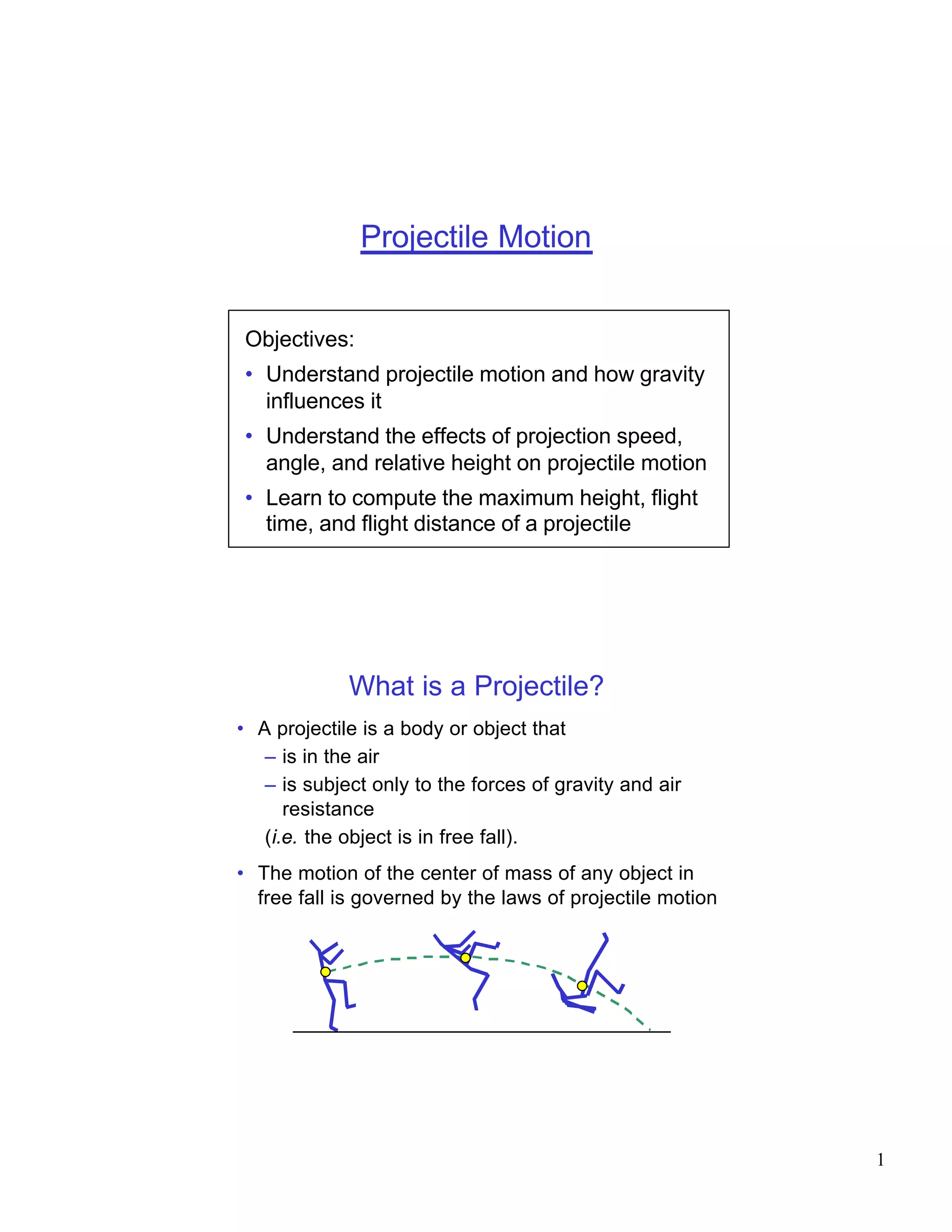
• A projectile is a body or object that
   – is in the air
   – is subject only to the forces of gravity and air
      resistance
   (i.e. the object is in free fall).
• The motion of the center of mass of any object in
  free fall is governed by the laws of projectile motion


                                                           1
Influence of Gravity
 • Gravity: pull of the mass of the Earth on a body
 • Gravity accelerates an object in a vertical
   direction towards the center of the Earth.
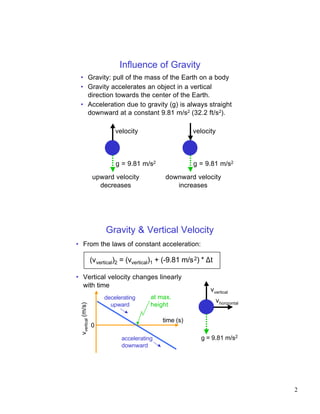
 • Acceleration due to gravity (g) is always straight
   downward at a constant 9.81 m/s2 (32.2 ft/s2).

                            velocity                       velocity


                             g = 9.81 m/s2                 g = 9.81 m/s2

                   upward velocity              downward velocity
                     decreases                     increases


                         Gravity & Vertical Velocity
• From the laws of constant acceleration:

                   (vvertical)2 = (vvertical)1 + (-9.81 m/s 2) * ∆t

• Vertical velocity changes linearly
  with time
                                                                  vvertical
                        decelerating      at max.
                                                                      vhorizontal
                                          height
 vvertical (m/s)


                          upward

                                               time (s)
                   0

                               accelerating                   g = 9.81 m/s2
                               downward


                                                                                    2
Gravity & Horizontal Velocity
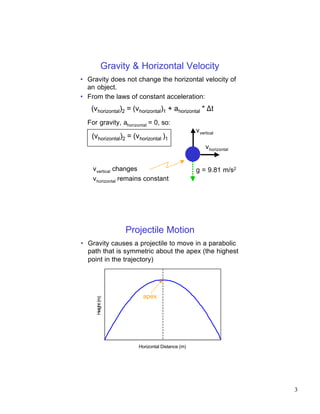
• Gravity does not change the horizontal velocity of
  an object.
• From the laws of constant acceleration:
   (vhorizontal)2 = (vhorizontal)1 + ahorizontal * ∆t
  For gravity, ahorizontal = 0, so:
                                                vvertical
   (vhorizontal)2 = (vhorizontal )1
                                                    vhorizontal


    vvertical changes                           g = 9.81 m/s2
    vhorizontal remains constant


                  Projectile Motion
• Gravity causes a projectile to move in a parabolic
  path that is symmetric about the apex (the highest
  point in the trajectory)


                        apex
     Height (m)


                      Horizontal Distance (m)


                                                                  3
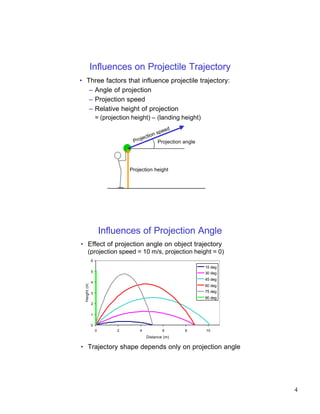
Influences on Projectile Trajectory
• Three factors that influence projectile trajectory:
   – Angle of projection
   – Projection speed
   – Relative height of projection
                   = (projection height) – (landing height)
                                                        ed
                                                  spe
                                            ion
                                       ject
                                 Pro              Projection angle


                                Projection height


                       Influences of Projection Angle
• Effect of projection angle on object trajectory
        (projection speed = 10 m/s, projection height = 0)
               6
                                                                     15 deg
               5                                                     30 deg
                                                                     45 deg
               4
  Height (m)


                                                                     60 deg
               3                                                     75 deg
                                                                     90 deg
               2


               1


               0
                   0       2        4               6        8       10
                                         Distance (m)

• Trajectory shape depends only on projection angle


                                                                              4
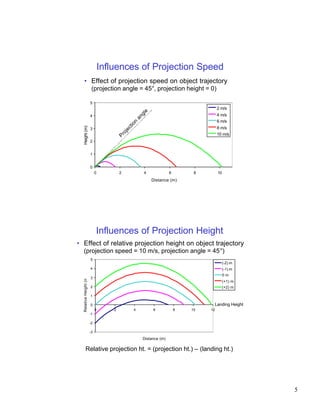
Influences of Projection Speed
    • Effect of projection speed on object trajectory
                         (projection angle = 45°, projection height = 0)

                        5
                                                                                           2 m/s


                                                          e
                                                      gl
                        4                                                                  4 m/s


                                                     an
                                                                                           6 m/s


                                                  n
                                               tio
  Height (m)


                        3
                                             ec                                            8 m/s
                                          oj

                                                                                           10 m/s
                                         Pr


                        2


                        1


                        0
                             0           2                4              6        8        10
                                                              Distance (m)


                             Influences of Projection Height
• Effect of relative projection height on object trajectory
  (projection speed = 10 m/s, projection angle = 45°)
                        5
                                                                                                (-2) m
                        4                                                                       (-1) m
                                                                                                0m
  Relative Height (m)


                        3
                                                                                                (+1) m
                        2                                                                       (+2) m

                        1

                        0                                                              Landing Height
                             0       2            4            6             8   10   12
                        -1

                        -2

                        -3
                                                          Distance (m)

          Relative projection ht. = (projection ht.) – (landing ht.)


                                                                                                         5
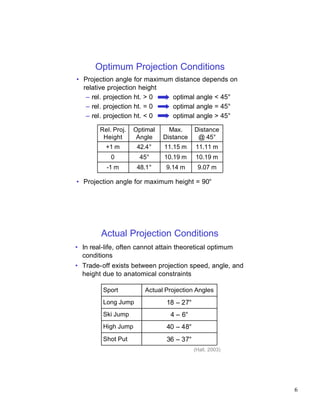
Optimum Projection Conditions
• Projection angle for maximum distance depends on
  relative projection height
   – rel. projection ht. > 0  optimal angle < 45°
   – rel. projection ht. = 0  optimal angle = 45°
   – rel. projection ht. < 0  optimal angle > 45°

        Rel. Proj.   Optimal     Max.      Distance
         Height       Angle    Distance     @ 45°
          +1 m        42.4°    11.15 m     11.11 m
            0          45°     10.19 m     10.19 m
          -1 m        48.1°     9.14 m      9.07 m

• Projection angle for maximum height = 90°


         Actual Projection Conditions
• In real-life, often cannot attain theoretical optimum
  conditions
• Trade-off exists between projection speed, angle, and
  height due to anatomical constraints

         Sport          Actual Projection Angles
         Long Jump              18 – 27°
         Ski Jump                4 – 6°
         High Jump              40 – 48°
         Shot Put               36 – 37°
                                           (Hall, 2003)


                                                          6
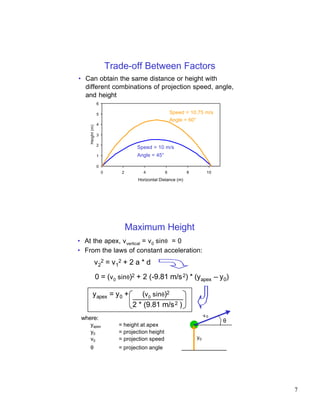
Trade-off Between Factors
• Can obtain the same distance or height with
  different combinations of projection speed, angle,
  and height
                 6

                 5                                    Speed = 10.75 m/s
                                                      Angle = 60°
                 4
    Height (m)


                 3

                 2
                                   Speed = 10 m/s
                 1                 Angle = 45°

                 0
                     0       2        4           6           8         10
                                    Horizontal Distance (m)


                                 Maximum Height
• At the apex, vvertical = v0 sinθ = 0
• From the laws of constant acceleration:
             v22 = v 12 + 2 a * d
                 0 = (v0 sinθ)2 + 2 (-9.81 m/s 2) * (yapex – y0)

         yapex = y 0 +               (v0 sinθ)2
                                  2 * (9.81 m/s 2 )
 where:                                                                v0
                                                                             θ
    yapex                   = height at apex
    y0                      = projection height
    v0                      = projection speed                    y0

    θ                       = projection angle


                                                                                 7
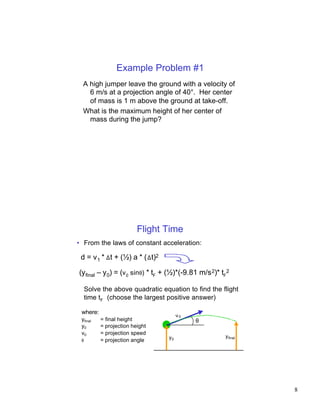
Example Problem #1
  A high jumper leave the ground with a velocity of
    6 m/s at a projection angle of 40°. Her center
    of mass is 1 m above the ground at take-off.
  What is the maximum height of her center of
    mass during the jump?


                         Flight Time
• From the laws of constant acceleration:

 d = v 1 * ∆ t + (½) a * ( ∆ t)2

(yfinal – y0) = (v0 sinθ) * tF + (½)*(-9.81 m/s 2)* tF2

     Solve the above quadratic equation to find the flight
     time tF (choose the largest positive answer)

 where:
                                        v0
 yfinal   = final height                     θ
 y0       = projection height
 v0       = projection speed
                                   y0                y final
 θ        = projection angle


                                                               8
Example Problem #2
 A figure skater is attempting a jump in which she
    performs 3 complete revolutions while in the air.
 She leaves the ice with a velocity of 7 m/s at a
    projection angle of 30°
 If she spins at 3 revolutions per second, will she be
    able to complete all 3 revolutions before landing?


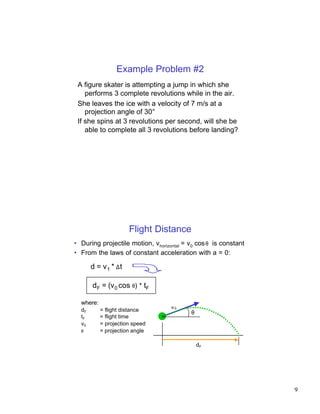
                      Flight Distance
• During projectile motion, vhorizontal = v0 cos θ is constant
• From the laws of constant acceleration with a = 0:

       d = v1 * ∆t

       dF = (v 0 cos θ) * tF

  where:
  dF       = flight distance       v0
                                          θ
  tF       = flight time
  v0       = projection speed
  θ        = projection angle

                                              dF


                                                                 9
Example Problem #3
A kicker is attempting field goal from 40 yards away.
The ball is kicked with an initial velocity of 24 m/s at
   a projection angle of 30°.
The crossbar of the goal post is 10 ft above the
   ground.
If his aim is correct, will he make the field goal?


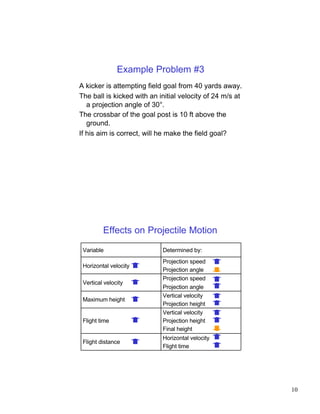
         Effects on Projectile Motion

 Variable                   Determined by:
                            Projection speed
 Horizontal velocity
                            Projection angle
                            Projection speed
 Vertical velocity
                            Projection angle
                            Vertical velocity
 Maximum height
                            Projection height
                            Vertical velocity
 Flight time                Projection height
                            Final height
                            Horizontal velocity
 Flight distance
                            Flight time


                                                           10
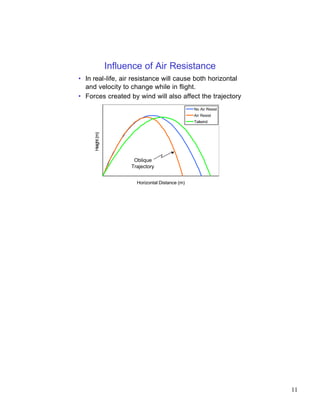
Influence of Air Resistance
• In real-life, air resistance will cause both horizontal
  and velocity to change while in flight.
• Forces created by wind will also affect the trajectory
                                                    No Air Resist
                                                    Air Resist
                                                    Tailwind
     Height (m)


                         Oblique
                        Trajectory


                          Horizontal Distance (m)


                                                                    11

Lecture 08v

  • 1.
    Projectile Motion Objectives: • Understandprojectile motion and how gravity influences it • Understand the effects of projection speed, angle, and relative height on projectile motion • Learn to compute the maximum height, flight time, and flight distance of a projectile What is a Projectile? • A projectile is a body or object that – is in the air – is subject only to the forces of gravity and air resistance (i.e. the object is in free fall). • The motion of the center of mass of any object in free fall is governed by the laws of projectile motion 1
  • 2.
    Influence of Gravity • Gravity: pull of the mass of the Earth on a body • Gravity accelerates an object in a vertical direction towards the center of the Earth. • Acceleration due to gravity (g) is always straight downward at a constant 9.81 m/s2 (32.2 ft/s2). velocity velocity g = 9.81 m/s2 g = 9.81 m/s2 upward velocity downward velocity decreases increases Gravity & Vertical Velocity • From the laws of constant acceleration: (vvertical)2 = (vvertical)1 + (-9.81 m/s 2) * ∆t • Vertical velocity changes linearly with time vvertical decelerating at max. vhorizontal height vvertical (m/s) upward time (s) 0 accelerating g = 9.81 m/s2 downward 2
  • 3.
    Gravity & HorizontalVelocity • Gravity does not change the horizontal velocity of an object. • From the laws of constant acceleration: (vhorizontal)2 = (vhorizontal)1 + ahorizontal * ∆t For gravity, ahorizontal = 0, so: vvertical (vhorizontal)2 = (vhorizontal )1 vhorizontal vvertical changes g = 9.81 m/s2 vhorizontal remains constant Projectile Motion • Gravity causes a projectile to move in a parabolic path that is symmetric about the apex (the highest point in the trajectory) apex Height (m) Horizontal Distance (m) 3
  • 4.
    Influences on ProjectileTrajectory • Three factors that influence projectile trajectory: – Angle of projection – Projection speed – Relative height of projection = (projection height) – (landing height) ed spe ion ject Pro Projection angle Projection height Influences of Projection Angle • Effect of projection angle on object trajectory (projection speed = 10 m/s, projection height = 0) 6 15 deg 5 30 deg 45 deg 4 Height (m) 60 deg 3 75 deg 90 deg 2 1 0 0 2 4 6 8 10 Distance (m) • Trajectory shape depends only on projection angle 4
  • 5.
    Influences of ProjectionSpeed • Effect of projection speed on object trajectory (projection angle = 45°, projection height = 0) 5 2 m/s e gl 4 4 m/s an 6 m/s n tio Height (m) 3 ec 8 m/s oj 10 m/s Pr 2 1 0 0 2 4 6 8 10 Distance (m) Influences of Projection Height • Effect of relative projection height on object trajectory (projection speed = 10 m/s, projection angle = 45°) 5 (-2) m 4 (-1) m 0m Relative Height (m) 3 (+1) m 2 (+2) m 1 0 Landing Height 0 2 4 6 8 10 12 -1 -2 -3 Distance (m) Relative projection ht. = (projection ht.) – (landing ht.) 5
  • 6.
    Optimum Projection Conditions •Projection angle for maximum distance depends on relative projection height – rel. projection ht. > 0 optimal angle < 45° – rel. projection ht. = 0 optimal angle = 45° – rel. projection ht. < 0 optimal angle > 45° Rel. Proj. Optimal Max. Distance Height Angle Distance @ 45° +1 m 42.4° 11.15 m 11.11 m 0 45° 10.19 m 10.19 m -1 m 48.1° 9.14 m 9.07 m • Projection angle for maximum height = 90° Actual Projection Conditions • In real-life, often cannot attain theoretical optimum conditions • Trade-off exists between projection speed, angle, and height due to anatomical constraints Sport Actual Projection Angles Long Jump 18 – 27° Ski Jump 4 – 6° High Jump 40 – 48° Shot Put 36 – 37° (Hall, 2003) 6
  • 7.
    Trade-off Between Factors •Can obtain the same distance or height with different combinations of projection speed, angle, and height 6 5 Speed = 10.75 m/s Angle = 60° 4 Height (m) 3 2 Speed = 10 m/s 1 Angle = 45° 0 0 2 4 6 8 10 Horizontal Distance (m) Maximum Height • At the apex, vvertical = v0 sinθ = 0 • From the laws of constant acceleration: v22 = v 12 + 2 a * d 0 = (v0 sinθ)2 + 2 (-9.81 m/s 2) * (yapex – y0) yapex = y 0 + (v0 sinθ)2 2 * (9.81 m/s 2 ) where: v0 θ yapex = height at apex y0 = projection height v0 = projection speed y0 θ = projection angle 7
  • 8.
    Example Problem #1 A high jumper leave the ground with a velocity of 6 m/s at a projection angle of 40°. Her center of mass is 1 m above the ground at take-off. What is the maximum height of her center of mass during the jump? Flight Time • From the laws of constant acceleration: d = v 1 * ∆ t + (½) a * ( ∆ t)2 (yfinal – y0) = (v0 sinθ) * tF + (½)*(-9.81 m/s 2)* tF2 Solve the above quadratic equation to find the flight time tF (choose the largest positive answer) where: v0 yfinal = final height θ y0 = projection height v0 = projection speed y0 y final θ = projection angle 8
  • 9.
    Example Problem #2 A figure skater is attempting a jump in which she performs 3 complete revolutions while in the air. She leaves the ice with a velocity of 7 m/s at a projection angle of 30° If she spins at 3 revolutions per second, will she be able to complete all 3 revolutions before landing? Flight Distance • During projectile motion, vhorizontal = v0 cos θ is constant • From the laws of constant acceleration with a = 0: d = v1 * ∆t dF = (v 0 cos θ) * tF where: dF = flight distance v0 θ tF = flight time v0 = projection speed θ = projection angle dF 9
  • 10.
    Example Problem #3 Akicker is attempting field goal from 40 yards away. The ball is kicked with an initial velocity of 24 m/s at a projection angle of 30°. The crossbar of the goal post is 10 ft above the ground. If his aim is correct, will he make the field goal? Effects on Projectile Motion Variable Determined by: Projection speed Horizontal velocity Projection angle Projection speed Vertical velocity Projection angle Vertical velocity Maximum height Projection height Vertical velocity Flight time Projection height Final height Horizontal velocity Flight distance Flight time 10
  • 11.
    Influence of AirResistance • In real-life, air resistance will cause both horizontal and velocity to change while in flight. • Forces created by wind will also affect the trajectory No Air Resist Air Resist Tailwind Height (m) Oblique Trajectory Horizontal Distance (m) 11