Qualitative Analysis of Motion

  Objectives:
  • Define the 3 types of motion
  • Identify the reference position, planes,
    and axes associated with the human body
  • Learn the terminology used to qualitatively
    describe directions and joint motions
  • Learn how to plan & conduct a qualitative
    analysis of human movement


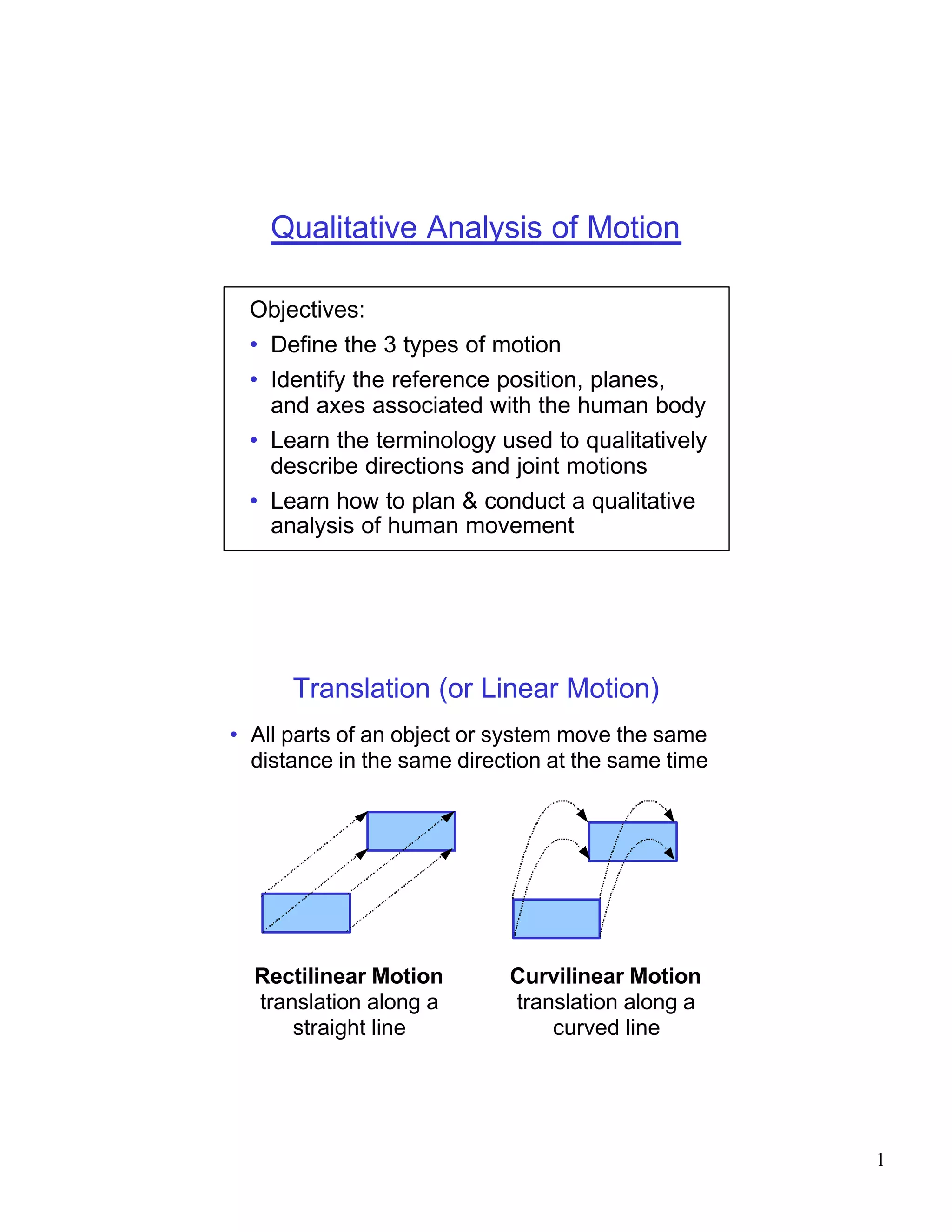
      Translation (or Linear Motion)
• All parts of an object or system move the same
  distance in the same direction at the same time


  Rectilinear Motion        Curvilinear Motion
  translation along a       translation along a
      straight line             curved line


                                                    1
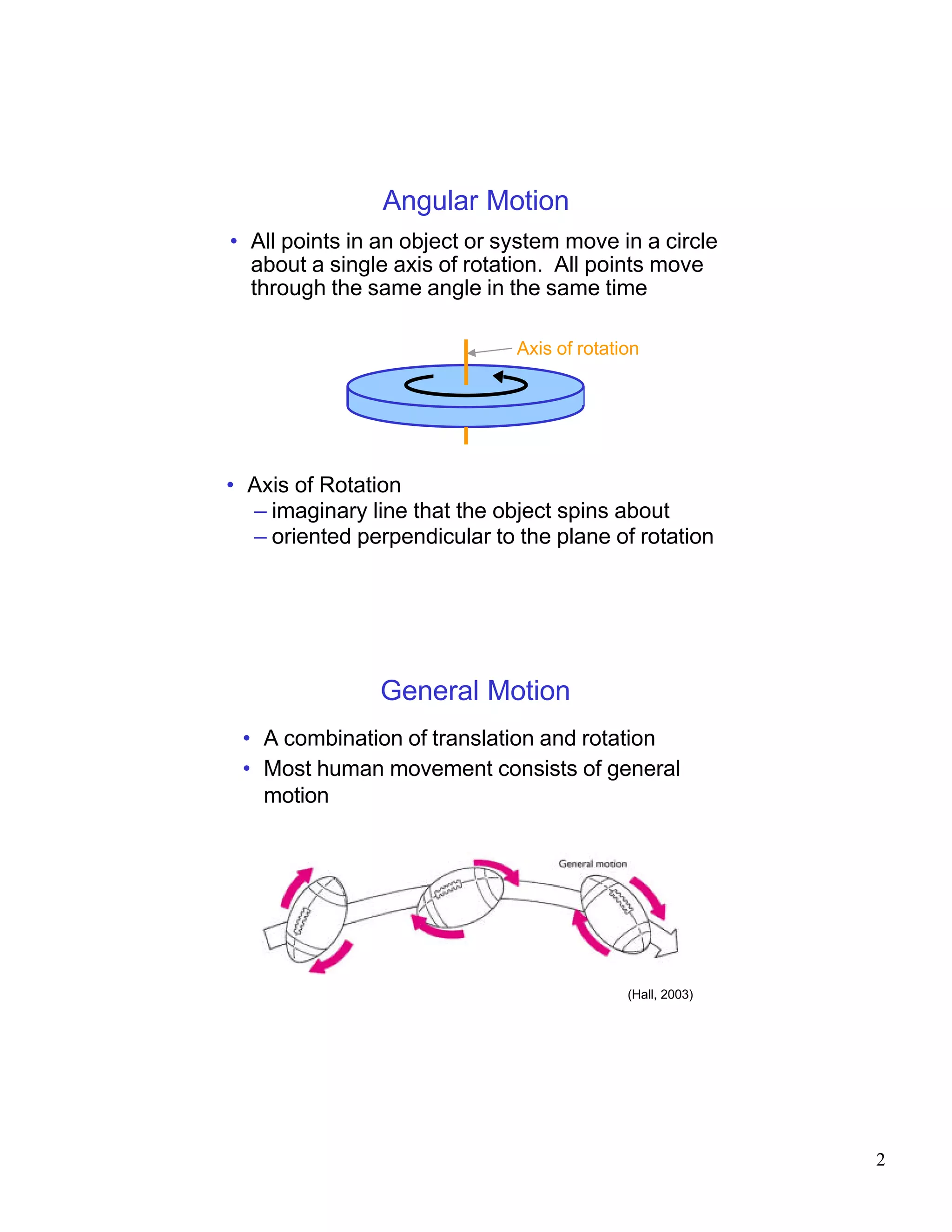
Angular Motion
• All points in an object or system move in a circle
  about a single axis of rotation. All points move
  through the same angle in the same time

                              Axis of rotation


• Axis of Rotation
  – imaginary line that the object spins about
  – oriented perpendicular to the plane of rotation


                General Motion
 • A combination of translation and rotation
 • Most human movement consists of general
   motion


                                            (Hall, 2003)


                                                           2
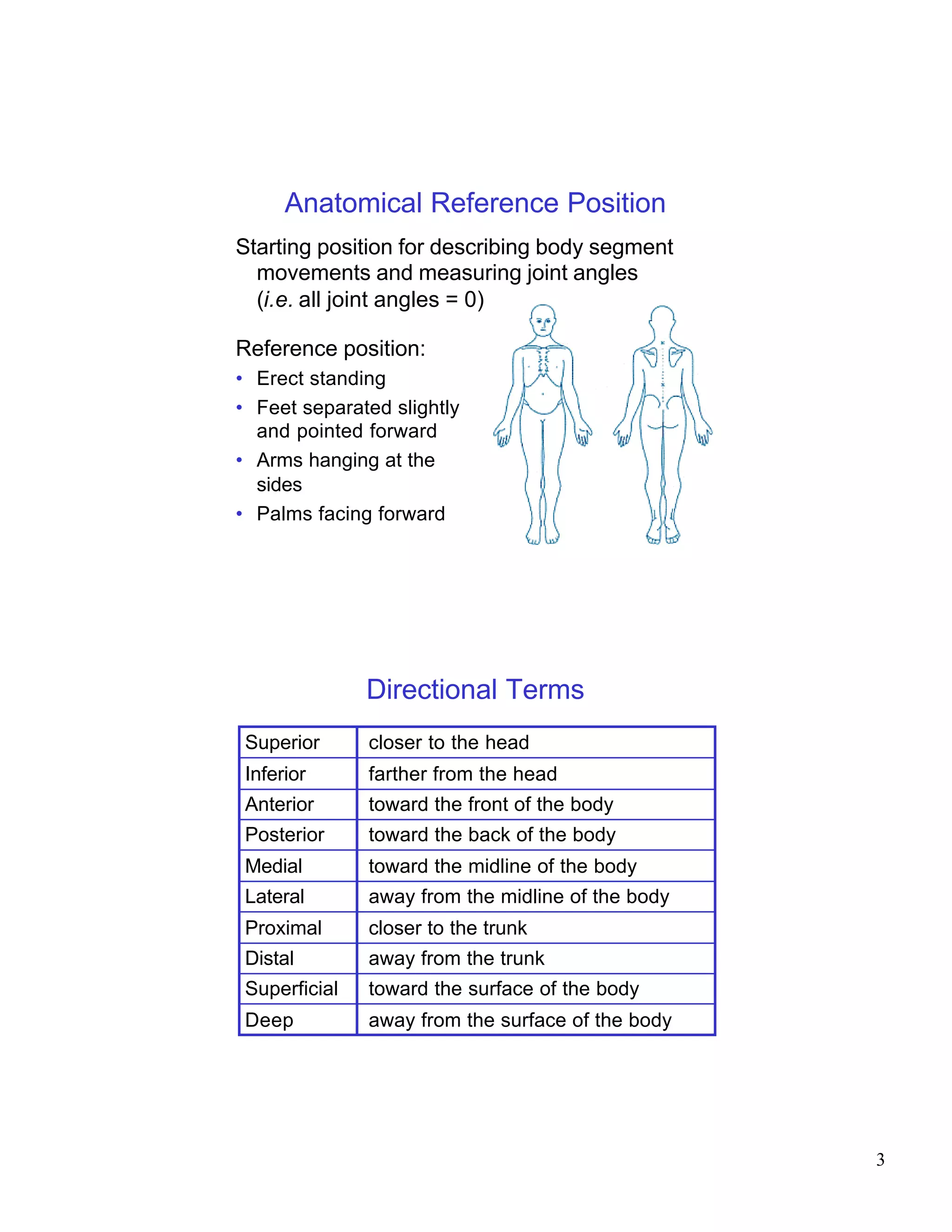
Anatomical Reference Position
Starting position for describing body segment
  movements and measuring joint angles
  (i.e. all joint angles = 0)

Reference position:
• Erect standing
• Feet separated slightly
  and pointed forward
• Arms hanging at the
  sides
• Palms facing forward


               Directional Terms
 Superior      closer to the head
 Inferior      farther from the head
 Anterior      toward the front of the body
 Posterior     toward the back of the body
 Medial        toward the midline of the body
 Lateral       away from the midline of the body
 Proximal      closer to the trunk
 Distal        away from the trunk
 Superficial   toward the surface of the body
 Deep          away from the surface of the body


                                                   3
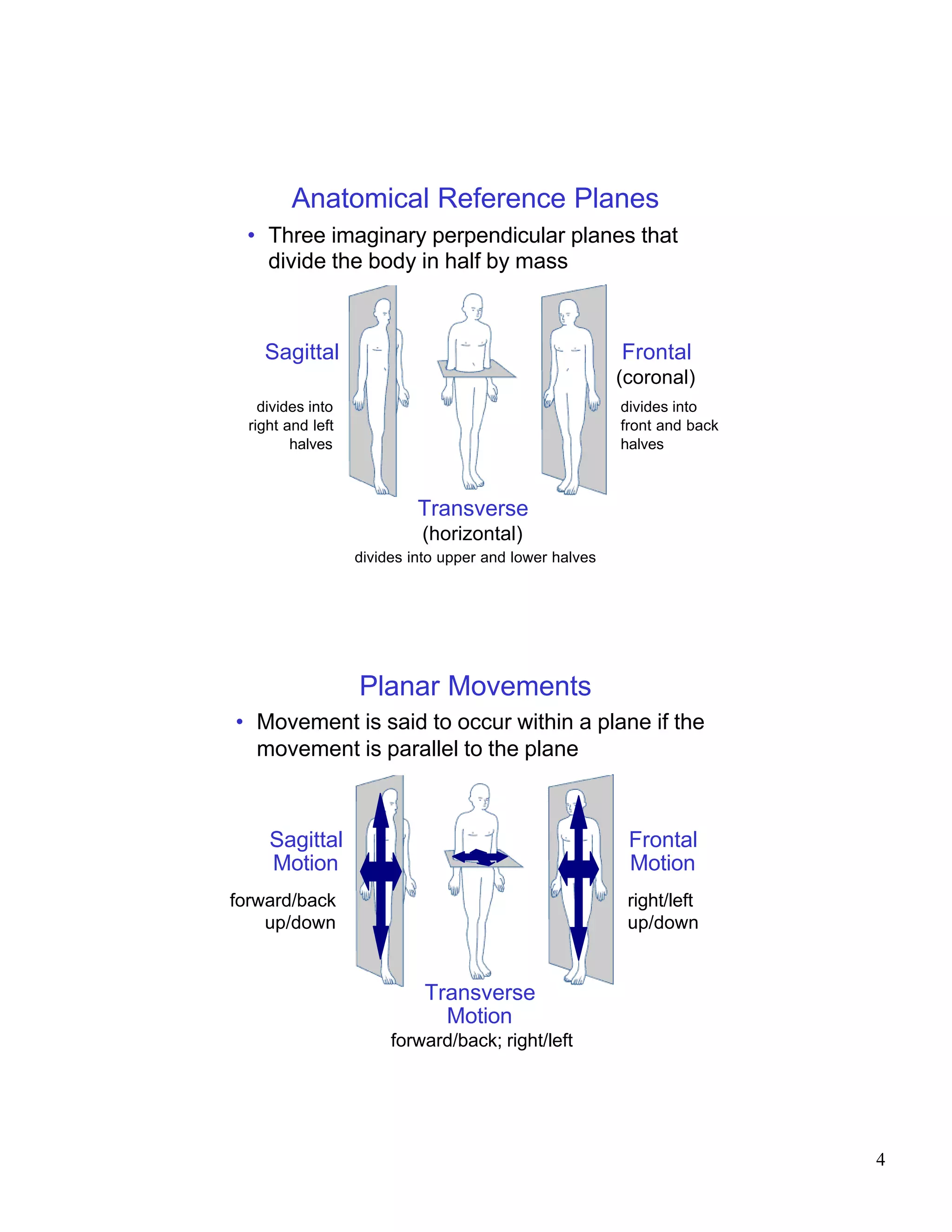
Anatomical Reference Planes
 • Three imaginary perpendicular planes that
   divide the body in half by mass


    Sagittal                                             Frontal
                                                         (coronal)
    divides into                                         divides into
  right and left                                         front and back
         halves                                          halves


                            Transverse
                            (horizontal)
                   divides into upper and lower halves


                   Planar Movements
• Movement is said to occur within a plane if the
  movement is parallel to the plane


     Sagittal                                             Frontal
     Motion                                               Motion
forward/back                                              right/left
    up/down                                               up/down


                             Transverse
                               Motion
                        forward/back; right/left


                                                                          4
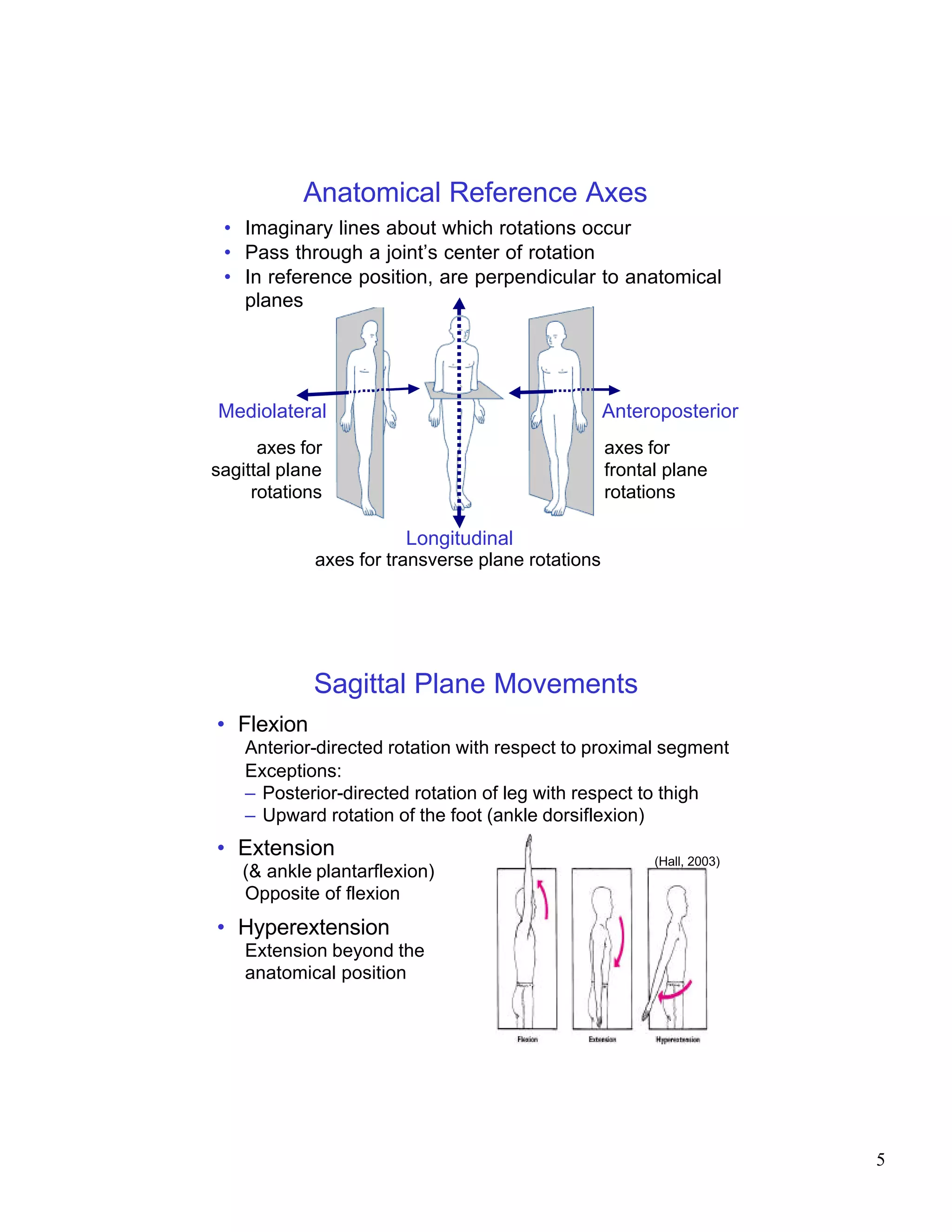
Anatomical Reference Axes
 • Imaginary lines about which rotations occur
 • Pass through a joint’s center of rotation
 • In reference position, are perpendicular to anatomical
   planes


Mediolateral                                       Anteroposterior
      axes for                                     axes for
sagittal plane                                     frontal plane
     rotations                                     rotations

                        Longitudinal
             axes for transverse plane rotations


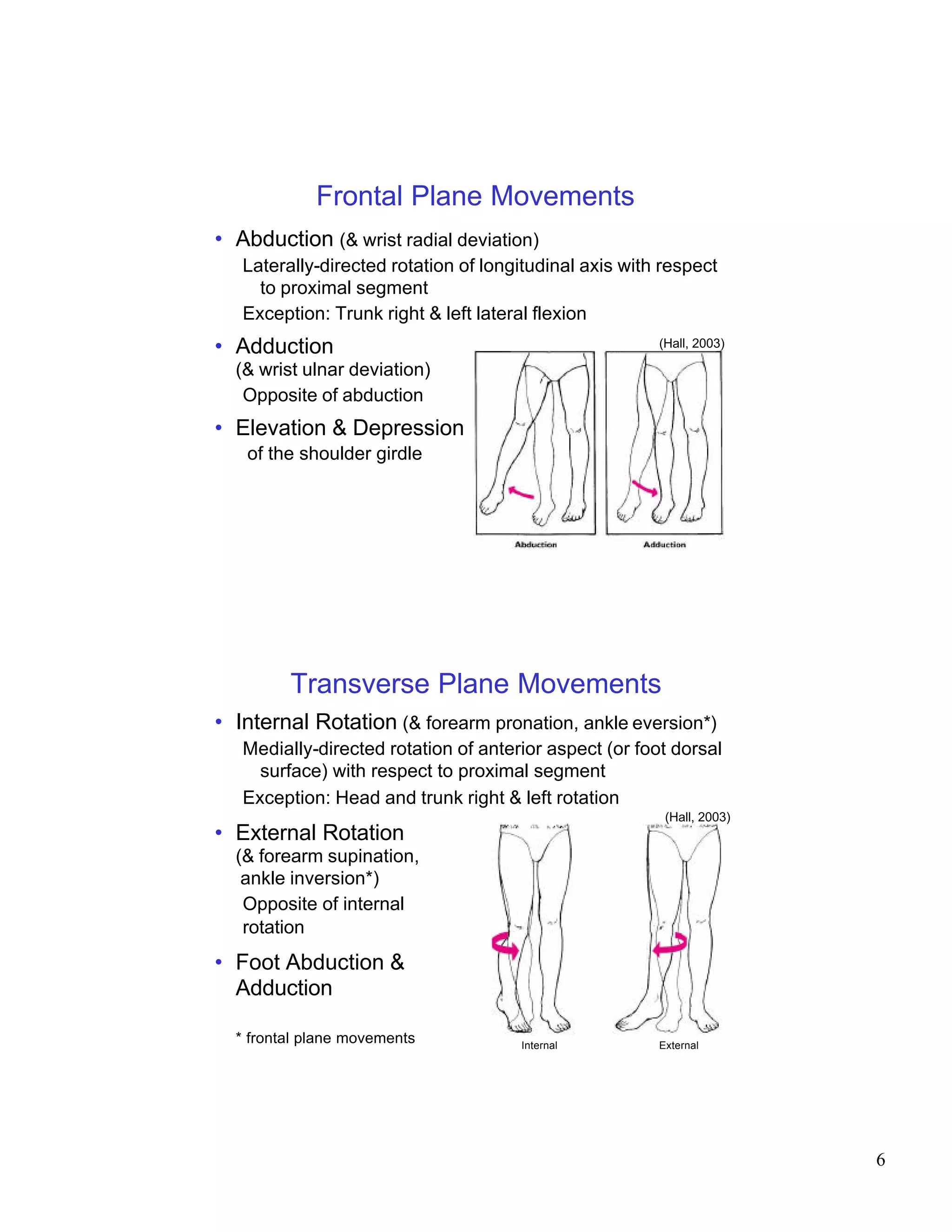
            Sagittal Plane Movements
• Flexion
    Anterior-directed rotation with respect to proximal segment
    Exceptions:
    – Posterior-directed rotation of leg with respect to thigh
    – Upward rotation of the foot (ankle dorsiflexion)
• Extension                                              (Hall, 2003)
   (& ankle plantarflexion)
   Opposite of flexion
• Hyperextension
    Extension beyond the
    anatomical position


                                                                        5
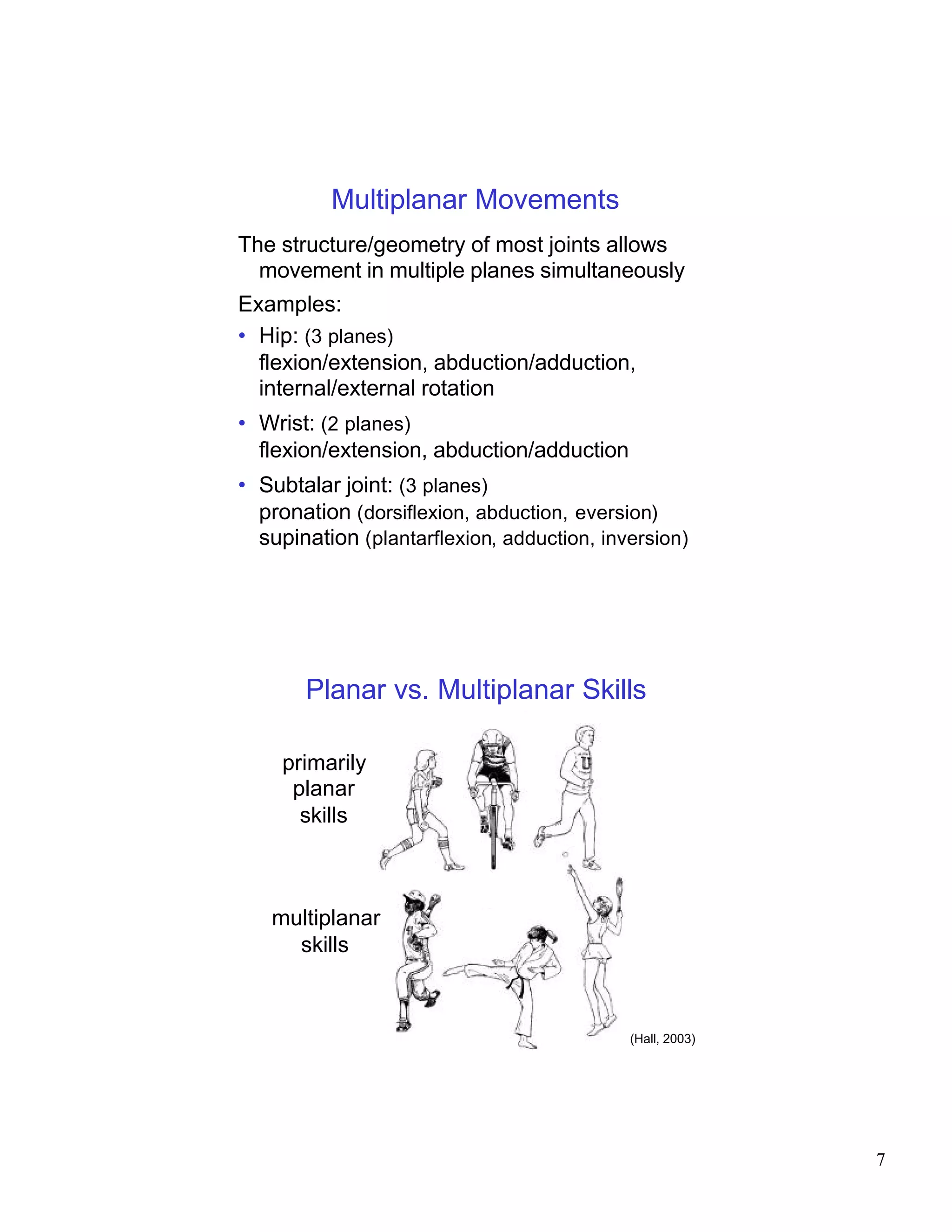
Frontal Plane Movements
• Abduction (& wrist radial deviation)
   Laterally-directed rotation of longitudinal axis with respect
     to proximal segment
   Exception: Trunk right & left lateral flexion
• Adduction                                             (Hall, 2003)

  (& wrist ulnar deviation)
   Opposite of abduction
• Elevation & Depression
   of the shoulder girdle


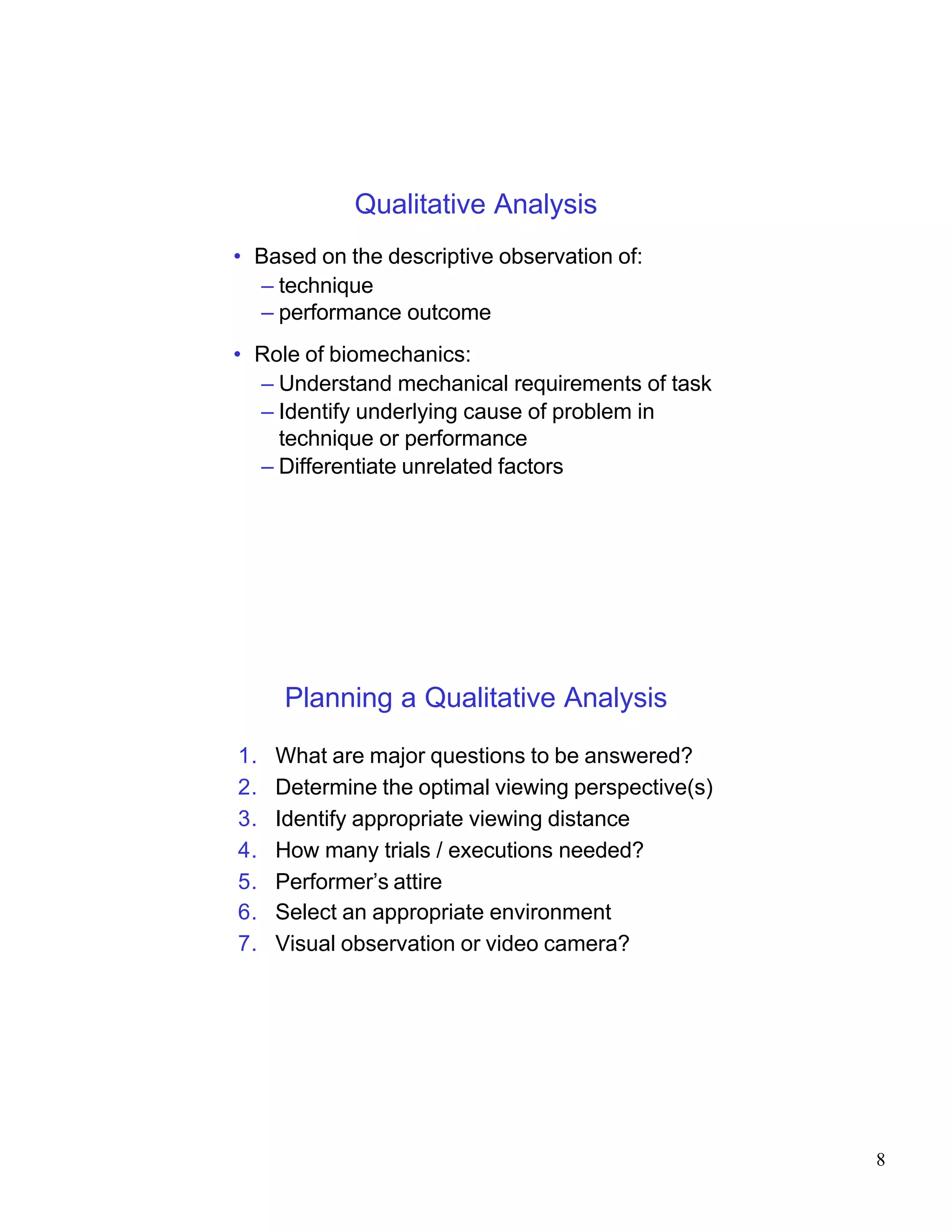
         Transverse Plane Movements
• Internal Rotation (& forearm pronation, ankle eversion*)
   Medially-directed rotation of anterior aspect (or foot dorsal
     surface) with respect to proximal segment
   Exception: Head and trunk right & left rotation
                                                         (Hall, 2003)
• External Rotation
  (& forearm supination,
   ankle inversion*)
   Opposite of internal
   rotation
• Foot Abduction &
  Adduction

  * frontal plane movements           Internal          External


                                                                        6
Multiplanar Movements
The structure/geometry of most joints allows
  movement in multiple planes simultaneously
Examples:
• Hip: (3 planes)
  flexion/extension, abduction/adduction,
  internal/external rotation
• Wrist: (2 planes)
  flexion/extension, abduction/adduction
• Subtalar joint: (3 planes)
  pronation (dorsiflexion, abduction, eversion)
  supination (plantarflexion, adduction, inversion)


       Planar vs. Multiplanar Skills

     primarily
      planar
       skills


   multiplanar
     skills


                                            (Hall, 2003)


                                                           7
Qualitative Analysis
• Based on the descriptive observation of:
  – technique
  – performance outcome
• Role of biomechanics:
  – Understand mechanical requirements of task
  – Identify underlying cause of problem in
    technique or performance
  – Differentiate unrelated factors


     Planning a Qualitative Analysis

1.   What are major questions to be answered?
2.   Determine the optimal viewing perspective(s)
3.   Identify appropriate viewing distance
4.   How many trials / executions needed?
5.   Performer’s attire
6.   Select an appropriate environment
7.   Visual observation or video camera?


                                                    8
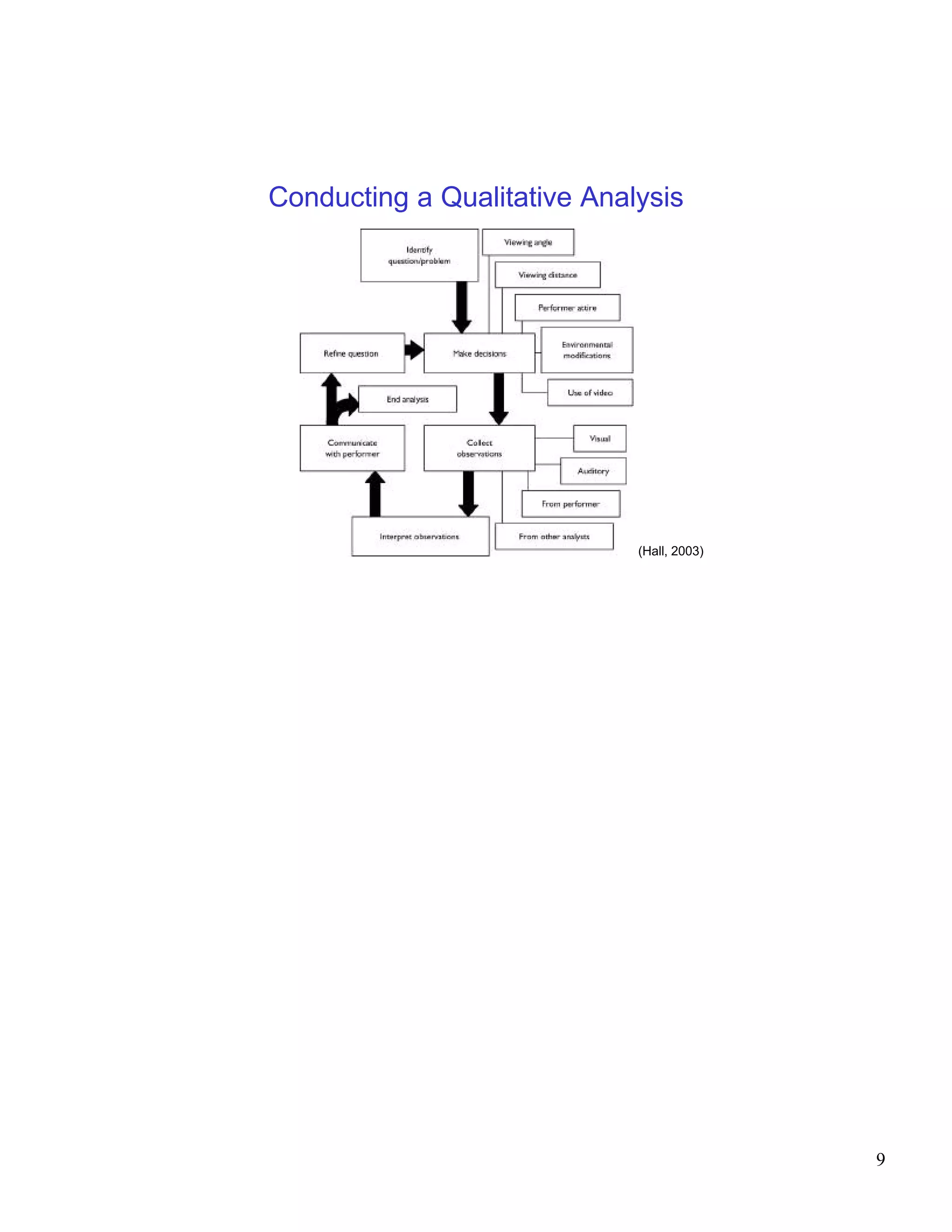
Conducting a Qualitative Analysis


                             (Hall, 2003)


                                            9

Lecture 04

  • 1.
    Qualitative Analysis ofMotion Objectives: • Define the 3 types of motion • Identify the reference position, planes, and axes associated with the human body • Learn the terminology used to qualitatively describe directions and joint motions • Learn how to plan & conduct a qualitative analysis of human movement Translation (or Linear Motion) • All parts of an object or system move the same distance in the same direction at the same time Rectilinear Motion Curvilinear Motion translation along a translation along a straight line curved line 1
  • 2.
    Angular Motion • Allpoints in an object or system move in a circle about a single axis of rotation. All points move through the same angle in the same time Axis of rotation • Axis of Rotation – imaginary line that the object spins about – oriented perpendicular to the plane of rotation General Motion • A combination of translation and rotation • Most human movement consists of general motion (Hall, 2003) 2
  • 3.
    Anatomical Reference Position Startingposition for describing body segment movements and measuring joint angles (i.e. all joint angles = 0) Reference position: • Erect standing • Feet separated slightly and pointed forward • Arms hanging at the sides • Palms facing forward Directional Terms Superior closer to the head Inferior farther from the head Anterior toward the front of the body Posterior toward the back of the body Medial toward the midline of the body Lateral away from the midline of the body Proximal closer to the trunk Distal away from the trunk Superficial toward the surface of the body Deep away from the surface of the body 3
  • 4.
    Anatomical Reference Planes • Three imaginary perpendicular planes that divide the body in half by mass Sagittal Frontal (coronal) divides into divides into right and left front and back halves halves Transverse (horizontal) divides into upper and lower halves Planar Movements • Movement is said to occur within a plane if the movement is parallel to the plane Sagittal Frontal Motion Motion forward/back right/left up/down up/down Transverse Motion forward/back; right/left 4
  • 5.
    Anatomical Reference Axes • Imaginary lines about which rotations occur • Pass through a joint’s center of rotation • In reference position, are perpendicular to anatomical planes Mediolateral Anteroposterior axes for axes for sagittal plane frontal plane rotations rotations Longitudinal axes for transverse plane rotations Sagittal Plane Movements • Flexion Anterior-directed rotation with respect to proximal segment Exceptions: – Posterior-directed rotation of leg with respect to thigh – Upward rotation of the foot (ankle dorsiflexion) • Extension (Hall, 2003) (& ankle plantarflexion) Opposite of flexion • Hyperextension Extension beyond the anatomical position 5
  • 6.
    Frontal Plane Movements •Abduction (& wrist radial deviation) Laterally-directed rotation of longitudinal axis with respect to proximal segment Exception: Trunk right & left lateral flexion • Adduction (Hall, 2003) (& wrist ulnar deviation) Opposite of abduction • Elevation & Depression of the shoulder girdle Transverse Plane Movements • Internal Rotation (& forearm pronation, ankle eversion*) Medially-directed rotation of anterior aspect (or foot dorsal surface) with respect to proximal segment Exception: Head and trunk right & left rotation (Hall, 2003) • External Rotation (& forearm supination, ankle inversion*) Opposite of internal rotation • Foot Abduction & Adduction * frontal plane movements Internal External 6
  • 7.
    Multiplanar Movements The structure/geometryof most joints allows movement in multiple planes simultaneously Examples: • Hip: (3 planes) flexion/extension, abduction/adduction, internal/external rotation • Wrist: (2 planes) flexion/extension, abduction/adduction • Subtalar joint: (3 planes) pronation (dorsiflexion, abduction, eversion) supination (plantarflexion, adduction, inversion) Planar vs. Multiplanar Skills primarily planar skills multiplanar skills (Hall, 2003) 7
  • 8.
    Qualitative Analysis • Basedon the descriptive observation of: – technique – performance outcome • Role of biomechanics: – Understand mechanical requirements of task – Identify underlying cause of problem in technique or performance – Differentiate unrelated factors Planning a Qualitative Analysis 1. What are major questions to be answered? 2. Determine the optimal viewing perspective(s) 3. Identify appropriate viewing distance 4. How many trials / executions needed? 5. Performer’s attire 6. Select an appropriate environment 7. Visual observation or video camera? 8
  • 9.
    Conducting a QualitativeAnalysis (Hall, 2003) 9