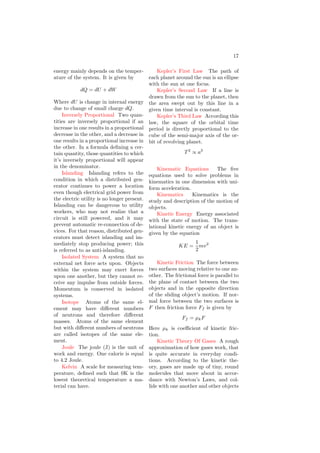
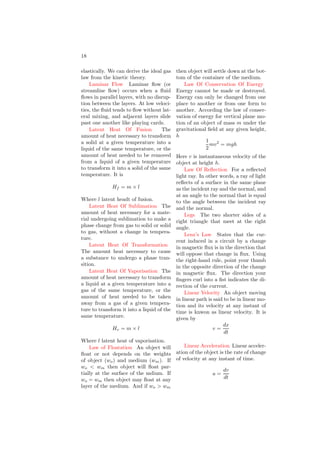
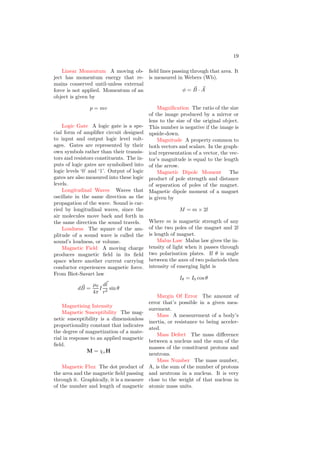
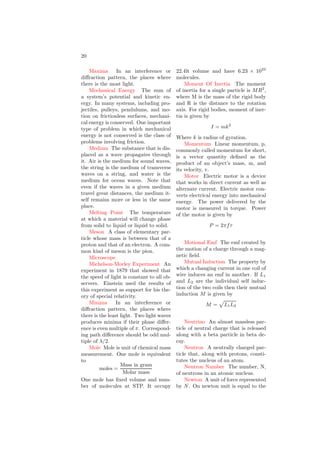
1
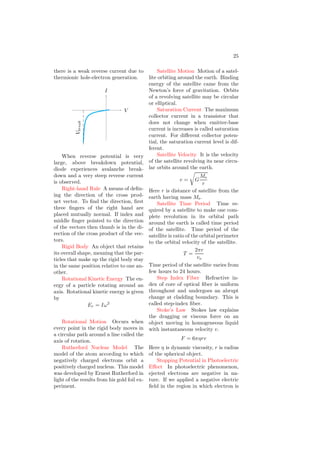
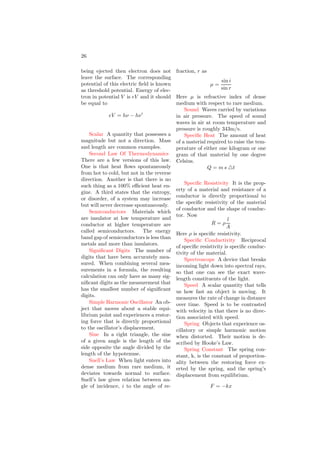
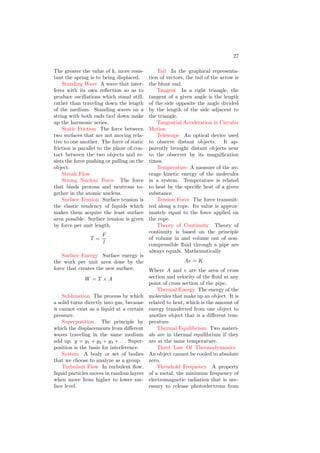
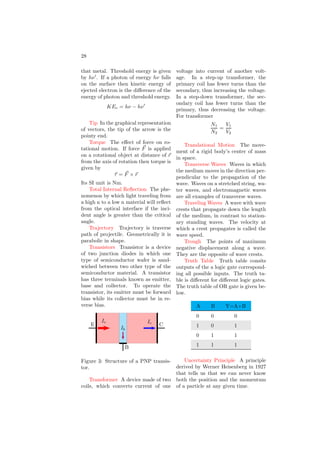
PHYSICS
DICTIONARY
Arun Umrao
www.sdmsacademy.in
DRAFT COPY - GPL LICENSING
2
Atom A particle of matter indivisi-
ble by chemical means. It is the funda-
mental building block of molecules. It
consists of a positively charged nucleus
and orbiting electrons. The number of
electrons is the same as the number of
protons in the nucleus.
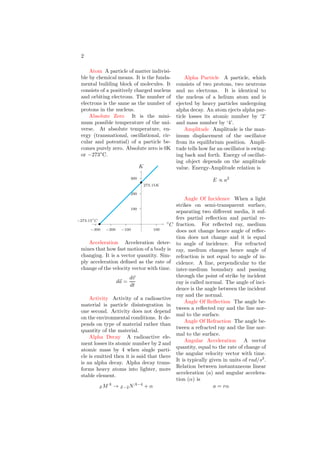
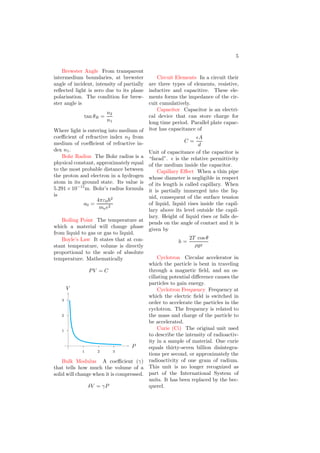
Absolute Zero It is the mini-
mum possible temperature of the uni-
verse. At absolute temperature, en-
ergy (transnational, oscillational, cir-
cular and potential) of a particle be-
comes purely zero. Absolute zero is 0K
or −273◦
C.
100
200
300
100
−100
−200
−300
◦
C
K
b
−273.15◦
C
b
273.15K
Acceleration Acceleration deter-
mines that how fast motion of a body is
changing. It is a vector quantity. Sim-
ply acceleration defined as the rate of
change of the velocity vector with time.
d~
a =
d~
v
dt
Activity Activity of a radioactive
material is particle disintegration in
one second. Activity does not depend
on the environmental conditions. It de-
pends on type of material rather than
quantity of the material.
Alpha Decay A radioactive ele-
ment losses its atomic number by 2 and
atomic mass by 4 when single parti-
cle is emitted then it is said that there
is an alpha decay. Alpha decay trans-
forms heavy atoms into lighter, more
stable element.
ZMA
→ Z−2NA−4
+ α
Alpha Particle A particle, which
consists of two protons, two neutrons
and no electrons. It is identical to
the nucleus of a helium atom and is
ejected by heavy particles undergoing
alpha decay. An atom ejects alpha par-
ticle losses its atomic number by ‘2’
and mass number by ‘4’.
Amplitude Amplitude is the max-
imum displacement of the oscillator
from its equilibrium position. Ampli-
tude tells how far an oscillator is swing-
ing back and forth. Energy of oscillat-
ing object depends on the amplitude
value. Energy-Amplitude relation is
E ∝ a2
Angle Of Incidence When a light
strikes on semi-transparent surface,
separating two different media, it suf-
fers partial reflection and partial re-
fraction. For reflected ray, medium
does not change hence angle of reflec-
tion does not change and it is equal
to angle of incidence. For refracted
ray, medium changes hence angle of
refraction is not equal to angle of in-
cidence. A line, perpendicular to the
inter-medium boundary and passing
through the point of strike by incident
ray is called normal. The angle of inci-
dence is the angle between the incident
ray and the normal.
Angle Of Reflection The angle be-
tween a reflected ray and the line nor-
mal to the surface.
Angle Of Refraction The angle be-
tween a refracted ray and the line nor-
mal to the surface.
Angular Acceleration A vector
quantity, equal to the rate of change of
the angular velocity vector with time.
It is typically given in units of rad/s2
.
Relation between instantaneous linear
acceleration (a) and angular accelera-
tion (α) is
a = rα
3
Angular Displacement The net
change, in a point’s angular position.
It is a scalar quantity.
Angular Frequency A frequency, f,
defined as the number of revolutions a
rigid body makes in a given time inter-
val. It is a scalar quantity commonly
denoted in units of Hertz (Hz) or s−1
.
Angular Momentum A vector
quantity, L, that is the rotational ana-
logue of linear momentum. The angu-
lar momentum is the vector product of
the body’s moment of inertia, I and its
angular velocity ω
~
L = I × ~
ω
Angular momentum can also be ex-
pressed as vector product of linear mo-
mentum, m~
v, its position from the ori-
gin, ~
r.
~
L = ~
r × m~
v
Angular Period The time, T , re-
quired for a rigid body to complete one
revolution. Angular period is recipro-
cal to the angular frequency.
Angular Position Position of a par-
ticle in polar coordinate system. In
polar coordinate system, there are two
angle used as reference for angular po-
sition. These two angle are angle of in-
clination (θ) and angle of azimuth (φ).
Angle of inclination is measured with
respect to perpendicular axis and angle
of azimuth is measured with respect to
x − axis along the horizontal plane.
Angular Velocity A vector quan-
tity, that reflects the change of angular
displacement with time.
ω =
dφ
dt
Unit of angular velocity is rad/s.
Anti-node & Nodes When two or
more waves travel in same medium si-
multaneously, they interfere with each
other. Waves, not only travel in the
medium but they also transport me-
chanical energy. This mechanical en-
ergy is proportional to the square of
the amplitude (I ∝ A2
). The angle
value in wave equation (I = A sin θ),
determines the distribution of energy
of the wave in 2π range. Energy dis-
tribution pattern of all waves is differ-
ent to each other due to different val-
ues of angle, θ. When these two en-
ergy distributions meet at different an-
gle (say θ1 and θ2), they suffer inter-
ference. Intensity of interfered energy
depends on phase angle (φ = θ1 − θ2).
If both waves meet at right opposite
angle, (φ = π), then resultant inten-
sity of two waves is zero. The point,
where interference energy is zero, are
called nodes. When two waves meet in
same angle at a point (φ = 0), resul-
tant intensity is maximum. This point
of highest energy is called anti-node.
Atom Atom is the smallest entity
of any matter. It consists protons &
neutrons in its nucleus and electrons
in its external orbits. Atom is electri-
cally neutral as number of protons and
electrons are equal. Number of pro-
tons in an atom represents its atomic
number and sum of masses of all con-
stituting particles represents its atomic
mass. There may be atoms, who have
equal numbers of protons but differ-
ent numbers of neutrons. These types
of atom are known as isotopes collec-
tively. Atoms having atomic number
more than 82 are called radioactive
atoms and the material is known as ra-
dioactive material.
Atomic Number A number, Z, as-
sociated with the number of protons in
the nucleus of an atom.
Axis Of Rotation The line that ev-
ery particle in the rotating rigid body
circles about. Axis of rotation may or
may not be inside the object.
4
x
y
ω
Barrier Potential
Background Radiation The radia-
tion found in the natural environment
originating primarily from the natu-
rally radioactive elements of Earth and
from cosmic rays. The term may also
mean radiation extraneous to an ex-
periment.
Biasing of Diode When a diode
is connected with external DC source,
then it is known as biasing of the diode.
p n
V
D1
V
Big Bang Beginning of the uni-
verse; a transition from conditions of
unimaginable density and temperature
to conditions of lower density and tem-
perature.
Black-body Radiation Radiation
emitted by a blackbody is called black-
body radiation.
E = σT 4
Black Hole An object so dense that
light cannot escape from it.
Bernoulli’s Theorem A non-
compressible liquid flowing streamline
in a pipe of varying area of cross sec-
tion. According to the Bernoulli’s the-
orem, total energy of liquid at every
cross section in the pipe is constant.
Flowing water has three types of en-
ergies. (i) Pressure energy, (ii) gravi-
tational potential energy and (iii) ki-
netic energy. Mathematically, for unit
volume of liquid
P + ρgh +
1
2
ρv2
= C
Beats When two waves of slightly
different frequencies interfere with one
another, they produce a “beating” in-
terference pattern that alternates be-
tween constructive (in-phase) and de-
structive (out-of-phase). Frequency of
the beats, f, is equal to the difference
in the frequencies of the two interfering
waves.
f = f1 ∼ f2
Beta Decay A particle, identical
to an electron, emits from nucleus of
a radioactive atom. The emission of
beta particle from a radioactive atom
is called beta decay. When beta de-
cay occurs, atomic mass of atom does
not change but its atomic number is
increased by one and atom losses mass
slightly.
Beta Particle A particle, identi-
cal to an electron. Beta particles are
ejected from an atom in the process of
beta decay.
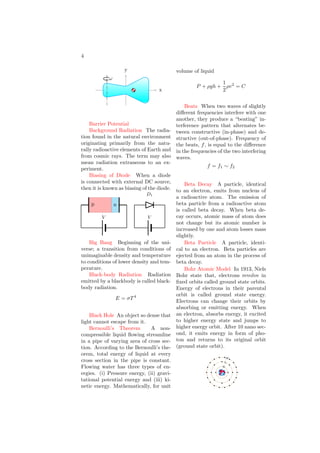
Bohr Atomic Model In 1913, Niels
Bohr state that, electrons revolve in
fixed orbits called ground state orbits.
Energy of electrons in their parental
orbit is called ground state energy.
Electrons can change their orbits by
absorbing or emitting energy. When
an electron, absorbs energy, it excited
to higher energy state and jumps to
higher energy orbit. After 10 nano sec-
ond, it emits energy in form of pho-
ton and returns to its original orbit
(ground state orbit).
b
b
b
b b
b
b
b
b
b
b
b
b
b
b
b
b
b
b
b
b
b
b
b
b
b
b
b
b
b
b
b b
b
b
b
b
b
b
b
b
b
b b
b
b b
b
b
b
b
b
b
b
b
b
b
b b
b
b
b
b
b
b
b
b
b
b
b
b
b
b
b
b
b
b
b
b
b b
b
b
b
K
L
M
5
Brewster Angle From transparent
intermedium boundaries, at brewster
angle of incident, intensity of partially
reflected light is zero due to its plane
polarisation. The condition for brew-
ster angle is
tan θB =
n2
n1
Where light is entering into medium of
coefficient of refractive index n2 from
medium of coefficient of refractive in-
dex n1.
Bohr Radius The Bohr radius is a
physical constant, approximately equal
to the most probable distance between
the proton and electron in a hydrogen
atom in its ground state. Its value is
5.291×10⁻¹¹
m. Bohr’s radius formula
is
a0 =
4πε0~2
mee2
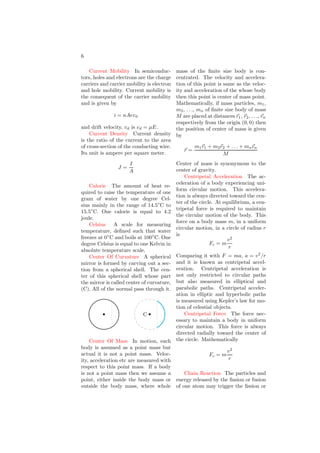
Boiling Point The temperature at
which a material will change phase
from liquid to gas or gas to liquid.
Boyle’s Law It states that at con-
stant temperature, volume is directly
proportional to the scale of absolute
temperature. Mathematically
PV = C
1
2
3
1 2 3
P
V
Bulk Modulus A coefficient (γ)
that tells how much the volume of a
solid will change when it is compressed.
δV = γP
Circuit Elements In a circuit their
are three types of elements, resistive,
inductive and capacitive. These ele-
ments forms the impedance of the cir-
cuit cumulatively.
Capacitor Capacitor is an electri-
cal device that can store charge for
long time period. Parallel plate capac-
itor has capacitance of
C =
ǫA
d
Unit of capacitance of the capacitor is
“farad”. ǫ is the relative permittivity
of the medium inside the capacitor.
Capillary Effect When a thin pipe
whose diameter is negligible in respect
of its length is called capillary. When
it is partially immerged into the liq-
uid, consequent of the surface tension
of liquid, liquid rises inside the capil-
lary above its level outside the capil-
lary. Height of liquid rises or falls de-
pends on the angle of contact and it is
given by
h =
2T cos θ
ρgr
Cyclotron Circular accelerator in
which the particle is bent in traveling
through a magnetic field, and an os-
cillating potential difference causes the
particles to gain energy.
Cyclotron Frequency Frequency at
which the electric field is switched in
order to accelerate the particles in the
cyclotron. The frequency is related to
the mass and charge of the particle to
be accelerated.
Curie (Ci) The original unit used
to describe the intensity of radioactiv-
ity in a sample of material. One curie
equals thirty-seven billion disintegra-
tions per second, or approximately the
radioactivity of one gram of radium.
This unit is no longer recognized as
part of the International System of
units. It has been replaced by the bec-
querel.
6
Current Mobility In semiconduc-
tors, holes and electrons are the charge
carriers and carrier mobility is electron
and hole mobility. Current mobility is
the consequent of the carrier mobility
and is given by
i = nAevd
and drift velocity, vd is vd = µE.
Current Density Current density
is the ratio of the current to the area
of cross-section of the conducting wire.
Its unit is ampere per square meter.
J =
I
A
Calorie The amount of heat re-
quired to raise the temperature of one
gram of water by one degree Cel-
sius mainly in the range of 14.5◦
C to
15.5◦
C. One calorie is equal to 4.2
joule.
Celsius A scale for measuring
temperature, defined such that water
freezes at 0◦
C and boils at 100◦
C. One
degree Celsius is equal to one Kelvin in
absolute temperature scale.
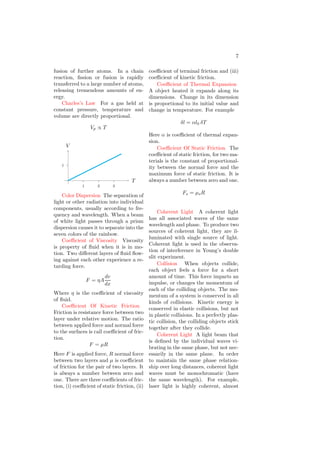
Center Of Curvature A spherical
mirror is formed by carving out a sec-
tion from a spherical shell. The cen-
ter of this spherical shell whose part
the mirror is called center of curvature,
(C). All of the normal pass through it.
b b
C
Center Of Mass In motion, each
body is assumed as a point mass but
actual it is not a point mass. Veloc-
ity, acceleration etc are measured with
respect to this point mass. If a body
is not a point mass then we assume a
point, either inside the body mass or
outside the body mass, where whole
mass of the finite size body is con-
centrated. The velocity and accelera-
tion of this point is same as the veloc-
ity and acceleration of the whose body
then this point is center of mass point.
Mathematically, if mass particles, m1,
m2, . . ., mn of finite size body of mass
M are placed at distances ~
r1, ~
r2, . . ., ~
rn
respectively from the origin (0, 0) then
the position of center of mass is given
by
~
r =
m1~
r1 + m2~
r2 + . . . + mn~
rn
M
Center of mass is synonymous to the
center of gravity.
Centripetal Acceleration The ac-
celeration of a body experiencing uni-
form circular motion. This accelera-
tion is always directed toward the cen-
ter of the circle. At equilibrium, a cen-
tripetal force is required to maintain
the circular motion of the body. This
force on a body mass m, in a uniform
circular motion, in a circle of radius r
is
Fc = m
v2
r
Comparing it with F = ma, a = v2
/r
and it is known as centripetal accel-
eration. Centripetal acceleration is
not only restricted to circular paths
but also measured in elliptical and
parabolic paths. Centripetal acceler-
ation in elliptic and hyperbolic paths
is measured using Kepler’s law for mo-
tion of celestial objects.
Centripetal Force The force nec-
essary to maintain a body in uniform
circular motion. This force is always
directed radially toward the center of
the circle. Mathematically
Fc = m
v2
r
Chain Reaction The particles and
energy released by the fission or fusion
of one atom may trigger the fission or
7
fusion of further atoms. In a chain
reaction, fission or fusion is rapidly
transferred to a large number of atoms,
releasing tremendous amounts of en-
ergy.
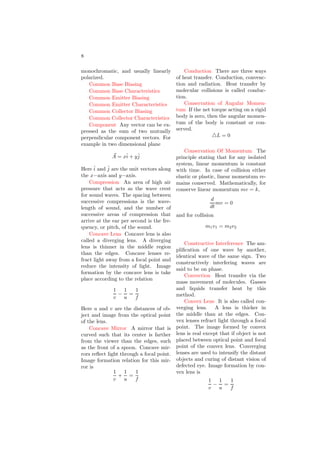
Charles’s Law For a gas held at
constant pressure, temperature and
volume are directly proportional.
Vp ∝ T
1
1 2 3
T
V
Color Dispersion The separation of
light or other radiation into individual
components, usually according to fre-
quency and wavelength. When a beam
of white light passes through a prism
dispersion causes it to separate into the
seven colors of the rainbow.
Coefficient of Viscosity Viscosity
is property of fluid when it is in mo-
tion. Two different layers of fluid flow-
ing against each other experience a re-
tarding force.
F = ηA
dv
dx
Where η is the coefficient of viscosity
of fluid.
Coefficient Of Kinetic Friction
Friction is resistance force between two
layer under relative motion. The ratio
between applied force and normal force
to the surfaces is call coefficient of fric-
tion.
F = µR
Here F is applied force, R normal force
between two layers and µ is coefficient
of friction for the pair of two layers. It
is always a number between zero and
one. There are three coefficients of fric-
tion, (i) coefficient of static friction, (ii)
coefficient of terminal friction and (iii)
coefficient of kinetic friction.
Coefficient of Thermal Expansion
A object heated it expands along its
dimensions. Change in its dimension
is proportional to its initial value and
change in temperature. For example
δl = αl0 δT
Here α is coefficient of thermal expan-
sion.
Coefficient Of Static Friction The
coefficient of static friction, for two ma-
terials is the constant of proportional-
ity between the normal force and the
maximum force of static friction. It is
always a number between zero and one.
Fs = µsR
Coherent Light A coherent light
has all associated waves of the same
wavelength and phase. To produce two
sources of coherent light, they are il-
luminated with single source of light.
Coherent light is used in the observa-
tion of interference in Young’s double
slit experiment.
Collision When objects collide,
each object feels a force for a short
amount of time. This force imparts an
impulse, or changes the momentum of
each of the colliding objects. The mo-
mentum of a system is conserved in all
kinds of collisions. Kinetic energy is
conserved in elastic collisions, but not
in plastic collisions. In a perfectly plas-
tic collision, the colliding objects stick
together after they collide.
Coherent Light A light beam that
is defined by the individual waves vi-
brating in the same phase, but not nec-
essarily in the same plane. In order
to maintain the same phase relation-
ship over long distances, coherent light
waves must be monochromatic (have
the same wavelength). For example,
laser light is highly coherent, almost
8
monochromatic, and usually linearly
polarized.
Common Base Biasing
Common Base Characteristics
Common Emitter Biasing
Common Emitter Characteristics
Common Collector Biasing
Common Collector Characteristics
Component Any vector can be ex-
pressed as the sum of two mutually
perpendicular component vectors. For
example in two dimensional plane
~
A = xî + yĵ
Here î and ĵ are the unit vectors along
the x−axis and y−axis.
Compression An area of high air
pressure that acts as the wave crest
for sound waves. The spacing between
successive compressions is the wave-
length of sound, and the number of
successive areas of compression that
arrive at the ear per second is the fre-
quency, or pitch, of the sound.
Concave Lens Concave lens is also
called a diverging lens. A diverging
lens is thinner in the middle region
than the edges. Concave lenses re-
fract light away from a focal point and
reduce the intensity of light. Image
formation by the concave lens is take
place according to the relation
1
v
−
1
u
=
1
f
Here u and v are the distances of ob-
ject and image from the optical point
of the lens.
Concave Mirror A mirror that is
curved such that its center is farther
from the viewer than the edges, such
as the front of a spoon. Concave mir-
rors reflect light through a focal point.
Image formation relation for this mir-
ror is
1
v
+
1
u
=
1
f
Conduction There are three ways
of heat transfer. Conduction, convenc-
tion and radiation. Heat transfer by
molecular collisions is called conduc-
tion.
Conservation of Angular Momen-
tum If the net torque acting on a rigid
body is zero, then the angular momen-
tum of the body is constant or con-
served.
△L = 0
Conservation Of Momentum The
principle stating that for any isolated
system, linear momentum is constant
with time. In case of collision either
elastic or plastic, linear momentum re-
mains conserved. Mathematically, for
conserve linear momentum mv = k,
d
dt
mv = 0
and for collision
m1v1 = m2v2
Constructive Interference The am-
plification of one wave by another,
identical wave of the same sign. Two
constructively interfering waves are
said to be on phase.
Convection Heat transfer via the
mass movement of molecules. Gasses
and liquids transfer heat by this
method.
Convex Lens It is also called con-
verging lens. A lens is thicker in
the middle than at the edges. Con-
vex lenses refract light through a focal
point. The image formed by convex
lens is real except that if object is not
placed between optical point and focal
point of the convex lens. Converging
lenses are used to intensify the distant
objects and curing of distant vision of
defected eye. Image formation by con-
vex lens is
1
v
−
1
u
=
1
f
9
Convex Mirror A mirror that is
curved such that its center is closer
to the viewer than the edges. Convex
mirrors reflect light away from a focal
point. Image formation by convex mir-
ror is given by
1
v
+
1
u
=
1
f
Cosine The cosine of an angle in a
right triangle is equal to the length of
the side adjacent to the angle divided
by the length of the hypotenuse.
Crest Oscillatory motion of
medium particles during the propa-
gation of transverse waves is normal
to the motion of wave. The points
of maximum displacement of these os-
cillating particles is called crest. In
standing waves, a crest is also known
as anti-node. The minimum displace-
ment of oscillating particle is called
trough.
Critical Angle For two given me-
dia, the smallest angle of incidence at
which total internal reflection occurs.
Total internal reflection occurs if
sin C >
1
µ
Cross Product A form of vector
multiplication, where two vectors are
multiplied to produce a third vector.
The cross product of two vectors, ~
A
and ~
B, separated by an angle, θ is
~
A × ~
B = | ~
A| | ~
B| cos θn̂
where n̂ is a unit vector perpendicu-
lar to both ~
A and ~
B. Right-hand rule
is used to get the direction of cross
product. Mathematically, cross prod-
uct also given by
~
C = ~
A × ~
B =
î ĵ k̂
a1 a2 a3
b1 b2 b3
Cycle In oscillation, a cycle occurs
when an object undergoing oscillatory
motion completes a “round-trip”. For
instance, a pendulum bob released at
angle has completed one cycle when it
swings to and then back to again. In
period motion, a cycle is the sequence
through which a system once during
each oscillation. A cycle can consist
of one trip up and down for a piece
of stretched string, or of a compression
followed by a rarefaction of air pressure
for sound waves.
De Broglie Wavelength A con-
stant that defines the speed at which
a radioactive element undergoes decay.
The greater λ is, the faster the element
decays. Decay constant does not de-
pends on the environmental factors but
it depends on the atomic number of ra-
dioactive material as well as its concen-
tration.
λ =
h
p
Here p is momentun of the object.
Decibel A logorithmic unit for
measuring the volume of sound. The
volume of sound is the square of the
amplitude of sound waves.
Depletion Region After diffu-
sion, majority charge carriers migrated
to opposite region leaving minority
charge carriers behind them. This
causes the reversal of the charge den-
sity about the junction. The region,
deep both side the junction where ma-
jority carriers are in minority is known
as depletion region or depletion layer.
Deposition The process by which a
gas turns directly into a solid because
it cannot exist as a liquid at certain
pressures.
Destructive Interference When
two or more waves travel in same
medium simultaneously, they start in-
teract with each other and produce a
resultant wave. Due to difference in in-
teraction angle, the resultant wave has
different amplitude and oscillating cy-
cle to the parent waves. If phase differ-
10
ence at any point of interaction of two
waves is 180 degree then they cancel
to each other and resultant amplitude
at this point is zero. It is known as
Destructive Interference. Despite the
name of this phenomenon, nothing is
destroyed by this interference-the two
waves emerge intact once they have
passed each other.
Dichroic Material Materials which
have different absorption for perpen-
dicular incident planes for light are
said to be dichroic. The mineral tour-
maline is the best known of natural
materials. Tourmaline refers to a class
of boron silicates. A tourmaline crystal
has a unique optic axis, and any elec-
tric field vector which is perpendicular
to that axis is strongly absorbed. Po-
laroid is strongly dichroic and therefore
an effective polarizer. If the transmis-
sion axes of ideal polarizers are perpen-
dicular, no light is transmitted. The
light tranmitted at other angles follows
the Law of Malus.
Dimension of Unit Dimension of
unit is relationships between differ-
ent physical quantities by identifying
their fundamental dimensions such as
length, mass, time, and electric charge.
For a physical quantity, there may be
one or more SI unit but every SI unit
of a physical quantity has only one di-
mension.
Diode Diode is a device that con-
verts an alternate current into direct
current and acts as rectifiers. A diode
is a p-n junction diode that exhibits
low resistance in forward bias and very
high resistance in reverse bias.
Diffusion Current Diffusion cur-
rent is a current in a semiconductor
caused by the diffusion of charge carri-
ers.
Diffraction The bending of light at
the corners of objects or as it passes
through narrow slits or apertures.
Diffraction Grating A sheet, film,
or screen with a pattern of equally
spaced slits. Typically the width of the
slits and space between them is chosen
to generate a particular diffraction pat-
tern.
Direction The property of a vector
that distinguishes it from a scalar.
Directly Proportional Two quanti-
ties are directly proportional if an in-
crease in one results in a proportional
increase in the other, and a decrease in
one results in a proportional decrease
in the other. In a formula defining
a certain quantity, those quantities to
which it’s directly proportional will ap-
pear in the numerator.
Dispersion The separation of dif-
ferent color light via refraction. Red
color light has lowest dispersion while
blue color has highest dispersion in vis-
ible range.
Displacement A vector quantity,
commonly denoted by the vector s,
which reflects an object’s change in
spatial position. The displacement
vector points from the object’s start-
ing position to the object’s current po-
sition in space. If an object is moved
from point A to point B in space along
path AB, the magnitude of the ob-
ject’s displacement is the separation of
points A and B. Note that the path
an object takes to get from point A to
point B does not figure when defining
displacement.
Distance If an object is moved
from point A to point B in space along
path AB, the distance that the object
has traveled is the length of the path
AB. Distance is to be contrasted with
displacement, which is simply a mea-
sure of the distance between points A
and B, and doesn’t take into account
the path followed between A and B. It
is a scalar quantity.
Drift Velocity The drift velocity is
the flow velocity that a particle attains
due to an electric field. Drift velocity
of an electron in a conductor of length
l and applied voltage V is given by
vd =
eV τ
lm
11
Drift Current Drift current is the
electric current, or movement of charge
carriers, which is due to the applied
electric field, often stated as the elec-
tromotive force over a given distance.
Doppler Shift Waves produced by
a source that is moving with respect to
the observer will seem to have a higher
frequency and smaller wavelength if
the motion is towards the observer,
and a lower frequency and longer wave-
length if the motion is away from the
observer. The speed of the waves is in-
dependent of the motion of the source.
Dot Product A form of vector mul-
tiplication, where two vectors are mul-
tiplied to produce a scalar. The dot
product of two vectors, A and B, is ex-
pressed by the equation ~
A · ~
B.
~
A · ~
B = x1x2 + y1y2 + z1z2
Dynamics The application of kine-
matics to understand why objects
move the way they do. More precisely,
dynamics is the study of how forces
cause motion.
Dynamic Resistance Dynamic re-
sistance of a transistor is ratio of the
emitter base potential to the emitter
current in common base configuration.
It is given by
rd =
VEB
iE
Escape Velocity It is the minimum
velocity of an object at the earth sur-
face from where it is thrown never re-
turns to the surface. Escape velocity
is independent of the mass of the ob-
ject. For Earth, its value is 11.2km per
second.
Effluent Velocity Effluent velocity
is the velocity of the liquid from a hole
at depth of h from the liquid level. It
is given by
v =
p
2gh
Efficiency The ratio of work done
by an engine to the heat taken by it.
Efficiency of a heat engine is never 100
Elastic Collision A collision in
which both kinetic energy and momen-
tum are conserved.
Electrical Resonance Electrical
resonance of a circuit (mainly LCR cir-
cuit) is a phenomenon at which the cir-
cuit shows peak response to the applied
electric source of a suitable frequency.
At resonance, the circuit is purely re-
sistive and effective impedance of the
circuit does not contain the impedance
contribution of inductor and capacitor.
E
L C R
Figure 1: A LCR circuit.
Electrical Resonance Frequency At
resonance, impedance of the circuit
does not contain the impedance con-
tribution of inductor and capacitor.
Hence
E
L C R
XL − XC = 0
Figure 2: A LCR circuit at resonance.
XL − XC = 0
This relation gives
f =
1
2π
1
√
LC
12
Electrical Resonance Power Power
of a resonance circuit is given by
P = P0 cos φ
where φ is phase factor of the resonat-
ing circuit. Here P0 is power supplied
to the circuit in state of resonance.
cos φ for a LCR circuit is
cos φ =
R
Z
and Z =
p
R2 + (XL ∼ XC)2.
Electric Field A charge in rest
or motion, emits electric field around
its space where another charge experi-
ences electric force, F = qE. Electric
field of charge +q at a distance of r
from it is given by
~
E =
1
4πǫ0
×
q
r2
Direction of electric field is always from
positive charge to negative charge.
Electric Generator A device that
converts mechanical energy to electri-
cal energy by rotating a coil in a mag-
netic field. It is also called as dynamo.
Induced emf in the electric generator is
given by
e = −
dφ
dt
Electromagnetic Induction The
property by which a charge moving in a
magnetic field creates an electric field.
Electromagnetic Spectrum The
spectrum containing all the different
kinds of electromagnetic waves, rang-
ing in wavelength and frequency.
Electromagnetic Wave A trans-
verse traveling wave created by the
oscillations of an electric field and a
magnetic field. Electromagnetic waves
travel at the speed of light, 3 ×
108
m/s.
Electron A negatively charged par-
ticle that orbits the nucleus of the
atom. Its mass is 9.1 × 10⁻³¹
kg and
has charge −1.6 × 10⁻¹⁹
C.
Electronvolt A unit of measure-
ment for energy on atomic levels. It
is denoted by 1eV. Its value in joule
unit is 1.6 × 10⁻¹⁹
joule.
Energy A conserved scalar quan-
tity associated with the state or con-
dition of an object or system of ob-
jects. We can roughly define energy
as the capacity for an object or sys-
tem to do work. There are many dif-
ferent types of energy, such as kinetic
energy, potential energy, thermal en-
ergy, chemical energy, mechanical en-
ergy, and electrical energy.
Entropy It is the disorder of a sys-
tem. Entropy increases with increase
of chaos in the system.
Euquations of Linear Motion In
linear motion, height of moving object
remains constant throughout its mo-
tion. There are three equations of lin-
ear motion. These are
v = u + at
s = ut +
1
2
at2
and
v2
= u2
+ 2as
Where all symbols are in their usual
meaning.
Equilibrium The state of a non-
rotating object upon whom the net
torque acting is zero.
Equilibrium Position The stable
position of a system where the net force
acting on the object is zero.
Errors in Measurement During
the measurement of physical quantity,
there may be some errors arises due
to the defects in instruments, environ-
mental changes and wrong methods
of observations etc. These errors are
known as errors in measurement.
Electric Dipole Moment The prod-
uct of charge and distance of separa-
tion for an electric dipole. Electric
13
dipole moment of an electric dipole is
given by
p = q × 2l
Where q is magnitude of any of the two
charges of the dipole and 2l is length
of axis.
Electromagnetic Radiation Radia-
tion consisting of electric and magnetic
fields that travel at the speed of light.
Excited State The state of an atom
or nucleus when it possesses more than
its normal energy. Typically, the ex-
cess energy is released as a gamma
ray.
Extrinsic Semiconductor Pure
semiconductor is insulator at room
temperature and conductor to certain
degree when temperature rises. To
made it conductor, external impurities
are added into it. This semiconductor
is known as extrinsic semiconductor.
Fermion A particle having a spin
that is an odd integer multiple of ℏ/2.
Fictive Temperature We know
that the density of a substance
changes/fluctuates with change in the
temperature of the substance. Fictive
temperature represents to the temper-
ature at which the density fluctuations
are “frozen” in the material.
Faraday’s Electro-magnetic Law
Faraday’s electromagnetic law states
that (a) there is an induced electro-
motive force (emf) if there is relative
motion between coil and magnet. (b)
The induced emf (e) is rate of change
of linked flux (φ) through the coil, ie
e = −
d
dt
φ
F Faraday’s constant. Its nu-
merical value is 96000 coulomb (F). If
one coulomb charge is passed through
a electrolyte solution having mono-
valent ions then at electrode one mole
of the ionic substance is deposited. To
deposit one mole material of valancy n,
charge required is nF.
First Law Of Thermodynamics Es-
sentially a restatement of energy con-
servation, it states that the change in
the internal energy of a system is equal
to the heat added plus the work done
on the system., Mathematically
Q = U + W
Focal Length The distance be-
tween the focal point and the vertex of
a mirror or lens. For concave mirrors
and convex lenses, this number is pos-
itive. For convex mirrors and concave
lenses, this number is negative.
Focal Point The point of a mir-
ror or lens where all light that runs
parallel to the principal axis will be
focused. Concave mirrors and convex
lenses are designed to focus light into
the focal point. Convex mirrors and
concave lenses focus light away from
the focal point.
Force A push or a pull that causes
an object to accelerate. Mass acceler-
ation relation for force is given by
F = m × a
Forward Biasing In forward bias-
ing, p-region of the diode is connected
with positive terminal of DC source
and n-region is connected with nega-
tive terminal. In forward biasing, the
deplation region is narrowed and junc-
tion offers negligible resistance.
p n
V
D1
V
Forward Current Characteristics
Forward biasing characteristic is the
graphical relation between forward po-
tential and forward current. In forward
biasing, depletion region is shortened
and there is normal forward current.
14
V
I
bc
Vknee
When forward potential is in-
creased, the forward current is in-
creases at first and then remains con-
stant. This constant current is known
as saturation current.
Free-body Diagram Free body di-
agram illustrates all the forces acting
on an object. These forces are drawn
as vectors originating from the center
of the object.
Frequency It is the number of cy-
cles executed by a system in one sec-
ond. Frequency (f) is inverse of the pe-
riod, T . In terms of angular frequency,
ω = 2πf.
Frictional Force A force caused
by the roughness of two materials in
contact, deformations in the materials,
and a molecular attraction between the
materials. Frictional forces are always
parallel to the plane of contact between
two surfaces and opposite the direc-
tion that the object is being pushed or
pulled.
Fundamental The standing wave
with the lowest frequency that is sup-
ported by a string with both ends tied
down is called the fundamental, or res-
onance, of the string. The wavelength
of the fundamental is twice the length
of the string.
Gain (Transistor)
Gravity Gravity is phenomenon of
force of attraction between two masses.
For example, a ball fall from the height
on the surface of the earth is phe-
nomenon of gravity. The gravitational
force, consequent of gravity acts along
the central axes of the mass.
Gravitational Field Gravitational
field of a heavy mass, M, at distance
of r from the center of heavy mass is
the strength of gravity by which it at-
tracts to unit mass placed at distant r.
For earth it is denoted by g and math-
ematically given by
g = G
M
r2
Gravitational Potential Gravita-
tional potential of a heavy mass, M,
placed at point of distance r from the
center of the heavy mass, is the work
done on unit mass when it is brought
from infinity to that point. Mathemat-
ically given by
V = G
M
r
Graded Index Fiber In some types
of optical fiber refractive index is made
of vary as a function of the radial dis-
tance from the center of the fiber.
Gamma Decay A form of radioac-
tivity where an excited atom releases
a photon of gamma radiation, thereby
returning to a lower energy state. The
atomic structure itself does not change
in the course of gamma radiation.
Gamma Ray An electromagnetic
wave of very high frequency. The pen-
etration power of gamma rays is largest
among all the radiation waves emitted
in radioactive decays.
Gold Foil Experiment Gold foil ex-
periment was carried out by Ernest
Rutherford popularly known as alpha
particle scattering. This experiment
proved for the first time that atoms
have nuclei.
Gravitational Constant The con-
stant of proportionality in Newton’s
Law of Gravitation. It reflects the pro-
portion of the gravitational force and
the product of two particles’ masses di-
15
vided by the square of the bodies’ sep-
aration.
F = G
mM
r2
Gravitational Potential Energy
The energy associated with the con-
figuration of bodies attracted to each
other by the gravitational force. It is a
measure of the amount of work neces-
sary to get the two bodies from a cho-
sen point of reference to their present
position. This point of reference is usu-
ally chosen to be a point of infinite dis-
tance, giving the equation. Objects of
mass m that is at a height of h above
the surface of the earth have a gravita-
tional potential energy, mgh.
Ground State In the Bohr model of
the atom, the state in which an elec-
tron has the least energy and orbits
closest to the nucleus.
Half-life The amount of time it
takes for one-half of a radioactive sam-
ple to decay.
t1/2 =
0.693
k
Or
N = N0

1
2
n
Where n is number of half years.
Harmonic Series The series of
standing waves supported by a string
with both ends tied down. The first
member of the series, called the fun-
damental, has two nodes at the ends
and one anti-node in the middle. The
higher harmonics are generated by
placing an integral number of nodes at
even intervals over the length of the
string. The harmonic series is very im-
portant in music.
Heat A transfer of thermal energy.
We don’t speak about systems having
heat, but about their transferring heat,
much in the way that dynamical sys-
tems don’t have work, but rather for
work.
Heat Engine A machine that oper-
ates by taking heat from a hot place,
doing some work with that heat, and
then exhausting the rest of the heat
into a cool place. The internal com-
bustion engine of a car is an example
of a heat engine.
Heat Transfer A transfer of ther-
mal energy from one system to an-
other. There are three methods of heat
transfer. (i) conduction, (ii) convec-
tion and (iii) radiation. In heat trans-
fer, conduction and convection requires
medium while radiation does not re-
quire medium for heat transfer.
Hertz (Hz) It is unit of frequency.
Its dimension is the inverse of the
time.
Holes Holes are the majority
charge carriers in p-type extrinsic
semiconductor. The motion of holes
is opposite to the direction of electric
field. In semiconductor, holes behave
like proton and its equivalent charge is
equal to the magnitude of the charge
of electron.
Hooke’s Law For an oscillating
spring, the restoring force exerted by
the spring is directly proportional to
the displacement.
F ∝ −x
That is, the more the spring is dis-
placed, the stronger the force that will
pull toward the equilibrium position.
The applied fource should be within
elastic limits of the spring otherwise
spring will be set to the permanent ex-
tension.
Hypotenuse The longest side of a
right triangle, opposite to the right an-
gle. Hypotenuse (h) is related with
base (b) and height (l) as
h2
= l2
+ b2
Hydrogen Spectrum Hydrogen
spectrum is series of electromagnetic
16
waves emitted or absorbed by an elec-
tron undergoing energy level transi-
tions. The wavelength of emitted or
absorbed electromagnetic wave is given
by
1
λ
= Z2
R

1
n2
1
−
1
n2
2

Where Z is atomic number of atom.
There are many spectrum series ac-
cording to the level of transitions.
First five series are the most promi-
nent and they are named as Lyman,
Balmer, Paschen, Bracket and Funds.
Ideal Gas Law A gas law from
which the volume of gas becomes zero
when temperature is zero kelvin at con-
stant pressure. It is
PV = µRT
Impulse A vector quantity defined
as the product of the force acting on
a body multiplied by the time interval
over which the force is exerted.
I = F × t
Incident Ray When dealing with
reflection or refraction, the incident
ray is the ray of light before it strikes
the reflecting or refracting surface.
Inclined Plane A wedge or a slide.
The dynamics of objects sliding down
inclined planes is a popular topic on
SAT II Physics.
Index Of Refraction Index of re-
fraction of medium B, in respect of
medium A is the ratio of the veloci-
ties of light in medium A to medium
B.
AnB =
velocity of light in medium A
velocity of light in medium B
Intrinsic Semiconductor A semi-
conductor material is insulator in its
purest form at room temperature. Its
conductivity increases with increase of
the temperature. This type of conduc-
tive semiconductors are known as in-
trinsic semiconductor.
Inductor Inductor is a coil with or
without metallic core. Inductors offer
impedance to their circuits due to their
inductive properties. Inductance of in-
ductors depends on the varying mag-
netic flux. This is why inductors do
not offer impedance to the circuit in
direct current.
Induced Current The current in-
duced in a circuit by a change in mag-
netic flux. Induced current is given by
I × Z = −
d
dt
φ
Here Z is impedance of the circuit.
Inelastic Collision A collision in
which momentum is conserved but ki-
netic energy is not.
Inertia The tendency of an object
to remain at a constant velocity, or its
resistance to being accelerated. New-
ton’s First Law is alternatively called
the Law of Inertia because it describes
this tendency. Inertia of an object is
given by
I =
Z
dm x2
Where dm is mass of the element at
distance x from the axis of rotation.
Inertial Reference Frame A refer-
ence frame in which Newton’s First
Law is true. Two inertial reference
frames move at a constant velocity rel-
ative to one another. According to the
first postulate of Einstein’s theory of
special relativity, the laws of physics
are the same in all inertial reference
frames.
Instantaneous Velocity Instanta-
neous velocity of an object is the ve-
locity at any given instant in time. In
contrast to it average velocity is a mea-
sure of the change in displacement over
a given time interval.
Internal Energy The energy stored
in a thermodynamic system. Internal
17
energy mainly depends on the temper-
ature of the system. It is given by
dQ = dU + dW
Where dU is change in internal energy
due to change of small charge dQ.
Inversely Proportional Two quan-
tities are inversely proportional if an
increase in one results in a proportional
decrease in the other, and a decrease in
one results in a proportional increase in
the other. In a formula defining a cer-
tain quantity, those quantities to which
it’s inversely proportional will appear
in the denominator.
Islanding Islanding refers to the
condition in which a distributed gen-
erator continues to power a location
even though electrical grid power from
the electric utility is no longer present.
Islanding can be dangerous to utility
workers, who may not realize that a
circuit is still powered, and it may
prevent automatic re-connection of de-
vices. For that reason, distributed gen-
erators must detect islanding and im-
mediately stop producing power; this
is referred to as anti-islanding.
Isolated System A system that no
external net force acts upon. Objects
within the system may exert forces
upon one another, but they cannot re-
ceive any impulse from outside forces.
Momentum is conserved in isolated
systems.
Isotope Atoms of the same el-
ement may have different numbers
of neutrons and therefore different
masses. Atoms of the same element
but with different numbers of neutrons
are called isotopes of the same ele-
ment.
Joule The joule (J) is the unit of
work and energy. One calorie is equal
to 4.2 Joule.
Kelvin A scale for measuring tem-
perature, defined such that 0K is the
lowest theoretical temperature a ma-
terial can have.
Kepler’s First Law The path of
each planet around the sun is an ellipse
with the sun at one focus.
Kepler’s Second Law If a line is
drawn from the sun to the planet, then
the area swept out by this line in a
given time interval is constant.
Kepler’s Third Law According this
law, the square of the orbital time
period is directly proportional to the
cube of the semi-major axis of the or-
bit of revolving planet.
T 2
∝ a3
Kinematic Equations The five
equations used to solve problems in
kinematics in one dimension with uni-
form acceleration.
Kinematics Kinematics is the
study and description of the motion of
objects.
Kinetic Energy Energy associated
with the state of motion. The trans-
lational kinetic energy of an object is
given by the equation
KE =
1
2
mv2
Kinetic Friction The force between
two surfaces moving relative to one an-
other. The frictional force is parallel to
the plane of contact between the two
objects and in the opposite direction
of the sliding object’s motion. If nor-
mal force between the two surfaces is
F then friction force Ff is given by
Ff = µkF
Here µk is coefficient of kinetic fric-
tion.
Kinetic Theory Of Gases A rough
approximation of how gases work, that
is quite accurate in everyday condi-
tions. According to the kinetic the-
ory, gases are made up of tiny, round
molecules that move about in accor-
dance with Newton’s Laws, and col-
lide with one another and other objects
18
elastically. We can derive the ideal gas
law from the kinetic theory.
Laminar Flow Laminar flow (or
streamline flow) occurs when a fluid
flows in parallel layers, with no disrup-
tion between the layers. At low veloci-
ties, the fluid tends to flow without lat-
eral mixing, and adjacent layers slide
past one another like playing cards.
Latent Heat Of Fusion The
amount of heat necessary to transform
a solid at a given temperature into a
liquid of the same temperature, or the
amount of heat needed to be removed
from a liquid of a given temperature
to transform it into a solid of the same
temperature. It is
Hf = m × l
Where l latent headt of fusion.
Latent Heat Of Sublimation The
amount of heat necessary for a mate-
rial undergoing sublimation to make a
phase change from gas to solid or solid
to gas, without a change in tempera-
ture.
Latent Heat Of Transformation
The amount heat necessary to cause
a substance to undergo a phase tran-
sition.
Latent Heat Of Vaporisation The
amount of heat necessary to transform
a liquid at a given temperature into a
gas of the same temperature, or the
amount of heat needed to be taken
away from a gas of a given tempera-
ture to transform it into a liquid of the
same temperature.
Hv = m × l
Where l latent heat of vaporisation.
Law of Floatation An object will
float or not depends on the weights
of object (wo) and medium (wm). If
wo  wm then object will float par-
tially at the surface of the mdium. If
wo = wm then object may float at any
layer of the medium. And if wo  wm
then object will settle down at the bot-
tom of the container of the medium.
Law Of Conservation Of Energy
Energy cannot be made or destroyed.
Energy can only be changed from one
place to another or from one form to
another. According the law of conser-
vation of energy for vertical plane mo-
tion of an object of mass m under the
gravitational field at any given height,
h
1
2
mv2
= mgh
Here v is instantaneous velocity of the
object at height h.
Law Of Reflection For a reflected
light ray. In other words, a ray of light
reflects of a surface in the same plane
as the incident ray and the normal, and
at an angle to the normal that is equal
to the angle between the incident ray
and the normal.
Legs The two shorter sides of a
right triangle that meet at the right
angle.
Lenz’s Law States that the cur-
rent induced in a circuit by a change
in magnetic flux is in the direction that
will oppose that change in flux. Using
the right-hand rule, point your thumb
in the opposite direction of the change
in magnetic flux. The direction your
fingers curl into a fist indicates the di-
rection of the current.
Linear Velocity An object moving
in linear path is said to be in linear mo-
tion and its velocity at any instant of
time is knwon as linear velocity. It is
given by
v =
dx
dt
Linear Acceleration Linear acceler-
ation of the object is the rate of change
of velocity at any instant of time.
a =
dv
dt

Physics dictionary for CBSE, ISCE, Class X Students by Arun Umrao

  • 1.
  • 2.
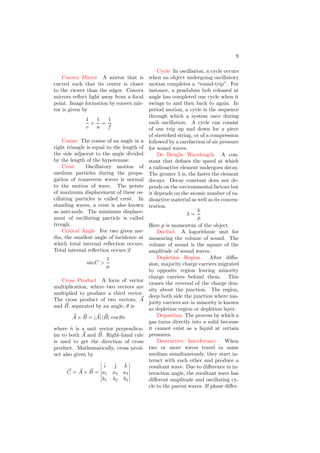
    2 Atom A particleof matter indivisi- ble by chemical means. It is the funda- mental building block of molecules. It consists of a positively charged nucleus and orbiting electrons. The number of electrons is the same as the number of protons in the nucleus. Absolute Zero It is the mini- mum possible temperature of the uni- verse. At absolute temperature, en- ergy (transnational, oscillational, cir- cular and potential) of a particle be- comes purely zero. Absolute zero is 0K or −273◦ C. 100 200 300 100 −100 −200 −300 ◦ C K b −273.15◦ C b 273.15K Acceleration Acceleration deter- mines that how fast motion of a body is changing. It is a vector quantity. Sim- ply acceleration defined as the rate of change of the velocity vector with time. d~ a = d~ v dt Activity Activity of a radioactive material is particle disintegration in one second. Activity does not depend on the environmental conditions. It de- pends on type of material rather than quantity of the material. Alpha Decay A radioactive ele- ment losses its atomic number by 2 and atomic mass by 4 when single parti- cle is emitted then it is said that there is an alpha decay. Alpha decay trans- forms heavy atoms into lighter, more stable element. ZMA → Z−2NA−4 + α Alpha Particle A particle, which consists of two protons, two neutrons and no electrons. It is identical to the nucleus of a helium atom and is ejected by heavy particles undergoing alpha decay. An atom ejects alpha par- ticle losses its atomic number by ‘2’ and mass number by ‘4’. Amplitude Amplitude is the max- imum displacement of the oscillator from its equilibrium position. Ampli- tude tells how far an oscillator is swing- ing back and forth. Energy of oscillat- ing object depends on the amplitude value. Energy-Amplitude relation is E ∝ a2 Angle Of Incidence When a light strikes on semi-transparent surface, separating two different media, it suf- fers partial reflection and partial re- fraction. For reflected ray, medium does not change hence angle of reflec- tion does not change and it is equal to angle of incidence. For refracted ray, medium changes hence angle of refraction is not equal to angle of in- cidence. A line, perpendicular to the inter-medium boundary and passing through the point of strike by incident ray is called normal. The angle of inci- dence is the angle between the incident ray and the normal. Angle Of Reflection The angle be- tween a reflected ray and the line nor- mal to the surface. Angle Of Refraction The angle be- tween a refracted ray and the line nor- mal to the surface. Angular Acceleration A vector quantity, equal to the rate of change of the angular velocity vector with time. It is typically given in units of rad/s2 . Relation between instantaneous linear acceleration (a) and angular accelera- tion (α) is a = rα
  • 3.
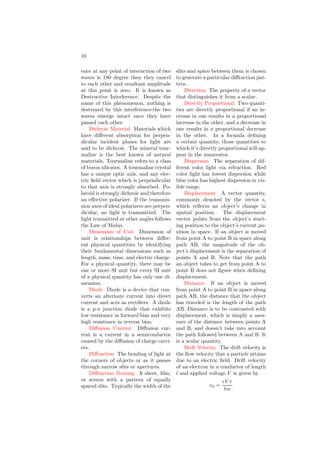
    3 Angular Displacement Thenet change, in a point’s angular position. It is a scalar quantity. Angular Frequency A frequency, f, defined as the number of revolutions a rigid body makes in a given time inter- val. It is a scalar quantity commonly denoted in units of Hertz (Hz) or s−1 . Angular Momentum A vector quantity, L, that is the rotational ana- logue of linear momentum. The angu- lar momentum is the vector product of the body’s moment of inertia, I and its angular velocity ω ~ L = I × ~ ω Angular momentum can also be ex- pressed as vector product of linear mo- mentum, m~ v, its position from the ori- gin, ~ r. ~ L = ~ r × m~ v Angular Period The time, T , re- quired for a rigid body to complete one revolution. Angular period is recipro- cal to the angular frequency. Angular Position Position of a par- ticle in polar coordinate system. In polar coordinate system, there are two angle used as reference for angular po- sition. These two angle are angle of in- clination (θ) and angle of azimuth (φ). Angle of inclination is measured with respect to perpendicular axis and angle of azimuth is measured with respect to x − axis along the horizontal plane. Angular Velocity A vector quan- tity, that reflects the change of angular displacement with time. ω = dφ dt Unit of angular velocity is rad/s. Anti-node & Nodes When two or more waves travel in same medium si- multaneously, they interfere with each other. Waves, not only travel in the medium but they also transport me- chanical energy. This mechanical en- ergy is proportional to the square of the amplitude (I ∝ A2 ). The angle value in wave equation (I = A sin θ), determines the distribution of energy of the wave in 2π range. Energy dis- tribution pattern of all waves is differ- ent to each other due to different val- ues of angle, θ. When these two en- ergy distributions meet at different an- gle (say θ1 and θ2), they suffer inter- ference. Intensity of interfered energy depends on phase angle (φ = θ1 − θ2). If both waves meet at right opposite angle, (φ = π), then resultant inten- sity of two waves is zero. The point, where interference energy is zero, are called nodes. When two waves meet in same angle at a point (φ = 0), resul- tant intensity is maximum. This point of highest energy is called anti-node. Atom Atom is the smallest entity of any matter. It consists protons & neutrons in its nucleus and electrons in its external orbits. Atom is electri- cally neutral as number of protons and electrons are equal. Number of pro- tons in an atom represents its atomic number and sum of masses of all con- stituting particles represents its atomic mass. There may be atoms, who have equal numbers of protons but differ- ent numbers of neutrons. These types of atom are known as isotopes collec- tively. Atoms having atomic number more than 82 are called radioactive atoms and the material is known as ra- dioactive material. Atomic Number A number, Z, as- sociated with the number of protons in the nucleus of an atom. Axis Of Rotation The line that ev- ery particle in the rotating rigid body circles about. Axis of rotation may or may not be inside the object.
  • 4.
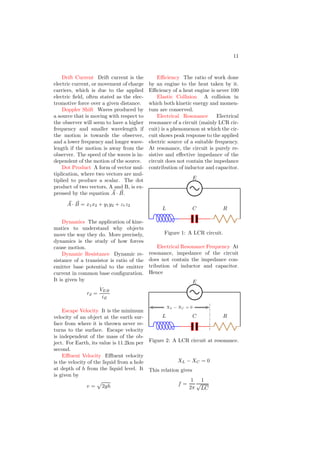
    4 x y ω Barrier Potential Background RadiationThe radia- tion found in the natural environment originating primarily from the natu- rally radioactive elements of Earth and from cosmic rays. The term may also mean radiation extraneous to an ex- periment. Biasing of Diode When a diode is connected with external DC source, then it is known as biasing of the diode. p n V D1 V Big Bang Beginning of the uni- verse; a transition from conditions of unimaginable density and temperature to conditions of lower density and tem- perature. Black-body Radiation Radiation emitted by a blackbody is called black- body radiation. E = σT 4 Black Hole An object so dense that light cannot escape from it. Bernoulli’s Theorem A non- compressible liquid flowing streamline in a pipe of varying area of cross sec- tion. According to the Bernoulli’s the- orem, total energy of liquid at every cross section in the pipe is constant. Flowing water has three types of en- ergies. (i) Pressure energy, (ii) gravi- tational potential energy and (iii) ki- netic energy. Mathematically, for unit volume of liquid P + ρgh + 1 2 ρv2 = C Beats When two waves of slightly different frequencies interfere with one another, they produce a “beating” in- terference pattern that alternates be- tween constructive (in-phase) and de- structive (out-of-phase). Frequency of the beats, f, is equal to the difference in the frequencies of the two interfering waves. f = f1 ∼ f2 Beta Decay A particle, identical to an electron, emits from nucleus of a radioactive atom. The emission of beta particle from a radioactive atom is called beta decay. When beta de- cay occurs, atomic mass of atom does not change but its atomic number is increased by one and atom losses mass slightly. Beta Particle A particle, identi- cal to an electron. Beta particles are ejected from an atom in the process of beta decay. Bohr Atomic Model In 1913, Niels Bohr state that, electrons revolve in fixed orbits called ground state orbits. Energy of electrons in their parental orbit is called ground state energy. Electrons can change their orbits by absorbing or emitting energy. When an electron, absorbs energy, it excited to higher energy state and jumps to higher energy orbit. After 10 nano sec- ond, it emits energy in form of pho- ton and returns to its original orbit (ground state orbit). b b b b b b b b b b b b b b b b b b b b b b b b b b b b b b b b b b b b b b b b b b b b b b b b b b b b b b b b b b b b b b b b b b b b b b b b b b b b b b b b b b b b K L M
  • 5.
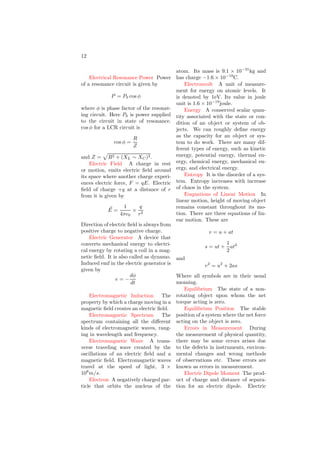
    5 Brewster Angle Fromtransparent intermedium boundaries, at brewster angle of incident, intensity of partially reflected light is zero due to its plane polarisation. The condition for brew- ster angle is tan θB = n2 n1 Where light is entering into medium of coefficient of refractive index n2 from medium of coefficient of refractive in- dex n1. Bohr Radius The Bohr radius is a physical constant, approximately equal to the most probable distance between the proton and electron in a hydrogen atom in its ground state. Its value is 5.291×10⁻¹¹ m. Bohr’s radius formula is a0 = 4πε0~2 mee2 Boiling Point The temperature at which a material will change phase from liquid to gas or gas to liquid. Boyle’s Law It states that at con- stant temperature, volume is directly proportional to the scale of absolute temperature. Mathematically PV = C 1 2 3 1 2 3 P V Bulk Modulus A coefficient (γ) that tells how much the volume of a solid will change when it is compressed. δV = γP Circuit Elements In a circuit their are three types of elements, resistive, inductive and capacitive. These ele- ments forms the impedance of the cir- cuit cumulatively. Capacitor Capacitor is an electri- cal device that can store charge for long time period. Parallel plate capac- itor has capacitance of C = ǫA d Unit of capacitance of the capacitor is “farad”. ǫ is the relative permittivity of the medium inside the capacitor. Capillary Effect When a thin pipe whose diameter is negligible in respect of its length is called capillary. When it is partially immerged into the liq- uid, consequent of the surface tension of liquid, liquid rises inside the capil- lary above its level outside the capil- lary. Height of liquid rises or falls de- pends on the angle of contact and it is given by h = 2T cos θ ρgr Cyclotron Circular accelerator in which the particle is bent in traveling through a magnetic field, and an os- cillating potential difference causes the particles to gain energy. Cyclotron Frequency Frequency at which the electric field is switched in order to accelerate the particles in the cyclotron. The frequency is related to the mass and charge of the particle to be accelerated. Curie (Ci) The original unit used to describe the intensity of radioactiv- ity in a sample of material. One curie equals thirty-seven billion disintegra- tions per second, or approximately the radioactivity of one gram of radium. This unit is no longer recognized as part of the International System of units. It has been replaced by the bec- querel.
  • 6.
    6 Current Mobility Insemiconduc- tors, holes and electrons are the charge carriers and carrier mobility is electron and hole mobility. Current mobility is the consequent of the carrier mobility and is given by i = nAevd and drift velocity, vd is vd = µE. Current Density Current density is the ratio of the current to the area of cross-section of the conducting wire. Its unit is ampere per square meter. J = I A Calorie The amount of heat re- quired to raise the temperature of one gram of water by one degree Cel- sius mainly in the range of 14.5◦ C to 15.5◦ C. One calorie is equal to 4.2 joule. Celsius A scale for measuring temperature, defined such that water freezes at 0◦ C and boils at 100◦ C. One degree Celsius is equal to one Kelvin in absolute temperature scale. Center Of Curvature A spherical mirror is formed by carving out a sec- tion from a spherical shell. The cen- ter of this spherical shell whose part the mirror is called center of curvature, (C). All of the normal pass through it. b b C Center Of Mass In motion, each body is assumed as a point mass but actual it is not a point mass. Veloc- ity, acceleration etc are measured with respect to this point mass. If a body is not a point mass then we assume a point, either inside the body mass or outside the body mass, where whole mass of the finite size body is con- centrated. The velocity and accelera- tion of this point is same as the veloc- ity and acceleration of the whose body then this point is center of mass point. Mathematically, if mass particles, m1, m2, . . ., mn of finite size body of mass M are placed at distances ~ r1, ~ r2, . . ., ~ rn respectively from the origin (0, 0) then the position of center of mass is given by ~ r = m1~ r1 + m2~ r2 + . . . + mn~ rn M Center of mass is synonymous to the center of gravity. Centripetal Acceleration The ac- celeration of a body experiencing uni- form circular motion. This accelera- tion is always directed toward the cen- ter of the circle. At equilibrium, a cen- tripetal force is required to maintain the circular motion of the body. This force on a body mass m, in a uniform circular motion, in a circle of radius r is Fc = m v2 r Comparing it with F = ma, a = v2 /r and it is known as centripetal accel- eration. Centripetal acceleration is not only restricted to circular paths but also measured in elliptical and parabolic paths. Centripetal acceler- ation in elliptic and hyperbolic paths is measured using Kepler’s law for mo- tion of celestial objects. Centripetal Force The force nec- essary to maintain a body in uniform circular motion. This force is always directed radially toward the center of the circle. Mathematically Fc = m v2 r Chain Reaction The particles and energy released by the fission or fusion of one atom may trigger the fission or
  • 7.
    7 fusion of furtheratoms. In a chain reaction, fission or fusion is rapidly transferred to a large number of atoms, releasing tremendous amounts of en- ergy. Charles’s Law For a gas held at constant pressure, temperature and volume are directly proportional. Vp ∝ T 1 1 2 3 T V Color Dispersion The separation of light or other radiation into individual components, usually according to fre- quency and wavelength. When a beam of white light passes through a prism dispersion causes it to separate into the seven colors of the rainbow. Coefficient of Viscosity Viscosity is property of fluid when it is in mo- tion. Two different layers of fluid flow- ing against each other experience a re- tarding force. F = ηA dv dx Where η is the coefficient of viscosity of fluid. Coefficient Of Kinetic Friction Friction is resistance force between two layer under relative motion. The ratio between applied force and normal force to the surfaces is call coefficient of fric- tion. F = µR Here F is applied force, R normal force between two layers and µ is coefficient of friction for the pair of two layers. It is always a number between zero and one. There are three coefficients of fric- tion, (i) coefficient of static friction, (ii) coefficient of terminal friction and (iii) coefficient of kinetic friction. Coefficient of Thermal Expansion A object heated it expands along its dimensions. Change in its dimension is proportional to its initial value and change in temperature. For example δl = αl0 δT Here α is coefficient of thermal expan- sion. Coefficient Of Static Friction The coefficient of static friction, for two ma- terials is the constant of proportional- ity between the normal force and the maximum force of static friction. It is always a number between zero and one. Fs = µsR Coherent Light A coherent light has all associated waves of the same wavelength and phase. To produce two sources of coherent light, they are il- luminated with single source of light. Coherent light is used in the observa- tion of interference in Young’s double slit experiment. Collision When objects collide, each object feels a force for a short amount of time. This force imparts an impulse, or changes the momentum of each of the colliding objects. The mo- mentum of a system is conserved in all kinds of collisions. Kinetic energy is conserved in elastic collisions, but not in plastic collisions. In a perfectly plas- tic collision, the colliding objects stick together after they collide. Coherent Light A light beam that is defined by the individual waves vi- brating in the same phase, but not nec- essarily in the same plane. In order to maintain the same phase relation- ship over long distances, coherent light waves must be monochromatic (have the same wavelength). For example, laser light is highly coherent, almost
  • 8.
    8 monochromatic, and usuallylinearly polarized. Common Base Biasing Common Base Characteristics Common Emitter Biasing Common Emitter Characteristics Common Collector Biasing Common Collector Characteristics Component Any vector can be ex- pressed as the sum of two mutually perpendicular component vectors. For example in two dimensional plane ~ A = xî + yĵ Here î and ĵ are the unit vectors along the x−axis and y−axis. Compression An area of high air pressure that acts as the wave crest for sound waves. The spacing between successive compressions is the wave- length of sound, and the number of successive areas of compression that arrive at the ear per second is the fre- quency, or pitch, of the sound. Concave Lens Concave lens is also called a diverging lens. A diverging lens is thinner in the middle region than the edges. Concave lenses re- fract light away from a focal point and reduce the intensity of light. Image formation by the concave lens is take place according to the relation 1 v − 1 u = 1 f Here u and v are the distances of ob- ject and image from the optical point of the lens. Concave Mirror A mirror that is curved such that its center is farther from the viewer than the edges, such as the front of a spoon. Concave mir- rors reflect light through a focal point. Image formation relation for this mir- ror is 1 v + 1 u = 1 f Conduction There are three ways of heat transfer. Conduction, convenc- tion and radiation. Heat transfer by molecular collisions is called conduc- tion. Conservation of Angular Momen- tum If the net torque acting on a rigid body is zero, then the angular momen- tum of the body is constant or con- served. △L = 0 Conservation Of Momentum The principle stating that for any isolated system, linear momentum is constant with time. In case of collision either elastic or plastic, linear momentum re- mains conserved. Mathematically, for conserve linear momentum mv = k, d dt mv = 0 and for collision m1v1 = m2v2 Constructive Interference The am- plification of one wave by another, identical wave of the same sign. Two constructively interfering waves are said to be on phase. Convection Heat transfer via the mass movement of molecules. Gasses and liquids transfer heat by this method. Convex Lens It is also called con- verging lens. A lens is thicker in the middle than at the edges. Con- vex lenses refract light through a focal point. The image formed by convex lens is real except that if object is not placed between optical point and focal point of the convex lens. Converging lenses are used to intensify the distant objects and curing of distant vision of defected eye. Image formation by con- vex lens is 1 v − 1 u = 1 f
  • 9.
    9 Convex Mirror Amirror that is curved such that its center is closer to the viewer than the edges. Convex mirrors reflect light away from a focal point. Image formation by convex mir- ror is given by 1 v + 1 u = 1 f Cosine The cosine of an angle in a right triangle is equal to the length of the side adjacent to the angle divided by the length of the hypotenuse. Crest Oscillatory motion of medium particles during the propa- gation of transverse waves is normal to the motion of wave. The points of maximum displacement of these os- cillating particles is called crest. In standing waves, a crest is also known as anti-node. The minimum displace- ment of oscillating particle is called trough. Critical Angle For two given me- dia, the smallest angle of incidence at which total internal reflection occurs. Total internal reflection occurs if sin C > 1 µ Cross Product A form of vector multiplication, where two vectors are multiplied to produce a third vector. The cross product of two vectors, ~ A and ~ B, separated by an angle, θ is ~ A × ~ B = | ~ A| | ~ B| cos θn̂ where n̂ is a unit vector perpendicu- lar to both ~ A and ~ B. Right-hand rule is used to get the direction of cross product. Mathematically, cross prod- uct also given by ~ C = ~ A × ~ B =
  • 15.
    î ĵ k̂ a1a2 a3 b1 b2 b3
  • 21.
    Cycle In oscillation,a cycle occurs when an object undergoing oscillatory motion completes a “round-trip”. For instance, a pendulum bob released at angle has completed one cycle when it swings to and then back to again. In period motion, a cycle is the sequence through which a system once during each oscillation. A cycle can consist of one trip up and down for a piece of stretched string, or of a compression followed by a rarefaction of air pressure for sound waves. De Broglie Wavelength A con- stant that defines the speed at which a radioactive element undergoes decay. The greater λ is, the faster the element decays. Decay constant does not de- pends on the environmental factors but it depends on the atomic number of ra- dioactive material as well as its concen- tration. λ = h p Here p is momentun of the object. Decibel A logorithmic unit for measuring the volume of sound. The volume of sound is the square of the amplitude of sound waves. Depletion Region After diffu- sion, majority charge carriers migrated to opposite region leaving minority charge carriers behind them. This causes the reversal of the charge den- sity about the junction. The region, deep both side the junction where ma- jority carriers are in minority is known as depletion region or depletion layer. Deposition The process by which a gas turns directly into a solid because it cannot exist as a liquid at certain pressures. Destructive Interference When two or more waves travel in same medium simultaneously, they start in- teract with each other and produce a resultant wave. Due to difference in in- teraction angle, the resultant wave has different amplitude and oscillating cy- cle to the parent waves. If phase differ-
  • 22.
    10 ence at anypoint of interaction of two waves is 180 degree then they cancel to each other and resultant amplitude at this point is zero. It is known as Destructive Interference. Despite the name of this phenomenon, nothing is destroyed by this interference-the two waves emerge intact once they have passed each other. Dichroic Material Materials which have different absorption for perpen- dicular incident planes for light are said to be dichroic. The mineral tour- maline is the best known of natural materials. Tourmaline refers to a class of boron silicates. A tourmaline crystal has a unique optic axis, and any elec- tric field vector which is perpendicular to that axis is strongly absorbed. Po- laroid is strongly dichroic and therefore an effective polarizer. If the transmis- sion axes of ideal polarizers are perpen- dicular, no light is transmitted. The light tranmitted at other angles follows the Law of Malus. Dimension of Unit Dimension of unit is relationships between differ- ent physical quantities by identifying their fundamental dimensions such as length, mass, time, and electric charge. For a physical quantity, there may be one or more SI unit but every SI unit of a physical quantity has only one di- mension. Diode Diode is a device that con- verts an alternate current into direct current and acts as rectifiers. A diode is a p-n junction diode that exhibits low resistance in forward bias and very high resistance in reverse bias. Diffusion Current Diffusion cur- rent is a current in a semiconductor caused by the diffusion of charge carri- ers. Diffraction The bending of light at the corners of objects or as it passes through narrow slits or apertures. Diffraction Grating A sheet, film, or screen with a pattern of equally spaced slits. Typically the width of the slits and space between them is chosen to generate a particular diffraction pat- tern. Direction The property of a vector that distinguishes it from a scalar. Directly Proportional Two quanti- ties are directly proportional if an in- crease in one results in a proportional increase in the other, and a decrease in one results in a proportional decrease in the other. In a formula defining a certain quantity, those quantities to which it’s directly proportional will ap- pear in the numerator. Dispersion The separation of dif- ferent color light via refraction. Red color light has lowest dispersion while blue color has highest dispersion in vis- ible range. Displacement A vector quantity, commonly denoted by the vector s, which reflects an object’s change in spatial position. The displacement vector points from the object’s start- ing position to the object’s current po- sition in space. If an object is moved from point A to point B in space along path AB, the magnitude of the ob- ject’s displacement is the separation of points A and B. Note that the path an object takes to get from point A to point B does not figure when defining displacement. Distance If an object is moved from point A to point B in space along path AB, the distance that the object has traveled is the length of the path AB. Distance is to be contrasted with displacement, which is simply a mea- sure of the distance between points A and B, and doesn’t take into account the path followed between A and B. It is a scalar quantity. Drift Velocity The drift velocity is the flow velocity that a particle attains due to an electric field. Drift velocity of an electron in a conductor of length l and applied voltage V is given by vd = eV τ lm
  • 23.
    11 Drift Current Driftcurrent is the electric current, or movement of charge carriers, which is due to the applied electric field, often stated as the elec- tromotive force over a given distance. Doppler Shift Waves produced by a source that is moving with respect to the observer will seem to have a higher frequency and smaller wavelength if the motion is towards the observer, and a lower frequency and longer wave- length if the motion is away from the observer. The speed of the waves is in- dependent of the motion of the source. Dot Product A form of vector mul- tiplication, where two vectors are mul- tiplied to produce a scalar. The dot product of two vectors, A and B, is ex- pressed by the equation ~ A · ~ B. ~ A · ~ B = x1x2 + y1y2 + z1z2 Dynamics The application of kine- matics to understand why objects move the way they do. More precisely, dynamics is the study of how forces cause motion. Dynamic Resistance Dynamic re- sistance of a transistor is ratio of the emitter base potential to the emitter current in common base configuration. It is given by rd = VEB iE Escape Velocity It is the minimum velocity of an object at the earth sur- face from where it is thrown never re- turns to the surface. Escape velocity is independent of the mass of the ob- ject. For Earth, its value is 11.2km per second. Effluent Velocity Effluent velocity is the velocity of the liquid from a hole at depth of h from the liquid level. It is given by v = p 2gh Efficiency The ratio of work done by an engine to the heat taken by it. Efficiency of a heat engine is never 100 Elastic Collision A collision in which both kinetic energy and momen- tum are conserved. Electrical Resonance Electrical resonance of a circuit (mainly LCR cir- cuit) is a phenomenon at which the cir- cuit shows peak response to the applied electric source of a suitable frequency. At resonance, the circuit is purely re- sistive and effective impedance of the circuit does not contain the impedance contribution of inductor and capacitor. E L C R Figure 1: A LCR circuit. Electrical Resonance Frequency At resonance, impedance of the circuit does not contain the impedance con- tribution of inductor and capacitor. Hence E L C R XL − XC = 0 Figure 2: A LCR circuit at resonance. XL − XC = 0 This relation gives f = 1 2π 1 √ LC
  • 24.
    12 Electrical Resonance PowerPower of a resonance circuit is given by P = P0 cos φ where φ is phase factor of the resonat- ing circuit. Here P0 is power supplied to the circuit in state of resonance. cos φ for a LCR circuit is cos φ = R Z and Z = p R2 + (XL ∼ XC)2. Electric Field A charge in rest or motion, emits electric field around its space where another charge experi- ences electric force, F = qE. Electric field of charge +q at a distance of r from it is given by ~ E = 1 4πǫ0 × q r2 Direction of electric field is always from positive charge to negative charge. Electric Generator A device that converts mechanical energy to electri- cal energy by rotating a coil in a mag- netic field. It is also called as dynamo. Induced emf in the electric generator is given by e = − dφ dt Electromagnetic Induction The property by which a charge moving in a magnetic field creates an electric field. Electromagnetic Spectrum The spectrum containing all the different kinds of electromagnetic waves, rang- ing in wavelength and frequency. Electromagnetic Wave A trans- verse traveling wave created by the oscillations of an electric field and a magnetic field. Electromagnetic waves travel at the speed of light, 3 × 10⁸ m/s. Electron A negatively charged par- ticle that orbits the nucleus of the atom. Its mass is 9.1 × 10⁻³¹ kg and has charge −1.6 × 10⁻¹⁹ C. Electronvolt A unit of measure- ment for energy on atomic levels. It is denoted by 1eV. Its value in joule unit is 1.6 × 10⁻¹⁹ joule. Energy A conserved scalar quan- tity associated with the state or con- dition of an object or system of ob- jects. We can roughly define energy as the capacity for an object or sys- tem to do work. There are many dif- ferent types of energy, such as kinetic energy, potential energy, thermal en- ergy, chemical energy, mechanical en- ergy, and electrical energy. Entropy It is the disorder of a sys- tem. Entropy increases with increase of chaos in the system. Euquations of Linear Motion In linear motion, height of moving object remains constant throughout its mo- tion. There are three equations of lin- ear motion. These are v = u + at s = ut + 1 2 at2 and v2 = u2 + 2as Where all symbols are in their usual meaning. Equilibrium The state of a non- rotating object upon whom the net torque acting is zero. Equilibrium Position The stable position of a system where the net force acting on the object is zero. Errors in Measurement During the measurement of physical quantity, there may be some errors arises due to the defects in instruments, environ- mental changes and wrong methods of observations etc. These errors are known as errors in measurement. Electric Dipole Moment The prod- uct of charge and distance of separa- tion for an electric dipole. Electric
  • 25.
    13 dipole moment ofan electric dipole is given by p = q × 2l Where q is magnitude of any of the two charges of the dipole and 2l is length of axis. Electromagnetic Radiation Radia- tion consisting of electric and magnetic fields that travel at the speed of light. Excited State The state of an atom or nucleus when it possesses more than its normal energy. Typically, the ex- cess energy is released as a gamma ray. Extrinsic Semiconductor Pure semiconductor is insulator at room temperature and conductor to certain degree when temperature rises. To made it conductor, external impurities are added into it. This semiconductor is known as extrinsic semiconductor. Fermion A particle having a spin that is an odd integer multiple of ℏ/2. Fictive Temperature We know that the density of a substance changes/fluctuates with change in the temperature of the substance. Fictive temperature represents to the temper- ature at which the density fluctuations are “frozen” in the material. Faraday’s Electro-magnetic Law Faraday’s electromagnetic law states that (a) there is an induced electro- motive force (emf) if there is relative motion between coil and magnet. (b) The induced emf (e) is rate of change of linked flux (φ) through the coil, ie e = − d dt φ F Faraday’s constant. Its nu- merical value is 96000 coulomb (F). If one coulomb charge is passed through a electrolyte solution having mono- valent ions then at electrode one mole of the ionic substance is deposited. To deposit one mole material of valancy n, charge required is nF. First Law Of Thermodynamics Es- sentially a restatement of energy con- servation, it states that the change in the internal energy of a system is equal to the heat added plus the work done on the system., Mathematically Q = U + W Focal Length The distance be- tween the focal point and the vertex of a mirror or lens. For concave mirrors and convex lenses, this number is pos- itive. For convex mirrors and concave lenses, this number is negative. Focal Point The point of a mir- ror or lens where all light that runs parallel to the principal axis will be focused. Concave mirrors and convex lenses are designed to focus light into the focal point. Convex mirrors and concave lenses focus light away from the focal point. Force A push or a pull that causes an object to accelerate. Mass acceler- ation relation for force is given by F = m × a Forward Biasing In forward bias- ing, p-region of the diode is connected with positive terminal of DC source and n-region is connected with nega- tive terminal. In forward biasing, the deplation region is narrowed and junc- tion offers negligible resistance. p n V D1 V Forward Current Characteristics Forward biasing characteristic is the graphical relation between forward po- tential and forward current. In forward biasing, depletion region is shortened and there is normal forward current.
  • 26.
    14 V I bc Vknee When forward potentialis in- creased, the forward current is in- creases at first and then remains con- stant. This constant current is known as saturation current. Free-body Diagram Free body di- agram illustrates all the forces acting on an object. These forces are drawn as vectors originating from the center of the object. Frequency It is the number of cy- cles executed by a system in one sec- ond. Frequency (f) is inverse of the pe- riod, T . In terms of angular frequency, ω = 2πf. Frictional Force A force caused by the roughness of two materials in contact, deformations in the materials, and a molecular attraction between the materials. Frictional forces are always parallel to the plane of contact between two surfaces and opposite the direc- tion that the object is being pushed or pulled. Fundamental The standing wave with the lowest frequency that is sup- ported by a string with both ends tied down is called the fundamental, or res- onance, of the string. The wavelength of the fundamental is twice the length of the string. Gain (Transistor) Gravity Gravity is phenomenon of force of attraction between two masses. For example, a ball fall from the height on the surface of the earth is phe- nomenon of gravity. The gravitational force, consequent of gravity acts along the central axes of the mass. Gravitational Field Gravitational field of a heavy mass, M, at distance of r from the center of heavy mass is the strength of gravity by which it at- tracts to unit mass placed at distant r. For earth it is denoted by g and math- ematically given by g = G M r2 Gravitational Potential Gravita- tional potential of a heavy mass, M, placed at point of distance r from the center of the heavy mass, is the work done on unit mass when it is brought from infinity to that point. Mathemat- ically given by V = G M r Graded Index Fiber In some types of optical fiber refractive index is made of vary as a function of the radial dis- tance from the center of the fiber. Gamma Decay A form of radioac- tivity where an excited atom releases a photon of gamma radiation, thereby returning to a lower energy state. The atomic structure itself does not change in the course of gamma radiation. Gamma Ray An electromagnetic wave of very high frequency. The pen- etration power of gamma rays is largest among all the radiation waves emitted in radioactive decays. Gold Foil Experiment Gold foil ex- periment was carried out by Ernest Rutherford popularly known as alpha particle scattering. This experiment proved for the first time that atoms have nuclei. Gravitational Constant The con- stant of proportionality in Newton’s Law of Gravitation. It reflects the pro- portion of the gravitational force and the product of two particles’ masses di-
  • 27.
    15 vided by thesquare of the bodies’ sep- aration. F = G mM r2 Gravitational Potential Energy The energy associated with the con- figuration of bodies attracted to each other by the gravitational force. It is a measure of the amount of work neces- sary to get the two bodies from a cho- sen point of reference to their present position. This point of reference is usu- ally chosen to be a point of infinite dis- tance, giving the equation. Objects of mass m that is at a height of h above the surface of the earth have a gravita- tional potential energy, mgh. Ground State In the Bohr model of the atom, the state in which an elec- tron has the least energy and orbits closest to the nucleus. Half-life The amount of time it takes for one-half of a radioactive sam- ple to decay. t1/2 = 0.693 k Or N = N0 1 2 n Where n is number of half years. Harmonic Series The series of standing waves supported by a string with both ends tied down. The first member of the series, called the fun- damental, has two nodes at the ends and one anti-node in the middle. The higher harmonics are generated by placing an integral number of nodes at even intervals over the length of the string. The harmonic series is very im- portant in music. Heat A transfer of thermal energy. We don’t speak about systems having heat, but about their transferring heat, much in the way that dynamical sys- tems don’t have work, but rather for work. Heat Engine A machine that oper- ates by taking heat from a hot place, doing some work with that heat, and then exhausting the rest of the heat into a cool place. The internal com- bustion engine of a car is an example of a heat engine. Heat Transfer A transfer of ther- mal energy from one system to an- other. There are three methods of heat transfer. (i) conduction, (ii) convec- tion and (iii) radiation. In heat trans- fer, conduction and convection requires medium while radiation does not re- quire medium for heat transfer. Hertz (Hz) It is unit of frequency. Its dimension is the inverse of the time. Holes Holes are the majority charge carriers in p-type extrinsic semiconductor. The motion of holes is opposite to the direction of electric field. In semiconductor, holes behave like proton and its equivalent charge is equal to the magnitude of the charge of electron. Hooke’s Law For an oscillating spring, the restoring force exerted by the spring is directly proportional to the displacement. F ∝ −x That is, the more the spring is dis- placed, the stronger the force that will pull toward the equilibrium position. The applied fource should be within elastic limits of the spring otherwise spring will be set to the permanent ex- tension. Hypotenuse The longest side of a right triangle, opposite to the right an- gle. Hypotenuse (h) is related with base (b) and height (l) as h2 = l2 + b2 Hydrogen Spectrum Hydrogen spectrum is series of electromagnetic
  • 28.
    16 waves emitted orabsorbed by an elec- tron undergoing energy level transi- tions. The wavelength of emitted or absorbed electromagnetic wave is given by 1 λ = Z2 R 1 n2 1 − 1 n2 2 Where Z is atomic number of atom. There are many spectrum series ac- cording to the level of transitions. First five series are the most promi- nent and they are named as Lyman, Balmer, Paschen, Bracket and Funds. Ideal Gas Law A gas law from which the volume of gas becomes zero when temperature is zero kelvin at con- stant pressure. It is PV = µRT Impulse A vector quantity defined as the product of the force acting on a body multiplied by the time interval over which the force is exerted. I = F × t Incident Ray When dealing with reflection or refraction, the incident ray is the ray of light before it strikes the reflecting or refracting surface. Inclined Plane A wedge or a slide. The dynamics of objects sliding down inclined planes is a popular topic on SAT II Physics. Index Of Refraction Index of re- fraction of medium B, in respect of medium A is the ratio of the veloci- ties of light in medium A to medium B. AnB = velocity of light in medium A velocity of light in medium B Intrinsic Semiconductor A semi- conductor material is insulator in its purest form at room temperature. Its conductivity increases with increase of the temperature. This type of conduc- tive semiconductors are known as in- trinsic semiconductor. Inductor Inductor is a coil with or without metallic core. Inductors offer impedance to their circuits due to their inductive properties. Inductance of in- ductors depends on the varying mag- netic flux. This is why inductors do not offer impedance to the circuit in direct current. Induced Current The current in- duced in a circuit by a change in mag- netic flux. Induced current is given by I × Z = − d dt φ Here Z is impedance of the circuit. Inelastic Collision A collision in which momentum is conserved but ki- netic energy is not. Inertia The tendency of an object to remain at a constant velocity, or its resistance to being accelerated. New- ton’s First Law is alternatively called the Law of Inertia because it describes this tendency. Inertia of an object is given by I = Z dm x2 Where dm is mass of the element at distance x from the axis of rotation. Inertial Reference Frame A refer- ence frame in which Newton’s First Law is true. Two inertial reference frames move at a constant velocity rel- ative to one another. According to the first postulate of Einstein’s theory of special relativity, the laws of physics are the same in all inertial reference frames. Instantaneous Velocity Instanta- neous velocity of an object is the ve- locity at any given instant in time. In contrast to it average velocity is a mea- sure of the change in displacement over a given time interval. Internal Energy The energy stored in a thermodynamic system. Internal
  • 29.
    17 energy mainly dependson the temper- ature of the system. It is given by dQ = dU + dW Where dU is change in internal energy due to change of small charge dQ. Inversely Proportional Two quan- tities are inversely proportional if an increase in one results in a proportional decrease in the other, and a decrease in one results in a proportional increase in the other. In a formula defining a cer- tain quantity, those quantities to which it’s inversely proportional will appear in the denominator. Islanding Islanding refers to the condition in which a distributed gen- erator continues to power a location even though electrical grid power from the electric utility is no longer present. Islanding can be dangerous to utility workers, who may not realize that a circuit is still powered, and it may prevent automatic re-connection of de- vices. For that reason, distributed gen- erators must detect islanding and im- mediately stop producing power; this is referred to as anti-islanding. Isolated System A system that no external net force acts upon. Objects within the system may exert forces upon one another, but they cannot re- ceive any impulse from outside forces. Momentum is conserved in isolated systems. Isotope Atoms of the same el- ement may have different numbers of neutrons and therefore different masses. Atoms of the same element but with different numbers of neutrons are called isotopes of the same ele- ment. Joule The joule (J) is the unit of work and energy. One calorie is equal to 4.2 Joule. Kelvin A scale for measuring tem- perature, defined such that 0K is the lowest theoretical temperature a ma- terial can have. Kepler’s First Law The path of each planet around the sun is an ellipse with the sun at one focus. Kepler’s Second Law If a line is drawn from the sun to the planet, then the area swept out by this line in a given time interval is constant. Kepler’s Third Law According this law, the square of the orbital time period is directly proportional to the cube of the semi-major axis of the or- bit of revolving planet. T 2 ∝ a3 Kinematic Equations The five equations used to solve problems in kinematics in one dimension with uni- form acceleration. Kinematics Kinematics is the study and description of the motion of objects. Kinetic Energy Energy associated with the state of motion. The trans- lational kinetic energy of an object is given by the equation KE = 1 2 mv2 Kinetic Friction The force between two surfaces moving relative to one an- other. The frictional force is parallel to the plane of contact between the two objects and in the opposite direction of the sliding object’s motion. If nor- mal force between the two surfaces is F then friction force Ff is given by Ff = µkF Here µk is coefficient of kinetic fric- tion. Kinetic Theory Of Gases A rough approximation of how gases work, that is quite accurate in everyday condi- tions. According to the kinetic the- ory, gases are made up of tiny, round molecules that move about in accor- dance with Newton’s Laws, and col- lide with one another and other objects
  • 30.
    18 elastically. We canderive the ideal gas law from the kinetic theory. Laminar Flow Laminar flow (or streamline flow) occurs when a fluid flows in parallel layers, with no disrup- tion between the layers. At low veloci- ties, the fluid tends to flow without lat- eral mixing, and adjacent layers slide past one another like playing cards. Latent Heat Of Fusion The amount of heat necessary to transform a solid at a given temperature into a liquid of the same temperature, or the amount of heat needed to be removed from a liquid of a given temperature to transform it into a solid of the same temperature. It is Hf = m × l Where l latent headt of fusion. Latent Heat Of Sublimation The amount of heat necessary for a mate- rial undergoing sublimation to make a phase change from gas to solid or solid to gas, without a change in tempera- ture. Latent Heat Of Transformation The amount heat necessary to cause a substance to undergo a phase tran- sition. Latent Heat Of Vaporisation The amount of heat necessary to transform a liquid at a given temperature into a gas of the same temperature, or the amount of heat needed to be taken away from a gas of a given tempera- ture to transform it into a liquid of the same temperature. Hv = m × l Where l latent heat of vaporisation. Law of Floatation An object will float or not depends on the weights of object (wo) and medium (wm). If wo wm then object will float par- tially at the surface of the mdium. If wo = wm then object may float at any layer of the medium. And if wo wm then object will settle down at the bot- tom of the container of the medium. Law Of Conservation Of Energy Energy cannot be made or destroyed. Energy can only be changed from one place to another or from one form to another. According the law of conser- vation of energy for vertical plane mo- tion of an object of mass m under the gravitational field at any given height, h 1 2 mv2 = mgh Here v is instantaneous velocity of the object at height h. Law Of Reflection For a reflected light ray. In other words, a ray of light reflects of a surface in the same plane as the incident ray and the normal, and at an angle to the normal that is equal to the angle between the incident ray and the normal. Legs The two shorter sides of a right triangle that meet at the right angle. Lenz’s Law States that the cur- rent induced in a circuit by a change in magnetic flux is in the direction that will oppose that change in flux. Using the right-hand rule, point your thumb in the opposite direction of the change in magnetic flux. The direction your fingers curl into a fist indicates the di- rection of the current. Linear Velocity An object moving in linear path is said to be in linear mo- tion and its velocity at any instant of time is knwon as linear velocity. It is given by v = dx dt Linear Acceleration Linear acceler- ation of the object is the rate of change of velocity at any instant of time. a = dv dt