ANSWERS

      Question 1

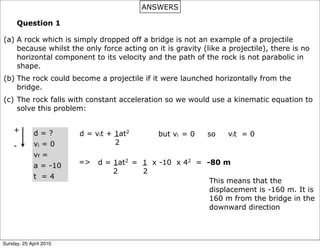
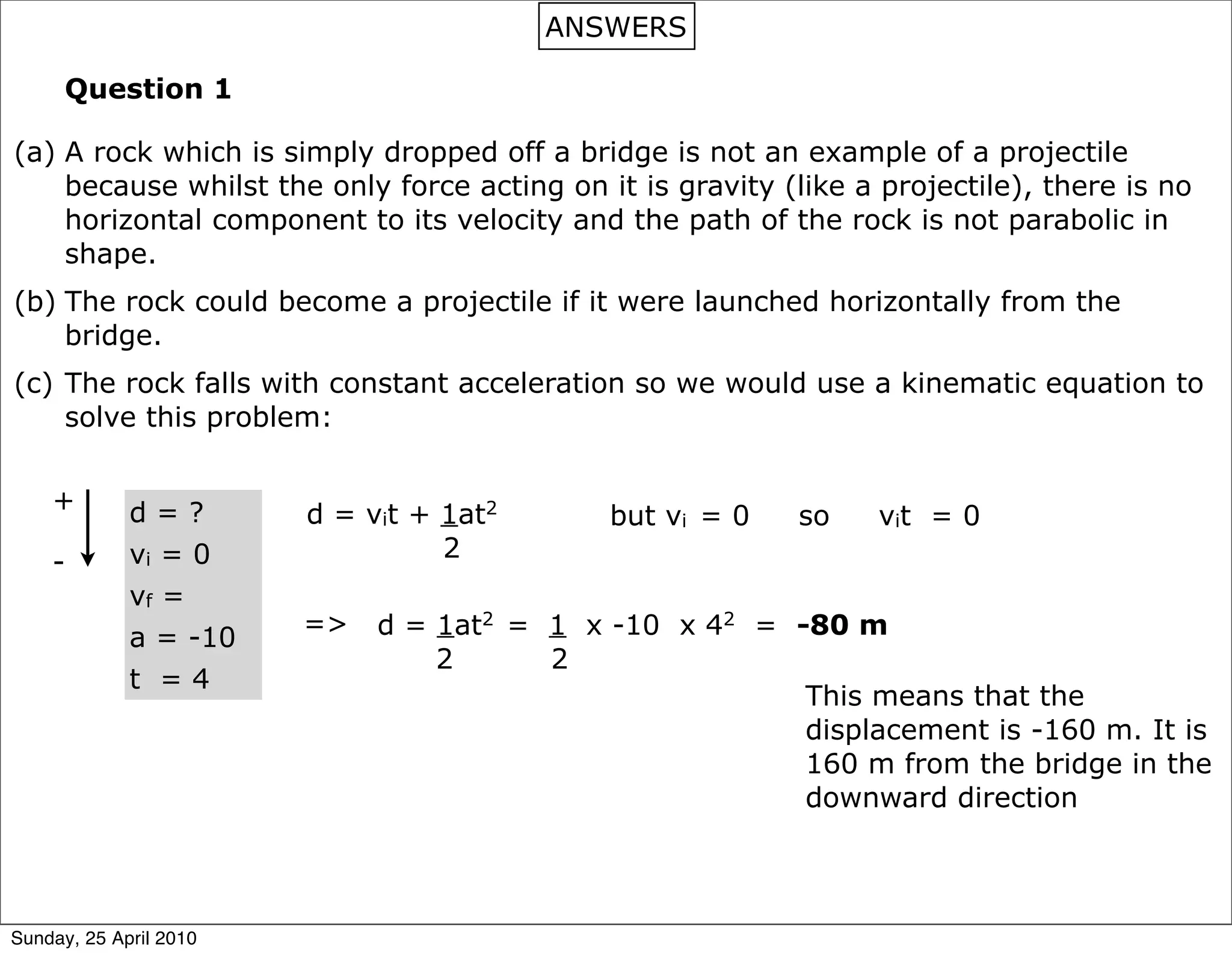
(a) A rock which is simply dropped off a bridge is not an example of a projectile
    because whilst the only force acting on it is gravity (like a projectile), there is no
    horizontal component to its velocity and the path of the rock is not parabolic in
    shape.
(b) The rock could become a projectile if it were launched horizontally from the
    bridge.
(c) The rock falls with constant acceleration so we would use a kinematic equation to
    solve this problem:


    +        d=?        d = vit + 1at2       but vi = 0    so     vit = 0
             vi = 0               2
    -
             vf =
                        =>   d = 1at2 = 1 x -10 x 42 = -80 m
             a = -10
                                 2      2
             t =4
                                                        This means that the
                                                        displacement is -160 m. It is
                                                        160 m from the bridge in the
                                                        downward direction


Sunday, 25 April 2010
(d) The rock is now a projectile so we need to accept that there is also now a
    horizontal component to its velocity. The horizontal component is independent of
    the vertical component which means that even though the rock is travelling
    horizontally this does not change the rate at which it is falling vertically so the rock
    will still take 4 s to reach the water.

(e) Very simple solution:             d = v.t = 6 x 4 = 24 m


      Question 2


(a)                                                   (b)

                            10 ms-2

                                                                      20 N   20 N
                   a              10 ms-2
                                                                                    20 N
                        10 ms-2             10 ms-2            20 N


                                                            Fw = mg = 2 x 10 = 20 N


Sunday, 25 April 2010
Question 3

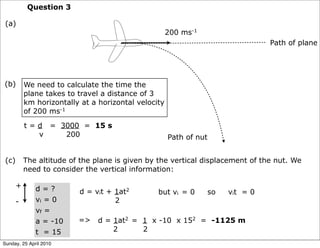
 (a)
                                                      200 ms-1
                                                                                   Path of plane


(b)        We need to calculate the time the
           plane takes to travel a distance of 3
           km horizontally at a horizontal velocity
           of 200 ms-1

           t = d = 3000 = 15 s
               v    200                               Path of nut


 (c)       The altitude of the plane is given by the vertical displacement of the nut. We
           need to consider the vertical information:

       +      d=?         d = vit + 1at2         but vi = 0         so   vit = 0
       -      vi = 0                2
              vf =
              a = -10     =>    d = 1at2 = 1 x -10 x 152 = -1125 m
              t = 15                2      2
Sunday, 25 April 2010
Question 4
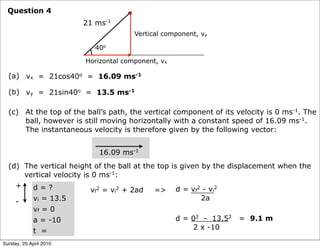
                        21 ms-1
                                      Vertical component, vy

                           40o

                        Horizontal component, vx

  (a) vx = 21cos40o = 16.09 ms-1

  (b) vy = 21sin40o = 13.5 ms-1

  (c) At the top of the ball’s path, the vertical component of its velocity is 0 ms-1. The
      ball, however is still moving horizontally with a constant speed of 16.09 ms-1.
      The instantaneous velocity is therefore given by the following vector:


                            16.09 ms-1
  (d) The vertical height of the ball at the top is given by the displacement when the
      vertical velocity is 0 ms-1:
    +   d=?               vf2 = vi2 + 2ad   => d = vf2 - vi2
        vi = 13.5                                         2a
    -
        vf = 0
        a = -10                                    d = 02 - 13.52 = 9.1 m
                                                        2 x -10
        t =
Sunday, 25 April 2010
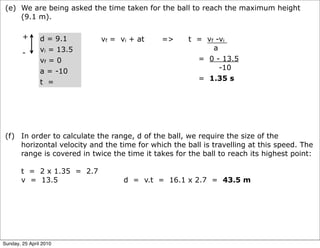
(e) We are being asked the time taken for the ball to reach the maximum height
     (9.1 m).

        +       d = 9.1     vf = vi + at     =>      t = vf -vi
                vi = 13.5                                  a
        -
                vf = 0                                 = 0 - 13.5
                                                             -10
                a = -10
                                                       = 1.35 s
                t =


 (f) In order to calculate the range, d of the ball, we require the size of the
     horizontal velocity and the time for which the ball is travelling at this speed. The
     range is covered in twice the time it takes for the ball to reach its highest point:

       t = 2 x 1.35 = 2.7
       v = 13.5                   d = v.t = 16.1 x 2.7 = 43.5 m


Sunday, 25 April 2010
Question 5


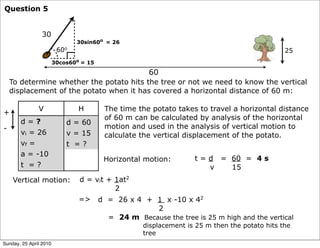
                 30
                               30sin60o = 26
                         60o                                                                 25
                        30cos60o = 15

                                                    60
    To determine whether the potato hits the tree or not we need to know the vertical
    displacement of the potato when it has covered a horizontal distance of 60 m:

               V                H       The time the potato takes to travel a horizontal distance
+
                                        of 60 m can be calculated by analysis of the horizontal
       d=?                  d = 60
-                                       motion and used in the analysis of vertical motion to
       vi = 26              v = 15      calculate the vertical displacement of the potato.
       vf =                 t =?
       a = -10
                                        Horizontal motion:       t = d = 60 = 4 s
       t =?                                                          v   15
    Vertical motion:            d = vit + 1at2
                                          2
                                => d = 26 x 4 + 1 x -10 x 42
                                                   2
                                        = 24 m Because the tree is 25 m high and the vertical
                                                  displacement is 25 m then the potato hits the
                                                  tree
Sunday, 25 April 2010
Question 6

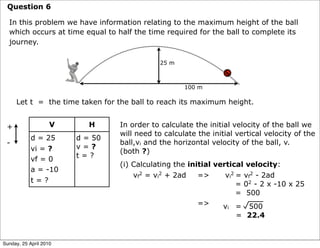
  In this problem we have information relating to the maximum height of the ball
  which occurs at time equal to half the time required for the ball to complete its
  journey.

                                             25 m


                                                    100 m

     Let t = the time taken for the ball to reach its maximum height.


 +                  V      H     In order to calculate the initial velocity of the ball we
                                 will need to calculate the initial vertical velocity of the
            d = 25      d = 50
 -                               ball,vi and the horizontal velocity of the ball, v.
            vi = ?      v=?
                                 (both ?)
                        t=?
            vf = 0
                                 (i) Calculating the initial vertical velocity:
            a = -10
                                     vf2 = vi2 + 2ad    =>      vi2 = vf2 - 2ad
            t=?
                                                                    = 02 - 2 x -10 x 25
                                                                    = 500
                                                        =>     v = 500
                                                                 i
                                                                     = 22.4


Sunday, 25 April 2010
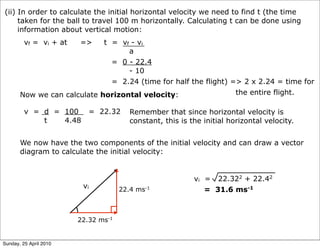
(ii) In order to calculate the initial horizontal velocity we need to find t (the time
     taken for the ball to travel 100 m horizontally. Calculating t can be done using
     information about vertical motion:
         vf = vi + at   =>   t = vf - vi
                                   a
                               = 0 - 22.4
                                   - 10
                               = 2.24 (time for half the flight) => 2 x 2.24 = time for
       Now we can calculate horizontal velocity:                  the entire flight.

         v = d = 100       = 22.32      Remember that since horizontal velocity is
             t   4.48                   constant, this is the initial horizontal velocity.


       We now have the two components of the initial velocity and can draw a vector
       diagram to calculate the initial velocity:


                                                           vi = 22.322 + 22.42
                         vi          22.4 ms-1                = 31.6 ms-1


                        22.32 ms-1


Sunday, 25 April 2010
Question 7
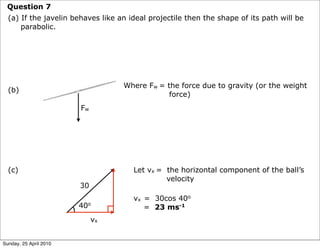
  (a) If the javelin behaves like an ideal projectile then the shape of its path will be
      parabolic.


                                   Where Fw = the force due to gravity (or the weight
  (b)
                                               force)
                        Fw


  (c)                                 Let vx = the horizontal component of the ball’s
                                               velocity
                        30
                                      vx = 30cos 40o
                        40o              = 23 ms-1
                             vx


Sunday, 25 April 2010
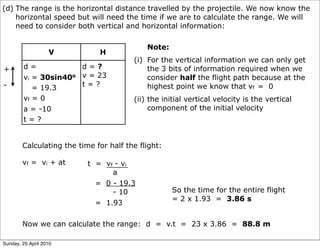
(d) The range is the horizontal distance travelled by the projectile. We now know the
    horizontal speed but will need the time if we are to calculate the range. We will
    need to consider both vertical and horizontal information:

                                            Note:
                   V          H
                                        (i) For the vertical information we can only get
+       d=            d=?                   the 3 bits of information required when we
        vi = 30sin40o v = 23                consider half the flight path because at the
-                     t=?                   highest point we know that vf = 0
           = 19.3
        vf = 0                          (ii) the initial vertical velocity is the vertical
        a = -10                              component of the initial velocity
        t=?


        Calculating the time for half the flight:

        vf = vi + at       t = vf - vi
                                 a
                             = 0 - 19.3
                                 - 10               So the time for the entire flight
                                                    = 2 x 1.93 = 3.86 s
                             = 1.93

        Now we can calculate the range: d = v.t = 23 x 3.86 = 88.8 m

Sunday, 25 April 2010

Projectiles

  • 1.
    ANSWERS Question 1 (a) A rock which is simply dropped off a bridge is not an example of a projectile because whilst the only force acting on it is gravity (like a projectile), there is no horizontal component to its velocity and the path of the rock is not parabolic in shape. (b) The rock could become a projectile if it were launched horizontally from the bridge. (c) The rock falls with constant acceleration so we would use a kinematic equation to solve this problem: + d=? d = vit + 1at2 but vi = 0 so vit = 0 vi = 0 2 - vf = => d = 1at2 = 1 x -10 x 42 = -80 m a = -10 2 2 t =4 This means that the displacement is -160 m. It is 160 m from the bridge in the downward direction Sunday, 25 April 2010
  • 2.
    (d) The rockis now a projectile so we need to accept that there is also now a horizontal component to its velocity. The horizontal component is independent of the vertical component which means that even though the rock is travelling horizontally this does not change the rate at which it is falling vertically so the rock will still take 4 s to reach the water. (e) Very simple solution: d = v.t = 6 x 4 = 24 m Question 2 (a) (b) 10 ms-2 20 N 20 N a 10 ms-2 20 N 10 ms-2 10 ms-2 20 N Fw = mg = 2 x 10 = 20 N Sunday, 25 April 2010
  • 3.
    Question 3 (a) 200 ms-1 Path of plane (b) We need to calculate the time the plane takes to travel a distance of 3 km horizontally at a horizontal velocity of 200 ms-1 t = d = 3000 = 15 s v 200 Path of nut (c) The altitude of the plane is given by the vertical displacement of the nut. We need to consider the vertical information: + d=? d = vit + 1at2 but vi = 0 so vit = 0 - vi = 0 2 vf = a = -10 => d = 1at2 = 1 x -10 x 152 = -1125 m t = 15 2 2 Sunday, 25 April 2010
  • 4.
    Question 4 21 ms-1 Vertical component, vy 40o Horizontal component, vx (a) vx = 21cos40o = 16.09 ms-1 (b) vy = 21sin40o = 13.5 ms-1 (c) At the top of the ball’s path, the vertical component of its velocity is 0 ms-1. The ball, however is still moving horizontally with a constant speed of 16.09 ms-1. The instantaneous velocity is therefore given by the following vector: 16.09 ms-1 (d) The vertical height of the ball at the top is given by the displacement when the vertical velocity is 0 ms-1: + d=? vf2 = vi2 + 2ad => d = vf2 - vi2 vi = 13.5 2a - vf = 0 a = -10 d = 02 - 13.52 = 9.1 m 2 x -10 t = Sunday, 25 April 2010
  • 5.
    (e) We arebeing asked the time taken for the ball to reach the maximum height (9.1 m). + d = 9.1 vf = vi + at => t = vf -vi vi = 13.5 a - vf = 0 = 0 - 13.5 -10 a = -10 = 1.35 s t = (f) In order to calculate the range, d of the ball, we require the size of the horizontal velocity and the time for which the ball is travelling at this speed. The range is covered in twice the time it takes for the ball to reach its highest point: t = 2 x 1.35 = 2.7 v = 13.5 d = v.t = 16.1 x 2.7 = 43.5 m Sunday, 25 April 2010
  • 6.
    Question 5 30 30sin60o = 26 60o 25 30cos60o = 15 60 To determine whether the potato hits the tree or not we need to know the vertical displacement of the potato when it has covered a horizontal distance of 60 m: V H The time the potato takes to travel a horizontal distance + of 60 m can be calculated by analysis of the horizontal d=? d = 60 - motion and used in the analysis of vertical motion to vi = 26 v = 15 calculate the vertical displacement of the potato. vf = t =? a = -10 Horizontal motion: t = d = 60 = 4 s t =? v 15 Vertical motion: d = vit + 1at2 2 => d = 26 x 4 + 1 x -10 x 42 2 = 24 m Because the tree is 25 m high and the vertical displacement is 25 m then the potato hits the tree Sunday, 25 April 2010
  • 7.
    Question 6 In this problem we have information relating to the maximum height of the ball which occurs at time equal to half the time required for the ball to complete its journey. 25 m 100 m Let t = the time taken for the ball to reach its maximum height. + V H In order to calculate the initial velocity of the ball we will need to calculate the initial vertical velocity of the d = 25 d = 50 - ball,vi and the horizontal velocity of the ball, v. vi = ? v=? (both ?) t=? vf = 0 (i) Calculating the initial vertical velocity: a = -10 vf2 = vi2 + 2ad => vi2 = vf2 - 2ad t=? = 02 - 2 x -10 x 25 = 500 => v = 500 i = 22.4 Sunday, 25 April 2010
  • 8.
    (ii) In orderto calculate the initial horizontal velocity we need to find t (the time taken for the ball to travel 100 m horizontally. Calculating t can be done using information about vertical motion: vf = vi + at => t = vf - vi a = 0 - 22.4 - 10 = 2.24 (time for half the flight) => 2 x 2.24 = time for Now we can calculate horizontal velocity: the entire flight. v = d = 100 = 22.32 Remember that since horizontal velocity is t 4.48 constant, this is the initial horizontal velocity. We now have the two components of the initial velocity and can draw a vector diagram to calculate the initial velocity: vi = 22.322 + 22.42 vi 22.4 ms-1 = 31.6 ms-1 22.32 ms-1 Sunday, 25 April 2010
  • 9.
    Question 7 (a) If the javelin behaves like an ideal projectile then the shape of its path will be parabolic. Where Fw = the force due to gravity (or the weight (b) force) Fw (c) Let vx = the horizontal component of the ball’s velocity 30 vx = 30cos 40o 40o = 23 ms-1 vx Sunday, 25 April 2010
  • 10.
    (d) The rangeis the horizontal distance travelled by the projectile. We now know the horizontal speed but will need the time if we are to calculate the range. We will need to consider both vertical and horizontal information: Note: V H (i) For the vertical information we can only get + d= d=? the 3 bits of information required when we vi = 30sin40o v = 23 consider half the flight path because at the - t=? highest point we know that vf = 0 = 19.3 vf = 0 (ii) the initial vertical velocity is the vertical a = -10 component of the initial velocity t=? Calculating the time for half the flight: vf = vi + at t = vf - vi a = 0 - 19.3 - 10 So the time for the entire flight = 2 x 1.93 = 3.86 s = 1.93 Now we can calculate the range: d = v.t = 23 x 3.86 = 88.8 m Sunday, 25 April 2010