KKiinneemmaattiiccss 11DD 
FFrreeeeffaallll 
© RHJansen
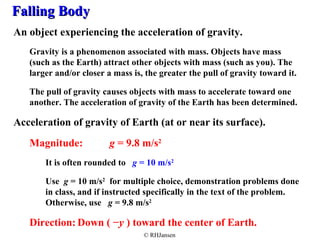
FFaalllliinngg BBooddyy 
An object experiencing the acceleration of gravity. 
Gravity is a phenomenon associated with mass. Objects have mass 
(such as the Earth) attract other objects with mass (such as you). The 
larger and/or closer a mass is, the greater the pull of gravity toward it. 
The pull of gravity causes objects with mass to accelerate toward one 
another. The acceleration of gravity of the Earth has been determined. 
Acceleration of gravity of Earth (at or near its surface). 
Magnitude: g = 9.8 m/s2 
It is often rounded to g = 10 m/s2 
Use g = 10 m/s2 for multiple choice, demonstration problems done 
in class, and if instructed specifically in the text of the problem. 
Otherwise, use g = 9.8 m/s2 
Direction:Down ( −y ) toward the center of Earth. 
© RHJansen
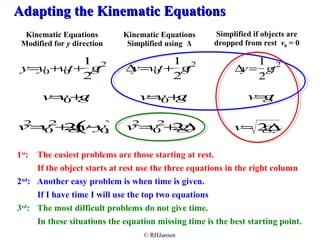
Adapting tthhee KKiinneemmaattiicc EEqquuaattiioonnss 
1 
2 
© RHJansen 
Kinematic Equations 
Modified for y direction 
Kinematic Equations 
Simplified using Δ 
Simplified if objects are 
dropped from rest v0 = 0 
1 
2 
y=y0+v0t+ 
gt2 
   
v=v0+gt 
2+2gy-y0 (   ) 
v2=v0 
Dy=v0t+ 
gt2 
   
v=v0+gt 
   
v2=v0 
   
2+2gDy 
Dy= 
1 
2 
gt2 
   
v=gt 
   
v= 2gDy 
1st: The easiest problems are those starting at rest. 
If the object starts at rest use the three equations in the right column 
2nd: Another easy problem is when time is given. 
If I have time I will use the top two equations 
3rd: The most difficult problems do not give time. 
In these situations the equation missing time is the best starting point.
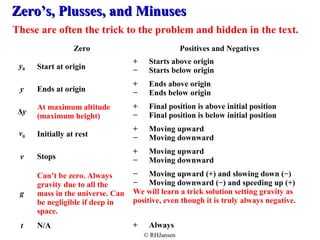
ZZeerroo’’ss,, PPlluusssseess,, aanndd MMiinnuusseess 
These are often the trick to the problem and hidden in the text. 
Zero Positives and Negatives 
y0 Start at origin + Starts above origin 
− Starts below origin 
y Ends at origin + Ends above origin 
− Ends below origin 
© RHJansen 
Δy At maximum altitude 
(maximum height) 
+ Final position is above initial position 
− Final position is below initial position 
v0 Initially at rest + Moving upward 
− Moving downward 
v Stops + Moving upward 
− Moving downward 
g 
Can’t be zero. Always 
gravity due to all the 
mass in the universe. Can 
be negligible if deep in 
space. 
− Moving upward (+) and slowing down (−) 
− Moving downward (−) and speeding up (+) 
We will learn a trick solution setting gravity as 
positive, even though it is truly always negative. 
t N/A + Always
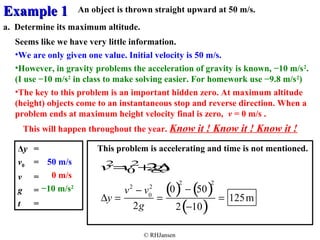
EExxaammppllee 11 
An object is thrown straight upward at 50 m/s. 
© RHJansen 
a. Determine its maximum altitude. 
Seems like we have very little information. 
•We are only given one value. Initial velocity is 50 m/s. 
•However, in gravity problems the acceleration of gravity is known, −10 m/s2. 
(I use −10 m/s2 in class to make solving easier. For homework use −9.8 m/s2) 
•The key to this problem is an important hidden zero. At maximum altitude 
(height) objects come to an instantaneous stop and reverse direction. When a 
problem ends at maximum height velocity final is zero, v = 0 m/s . 
This will happen throughout the year. Know it ! Know it ! Know it ! 
50 m/s 
0 m/s 
   
v2=v0 
2+2gDy 
Δy = 
v0 = 
v = 
g = 
t = 
−10 m/s2 
This problem is accelerating and time is not mentioned. 
Dy = 
v2 - v0 
2 
2g 
= 
(0)2 - (50)2 
2(-10) = 125m
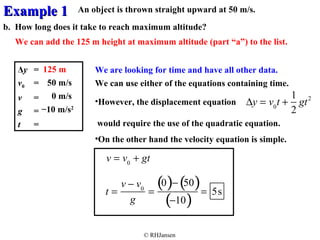
EExxaammppllee 11 
An object is thrown straight upward at 50 m/s. 
b. How long does it take to reach maximum altitude? 
We can add the 125 m height at maximum altitude (part “a”) to the list. 
125 m We are looking for time and have all other data. 
We can use either of the equations containing time. 
•However, the displacement equation 
would require the use of the quadratic equation. 
•On the other hand the velocity equation is simple. 
v = v0 + gt 
© RHJansen 
Δy = 
v0 = 
v = 
g = 
t = 
50 m/s 
0 m/s 
−10 m/s2 
t = 
v - v0 
g 
= 
(0)- (50) 
(-10) = 5s 
Dy = v0t + 1 
2 
gt2
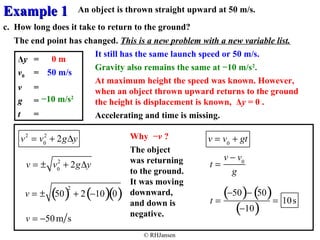
EExxaammppllee 11 
An object is thrown straight upward at 50 m/s. 
c. How long does it take to return to the ground? 
The end point has changed. This is a new problem with a new variable list. 
0 m It still has the same launch speed or 50 m/s. 
Gravity also remains the same at −10 m/s2. 
At maximum height the speed was known. However, 
when an object thrown upward returns to the ground 
the height is displacement is known, Δy = 0 . 
Accelerating and time is missing. 
© RHJansen 
v = v0 + gt 
Δy = 
v0 = 
v = 
g = 
t = 
50 m/s 
−10 m/s2 
t = 
v - v0 
g 
v2 = v0 
2 + 2gDy 
2 + 2gDy 
v = ± v0 
v = ± (50)2 + 2(-10)(0) 
v = -50m s 
Why −v ? 
The object 
was returning 
to the ground. 
It was moving 
downward, 
and down is 
negative. 
t = 
(-50)- (50) 
(-10) = 10s
EExxaammppllee 11 
An object is thrown straight upward at 50 m/s. 
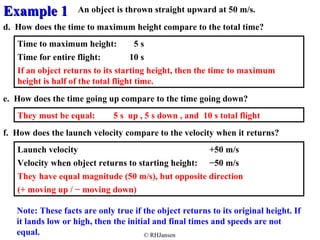
d. How does the time to maximum height compare to the total time? 
Time to maximum height: 5 s 
Time for entire flight: 10 s 
If an object returns to its starting height, then the time to maximum 
height is half of the total flight time. 
e. How does the time going up compare to the time going down? 
They must be equal: 5 s up , 5 s down , and 10 s total flight 
f. How does the launch velocity compare to the velocity when it returns? 
Launch velocity +50 m/s 
Velocity when object returns to starting height: −50 m/s 
They have equal magnitude (50 m/s), but opposite direction 
(+ moving up / − moving down) 
Note: These facts are only true if the object returns to its original height. If 
it lands low or high, then the initial and final times and speeds are not 
equal. 
© RHJansen
TThhee PPrroobblleemm WWiitthh AAcccceelleerraattiioonn 
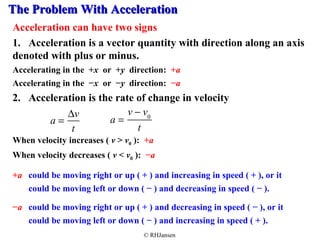
Acceleration can have two signs 
1. Acceleration is a vector quantity with direction along an axis 
denoted with plus or minus. 
Accelerating in the +x or +y direction: +a 
Accelerating in the −x or −y direction: −a 
2. Acceleration is the rate of change in velocity 
When velocity increases ( v > v0 ): +a 
When velocity decreases ( v < v0 ): −a 
+a could be moving right or up ( + ) and increasing in speed ( + ), or it 
could be moving left or down ( − ) and decreasing in speed ( − ). 
−a could be moving right or up ( + ) and decreasing in speed ( − ), or it 
could be moving left or down ( − ) and increasing in speed ( + ). 
© RHJansen 
a = 
v - v0 
t 
a = Dv 
t
There is aa ttrriicckk ttoo ssiimmpplliiffyyiinngg tthhee ssiiggnnss 
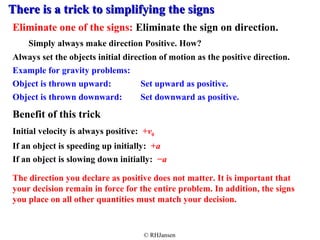
Eliminate one of the signs: Eliminate the sign on direction. 
Simply always make direction Positive. How? 
Always set the objects initial direction of motion as the positive direction. 
Example for gravity problems: 
Object is thrown upward: Set upward as positive. 
Object is thrown downward: Set downward as positive. 
Benefit of this trick 
Initial velocity is always positive: +v0 
If an object is speeding up initially: +a 
If an object is slowing down initially: −a 
The direction you declare as positive does not matter. It is important that 
your decision remain in force for the entire problem. In addition, the signs 
you place on all other quantities must match your decision. 
© RHJansen
There is aa ttrriicckk ttoo ssiimmpplliiffyyiinngg tthhee ssiiggnnss 
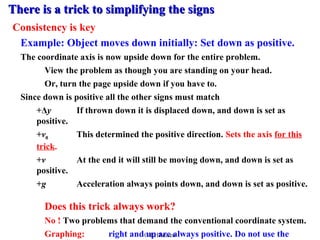
Consistency is key 
Example: Object moves down initially: Set down as positive. 
The coordinate axis is now upside down for the entire problem. 
View the problem as though you are standing on your head. 
Or, turn the page upside down if you have to. 
Since down is positive all the other signs must match 
+Δy If thrown down it is displaced down, and down is set as 
positive. 
+vThis determined the positive direction. Sets the axis for this 
0 trick. 
+v At the end it will still be moving down, and down is set as 
positive. 
+g Acceleration always points down, and down is set as positive. 
Does this trick always work? 
No ! Two problems that demand the conventional coordinate system. 
Graphing: right and © up RHJansen 
are always positive. Do not use the 
trick.
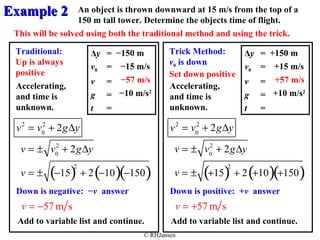
EExxaammppllee 22 
An object is thrown downward at 15 m/s from the top of a 
150 m tall tower. Determine the objects time of flight. 
This will be solved using both the traditional method and using the trick. 
Traditional: −150 m Δy = 
+150 m 
Up is always 
−15 m/s 
positive 
+15 m/s 
2 + 2gDy 
−57 m/s +57 m/s 
2 + 2gDy 
Down is negative: −v answer Down is positive: +v answer 
© RHJansen 
Δy = 
v0 = 
v = 
g = 
t = 
−10 m/s2 
v0 = 
v = 
g = 
t = 
+10 m/s2 
Trick Method: 
v0 is down 
Set down positive 
Accelerating, 
and time is 
unknown. 
Accelerating, 
and time is 
unknown. 
v2 = v0 
2 + 2gDy 
v = ± v0 
v = ± (-15)2 + 2(-10)(-150) 
v2 = v0 
2 + 2gDy 
v = ± v0 
v = ± (+15)2 + 2(+10)(+150) 
v = -57m s v = +57m s 
Add to variable list and continue. Add to variable list and continue.
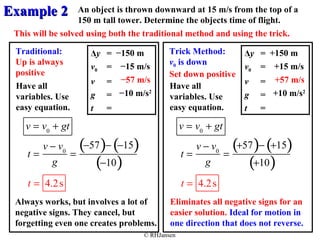
EExxaammppllee 22 
An object is thrown downward at 15 m/s from the top of a 
150 m tall tower. Determine the objects time of flight. 
This will be solved using both the traditional method and using the trick. 
Traditional: −150 m Δy = 
+150 m 
Up is always 
−15 m/s 
positive 
−57 m/s +57 m/s 
© RHJansen 
Δy = 
v0 = 
v = 
g = 
t = 
−10 m/s2 
v0 = 
v = 
g = 
t = 
+15 m/s 
+10 m/s2 
Trick Method: 
v0 is down 
Set down positive 
Have all 
variables. Use 
easy equation. 
Have all 
variables. Use 
easy equation. 
t = 
v - v0 
g 
Always works, but involves a lot of 
negative signs. They cancel, but 
forgetting even one creates problems. 
t = 
v - v0 
g 
Eliminates all negative signs for an 
easier solution. Ideal for motion in 
one direction that does not reverse. 
v = v0 + gt 
t = 4.2s 
= 
(-57)- (-15) 
(-10) 
v = v0 + gt 
t = 4.2s 
= 
(+57)- (+15) 
(+10)
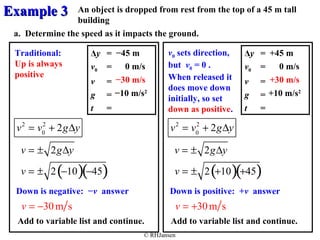
EExxaammppllee 33 
An object is dropped from rest from the top of a 45 m tall 
building 
a. Determine the speed as it impacts the ground. 
Traditional: −45 m Δy = 
+45 m 
Up is always 
0 m/s 
positive 
0 m/s 
−30 m/s +30 m/s 
Down is negative: −v answer Down is positive: +v answer 
© RHJansen 
Δy = 
v0 = 
v = 
g = 
t = 
−10 m/s2 
v0 = 
v = 
g = 
t = 
+10 m/s2 
v0 sets direction, 
but v0 = 0 . 
When released it 
does move down 
initially, so set 
down as positive. 
v2 = v0 
2 + 2gDy 
v = ± 2gDy 
v = ± 2(-10)(-45) 
v2 = v0 
2 + 2gDy 
v = ± 2gDy 
v = ± 2(+10)(+45) 
v = -30m s v = +30m s 
Add to variable list and continue. Add to variable list and continue.
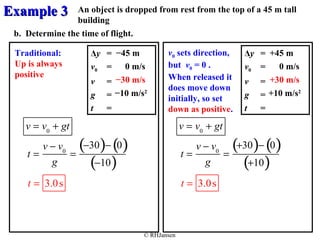
EExxaammppllee 33 
An object is dropped from rest from the top of a 45 m tall 
building 
Traditional: −45 m Δy = 
+45 m 
Up is always 
0 m/s 
positive 
© RHJansen 
b. Determine the time of flight. 
Δy = 
v0 = 
v = 
g = 
t = 
−10 m/s2 
v0 = 
v = 
g = 
t = 
0 m/s 
+10 m/s2 
v0 sets direction, 
but v0 = 0 . 
When released it 
does move down 
initially, so set 
down as positive. 
−30 m/s +30 m/s 
v = v0 + gt 
t = 
v - v0 
g 
t = 3.0s 
= 
(-30)- (0) 
(-10) 
v = v0 + gt 
t = 
v - v0 
g 
t = 3.0s 
= 
(+30)- (0) 
(+10)

Pp104 freefall

  • 1.
  • 2.
    FFaalllliinngg BBooddyy Anobject experiencing the acceleration of gravity. Gravity is a phenomenon associated with mass. Objects have mass (such as the Earth) attract other objects with mass (such as you). The larger and/or closer a mass is, the greater the pull of gravity toward it. The pull of gravity causes objects with mass to accelerate toward one another. The acceleration of gravity of the Earth has been determined. Acceleration of gravity of Earth (at or near its surface). Magnitude: g = 9.8 m/s2 It is often rounded to g = 10 m/s2 Use g = 10 m/s2 for multiple choice, demonstration problems done in class, and if instructed specifically in the text of the problem. Otherwise, use g = 9.8 m/s2 Direction:Down ( −y ) toward the center of Earth. © RHJansen
  • 3.
    Adapting tthhee KKiinneemmaattiiccEEqquuaattiioonnss 1 2 © RHJansen Kinematic Equations Modified for y direction Kinematic Equations Simplified using Δ Simplified if objects are dropped from rest v0 = 0 1 2 y=y0+v0t+ gt2   v=v0+gt 2+2gy-y0 (  ) v2=v0 Dy=v0t+ gt2   v=v0+gt   v2=v0   2+2gDy Dy= 1 2 gt2   v=gt   v= 2gDy 1st: The easiest problems are those starting at rest. If the object starts at rest use the three equations in the right column 2nd: Another easy problem is when time is given. If I have time I will use the top two equations 3rd: The most difficult problems do not give time. In these situations the equation missing time is the best starting point.
  • 4.
    ZZeerroo’’ss,, PPlluusssseess,, aannddMMiinnuusseess These are often the trick to the problem and hidden in the text. Zero Positives and Negatives y0 Start at origin + Starts above origin − Starts below origin y Ends at origin + Ends above origin − Ends below origin © RHJansen Δy At maximum altitude (maximum height) + Final position is above initial position − Final position is below initial position v0 Initially at rest + Moving upward − Moving downward v Stops + Moving upward − Moving downward g Can’t be zero. Always gravity due to all the mass in the universe. Can be negligible if deep in space. − Moving upward (+) and slowing down (−) − Moving downward (−) and speeding up (+) We will learn a trick solution setting gravity as positive, even though it is truly always negative. t N/A + Always
  • 5.
    EExxaammppllee 11 Anobject is thrown straight upward at 50 m/s. © RHJansen a. Determine its maximum altitude. Seems like we have very little information. •We are only given one value. Initial velocity is 50 m/s. •However, in gravity problems the acceleration of gravity is known, −10 m/s2. (I use −10 m/s2 in class to make solving easier. For homework use −9.8 m/s2) •The key to this problem is an important hidden zero. At maximum altitude (height) objects come to an instantaneous stop and reverse direction. When a problem ends at maximum height velocity final is zero, v = 0 m/s . This will happen throughout the year. Know it ! Know it ! Know it ! 50 m/s 0 m/s   v2=v0 2+2gDy Δy = v0 = v = g = t = −10 m/s2 This problem is accelerating and time is not mentioned. Dy = v2 - v0 2 2g = (0)2 - (50)2 2(-10) = 125m
  • 6.
    EExxaammppllee 11 Anobject is thrown straight upward at 50 m/s. b. How long does it take to reach maximum altitude? We can add the 125 m height at maximum altitude (part “a”) to the list. 125 m We are looking for time and have all other data. We can use either of the equations containing time. •However, the displacement equation would require the use of the quadratic equation. •On the other hand the velocity equation is simple. v = v0 + gt © RHJansen Δy = v0 = v = g = t = 50 m/s 0 m/s −10 m/s2 t = v - v0 g = (0)- (50) (-10) = 5s Dy = v0t + 1 2 gt2
  • 7.
    EExxaammppllee 11 Anobject is thrown straight upward at 50 m/s. c. How long does it take to return to the ground? The end point has changed. This is a new problem with a new variable list. 0 m It still has the same launch speed or 50 m/s. Gravity also remains the same at −10 m/s2. At maximum height the speed was known. However, when an object thrown upward returns to the ground the height is displacement is known, Δy = 0 . Accelerating and time is missing. © RHJansen v = v0 + gt Δy = v0 = v = g = t = 50 m/s −10 m/s2 t = v - v0 g v2 = v0 2 + 2gDy 2 + 2gDy v = ± v0 v = ± (50)2 + 2(-10)(0) v = -50m s Why −v ? The object was returning to the ground. It was moving downward, and down is negative. t = (-50)- (50) (-10) = 10s
  • 8.
    EExxaammppllee 11 Anobject is thrown straight upward at 50 m/s. d. How does the time to maximum height compare to the total time? Time to maximum height: 5 s Time for entire flight: 10 s If an object returns to its starting height, then the time to maximum height is half of the total flight time. e. How does the time going up compare to the time going down? They must be equal: 5 s up , 5 s down , and 10 s total flight f. How does the launch velocity compare to the velocity when it returns? Launch velocity +50 m/s Velocity when object returns to starting height: −50 m/s They have equal magnitude (50 m/s), but opposite direction (+ moving up / − moving down) Note: These facts are only true if the object returns to its original height. If it lands low or high, then the initial and final times and speeds are not equal. © RHJansen
  • 9.
    TThhee PPrroobblleemm WWiitthhAAcccceelleerraattiioonn Acceleration can have two signs 1. Acceleration is a vector quantity with direction along an axis denoted with plus or minus. Accelerating in the +x or +y direction: +a Accelerating in the −x or −y direction: −a 2. Acceleration is the rate of change in velocity When velocity increases ( v > v0 ): +a When velocity decreases ( v < v0 ): −a +a could be moving right or up ( + ) and increasing in speed ( + ), or it could be moving left or down ( − ) and decreasing in speed ( − ). −a could be moving right or up ( + ) and decreasing in speed ( − ), or it could be moving left or down ( − ) and increasing in speed ( + ). © RHJansen a = v - v0 t a = Dv t
  • 10.
    There is aattrriicckk ttoo ssiimmpplliiffyyiinngg tthhee ssiiggnnss Eliminate one of the signs: Eliminate the sign on direction. Simply always make direction Positive. How? Always set the objects initial direction of motion as the positive direction. Example for gravity problems: Object is thrown upward: Set upward as positive. Object is thrown downward: Set downward as positive. Benefit of this trick Initial velocity is always positive: +v0 If an object is speeding up initially: +a If an object is slowing down initially: −a The direction you declare as positive does not matter. It is important that your decision remain in force for the entire problem. In addition, the signs you place on all other quantities must match your decision. © RHJansen
  • 11.
    There is aattrriicckk ttoo ssiimmpplliiffyyiinngg tthhee ssiiggnnss Consistency is key Example: Object moves down initially: Set down as positive. The coordinate axis is now upside down for the entire problem. View the problem as though you are standing on your head. Or, turn the page upside down if you have to. Since down is positive all the other signs must match +Δy If thrown down it is displaced down, and down is set as positive. +vThis determined the positive direction. Sets the axis for this 0 trick. +v At the end it will still be moving down, and down is set as positive. +g Acceleration always points down, and down is set as positive. Does this trick always work? No ! Two problems that demand the conventional coordinate system. Graphing: right and © up RHJansen are always positive. Do not use the trick.
  • 12.
    EExxaammppllee 22 Anobject is thrown downward at 15 m/s from the top of a 150 m tall tower. Determine the objects time of flight. This will be solved using both the traditional method and using the trick. Traditional: −150 m Δy = +150 m Up is always −15 m/s positive +15 m/s 2 + 2gDy −57 m/s +57 m/s 2 + 2gDy Down is negative: −v answer Down is positive: +v answer © RHJansen Δy = v0 = v = g = t = −10 m/s2 v0 = v = g = t = +10 m/s2 Trick Method: v0 is down Set down positive Accelerating, and time is unknown. Accelerating, and time is unknown. v2 = v0 2 + 2gDy v = ± v0 v = ± (-15)2 + 2(-10)(-150) v2 = v0 2 + 2gDy v = ± v0 v = ± (+15)2 + 2(+10)(+150) v = -57m s v = +57m s Add to variable list and continue. Add to variable list and continue.
  • 13.
    EExxaammppllee 22 Anobject is thrown downward at 15 m/s from the top of a 150 m tall tower. Determine the objects time of flight. This will be solved using both the traditional method and using the trick. Traditional: −150 m Δy = +150 m Up is always −15 m/s positive −57 m/s +57 m/s © RHJansen Δy = v0 = v = g = t = −10 m/s2 v0 = v = g = t = +15 m/s +10 m/s2 Trick Method: v0 is down Set down positive Have all variables. Use easy equation. Have all variables. Use easy equation. t = v - v0 g Always works, but involves a lot of negative signs. They cancel, but forgetting even one creates problems. t = v - v0 g Eliminates all negative signs for an easier solution. Ideal for motion in one direction that does not reverse. v = v0 + gt t = 4.2s = (-57)- (-15) (-10) v = v0 + gt t = 4.2s = (+57)- (+15) (+10)
  • 14.
    EExxaammppllee 33 Anobject is dropped from rest from the top of a 45 m tall building a. Determine the speed as it impacts the ground. Traditional: −45 m Δy = +45 m Up is always 0 m/s positive 0 m/s −30 m/s +30 m/s Down is negative: −v answer Down is positive: +v answer © RHJansen Δy = v0 = v = g = t = −10 m/s2 v0 = v = g = t = +10 m/s2 v0 sets direction, but v0 = 0 . When released it does move down initially, so set down as positive. v2 = v0 2 + 2gDy v = ± 2gDy v = ± 2(-10)(-45) v2 = v0 2 + 2gDy v = ± 2gDy v = ± 2(+10)(+45) v = -30m s v = +30m s Add to variable list and continue. Add to variable list and continue.
  • 15.
    EExxaammppllee 33 Anobject is dropped from rest from the top of a 45 m tall building Traditional: −45 m Δy = +45 m Up is always 0 m/s positive © RHJansen b. Determine the time of flight. Δy = v0 = v = g = t = −10 m/s2 v0 = v = g = t = 0 m/s +10 m/s2 v0 sets direction, but v0 = 0 . When released it does move down initially, so set down as positive. −30 m/s +30 m/s v = v0 + gt t = v - v0 g t = 3.0s = (-30)- (0) (-10) v = v0 + gt t = v - v0 g t = 3.0s = (+30)- (0) (+10)