Vectors

     Objectives:
     • Define the concept of a vector
     • Learn how to perform basic vector
       operations using graphical and
       numerical methods
     • Learn how to use vector algebra to
       solve simple problems


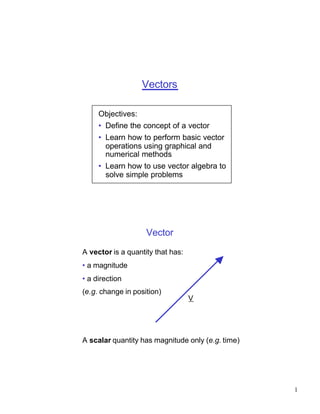
                    Vector

A vector is a quantity that has:
• a magnitude
• a direction
(e.g. change in position)
                                   V


A scalar quantity has magnitude only (e.g. time)


                                                   1
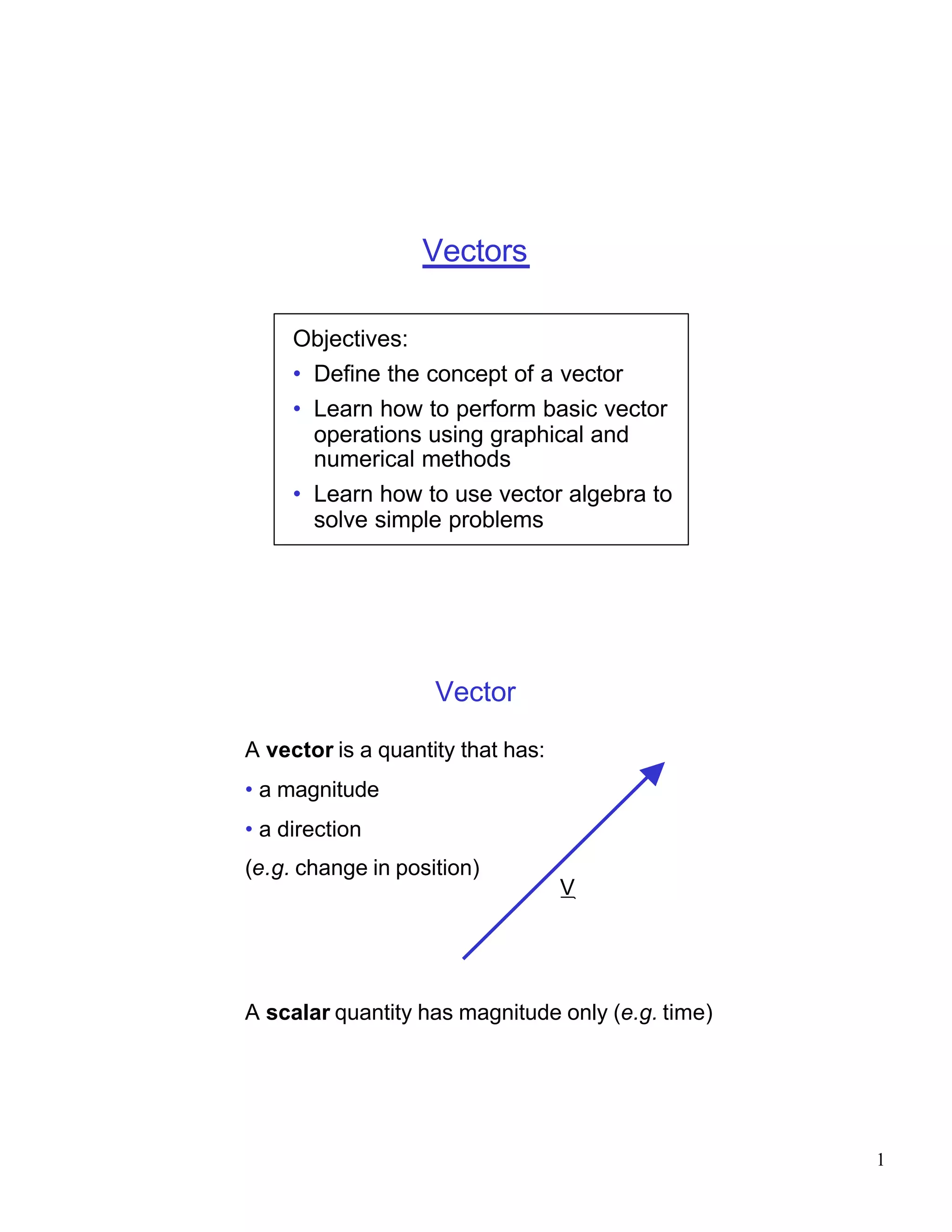
Numerical Representation
Methods of expressing a vector (V) numerically:
• its magnitude (V) and direction (θ) with respect
  to a reference axis
• its components (Vx, Vy) along each reference
  axis
              y

            Vy                     V

                        V

                    θ
                                          x
          (0,0)                   Vx


            Vector Composition
• Process of determining a single vector from
  two or more vectors by vector addition
• Performed graphically using tip-to-tail method


                     V1 + V2        copy of
           V2                       V2


                             V1

resultant : vector resulting from the composition


                                                     2
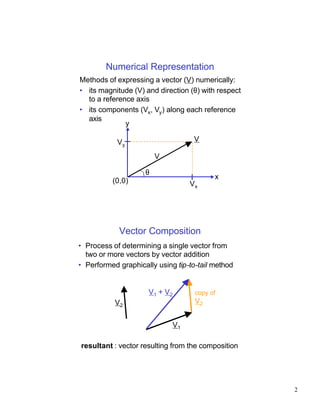
Vector Resolution
• Process of replacing a single vector with two
  perpendicular vectors whose composition
  equals the original vector


                                                      V2
         V                V2            V

                                               V1

          V1
                                    Another Resolution of V


         Resolution into Components
• Trigonometry can be used to numerically
  resolve a vector into its x- and y-components
     y
                                                      Vx
                                            cos θ =
                               V                       V
                                                      Vy
                                            sin θ =
                                                      V
                 V             Vy
                                            Vx = V * cos θ
             θ                              Vy = V * sin θ
                                    x
(0,0)                Vx


                                                              3
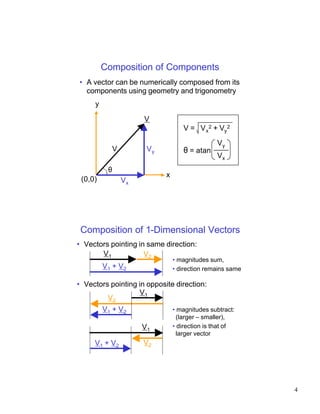
Composition of Components
• A vector can be numerically composed from its
  components using geometry and trigonometry
     y

                       V
                                    V = V x2 + Vy2

                                                Vy
              V         Vy          θ = atan
                                                Vx
          θ
                             x
 (0,0)            Vx


 Composition of 1-Dimensional Vectors
• Vectors pointing in same direction:
       V1            V2
                                 • magnitudes sum,
         V1 + V2                 • direction remains same

• Vectors pointing in opposite direction:
                   V1
         V2
         V1 + V2                 • magnitudes subtract:
                                   (larger – smaller),
                       V1        • direction is that of
                                   larger vector
     V1 + V2           V2


                                                            4
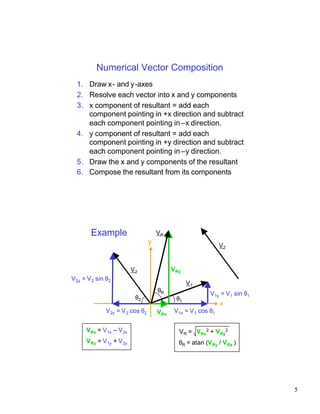
Numerical Vector Composition
  1. Draw x- and y-axes
  2. Resolve each vector into x and y components
  3. x component of resultant = add each
     component pointing in +x direction and subtract
     each component pointing in –x direction.
  4. y component of resultant = add each
     component pointing in +y direction and subtract
     each component pointing in –y direction.
  5. Draw the x and y components of the resultant
  6. Compose the resultant from its components


       Example                       VR
                                 y                            V2


                        V2                 VRy
V2y = V 2 sin θ2
                                                 V1
                                     θR                  V1y = V 1 sin θ1
                         θ2                 θ1
                                                              x
              V2x = V 2 cos θ2       VRx   V1x = V 1 cos θ1


      VRx = V1x – V2x                        VR = VRx2 + VRy2
      VRy = V1y + V2y                        θR = atan (VRy / VRx )


                                                                            5
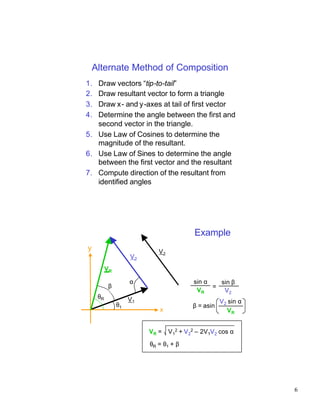
Alternate Method of Composition
1. Draw vectors “tip-to-tail”
2. Draw resultant vector to form a triangle
3. Draw x- and y-axes at tail of first vector
4. Determine the angle between the first and
   second vector in the triangle.
5. Use Law of Cosines to determine the
   magnitude of the resultant.
6. Use Law of Sines to determine the angle
   between the first vector and the resultant
7. Compute direction of the resultant from
   identified angles


                                          Example
y                           V2
                    V2
          VR

                    α                     sin α   sin β
           β                                    =
                                           VR      V2
     θR             V1                               V2 sin α
               θ1                         β = asin
                            x                          VR


                         VR =    V 12 + V22 – 2V1V2 cos α

                         θR = θ1 + β


                                                                6
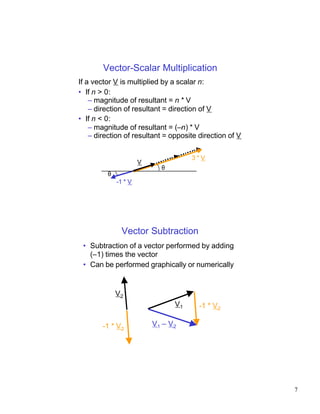
Vector-Scalar Multiplication
If a vector V is multiplied by a scalar n:
• If n > 0:
    – magnitude of resultant = n * V
    – direction of resultant = direction of V
• If n < 0:
    – magnitude of resultant = (–n) * V
    – direction of resultant = opposite direction of V

                                     3*V
                      V
                            θ
         θ
             -1 * V


               Vector Subtraction
 • Subtraction of a vector performed by adding
   (–1) times the vector
 • Can be performed graphically or numerically


             V2
                                V1      -1 * V2

        -1 * V2           V1 – V2


                                                         7
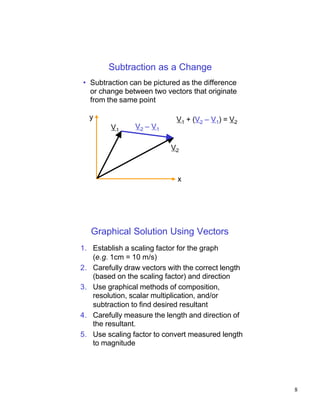
Subtraction as a Change
• Subtraction can be pictured as the difference
  or change between two vectors that originate
  from the same point

  y                          V1 + (V2 – V1) = V2
         V1     V2 – V1

                           V2


                             x


   Graphical Solution Using Vectors
1. Establish a scaling factor for the graph
   (e.g. 1cm = 10 m/s)
2. Carefully draw vectors with the correct length
   (based on the scaling factor) and direction
3. Use graphical methods of composition,
   resolution, scalar multiplication, and/or
   subtraction to find desired resultant
4. Carefully measure the length and direction of
   the resultant.
5. Use scaling factor to convert measured length
   to magnitude


                                                    8
Example Problem #1
Two volleyball players simultaneously contact the
    ball above the net.
Player #1 hits the ball from the left with a force of
    300 N (67 lb), angled 45° below the horizontal.
Player #2 hits the ball from the right with a force of
    250 N (56 lb), angled 20° below the horizontal.
What is the magnitude and direction of the net
    force applied to the ball by the 2 players?


  Numerical Solutions Using Vectors
1. Sketch the vectors on a diagram of the
   problem
2. Choose and diagram the coordinate axes,
   based on:
   •   axes used in the problem statement
   •   axes that are physically meaningful
3. Establish and label known magnitudes and
   angles or x- and y-components
4. Use numerical methods of composition,
   resolution, scalar multiplication, and/or
   subtraction to find desired solution


                                                         9
Graphical vs. Numerical Method
•    Graphical Method
    – Simple
    – Must be done by hand
    – Gives approximate result
•    Numerical Method
    – Requires complex calculations
    – Gives accurate result
    – Can be performed by computer
    – Can perform analyses in 3 dimensions


           Example Problem #2
A golfer is teeing off from the center of the
    fairway for a hole that is located 300 yards
    away and 30° to the right of center.
The golfer’s tee shot goes 210 yards and 15° to
    the left of center of the fairway.
To reach the hole on the second shot, how far
    and in what direction must the golfer hit the
    ball?


                                                    10

Lecture 05

  • 1.
    Vectors Objectives: • Define the concept of a vector • Learn how to perform basic vector operations using graphical and numerical methods • Learn how to use vector algebra to solve simple problems Vector A vector is a quantity that has: • a magnitude • a direction (e.g. change in position) V A scalar quantity has magnitude only (e.g. time) 1
  • 2.
    Numerical Representation Methods ofexpressing a vector (V) numerically: • its magnitude (V) and direction (θ) with respect to a reference axis • its components (Vx, Vy) along each reference axis y Vy V V θ x (0,0) Vx Vector Composition • Process of determining a single vector from two or more vectors by vector addition • Performed graphically using tip-to-tail method V1 + V2 copy of V2 V2 V1 resultant : vector resulting from the composition 2
  • 3.
    Vector Resolution • Processof replacing a single vector with two perpendicular vectors whose composition equals the original vector V2 V V2 V V1 V1 Another Resolution of V Resolution into Components • Trigonometry can be used to numerically resolve a vector into its x- and y-components y Vx cos θ = V V Vy sin θ = V V Vy Vx = V * cos θ θ Vy = V * sin θ x (0,0) Vx 3
  • 4.
    Composition of Components •A vector can be numerically composed from its components using geometry and trigonometry y V V = V x2 + Vy2 Vy V Vy θ = atan Vx θ x (0,0) Vx Composition of 1-Dimensional Vectors • Vectors pointing in same direction: V1 V2 • magnitudes sum, V1 + V2 • direction remains same • Vectors pointing in opposite direction: V1 V2 V1 + V2 • magnitudes subtract: (larger – smaller), V1 • direction is that of larger vector V1 + V2 V2 4
  • 5.
    Numerical Vector Composition 1. Draw x- and y-axes 2. Resolve each vector into x and y components 3. x component of resultant = add each component pointing in +x direction and subtract each component pointing in –x direction. 4. y component of resultant = add each component pointing in +y direction and subtract each component pointing in –y direction. 5. Draw the x and y components of the resultant 6. Compose the resultant from its components Example VR y V2 V2 VRy V2y = V 2 sin θ2 V1 θR V1y = V 1 sin θ1 θ2 θ1 x V2x = V 2 cos θ2 VRx V1x = V 1 cos θ1 VRx = V1x – V2x VR = VRx2 + VRy2 VRy = V1y + V2y θR = atan (VRy / VRx ) 5
  • 6.
    Alternate Method ofComposition 1. Draw vectors “tip-to-tail” 2. Draw resultant vector to form a triangle 3. Draw x- and y-axes at tail of first vector 4. Determine the angle between the first and second vector in the triangle. 5. Use Law of Cosines to determine the magnitude of the resultant. 6. Use Law of Sines to determine the angle between the first vector and the resultant 7. Compute direction of the resultant from identified angles Example y V2 V2 VR α sin α sin β β = VR V2 θR V1 V2 sin α θ1 β = asin x VR VR = V 12 + V22 – 2V1V2 cos α θR = θ1 + β 6
  • 7.
    Vector-Scalar Multiplication If avector V is multiplied by a scalar n: • If n > 0: – magnitude of resultant = n * V – direction of resultant = direction of V • If n < 0: – magnitude of resultant = (–n) * V – direction of resultant = opposite direction of V 3*V V θ θ -1 * V Vector Subtraction • Subtraction of a vector performed by adding (–1) times the vector • Can be performed graphically or numerically V2 V1 -1 * V2 -1 * V2 V1 – V2 7
  • 8.
    Subtraction as aChange • Subtraction can be pictured as the difference or change between two vectors that originate from the same point y V1 + (V2 – V1) = V2 V1 V2 – V1 V2 x Graphical Solution Using Vectors 1. Establish a scaling factor for the graph (e.g. 1cm = 10 m/s) 2. Carefully draw vectors with the correct length (based on the scaling factor) and direction 3. Use graphical methods of composition, resolution, scalar multiplication, and/or subtraction to find desired resultant 4. Carefully measure the length and direction of the resultant. 5. Use scaling factor to convert measured length to magnitude 8
  • 9.
    Example Problem #1 Twovolleyball players simultaneously contact the ball above the net. Player #1 hits the ball from the left with a force of 300 N (67 lb), angled 45° below the horizontal. Player #2 hits the ball from the right with a force of 250 N (56 lb), angled 20° below the horizontal. What is the magnitude and direction of the net force applied to the ball by the 2 players? Numerical Solutions Using Vectors 1. Sketch the vectors on a diagram of the problem 2. Choose and diagram the coordinate axes, based on: • axes used in the problem statement • axes that are physically meaningful 3. Establish and label known magnitudes and angles or x- and y-components 4. Use numerical methods of composition, resolution, scalar multiplication, and/or subtraction to find desired solution 9
  • 10.
    Graphical vs. NumericalMethod • Graphical Method – Simple – Must be done by hand – Gives approximate result • Numerical Method – Requires complex calculations – Gives accurate result – Can be performed by computer – Can perform analyses in 3 dimensions Example Problem #2 A golfer is teeing off from the center of the fairway for a hole that is located 300 yards away and 30° to the right of center. The golfer’s tee shot goes 210 yards and 15° to the left of center of the fairway. To reach the hole on the second shot, how far and in what direction must the golfer hit the ball? 10