Chapter 2 Motion

2-1. Speed                 2-8. Mass
2-2. Vectors               2-9. Second Law of Motion
2-3. Acceleration          2-10. Mass and Weight
2-4. Distance, Time, and   2-11. Third Law of Motion
     Acceleration          2-12. Circular Motion
2-5. Free Fall System      2-13. Newton's Law of
2-6. Air Resistance               Gravity
2-7. First Law of Motion   2-14. Artificial Satellites
2-1. Speed
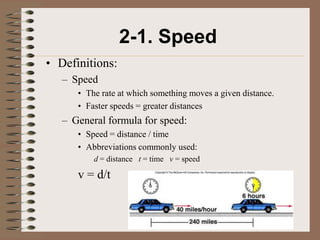
• Definitions:
   – Speed
      • The rate at which something moves a given distance.
      • Faster speeds = greater distances
   – General formula for speed:
      • Speed = distance / time
      • Abbreviations commonly used:
          d = distance t = time v = speed

      v = d/t
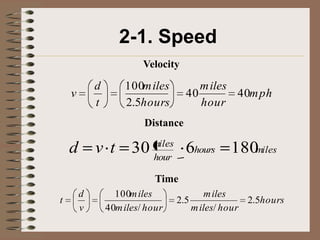
2-1. Speed
                         Velocity

            d       100m iles          m iles
    v                               40        40m ph
            t       2.5hours           hour
                         Distance

    d       v t 30 miles 6hours 180miles
                   hour

                            Time
        d         100m iles              m iles
t                                2.5              2.5hours
        v       40m iles/ hour       m iles/ hour
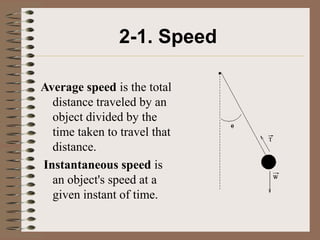
2-1. Speed

Average speed is the total
  distance traveled by an
  object divided by the
  time taken to travel that
  distance.
Instantaneous speed is
  an object's speed at a
  given instant of time.
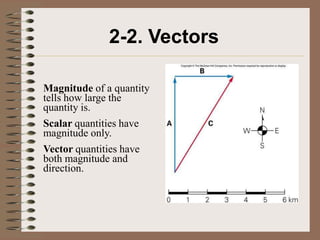
2-2. Vectors

Magnitude of a quantity
tells how large the
quantity is.
Scalar quantities have
magnitude only.
Vector quantities have
both magnitude and
direction.
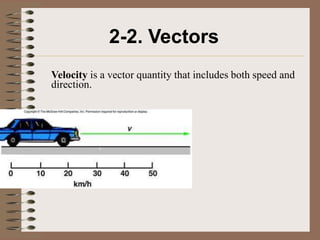
2-2. Vectors
Velocity is a vector quantity that includes both speed and
direction.
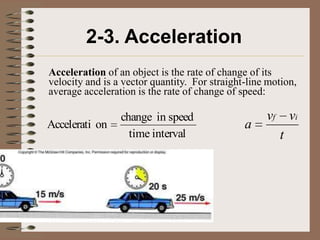
2-3. Acceleration
Acceleration of an object is the rate of change of its
velocity and is a vector quantity. For straight-line motion,
average acceleration is the rate of change of speed:

                 change in speed                    vf       vi
Accelerati on                                  a
                   time interval                         t
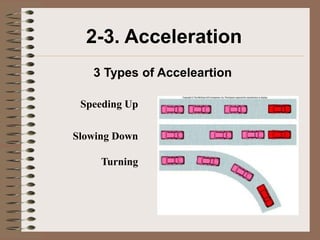
2-3. Acceleration
   3 Types of Acceleartion

 Speeding Up


Slowing Down

     Turning
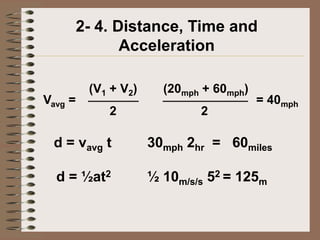
2- 4. Distance, Time and
            Acceleration

         (V1 + V2)     (20mph + 60mph)
Vavg =                                   = 40mph
            2                2

 d = vavg t          30mph 2hr = 60miles

  d = ½at2           ½ 10m/s/s 52 = 125m
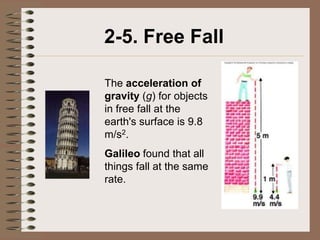
2-5. Free Fall

The acceleration of
gravity (g) for objects
in free fall at the
earth's surface is 9.8
m/s2.
Galileo found that all
things fall at the same
rate.
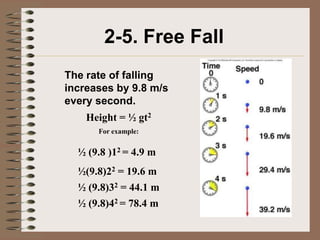
2-5. Free Fall
The rate of falling
increases by 9.8 m/s
every second.
    Height = ½ gt2
      For example:


  ½ (9.8 )12 = 4.9 m
  ½(9.8)22 = 19.6 m
  ½ (9.8)32 = 44.1 m
  ½ (9.8)42 = 78.4 m
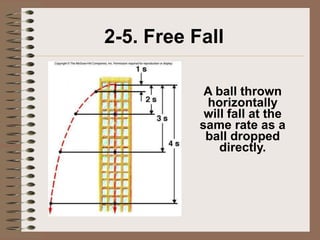
2-5. Free Fall

            A ball thrown
            horizontally
            will fall at the
           same rate as a
            ball dropped
               directly.
2-5. Free Fall

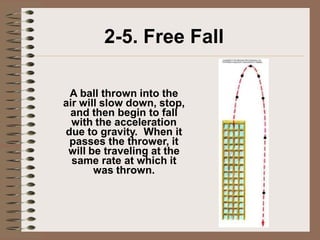
 A ball thrown into the
air will slow down, stop,
 and then begin to fall
  with the acceleration
due to gravity. When it
 passes the thrower, it
 will be traveling at the
  same rate at which it
       was thrown.
2-5. Free Fall


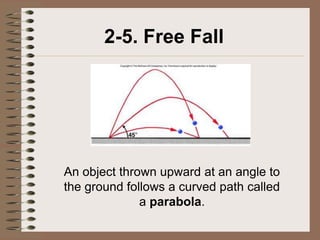
An object thrown upward at an angle to
the ground follows a curved path called
              a parabola.
2-6. Air Resistance

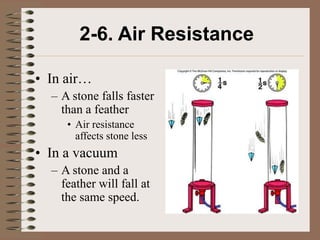
• In air…
  – A stone falls faster
    than a feather
     • Air resistance
       affects stone less
• In a vacuum
  – A stone and a
    feather will fall at
    the same speed.
2-6. Air Resistance
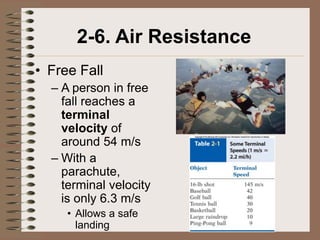
• Free Fall
  – A person in free
    fall reaches a
    terminal
    velocity of
    around 54 m/s
  – With a
    parachute,
    terminal velocity
    is only 6.3 m/s
     • Allows a safe
       landing
2-6. Air Resistance
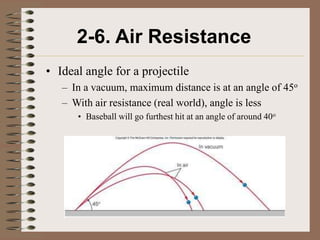
• Ideal angle for a projectile
   – In a vacuum, maximum distance is at an angle of 45o
   – With air resistance (real world), angle is less
      • Baseball will go furthest hit at an angle of around 40o
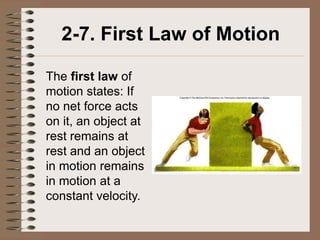
2-7. First Law of Motion

The first law of
motion states: If
no net force acts
on it, an object at
rest remains at
rest and an object
in motion remains
in motion at a
constant velocity.
Foucault Pendulum
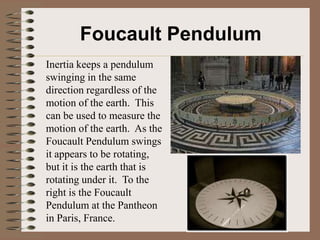
Inertia keeps a pendulum
swinging in the same
direction regardless of the
motion of the earth. This
can be used to measure the
motion of the earth. As the
Foucault Pendulum swings
it appears to be rotating,
but it is the earth that is
rotating under it. To the
right is the Foucault
Pendulum at the Pantheon
in Paris, France.
Foucault Pendulum
Other Web sites that illustrate the Foucault Pendulum.
http://en.wikipedia.org/wiki/File:Foucault-
rotz.gif
http://www.physclips.unsw.edu.au/jw/foucault_
pendulum.html
http://aspire.cosmic-
ray.org/labs/scientific_method/pendulum.swf
http://www.calacademy.org/products/pendulum/
page7.htm
http://www.youtube.com/watch?v=nB2SXLYw
KkM
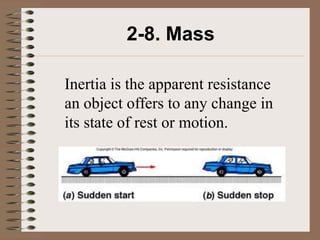
2-8. Mass

Inertia is the apparent resistance
an object offers to any change in
its state of rest or motion.
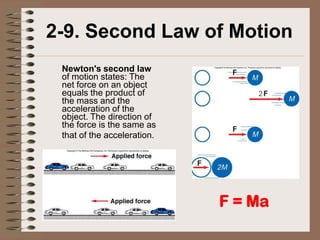
2-9. Second Law of Motion
 Newton's second law
 of motion states: The
 net force on an object
 equals the product of
 the mass and the
 acceleration of the
 object. The direction of
 the force is the same as
 that of the acceleration.


                             F = Ma
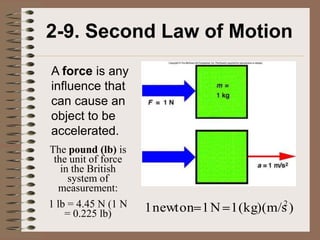
2-9. Second Law of Motion
A force is any
influence that
can cause an
object to be
accelerated.
The pound (lb) is
 the unit of force
   in the British
     system of
  measurement:
1 lb = 4.45 N (1 N                          2
                     1 newton 1 N 1 (kg)(m/s )
    = 0.225 lb)
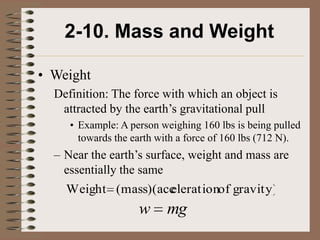
2-10. Mass and Weight

• Weight
  Definition: The force with which an object is
   attracted by the earth’s gravitational pull
     • Example: A person weighing 160 lbs is being pulled
       towards the earth with a force of 160 lbs (712 N).
  – Near the earth’s surface, weight and mass are
    essentially the same
    Weight (mass)(acc
                    elerationof gravity)
                    w     mg
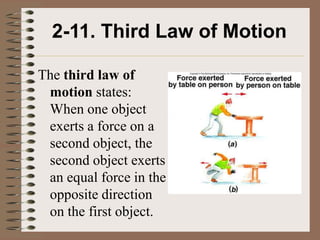
2-11. Third Law of Motion

The third law of
 motion states:
 When one object
 exerts a force on a
 second object, the
 second object exerts
 an equal force in the
 opposite direction
 on the first object.
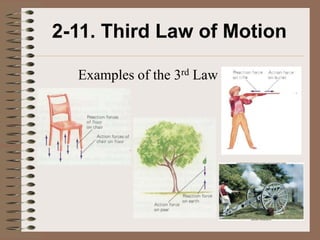
2-11. Third Law of Motion

  Examples of the 3rd Law
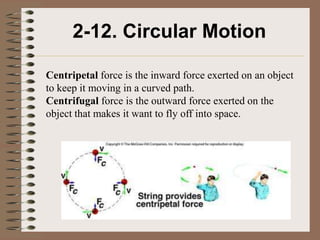
2-12. Circular Motion

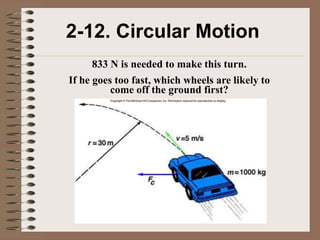
Centripetal force is the inward force exerted on an object
to keep it moving in a curved path.
Centrifugal force is the outward force exerted on the
object that makes it want to fly off into space.
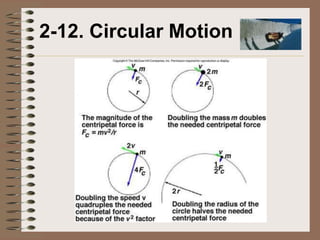
2-12. Circular Motion
     833 N is needed to make this turn.
If he goes too fast, which wheels are likely to
          come off the ground first?
2-13. Newton's Law of
           Gravity
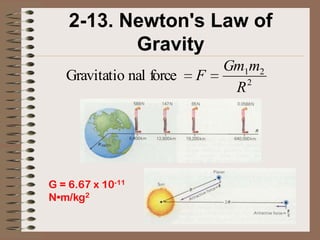
                              Gm1m2
   Gravitatio nal force   F      2
                               R


G = 6.67 x 10⁻¹¹
N•m/kg2
2-13. Newton's Law of
            Gravity

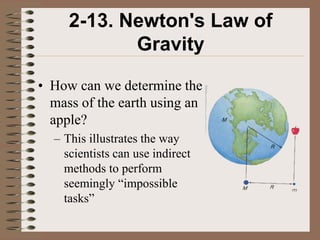
• How can we determine the
  mass of the earth using an
  apple?
  – This illustrates the way
    scientists can use indirect
    methods to perform
    seemingly “impossible
    tasks”
2-13. Newton's Law of
            Gravity
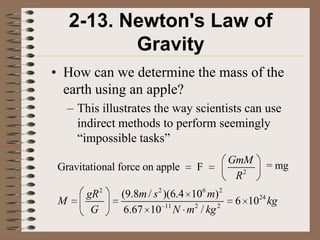
• How can we determine the mass of the
  earth using an apple?
     – This illustrates the way scientists can use
       indirect methods to perform seemingly
       “impossible tasks”
                                             GmM   = mg
 Gravitational force on apple      F
                                              R2
         gR 2   (9.8m / s 2 )(6.4 106 m) 2
 M                                           6 1024 kg
          G      6.67 10 11 N m2 / kg 2
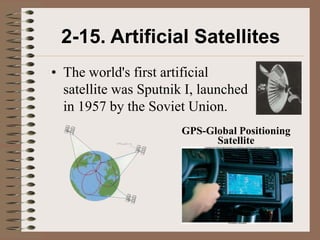
2-15. Artificial Satellites
• The world's first artificial
  satellite was Sputnik I, launched
  in 1957 by the Soviet Union.
                       GPS-Global Positioning
                             Satellite
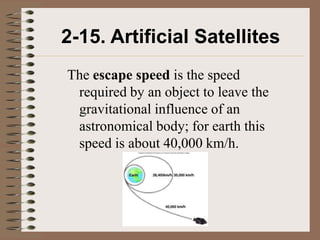
2-15. Artificial Satellites
The escape speed is the speed
 required by an object to leave the
 gravitational influence of an
 astronomical body; for earth this
 speed is about 40,000 km/h.
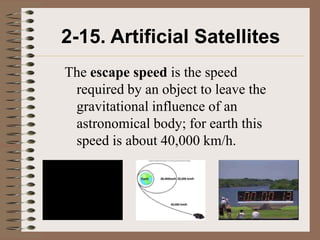
2-15. Artificial Satellites
The escape speed is the speed
 required by an object to leave the
 gravitational influence of an
 astronomical body; for earth this
 speed is about 40,000 km/h.

C2 motion

  • 1.
    Chapter 2 Motion 2-1.Speed 2-8. Mass 2-2. Vectors 2-9. Second Law of Motion 2-3. Acceleration 2-10. Mass and Weight 2-4. Distance, Time, and 2-11. Third Law of Motion Acceleration 2-12. Circular Motion 2-5. Free Fall System 2-13. Newton's Law of 2-6. Air Resistance Gravity 2-7. First Law of Motion 2-14. Artificial Satellites
  • 2.
    2-1. Speed • Definitions: – Speed • The rate at which something moves a given distance. • Faster speeds = greater distances – General formula for speed: • Speed = distance / time • Abbreviations commonly used: d = distance t = time v = speed v = d/t
  • 3.
    2-1. Speed Velocity d 100m iles m iles v 40 40m ph t 2.5hours hour Distance d v t 30 miles 6hours 180miles hour Time d 100m iles m iles t 2.5 2.5hours v 40m iles/ hour m iles/ hour
  • 4.
    2-1. Speed Average speedis the total distance traveled by an object divided by the time taken to travel that distance. Instantaneous speed is an object's speed at a given instant of time.
  • 5.
    2-2. Vectors Magnitude ofa quantity tells how large the quantity is. Scalar quantities have magnitude only. Vector quantities have both magnitude and direction.
  • 6.
    2-2. Vectors Velocity isa vector quantity that includes both speed and direction.
  • 7.
    2-3. Acceleration Acceleration ofan object is the rate of change of its velocity and is a vector quantity. For straight-line motion, average acceleration is the rate of change of speed: change in speed vf vi Accelerati on a time interval t
  • 8.
    2-3. Acceleration 3 Types of Acceleartion Speeding Up Slowing Down Turning
  • 9.
    2- 4. Distance,Time and Acceleration (V1 + V2) (20mph + 60mph) Vavg = = 40mph 2 2 d = vavg t 30mph 2hr = 60miles d = ½at2 ½ 10m/s/s 52 = 125m
  • 10.
    2-5. Free Fall Theacceleration of gravity (g) for objects in free fall at the earth's surface is 9.8 m/s2. Galileo found that all things fall at the same rate.
  • 11.
    2-5. Free Fall Therate of falling increases by 9.8 m/s every second. Height = ½ gt2 For example: ½ (9.8 )12 = 4.9 m ½(9.8)22 = 19.6 m ½ (9.8)32 = 44.1 m ½ (9.8)42 = 78.4 m
  • 12.
    2-5. Free Fall A ball thrown horizontally will fall at the same rate as a ball dropped directly.
  • 13.
    2-5. Free Fall A ball thrown into the air will slow down, stop, and then begin to fall with the acceleration due to gravity. When it passes the thrower, it will be traveling at the same rate at which it was thrown.
  • 14.
    2-5. Free Fall Anobject thrown upward at an angle to the ground follows a curved path called a parabola.
  • 15.
    2-6. Air Resistance •In air… – A stone falls faster than a feather • Air resistance affects stone less • In a vacuum – A stone and a feather will fall at the same speed.
  • 16.
    2-6. Air Resistance •Free Fall – A person in free fall reaches a terminal velocity of around 54 m/s – With a parachute, terminal velocity is only 6.3 m/s • Allows a safe landing
  • 17.
    2-6. Air Resistance •Ideal angle for a projectile – In a vacuum, maximum distance is at an angle of 45o – With air resistance (real world), angle is less • Baseball will go furthest hit at an angle of around 40o
  • 18.
    2-7. First Lawof Motion The first law of motion states: If no net force acts on it, an object at rest remains at rest and an object in motion remains in motion at a constant velocity.
  • 19.
    Foucault Pendulum Inertia keepsa pendulum swinging in the same direction regardless of the motion of the earth. This can be used to measure the motion of the earth. As the Foucault Pendulum swings it appears to be rotating, but it is the earth that is rotating under it. To the right is the Foucault Pendulum at the Pantheon in Paris, France.
  • 20.
    Foucault Pendulum Other Websites that illustrate the Foucault Pendulum. http://en.wikipedia.org/wiki/File:Foucault- rotz.gif http://www.physclips.unsw.edu.au/jw/foucault_ pendulum.html http://aspire.cosmic- ray.org/labs/scientific_method/pendulum.swf http://www.calacademy.org/products/pendulum/ page7.htm http://www.youtube.com/watch?v=nB2SXLYw KkM
  • 21.
    2-8. Mass Inertia isthe apparent resistance an object offers to any change in its state of rest or motion.
  • 22.
    2-9. Second Lawof Motion Newton's second law of motion states: The net force on an object equals the product of the mass and the acceleration of the object. The direction of the force is the same as that of the acceleration. F = Ma
  • 23.
    2-9. Second Lawof Motion A force is any influence that can cause an object to be accelerated. The pound (lb) is the unit of force in the British system of measurement: 1 lb = 4.45 N (1 N 2 1 newton 1 N 1 (kg)(m/s ) = 0.225 lb)
  • 24.
    2-10. Mass andWeight • Weight Definition: The force with which an object is attracted by the earth’s gravitational pull • Example: A person weighing 160 lbs is being pulled towards the earth with a force of 160 lbs (712 N). – Near the earth’s surface, weight and mass are essentially the same Weight (mass)(acc elerationof gravity) w mg
  • 25.
    2-11. Third Lawof Motion The third law of motion states: When one object exerts a force on a second object, the second object exerts an equal force in the opposite direction on the first object.
  • 26.
    2-11. Third Lawof Motion Examples of the 3rd Law
  • 27.
    2-12. Circular Motion Centripetalforce is the inward force exerted on an object to keep it moving in a curved path. Centrifugal force is the outward force exerted on the object that makes it want to fly off into space.
  • 28.
  • 29.
    2-12. Circular Motion 833 N is needed to make this turn. If he goes too fast, which wheels are likely to come off the ground first?
  • 30.
    2-13. Newton's Lawof Gravity Gm1m2 Gravitatio nal force F 2 R G = 6.67 x 10⁻¹¹ N•m/kg2
  • 31.
    2-13. Newton's Lawof Gravity • How can we determine the mass of the earth using an apple? – This illustrates the way scientists can use indirect methods to perform seemingly “impossible tasks”
  • 32.
    2-13. Newton's Lawof Gravity • How can we determine the mass of the earth using an apple? – This illustrates the way scientists can use indirect methods to perform seemingly “impossible tasks” GmM = mg Gravitational force on apple F R2 gR 2 (9.8m / s 2 )(6.4 106 m) 2 M 6 1024 kg G 6.67 10 11 N m2 / kg 2
  • 33.
    2-15. Artificial Satellites •The world's first artificial satellite was Sputnik I, launched in 1957 by the Soviet Union. GPS-Global Positioning Satellite
  • 34.
    2-15. Artificial Satellites Theescape speed is the speed required by an object to leave the gravitational influence of an astronomical body; for earth this speed is about 40,000 km/h.
  • 35.
    2-15. Artificial Satellites Theescape speed is the speed required by an object to leave the gravitational influence of an astronomical body; for earth this speed is about 40,000 km/h.