RASTER DATA MODEL
A SEMINOR ON
SEMINOR CONTENTS
INTRODUCTION
RASTER DATA MODEL
USES OF RASTER DATA MODEL
TYPES OF RASTER DATA
VECTOR GRAPHICS
RASTER DATA FORMATS
ADVANTAGES AND DISADVANTAGES
CONCLUSION
REFERENCE
INTRODUTION
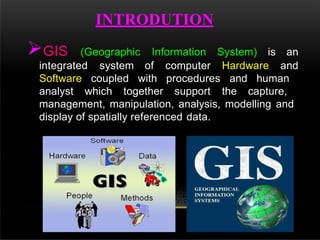
GIS (Geographic Information System) is an
integrated system of computer Hardware and
Software coupled with procedures and human
analyst which together support the capture,
management, manipulation, analysis, modelling and
display of spatially referenced data.
CONT…
HARD WARE
Computers, Networks, Printers
SOFTWARE
GIS Software, Database software, OS Software,
Network Software
DATA
Vector Data, Raster Data, Image Data, Attribute
Data
METHODS
Guidelines, Standards, Procedures
PEOPLES
Administrators, Managers, GIS Technician's,
Application
experts , End User, Consumers
TYPES OF GIS DATA
The basic data type in a GIS reflects traditional data
found on a map. Accordingly, GIS technology utilizes two
basic types of data:
 SPATIAL DATA
Describes the absolute and relative location of
geographic features.
 ATTRIBUTE DATA
Describes characteristics of the spatial features.
These characteristics can be quantitative
and/or qualitative in nature.
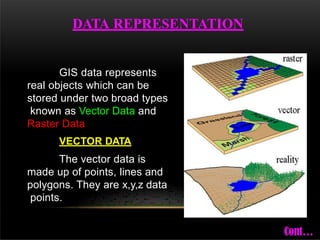
GIS data represents
real objects which can be
stored under two broad types
known as Vector Data and
Raster Data
VECTOR DATA
The vector data is
made up of points, lines and
polygons. They are x,y,z data
points.
DATA REPRESENTATION
RASTER DATA MODEL
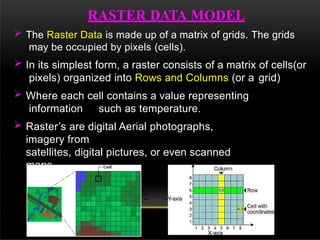
 The Raster Data is made up of a matrix of grids. The grids
may be occupied by pixels (cells).
 In its simplest form, a raster consists of a matrix of cells(or
pixels) organized into Rows and Columns (or a grid)
 Where each cell contains a value representing
information such as temperature.
 Raster’s are digital Aerial photographs,
imagery from
satellites, digital pictures, or even scanned
maps.
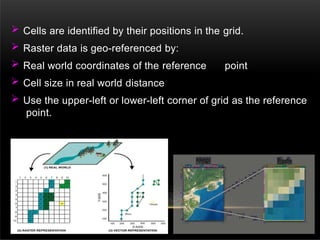
 Cells are identified by their positions in the grid.
 Raster data is geo-referenced by:
 Real world coordinates of the reference point
 Cell size in real world distance
 Use the upper-left or lower-left corner of grid as the reference
point.
DIFFERENCE BETWEEN RASTER
AND VECTOR
DATA SETS
As compared to the vector data structure, the
raster data structure is not particularly accurate at
representing discrete features - that is, those features
that have a distinct boundary or shape.
The term Raster implies a regularly spaced grid.
Raster data consists of rows and columns of cells (or
pixels). In this format a single value is stored against
each cell. Raster data can represent a multiplicity of
things including:
Cont…
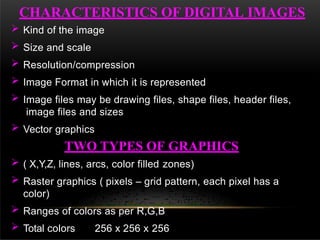
 Kind of the image
 Size and scale
 Resolution/compression
 Image Format in which it is represented
 Image files may be drawing files, shape files, header files,
image files and sizes
 Vector graphics
TWO TYPES OF GRAPHICS
 ( X,Y,Z, lines, arcs, color filled zones)
 Raster graphics ( pixels – grid pattern, each pixel has a
color)
 Ranges of colors as per R,G,B
 Total colors 256 x 256 x 256
CHARACTERISTICS OF DIGITAL IMAGES
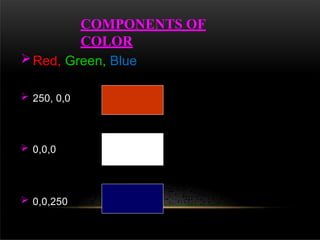
Red, Green, Blue
 250, 0,0
 0,0,0
 0,0,250
COMPONENTS OF
COLOR
Raster data is stored in various formats; some
of these include
 BMP (Bitmap Image)
 TIFF (Tag Index File Format)
 JPEG/JPG (Joint Photographic Expert Group)
 IMG (Image File Format)
 GIF (Graphic Intercharge Format)
 PSP (Portable Sony Play station)
 CDR (Crash Data Retrieval)
POPULAR RASTER IMAGE FILES
 Vector (also known as "object-oriented") graphics are
constructed using mathematical formulas describing
shapes, colors, and placement.
 Rather than a grid of pixels, a vector graphic consists of
shapes, curves, lines, and text which together make a
picture.
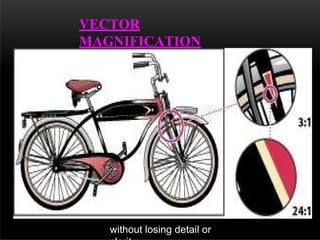
 Vector graphics are resolution-independent--that is, they
can be scaled to any size and printed at any resolution
without losing detail or clarity.
 As a result, vector graphics are the best choice for
representing bold graphics that must retain crisp
lines when scaled to various sizes--for example,
logos.
VECTOR GRAPHICS
VECTOR
MAGNIFICATION
without losing detail or
SVG, OR SCALABLE VECTOR GRAPHICS
 Is a language for describing vector graphics in XML
(Extensible Markup Language).
 With SVG, one can code graphics directly into an XML
document.
GRAY-SCALE
 Example of a Gray-scale Bit-map Image
 Each pixel is usually stored as a byte (value between
0 to
255)
 A 640 x 480 Gray-scale image requires over 300 KB of
storage.
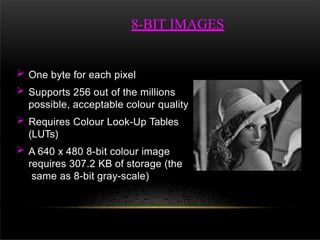
 One byte for each pixel
 Supports 256 out of the millions
possible, acceptable colour quality
 Requires Colour Look-Up Tables
(LUTs)
 A 640 x 480 8-bit colour image
requires 307.2 KB of storage (the
same as 8-bit gray-scale)
8-BIT IMAGES
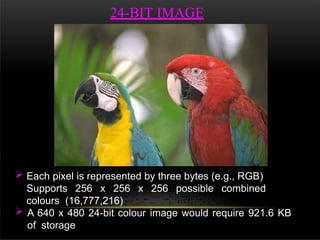
24-BIT IMAGE
 Each pixel is represented by three bytes (e.g., RGB)
Supports 256 x 256 x 256 possible combined
colours (16,777,216)
 A 640 x 480 24-bit colour image would require 921.6 KB
of storage
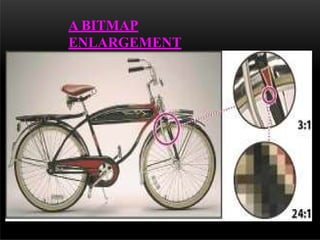
A BITMAP
ENLARGEMENT
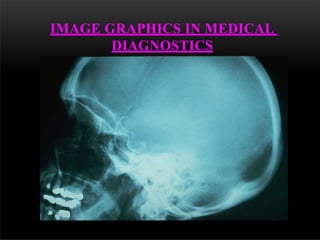
IMAGE GRAPHICS IN MEDICAL
DIAGNOSTICS
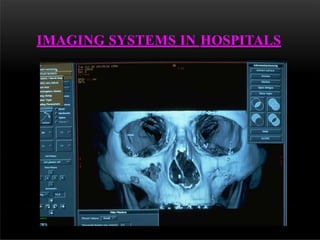
IMAGING SYSTEMS IN HOSPITALS
PHOTOGRAPHIC IMAGES-DIGITAL
VECTOR GRAPHICS - CLIP
ART
RASTER GRAPHICS
 Depends on the Image Resolution
 Image Size, number of pixels
 Compression and decompression
 Display systems
 Main factor: Pixel dimension
 The display size of an image on-screen is determined by
the pixel dimensions of the image plus the size and
setting of the monitor.
QUALITY OF AN IMAGE
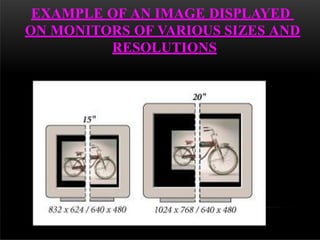
EXAMPLE OF AN IMAGE DISPLAYED
ON MONITORS OF VARIOUS SIZES AND
RESOLUTIONS
PIXELS PER SQ. INCH
EXAMPLE OF AN IMAGE AT 72-PPI
AND
300-PPI ( Pixels Per Inch )
 Image resolution
 Monitor resolution/ Printer resolution
 Screen frequency
 File type, format, compression
 File size
 Maximum pixel
KEY FACTORS
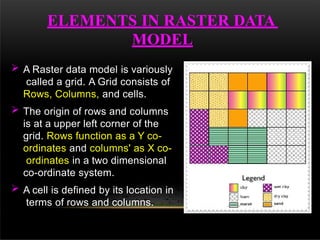
 A Raster data model is variously
called a grid. A Grid consists of
Rows, Columns, and cells.
 The origin of rows and columns
is at a upper left corner of the
grid. Rows function as a Y co-
ordinates and columns' as X co-
ordinates in a two dimensional
co-ordinate system.
 A cell is defined by its location in
terms of rows and columns.
ELEMENTS IN RASTER DATA
MODEL
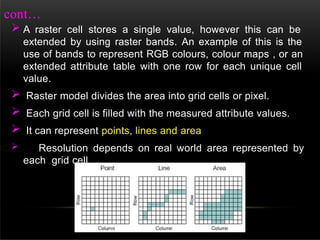
 A raster cell stores a single value, however this can be
extended by using raster bands. An example of this is the
use of bands to represent RGB colours, colour maps , or an
extended attribute table with one row for each unique cell
value.
 Raster model divides the area into grid cells or pixel.
 Each grid cell is filled with the measured attribute values.
 It can represent points, lines and area
 Resolution depends on real world area represented by
each grid cell.
cont…
DISCRETE AND CONTINUONS
DATA
When data is presented in raster format, they may
be discrete or continuous data.
 1. The numeric distribution of discrete data are
independent numbers and the geographic distribution
has abrupt boundaries.
 2. The numeric distribution of continuous data are a
range of values and their geographic distribution is
along a spatial gradient.
 Geographical variation in the real world is infinitely
complex
 The closer you look, the more detail you see, almost
without limit
 It would take an infinitely large database to capture the
real world precisely.
 Raster grid cells allow us to approximate the variation over
a landscape.
 Data must somehow be reduced to a finite and
manageable quantity by a process of generalization or
abstraction.
 We have to pick out the most characteristic features.
 Geographical variation must be represented in terms of
discrete elements or objects
USES OF RASTER DATA MODEL
TYPES OF RASTER DATA
SATELLITE IMAGERY
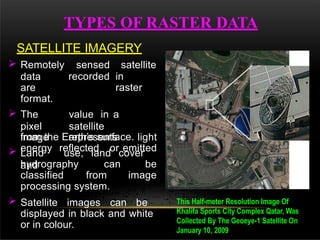
 Remotely sensed satellite
data
are
format.
recorded in
raster
 The
pixel
value in a
satellite
image represents light
energy reflected or emitted
from the Earth’s surface.
 Land use, land cover
and
hydrography can be
classified from image
processing system.
 Satellite images can be
displayed in black and white
or in colour.
This Half-meter Resolution Image Of
Khalifa Sports City Complex Qatar, Was
Collected By The Geoeye-1 Satellite On
January 10, 2009
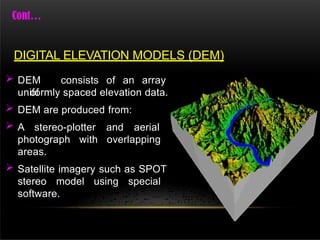
 DEM consists of an array
of
uniformly spaced elevation data.
 DEM are produced from:
 A stereo-plotter and aerial
photograph with overlapping
areas.
 Satellite imagery such as SPOT
stereo model using special
software.
DIGITAL ELEVATION MODELS (DEM)
Reference Frame
'
I
...,
_ ·- ._,
_
-!- ·-
' I
I
.
,
I
I
....}
.
-f F, O - ,
·'
.•
H .
,
. ·1-
1 ,-..
., ,-
-
f
-
t +- - . - J ••
,-.'
!'
t
4
"
1,l
m
1.800
-
'1.82
3
1.lfl4
U1
41
UilJ ;
.. - - -- -- t
1,81
17
2,31
8 :'
:
.
f1-
6
.
.
1 ,S1i'
'1.&l
1,tol 1$16
1 4 11'3
1.927
1.sli
1,B:']6
, 1
l
,
F
i
f
l
3
-
-
1.79
5
r r B
m
.318
1, 94
·™
1.770
.
w
1,10:i
1,7'84
·
1:i'ta
T
3 T m m r .. ·
Dat a Values
20 Latt ice
n
oo1
! G r..,t
10, lff i
I Q r8'lt
uoo r"""
'15'0Q
[ ,.,;l
'l]Oi) jQ-,et
11 . , .., ,
aoo
fe,c,!
Jl)or l
oor t
2D Grid
30 Lattice
3D Grid
G1
rid- b ased dat,a c.a1
1
1 be displayed ilil 2D/ 3D tattice 0 1
r grid
for ms 7
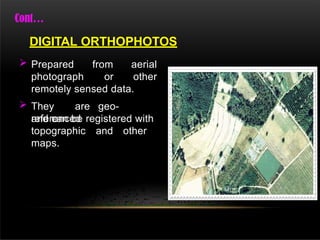
 Prepared
photograph
from aerial
or other
remotely sensed data.
 They are geo-
referenced
and can be registered with
topographic and other
maps.
DIGITAL ORTHOPHOTOS
BINARY SCANNED FILES
 Scanned image containing values of 1 and 0.
 Maps to be digitized are typically scanned at 300 or 400 dpi
(dots per square inch).
GRAPHIC FILES
 Maps, photographs and images can be stored as
digital graphic files.
 The
Geographic
location of each cell is implied by its
position in the cell matrix.
 Due to the nature of the data storage technique,
data
analysis is usually easy to program and quick to perform.
 The inherent nature of raster maps, e.g. one attribute maps,
is ideally suited for mathematical modelling and quantitative
analysis.
 Discrete data, e.g. forestry stands, is accommodated equally
well as continuous data, e.g. Elevation data, and facilitates
the integrating of the two data types.
ADVANTAGES
 Grid-cell systems are very compatible with raster-
based output devices.
cont…
 The cell size determines the resolution at which the data is
represented;
 It is especially difficult to adequately represent
linear
features depending on the cell resolution.
 Since most input data is in vector form, data must undergo
vector-to-raster conversion. Besides increased processing
requirements this may introduce data integrity concerns due
to generalization and choice of inappropriate cell size.
 Most output maps from grid-cell systems do not conform to
high-quality cartographic needs.
DISADVANTAGES
CONCLUSION
 GIS data is stored in two types: Raster Data and Vector Data
 Raster data consists of rows and columns of cells (or pixels).
 Raster data may be discrete or continuous.
 Raster data allows approximation of variation over
a
landscape. It makes data finite and manageable.
 Types of raster includes satellite imageries, Digital Elevation
Models, Digital Orthophotos, binary scanned files and
graphic files.
 Raster data may be stored as TIFF, Geo TIFF, GIF, JPEG,
etc.
 The inherent nature of raster maps, e.g. one attribute maps,
is ideally suited for mathematical modelling and quantitative
analysis.
REFERENCE
 B. BHATTA, (2008) Remote Sensing And Gis Oxford University
Press, Pp: 442,121,129,135, 144.
 FLOYD F. SABINS, (1996/1997) Remote Sensing Principles
And Interpretation, W.H. FREEMAN AND COMPANY
NEWYORK 3rd Edition, Pp: 29,69,105,177,236.
 KALICHARAN SAHU, (2008), Text Book Of Remote Sensing
And Gis, Atlantic Publications, Pp: 1-2,127-198.
 Textbook Of Remote Sensing And Geographical Information
System, M.ANJI REDDY, Second Edition, Pp 1-23.
WEBSITES
 http://en.wikipedia.org/wiki/Raster_data
 http://geospatial.referata.com/wiki/Raster_Data_Model
 http://gis.stackexchange.com/questions/57142/what-is-the-
difference-between-vector-and-raster-data-models
BOOKS
THANK YOU

rasterdatamodel.........................

  • 1.
  • 2.
    SEMINOR CONTENTS INTRODUCTION RASTER DATAMODEL USES OF RASTER DATA MODEL TYPES OF RASTER DATA VECTOR GRAPHICS RASTER DATA FORMATS ADVANTAGES AND DISADVANTAGES CONCLUSION REFERENCE
  • 3.
    INTRODUTION GIS (Geographic InformationSystem) is an integrated system of computer Hardware and Software coupled with procedures and human analyst which together support the capture, management, manipulation, analysis, modelling and display of spatially referenced data.
  • 4.
    CONT… HARD WARE Computers, Networks,Printers SOFTWARE GIS Software, Database software, OS Software, Network Software DATA Vector Data, Raster Data, Image Data, Attribute Data METHODS Guidelines, Standards, Procedures PEOPLES Administrators, Managers, GIS Technician's, Application experts , End User, Consumers
  • 5.
    TYPES OF GISDATA The basic data type in a GIS reflects traditional data found on a map. Accordingly, GIS technology utilizes two basic types of data:  SPATIAL DATA Describes the absolute and relative location of geographic features.  ATTRIBUTE DATA Describes characteristics of the spatial features. These characteristics can be quantitative and/or qualitative in nature.
  • 6.
    GIS data represents realobjects which can be stored under two broad types known as Vector Data and Raster Data VECTOR DATA The vector data is made up of points, lines and polygons. They are x,y,z data points. DATA REPRESENTATION
  • 7.
    RASTER DATA MODEL The Raster Data is made up of a matrix of grids. The grids may be occupied by pixels (cells).  In its simplest form, a raster consists of a matrix of cells(or pixels) organized into Rows and Columns (or a grid)  Where each cell contains a value representing information such as temperature.  Raster’s are digital Aerial photographs, imagery from satellites, digital pictures, or even scanned maps.
  • 8.
     Cells areidentified by their positions in the grid.  Raster data is geo-referenced by:  Real world coordinates of the reference point  Cell size in real world distance  Use the upper-left or lower-left corner of grid as the reference point.
  • 9.
    DIFFERENCE BETWEEN RASTER ANDVECTOR DATA SETS As compared to the vector data structure, the raster data structure is not particularly accurate at representing discrete features - that is, those features that have a distinct boundary or shape. The term Raster implies a regularly spaced grid. Raster data consists of rows and columns of cells (or pixels). In this format a single value is stored against each cell. Raster data can represent a multiplicity of things including: Cont…
  • 10.
     Kind ofthe image  Size and scale  Resolution/compression  Image Format in which it is represented  Image files may be drawing files, shape files, header files, image files and sizes  Vector graphics TWO TYPES OF GRAPHICS  ( X,Y,Z, lines, arcs, color filled zones)  Raster graphics ( pixels – grid pattern, each pixel has a color)  Ranges of colors as per R,G,B  Total colors 256 x 256 x 256 CHARACTERISTICS OF DIGITAL IMAGES
  • 11.
    Red, Green, Blue 250, 0,0  0,0,0  0,0,250 COMPONENTS OF COLOR
  • 12.
    Raster data isstored in various formats; some of these include  BMP (Bitmap Image)  TIFF (Tag Index File Format)  JPEG/JPG (Joint Photographic Expert Group)  IMG (Image File Format)  GIF (Graphic Intercharge Format)  PSP (Portable Sony Play station)  CDR (Crash Data Retrieval) POPULAR RASTER IMAGE FILES
  • 13.
     Vector (alsoknown as "object-oriented") graphics are constructed using mathematical formulas describing shapes, colors, and placement.  Rather than a grid of pixels, a vector graphic consists of shapes, curves, lines, and text which together make a picture.  Vector graphics are resolution-independent--that is, they can be scaled to any size and printed at any resolution without losing detail or clarity.  As a result, vector graphics are the best choice for representing bold graphics that must retain crisp lines when scaled to various sizes--for example, logos. VECTOR GRAPHICS
  • 14.
  • 15.
    SVG, OR SCALABLEVECTOR GRAPHICS  Is a language for describing vector graphics in XML (Extensible Markup Language).  With SVG, one can code graphics directly into an XML document. GRAY-SCALE  Example of a Gray-scale Bit-map Image  Each pixel is usually stored as a byte (value between 0 to 255)  A 640 x 480 Gray-scale image requires over 300 KB of storage.
  • 16.
     One bytefor each pixel  Supports 256 out of the millions possible, acceptable colour quality  Requires Colour Look-Up Tables (LUTs)  A 640 x 480 8-bit colour image requires 307.2 KB of storage (the same as 8-bit gray-scale) 8-BIT IMAGES
  • 17.
    24-BIT IMAGE  Eachpixel is represented by three bytes (e.g., RGB) Supports 256 x 256 x 256 possible combined colours (16,777,216)  A 640 x 480 24-bit colour image would require 921.6 KB of storage
  • 18.
  • 19.
    IMAGE GRAPHICS INMEDICAL DIAGNOSTICS
  • 20.
  • 21.
  • 22.
  • 23.
  • 24.
     Depends onthe Image Resolution  Image Size, number of pixels  Compression and decompression  Display systems  Main factor: Pixel dimension  The display size of an image on-screen is determined by the pixel dimensions of the image plus the size and setting of the monitor. QUALITY OF AN IMAGE
  • 25.
    EXAMPLE OF ANIMAGE DISPLAYED ON MONITORS OF VARIOUS SIZES AND RESOLUTIONS
  • 26.
    PIXELS PER SQ.INCH EXAMPLE OF AN IMAGE AT 72-PPI AND 300-PPI ( Pixels Per Inch )
  • 27.
     Image resolution Monitor resolution/ Printer resolution  Screen frequency  File type, format, compression  File size  Maximum pixel KEY FACTORS
  • 28.
     A Rasterdata model is variously called a grid. A Grid consists of Rows, Columns, and cells.  The origin of rows and columns is at a upper left corner of the grid. Rows function as a Y co- ordinates and columns' as X co- ordinates in a two dimensional co-ordinate system.  A cell is defined by its location in terms of rows and columns. ELEMENTS IN RASTER DATA MODEL
  • 29.
     A rastercell stores a single value, however this can be extended by using raster bands. An example of this is the use of bands to represent RGB colours, colour maps , or an extended attribute table with one row for each unique cell value.  Raster model divides the area into grid cells or pixel.  Each grid cell is filled with the measured attribute values.  It can represent points, lines and area  Resolution depends on real world area represented by each grid cell. cont…
  • 30.
    DISCRETE AND CONTINUONS DATA Whendata is presented in raster format, they may be discrete or continuous data.  1. The numeric distribution of discrete data are independent numbers and the geographic distribution has abrupt boundaries.  2. The numeric distribution of continuous data are a range of values and their geographic distribution is along a spatial gradient.
  • 31.
     Geographical variationin the real world is infinitely complex  The closer you look, the more detail you see, almost without limit  It would take an infinitely large database to capture the real world precisely.  Raster grid cells allow us to approximate the variation over a landscape.  Data must somehow be reduced to a finite and manageable quantity by a process of generalization or abstraction.  We have to pick out the most characteristic features.  Geographical variation must be represented in terms of discrete elements or objects USES OF RASTER DATA MODEL
  • 32.
    TYPES OF RASTERDATA SATELLITE IMAGERY  Remotely sensed satellite data are format. recorded in raster  The pixel value in a satellite image represents light energy reflected or emitted from the Earth’s surface.  Land use, land cover and hydrography can be classified from image processing system.  Satellite images can be displayed in black and white or in colour. This Half-meter Resolution Image Of Khalifa Sports City Complex Qatar, Was Collected By The Geoeye-1 Satellite On January 10, 2009
  • 33.
     DEM consistsof an array of uniformly spaced elevation data.  DEM are produced from:  A stereo-plotter and aerial photograph with overlapping areas.  Satellite imagery such as SPOT stereo model using special software. DIGITAL ELEVATION MODELS (DEM)
  • 34.
    Reference Frame ' I ..., _ ·-._, _ -!- ·- ' I I . , I I ....} . -f F, O - , ·' .• H . , . ·1- 1 ,-.. ., ,- - f - t +- - . - J •• ,-.' !' t 4 " 1,l m 1.800 - '1.82 3 1.lfl4 U1 41 UilJ ; .. - - -- -- t 1,81 17 2,31 8 :' : . f1- 6 . . 1 ,S1i' '1.&l 1,tol 1$16 1 4 11'3 1.927 1.sli 1,B:']6 , 1 l , F i f l 3 - - 1.79 5 r r B m .318 1, 94 ·™ 1.770 . w 1,10:i 1,7'84 · 1:i'ta T 3 T m m r .. · Dat a Values 20 Latt ice n oo1 ! G r..,t 10, lff i I Q r8'lt uoo r""" '15'0Q [ ,.,;l 'l]Oi) jQ-,et 11 . , .., , aoo fe,c,! Jl)or l oor t 2D Grid 30 Lattice 3D Grid G1 rid- b ased dat,a c.a1 1 1 be displayed ilil 2D/ 3D tattice 0 1 r grid for ms 7
  • 35.
     Prepared photograph from aerial orother remotely sensed data.  They are geo- referenced and can be registered with topographic and other maps. DIGITAL ORTHOPHOTOS
  • 36.
    BINARY SCANNED FILES Scanned image containing values of 1 and 0.  Maps to be digitized are typically scanned at 300 or 400 dpi (dots per square inch). GRAPHIC FILES  Maps, photographs and images can be stored as digital graphic files.
  • 37.
     The Geographic location ofeach cell is implied by its position in the cell matrix.  Due to the nature of the data storage technique, data analysis is usually easy to program and quick to perform.  The inherent nature of raster maps, e.g. one attribute maps, is ideally suited for mathematical modelling and quantitative analysis.  Discrete data, e.g. forestry stands, is accommodated equally well as continuous data, e.g. Elevation data, and facilitates the integrating of the two data types. ADVANTAGES  Grid-cell systems are very compatible with raster- based output devices. cont…
  • 38.
     The cellsize determines the resolution at which the data is represented;  It is especially difficult to adequately represent linear features depending on the cell resolution.  Since most input data is in vector form, data must undergo vector-to-raster conversion. Besides increased processing requirements this may introduce data integrity concerns due to generalization and choice of inappropriate cell size.  Most output maps from grid-cell systems do not conform to high-quality cartographic needs. DISADVANTAGES
  • 39.
    CONCLUSION  GIS datais stored in two types: Raster Data and Vector Data  Raster data consists of rows and columns of cells (or pixels).  Raster data may be discrete or continuous.  Raster data allows approximation of variation over a landscape. It makes data finite and manageable.  Types of raster includes satellite imageries, Digital Elevation Models, Digital Orthophotos, binary scanned files and graphic files.  Raster data may be stored as TIFF, Geo TIFF, GIF, JPEG, etc.  The inherent nature of raster maps, e.g. one attribute maps, is ideally suited for mathematical modelling and quantitative analysis.
  • 40.
    REFERENCE  B. BHATTA,(2008) Remote Sensing And Gis Oxford University Press, Pp: 442,121,129,135, 144.  FLOYD F. SABINS, (1996/1997) Remote Sensing Principles And Interpretation, W.H. FREEMAN AND COMPANY NEWYORK 3rd Edition, Pp: 29,69,105,177,236.  KALICHARAN SAHU, (2008), Text Book Of Remote Sensing And Gis, Atlantic Publications, Pp: 1-2,127-198.  Textbook Of Remote Sensing And Geographical Information System, M.ANJI REDDY, Second Edition, Pp 1-23. WEBSITES  http://en.wikipedia.org/wiki/Raster_data  http://geospatial.referata.com/wiki/Raster_Data_Model  http://gis.stackexchange.com/questions/57142/what-is-the- difference-between-vector-and-raster-data-models BOOKS
  • 42.