Theoretical Approaches in
Teaching and Learning in the
Clinical Setting
Prepared By: Mae Michelle Aguilar RN
NRSG 215A
Objectives
• To know the different Learning Theories
applied in the nursing education.
• Identify different learning styles, types and
models.
• Determine the application of Learning
Theories in approaches to teaching in the
clinical setting.
LEARNING THEORIES
• BEHAVIORIST THEORIES
• COGNITIVE THEORIES
• SOCIAL THEORIES
BEHAVIORIST THEORIES
• Focuses of objectively observable behavior.
• The acquisition of new behavior is based on
environmental conditions where there is a
stimulus (S) that produces a response (R).
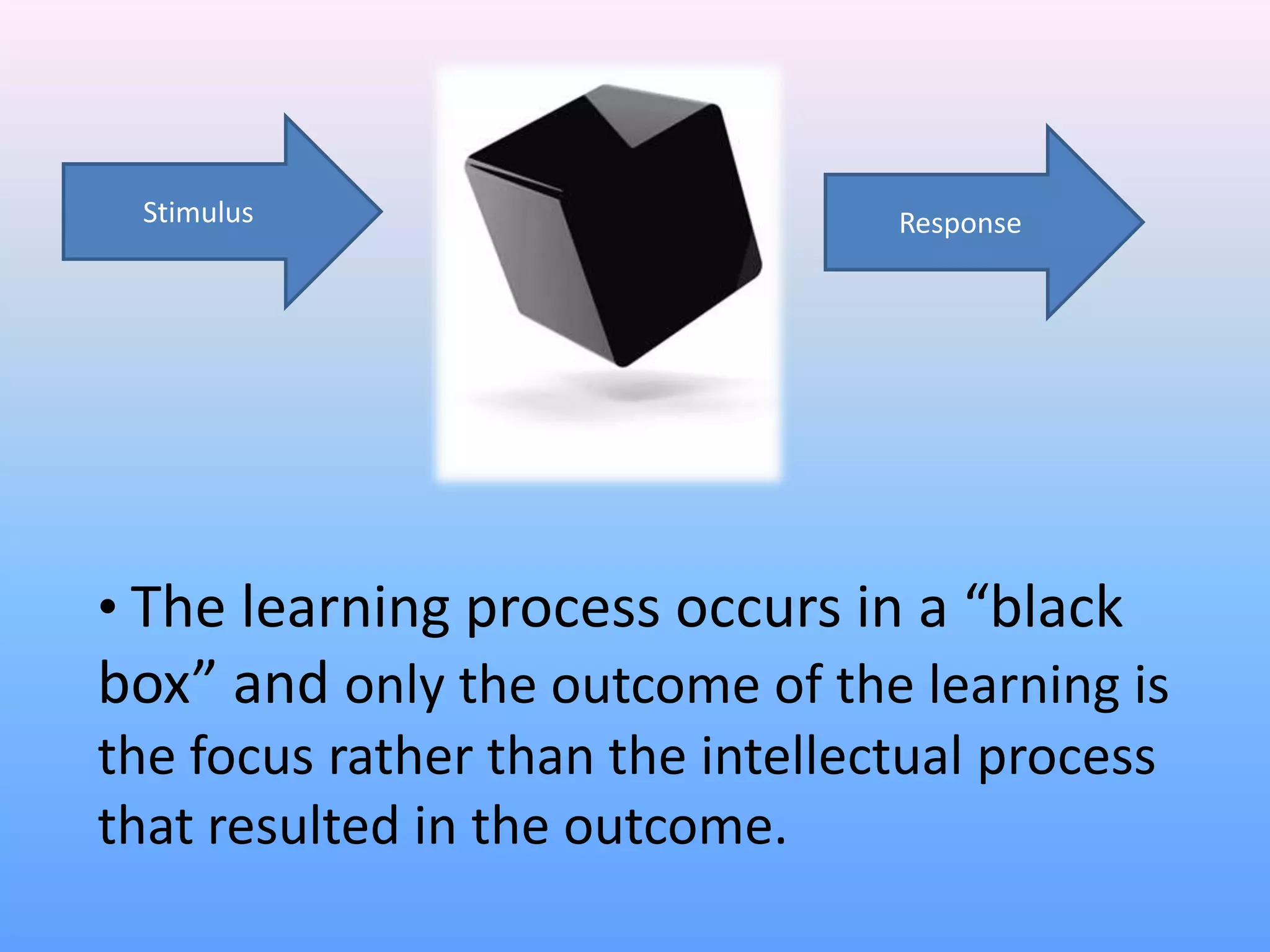
• The learning process occurs in a “black
box” and only the outcome of the learning is
the focus rather than the intellectual process
that resulted in the outcome.
Stimulus Response
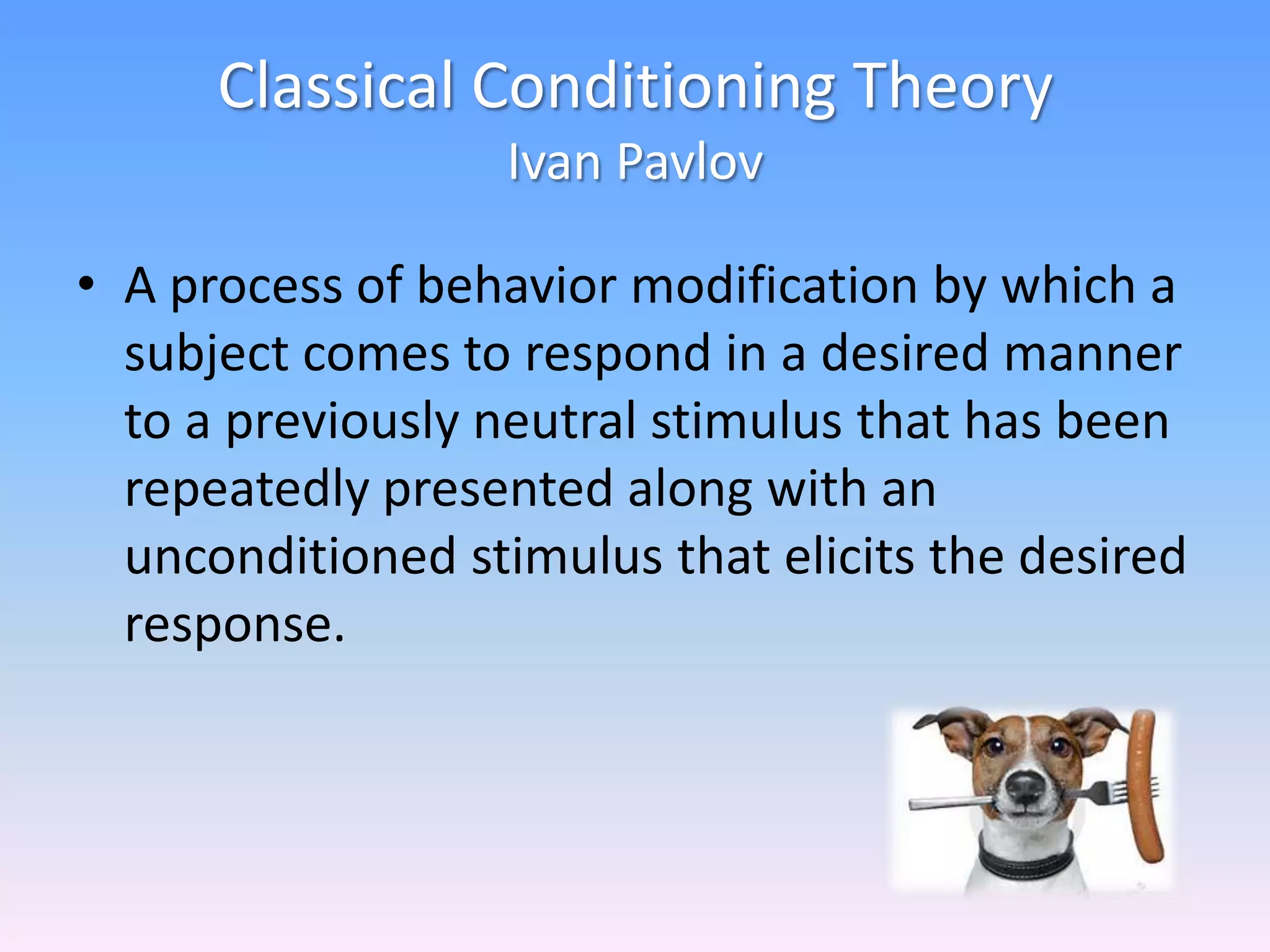
Classical Conditioning Theory
Ivan Pavlov
• A process of behavior modification by which a
subject comes to respond in a desired manner
to a previously neutral stimulus that has been
repeatedly presented along with an
unconditioned stimulus that elicits the desired
response.
Basic Principles of the Process
• Unconditioned Stimuli – Automatically or
naturally triggers a response.
• Unconditioned Response – Response that occurs
naturally to the unconditioned stimuli.
• Conditioned Stimulus - previously neutral
stimulus that, after becoming associated with the
unconditioned stimulus, eventually comes to
trigger a conditioned response.
• Conditioned Response – The learned response.
Application: Learning CPR
• US: Seeing an unconscious person.
• UR: Attempting to rouse that person.
• CS: “CODE BLUE”
• CR: Nurse need not to witness the
unconscious individual to know what is
happening and how to respond.
BEHAVIORISM THEORY
John Watson
“A man is stripped of his responsibility, freedom and dignity and
is reduced to a purely biological being, to be reshaped by
those who are able to use the tools of Behaviorism
effectively.” -John Watson
• Behavior is a result of a series of conditioned
reflexes and all emotion and thought is a
result of behavior learned through
conditioning.
CONTIGUITY THEORY
Edwin Ray Guthrie
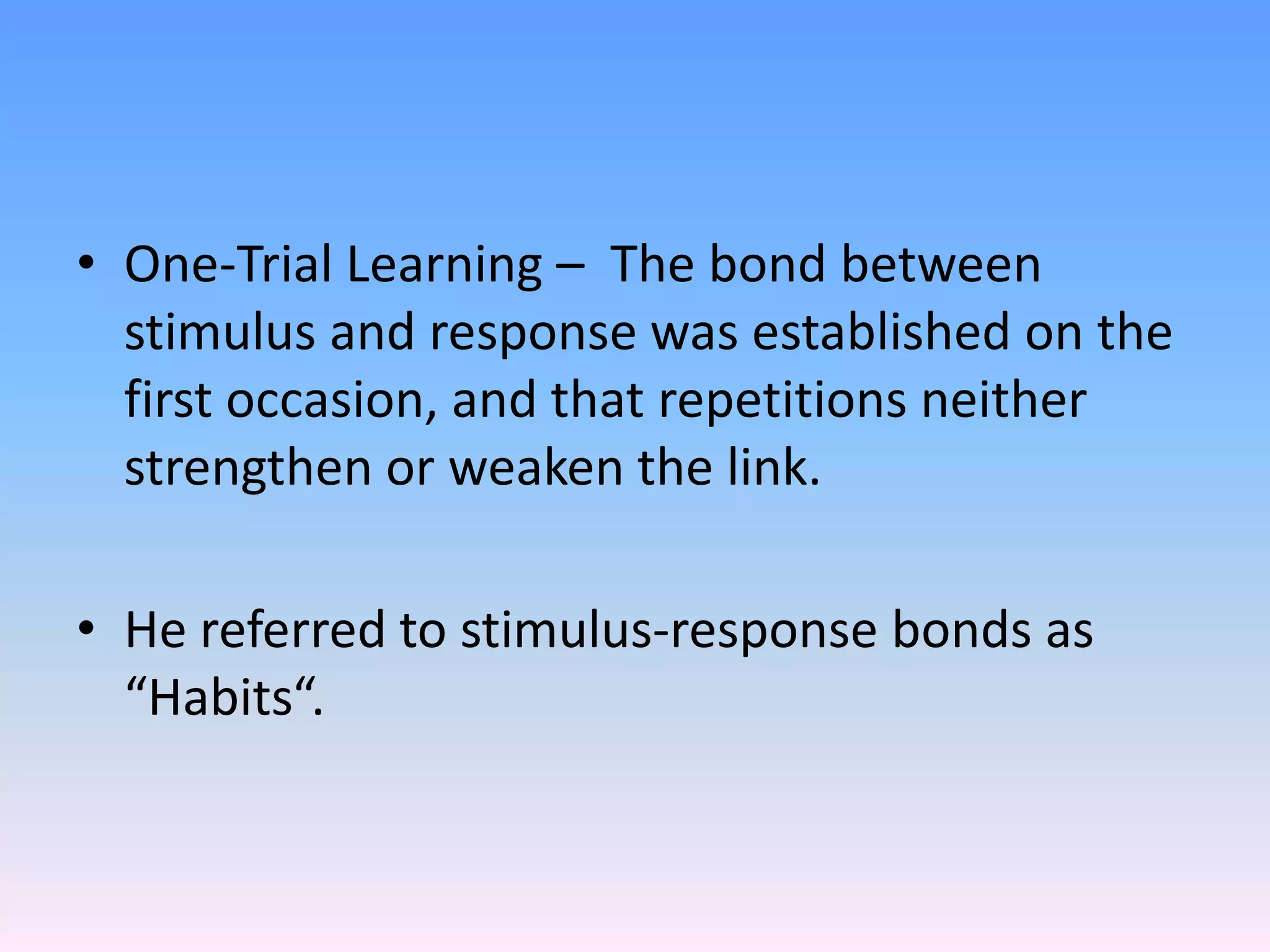
“A combination of stimulus which has accompanied a
movement will on its recurrence tends to be followed by
that movement.” (Guthrie 1952)
Guthrie-Horton Experiment
• One-Trial Learning – The bond between
stimulus and response was established on the
first occasion, and that repetitions neither
strengthen or weaken the link.
• He referred to stimulus-response bonds as
“Habits“.
PRINCIPLES:
• Learning occurs through doing.
• Since learning involves the conditioning of specific
movements, instruction must present very specific
tasks
• Exposure to many variations in stimulus patterns is
desirable in order to produce a generalized
response.
• The last response in a learning situation should be
correct since it is the one that will be associated.
CONNECTIONISM THEORY
Edward Thorndike
• “Reward and Punishment”
3 Laws:
1. Exercise and Repetition – the more the
stimulus induced response is repeated, the
longer it will be retained.
2. Law of Effect – Pleasure-Pain Principle.
3. The Law of Readiness - a series of responses
can be chained together to satisfy some goal
which will result in annoyance if blocked.
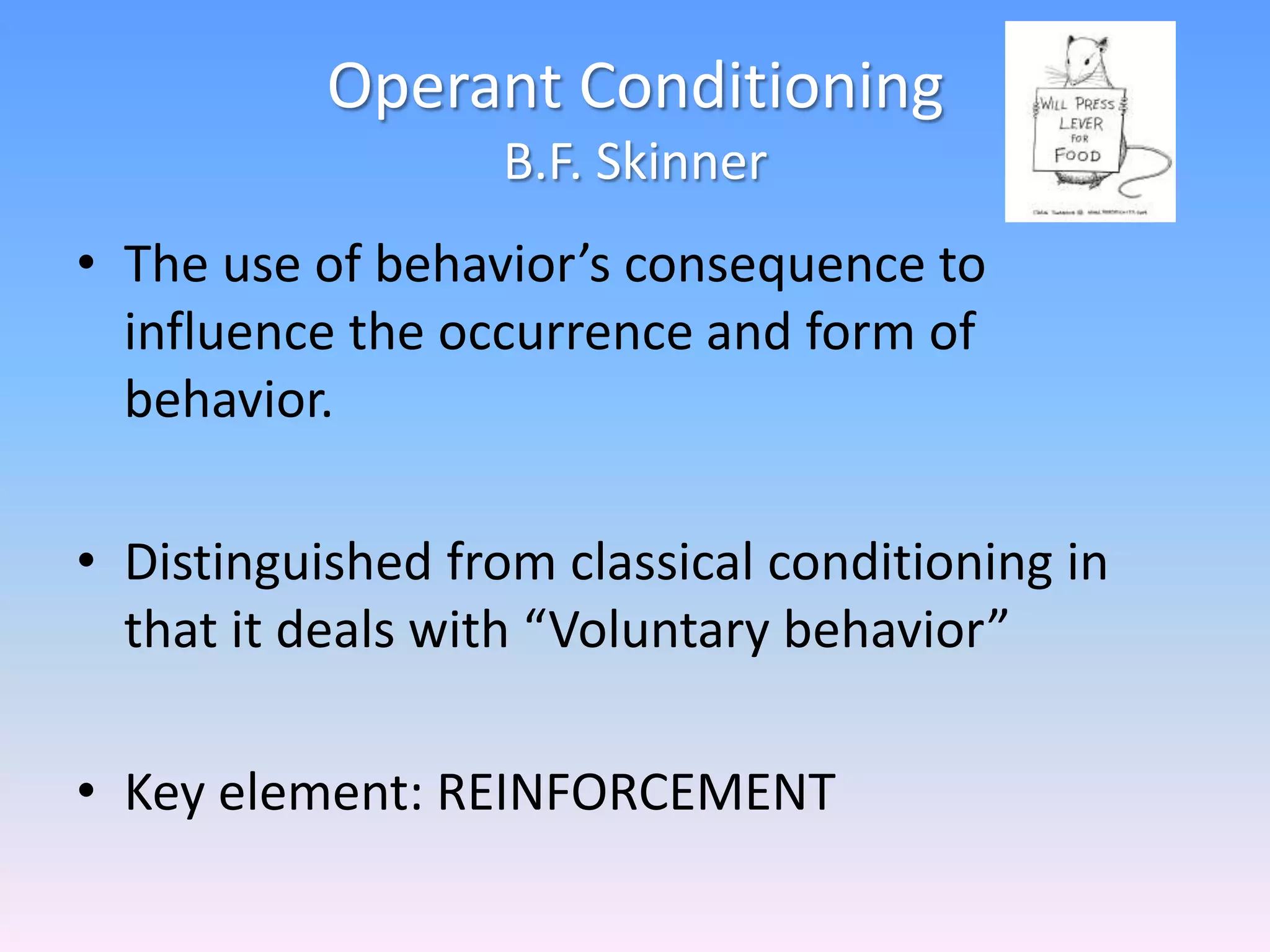
Operant Conditioning
B.F. Skinner
• The use of behavior’s consequence to
influence the occurrence and form of
behavior.
• Distinguished from classical conditioning in
that it deals with “Voluntary behavior”
• Key element: REINFORCEMENT
FOUR TYPES
• Positive Reinforcement - particular behavior
is strengthened by the consequence of
experiencing a positive condition
• Negative Reinforcement - particular behavior
is strengthened by the consequence of
stopping or avoiding a negative condition.
• Punishment - a particular behavior is weakened
by the consequence of experiencing a negative
condition.
• Extinction - particular behavior is weakened by
the consequence of not experiencing a positive
condition or stopping a negative condition
COGNITIVE THEORIES
• The focus is in the mental process that are
responsible for behaving and its meaning.
• INFORMATION PROCESSING – one of the terms
used to describe this field.
• Learning is an active process from which the
learner constructs meaning based on prior
knowledge and view of the world (FEDEN 1994)
GESTALT LEARNING THEORY
Kohler and Koffka, Max Wertheimer
• A holistic approach as it prompts to look at
the “whole picture” rather than the discrete
aspects of the situation.
• Focus is on learner’s thought process or
cognition.
• Key Principle: INSIGHT – reflects the learners
ability to recognize patterns and relationships
that are present in the stimulus situation.
LAW OF RELATIVISIM – components of a whole
are seen in relation to one another. It is the
basis of these relationships, rather than the
components, that meaning is derived.
SUBSUMPTION THEORY OF VERBAL LEARNING
David Ausbel
• New information is subsumed into existing
thought and memory structures.
• Learning occurs if existing cognitive structures
are organized and differentiated.
SCHEMA THEORY
David Rumelhart
• Schema/Schemata(Pleural) – Knowledge
structures stored in memory.
• Schema help comprehend events or situations
and predict unobserved events.
3 Modes of Learning
1. Accretion – Learning of facts.
2. Tuning – Existing schemata evolve or are
refined throughout life spans.
3. Restructuring – Development of new
schemata.
Levels of Processing Theory
• Information is process sequentially. Occurs in
both memory storage and retrieval.
Connectionistic Model
Parallel Distributing Processing Model
• Information is process by different parts of the
memory system simultaneously.
• Information is stored in many places throughout
the brain forming a network of connections.
HUITT 2000
STAGE THEORY
• Information is processed and stored in 3
stages:
1. Sensory Memory- Fleeting. Usually forgotten
when not attend to in that time frame.
2. Short-term Memory - Last about 20 secs.
3. Long-term Memory – Firmly tied name to an
existing schema in the brain.
COMMON CONCEPTS IN COGNITIVE
THEORIES
LEARNING - concerned with what the
knowledge means to that person.
– Learning does not follow the same principle and
path in every circumstance.
METACOGNITION
• “Thinking about one’s thinking.”
• Process learners use to gauge their thinking
while reading, studying, trying to learn and
problem solving.
• Teaching strategies: Journal writing, group
dialogues
MEMORY
• Consolidation Function (Gordon 1995)
– the more we connect new information to the old,
the more we ruminate over new information and
the more frequently we think about it the more
long lasting it will be.
• Meaningful material (makes sense) that has
meaning to the learner is tied to the schema.
• Forgetting – happens when there is weakening
of connections (networks) in the memory due
to disuse overtime, not enough cues, disease,
interference from new memories (Gordon
1995)
• INTENT to learn partly determines whether
they will remember or forget something
learned (White 1997)
TRANSFER
• Ability to take information learned in one
situation and apply it to another.
• “What teaching is all about.”
FACTORS:
• Extent to which material was originally
learned.
• Ability to retrieve information from memory.
• The way material was taught and learned.
• Similarity of the new situation to the original.
– POSITIVE TRANSFER
– NEGATIVE TRANSFER
SOCIAL THEORIES
• Knowledge is socially constructed in
interaction with others and interpreted
through the lens of what is know and what is
culturally acceptable.(FRIENE 1970)
• Learning emerges from social situations which
prompts then to seek knowledge and skills.
SOCIAL COGNITIVE THEORY
Albert Banduria
• Individuals are capable of self-regulation and
self-direction.
• People learn when in constant interaction
with their environment.
• Most learning occurs through observing
people’s behavior (MODELING)
Conditions Necessary for Effective
Modeling
• Attention – Individuals focus or concentrate. It
determines which model behaviors to be
learned.
• Retention - ability to retain modeled
behaviors in permanent memory.
• Reproduction – replication of image including
physical capabilities and self-observation.
• Motivation – Reason to learn or imitate. Value
outcomes and perceived rewards fosters
motivation.
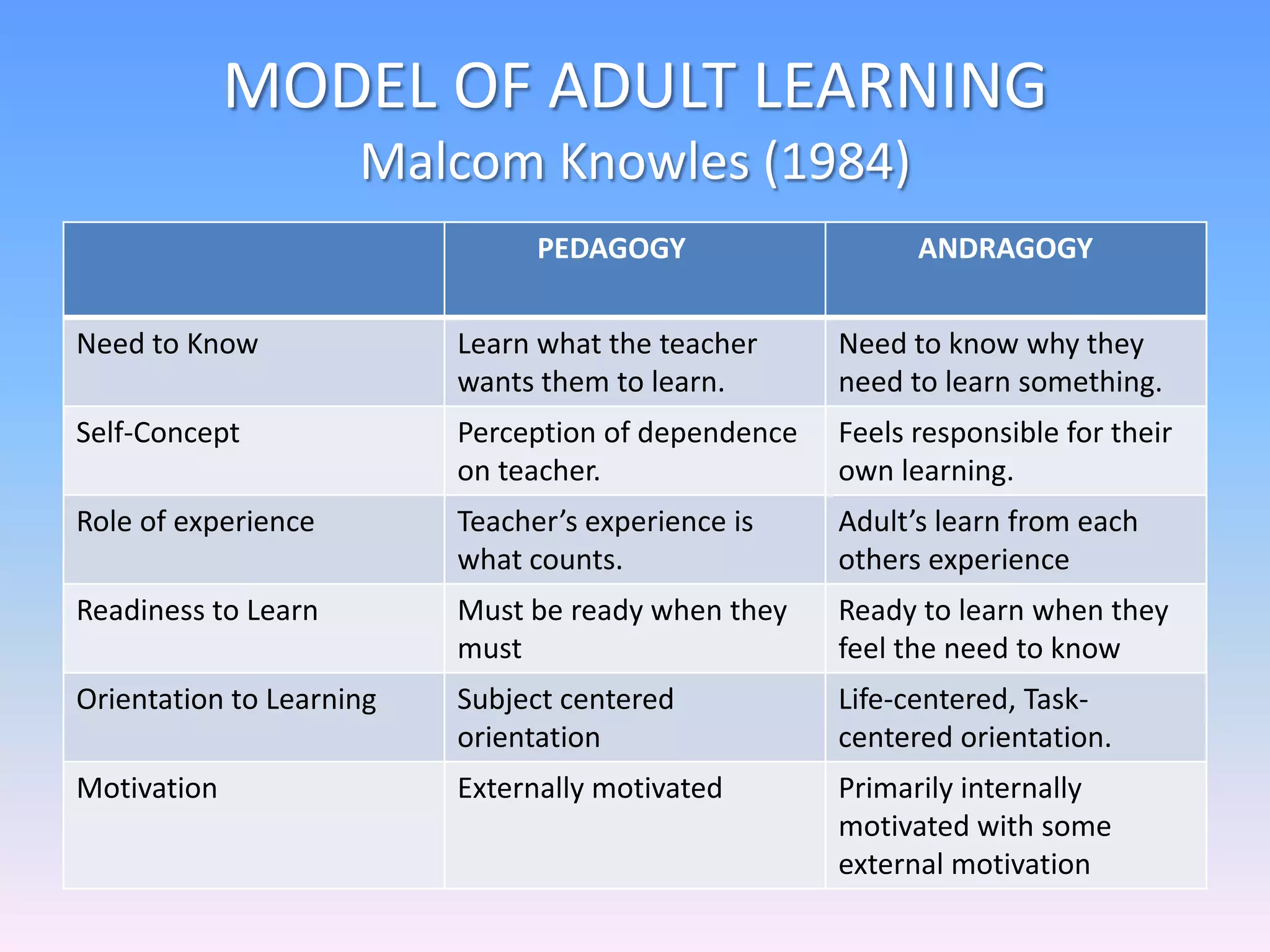
MODEL OF ADULT LEARNING
Malcom Knowles (1984)
PEDAGOGY ANDRAGOGY
Need to Know Learn what the teacher
wants them to learn.
Need to know why they
need to learn something.
Self-Concept Perception of dependence
on teacher.
Feels responsible for their
own learning.
Role of experience Teacher’s experience is
what counts.
Adult’s learn from each
others experience
Readiness to Learn Must be ready when they
must
Ready to learn when they
feel the need to know
Orientation to Learning Subject centered
orientation
Life-centered, Task-
centered orientation.
Motivation Externally motivated Primarily internally
motivated with some
external motivation
• Clinical setting provides excellent opportunity
to use andragogical approach to teaching and
learning.
• Clinical Instructor’s Role : Facilitator, Guide,
Coach, Role Model, Challenger and Motivator
Benner’s Framework for the
Development of Clinical Expertise
• Has the most relevance for clinical instruction
in nursing.
• Used Hermeneutical Phenomenology – an
approach to the interpretation of human
concerns and behaviors.
3 Major Themes
1. Skilled nursing does not rely on theoretical
knowledge alone. Practical and clinical
knowledge embedded in clinical situations
nurses encounter is necessary to explicate,
understand, and apply the theory.
2. Ability to grasp a clinical situation is
dependent on the ability to single out relevant
from irrelevant elements of the situation.
“Perceptual awareness” – sees what is most
salient. Manifested in the nurse’s intuitive
grasp.
3. Requires emotional, caring, morally
responsible involvement with patients.
Stages:
1. Novice
2. Advanced Beginner
3. Competent
4. Proficient
5. Expert
LEARNING PROPOSITIONS
1. Behaviors that is rewarded are more likely to
occur.
2. Sheer repetition without indication of
improvement or any kind of reinforcement is
a poor way to attempt to learn.
3. Threat and punishment have variable and
uncertain effects on learning.
4. Reward must follow almost immediately after
the desired behavior.
5. Learners progress in any area of learning only
as far as they need to, to achieve their
purpose.
6. Forgetting proceeds rapidly at first, then more
and more slowly.
7.Learning from reading is facilitated more by
the time spent recalling what was read than
re-reading.
8. To help in forming general concepts, present
it in different ways.
9. When there is too much frustration, behavior
ceases to be integrated, purposeful and
rational.
10. No school subjects are markedly superior to
others.
11. What is learned is most likely to be available
for use.
12. Children especially adults remember new
information which confirms previous
attitudes.
13. Adults need to know why the need to learn.
Gagne’s Conditions of Learning
• Signal Learning
• Stimulus-response Learning
• Chaining
• Verbal Association
• Discrimination Learning
• Concept Learning
• Rule Learning
• PROBLEM-SOLVING
Learning Styles
• Involves more than just cognitive styles.
• The habitual manner in which learners rescue
and produce information, process it,
understand it, value it, and recall it.
Concepts:
• Holistic (Global) – gets the whole picture
quickly. Processes information simultaneously
rather than step to step.
• Analytic Thinkers – process details of a
picture. Objective, does not need to connect
to personal values.
• Habitual Verbal Approach- words or verbal
associations.
• Visual Approach- mental pictures and images
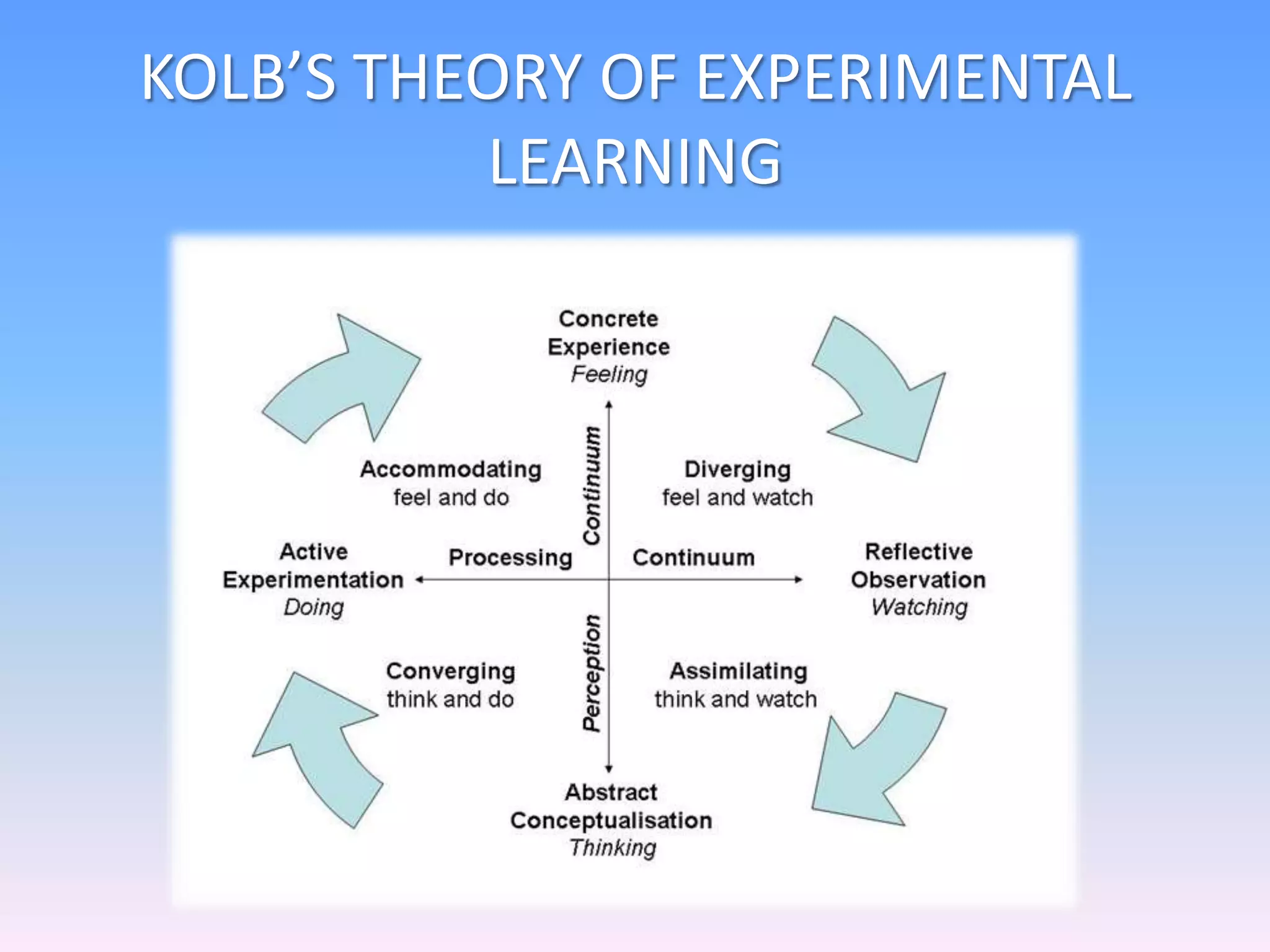
KOLB’S THEORY OF EXPERIMENTAL
LEARNING
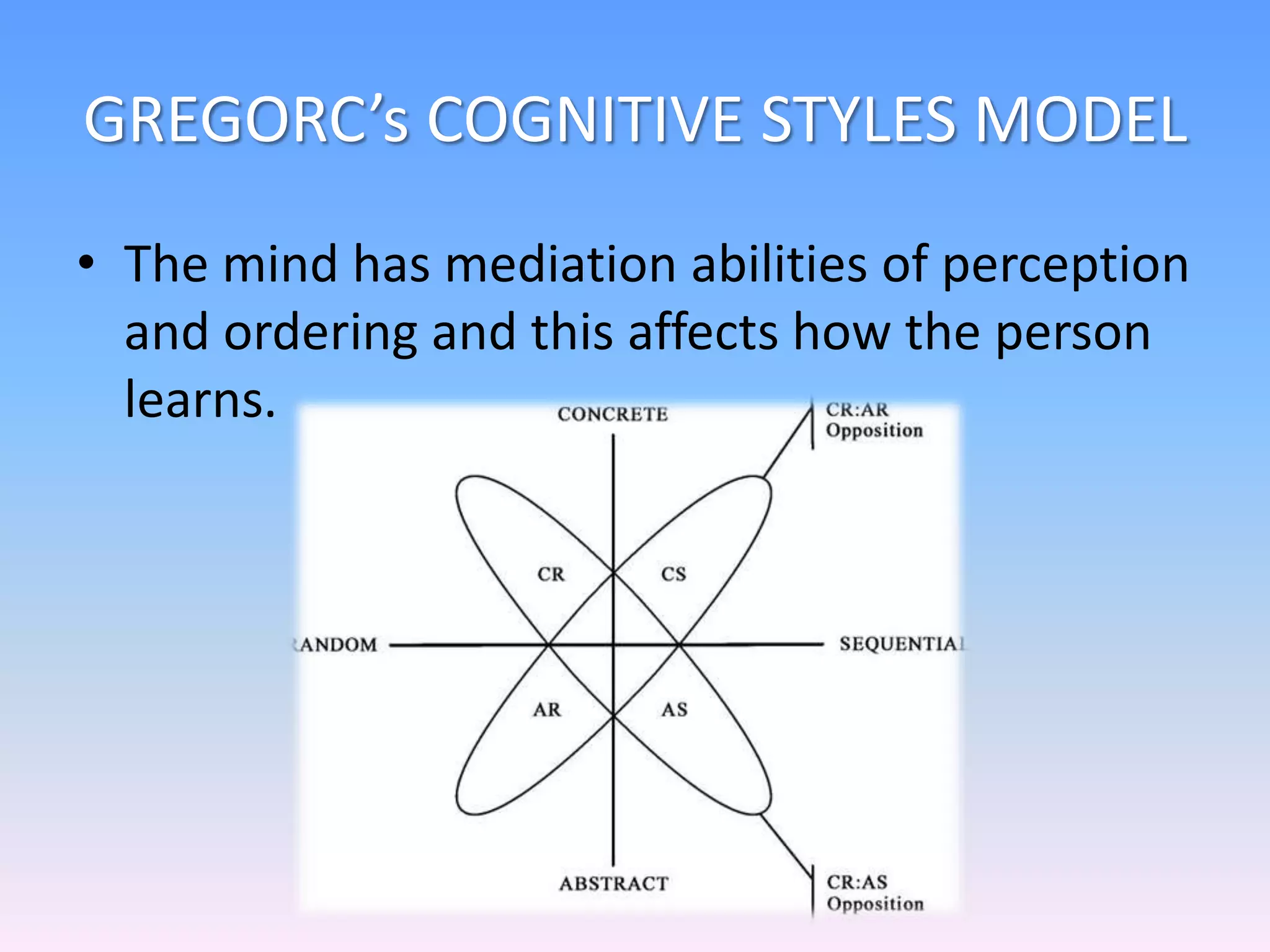
GREGORC’s COGNITIVE STYLES MODEL
• The mind has mediation abilities of perception
and ordering and this affects how the person
learns.
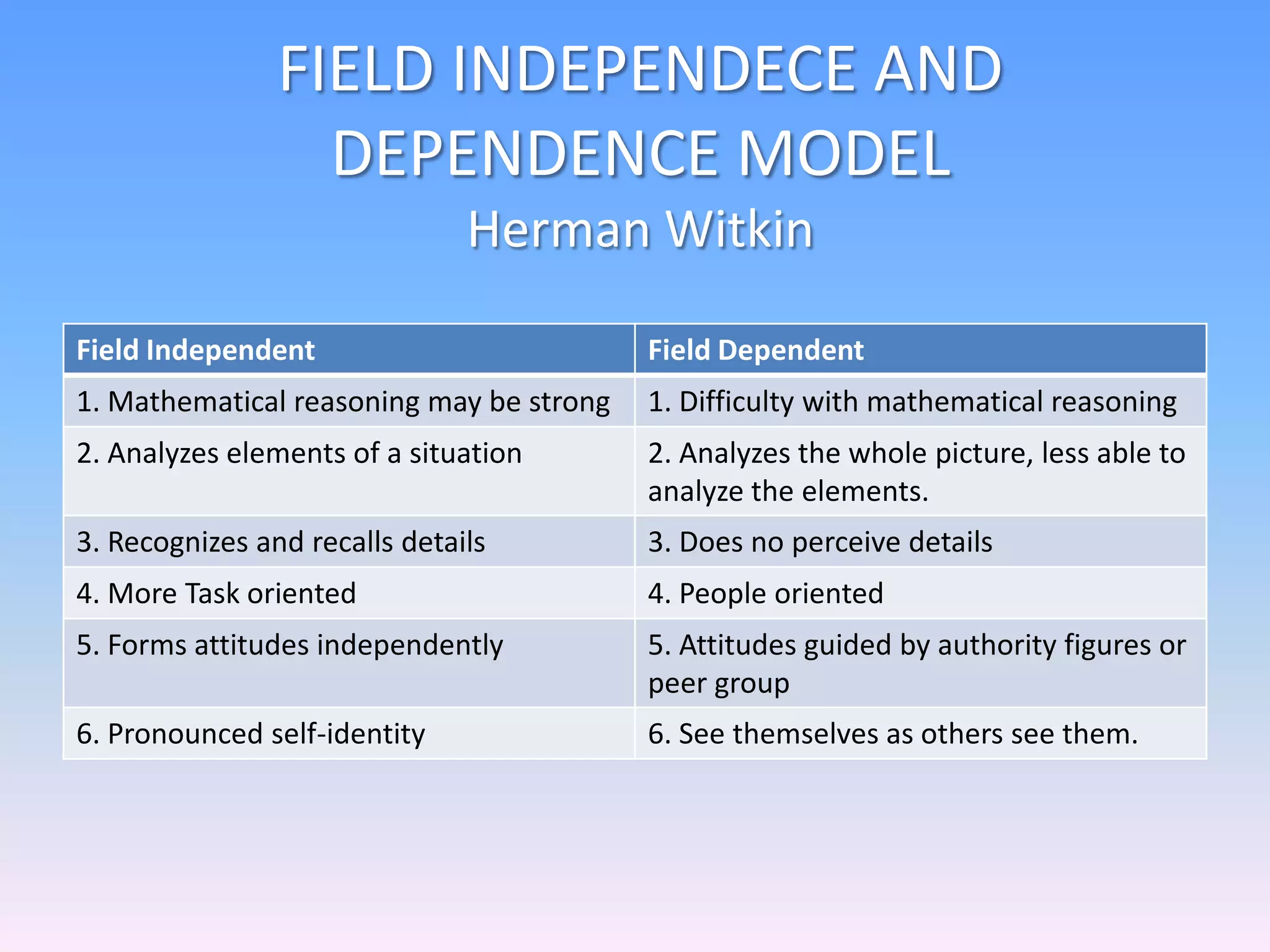
FIELD INDEPENDECE AND
DEPENDENCE MODEL
Herman Witkin
Field Independent Field Dependent
1. Mathematical reasoning may be strong 1. Difficulty with mathematical reasoning
2. Analyzes elements of a situation 2. Analyzes the whole picture, less able to
analyze the elements.
3. Recognizes and recalls details 3. Does no perceive details
4. More Task oriented 4. People oriented
5. Forms attitudes independently 5. Attitudes guided by authority figures or
peer group
6. Pronounced self-identity 6. See themselves as others see them.
References:
• Clinical Teaching and Evaluation: A Teaching
Resource by Andrea O’Connor
• Teaching Strategies for Nurse Educators by
Sandra DeYoung
Thank You for
Listening!

Learning theory

  • 1.
    Theoretical Approaches in Teachingand Learning in the Clinical Setting Prepared By: Mae Michelle Aguilar RN NRSG 215A
  • 2.
    Objectives • To knowthe different Learning Theories applied in the nursing education. • Identify different learning styles, types and models. • Determine the application of Learning Theories in approaches to teaching in the clinical setting.
  • 3.
    LEARNING THEORIES • BEHAVIORISTTHEORIES • COGNITIVE THEORIES • SOCIAL THEORIES
  • 4.
    BEHAVIORIST THEORIES • Focusesof objectively observable behavior. • The acquisition of new behavior is based on environmental conditions where there is a stimulus (S) that produces a response (R).
  • 5.
    • The learningprocess occurs in a “black box” and only the outcome of the learning is the focus rather than the intellectual process that resulted in the outcome. Stimulus Response
  • 6.
    Classical Conditioning Theory IvanPavlov • A process of behavior modification by which a subject comes to respond in a desired manner to a previously neutral stimulus that has been repeatedly presented along with an unconditioned stimulus that elicits the desired response.
  • 7.
    Basic Principles ofthe Process • Unconditioned Stimuli – Automatically or naturally triggers a response. • Unconditioned Response – Response that occurs naturally to the unconditioned stimuli. • Conditioned Stimulus - previously neutral stimulus that, after becoming associated with the unconditioned stimulus, eventually comes to trigger a conditioned response. • Conditioned Response – The learned response.
  • 8.
    Application: Learning CPR •US: Seeing an unconscious person. • UR: Attempting to rouse that person. • CS: “CODE BLUE” • CR: Nurse need not to witness the unconscious individual to know what is happening and how to respond.
  • 9.
    BEHAVIORISM THEORY John Watson “Aman is stripped of his responsibility, freedom and dignity and is reduced to a purely biological being, to be reshaped by those who are able to use the tools of Behaviorism effectively.” -John Watson • Behavior is a result of a series of conditioned reflexes and all emotion and thought is a result of behavior learned through conditioning.
  • 10.
    CONTIGUITY THEORY Edwin RayGuthrie “A combination of stimulus which has accompanied a movement will on its recurrence tends to be followed by that movement.” (Guthrie 1952) Guthrie-Horton Experiment
  • 11.
    • One-Trial Learning– The bond between stimulus and response was established on the first occasion, and that repetitions neither strengthen or weaken the link. • He referred to stimulus-response bonds as “Habits“.
  • 12.
    PRINCIPLES: • Learning occursthrough doing. • Since learning involves the conditioning of specific movements, instruction must present very specific tasks • Exposure to many variations in stimulus patterns is desirable in order to produce a generalized response. • The last response in a learning situation should be correct since it is the one that will be associated.
  • 13.
    CONNECTIONISM THEORY Edward Thorndike •“Reward and Punishment” 3 Laws: 1. Exercise and Repetition – the more the stimulus induced response is repeated, the longer it will be retained.
  • 14.
    2. Law ofEffect – Pleasure-Pain Principle. 3. The Law of Readiness - a series of responses can be chained together to satisfy some goal which will result in annoyance if blocked.
  • 15.
    Operant Conditioning B.F. Skinner •The use of behavior’s consequence to influence the occurrence and form of behavior. • Distinguished from classical conditioning in that it deals with “Voluntary behavior” • Key element: REINFORCEMENT
  • 16.
    FOUR TYPES • PositiveReinforcement - particular behavior is strengthened by the consequence of experiencing a positive condition • Negative Reinforcement - particular behavior is strengthened by the consequence of stopping or avoiding a negative condition.
  • 17.
    • Punishment -a particular behavior is weakened by the consequence of experiencing a negative condition. • Extinction - particular behavior is weakened by the consequence of not experiencing a positive condition or stopping a negative condition
  • 18.
    COGNITIVE THEORIES • Thefocus is in the mental process that are responsible for behaving and its meaning. • INFORMATION PROCESSING – one of the terms used to describe this field. • Learning is an active process from which the learner constructs meaning based on prior knowledge and view of the world (FEDEN 1994)
  • 19.
    GESTALT LEARNING THEORY Kohlerand Koffka, Max Wertheimer • A holistic approach as it prompts to look at the “whole picture” rather than the discrete aspects of the situation. • Focus is on learner’s thought process or cognition.
  • 20.
    • Key Principle:INSIGHT – reflects the learners ability to recognize patterns and relationships that are present in the stimulus situation. LAW OF RELATIVISIM – components of a whole are seen in relation to one another. It is the basis of these relationships, rather than the components, that meaning is derived.
  • 21.
    SUBSUMPTION THEORY OFVERBAL LEARNING David Ausbel • New information is subsumed into existing thought and memory structures. • Learning occurs if existing cognitive structures are organized and differentiated.
  • 22.
    SCHEMA THEORY David Rumelhart •Schema/Schemata(Pleural) – Knowledge structures stored in memory. • Schema help comprehend events or situations and predict unobserved events.
  • 23.
    3 Modes ofLearning 1. Accretion – Learning of facts. 2. Tuning – Existing schemata evolve or are refined throughout life spans. 3. Restructuring – Development of new schemata.
  • 24.
    Levels of ProcessingTheory • Information is process sequentially. Occurs in both memory storage and retrieval. Connectionistic Model Parallel Distributing Processing Model • Information is process by different parts of the memory system simultaneously. • Information is stored in many places throughout the brain forming a network of connections. HUITT 2000
  • 25.
    STAGE THEORY • Informationis processed and stored in 3 stages: 1. Sensory Memory- Fleeting. Usually forgotten when not attend to in that time frame. 2. Short-term Memory - Last about 20 secs. 3. Long-term Memory – Firmly tied name to an existing schema in the brain.
  • 26.
    COMMON CONCEPTS INCOGNITIVE THEORIES LEARNING - concerned with what the knowledge means to that person. – Learning does not follow the same principle and path in every circumstance.
  • 27.
    METACOGNITION • “Thinking aboutone’s thinking.” • Process learners use to gauge their thinking while reading, studying, trying to learn and problem solving. • Teaching strategies: Journal writing, group dialogues
  • 28.
    MEMORY • Consolidation Function(Gordon 1995) – the more we connect new information to the old, the more we ruminate over new information and the more frequently we think about it the more long lasting it will be. • Meaningful material (makes sense) that has meaning to the learner is tied to the schema.
  • 29.
    • Forgetting –happens when there is weakening of connections (networks) in the memory due to disuse overtime, not enough cues, disease, interference from new memories (Gordon 1995) • INTENT to learn partly determines whether they will remember or forget something learned (White 1997)
  • 30.
    TRANSFER • Ability totake information learned in one situation and apply it to another. • “What teaching is all about.”
  • 31.
    FACTORS: • Extent towhich material was originally learned. • Ability to retrieve information from memory. • The way material was taught and learned. • Similarity of the new situation to the original. – POSITIVE TRANSFER – NEGATIVE TRANSFER
  • 32.
    SOCIAL THEORIES • Knowledgeis socially constructed in interaction with others and interpreted through the lens of what is know and what is culturally acceptable.(FRIENE 1970) • Learning emerges from social situations which prompts then to seek knowledge and skills.
  • 33.
    SOCIAL COGNITIVE THEORY AlbertBanduria • Individuals are capable of self-regulation and self-direction. • People learn when in constant interaction with their environment. • Most learning occurs through observing people’s behavior (MODELING)
  • 34.
    Conditions Necessary forEffective Modeling • Attention – Individuals focus or concentrate. It determines which model behaviors to be learned. • Retention - ability to retain modeled behaviors in permanent memory. • Reproduction – replication of image including physical capabilities and self-observation. • Motivation – Reason to learn or imitate. Value outcomes and perceived rewards fosters motivation.
  • 35.
    MODEL OF ADULTLEARNING Malcom Knowles (1984) PEDAGOGY ANDRAGOGY Need to Know Learn what the teacher wants them to learn. Need to know why they need to learn something. Self-Concept Perception of dependence on teacher. Feels responsible for their own learning. Role of experience Teacher’s experience is what counts. Adult’s learn from each others experience Readiness to Learn Must be ready when they must Ready to learn when they feel the need to know Orientation to Learning Subject centered orientation Life-centered, Task- centered orientation. Motivation Externally motivated Primarily internally motivated with some external motivation
  • 36.
    • Clinical settingprovides excellent opportunity to use andragogical approach to teaching and learning. • Clinical Instructor’s Role : Facilitator, Guide, Coach, Role Model, Challenger and Motivator
  • 37.
    Benner’s Framework forthe Development of Clinical Expertise • Has the most relevance for clinical instruction in nursing. • Used Hermeneutical Phenomenology – an approach to the interpretation of human concerns and behaviors.
  • 38.
    3 Major Themes 1.Skilled nursing does not rely on theoretical knowledge alone. Practical and clinical knowledge embedded in clinical situations nurses encounter is necessary to explicate, understand, and apply the theory.
  • 39.
    2. Ability tograsp a clinical situation is dependent on the ability to single out relevant from irrelevant elements of the situation. “Perceptual awareness” – sees what is most salient. Manifested in the nurse’s intuitive grasp.
  • 40.
    3. Requires emotional,caring, morally responsible involvement with patients.
  • 41.
    Stages: 1. Novice 2. AdvancedBeginner 3. Competent 4. Proficient 5. Expert
  • 42.
    LEARNING PROPOSITIONS 1. Behaviorsthat is rewarded are more likely to occur. 2. Sheer repetition without indication of improvement or any kind of reinforcement is a poor way to attempt to learn. 3. Threat and punishment have variable and uncertain effects on learning. 4. Reward must follow almost immediately after the desired behavior.
  • 43.
    5. Learners progressin any area of learning only as far as they need to, to achieve their purpose. 6. Forgetting proceeds rapidly at first, then more and more slowly. 7.Learning from reading is facilitated more by the time spent recalling what was read than re-reading.
  • 44.
    8. To helpin forming general concepts, present it in different ways. 9. When there is too much frustration, behavior ceases to be integrated, purposeful and rational. 10. No school subjects are markedly superior to others.
  • 45.
    11. What islearned is most likely to be available for use. 12. Children especially adults remember new information which confirms previous attitudes. 13. Adults need to know why the need to learn.
  • 46.
    Gagne’s Conditions ofLearning • Signal Learning • Stimulus-response Learning • Chaining • Verbal Association • Discrimination Learning • Concept Learning • Rule Learning • PROBLEM-SOLVING
  • 47.
    Learning Styles • Involvesmore than just cognitive styles. • The habitual manner in which learners rescue and produce information, process it, understand it, value it, and recall it.
  • 48.
    Concepts: • Holistic (Global)– gets the whole picture quickly. Processes information simultaneously rather than step to step. • Analytic Thinkers – process details of a picture. Objective, does not need to connect to personal values.
  • 49.
    • Habitual VerbalApproach- words or verbal associations. • Visual Approach- mental pictures and images
  • 50.
    KOLB’S THEORY OFEXPERIMENTAL LEARNING
  • 51.
    GREGORC’s COGNITIVE STYLESMODEL • The mind has mediation abilities of perception and ordering and this affects how the person learns.
  • 52.
    FIELD INDEPENDECE AND DEPENDENCEMODEL Herman Witkin Field Independent Field Dependent 1. Mathematical reasoning may be strong 1. Difficulty with mathematical reasoning 2. Analyzes elements of a situation 2. Analyzes the whole picture, less able to analyze the elements. 3. Recognizes and recalls details 3. Does no perceive details 4. More Task oriented 4. People oriented 5. Forms attitudes independently 5. Attitudes guided by authority figures or peer group 6. Pronounced self-identity 6. See themselves as others see them.
  • 53.
    References: • Clinical Teachingand Evaluation: A Teaching Resource by Andrea O’Connor • Teaching Strategies for Nurse Educators by Sandra DeYoung
  • 54.