Learning Theories
Presented by:
Preksha Pagare
What is Learning?
• Learning is a relatively permanent change in human
capabilities that is not a result of growth processes.
• These capabilities are related to specific learning
outcomes.
Learning Outcomes
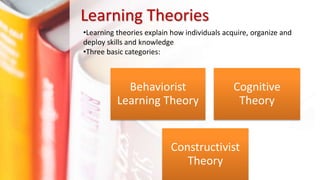
Learning Theories
Behaviorist
Learning Theory
Cognitive
Theory
Constructivist
Theory
•Learning theories explain how individuals acquire, organize and
deploy skills and knowledge
•Three basic categories:
Behaviorist Learning Theory
• Behaviorist learning theories emphasize
changes in behavior that result from
stimulus-response associations made by
the learner
• Behaviors can also be unlearned, and
replaced by new behaviors
• A key element to this theory of learning is
the rewarded response
Classical Conditioning
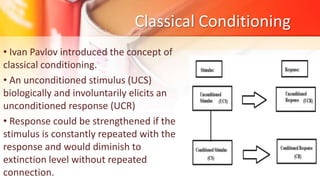
• Ivan Pavlov introduced the concept of
classical conditioning.
• An unconditioned stimulus (UCS)
biologically and involuntarily elicits an
unconditioned response (UCR)
• Response could be strengthened if the
stimulus is constantly repeated with the
response and would diminish to
extinction level without repeated
connection.
Operant Conditioning
• Comprehensive view of conditioning
• a systematic programme of rewards and
punishments to influence behaviour or bring
about desired behaviour
• By controlling the environ-mental situations and
consequences for behavior, people could predict
and control that behavior
Reinforcement Theory
• Emphasizes that people are motivated to
perform or avoid certain behaviors because of
past outcomes that have resulted from those
behavior
• From a training perspective, it suggests that for
learners to acquire knowledge, change
behavior, or modify skills, the trainer needs to
identify what outcomes the learner finds most
positive (and negative)
• Trainers then need to link these outcomes to
learners acquiring knowledge, skills, or
changing behaviors
Positive Reinforcement
• a pleasurable outcome resulting from a behavior
Negative Reinforcement
• is the removal of an unpleasant outcome
Punishment
• an unpleasant outcome after a behavior, leading to a decrease in that
behavior
Extinction
• withdrawing positive or negative reinforcers to eliminate a behavior
Reinforcement Theory (continued)
Behavior Modification
• Specification of the desired outcome
• Development of a positive, nurturing
environment (by removing negative stimuli from
the learning environment)
• Identification and use of appropriate reinforcers
(intrinsic and extrinsic rewards)
• Establishing a pattern of success
• Reduction in the frequency of rewards
• Evaluation and assessment of the effectiveness
of the approach based on expectations and
learner’s results.
Cognitive Theory
• An observable change in mental
knowledge
• It is about the change in what the learner
knows rather than what he/she does
• Learning occurs whether or not there is an
observable change in the behavior
• Humans learn and make decisions based
on what is the most logical thing to learn
and do
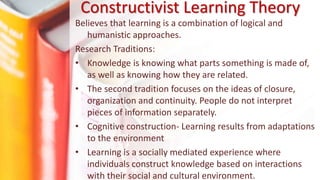
Believes that learning is a combination of logical and
humanistic approaches.
Research Traditions:
• Knowledge is knowing what parts something is made of,
as well as knowing how they are related.
• The second tradition focuses on the ideas of closure,
organization and continuity. People do not interpret
pieces of information separately.
• Cognitive construction- Learning results from adaptations
to the environment
• Learning is a socially mediated experience where
individuals construct knowledge based on interactions
with their social and cultural environment.
Constructivist Learning Theory
Social Learning Theory
• Emphasizes that people learn by
observing other persons (models) whom
they believe are credible and
knowledgeable
• Behavior that is reinforced or rewarded
tends to be repeated
• The models’ behavior or skill that is
rewarded is adopted by the observer
• Learning new skills or behavior comes from:
–directly experiencing the consequences of
using behavior or skills, or
–the process of observing others and seeing
the consequences of their behavior
• Learning is also influenced by a person’s self-
efficacy
–self-efficacy is a person’s judgment about
whether he or she can successfully learn
knowledge and skills
Social Learning Theory (continued)
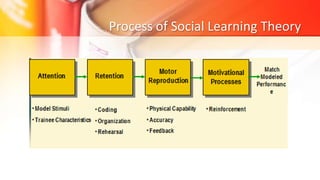
Process of Social Learning Theory
Information Processing Learning
Theory
• The human learner is conceived to be a
processor of information, in much the
same way a computer is
• When learning occurs, information is input
from the environment, processed and
stored in memory, and output is in the
form of a learned capability
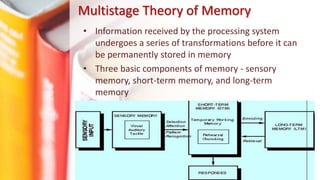
Multistage Theory of Memory
• Information received by the processing system
undergoes a series of transformations before it can
be permanently stored in memory
• Three basic components of memory - sensory
memory, short-term memory, and long-term
memory
Goal Setting Theory
• Specific and challenging goals along with
appropriate feedback contribute to higher
and better task performance
• The goals indicate and give direction to an
employee about what needs to be done
and how much efforts are required to be
put in.
Goal Orientation
• Refers to the goals held by a trainee in a learning
situation
• Goal orientation affects the amount of effort a
trainee will expend in learning (motivation to learn)
• Trainees with a learning orientation exert greater
effort to learn and use more complex learning
strategies than trainees with a performance
orientation
Mastery Orientation
• Direct greater attention to
the task
• Learn for the sake of
learning
Performance Orientation
• Direct more attention to
performing well
• Devote less effort to
learning
Adult Learning Theory - Andragogy
It is based on following assumptions:
– Adults have the need to know why they are
learning something
– Adults have a need to be self-directed
– Adults bring more work-related experiences
into the learning situation
– Adults enter into a learning experience with a
problem-centered approach to learning
– Adults are motivated to learn by both extrinsic
and intrinsic motivators
Learning should be:
• Motivational (Learner should be
able to see end-result)
• Experiential (Learning by exploring)
• Problem Solving (Example- Case
Study)
• Of immediate value (Direct bearing
on job)
Adult Learning Theory – Andragogy
(continued)
• Adult Educators should -
– Set a cooperative climate for learning in the classroom;
– Assess the learner’s specific needs and interests;
– Develop learning objectives based on the learner’s
needs, interests, and skill levels;
– Design sequential activities to achieve the objectives;
– Work collaboratively with the learner to select
methods, materials, and resources for instruction
– Evaluate the quality of the learning experience and
make adjustments, as needed, while assessing needs
for further learning.
Adult Learning Theory – Andragogy
(continued)
Learning theories

Learning theories

  • 1.
  • 2.
    What is Learning? •Learning is a relatively permanent change in human capabilities that is not a result of growth processes. • These capabilities are related to specific learning outcomes.
  • 3.
  • 4.
    Learning Theories Behaviorist Learning Theory Cognitive Theory Constructivist Theory •Learningtheories explain how individuals acquire, organize and deploy skills and knowledge •Three basic categories:
  • 5.
    Behaviorist Learning Theory •Behaviorist learning theories emphasize changes in behavior that result from stimulus-response associations made by the learner • Behaviors can also be unlearned, and replaced by new behaviors • A key element to this theory of learning is the rewarded response
  • 6.
    Classical Conditioning • IvanPavlov introduced the concept of classical conditioning. • An unconditioned stimulus (UCS) biologically and involuntarily elicits an unconditioned response (UCR) • Response could be strengthened if the stimulus is constantly repeated with the response and would diminish to extinction level without repeated connection.
  • 7.
    Operant Conditioning • Comprehensiveview of conditioning • a systematic programme of rewards and punishments to influence behaviour or bring about desired behaviour • By controlling the environ-mental situations and consequences for behavior, people could predict and control that behavior
  • 8.
    Reinforcement Theory • Emphasizesthat people are motivated to perform or avoid certain behaviors because of past outcomes that have resulted from those behavior • From a training perspective, it suggests that for learners to acquire knowledge, change behavior, or modify skills, the trainer needs to identify what outcomes the learner finds most positive (and negative) • Trainers then need to link these outcomes to learners acquiring knowledge, skills, or changing behaviors
  • 9.
    Positive Reinforcement • apleasurable outcome resulting from a behavior Negative Reinforcement • is the removal of an unpleasant outcome Punishment • an unpleasant outcome after a behavior, leading to a decrease in that behavior Extinction • withdrawing positive or negative reinforcers to eliminate a behavior Reinforcement Theory (continued)
  • 10.
    Behavior Modification • Specificationof the desired outcome • Development of a positive, nurturing environment (by removing negative stimuli from the learning environment) • Identification and use of appropriate reinforcers (intrinsic and extrinsic rewards) • Establishing a pattern of success • Reduction in the frequency of rewards • Evaluation and assessment of the effectiveness of the approach based on expectations and learner’s results.
  • 11.
    Cognitive Theory • Anobservable change in mental knowledge • It is about the change in what the learner knows rather than what he/she does • Learning occurs whether or not there is an observable change in the behavior • Humans learn and make decisions based on what is the most logical thing to learn and do
  • 12.
    Believes that learningis a combination of logical and humanistic approaches. Research Traditions: • Knowledge is knowing what parts something is made of, as well as knowing how they are related. • The second tradition focuses on the ideas of closure, organization and continuity. People do not interpret pieces of information separately. • Cognitive construction- Learning results from adaptations to the environment • Learning is a socially mediated experience where individuals construct knowledge based on interactions with their social and cultural environment. Constructivist Learning Theory
  • 13.
    Social Learning Theory •Emphasizes that people learn by observing other persons (models) whom they believe are credible and knowledgeable • Behavior that is reinforced or rewarded tends to be repeated • The models’ behavior or skill that is rewarded is adopted by the observer
  • 14.
    • Learning newskills or behavior comes from: –directly experiencing the consequences of using behavior or skills, or –the process of observing others and seeing the consequences of their behavior • Learning is also influenced by a person’s self- efficacy –self-efficacy is a person’s judgment about whether he or she can successfully learn knowledge and skills Social Learning Theory (continued)
  • 15.
    Process of SocialLearning Theory
  • 16.
    Information Processing Learning Theory •The human learner is conceived to be a processor of information, in much the same way a computer is • When learning occurs, information is input from the environment, processed and stored in memory, and output is in the form of a learned capability
  • 17.
    Multistage Theory ofMemory • Information received by the processing system undergoes a series of transformations before it can be permanently stored in memory • Three basic components of memory - sensory memory, short-term memory, and long-term memory
  • 18.
    Goal Setting Theory •Specific and challenging goals along with appropriate feedback contribute to higher and better task performance • The goals indicate and give direction to an employee about what needs to be done and how much efforts are required to be put in.
  • 19.
    Goal Orientation • Refersto the goals held by a trainee in a learning situation • Goal orientation affects the amount of effort a trainee will expend in learning (motivation to learn) • Trainees with a learning orientation exert greater effort to learn and use more complex learning strategies than trainees with a performance orientation Mastery Orientation • Direct greater attention to the task • Learn for the sake of learning Performance Orientation • Direct more attention to performing well • Devote less effort to learning
  • 20.
    Adult Learning Theory- Andragogy It is based on following assumptions: – Adults have the need to know why they are learning something – Adults have a need to be self-directed – Adults bring more work-related experiences into the learning situation – Adults enter into a learning experience with a problem-centered approach to learning – Adults are motivated to learn by both extrinsic and intrinsic motivators
  • 21.
    Learning should be: •Motivational (Learner should be able to see end-result) • Experiential (Learning by exploring) • Problem Solving (Example- Case Study) • Of immediate value (Direct bearing on job) Adult Learning Theory – Andragogy (continued)
  • 22.
    • Adult Educatorsshould - – Set a cooperative climate for learning in the classroom; – Assess the learner’s specific needs and interests; – Develop learning objectives based on the learner’s needs, interests, and skill levels; – Design sequential activities to achieve the objectives; – Work collaboratively with the learner to select methods, materials, and resources for instruction – Evaluate the quality of the learning experience and make adjustments, as needed, while assessing needs for further learning. Adult Learning Theory – Andragogy (continued)