MOST ESSENTIAL
LEARNING
COMPETENCIES
Here starts
the LAC
Session!
Maripaz M. Señorita
Resource Person
Session Objectives:
By the end of this session, you will be able to:
1. explain the background and development of the
MELCs
2. unpack the MELCs
3. combine the related competencies into learning
objectives
L1
Background, Rationale,
and Development of
MELCs
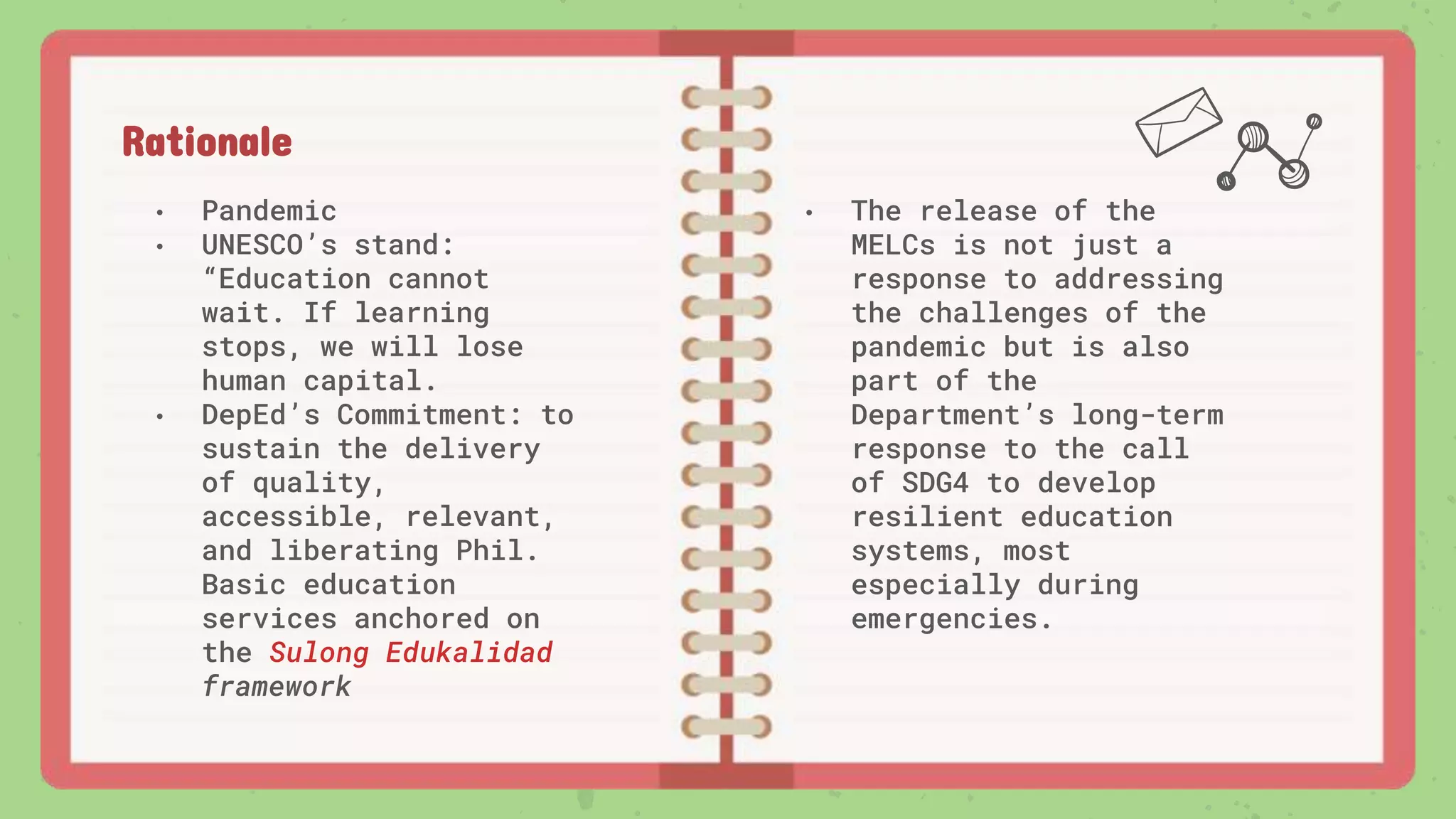
Rationale
• Pandemic
• UNESCO’s stand:
“Education cannot
wait. If learning
stops, we will lose
human capital.
• DepEd’s Commitment: to
sustain the delivery
of quality,
accessible, relevant,
and liberating Phil.
Basic education
services anchored on
the Sulong Edukalidad
framework
• The release of the
MELCs is not just a
response to addressing
the challenges of the
pandemic but is also
part of the
Department’s long-term
response to the call
of SDG4 to develop
resilient education
systems, most
especially during
emergencies.
The K to 12
curriculum review is
not just meant to
fulfill one of the
provisions of RA
105333 to review the
curriculum, but is
also part of Sec.
Briones’ continuing
commitment to ensure
quality, accessible,
relevant, and
liberating education
Mapping of the
essential and desirable
learning competencies
within the curriculum
Identification of
prerequisite knowledge
and skills needed to
prepare students for
essential learning
competencies
Analysis of the
interconnectedness
of prerequisite
knowledge and skills
among the learning
competencies
Essential Learning
Competencies
Defined as what the students
need, considered indispensable,
in the teaching-learning
process to build skills to
equip learners for subsequent
grade levels and consequently,
for lifelong learners
Desirable Learning
Competencies
Defined as what may enhance
education but may not be
necessary in building
foundational skills
ENDURANCE
A learning competency is considered
enduring if it remains with learners
long after a test or unit of study is
completed or if it is useful beyond a
single test or unit of study
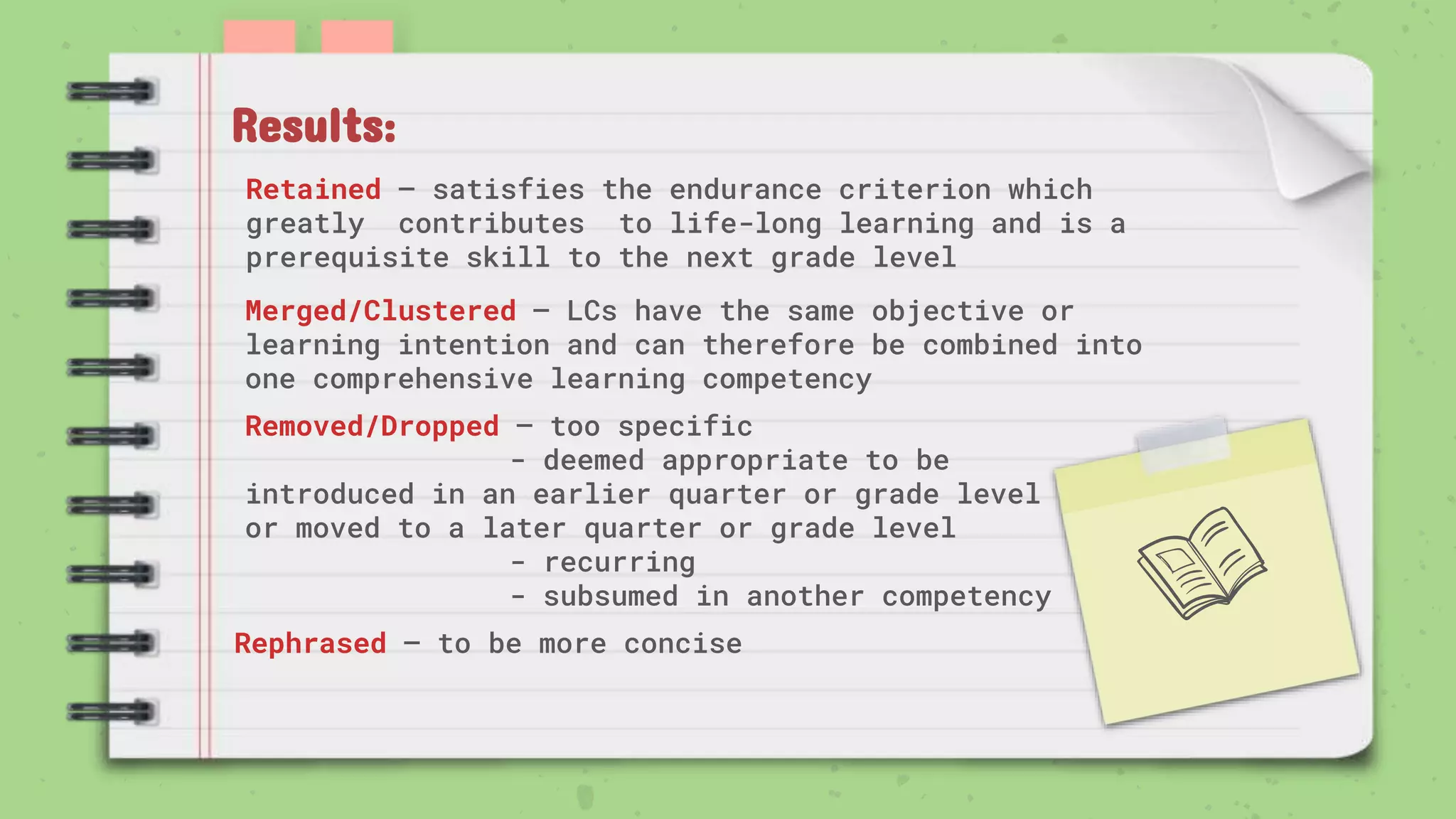
Results:
Retained – satisfies the endurance criterion which
greatly contributes to life-long learning and is a
prerequisite skill to the next grade level
Merged/Clustered – LCs have the same objective or
learning intention and can therefore be combined into
one comprehensive learning competency
Removed/Dropped – too specific
- deemed appropriate to be
introduced in an earlier quarter or grade level
or moved to a later quarter or grade level
- recurring
- subsumed in another competency
Rephrased – to be more concise
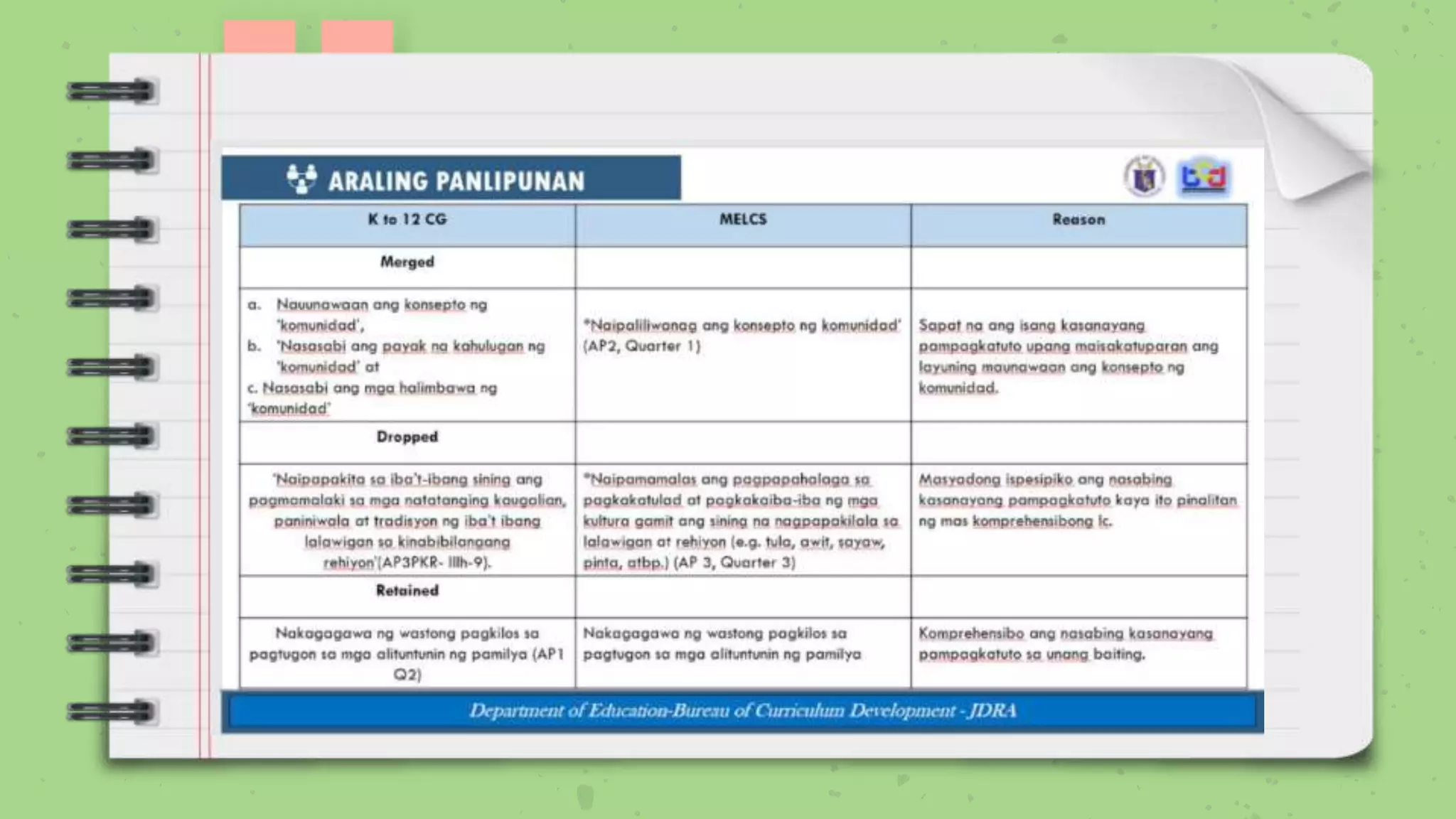
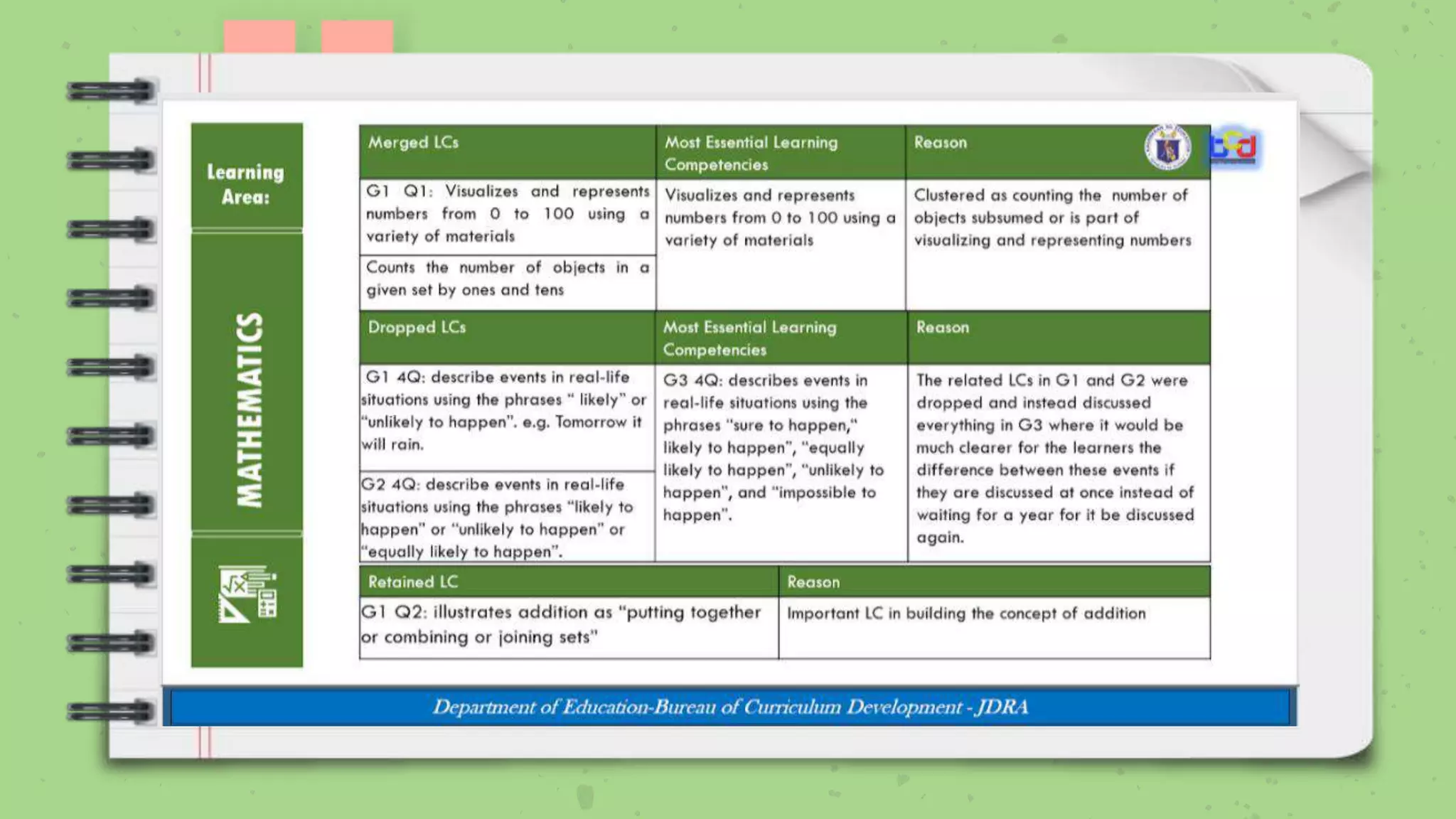
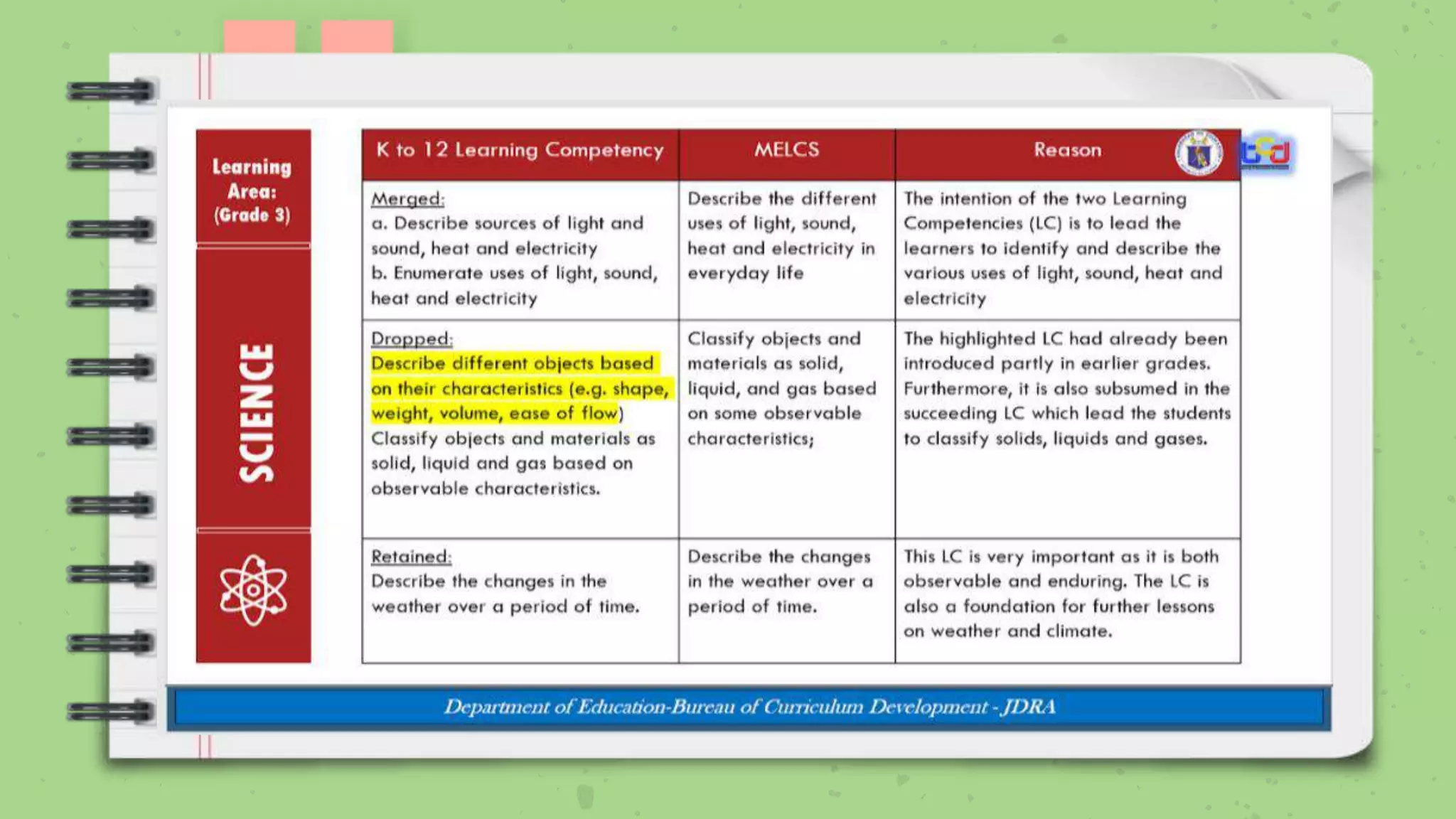
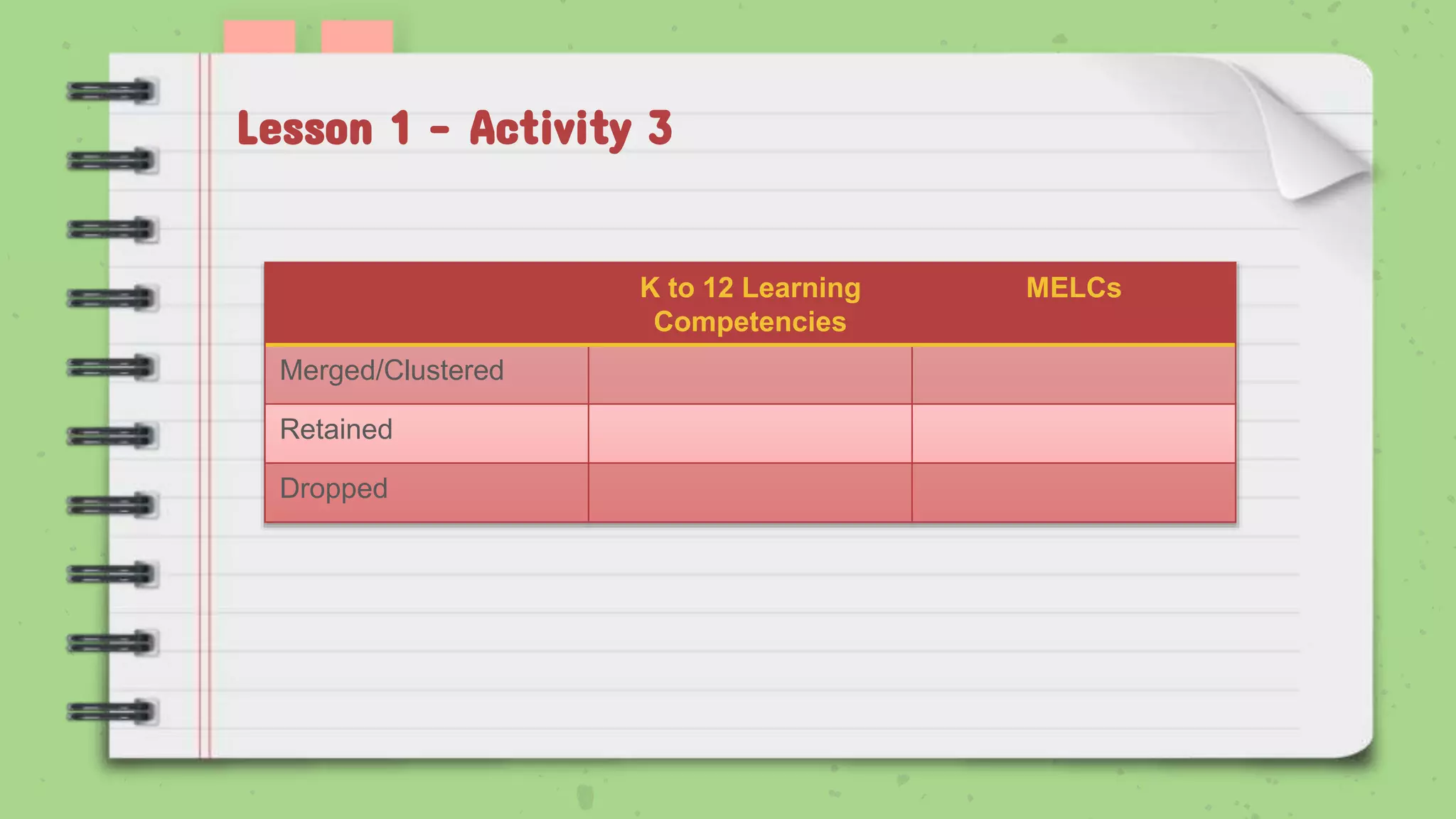
Lesson 1 – Activity 3
K to 12 Learning
Competencies
MELCs
Merged/Clustered
Retained
Dropped
Field implementers and
private schools are
encouraged to
contextualize the MELCs
in order to accommodate
the varying contexts of
learners, teachers,
learning environment and
support structures
considering both the
content and performance
standards.
L2
UNPACKING AND
COMBINING THE MELCs
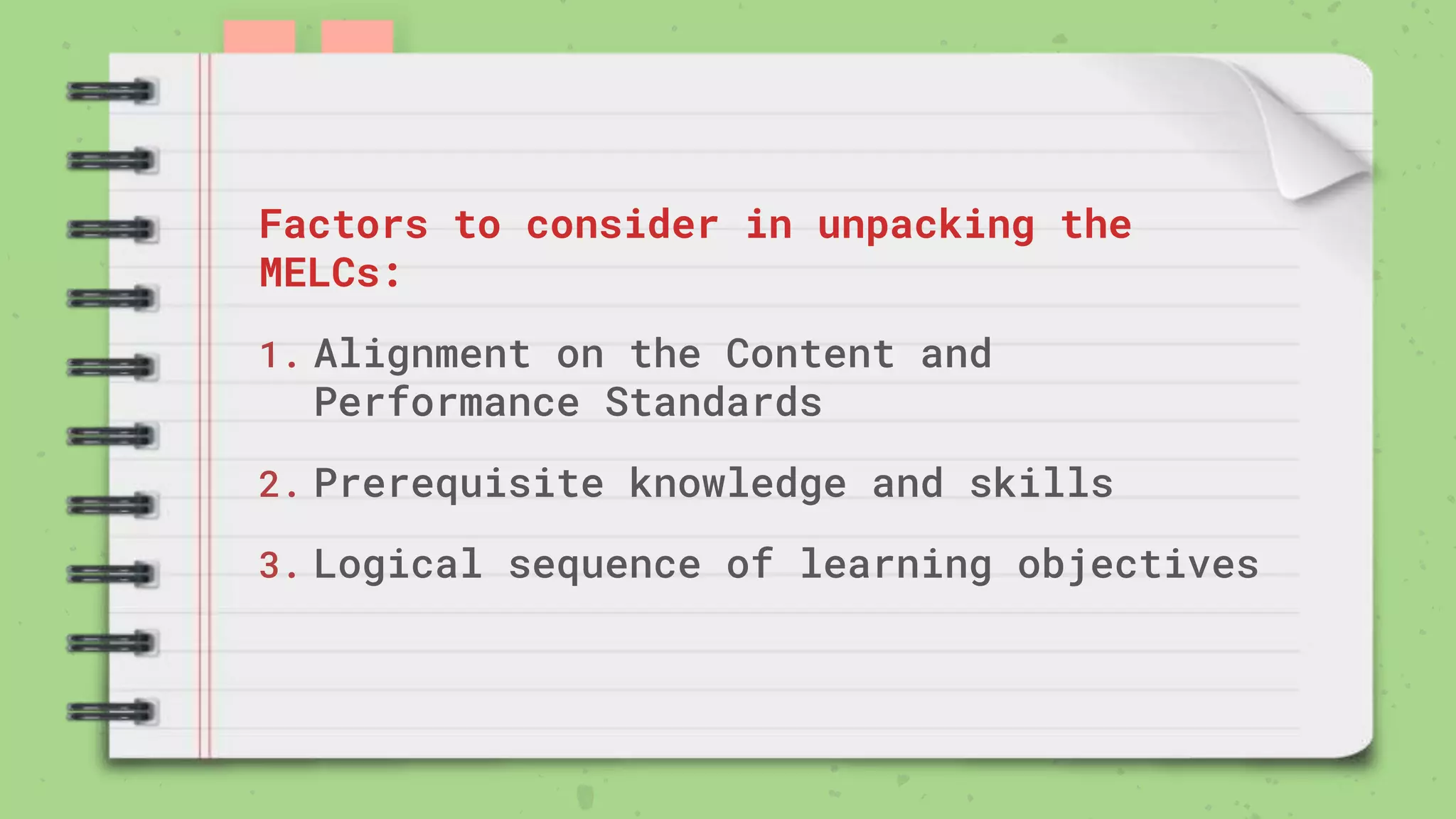
Factors to consider in unpacking the
MELCs:
1. Alignment on the Content and
Performance Standards
2. Prerequisite knowledge and skills
3. Logical sequence of learning objectives
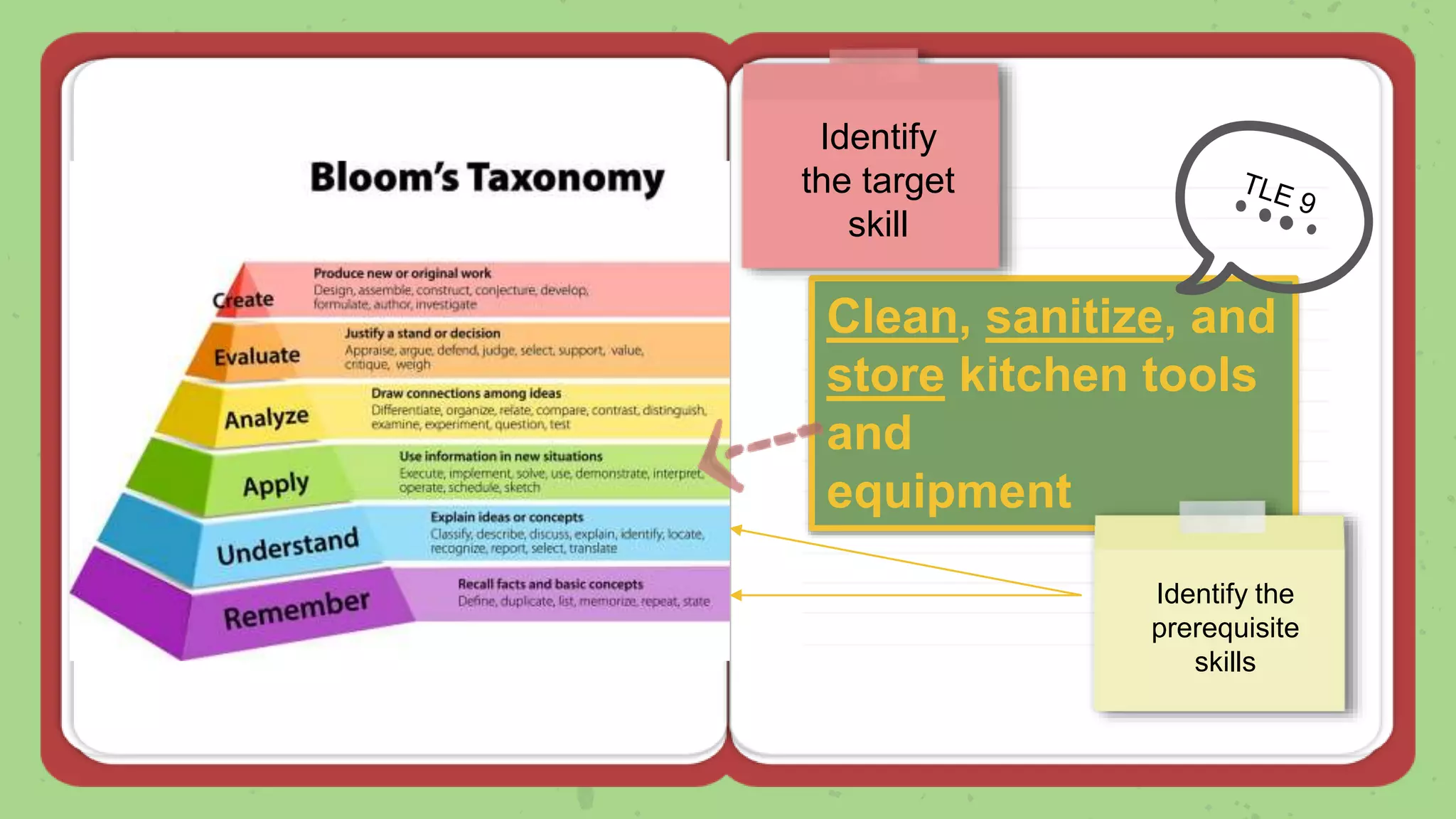
How to
unpack LC’s
Clean, sanitize, and
store kitchen tools
and
equipment
Identify the
prerequisite
skills
Identify
the target
skill
Identify the content/s or
prerequisite contents
Clean, sanitize, and
store kitchen tools and
equipment
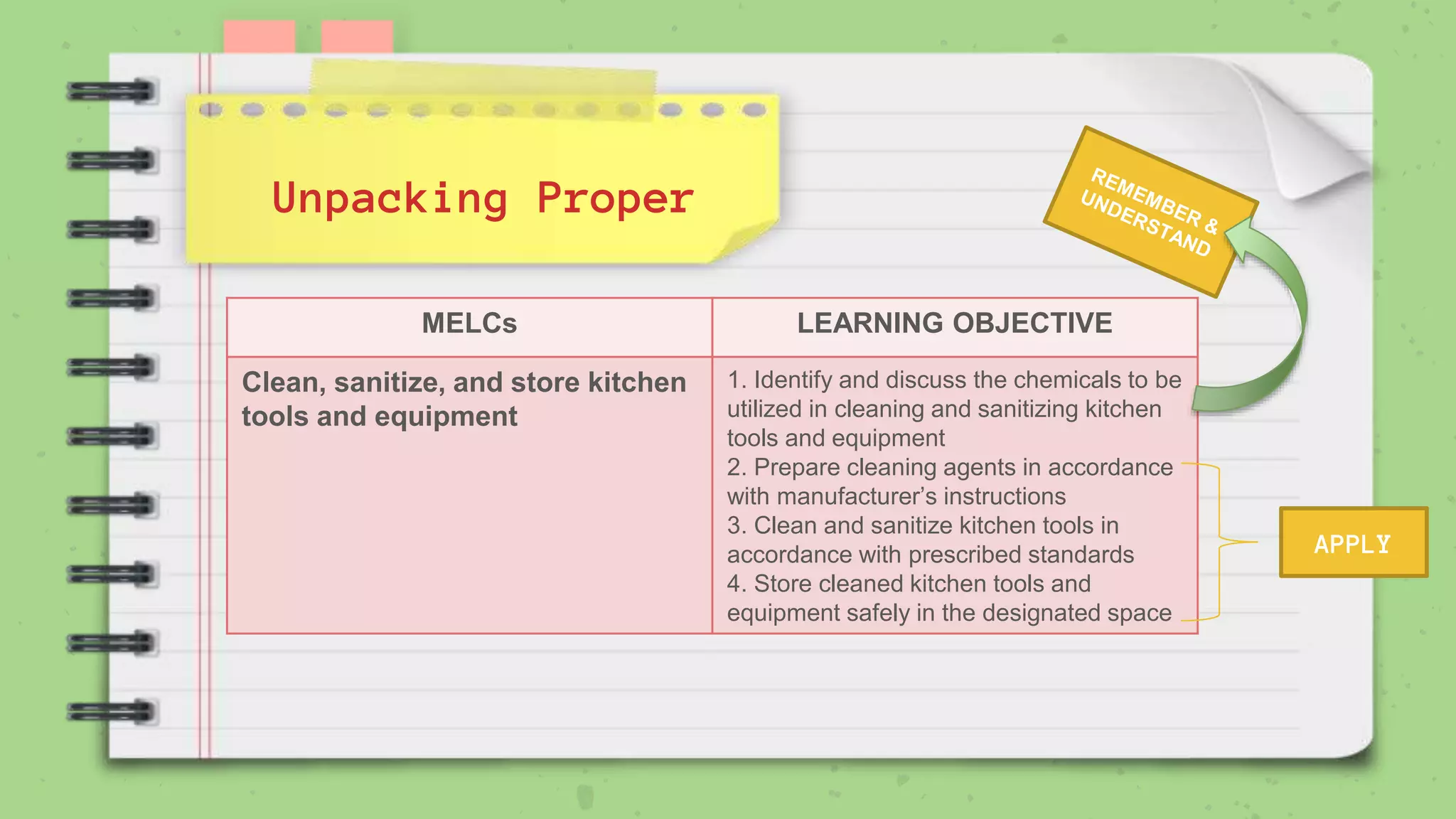
Unpacking Proper
MELCs LEARNING OBJECTIVE
Clean, sanitize, and store kitchen
tools and equipment
1. Identify and discuss the chemicals to be
utilized in cleaning and sanitizing kitchen
tools and equipment
2. Prepare cleaning agents in accordance
with manufacturer’s instructions
3. Clean and sanitize kitchen tools in
accordance with prescribed standards
4. Store cleaned kitchen tools and
equipment safely in the designated space
APPLY
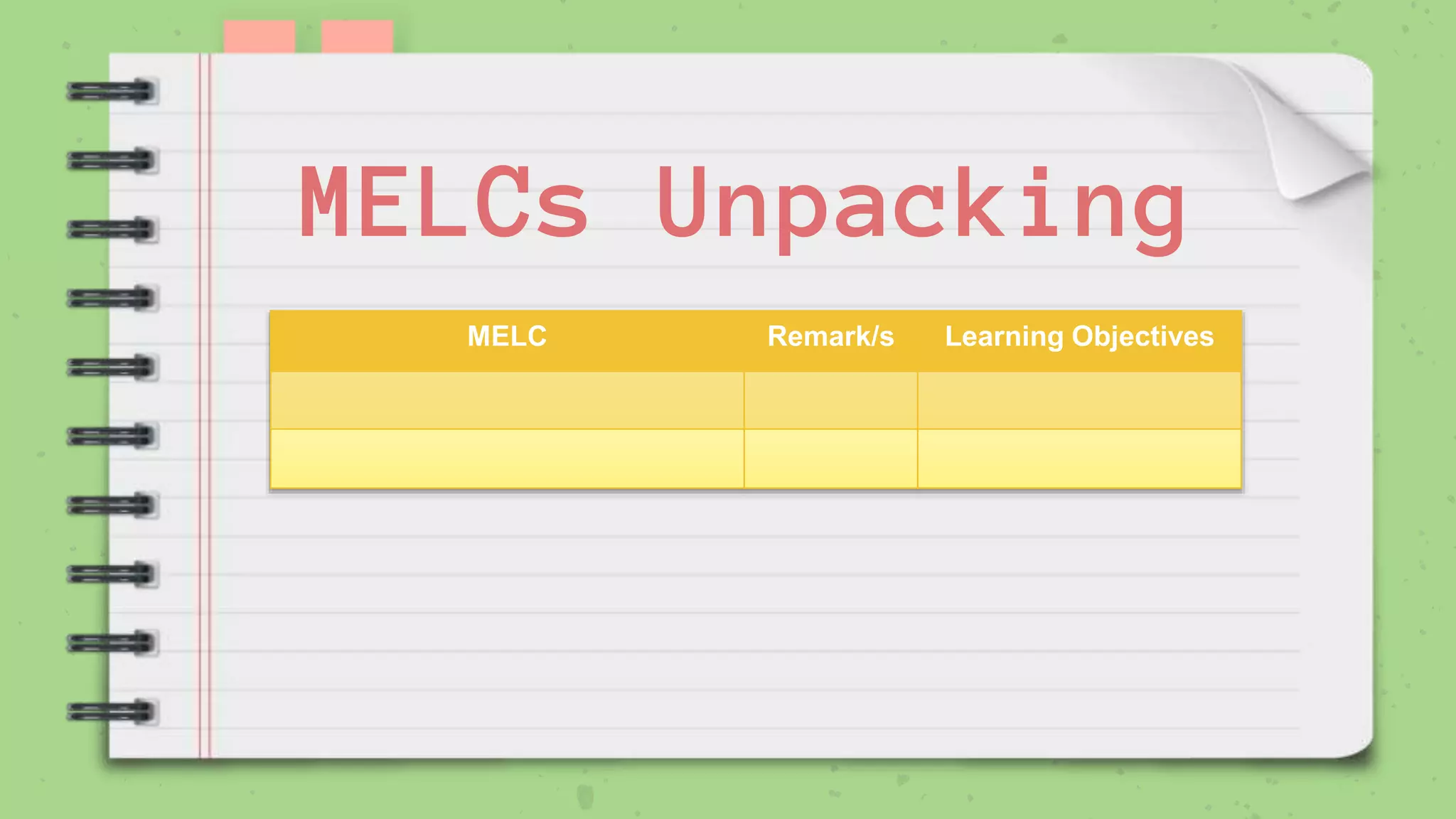
MELC Remark/s Learning Objectives
MELCs Unpacking
Combining
the MELCs
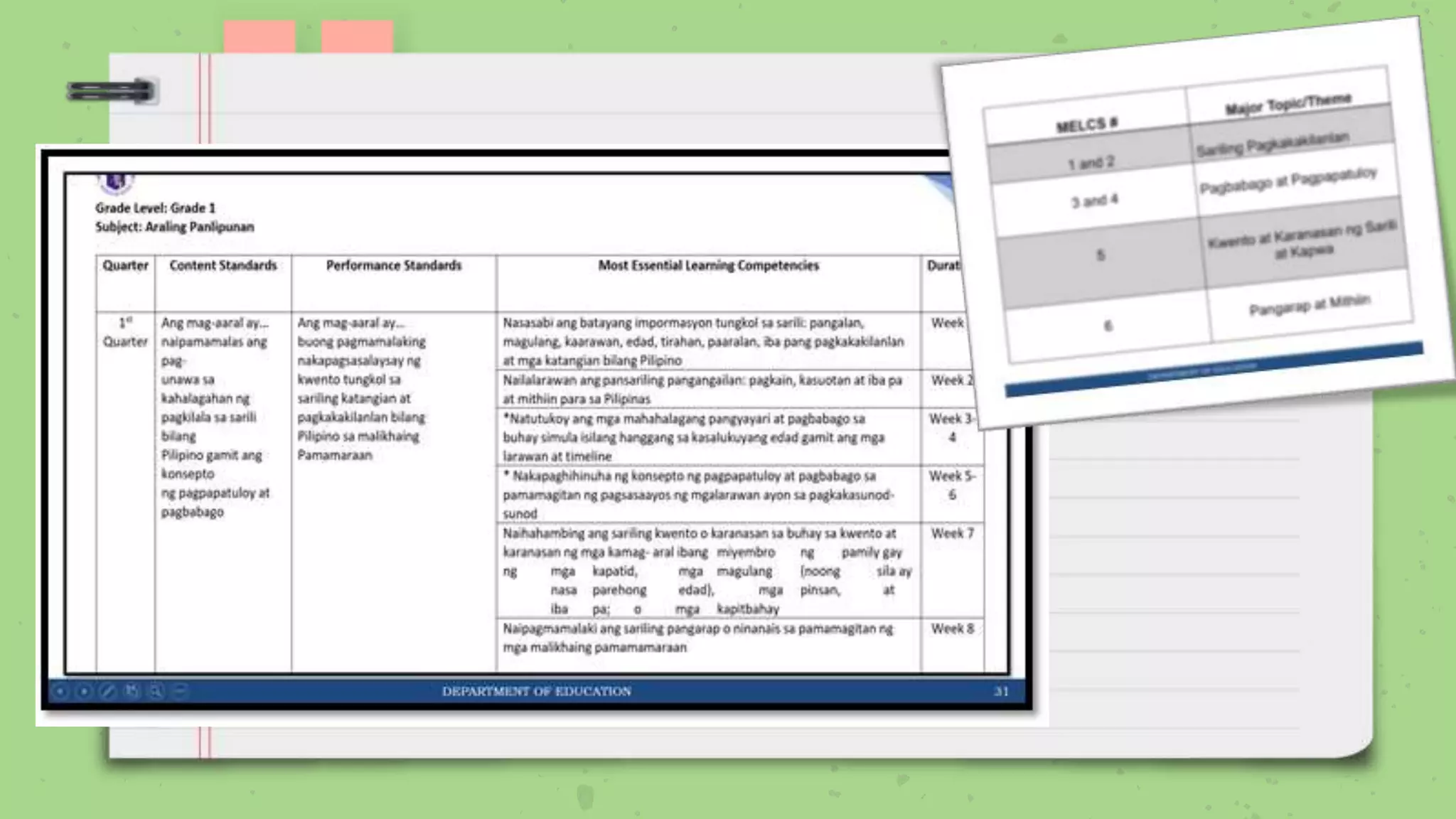
1. Commonality of the
content, topic or themed
2. Alignment with the Content
and Performance Standards
Criteria in Combining MELCs
OPEN FORUM
Output
Making
Most Essential Learning Competencies

Most Essential Learning Competencies

  • 1.
    MOST ESSENTIAL LEARNING COMPETENCIES Here starts theLAC Session! Maripaz M. Señorita Resource Person
  • 2.
    Session Objectives: By theend of this session, you will be able to: 1. explain the background and development of the MELCs 2. unpack the MELCs 3. combine the related competencies into learning objectives
  • 3.
  • 4.
    Rationale • Pandemic • UNESCO’sstand: “Education cannot wait. If learning stops, we will lose human capital. • DepEd’s Commitment: to sustain the delivery of quality, accessible, relevant, and liberating Phil. Basic education services anchored on the Sulong Edukalidad framework • The release of the MELCs is not just a response to addressing the challenges of the pandemic but is also part of the Department’s long-term response to the call of SDG4 to develop resilient education systems, most especially during emergencies.
  • 5.
    The K to12 curriculum review is not just meant to fulfill one of the provisions of RA 105333 to review the curriculum, but is also part of Sec. Briones’ continuing commitment to ensure quality, accessible, relevant, and liberating education
  • 6.
    Mapping of the essentialand desirable learning competencies within the curriculum Identification of prerequisite knowledge and skills needed to prepare students for essential learning competencies Analysis of the interconnectedness of prerequisite knowledge and skills among the learning competencies
  • 7.
    Essential Learning Competencies Defined aswhat the students need, considered indispensable, in the teaching-learning process to build skills to equip learners for subsequent grade levels and consequently, for lifelong learners
  • 8.
    Desirable Learning Competencies Defined aswhat may enhance education but may not be necessary in building foundational skills
  • 10.
    ENDURANCE A learning competencyis considered enduring if it remains with learners long after a test or unit of study is completed or if it is useful beyond a single test or unit of study
  • 11.
    Results: Retained – satisfiesthe endurance criterion which greatly contributes to life-long learning and is a prerequisite skill to the next grade level Merged/Clustered – LCs have the same objective or learning intention and can therefore be combined into one comprehensive learning competency Removed/Dropped – too specific - deemed appropriate to be introduced in an earlier quarter or grade level or moved to a later quarter or grade level - recurring - subsumed in another competency Rephrased – to be more concise
  • 15.
    Lesson 1 –Activity 3 K to 12 Learning Competencies MELCs Merged/Clustered Retained Dropped
  • 16.
    Field implementers and privateschools are encouraged to contextualize the MELCs in order to accommodate the varying contexts of learners, teachers, learning environment and support structures considering both the content and performance standards.
  • 17.
  • 18.
    Factors to considerin unpacking the MELCs: 1. Alignment on the Content and Performance Standards 2. Prerequisite knowledge and skills 3. Logical sequence of learning objectives
  • 22.
  • 23.
    Clean, sanitize, and storekitchen tools and equipment Identify the prerequisite skills Identify the target skill
  • 24.
    Identify the content/sor prerequisite contents Clean, sanitize, and store kitchen tools and equipment
  • 25.
    Unpacking Proper MELCs LEARNINGOBJECTIVE Clean, sanitize, and store kitchen tools and equipment 1. Identify and discuss the chemicals to be utilized in cleaning and sanitizing kitchen tools and equipment 2. Prepare cleaning agents in accordance with manufacturer’s instructions 3. Clean and sanitize kitchen tools in accordance with prescribed standards 4. Store cleaned kitchen tools and equipment safely in the designated space APPLY
  • 26.
    MELC Remark/s LearningObjectives MELCs Unpacking
  • 27.
  • 28.
    1. Commonality ofthe content, topic or themed 2. Alignment with the Content and Performance Standards Criteria in Combining MELCs
  • 30.
  • 31.