Chapter 1:
Problem Solving and The
Conceptual Framework of
the K to 12 Mathematics
Curriculum
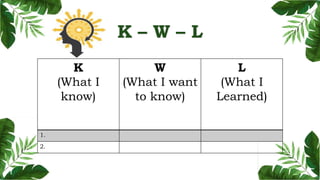
K – W – L
K
(What I
know)
W
(What I want
to know)
L
(What I
Learned)
1.
2.
Learning outcomes:
At the end of the lesson students are expected to:
Describe the conceptual framework of the k to 12
mathematics curriculum.
Explain the pedagogies in teaching Mathematics in
their own words.
Illustrate the concept of Spiral Approach
Observes accuracy and honesty in performing the
task
Nature of Mathematics
Mathematics is a core subject of basic
education that encompasses life at any stage.
Its importance goes beyond the lesson and the
school. It provides learners with the answers to
many questions about the world they live in.
It plays a vital role in many fields including
natural science, social sciences, engineering
finance, and many more. Its application to
these fields makes use of new mathematical
innovations in which new disciplines are
developed.
Checkpoint!
Think of instances in which Mathematics
plays a vital role in your day-to-day life.
The Conceptual
Framework of the K
to 12 Mathematics
Curriculum
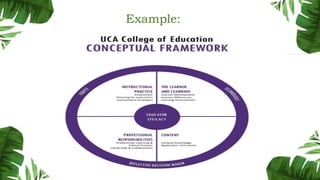
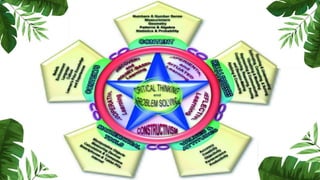
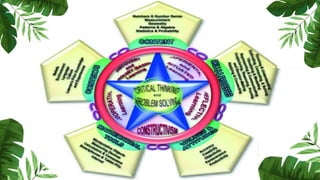
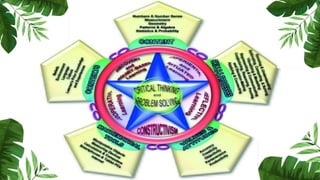
CONCEPTUAL FRAMEWORK
an analytical tool with several variations and
contexts. It can be applied in different
categories of work where an overall picture is
needed.
Example:
The Conceptual
Framework of the K
to 12 Mathematics
Curriculum
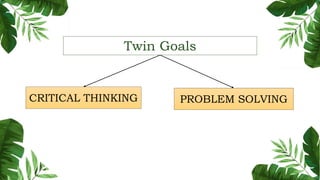
Twin Goals
CRITICAL THINKING PROBLEM SOLVING
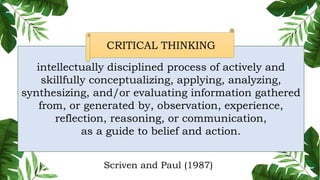
intellectually disciplined process of actively and
skillfully conceptualizing, applying, analyzing,
synthesizing, and/or evaluating information gathered
from, or generated by, observation, experience,
reflection, reasoning, or communication,
as a guide to belief and action.
CRITICAL THINKING
Scriven and Paul (1987)
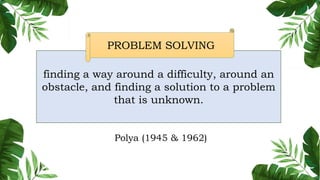
finding a way around a difficulty, around an
obstacle, and finding a solution to a problem
that is unknown.
PROBLEM SOLVING
Polya (1945 & 1962)
problem solving focuses the student attention on ideas
and sense making rather than memorization of facts
develops the student’s s belief that they are capable of
doing mathematics and that mathematics makes sense
teaching through problem solving is fun and when
learning is fun, students have a better chance of
remembering it later.
it provides ongoing assessment data that can be used
to make instructional decisions, help students succeed,
and inform parents
Checkpoint!
What is the relationship between critical
thinking and problem solving?
Pedagogies of
the Mathematics
Curriculum
learners construct knowledge
rather than just passively take in
information.
CONSTRUCTIVISM
The learner constructs and clarifies
meaning in terms of their own
understanding and cognition, supporting
changes in conceptual perspective.
REFLECTIVE LEARNING
the process whereby knowledge is
created through the transformation
of experience.
EXPERIENTIAL AND
SITUATED LEARNING
students are encouraged to construct
their own knowledge through a self-
directed learning process—essentially
“instructionless” learning
DISCOVERY AND INQUIRY –
BASED LEARNING
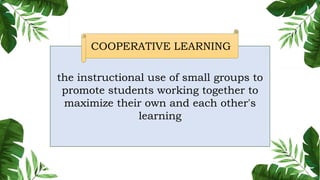
the instructional use of small groups to
promote students working together to
maximize their own and each other's
learning
COOPERATIVE LEARNING
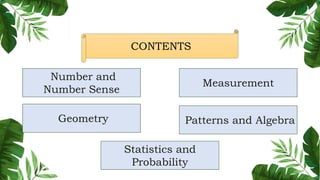
Number and
Number Sense
CONTENTS
Measurement
Geometry Patterns and Algebra
Statistics and
Probability
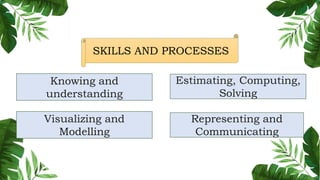
Knowing and
understanding
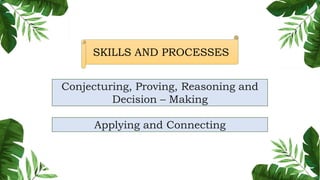
SKILLS AND PROCESSES
Estimating, Computing,
Solving
Visualizing and
Modelling
Representing and
Communicating
SKILLS AND PROCESSES
Conjecturing, Proving, Reasoning and
Decision – Making
Applying and Connecting
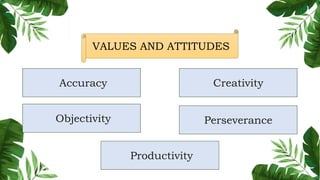
Accuracy
VALUES AND ATTITUDES
Creativity
Objectivity Perseverance
Productivity
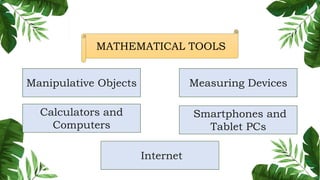
Manipulative Objects
MATHEMATICAL TOOLS
Measuring Devices
Calculators and
Computers
Smartphones and
Tablet PCs
Internet
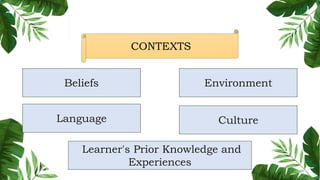
Beliefs
CONTEXTS
Environment
Language Culture
Learner's Prior Knowledge and
Experiences
THE K TO 12
MATHEMATICS CORE
LEARNING AREA
STANDARDS
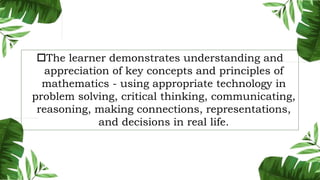
The learner demonstrates understanding and
appreciation of key concepts and principles of
mathematics - using appropriate technology in
problem solving, critical thinking, communicating,
reasoning, making connections, representations,
and decisions in real life.
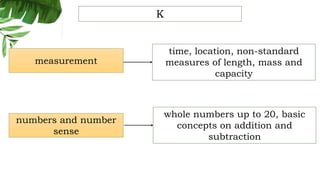
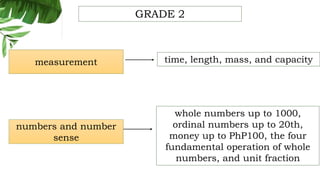
numbers and number
sense
measurement
whole numbers up to 20, basic
concepts on addition and
subtraction
time, location, non-standard
measures of length, mass and
capacity
K
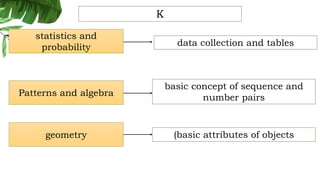
geometry
Patterns and algebra
statistics and
probability
(basic attributes of objects
basic concept of sequence and
number pairs
data collection and tables
K
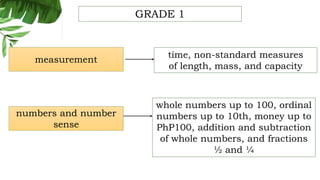
numbers and number
sense
measurement
whole numbers up to 100, ordinal
numbers up to 10th, money up to
PhP100, addition and subtraction
of whole numbers, and fractions
½ and ¼
time, non-standard measures
of length, mass, and capacity
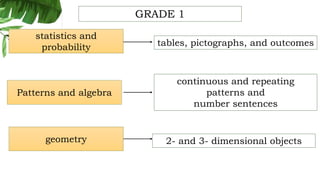
GRADE 1
geometry
Patterns and algebra
statistics and
probability
2- and 3- dimensional objects
continuous and repeating
patterns and
number sentences
tables, pictographs, and outcomes
GRADE 1
numbers and number
sense
measurement
whole numbers up to 1000,
ordinal numbers up to 20th,
money up to PhP100, the four
fundamental operation of whole
numbers, and unit fraction
time, length, mass, and capacity
GRADE 2
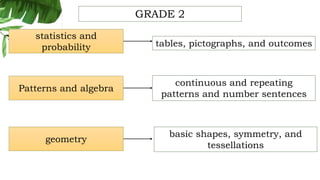
geometry
Patterns and algebra
statistics and
probability
basic shapes, symmetry, and
tessellations
continuous and repeating
patterns and number sentences
tables, pictographs, and outcomes
GRADE 2
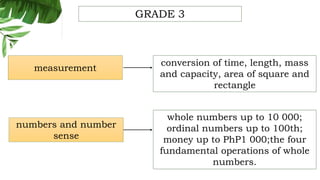
numbers and number
sense
measurement
whole numbers up to 10 000;
ordinal numbers up to 100th;
money up to PhP1 000;the four
fundamental operations of whole
numbers.
conversion of time, length, mass
and capacity, area of square and
rectangle
GRADE 3
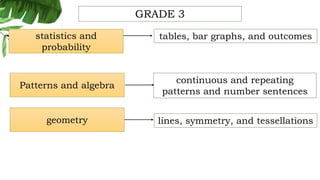
geometry
Patterns and algebra
statistics and
probability
lines, symmetry, and tessellations
continuous and repeating
patterns and number sentences
tables, bar graphs, and outcomes
GRADE 3
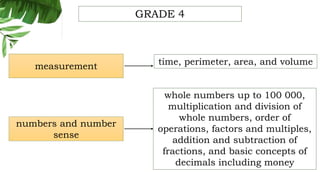
numbers and number
sense
measurement
whole numbers up to 100 000,
multiplication and division of
whole numbers, order of
operations, factors and multiples,
addition and subtraction of
fractions, and basic concepts of
decimals including money
time, perimeter, area, and volume
GRADE 4
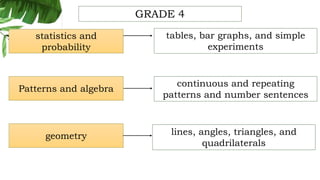
geometry
Patterns and algebra
statistics and
probability
lines, angles, triangles, and
quadrilaterals
continuous and repeating
patterns and number sentences
tables, bar graphs, and simple
experiments
GRADE 4
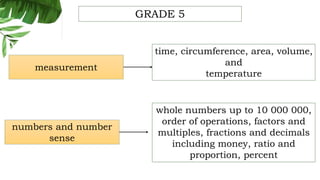
numbers and number
sense
measurement
whole numbers up to 10 000 000,
order of operations, factors and
multiples, fractions and decimals
including money, ratio and
proportion, percent
time, circumference, area, volume,
and
temperature
GRADE 5
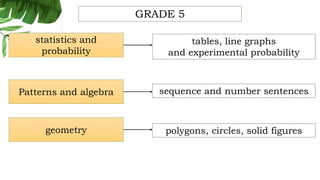
geometry
Patterns and algebra
statistics and
probability
polygons, circles, solid figures
sequence and number sentences
tables, line graphs
and experimental probability
GRADE 5
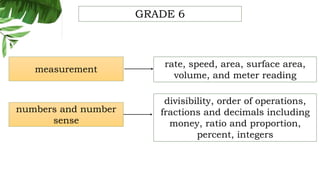
numbers and number
sense
measurement
divisibility, order of operations,
fractions and decimals including
money, ratio and proportion,
percent, integers
rate, speed, area, surface area,
volume, and meter reading
GRADE 6
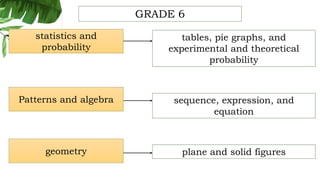
geometry
Patterns and algebra
statistics and
probability
plane and solid figures
sequence, expression, and
equation
tables, pie graphs, and
experimental and theoretical
probability
GRADE 6
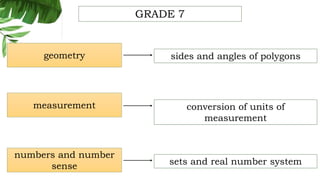
numbers and number
sense
measurement
geometry
sets and real number system
conversion of units of
measurement
sides and angles of polygons
GRADE 7
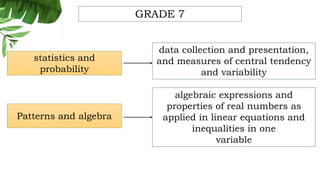
Patterns and algebra
statistics and
probability
algebraic expressions and
properties of real numbers as
applied in linear equations and
inequalities in one
variable
data collection and presentation,
and measures of central tendency
and variability
GRADE 7
geometry
Patterns and algebra
statistics and
probability
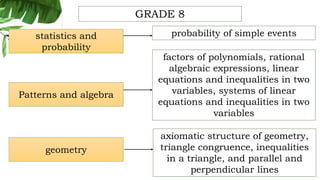
axiomatic structure of geometry,
triangle congruence, inequalities
in a triangle, and parallel and
perpendicular lines
factors of polynomials, rational
algebraic expressions, linear
equations and inequalities in two
variables, systems of linear
equations and inequalities in two
variables
probability of simple events
GRADE 8
geometry
Patterns and algebra
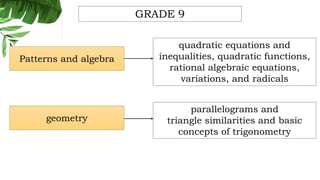
parallelograms and
triangle similarities and basic
concepts of trigonometry
quadratic equations and
inequalities, quadratic functions,
rational algebraic equations,
variations, and radicals
GRADE 9
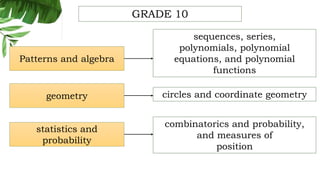
geometry
Patterns and algebra
circles and coordinate geometry
sequences, series,
polynomials, polynomial
equations, and polynomial
functions
GRADE 10
statistics and
probability
combinatorics and probability,
and measures of
position
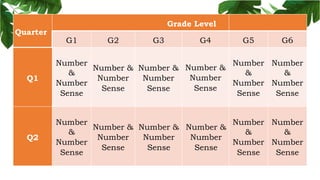
Quarter
Grade Level
G1 G2 G3 G4 G5 G6
Q1
Number
&
Number
Sense
Number &
Number
Sense
Number &
Number
Sense
Number &
Number
Sense
Number
&
Number
Sense
Number
&
Number
Sense
Q2
Number
&
Number
Sense
Number &
Number
Sense
Number &
Number
Sense
Number &
Number
Sense
Number
&
Number
Sense
Number
&
Number
Sense
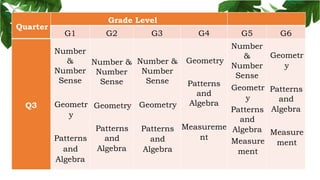
Quarter
Grade Level
G1 G2 G3 G4 G5 G6
Q3
Number
&
Number
Sense
Geometr
y
Patterns
and
Algebra
Number &
Number
Sense
Geometry
Patterns
and
Algebra
Number &
Number
Sense
Geometry
Patterns
and
Algebra
Geometry
Patterns
and
Algebra
Measureme
nt
Number
&
Number
Sense
Geometr
y
Patterns
and
Algebra
Measure
ment
Geometr
y
Patterns
and
Algebra
Measure
ment
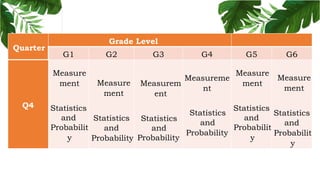
Quarter
Grade Level
G1 G2 G3 G4 G5 G6
Q4
Measure
ment
Statistics
and
Probabilit
y
Measure
ment
Statistics
and
Probability
Measurem
ent
Statistics
and
Probability
Measureme
nt
Statistics
and
Probability
Measure
ment
Statistics
and
Probabilit
y
Measure
ment
Statistics
and
Probabilit
y
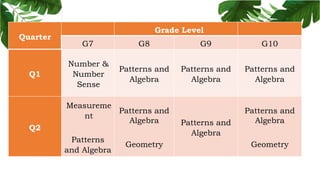
Quarter
Grade Level
G7 G8 G9 G10
Q1
Number &
Number
Sense
Patterns and
Algebra
Patterns and
Algebra
Patterns and
Algebra
Q2
Measureme
nt
Patterns
and Algebra
Patterns and
Algebra
Geometry
Patterns and
Algebra
Patterns and
Algebra
Geometry
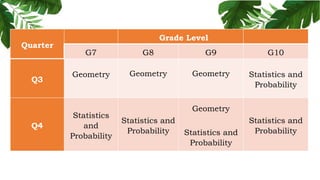
Quarter
Grade Level
G7 G8 G9 G10
Q3
Geometry Geometry Geometry Statistics and
Probability
Q4
Statistics
and
Probability
Statistics and
Probability
Geometry
Statistics and
Probability
Statistics and
Probability
Math Concept: The Spiral Approach
The Mathematics K to 12 curriculum is seamless. This
ensures smooth transition between grade level and a
continuum of competencies through spiral progression
where learning of knowledge, skills, values, and
attitudes increases in depth and breadth.
Math Concept: The Spiral Approach
There is also continuity of competencies and standards
from elementary to secondary level through a unified
curriculum framework.
Math Concept: The Spiral Approach
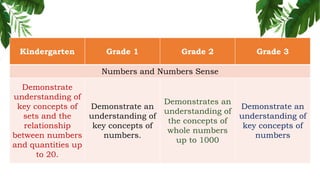
The unified standards and competencies ensure
integration of what learners learn across grade levels
and across learning areas for a more meaningful
learning. Below is an example of spiraling of concepts
about Numbers and Number Sense and Geometry from
Kindergarten to Grade 3.
Kindergarten Grade 1 Grade 2 Grade 3
Numbers and Numbers Sense
Demonstrate
understanding of
key concepts of
sets and the
relationship
between numbers
and quantities up
to 20.
Demonstrate an
understanding of
key concepts of
numbers.
Demonstrates an
understanding of
the concepts of
whole numbers
up to 1000
Demonstrate an
understanding of
key concepts of
numbers
Kindergarten Grade 1 Grade 2 Grade 3
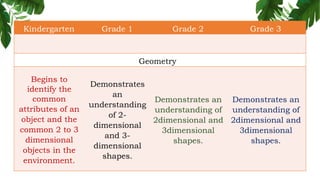
Geometry
Begins to
identify the
common
attributes of an
object and the
common 2 to 3
dimensional
objects in the
environment.
Demonstrates
an
understanding
of 2-
dimensional
and 3-
dimensional
shapes.
Demonstrates an
understanding of
2dimensional and
3dimensional
shapes.
Demonstrates an
understanding of
2dimensional and
3dimensional
shapes.
Thank
You!
ACTIVIT TIME!
Instruction: Bring out 1/2 sheet of paper and answer
the following activities.
1. Describe the conceptual framework in the k to 12
mathematics curriculum in your own words. At least 5
sentences.
ACTIVIT TIME!
2. Choose 2 pedagogies and explain why these should
be given more emphasis in teaching Mathematics.
3. Create a spiral and input the lessons that should be
discussed in statistics from Grade 6 to Grade 8 on the
spaces between the curves. Below your
drawing/illustration, explain the spiral concept.

Conceptual-Framework.pptx

  • 1.
    Chapter 1: Problem Solvingand The Conceptual Framework of the K to 12 Mathematics Curriculum
  • 2.
    K – W– L K (What I know) W (What I want to know) L (What I Learned) 1. 2.
  • 3.
    Learning outcomes: At theend of the lesson students are expected to: Describe the conceptual framework of the k to 12 mathematics curriculum. Explain the pedagogies in teaching Mathematics in their own words. Illustrate the concept of Spiral Approach Observes accuracy and honesty in performing the task
  • 4.
    Nature of Mathematics Mathematicsis a core subject of basic education that encompasses life at any stage.
  • 5.
    Its importance goesbeyond the lesson and the school. It provides learners with the answers to many questions about the world they live in.
  • 6.
    It plays avital role in many fields including natural science, social sciences, engineering finance, and many more. Its application to these fields makes use of new mathematical innovations in which new disciplines are developed.
  • 7.
    Checkpoint! Think of instancesin which Mathematics plays a vital role in your day-to-day life.
  • 8.
    The Conceptual Framework ofthe K to 12 Mathematics Curriculum
  • 9.
    CONCEPTUAL FRAMEWORK an analyticaltool with several variations and contexts. It can be applied in different categories of work where an overall picture is needed.
  • 10.
  • 11.
    The Conceptual Framework ofthe K to 12 Mathematics Curriculum
  • 13.
  • 14.
    intellectually disciplined processof actively and skillfully conceptualizing, applying, analyzing, synthesizing, and/or evaluating information gathered from, or generated by, observation, experience, reflection, reasoning, or communication, as a guide to belief and action. CRITICAL THINKING Scriven and Paul (1987)
  • 15.
    finding a wayaround a difficulty, around an obstacle, and finding a solution to a problem that is unknown. PROBLEM SOLVING Polya (1945 & 1962)
  • 16.
    problem solving focusesthe student attention on ideas and sense making rather than memorization of facts develops the student’s s belief that they are capable of doing mathematics and that mathematics makes sense
  • 17.
    teaching through problemsolving is fun and when learning is fun, students have a better chance of remembering it later. it provides ongoing assessment data that can be used to make instructional decisions, help students succeed, and inform parents
  • 18.
    Checkpoint! What is therelationship between critical thinking and problem solving?
  • 19.
  • 20.
    learners construct knowledge ratherthan just passively take in information. CONSTRUCTIVISM
  • 21.
    The learner constructsand clarifies meaning in terms of their own understanding and cognition, supporting changes in conceptual perspective. REFLECTIVE LEARNING
  • 22.
    the process wherebyknowledge is created through the transformation of experience. EXPERIENTIAL AND SITUATED LEARNING
  • 23.
    students are encouragedto construct their own knowledge through a self- directed learning process—essentially “instructionless” learning DISCOVERY AND INQUIRY – BASED LEARNING
  • 24.
    the instructional useof small groups to promote students working together to maximize their own and each other's learning COOPERATIVE LEARNING
  • 26.
    Number and Number Sense CONTENTS Measurement GeometryPatterns and Algebra Statistics and Probability
  • 27.
    Knowing and understanding SKILLS ANDPROCESSES Estimating, Computing, Solving Visualizing and Modelling Representing and Communicating
  • 28.
    SKILLS AND PROCESSES Conjecturing,Proving, Reasoning and Decision – Making Applying and Connecting
  • 29.
  • 30.
    Manipulative Objects MATHEMATICAL TOOLS MeasuringDevices Calculators and Computers Smartphones and Tablet PCs Internet
  • 31.
  • 33.
    THE K TO12 MATHEMATICS CORE LEARNING AREA STANDARDS
  • 34.
    The learner demonstratesunderstanding and appreciation of key concepts and principles of mathematics - using appropriate technology in problem solving, critical thinking, communicating, reasoning, making connections, representations, and decisions in real life.
  • 35.
    numbers and number sense measurement wholenumbers up to 20, basic concepts on addition and subtraction time, location, non-standard measures of length, mass and capacity K
  • 36.
    geometry Patterns and algebra statisticsand probability (basic attributes of objects basic concept of sequence and number pairs data collection and tables K
  • 37.
    numbers and number sense measurement wholenumbers up to 100, ordinal numbers up to 10th, money up to PhP100, addition and subtraction of whole numbers, and fractions ½ and ¼ time, non-standard measures of length, mass, and capacity GRADE 1
  • 38.
    geometry Patterns and algebra statisticsand probability 2- and 3- dimensional objects continuous and repeating patterns and number sentences tables, pictographs, and outcomes GRADE 1
  • 39.
    numbers and number sense measurement wholenumbers up to 1000, ordinal numbers up to 20th, money up to PhP100, the four fundamental operation of whole numbers, and unit fraction time, length, mass, and capacity GRADE 2
  • 40.
    geometry Patterns and algebra statisticsand probability basic shapes, symmetry, and tessellations continuous and repeating patterns and number sentences tables, pictographs, and outcomes GRADE 2
  • 41.
    numbers and number sense measurement wholenumbers up to 10 000; ordinal numbers up to 100th; money up to PhP1 000;the four fundamental operations of whole numbers. conversion of time, length, mass and capacity, area of square and rectangle GRADE 3
  • 42.
    geometry Patterns and algebra statisticsand probability lines, symmetry, and tessellations continuous and repeating patterns and number sentences tables, bar graphs, and outcomes GRADE 3
  • 43.
    numbers and number sense measurement wholenumbers up to 100 000, multiplication and division of whole numbers, order of operations, factors and multiples, addition and subtraction of fractions, and basic concepts of decimals including money time, perimeter, area, and volume GRADE 4
  • 44.
    geometry Patterns and algebra statisticsand probability lines, angles, triangles, and quadrilaterals continuous and repeating patterns and number sentences tables, bar graphs, and simple experiments GRADE 4
  • 45.
    numbers and number sense measurement wholenumbers up to 10 000 000, order of operations, factors and multiples, fractions and decimals including money, ratio and proportion, percent time, circumference, area, volume, and temperature GRADE 5
  • 46.
    geometry Patterns and algebra statisticsand probability polygons, circles, solid figures sequence and number sentences tables, line graphs and experimental probability GRADE 5
  • 47.
    numbers and number sense measurement divisibility,order of operations, fractions and decimals including money, ratio and proportion, percent, integers rate, speed, area, surface area, volume, and meter reading GRADE 6
  • 48.
    geometry Patterns and algebra statisticsand probability plane and solid figures sequence, expression, and equation tables, pie graphs, and experimental and theoretical probability GRADE 6
  • 49.
    numbers and number sense measurement geometry setsand real number system conversion of units of measurement sides and angles of polygons GRADE 7
  • 50.
    Patterns and algebra statisticsand probability algebraic expressions and properties of real numbers as applied in linear equations and inequalities in one variable data collection and presentation, and measures of central tendency and variability GRADE 7
  • 51.
    geometry Patterns and algebra statisticsand probability axiomatic structure of geometry, triangle congruence, inequalities in a triangle, and parallel and perpendicular lines factors of polynomials, rational algebraic expressions, linear equations and inequalities in two variables, systems of linear equations and inequalities in two variables probability of simple events GRADE 8
  • 52.
    geometry Patterns and algebra parallelogramsand triangle similarities and basic concepts of trigonometry quadratic equations and inequalities, quadratic functions, rational algebraic equations, variations, and radicals GRADE 9
  • 53.
    geometry Patterns and algebra circlesand coordinate geometry sequences, series, polynomials, polynomial equations, and polynomial functions GRADE 10 statistics and probability combinatorics and probability, and measures of position
  • 54.
    Quarter Grade Level G1 G2G3 G4 G5 G6 Q1 Number & Number Sense Number & Number Sense Number & Number Sense Number & Number Sense Number & Number Sense Number & Number Sense Q2 Number & Number Sense Number & Number Sense Number & Number Sense Number & Number Sense Number & Number Sense Number & Number Sense
  • 55.
    Quarter Grade Level G1 G2G3 G4 G5 G6 Q3 Number & Number Sense Geometr y Patterns and Algebra Number & Number Sense Geometry Patterns and Algebra Number & Number Sense Geometry Patterns and Algebra Geometry Patterns and Algebra Measureme nt Number & Number Sense Geometr y Patterns and Algebra Measure ment Geometr y Patterns and Algebra Measure ment
  • 56.
    Quarter Grade Level G1 G2G3 G4 G5 G6 Q4 Measure ment Statistics and Probabilit y Measure ment Statistics and Probability Measurem ent Statistics and Probability Measureme nt Statistics and Probability Measure ment Statistics and Probabilit y Measure ment Statistics and Probabilit y
  • 57.
    Quarter Grade Level G7 G8G9 G10 Q1 Number & Number Sense Patterns and Algebra Patterns and Algebra Patterns and Algebra Q2 Measureme nt Patterns and Algebra Patterns and Algebra Geometry Patterns and Algebra Patterns and Algebra Geometry
  • 58.
    Quarter Grade Level G7 G8G9 G10 Q3 Geometry Geometry Geometry Statistics and Probability Q4 Statistics and Probability Statistics and Probability Geometry Statistics and Probability Statistics and Probability
  • 59.
    Math Concept: TheSpiral Approach The Mathematics K to 12 curriculum is seamless. This ensures smooth transition between grade level and a continuum of competencies through spiral progression where learning of knowledge, skills, values, and attitudes increases in depth and breadth.
  • 60.
    Math Concept: TheSpiral Approach There is also continuity of competencies and standards from elementary to secondary level through a unified curriculum framework.
  • 61.
    Math Concept: TheSpiral Approach The unified standards and competencies ensure integration of what learners learn across grade levels and across learning areas for a more meaningful learning. Below is an example of spiraling of concepts about Numbers and Number Sense and Geometry from Kindergarten to Grade 3.
  • 62.
    Kindergarten Grade 1Grade 2 Grade 3 Numbers and Numbers Sense Demonstrate understanding of key concepts of sets and the relationship between numbers and quantities up to 20. Demonstrate an understanding of key concepts of numbers. Demonstrates an understanding of the concepts of whole numbers up to 1000 Demonstrate an understanding of key concepts of numbers
  • 63.
    Kindergarten Grade 1Grade 2 Grade 3 Geometry Begins to identify the common attributes of an object and the common 2 to 3 dimensional objects in the environment. Demonstrates an understanding of 2- dimensional and 3- dimensional shapes. Demonstrates an understanding of 2dimensional and 3dimensional shapes. Demonstrates an understanding of 2dimensional and 3dimensional shapes.
  • 64.
  • 65.
    ACTIVIT TIME! Instruction: Bringout 1/2 sheet of paper and answer the following activities. 1. Describe the conceptual framework in the k to 12 mathematics curriculum in your own words. At least 5 sentences.
  • 66.
    ACTIVIT TIME! 2. Choose2 pedagogies and explain why these should be given more emphasis in teaching Mathematics. 3. Create a spiral and input the lessons that should be discussed in statistics from Grade 6 to Grade 8 on the spaces between the curves. Below your drawing/illustration, explain the spiral concept.