Module - Creating& maintaining a learning
culture at workplace
Lecturer - Madhawa Waidyaratna 1
“ ”Madhawa Waidyaratna
B. Sc. (Chem.), MBA , MSc (IT), MA, MCSSL, MSLIM
National Diploma In Quantity Surveying (NDQS) – 2013/2015
Creating and Maintaining a
Learning Culture at Workplace
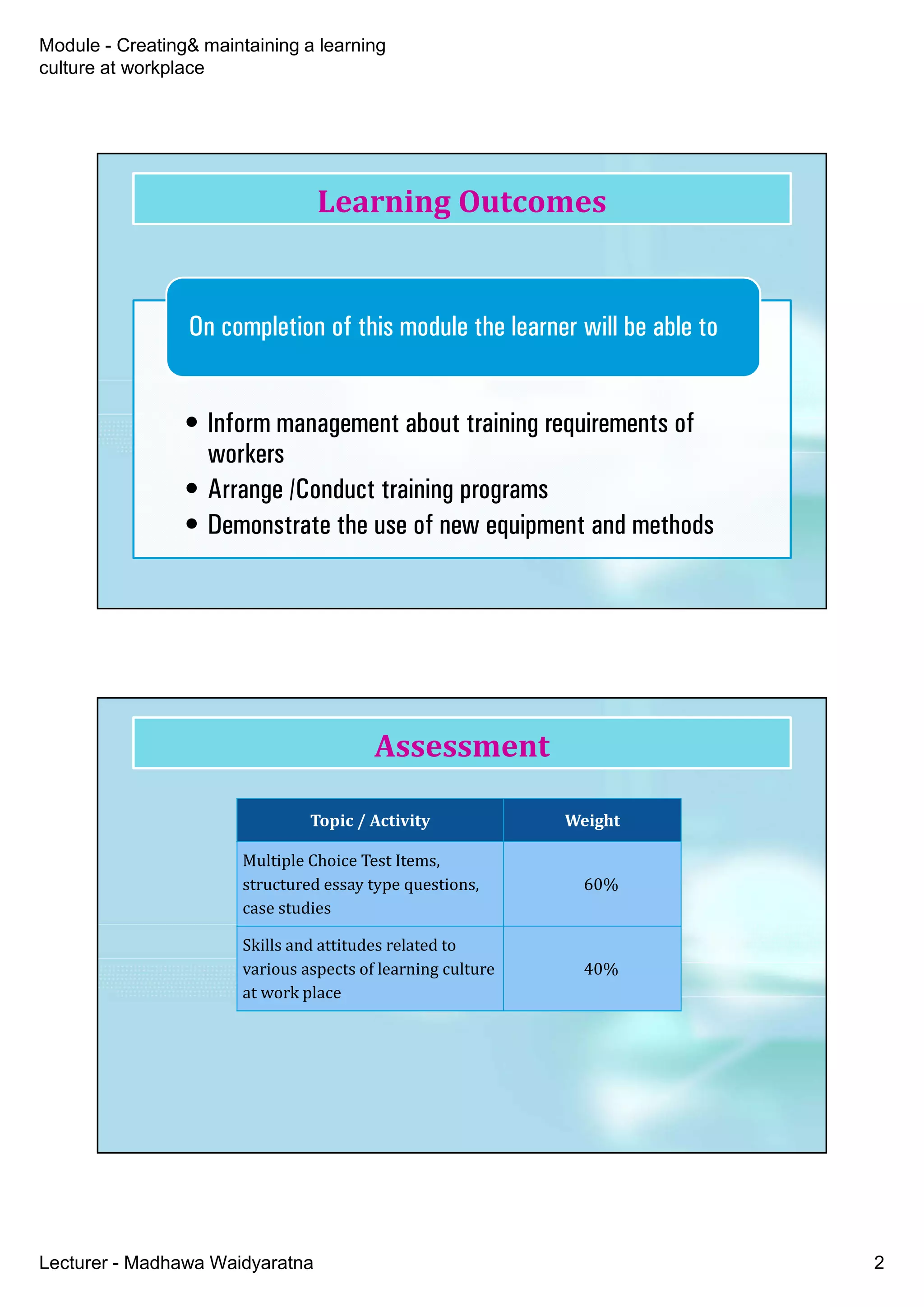
Module Aim
• Create awareness and understanding of the concept of
learning culture.
• Develop competencies required to create and maintain a
learning culture at the workplace
To enable the students to:
Module - Creating& maintaining a learning
culture at workplace
Lecturer - Madhawa Waidyaratna 2
• Inform management about training requirements of
workers
• Arrange /Conduct training programs
• Demonstrate the use of new equipment and methods
On completion of this module the learner will be able to
Learning Outcomes
Assessment
Topic / Activity Weight
Multiple Choice Test Items,
structured essay type questions,
case studies
60%
Skills and attitudes related to
various aspects of learning culture
at work place
40%
Module - Creating& maintaining a learning
culture at workplace
Lecturer - Madhawa Waidyaratna 3
• Organization that acquires knowledge and innovates fast
enough to survive and thrive in a rapidly
changing environment.
• Learning organizations
– Create a culture that encourages and supports
continuous employee learning, critical thinking, and risk
taking with new ideas
– Allow mistakes, and value employee contributions
– Learn from experience and experiment
– Disseminate the new knowledge throughout the organization
for incorporation into day-to-day activities.
Learning Organizations
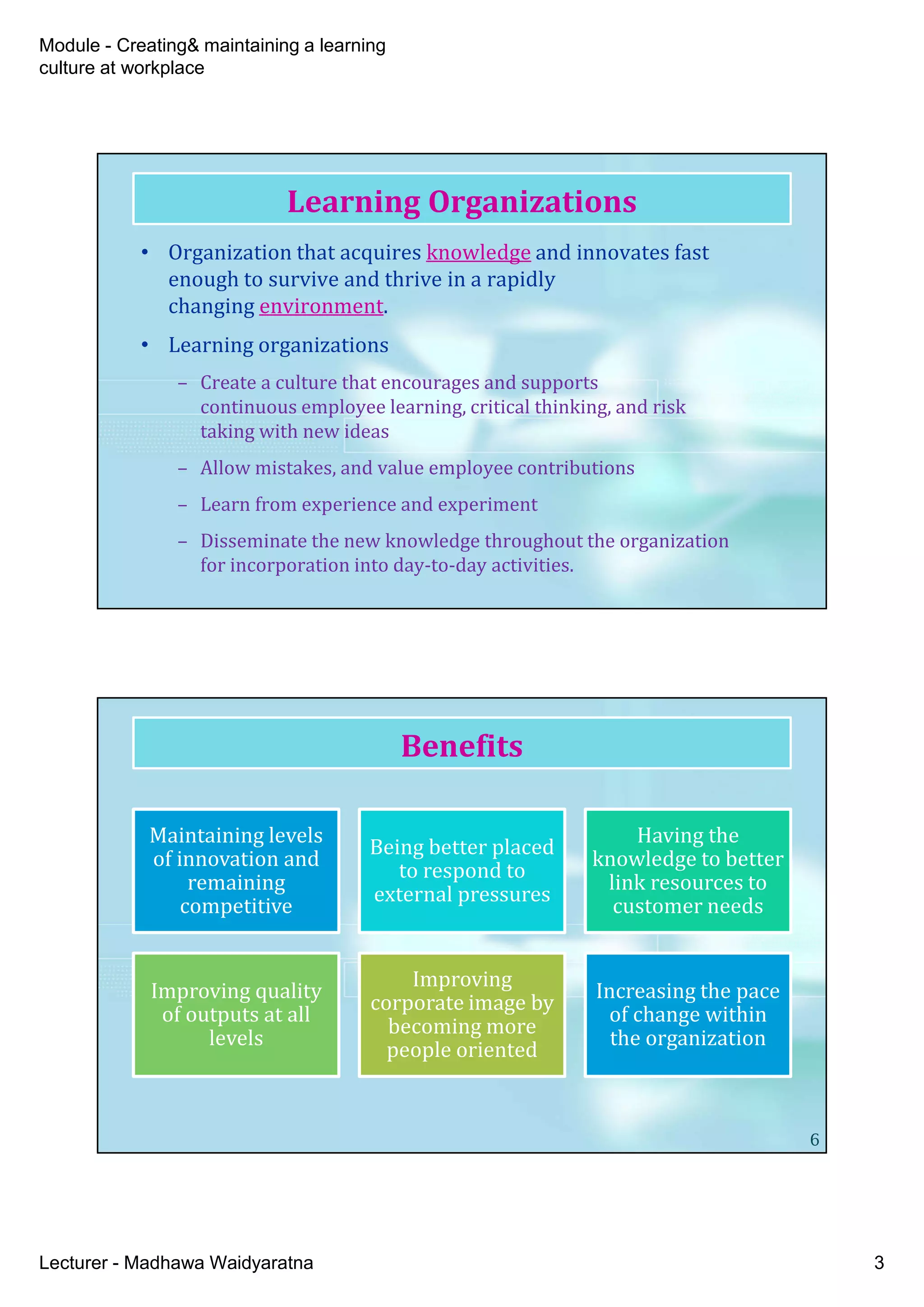
Benefits
6
Maintaining levels
of innovation and
remaining
competitive
Being better placed
to respond to
external pressures
Having the
knowledge to better
link resources to
customer needs
Improving quality
of outputs at all
levels
Improving
corporate image by
becoming more
people oriented
Increasing the pace
of change within
the organization
Module - Creating& maintaining a learning
culture at workplace
Lecturer - Madhawa Waidyaratna 4
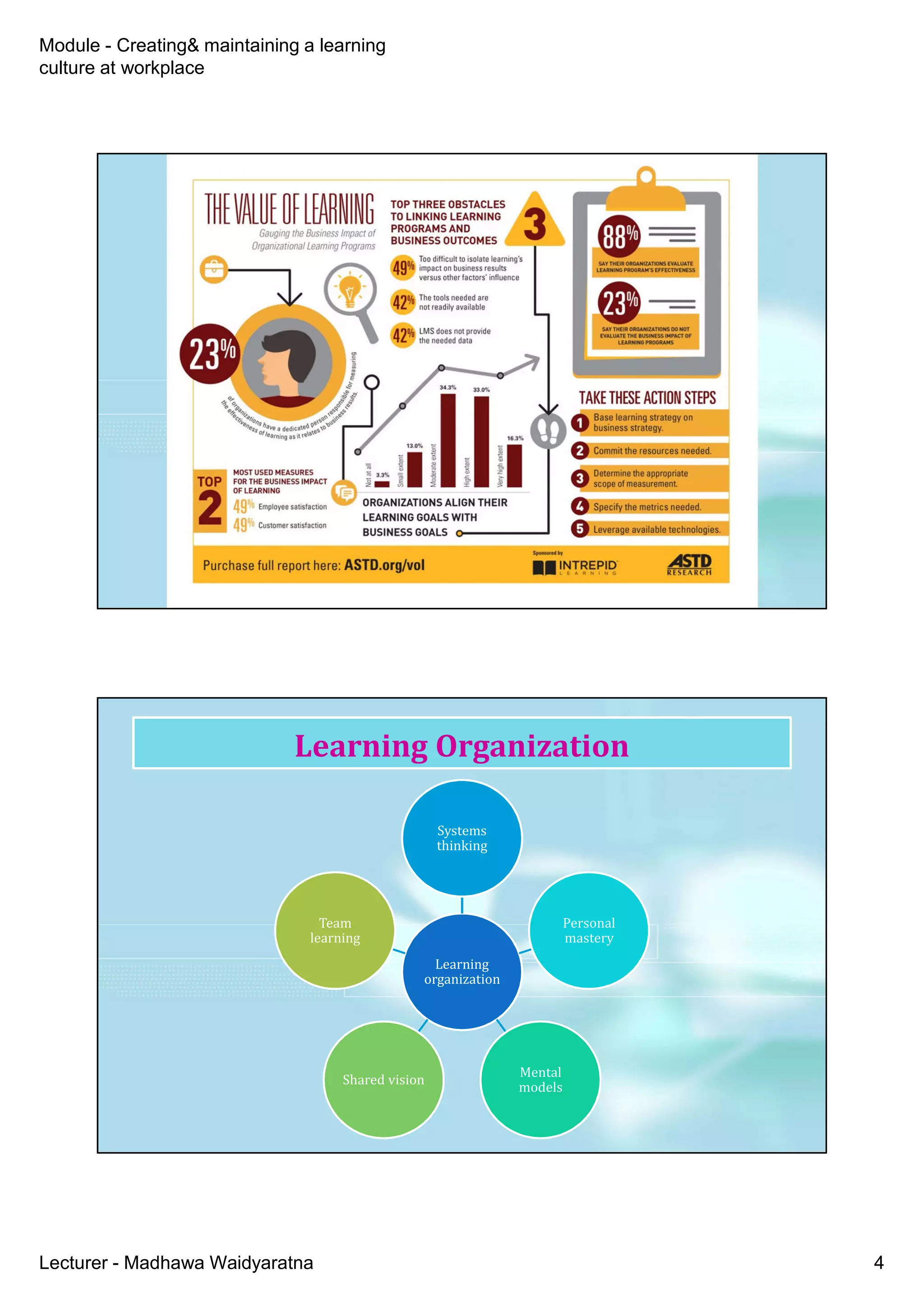
Learning
organization
Systems
thinking
Personal
mastery
Mental
models
Shared vision
Team
learning
Learning Organization
Module - Creating& maintaining a learning
culture at workplace
Lecturer - Madhawa Waidyaratna 5
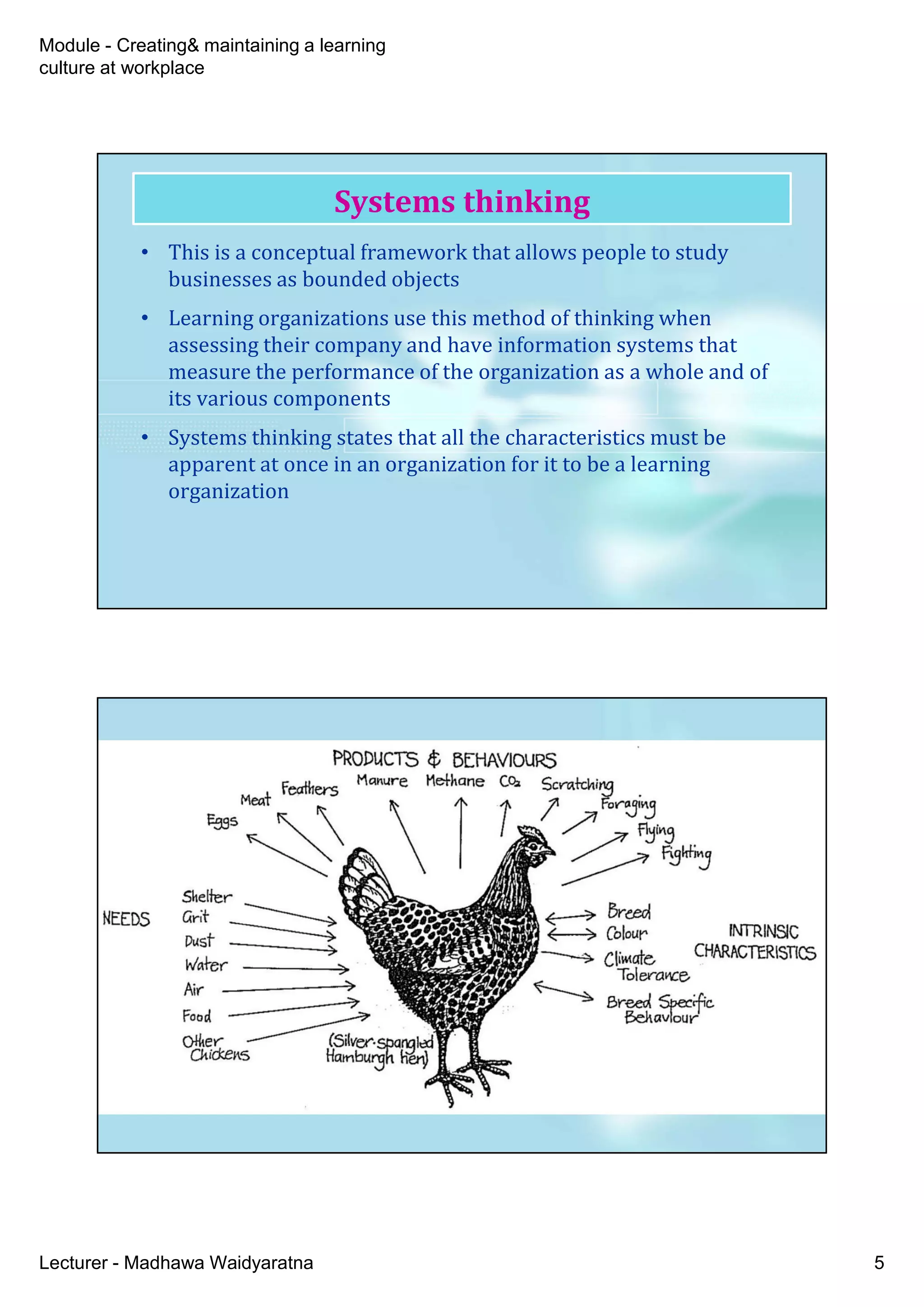
• This is a conceptual framework that allows people to study
businesses as bounded objects
• Learning organizations use this method of thinking when
assessing their company and have information systems that
measure the performance of the organization as a whole and of
its various components
• Systems thinking states that all the characteristics must be
apparent at once in an organization for it to be a learning
organization
Systems thinking
Module - Creating& maintaining a learning
culture at workplace
Lecturer - Madhawa Waidyaratna 6
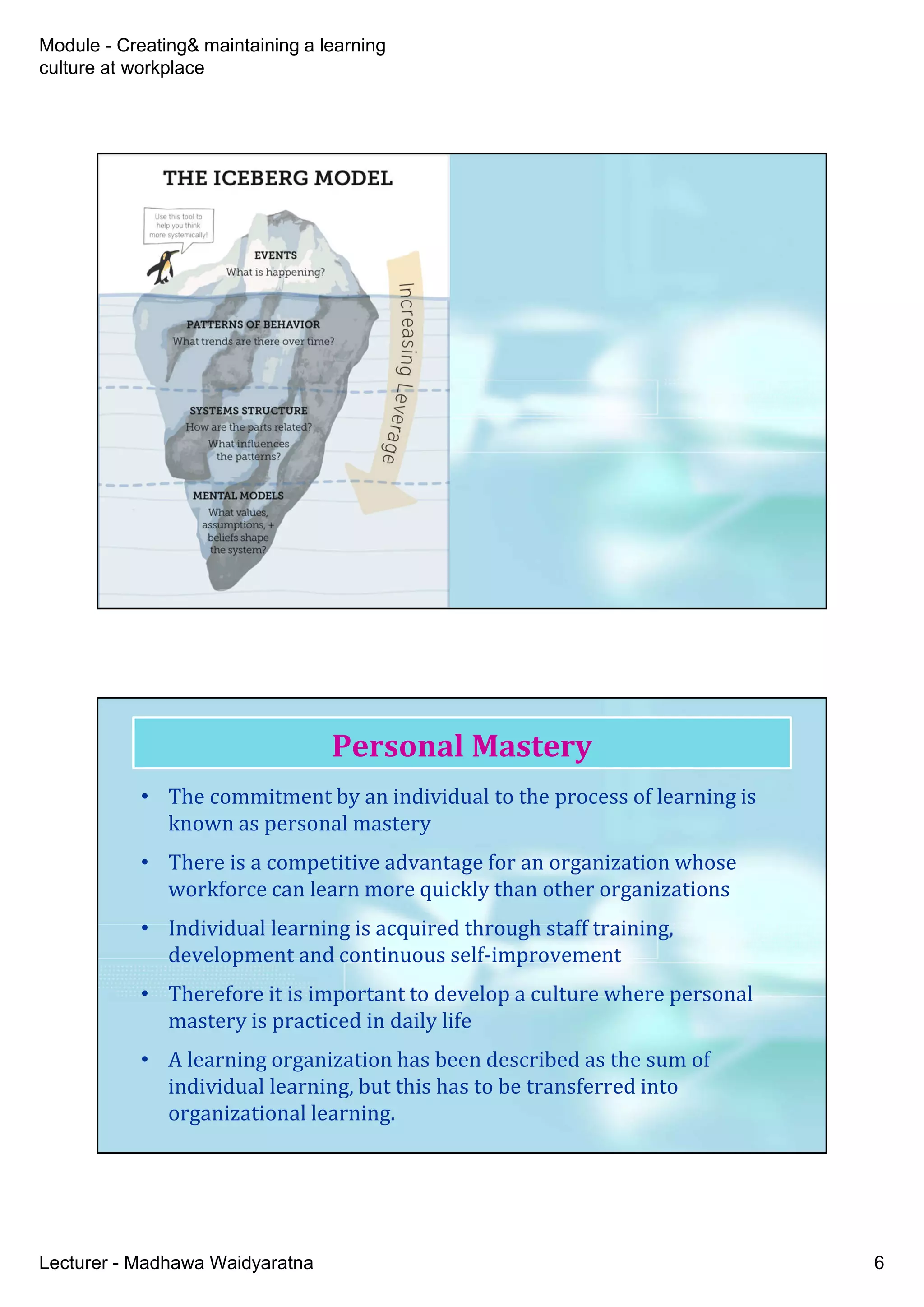
• The commitment by an individual to the process of learning is
known as personal mastery
• There is a competitive advantage for an organization whose
workforce can learn more quickly than other organizations
• Individual learning is acquired through staff training,
development and continuous self-improvement
• Therefore it is important to develop a culture where personal
mastery is practiced in daily life
• A learning organization has been described as the sum of
individual learning, but this has to be transferred into
organizational learning.
Personal Mastery
Module - Creating& maintaining a learning
culture at workplace
Lecturer - Madhawa Waidyaratna 7
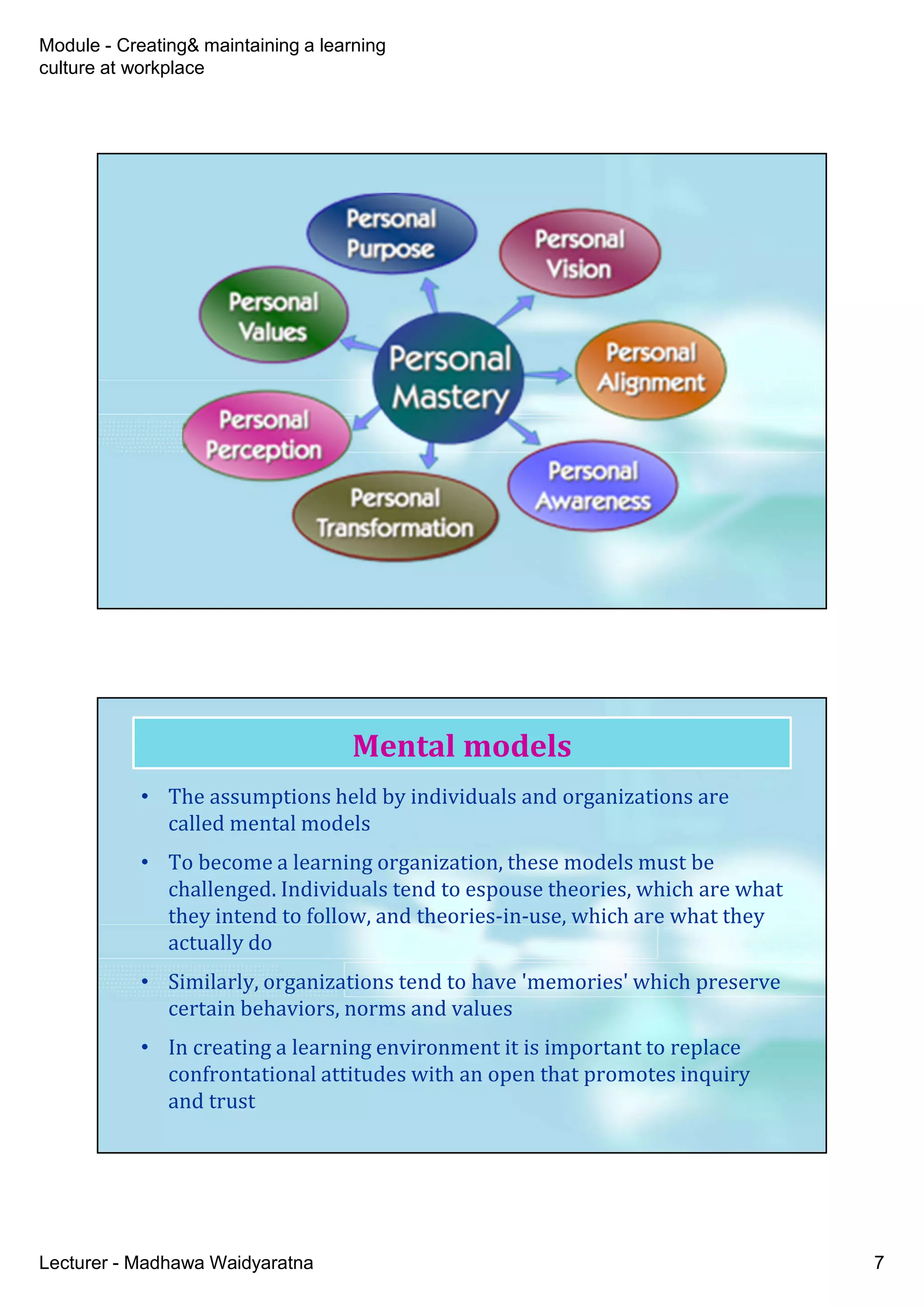
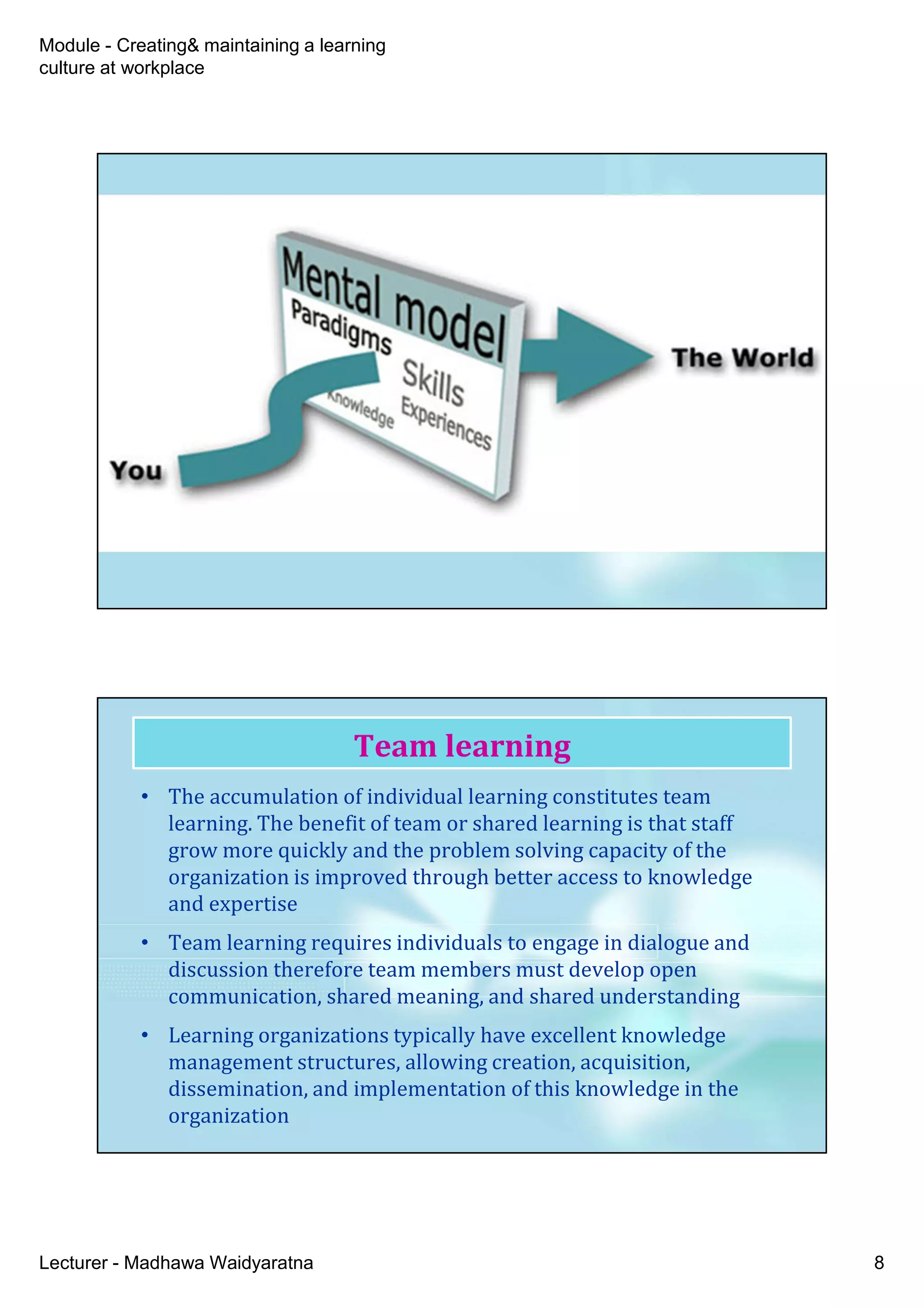
• The assumptions held by individuals and organizations are
called mental models
• To become a learning organization, these models must be
challenged. Individuals tend to espouse theories, which are what
they intend to follow, and theories-in-use, which are what they
actually do
• Similarly, organizations tend to have 'memories' which preserve
certain behaviors, norms and values
• In creating a learning environment it is important to replace
confrontational attitudes with an open that promotes inquiry
and trust
Mental models
Module - Creating& maintaining a learning
culture at workplace
Lecturer - Madhawa Waidyaratna 8
• The accumulation of individual learning constitutes team
learning. The benefit of team or shared learning is that staff
grow more quickly and the problem solving capacity of the
organization is improved through better access to knowledge
and expertise
• Team learning requires individuals to engage in dialogue and
discussion therefore team members must develop open
communication, shared meaning, and shared understanding
• Learning organizations typically have excellent knowledge
management structures, allowing creation, acquisition,
dissemination, and implementation of this knowledge in the
organization
Team learning
Module - Creating& maintaining a learning
culture at workplace
Lecturer - Madhawa Waidyaratna 9
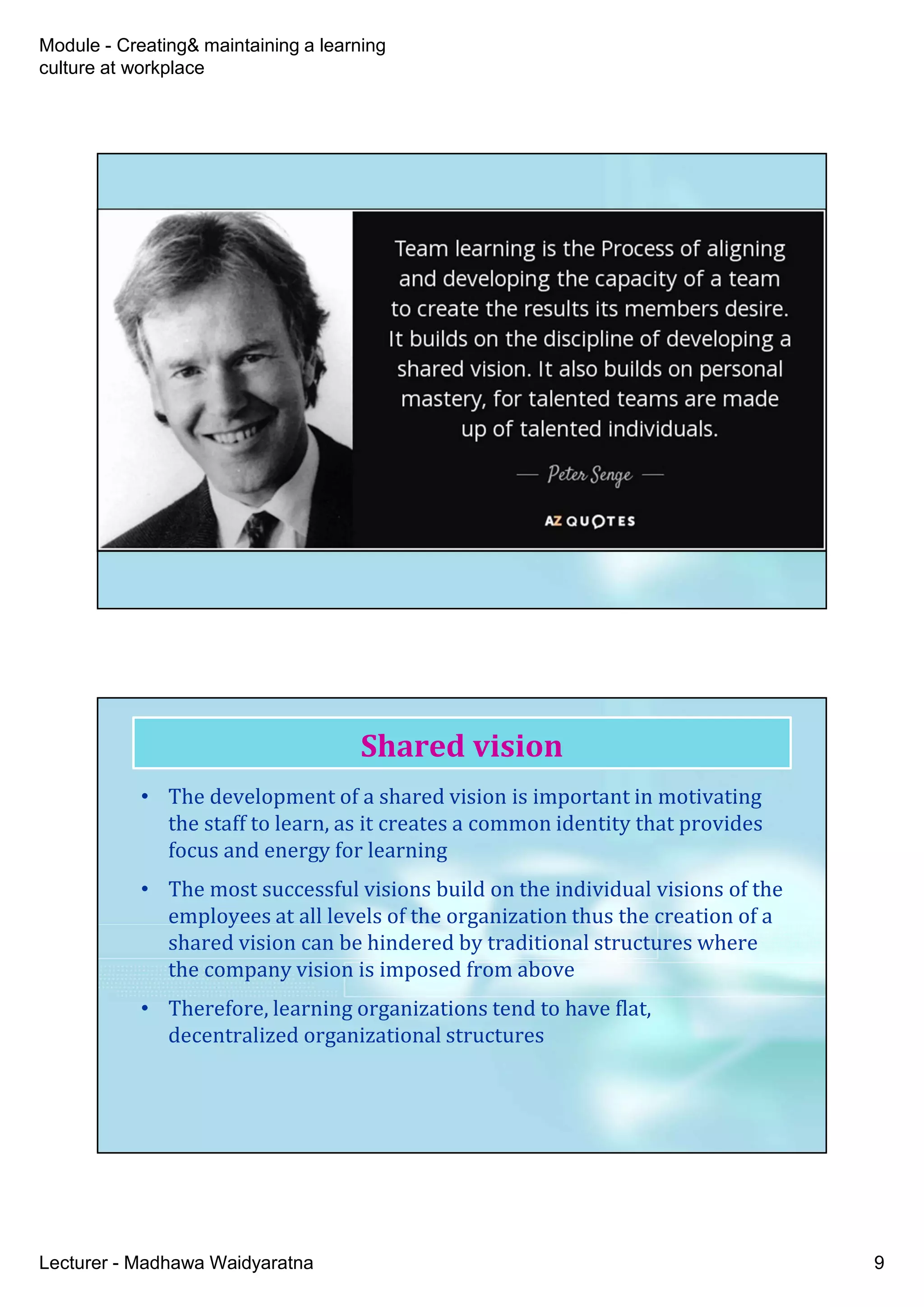
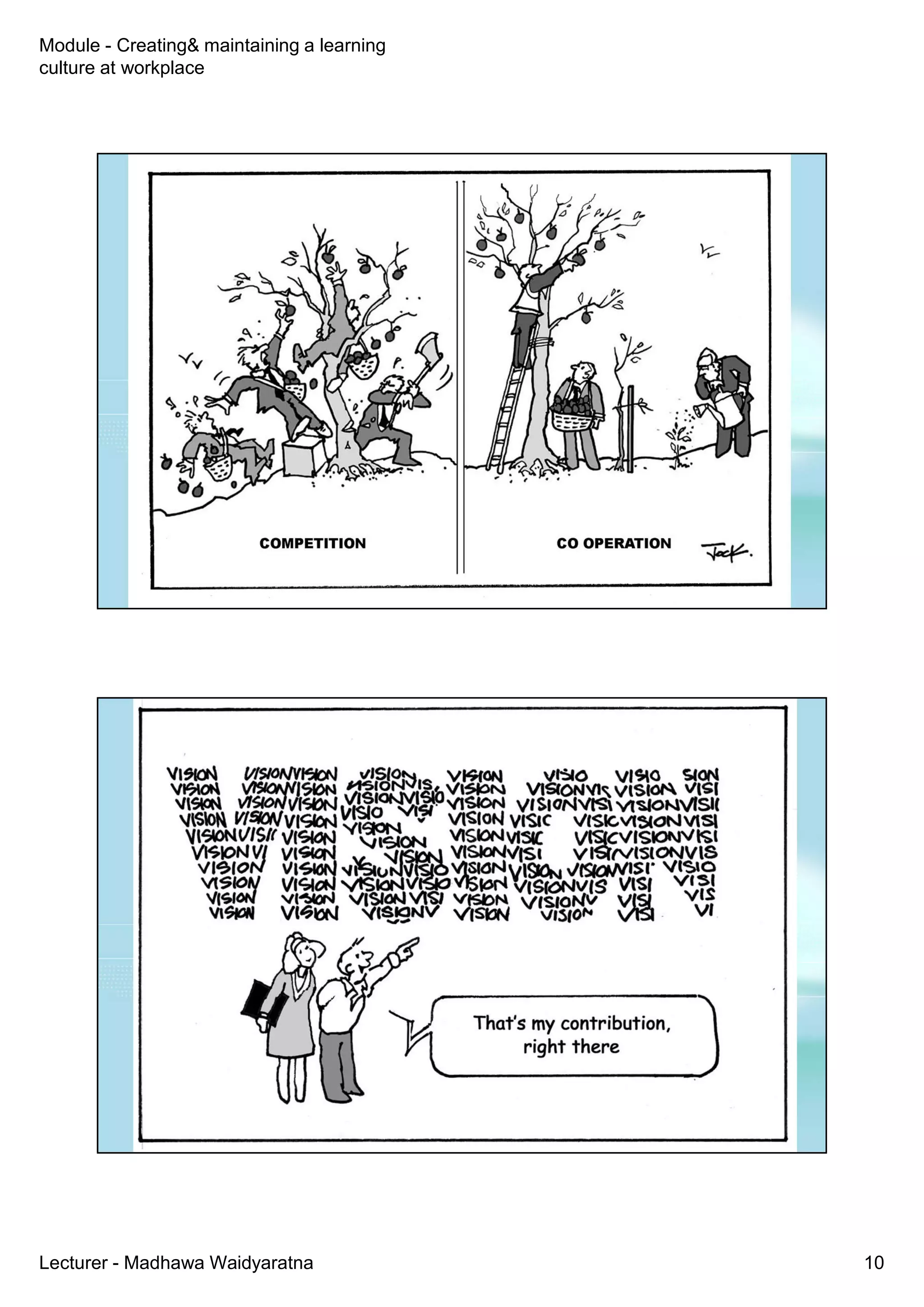
• The development of a shared vision is important in motivating
the staff to learn, as it creates a common identity that provides
focus and energy for learning
• The most successful visions build on the individual visions of the
employees at all levels of the organization thus the creation of a
shared vision can be hindered by traditional structures where
the company vision is imposed from above
• Therefore, learning organizations tend to have flat,
decentralized organizational structures
Shared vision
Module - Creating& maintaining a learning
culture at workplace
Lecturer - Madhawa Waidyaratna 10
Module - Creating& maintaining a learning
culture at workplace
Lecturer - Madhawa Waidyaratna 11
and
DEVELOPMENT
and
DEVELOPMENT
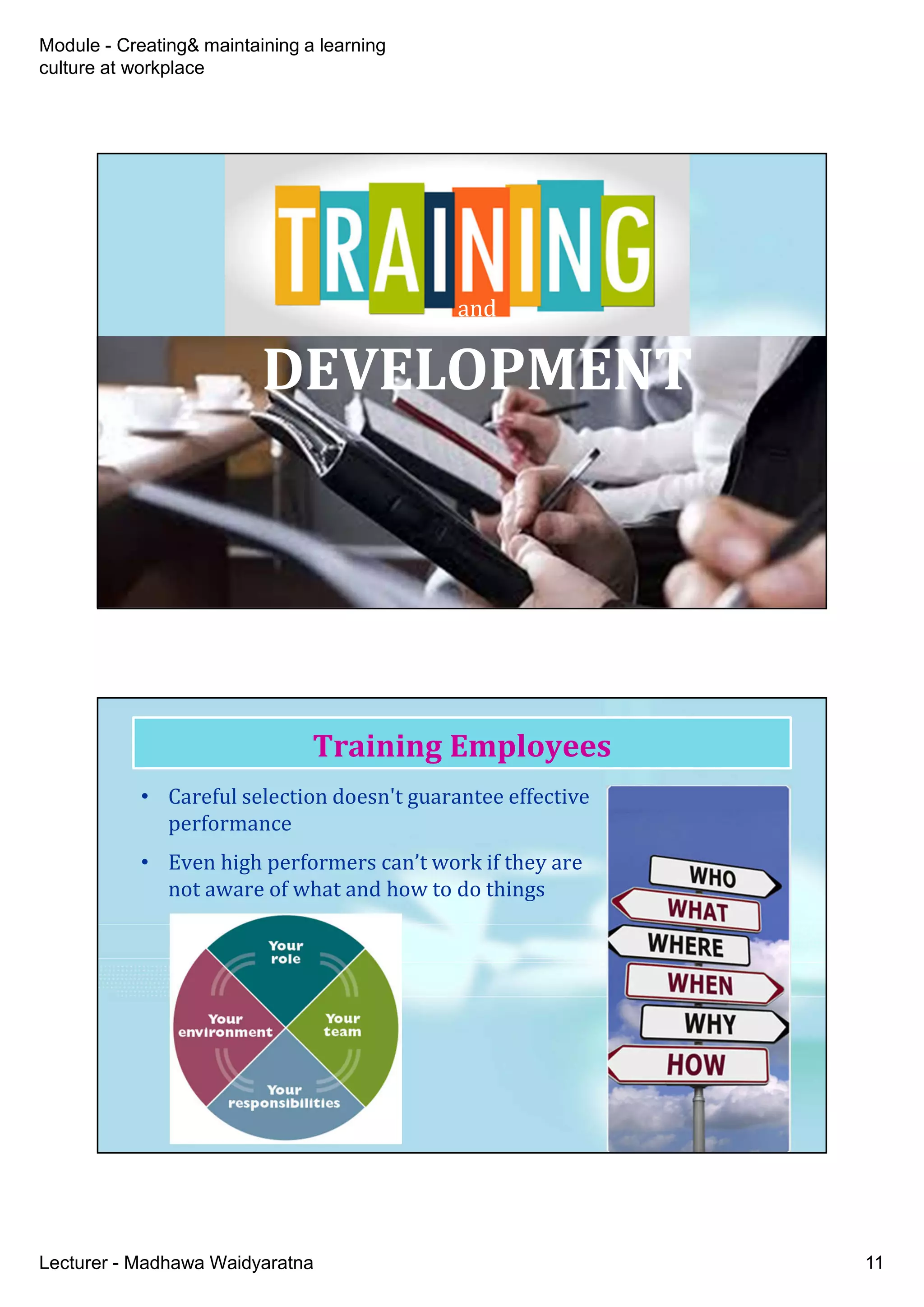
• Careful selection doesn't guarantee effective
performance
• Even high performers can’t work if they are
not aware of what and how to do things
Training Employees
Module - Creating& maintaining a learning
culture at workplace
Lecturer - Madhawa Waidyaratna 12
Training and Development
• Training - Aims to improve employees’ current work skills and
behaviour
• Development - Aims to increase abilities in relation to some
future position or job.
– International Human Resource Management, 4th Edition by Peter J.
Dowling and Denice E. Welch
Training and Development
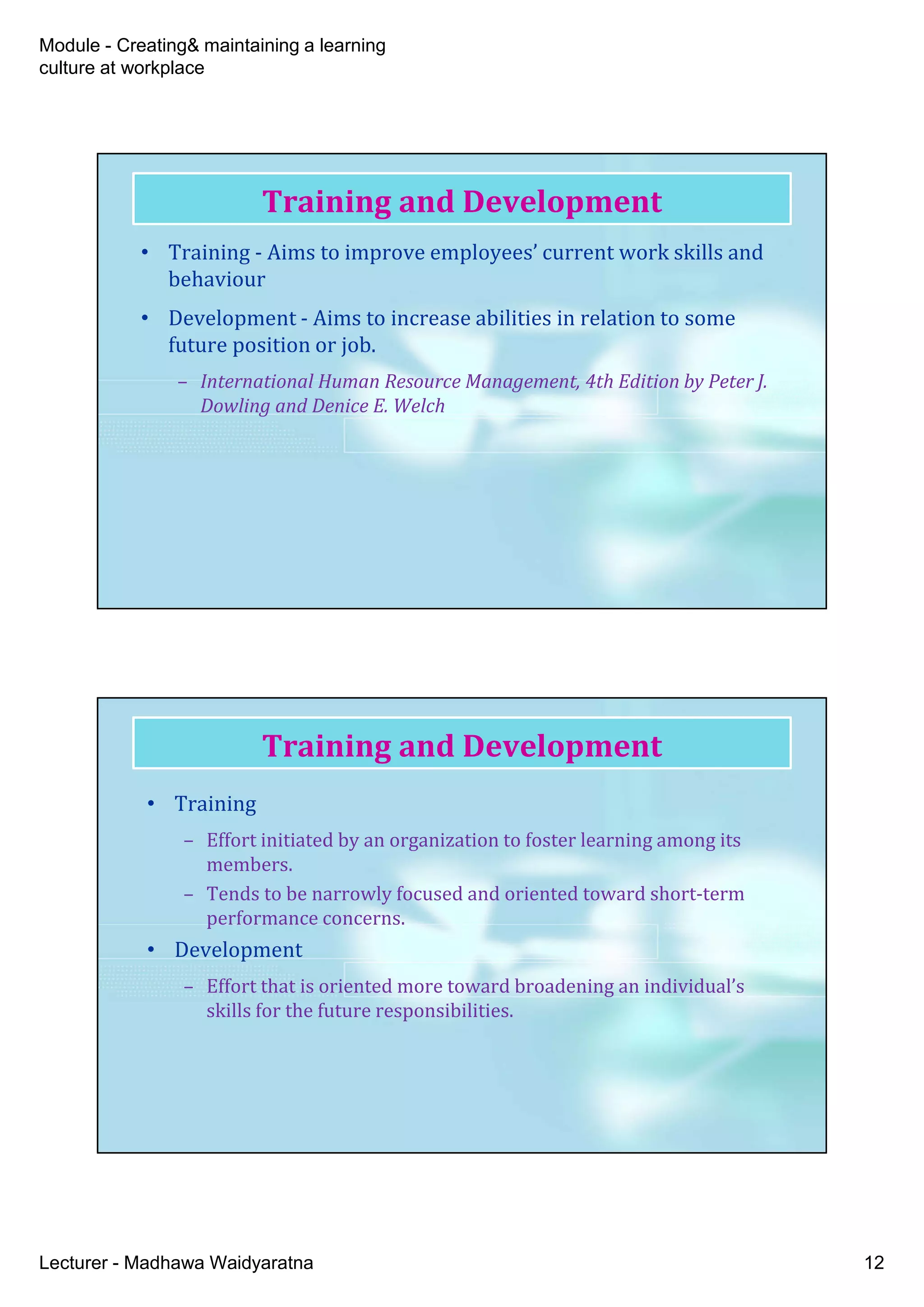
• Training
– Effort initiated by an organization to foster learning among its
members.
– Tends to be narrowly focused and oriented toward short-term
performance concerns.
• Development
– Effort that is oriented more toward broadening an individual’s
skills for the future responsibilities.
Module - Creating& maintaining a learning
culture at workplace
Lecturer - Madhawa Waidyaratna 13
Definition of Training
• A learning process that involves the acquisition of skills,
concepts, rules, or attitudes to enhance employee performance.
– Stephanie, 2005
• An organization planned efforts to help employees acquired job-
related knowledge, skills, abilities, and behaviors with the goals
of a playing these on the job
– Raymon A. Noe- Fundamantel of HRM
• Teaching or developing any skills and knowledge that relate to
specific useful competencies
• Training has specific goals of improving one's capability,
capacity, productivity and performance
• It forms the core of apprenticeships and provides the backbone of
content at institutes of technology
• In addition to the basic training required for a trade, need to continue
training beyond initial qualifications
– to maintain, upgrade and update skills throughout working life
– Many professions and occupations may refer to this sort of training
as professional development.
Training
Module - Creating& maintaining a learning
culture at workplace
Lecturer - Madhawa Waidyaratna 14
• Remedial skills training
• Developmental training
• Orientation training
• ‘firm specific’ training
• ‘transferable’ training
Training And Development
27
• Increased productivity
• Reduced employee turnover
• Increased efficiency resulting in financial gains
• Decreased need for supervision
• Increases workers’ job satisfaction
• Keep workers’ skills and knowledge up-to-date
• Increased workers motivation
Benefits of Training
Module - Creating& maintaining a learning
culture at workplace
Lecturer - Madhawa Waidyaratna 15
• Creating a pool of readily available and adequate replacements
for personnel who may leave or move up in the organization
• Enhancing the company's ability to adopt and use advances in
technology because of a sufficiently knowledgeable staff
• Building a more efficient, effective and highly motivated team,
which enhances the company's competitive position and
improves employee morale
• Ensuring adequate human resources for expansion into new
programs
Reasons for Training
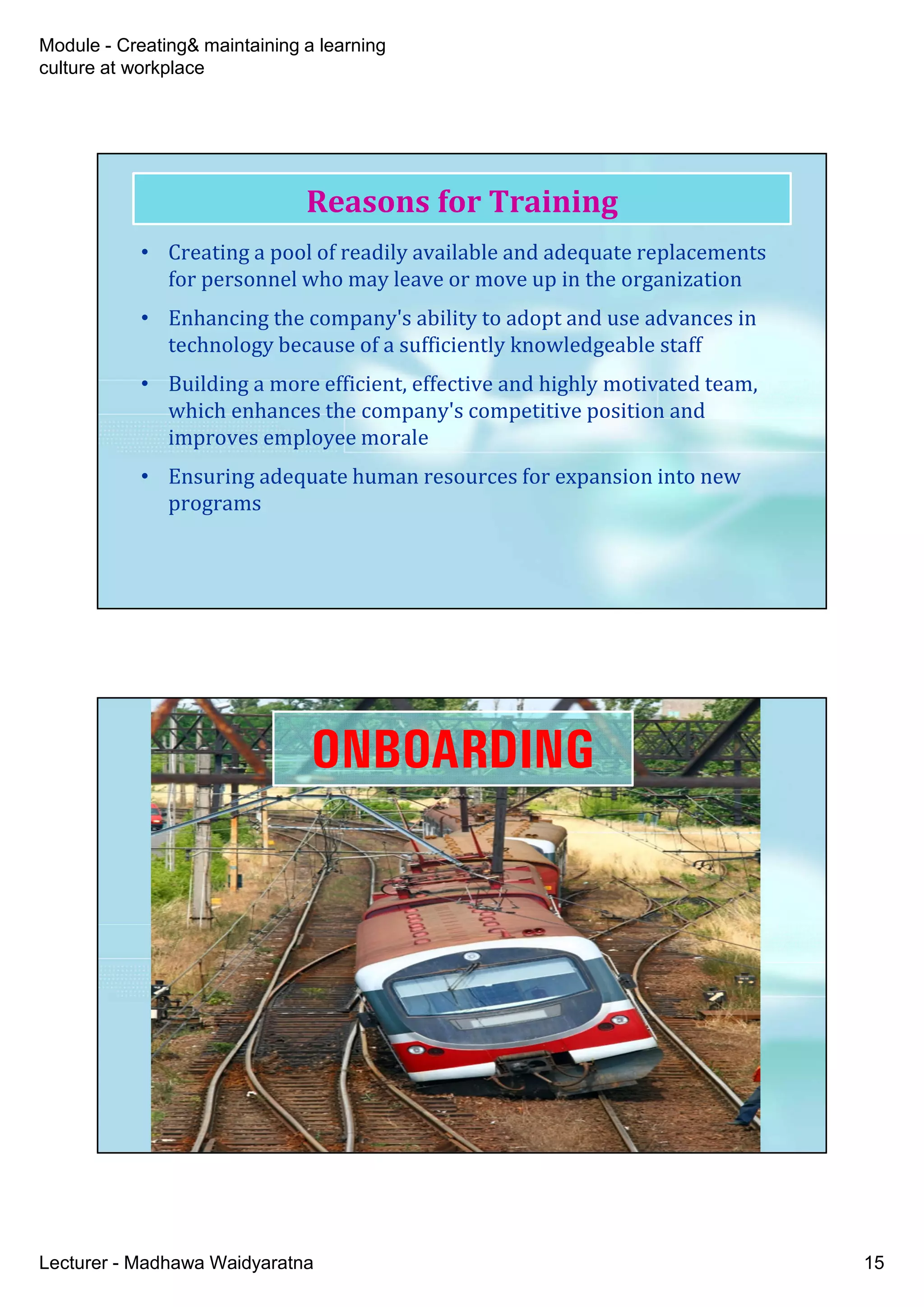
ONBOARDING
Module - Creating& maintaining a learning
culture at workplace
Lecturer - Madhawa Waidyaratna 16
• Onboarding is the process of acquiring, accommodating,
assimilating and accelerating new employees into a system,
culture or methodology
• Includes both recruiting and orientation
• Improves productivity and employee retention, builds a shared
corporate culture, and creates a faster learning curve
• It is especially valuable to new employees transitioning into
more and more complex roles
• Effective Onboarding of new employees can be one of the most
important contributions for long-term organizational success
What is Onboarding?
Module - Creating& maintaining a learning
culture at workplace
Lecturer - Madhawa Waidyaratna 17
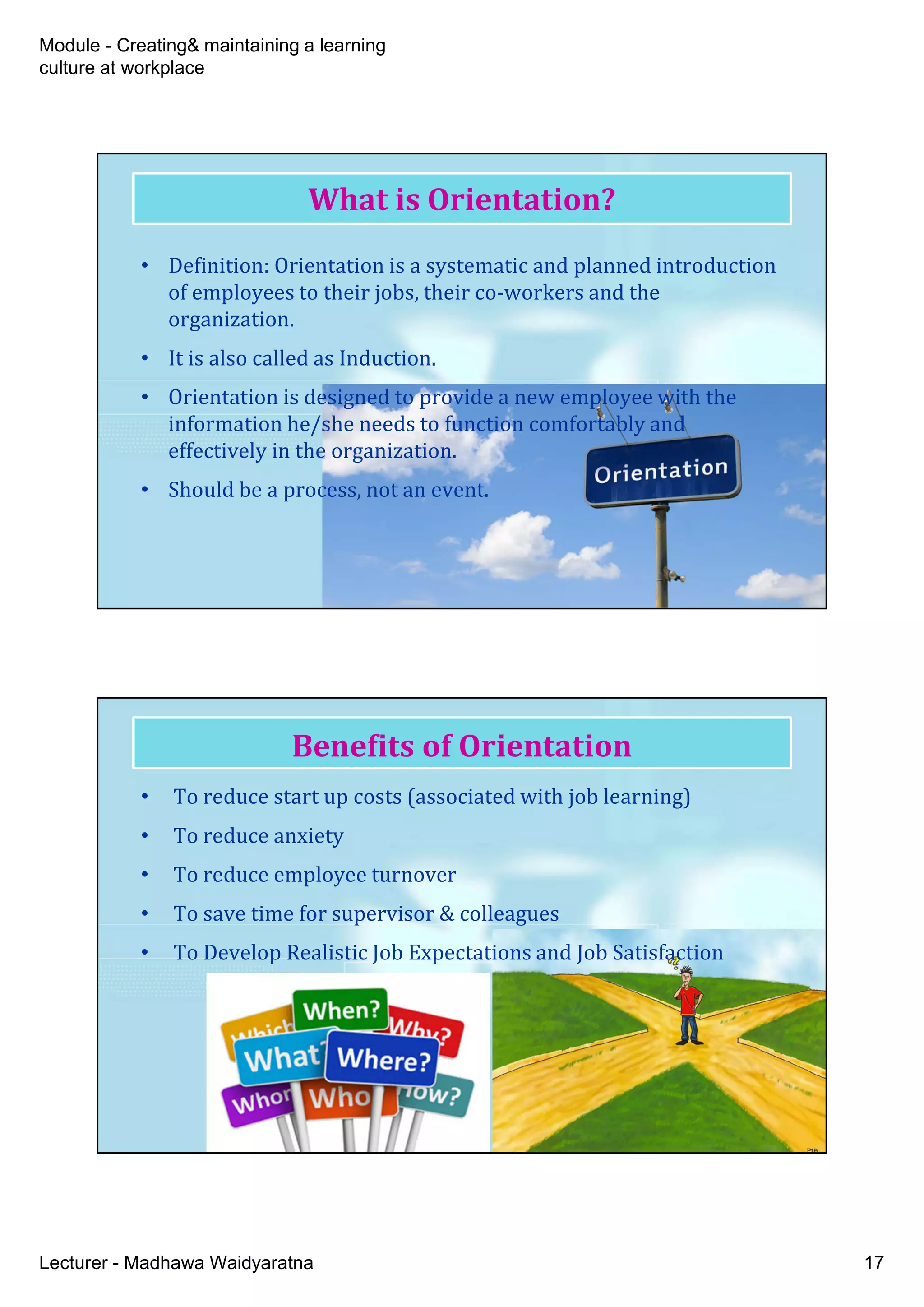
What is Orientation?
• Definition: Orientation is a systematic and planned introduction
of employees to their jobs, their co-workers and the
organization.
• It is also called as Induction.
• Orientation is designed to provide a new employee with the
information he/she needs to function comfortably and
effectively in the organization.
• Should be a process, not an event.
Benefits of Orientation
• To reduce start up costs (associated with job learning)
• To reduce anxiety
• To reduce employee turnover
• To save time for supervisor & colleagues
• To Develop Realistic Job Expectations and Job Satisfaction
Module - Creating& maintaining a learning
culture at workplace
Lecturer - Madhawa Waidyaratna 18
Benefits of Orientation
• The idea is to make the new employees feel ‘at home’ in the new
environment
• Expedite proficiency
• Assist in newcomer assimilation
• Enhance adjustment to work group and norms
• Encourage positive attitude
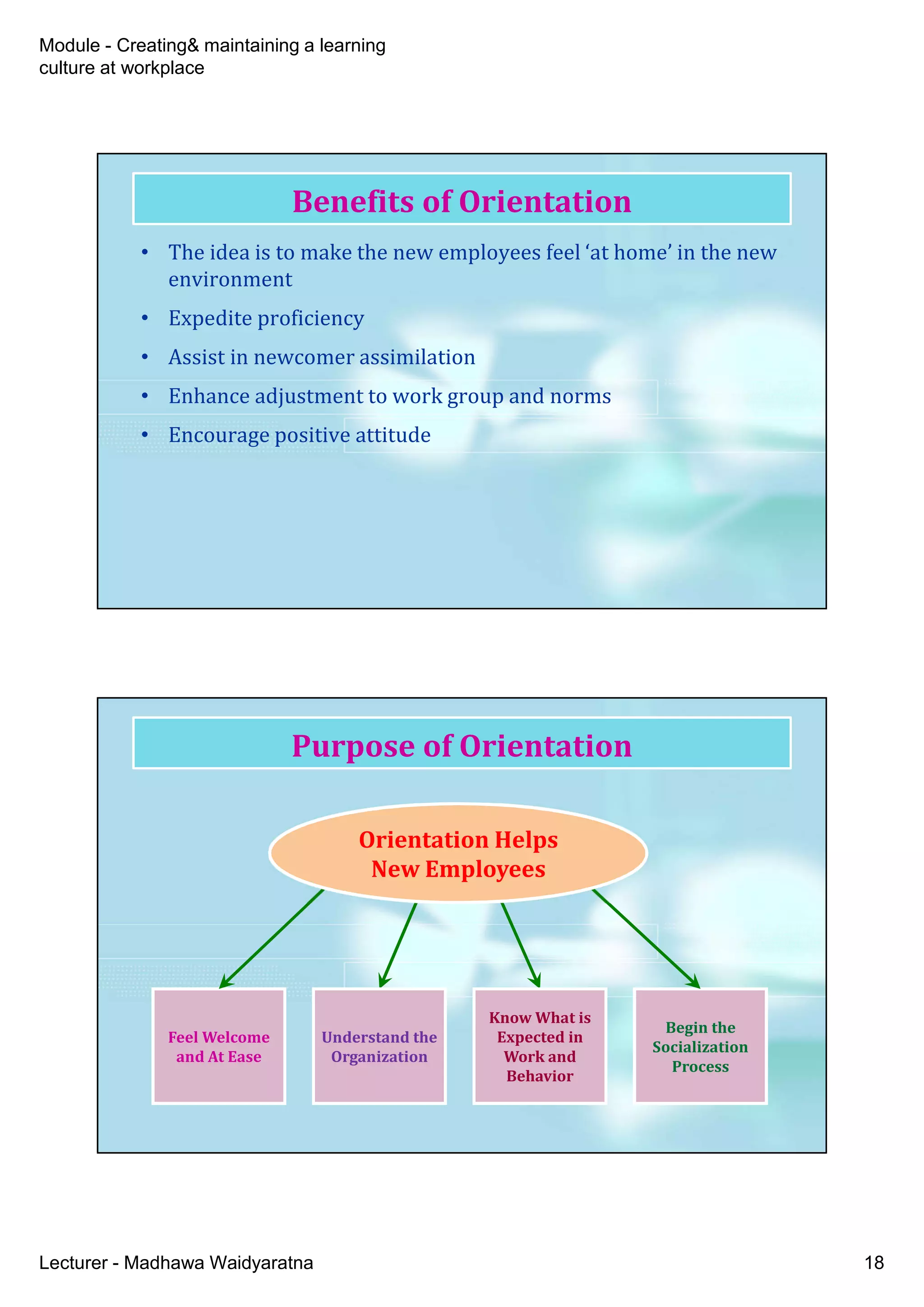
Purpose of Orientation
Feel Welcome
and At Ease
Feel Welcome
and At Ease
Begin the
Socialization
Process
Begin the
Socialization
Process
Understand the
Organization
Understand the
Organization
Know What is
Expected in
Work and
Behavior
Know What is
Expected in
Work and
Behavior
Orientation Helps
New Employees
Orientation Helps
New Employees
Module - Creating& maintaining a learning
culture at workplace
Lecturer - Madhawa Waidyaratna 19
• Make the employee feel welcome, at home and part of the team
• Have basic information to function effectively. (email access,
personal policies, benefits, employer expectation in terms of
work behavior
• Understand the organization in broader terms (Past, present,
culture, strategies, vision
• Start the person on the process of becoming socialized into the
organization culture, values and ways of doing things
Purpose of Orientation
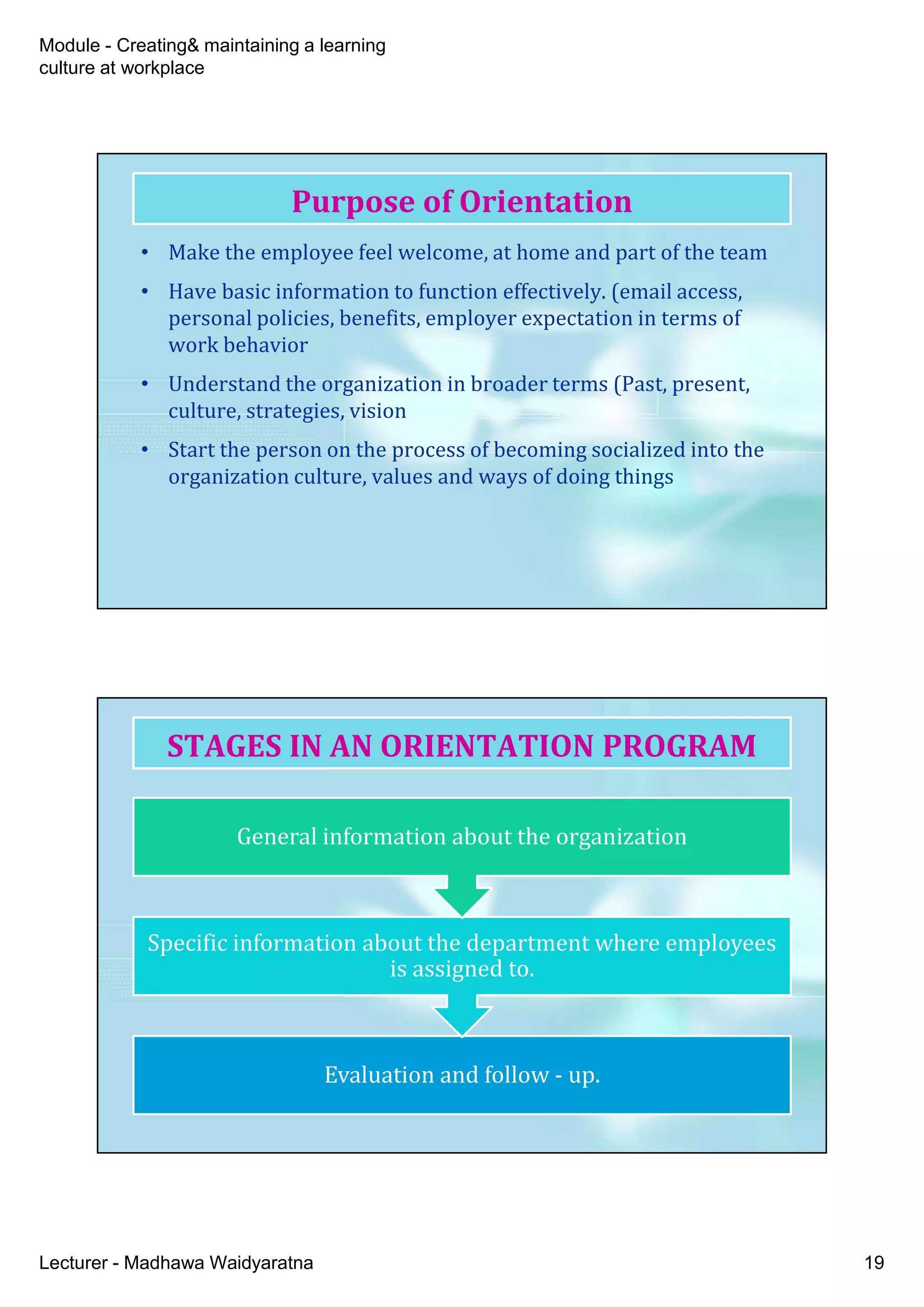
Evaluation and follow - up.
Specific information about the department where employees
is assigned to.
General information about the organization
STAGES IN AN ORIENTATION PROGRAM
Module - Creating& maintaining a learning
culture at workplace
Lecturer - Madhawa Waidyaratna 20
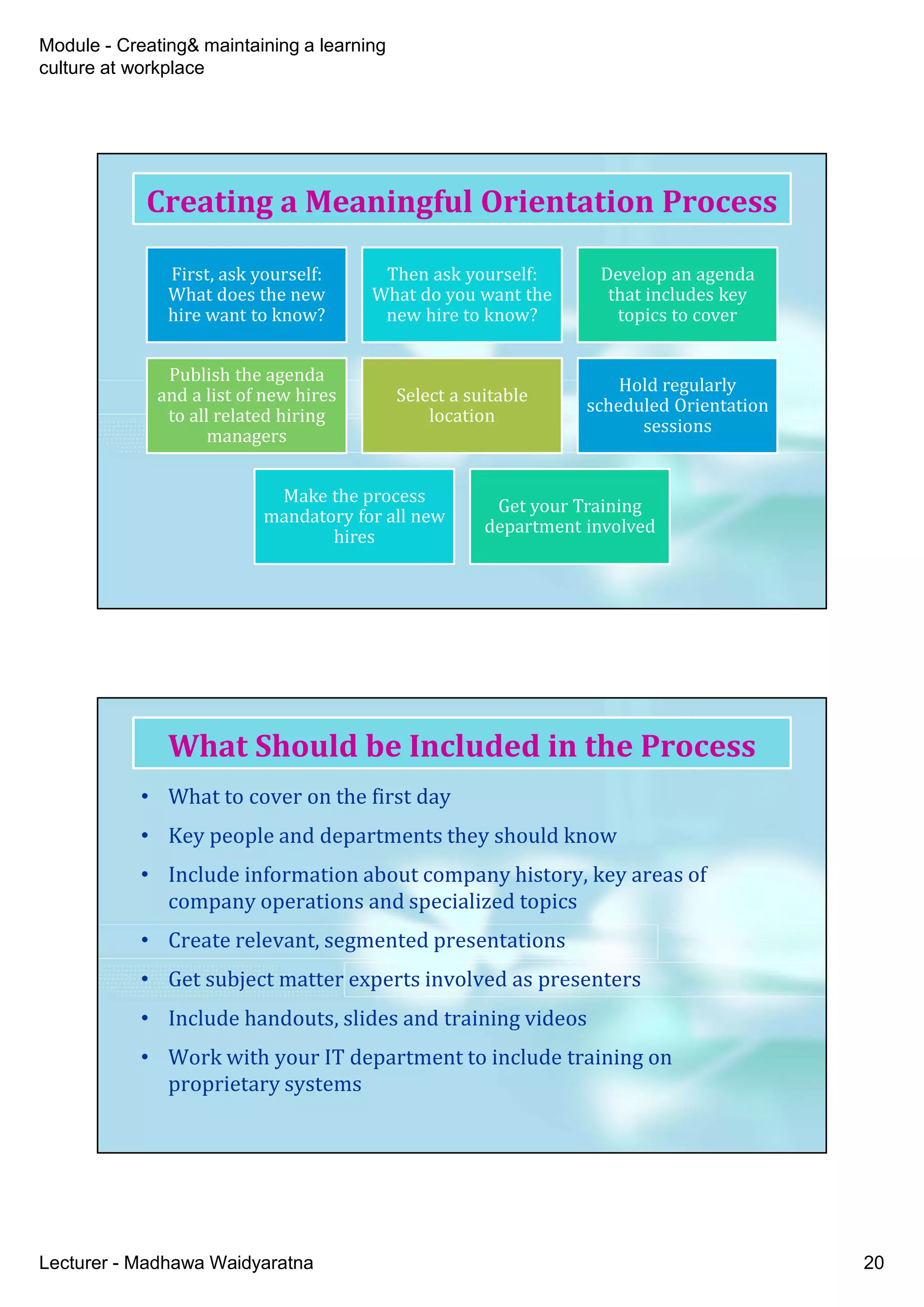
First, ask yourself:
What does the new
hire want to know?
Then ask yourself:
What do you want the
new hire to know?
Develop an agenda
that includes key
topics to cover
Publish the agenda
and a list of new hires
to all related hiring
managers
Select a suitable
location
Hold regularly
scheduled Orientation
sessions
Make the process
mandatory for all new
hires
Get your Training
department involved
Creating a Meaningful Orientation Process
• What to cover on the first day
• Key people and departments they should know
• Include information about company history, key areas of
company operations and specialized topics
• Create relevant, segmented presentations
• Get subject matter experts involved as presenters
• Include handouts, slides and training videos
• Work with your IT department to include training on
proprietary systems
What Should be Included in the Process
Module - Creating& maintaining a learning
culture at workplace
Lecturer - Madhawa Waidyaratna 21
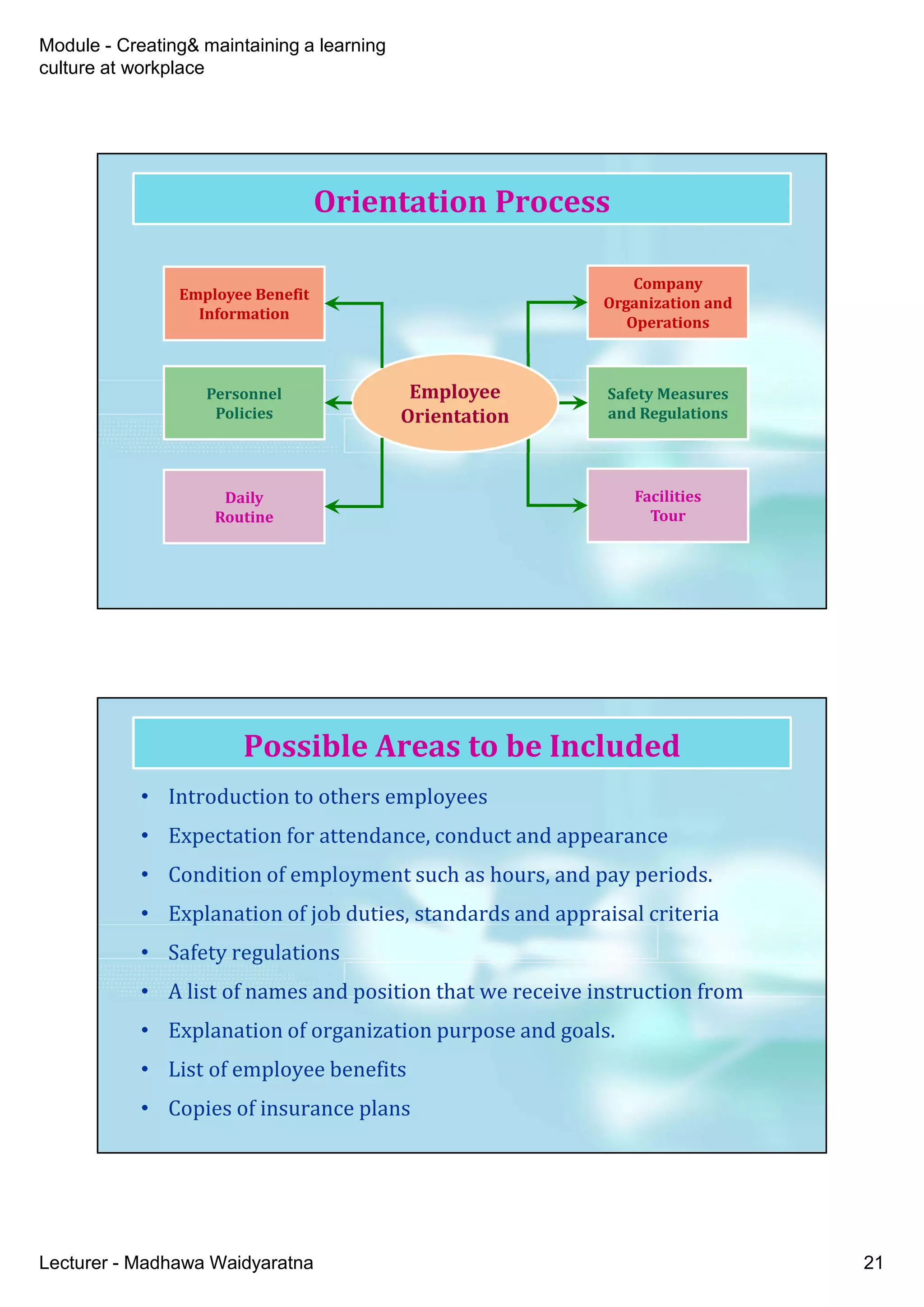
Orientation Process
Company
Organization and
Operations
Company
Organization and
Operations
Safety Measures
and Regulations
Safety Measures
and Regulations
Facilities
Tour
Facilities
Tour
Employee
Orientation
Employee
Orientation
Employee Benefit
Information
Employee Benefit
Information
Personnel
Policies
Personnel
Policies
Daily
Routine
Daily
Routine
• Introduction to others employees
• Expectation for attendance, conduct and appearance
• Condition of employment such as hours, and pay periods.
• Explanation of job duties, standards and appraisal criteria
• Safety regulations
• A list of names and position that we receive instruction from
• Explanation of organization purpose and goals.
• List of employee benefits
• Copies of insurance plans
Possible Areas to be Included
Module - Creating& maintaining a learning
culture at workplace
Lecturer - Madhawa Waidyaratna 22
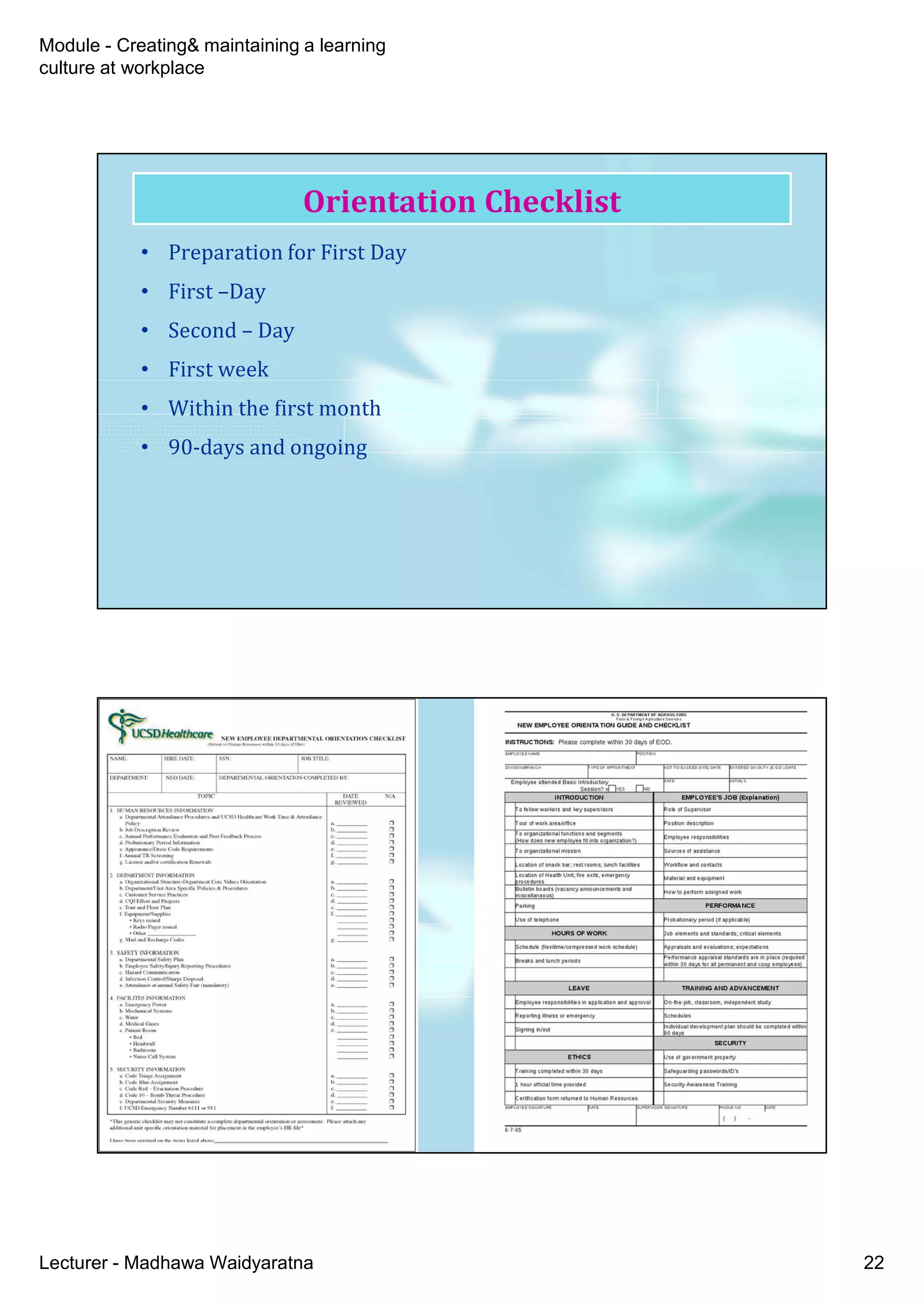
Orientation Checklist
• Preparation for First Day
• First –Day
• Second – Day
• First week
• Within the first month
• 90-days and ongoing
New Employee
Departmental
Orientation
Checklist
Module - Creating& maintaining a learning
culture at workplace
Lecturer - Madhawa Waidyaratna 23
Orientation Programme
• Orientation checklist, employee handbook and orientation
program
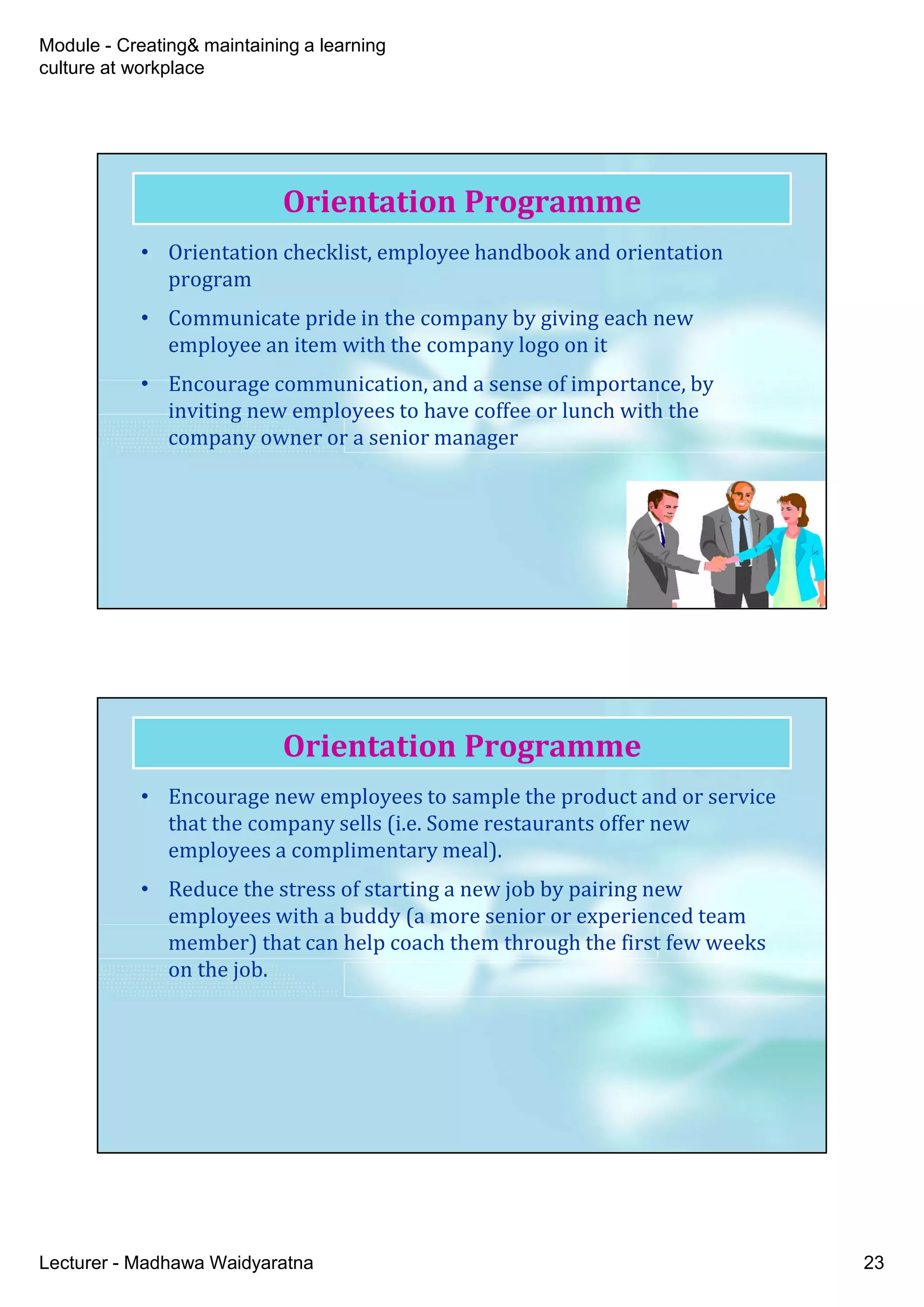
• Communicate pride in the company by giving each new
employee an item with the company logo on it
• Encourage communication, and a sense of importance, by
inviting new employees to have coffee or lunch with the
company owner or a senior manager
Orientation Programme
• Encourage new employees to sample the product and or service
that the company sells (i.e. Some restaurants offer new
employees a complimentary meal).
• Reduce the stress of starting a new job by pairing new
employees with a buddy (a more senior or experienced team
member) that can help coach them through the first few weeks
on the job.
Module - Creating& maintaining a learning
culture at workplace
Lecturer - Madhawa Waidyaratna 24
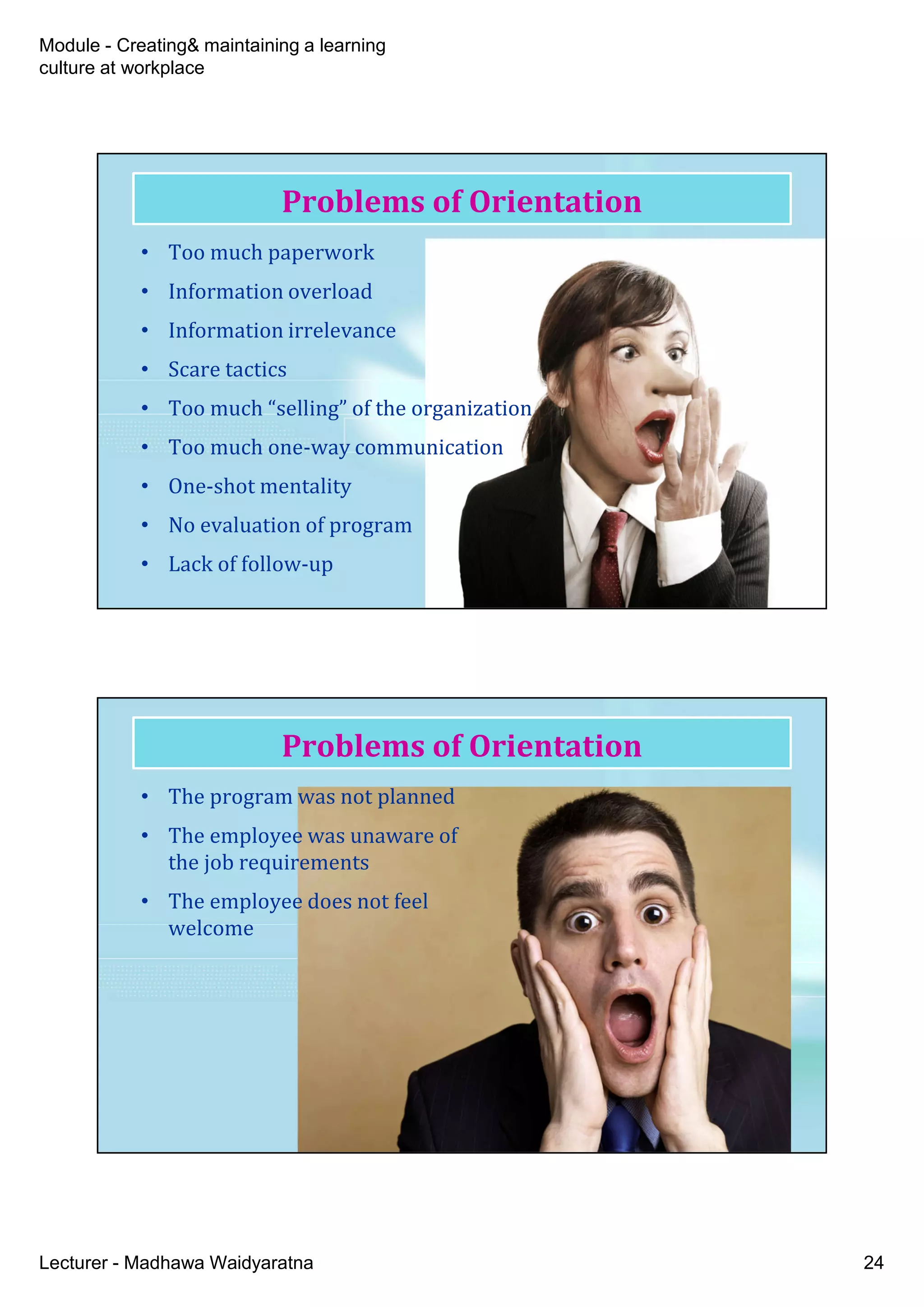
Problems of Orientation
• Too much paperwork
• Information overload
• Information irrelevance
• Scare tactics
• Too much “selling” of the organization
• Too much one-way communication
• One-shot mentality
• No evaluation of program
• Lack of follow-up
Problems of Orientation
• The program was not planned
• The employee was unaware of
the job requirements
• The employee does not feel
welcome
Module - Creating& maintaining a learning
culture at workplace
Lecturer - Madhawa Waidyaratna 25
• Survey all new hires at the end of the Orientation process
• Develop survey questions that ask the new hire to rate the
content of each specific section
• Include a section at the end of the survey for comments and
suggestions
• Use the survey feedback to continuously improve your
Orientation process
• Survey data will provide effective support for the continuation
of the Orientation process
Measuring Effectiveness of the Process

Creating Learning Culture at Workplace

  • 1.
    Module - Creating&maintaining a learning culture at workplace Lecturer - Madhawa Waidyaratna 1 “ ”Madhawa Waidyaratna B. Sc. (Chem.), MBA , MSc (IT), MA, MCSSL, MSLIM National Diploma In Quantity Surveying (NDQS) – 2013/2015 Creating and Maintaining a Learning Culture at Workplace Module Aim • Create awareness and understanding of the concept of learning culture. • Develop competencies required to create and maintain a learning culture at the workplace To enable the students to:
  • 2.
    Module - Creating&maintaining a learning culture at workplace Lecturer - Madhawa Waidyaratna 2 • Inform management about training requirements of workers • Arrange /Conduct training programs • Demonstrate the use of new equipment and methods On completion of this module the learner will be able to Learning Outcomes Assessment Topic / Activity Weight Multiple Choice Test Items, structured essay type questions, case studies 60% Skills and attitudes related to various aspects of learning culture at work place 40%
  • 3.
    Module - Creating&maintaining a learning culture at workplace Lecturer - Madhawa Waidyaratna 3 • Organization that acquires knowledge and innovates fast enough to survive and thrive in a rapidly changing environment. • Learning organizations – Create a culture that encourages and supports continuous employee learning, critical thinking, and risk taking with new ideas – Allow mistakes, and value employee contributions – Learn from experience and experiment – Disseminate the new knowledge throughout the organization for incorporation into day-to-day activities. Learning Organizations Benefits 6 Maintaining levels of innovation and remaining competitive Being better placed to respond to external pressures Having the knowledge to better link resources to customer needs Improving quality of outputs at all levels Improving corporate image by becoming more people oriented Increasing the pace of change within the organization
  • 4.
    Module - Creating&maintaining a learning culture at workplace Lecturer - Madhawa Waidyaratna 4 Learning organization Systems thinking Personal mastery Mental models Shared vision Team learning Learning Organization
  • 5.
    Module - Creating&maintaining a learning culture at workplace Lecturer - Madhawa Waidyaratna 5 • This is a conceptual framework that allows people to study businesses as bounded objects • Learning organizations use this method of thinking when assessing their company and have information systems that measure the performance of the organization as a whole and of its various components • Systems thinking states that all the characteristics must be apparent at once in an organization for it to be a learning organization Systems thinking
  • 6.
    Module - Creating&maintaining a learning culture at workplace Lecturer - Madhawa Waidyaratna 6 • The commitment by an individual to the process of learning is known as personal mastery • There is a competitive advantage for an organization whose workforce can learn more quickly than other organizations • Individual learning is acquired through staff training, development and continuous self-improvement • Therefore it is important to develop a culture where personal mastery is practiced in daily life • A learning organization has been described as the sum of individual learning, but this has to be transferred into organizational learning. Personal Mastery
  • 7.
    Module - Creating&maintaining a learning culture at workplace Lecturer - Madhawa Waidyaratna 7 • The assumptions held by individuals and organizations are called mental models • To become a learning organization, these models must be challenged. Individuals tend to espouse theories, which are what they intend to follow, and theories-in-use, which are what they actually do • Similarly, organizations tend to have 'memories' which preserve certain behaviors, norms and values • In creating a learning environment it is important to replace confrontational attitudes with an open that promotes inquiry and trust Mental models
  • 8.
    Module - Creating&maintaining a learning culture at workplace Lecturer - Madhawa Waidyaratna 8 • The accumulation of individual learning constitutes team learning. The benefit of team or shared learning is that staff grow more quickly and the problem solving capacity of the organization is improved through better access to knowledge and expertise • Team learning requires individuals to engage in dialogue and discussion therefore team members must develop open communication, shared meaning, and shared understanding • Learning organizations typically have excellent knowledge management structures, allowing creation, acquisition, dissemination, and implementation of this knowledge in the organization Team learning
  • 9.
    Module - Creating&maintaining a learning culture at workplace Lecturer - Madhawa Waidyaratna 9 • The development of a shared vision is important in motivating the staff to learn, as it creates a common identity that provides focus and energy for learning • The most successful visions build on the individual visions of the employees at all levels of the organization thus the creation of a shared vision can be hindered by traditional structures where the company vision is imposed from above • Therefore, learning organizations tend to have flat, decentralized organizational structures Shared vision
  • 10.
    Module - Creating&maintaining a learning culture at workplace Lecturer - Madhawa Waidyaratna 10
  • 11.
    Module - Creating&maintaining a learning culture at workplace Lecturer - Madhawa Waidyaratna 11 and DEVELOPMENT and DEVELOPMENT • Careful selection doesn't guarantee effective performance • Even high performers can’t work if they are not aware of what and how to do things Training Employees
  • 12.
    Module - Creating&maintaining a learning culture at workplace Lecturer - Madhawa Waidyaratna 12 Training and Development • Training - Aims to improve employees’ current work skills and behaviour • Development - Aims to increase abilities in relation to some future position or job. – International Human Resource Management, 4th Edition by Peter J. Dowling and Denice E. Welch Training and Development • Training – Effort initiated by an organization to foster learning among its members. – Tends to be narrowly focused and oriented toward short-term performance concerns. • Development – Effort that is oriented more toward broadening an individual’s skills for the future responsibilities.
  • 13.
    Module - Creating&maintaining a learning culture at workplace Lecturer - Madhawa Waidyaratna 13 Definition of Training • A learning process that involves the acquisition of skills, concepts, rules, or attitudes to enhance employee performance. – Stephanie, 2005 • An organization planned efforts to help employees acquired job- related knowledge, skills, abilities, and behaviors with the goals of a playing these on the job – Raymon A. Noe- Fundamantel of HRM • Teaching or developing any skills and knowledge that relate to specific useful competencies • Training has specific goals of improving one's capability, capacity, productivity and performance • It forms the core of apprenticeships and provides the backbone of content at institutes of technology • In addition to the basic training required for a trade, need to continue training beyond initial qualifications – to maintain, upgrade and update skills throughout working life – Many professions and occupations may refer to this sort of training as professional development. Training
  • 14.
    Module - Creating&maintaining a learning culture at workplace Lecturer - Madhawa Waidyaratna 14 • Remedial skills training • Developmental training • Orientation training • ‘firm specific’ training • ‘transferable’ training Training And Development 27 • Increased productivity • Reduced employee turnover • Increased efficiency resulting in financial gains • Decreased need for supervision • Increases workers’ job satisfaction • Keep workers’ skills and knowledge up-to-date • Increased workers motivation Benefits of Training
  • 15.
    Module - Creating&maintaining a learning culture at workplace Lecturer - Madhawa Waidyaratna 15 • Creating a pool of readily available and adequate replacements for personnel who may leave or move up in the organization • Enhancing the company's ability to adopt and use advances in technology because of a sufficiently knowledgeable staff • Building a more efficient, effective and highly motivated team, which enhances the company's competitive position and improves employee morale • Ensuring adequate human resources for expansion into new programs Reasons for Training ONBOARDING
  • 16.
    Module - Creating&maintaining a learning culture at workplace Lecturer - Madhawa Waidyaratna 16 • Onboarding is the process of acquiring, accommodating, assimilating and accelerating new employees into a system, culture or methodology • Includes both recruiting and orientation • Improves productivity and employee retention, builds a shared corporate culture, and creates a faster learning curve • It is especially valuable to new employees transitioning into more and more complex roles • Effective Onboarding of new employees can be one of the most important contributions for long-term organizational success What is Onboarding?
  • 17.
    Module - Creating&maintaining a learning culture at workplace Lecturer - Madhawa Waidyaratna 17 What is Orientation? • Definition: Orientation is a systematic and planned introduction of employees to their jobs, their co-workers and the organization. • It is also called as Induction. • Orientation is designed to provide a new employee with the information he/she needs to function comfortably and effectively in the organization. • Should be a process, not an event. Benefits of Orientation • To reduce start up costs (associated with job learning) • To reduce anxiety • To reduce employee turnover • To save time for supervisor & colleagues • To Develop Realistic Job Expectations and Job Satisfaction
  • 18.
    Module - Creating&maintaining a learning culture at workplace Lecturer - Madhawa Waidyaratna 18 Benefits of Orientation • The idea is to make the new employees feel ‘at home’ in the new environment • Expedite proficiency • Assist in newcomer assimilation • Enhance adjustment to work group and norms • Encourage positive attitude Purpose of Orientation Feel Welcome and At Ease Feel Welcome and At Ease Begin the Socialization Process Begin the Socialization Process Understand the Organization Understand the Organization Know What is Expected in Work and Behavior Know What is Expected in Work and Behavior Orientation Helps New Employees Orientation Helps New Employees
  • 19.
    Module - Creating&maintaining a learning culture at workplace Lecturer - Madhawa Waidyaratna 19 • Make the employee feel welcome, at home and part of the team • Have basic information to function effectively. (email access, personal policies, benefits, employer expectation in terms of work behavior • Understand the organization in broader terms (Past, present, culture, strategies, vision • Start the person on the process of becoming socialized into the organization culture, values and ways of doing things Purpose of Orientation Evaluation and follow - up. Specific information about the department where employees is assigned to. General information about the organization STAGES IN AN ORIENTATION PROGRAM
  • 20.
    Module - Creating&maintaining a learning culture at workplace Lecturer - Madhawa Waidyaratna 20 First, ask yourself: What does the new hire want to know? Then ask yourself: What do you want the new hire to know? Develop an agenda that includes key topics to cover Publish the agenda and a list of new hires to all related hiring managers Select a suitable location Hold regularly scheduled Orientation sessions Make the process mandatory for all new hires Get your Training department involved Creating a Meaningful Orientation Process • What to cover on the first day • Key people and departments they should know • Include information about company history, key areas of company operations and specialized topics • Create relevant, segmented presentations • Get subject matter experts involved as presenters • Include handouts, slides and training videos • Work with your IT department to include training on proprietary systems What Should be Included in the Process
  • 21.
    Module - Creating&maintaining a learning culture at workplace Lecturer - Madhawa Waidyaratna 21 Orientation Process Company Organization and Operations Company Organization and Operations Safety Measures and Regulations Safety Measures and Regulations Facilities Tour Facilities Tour Employee Orientation Employee Orientation Employee Benefit Information Employee Benefit Information Personnel Policies Personnel Policies Daily Routine Daily Routine • Introduction to others employees • Expectation for attendance, conduct and appearance • Condition of employment such as hours, and pay periods. • Explanation of job duties, standards and appraisal criteria • Safety regulations • A list of names and position that we receive instruction from • Explanation of organization purpose and goals. • List of employee benefits • Copies of insurance plans Possible Areas to be Included
  • 22.
    Module - Creating&maintaining a learning culture at workplace Lecturer - Madhawa Waidyaratna 22 Orientation Checklist • Preparation for First Day • First –Day • Second – Day • First week • Within the first month • 90-days and ongoing New Employee Departmental Orientation Checklist
  • 23.
    Module - Creating&maintaining a learning culture at workplace Lecturer - Madhawa Waidyaratna 23 Orientation Programme • Orientation checklist, employee handbook and orientation program • Communicate pride in the company by giving each new employee an item with the company logo on it • Encourage communication, and a sense of importance, by inviting new employees to have coffee or lunch with the company owner or a senior manager Orientation Programme • Encourage new employees to sample the product and or service that the company sells (i.e. Some restaurants offer new employees a complimentary meal). • Reduce the stress of starting a new job by pairing new employees with a buddy (a more senior or experienced team member) that can help coach them through the first few weeks on the job.
  • 24.
    Module - Creating&maintaining a learning culture at workplace Lecturer - Madhawa Waidyaratna 24 Problems of Orientation • Too much paperwork • Information overload • Information irrelevance • Scare tactics • Too much “selling” of the organization • Too much one-way communication • One-shot mentality • No evaluation of program • Lack of follow-up Problems of Orientation • The program was not planned • The employee was unaware of the job requirements • The employee does not feel welcome
  • 25.
    Module - Creating&maintaining a learning culture at workplace Lecturer - Madhawa Waidyaratna 25 • Survey all new hires at the end of the Orientation process • Develop survey questions that ask the new hire to rate the content of each specific section • Include a section at the end of the survey for comments and suggestions • Use the survey feedback to continuously improve your Orientation process • Survey data will provide effective support for the continuation of the Orientation process Measuring Effectiveness of the Process