Unit 4 Learning  Smita Choudhary Faculty HR/OB Learning is not attained by chance, it must be sought for with ardor and attended to with diligence .  Learning
Contents  Introduction Theories of learning Shaping behavior Behavior modification Specific organizational application Learning
Introduction Learning is not a one time activity or an annual, half yearly, quarterly or monthly activity.  Learning is a continuous process.  It begins right from when a child is born and ends with his death.  It is rightly said by Denis Waitley (American motivational speaker), “All of the top achievers I know are life-long learners... Looking for new skills, insights, and ideas. If they're not learning, they're not growing... not moving toward excellence.” There is no end to learning. Learning
Introduction  Learning is a process that improves the knowledge, skill and attitude (KSA) of individuals, increases his/her willingness to adopt these KSAs and implement them on the job. Learning can be defined as “any relatively permanent change in behavior that occurs as a result of experience”. ----- (Robbins, 2003 ) Learning
Why Learning is Important Learning is important to ensure that we keep up-to-date with developments in our particular field.  It is also an important source of motivation, stimulation and job satisfaction.  Learning is therefore important because it helps us to keep in tune with trends and developments in our own field. Learning has the power to change us. Specifically, we can become more successful. Learning
Characteristics of Learning Changes take place during learning. The change must be permanent Learning is related to behavior Some experience is necessary for learning Learning
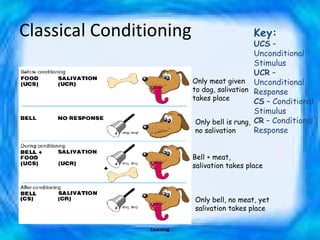
Theories of Learning Classical conditioning It was proposed by Ivan Pavlov in 1927. It evolved from the experiments conducted on dogs by Russian psychologist, Ivan Pavlov. In the process of classical conditioning, a neutral stimulus when paired with an unconditioned stimulus, becomes a conditioned stimulus that brings about a conditioned response. Learning
Classical Conditioning  Key: UCS  – Unconditional Stimulus UCR  – Unconditional Response CS  – Conditional Stimulus CR  – Conditional Response  Only meat given to dog, salivation takes place Only bell is rung, no salivation  Bell + meat, salivation takes place Only bell, no meat, yet salivation takes place Learning
Operant Conditioning This theory was proposed by B.F. Skinner (1953, 1954). It  believes that learning depends on change in overt behavior. The behavior of an individual changes due to his response to the stimuli. The individual responds, when a particular Stimulus-Response (S-R) pattern is rewarded. Reinforcement is an important part of Skinner’s S-R theory. A reinforcer improves the desired response. Operant conditioning is more applicable in human learning. Learning
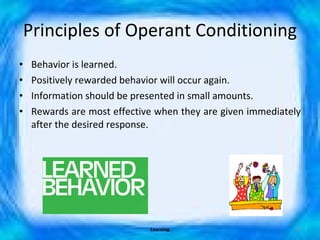
Principles of Operant Conditioning Behavior is learned. Positively rewarded behavior will occur again. Information should be presented in small amounts.  Rewards are most effective when they are given immediately after the desired response. Learning
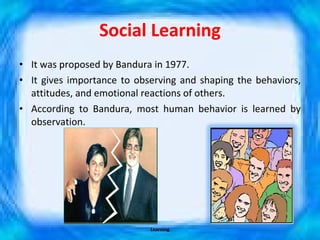
Social Learning It was proposed by Bandura in 1977. It gives importance to observing and shaping the behaviors, attitudes, and emotional reactions of others. According to Bandura, most human behavior is learned by observation. Learning
Processes of Social Learning Attentional processes  – People learn from a model only when they pay attention to its important characteristics. Retention processes  – A model’s effect depends on how well an individual remembers the model’s action after the model is not available.  Motor reproduction processes  – After a person has observed the model, he/she must do what the model did. Reinforcement processes  – Individuals are encouraged to follow the behavior shown by the model if they are positively rewarded for it. Learning
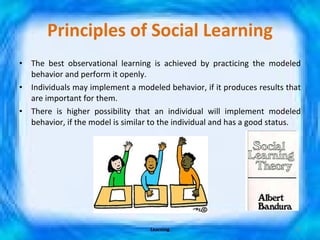
Principles of Social Learning The best observational learning is achieved by practicing the modeled behavior and perform it openly. Individuals may implement a modeled behavior, if it produces results that are important for them. There is higher possibility that an individual will implement modeled behavior, if the model is similar to the individual and has a good status. Learning
Shaping Behavior It is the process of changing the individual’s behavior by guiding their learning in systematic steps. The four methods of shaping behavior are- 1 . Positive reinforcement 2.  Negative reinforcement 3.  Punishment 4.  Extinction Learning
Meaning of Reinforcement : Reinforce means to strengthen, and reinforcement refers to a stimulus which strengthens the probability of a particular response being repeated. Positive reinforcement. Negative reinforcement. Reinforcement is anything that increases the intensity of a response. It can be negative or positive. Commonly used reinforcers in organizations:- Appreciating the good work of employees Awarding promotions or raises Learning
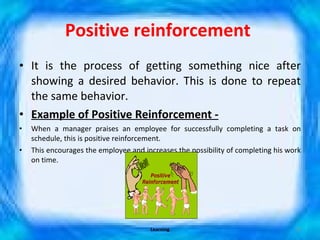
Positive reinforcement  It is the process of getting something nice after showing a desired behavior. This is done to repeat the same behavior. Example of Positive Reinforcement - When a manager praises an employee for successfully completing a task on schedule, this is positive reinforcement.  This encourages the employee and increases the possibility of completing his work on time. Learning
Negative Reinforcement In this, a reward is taken away if an undesired behavior is displayed. Example of Negative reinforcement- Taking away scholarship from a student, if he does not perform well in the examination. When a worker is asked to get back to work when he is noticed talking to his colleagues, this is negative reinforcement. Learning
Punishment   Punishment is the practice of forcing something unpleasant or on a person, usually in response to disobedient or morally wrong behavior or undesired behavior.  Should be immediate. Has effect on others who are watching Punisher must provide an acceptable alternative to offender 5.  Can have side effects of hate and revenge Learning
Extinction  It is removal of any reward (reinforcement) that is helping to maintain a particular behavior. If a person puts in extra effort but his work is not being recognized or rewarded, he will stop doing it. Learning
Schedules of Reinforcement Reinforcement schedules are of two types- Continuous reinforcement schedule Intermittent reinforcement schedule Learning
Continuous Reinforcement Schedule In this a desired behavior is always rewarded. It is the traditional reinforcement schedule. Learning
Intermittent Reinforcement Schedule In this schedule, every case of desired behavior is not rewarded. But the frequency of reward is sufficient to encourage desired behavior. Learning
Categories of Intermittent Techniques  Fixed interval reinforcement schedule  – Rewards are given at fixed time intervals. E.g. honesty pay Variable interval reinforcements  – Rewards are given at time intervals that are not fixed.  Fixed ratio schedule  – Reward is given after a fixed number of responses. E.g. Piece rate Generally variable schedules lead to higher performance than fixed schedules. Continuous reinforcers are appropriate for newly desired, low frequency or unstable responses. Intermittent reinforcers are appropriate for stable or high frequency responses. Learning
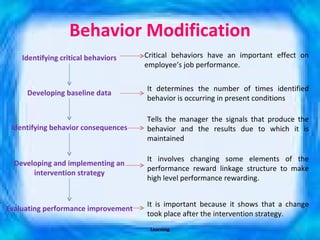
Behavior Modification Identifying critical behaviors Developing baseline data Identifying behavior consequences Developing and implementing an intervention strategy Evaluating performance improvement Critical behaviors have an important effect on employee’s job performance. It determines the number of times identified behavior is occurring in present conditions  Tells the manager the signals that produce the behavior and the results due to which it is maintained It involves changing some elements of the performance reward linkage structure to make high level performance rewarding. It is important because it shows that a change took place after the intervention strategy. Learning
Specific Organizational Application 1)  Using lotteries to reduce absenteeism In this method lotteries are used to reduce absenteeism in organizations. This method was used by  Continental Airlines  to reward its 40,000 employees for attendance.  The company holds a draw two times a year and gives eight new sports utility vehicles. For this draw employees who have not taken a single leave during the last six months are eligible. This reduced the company’s absence rate to a great extent (Robbins 2003). Learning
2) Well pay vs. sick pay Organizations that pay for sick leaves face two times more absenteeism than organizations who do not pay for sick leaves. One organization in USA implemented a well pay program. It paid bonus to employees who did not take any leave for a four weak period. This program increased organization’s savings, reduced absenteeism, increased productivity and improved employee satisfaction. Forbes magazine also used this approach to cut its health care costs. Learning
3) Employee Discipline All managers have to deal with problem behaviors in the organization. To counter this, managers may take disciplinary action like  oral warning, written warning and temporary suspension.  But it is a short term solution and causes side effects. Disciplinary action tells the employees what not to do but does not teach them what to do. Practically, it is used commonly because it can give fast results in the short run. Most organizations have some kind of training program. Learning
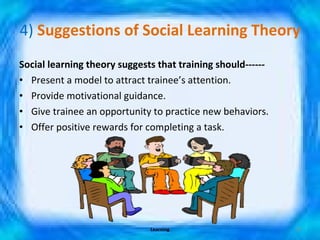
4)  Suggestions of Social Learning Theory Social learning theory suggests that training should------ Present a model to attract trainee’s attention. Provide motivational guidance. Give trainee an opportunity to practice new behaviors. Offer positive rewards for completing a task. Learning
5) Self-Management Use of learning concepts allow individuals to manage their own behavior. Self-management requires an individual to carefully control the stimuli, internal processes and responses to achieve personal behavioral results. Learning
Learning

Learning

  • 1.
    Unit 4 Learning Smita Choudhary Faculty HR/OB Learning is not attained by chance, it must be sought for with ardor and attended to with diligence . Learning
  • 2.
    Contents IntroductionTheories of learning Shaping behavior Behavior modification Specific organizational application Learning
  • 3.
    Introduction Learning isnot a one time activity or an annual, half yearly, quarterly or monthly activity. Learning is a continuous process. It begins right from when a child is born and ends with his death. It is rightly said by Denis Waitley (American motivational speaker), “All of the top achievers I know are life-long learners... Looking for new skills, insights, and ideas. If they're not learning, they're not growing... not moving toward excellence.” There is no end to learning. Learning
  • 4.
    Introduction Learningis a process that improves the knowledge, skill and attitude (KSA) of individuals, increases his/her willingness to adopt these KSAs and implement them on the job. Learning can be defined as “any relatively permanent change in behavior that occurs as a result of experience”. ----- (Robbins, 2003 ) Learning
  • 5.
    Why Learning isImportant Learning is important to ensure that we keep up-to-date with developments in our particular field. It is also an important source of motivation, stimulation and job satisfaction. Learning is therefore important because it helps us to keep in tune with trends and developments in our own field. Learning has the power to change us. Specifically, we can become more successful. Learning
  • 6.
    Characteristics of LearningChanges take place during learning. The change must be permanent Learning is related to behavior Some experience is necessary for learning Learning
  • 7.
    Theories of LearningClassical conditioning It was proposed by Ivan Pavlov in 1927. It evolved from the experiments conducted on dogs by Russian psychologist, Ivan Pavlov. In the process of classical conditioning, a neutral stimulus when paired with an unconditioned stimulus, becomes a conditioned stimulus that brings about a conditioned response. Learning
  • 8.
    Classical Conditioning Key: UCS – Unconditional Stimulus UCR – Unconditional Response CS – Conditional Stimulus CR – Conditional Response Only meat given to dog, salivation takes place Only bell is rung, no salivation Bell + meat, salivation takes place Only bell, no meat, yet salivation takes place Learning
  • 9.
    Operant Conditioning Thistheory was proposed by B.F. Skinner (1953, 1954). It believes that learning depends on change in overt behavior. The behavior of an individual changes due to his response to the stimuli. The individual responds, when a particular Stimulus-Response (S-R) pattern is rewarded. Reinforcement is an important part of Skinner’s S-R theory. A reinforcer improves the desired response. Operant conditioning is more applicable in human learning. Learning
  • 10.
    Principles of OperantConditioning Behavior is learned. Positively rewarded behavior will occur again. Information should be presented in small amounts. Rewards are most effective when they are given immediately after the desired response. Learning
  • 11.
    Social Learning Itwas proposed by Bandura in 1977. It gives importance to observing and shaping the behaviors, attitudes, and emotional reactions of others. According to Bandura, most human behavior is learned by observation. Learning
  • 12.
    Processes of SocialLearning Attentional processes – People learn from a model only when they pay attention to its important characteristics. Retention processes – A model’s effect depends on how well an individual remembers the model’s action after the model is not available. Motor reproduction processes – After a person has observed the model, he/she must do what the model did. Reinforcement processes – Individuals are encouraged to follow the behavior shown by the model if they are positively rewarded for it. Learning
  • 13.
    Principles of SocialLearning The best observational learning is achieved by practicing the modeled behavior and perform it openly. Individuals may implement a modeled behavior, if it produces results that are important for them. There is higher possibility that an individual will implement modeled behavior, if the model is similar to the individual and has a good status. Learning
  • 14.
    Shaping Behavior Itis the process of changing the individual’s behavior by guiding their learning in systematic steps. The four methods of shaping behavior are- 1 . Positive reinforcement 2. Negative reinforcement 3. Punishment 4. Extinction Learning
  • 15.
    Meaning of Reinforcement: Reinforce means to strengthen, and reinforcement refers to a stimulus which strengthens the probability of a particular response being repeated. Positive reinforcement. Negative reinforcement. Reinforcement is anything that increases the intensity of a response. It can be negative or positive. Commonly used reinforcers in organizations:- Appreciating the good work of employees Awarding promotions or raises Learning
  • 16.
    Positive reinforcement It is the process of getting something nice after showing a desired behavior. This is done to repeat the same behavior. Example of Positive Reinforcement - When a manager praises an employee for successfully completing a task on schedule, this is positive reinforcement. This encourages the employee and increases the possibility of completing his work on time. Learning
  • 17.
    Negative Reinforcement Inthis, a reward is taken away if an undesired behavior is displayed. Example of Negative reinforcement- Taking away scholarship from a student, if he does not perform well in the examination. When a worker is asked to get back to work when he is noticed talking to his colleagues, this is negative reinforcement. Learning
  • 18.
    Punishment Punishment is the practice of forcing something unpleasant or on a person, usually in response to disobedient or morally wrong behavior or undesired behavior. Should be immediate. Has effect on others who are watching Punisher must provide an acceptable alternative to offender 5. Can have side effects of hate and revenge Learning
  • 19.
    Extinction Itis removal of any reward (reinforcement) that is helping to maintain a particular behavior. If a person puts in extra effort but his work is not being recognized or rewarded, he will stop doing it. Learning
  • 20.
    Schedules of ReinforcementReinforcement schedules are of two types- Continuous reinforcement schedule Intermittent reinforcement schedule Learning
  • 21.
    Continuous Reinforcement ScheduleIn this a desired behavior is always rewarded. It is the traditional reinforcement schedule. Learning
  • 22.
    Intermittent Reinforcement ScheduleIn this schedule, every case of desired behavior is not rewarded. But the frequency of reward is sufficient to encourage desired behavior. Learning
  • 23.
    Categories of IntermittentTechniques Fixed interval reinforcement schedule – Rewards are given at fixed time intervals. E.g. honesty pay Variable interval reinforcements – Rewards are given at time intervals that are not fixed. Fixed ratio schedule – Reward is given after a fixed number of responses. E.g. Piece rate Generally variable schedules lead to higher performance than fixed schedules. Continuous reinforcers are appropriate for newly desired, low frequency or unstable responses. Intermittent reinforcers are appropriate for stable or high frequency responses. Learning
  • 24.
    Behavior Modification Identifyingcritical behaviors Developing baseline data Identifying behavior consequences Developing and implementing an intervention strategy Evaluating performance improvement Critical behaviors have an important effect on employee’s job performance. It determines the number of times identified behavior is occurring in present conditions Tells the manager the signals that produce the behavior and the results due to which it is maintained It involves changing some elements of the performance reward linkage structure to make high level performance rewarding. It is important because it shows that a change took place after the intervention strategy. Learning
  • 25.
    Specific Organizational Application1) Using lotteries to reduce absenteeism In this method lotteries are used to reduce absenteeism in organizations. This method was used by Continental Airlines to reward its 40,000 employees for attendance. The company holds a draw two times a year and gives eight new sports utility vehicles. For this draw employees who have not taken a single leave during the last six months are eligible. This reduced the company’s absence rate to a great extent (Robbins 2003). Learning
  • 26.
    2) Well payvs. sick pay Organizations that pay for sick leaves face two times more absenteeism than organizations who do not pay for sick leaves. One organization in USA implemented a well pay program. It paid bonus to employees who did not take any leave for a four weak period. This program increased organization’s savings, reduced absenteeism, increased productivity and improved employee satisfaction. Forbes magazine also used this approach to cut its health care costs. Learning
  • 27.
    3) Employee DisciplineAll managers have to deal with problem behaviors in the organization. To counter this, managers may take disciplinary action like oral warning, written warning and temporary suspension. But it is a short term solution and causes side effects. Disciplinary action tells the employees what not to do but does not teach them what to do. Practically, it is used commonly because it can give fast results in the short run. Most organizations have some kind of training program. Learning
  • 28.
    4) Suggestionsof Social Learning Theory Social learning theory suggests that training should------ Present a model to attract trainee’s attention. Provide motivational guidance. Give trainee an opportunity to practice new behaviors. Offer positive rewards for completing a task. Learning
  • 29.
    5) Self-Management Useof learning concepts allow individuals to manage their own behavior. Self-management requires an individual to carefully control the stimuli, internal processes and responses to achieve personal behavioral results. Learning
  • 30.