LEARNING
Prof. Shrinivas V K
Prof. SVK
DEFINITIONS
“Learning is a relatively permanent
change in behavior that occurs as a
result of a prior experience”
“Learning has taken place if an
individual behaves, reacts, responds
as a result of experience in a manner
different from the way he formerly
behaved”
“A permanent change in behavior
through education and training,
practice and experience”
Prof. SVK
TheoriesofLearning
• Classical conditioning by Ivan Pavlov
• Operant conditioning by B. F. Skinner
• Cognitive learning by Edward Tolman
• Social learning
Prof. SVK
Classical Conditioning
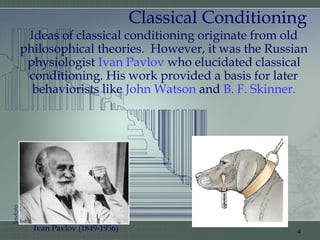
Ideas of classical conditioning originate from old
philosophical theories. However, it was the Russian
physiologist Ivan Pavlov who elucidated classical
conditioning. His work provided a basis for later
behaviorists like John Watson and B. F. Skinner.
4Ivan Pavlov (1849-1936)
Sovfoto
Classicalconditioning
• Classical conditioning is the association of one
event with another desired event resulting in a
behavior.
• A type of conditioning in which an individual
responds to some stimulus that would not
ordinarily produce such a response.
• He tried to relate the dog’s salivation and the
ringing of the bell.
• He conducted an experiment on dogs and
tried to establish a Stimulus Response
connection.
Prof. SVK
• Unconditioned stimulus (Meat)
• Unconditioned response (Salivation)
• Conditioned/artificial stimulus ( Bell )
• Conditioned response
(Salivation=bell)
Prof. SVK
Pavlov’sExperiments
7
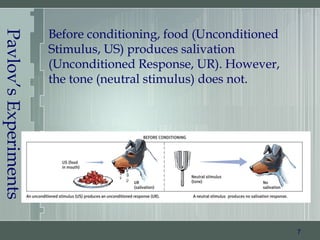
Before conditioning, food (Unconditioned
Stimulus, US) produces salivation
(Unconditioned Response, UR). However,
the tone (neutral stimulus) does not.
Pavlov’sExperiments
8
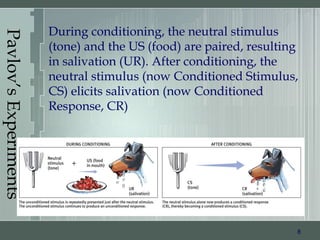
During conditioning, the neutral stimulus
(tone) and the US (food) are paired, resulting
in salivation (UR). After conditioning, the
neutral stimulus (now Conditioned Stimulus,
CS) elicits salivation (now Conditioned
Response, CR)
Prof. SVK
Crticisism
• It is passive.
• Mostly behaviour is emitted than
elicited.
• It is voluntary not reflexive
Prof. SVK
BFSkinner’sOperant
conditioning
• A type of conditioning in which
desired voluntary behaviour leads to
a reward or prevents a punishment.
• Operant behaviour means voluntary
or learned behaviour in contrast to
reflexive or unlearned behaviour.
Prof. SVK
Methodstoshapebehaviour
• Positive reinforcement: Following a
response with something pleasant.
• Negative reinforcement: Following a
response by the termination or
withdrawal of something unpleasant.
• Punishment: Causing an unpleasant
condition to eliminate undesirable
behaviour
• Extinction: Eliminating any reinforcement
that is maintaining a behaviour
Prof. SVK
Sociallearning
• People can learn through observation
and direct experince.
• 4 step model
1) Attentional process
2) Retention process
3) Motor reproduction
4) Reinforcement process
Prof. SVK
Cognitivelearning
• Not all cases of learning can easily be
captured by classical conditioning
and operant conditioning.
• Learning would be extremely
inefficient if we had to rely
completely on conditioning for all our
learning.
• Human beings can learn efficiently
by observation, taking instruction,
and imitating the behavior of others.
Prof. SVK
• “Cognitive learning is defined as the
acquisition of knowledge and skill by
mental or cognitive processes”
• Cognitive processes include creating
mental representations of physical
objects and events, and other forms
of information processing.
• In cognitive learning, the individual
learns by listening, watching,
touching, reading, or experiencing
and then processing and
remembering the information.
Prof. SVK
• Using rats in the laboratory, he
showed that they learnt to run
through a complicated maze
towards their goal of food.
• It was observed that rats developed
expectations at every choice points
in the maze.
• Learning happened when the
environmental cues and
expecatations were strengthened
because the cues led to the
expected goals.
Prof. SVK
Principlesoflearning
• It is the process of changing the
individual’s behavior by guiding their
learning in systematic steps.
• The four methods of shaping behavior
are-
• 1. Positive reinforcement
• 2. Negative reinforcement
• 3. Punishment
• 4. Extinction
Prof. SVK
MeaningofReinforcement:
 Reinforce means to strengthen, and reinforcement
refers to a stimulus which strengthens the
probability of a particular response being
repeated.
 Positive reinforcement.
 Negative reinforcement.
 Reinforcement is anything that increases the
intensity of a response. It can be negative or
positive.
 Commonly used reinforcers in organizations:-
 Appreciating the good work of employees
 Awarding promotions or raises
•
Prof. SVK
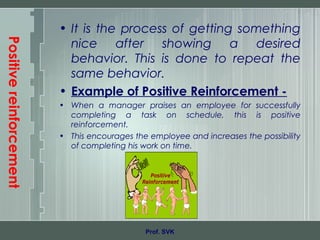
Positivereinforcement
• It is the process of getting something
nice after showing a desired
behavior. This is done to repeat the
same behavior.
• Example of Positive Reinforcement -
• When a manager praises an employee for successfully
completing a task on schedule, this is positive
reinforcement.
• This encourages the employee and increases the possibility
of completing his work on time.
Prof. SVK
NegativeReinforcement
• In this, a reward is taken away if an
undesired behavior is displayed.
Example of Negative reinforcement-
• Taking away scholarship from a
student, if he does not perform well in
the examination.
• When a worker is asked to get back to work
when he is noticed talking to his colleagues,
this is negative reinforcement.
Prof. SVK
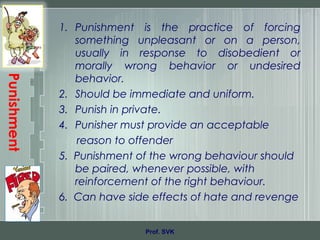
Punishment
1. Punishment is the practice of forcing
something unpleasant or on a person,
usually in response to disobedient or
morally wrong behavior or undesired
behavior.
2. Should be immediate and uniform.
3. Punish in private.
4. Punisher must provide an acceptable
reason to offender
5. Punishment of the wrong behaviour should
be paired, whenever possible, with
reinforcement of the right behaviour.
6. Can have side effects of hate and revenge
Prof. SVK
Extinction
• It is removal of any reward
(reinforcement) that is helping to
maintain a particular behavior.
• If a person puts in extra effort but his
work is not being recognized or
rewarded, he will stop doing it.
Prof. SVK
SchedulesofReinforcement
• Reinforcement schedules are of two
types-
– Continuous reinforcement schedule
– Intermittent reinforcement schedule
Prof. SVK
ContinuousReinforcementSchedule
• In this a desired behavior is always
rewarded.
• It is the traditional reinforcement
schedule.
Prof. SVK
IntermittentReinforcement
Schedule
• In this schedule, every case of desired
behavior is not rewarded.
• But the frequency of reward is
sufficient to encourage desired
behavior.
Prof. SVK
CategoriesofIntermittent
Techniques
• Fixed interval reinforcement schedule –
Rewards are given at fixed time intervals.
E.g. honesty pay
• Variable interval reinforcements – Rewards
are given at time intervals that are not fixed.
• Fixed ratio schedule – Reward is given after
a fixed number of responses. E.g. Piece rate
Generally variable schedules lead to higher performance
than fixed schedules.
Continuous reinforcers are appropriate for newly desired, low
frequency or unstable responses.
Intermittent reinforcers are appropriate for stable or high
frequency responses.
Prof. SVK
SpecificOrganizational
Application
1) Using lotteries to reduce absenteeism
• In this method lotteries are used to reduce
absenteeism in organizations.
• This method was used by Continental
Airlines to reward its 40,000 employees for
attendance.
• The company holds a draw two times a
year and gives eight new sports utility
vehicles.
• For this draw employees who have not
taken a single leave during the last six
months are eligible.
• This reduced the company’s absence rate
to a great extent (Robbins 2003).
Prof. SVK
2)Wellpayvs.sickpay
• Organizations that pay for sick leaves face
two times more absenteeism than
organizations who do not pay for sick
leaves.
• One organization in USA implemented a
well pay program.
• It paid bonus to employees who did not
take any leave for a four weak period.
• This program increased organization’s
savings, reduced absenteeism, increased
productivity and improved employee
satisfaction.
• Forbes magazine also used this approach to
cut its health care costs.
Prof. SVK
3)EmployeeDiscipline
• All managers have to deal with problem
behaviors in the organization.
• To counter this, managers may take
disciplinary action like oral warning, written
warning and temporary suspension. But it is
a short term solution and causes side
effects.
• Disciplinary action tells the employees what
not to do but does not teach them what to
do.
• Practically, it is used commonly because it
can give fast results in the short run.
• Most organizations have some kind of
training program.
Prof. SVK
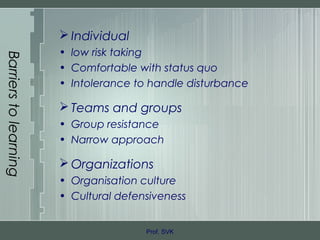
Barrierstolearning
 Individual
• low risk taking
• Comfortable with status quo
• Intolerance to handle disturbance
 Teams and groups
• Group resistance
• Narrow approach
 Organizations
• Organisation culture
• Cultural defensiveness
Prof. SVK
Thank you……
Prof. SVK

Learning-Organisational Behavior

  • 1.
  • 2.
    DEFINITIONS “Learning is arelatively permanent change in behavior that occurs as a result of a prior experience” “Learning has taken place if an individual behaves, reacts, responds as a result of experience in a manner different from the way he formerly behaved” “A permanent change in behavior through education and training, practice and experience” Prof. SVK
  • 3.
    TheoriesofLearning • Classical conditioningby Ivan Pavlov • Operant conditioning by B. F. Skinner • Cognitive learning by Edward Tolman • Social learning Prof. SVK
  • 4.
    Classical Conditioning Ideas ofclassical conditioning originate from old philosophical theories. However, it was the Russian physiologist Ivan Pavlov who elucidated classical conditioning. His work provided a basis for later behaviorists like John Watson and B. F. Skinner. 4Ivan Pavlov (1849-1936) Sovfoto
  • 5.
    Classicalconditioning • Classical conditioningis the association of one event with another desired event resulting in a behavior. • A type of conditioning in which an individual responds to some stimulus that would not ordinarily produce such a response. • He tried to relate the dog’s salivation and the ringing of the bell. • He conducted an experiment on dogs and tried to establish a Stimulus Response connection. Prof. SVK
  • 6.
    • Unconditioned stimulus(Meat) • Unconditioned response (Salivation) • Conditioned/artificial stimulus ( Bell ) • Conditioned response (Salivation=bell) Prof. SVK
  • 7.
    Pavlov’sExperiments 7 Before conditioning, food(Unconditioned Stimulus, US) produces salivation (Unconditioned Response, UR). However, the tone (neutral stimulus) does not.
  • 8.
    Pavlov’sExperiments 8 During conditioning, theneutral stimulus (tone) and the US (food) are paired, resulting in salivation (UR). After conditioning, the neutral stimulus (now Conditioned Stimulus, CS) elicits salivation (now Conditioned Response, CR)
  • 9.
  • 10.
    Crticisism • It ispassive. • Mostly behaviour is emitted than elicited. • It is voluntary not reflexive Prof. SVK
  • 11.
    BFSkinner’sOperant conditioning • A typeof conditioning in which desired voluntary behaviour leads to a reward or prevents a punishment. • Operant behaviour means voluntary or learned behaviour in contrast to reflexive or unlearned behaviour. Prof. SVK
  • 12.
    Methodstoshapebehaviour • Positive reinforcement:Following a response with something pleasant. • Negative reinforcement: Following a response by the termination or withdrawal of something unpleasant. • Punishment: Causing an unpleasant condition to eliminate undesirable behaviour • Extinction: Eliminating any reinforcement that is maintaining a behaviour Prof. SVK
  • 13.
    Sociallearning • People canlearn through observation and direct experince. • 4 step model 1) Attentional process 2) Retention process 3) Motor reproduction 4) Reinforcement process Prof. SVK
  • 14.
    Cognitivelearning • Not allcases of learning can easily be captured by classical conditioning and operant conditioning. • Learning would be extremely inefficient if we had to rely completely on conditioning for all our learning. • Human beings can learn efficiently by observation, taking instruction, and imitating the behavior of others. Prof. SVK
  • 15.
    • “Cognitive learningis defined as the acquisition of knowledge and skill by mental or cognitive processes” • Cognitive processes include creating mental representations of physical objects and events, and other forms of information processing. • In cognitive learning, the individual learns by listening, watching, touching, reading, or experiencing and then processing and remembering the information. Prof. SVK
  • 16.
    • Using ratsin the laboratory, he showed that they learnt to run through a complicated maze towards their goal of food. • It was observed that rats developed expectations at every choice points in the maze. • Learning happened when the environmental cues and expecatations were strengthened because the cues led to the expected goals. Prof. SVK
  • 17.
    Principlesoflearning • It isthe process of changing the individual’s behavior by guiding their learning in systematic steps. • The four methods of shaping behavior are- • 1. Positive reinforcement • 2. Negative reinforcement • 3. Punishment • 4. Extinction Prof. SVK
  • 18.
    MeaningofReinforcement:  Reinforce meansto strengthen, and reinforcement refers to a stimulus which strengthens the probability of a particular response being repeated.  Positive reinforcement.  Negative reinforcement.  Reinforcement is anything that increases the intensity of a response. It can be negative or positive.  Commonly used reinforcers in organizations:-  Appreciating the good work of employees  Awarding promotions or raises • Prof. SVK
  • 19.
    Positivereinforcement • It isthe process of getting something nice after showing a desired behavior. This is done to repeat the same behavior. • Example of Positive Reinforcement - • When a manager praises an employee for successfully completing a task on schedule, this is positive reinforcement. • This encourages the employee and increases the possibility of completing his work on time. Prof. SVK
  • 20.
    NegativeReinforcement • In this,a reward is taken away if an undesired behavior is displayed. Example of Negative reinforcement- • Taking away scholarship from a student, if he does not perform well in the examination. • When a worker is asked to get back to work when he is noticed talking to his colleagues, this is negative reinforcement. Prof. SVK
  • 21.
    Punishment 1. Punishment isthe practice of forcing something unpleasant or on a person, usually in response to disobedient or morally wrong behavior or undesired behavior. 2. Should be immediate and uniform. 3. Punish in private. 4. Punisher must provide an acceptable reason to offender 5. Punishment of the wrong behaviour should be paired, whenever possible, with reinforcement of the right behaviour. 6. Can have side effects of hate and revenge Prof. SVK
  • 22.
    Extinction • It isremoval of any reward (reinforcement) that is helping to maintain a particular behavior. • If a person puts in extra effort but his work is not being recognized or rewarded, he will stop doing it. Prof. SVK
  • 23.
    SchedulesofReinforcement • Reinforcement schedulesare of two types- – Continuous reinforcement schedule – Intermittent reinforcement schedule Prof. SVK
  • 24.
    ContinuousReinforcementSchedule • In thisa desired behavior is always rewarded. • It is the traditional reinforcement schedule. Prof. SVK
  • 25.
    IntermittentReinforcement Schedule • In thisschedule, every case of desired behavior is not rewarded. • But the frequency of reward is sufficient to encourage desired behavior. Prof. SVK
  • 26.
    CategoriesofIntermittent Techniques • Fixed intervalreinforcement schedule – Rewards are given at fixed time intervals. E.g. honesty pay • Variable interval reinforcements – Rewards are given at time intervals that are not fixed. • Fixed ratio schedule – Reward is given after a fixed number of responses. E.g. Piece rate Generally variable schedules lead to higher performance than fixed schedules. Continuous reinforcers are appropriate for newly desired, low frequency or unstable responses. Intermittent reinforcers are appropriate for stable or high frequency responses. Prof. SVK
  • 27.
    SpecificOrganizational Application 1) Using lotteriesto reduce absenteeism • In this method lotteries are used to reduce absenteeism in organizations. • This method was used by Continental Airlines to reward its 40,000 employees for attendance. • The company holds a draw two times a year and gives eight new sports utility vehicles. • For this draw employees who have not taken a single leave during the last six months are eligible. • This reduced the company’s absence rate to a great extent (Robbins 2003). Prof. SVK
  • 28.
    2)Wellpayvs.sickpay • Organizations thatpay for sick leaves face two times more absenteeism than organizations who do not pay for sick leaves. • One organization in USA implemented a well pay program. • It paid bonus to employees who did not take any leave for a four weak period. • This program increased organization’s savings, reduced absenteeism, increased productivity and improved employee satisfaction. • Forbes magazine also used this approach to cut its health care costs. Prof. SVK
  • 29.
    3)EmployeeDiscipline • All managershave to deal with problem behaviors in the organization. • To counter this, managers may take disciplinary action like oral warning, written warning and temporary suspension. But it is a short term solution and causes side effects. • Disciplinary action tells the employees what not to do but does not teach them what to do. • Practically, it is used commonly because it can give fast results in the short run. • Most organizations have some kind of training program. Prof. SVK
  • 30.
    Barrierstolearning  Individual • lowrisk taking • Comfortable with status quo • Intolerance to handle disturbance  Teams and groups • Group resistance • Narrow approach  Organizations • Organisation culture • Cultural defensiveness Prof. SVK
  • 31.

Editor's Notes

  • #8 OBJECTIVE 2| Explain how an unconditioned stimulus (US)
  • #9 Unconditioned Stimulus (UCS): A stimulus that automatically and naturally triggers a response. Unconditioned Response (UCR): A unlearned, naturally occurring response to the unconditioned stimulus, like salivation in the dog when food is in the mouth. Conditioned Stimulus (CS): Originally a neutral stimulus that, after association with an unconditioned stimulus, comes to trigger a conditioned response. Conditioned Response (CR): A learned response to a previously neutral conditioned stimulus.