and, if so, are you ready for 6σ?
For starters, let’s consider the
sometimes tortured relationship
between Lean and Six Sigma…
“The typical approach to lean six sigma fits
Western thinking about simple cause-effect
relationships and the overall perspective that
the business is a technical system that needs
clever manipulation with the right tool kit to
achieve financial returns.
This type of thinking is totally alien to the
human systems underpinnings of Lean.”
     - Jeffrey Liker
       Professor of Industrial and Operations Engineering
       University of Michigan
What is Six Sigma ?
 Achieve 3.4 defects per million opportunities
 Lead by Six Sigma Belts
 Strong emphasis on statistical analysis
What is Lean?
 Employee engagement philosophy
 Collection of process improvement tools
 Eliminate waste
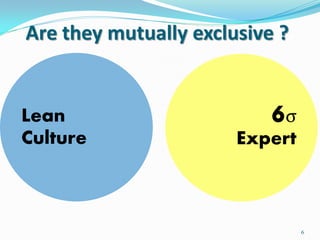
Are they mutually exclusive ?


Lean                       6σ
Culture                Expert


                                6
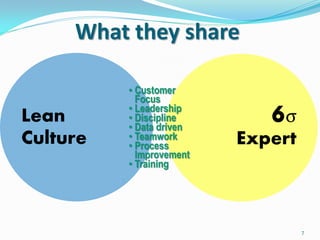
What they share

          • Customer
            Focus
Lean      • Leadership
          • Discipline
          • Data driven
                             6σ
Culture   • Teamwork
          • Process       Expert
            Improvement
          • Training


                                   7
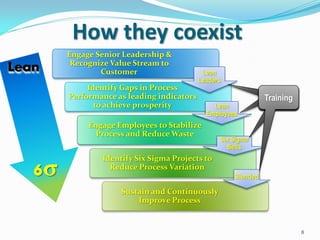
How they coexist
        Engage Senior Leadership &
         Recognize Value Stream to
Lean            Customer                     Lean
                                            Leaders
             Identify Gaps in Process
        Performance as leading indicators                       Training
               to achieve prosperity            Lean
                                              Employees
             Engage Employees to Stabilize
              Process and Reduce Waste
                                                  Six Sigma
                                                    Belts
                Identify Six Sigma Projects to
   6σ             Reduce Process Variation
                                                      Blended

                     Sustain and Continuously
                         Improve Process


                                                                           8
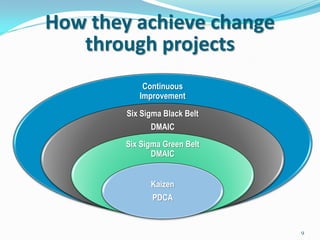
How they achieve change
   through projects
            Continuous
           Improvement
        Six Sigma Black Belt
              DMAIC
        Six Sigma Green Belt
               DMAIC


              Kaizen
               PDCA


                               9
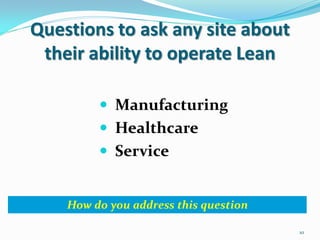
Questions to ask any site about
 their ability to operate Lean

          Manufacturing
          Healthcare
          Service


    How do you address this question

                                       10
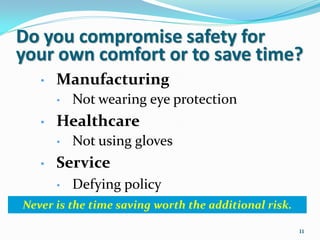
Do you compromise safety for
your own comfort or to save time?
   •   Manufacturing
       •   Not wearing eye protection
   •   Healthcare
       •   Not using gloves
   •   Service
       •   Defying policy
Never is the time saving worth the additional risk.

                                                      11
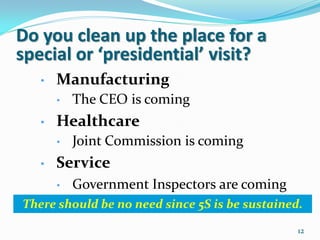
Do you clean up the place for a
special or ‘presidential’ visit?
   •   Manufacturing
       •   The CEO is coming
   •   Healthcare
       •   Joint Commission is coming
   •   Service
       •   Government Inspectors are coming
There should be no need since 5S is be sustained.

                                                12
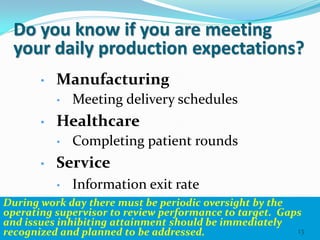
Do you know if you are meeting
 your daily production expectations?
       •   Manufacturing
           •   Meeting delivery schedules
       •   Healthcare
           •   Completing patient rounds
       •   Service
           •   Information exit rate
During work day there must be periodic oversight by the
operating supervisor to review performance to target. Gaps
and issues inhibiting attainment should be immediately
recognized and planned to be addressed.                  13
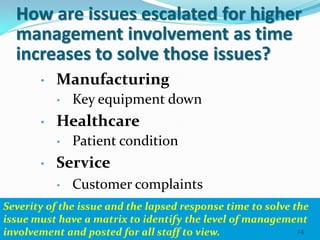
How are issues escalated for higher
  management involvement as time
  increases to solve those issues?
       •   Manufacturing
           •   Key equipment down
       •   Healthcare
           •   Patient condition
       •   Service
           •   Customer complaints
Severity of the issue and the lapsed response time to solve the
issue must have a matrix to identify the level of management
involvement and posted for all staff to view.                14
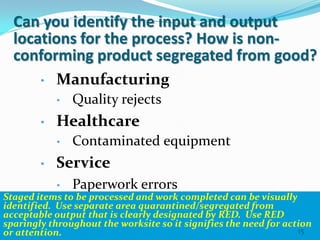
Can you identify the input and output
  locations for the process? How is non-
  conforming product segregated from good?
        •   Manufacturing
            •   Quality rejects
        •   Healthcare
            •   Contaminated equipment
        •   Service
            • Paperwork errors
Staged items to be processed and work completed can be visually
identified. Use separate area quarantined/segregated from
acceptable output that is clearly designated by RED. Use RED
sparingly throughout the worksite so it signifies the need for action
or attention.                                                     15
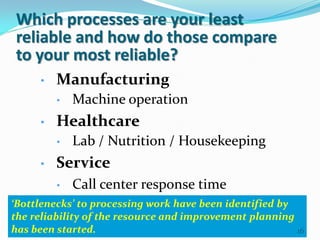
Which processes are your least
reliable and how do those compare
to your most reliable?
     •   Manufacturing
         •   Machine operation
     •   Healthcare
         •   Lab / Nutrition / Housekeeping
     •   Service
         •   Call center response time
‘Bottlenecks’ to processing work have been identified by
the reliability of the resource and improvement planning
has been started.                                        16
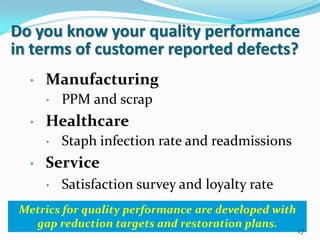
Do you know your quality performance
in terms of customer reported defects?
  •   Manufacturing
      •   PPM and scrap
  •   Healthcare
      •   Staph infection rate and readmissions
  •   Service
      •   Satisfaction survey and loyalty rate
 Metrics for quality performance are developed with
   gap reduction targets and restoration plans.
                                                      17
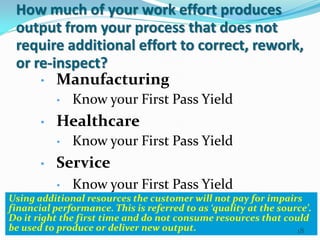
How much of your work effort produces
 output from your process that does not
 require additional effort to correct, rework,
 or re-inspect?
     • Manufacturing
           •   Know your First Pass Yield
       •   Healthcare
           •   Know your First Pass Yield
       •   Service
           • Know your First Pass Yield
Using additional resources the customer will not pay for impairs
financial performance. This is referred to as ‘quality at the source’.
Do it right the first time and do not consume resources that could
be used to produce or deliver new output.                         18
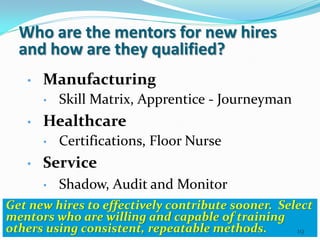
Who are the mentors for new hires
  and how are they qualified?
   •   Manufacturing
       •   Skill Matrix, Apprentice - Journeyman
   •   Healthcare
       •   Certifications, Floor Nurse
   •   Service
       •   Shadow, Audit and Monitor
Get new hires to effectively contribute sooner. Select
mentors who are willing and capable of training
others using consistent, repeatable methods.       19
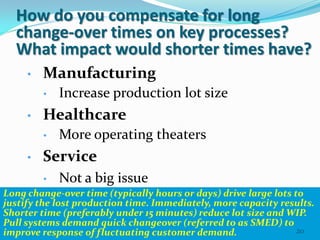
How do you compensate for long
  change-over times on key processes?
  What impact would shorter times have?
     •   Manufacturing
         •   Increase production lot size
     •   Healthcare
         •   More operating theaters
     •   Service
          • Not a big issue
Long change-over time (typically hours or days) drive large lots to
justify the lost production time. Immediately, more capacity results.
Shorter time (preferably under 15 minutes) reduce lot size and WIP.
Pull systems demand quick changeover (referred to as SMED) to
improve response of fluctuating customer demand.                  20
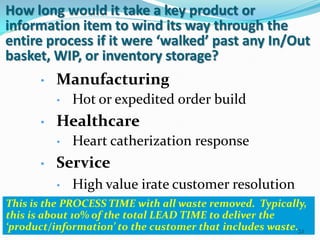
How long would it take a key product or
information item to wind its way through the
entire process if it were ‘walked’ past any In/Out
basket, WIP, or inventory storage?
      •   Manufacturing
          •   Hot or expedited order build
      •   Healthcare
          •   Heart catherization response
      •   Service
          •   High value irate customer resolution
This is the PROCESS TIME with all waste removed. Typically,
this is about 10% of the total LEAD TIME to deliver the
‘product/information’ to the customer that includes waste.21
Rather than looking at inventory in terms
 of monetary value, ask how much time is
 invested to deplete the inventory in terms
 of customer demand?
     • Manufacturing
          •   Raw materials and WIP
      •   Healthcare
          •   Consumable supplies
      •   Service
          •   In-basket accumulation
This reveals our confidence to deliver the process output.
Unreliable process or material sourcing is buffered by
response time accumulated as ‘just-in-case’ inventory.     22
How much information about operating
the process is endowed to key staff (tribal
knowledge) versus documentation?
      •   Manufacturing
          •   Knack to do work
      •   Healthcare
          •   Legacy practices
      •   Service
          •   Fiefdom of knowledge
Standardized processes require an identifiable documented
‘baseline’ to improve. Sharing this information permits
those involved to recognize its effect both downstream and
upstream of the process and engage to improve.           23
When do you believe Six Sigma (6σ)
 would be appropriate for your process?
   •   Manufacturing
       •   A stable process - then reduce variation
   •   Healthcare
       •   A stable process - then reduce variation
   •   Service
       •   A stable process - then reduce variation

First, have a lean culture in place that will sustain change.

                                                           24
Thank you for your attention!
        Q&A

                                25

Are You Lean ?

  • 1.
    and, if so,are you ready for 6σ?
  • 2.
    For starters, let’sconsider the sometimes tortured relationship between Lean and Six Sigma…
  • 3.
    “The typical approachto lean six sigma fits Western thinking about simple cause-effect relationships and the overall perspective that the business is a technical system that needs clever manipulation with the right tool kit to achieve financial returns. This type of thinking is totally alien to the human systems underpinnings of Lean.” - Jeffrey Liker Professor of Industrial and Operations Engineering University of Michigan
  • 4.
    What is SixSigma ?  Achieve 3.4 defects per million opportunities  Lead by Six Sigma Belts  Strong emphasis on statistical analysis
  • 5.
    What is Lean? Employee engagement philosophy  Collection of process improvement tools  Eliminate waste
  • 6.
    Are they mutuallyexclusive ? Lean 6σ Culture Expert 6
  • 7.
    What they share • Customer Focus Lean • Leadership • Discipline • Data driven 6σ Culture • Teamwork • Process Expert Improvement • Training 7
  • 8.
    How they coexist Engage Senior Leadership & Recognize Value Stream to Lean Customer Lean Leaders Identify Gaps in Process Performance as leading indicators Training to achieve prosperity Lean Employees Engage Employees to Stabilize Process and Reduce Waste Six Sigma Belts Identify Six Sigma Projects to 6σ Reduce Process Variation Blended Sustain and Continuously Improve Process 8
  • 9.
    How they achievechange through projects Continuous Improvement Six Sigma Black Belt DMAIC Six Sigma Green Belt DMAIC Kaizen PDCA 9
  • 10.
    Questions to askany site about their ability to operate Lean  Manufacturing  Healthcare  Service How do you address this question 10
  • 11.
    Do you compromisesafety for your own comfort or to save time? • Manufacturing • Not wearing eye protection • Healthcare • Not using gloves • Service • Defying policy Never is the time saving worth the additional risk. 11
  • 12.
    Do you cleanup the place for a special or ‘presidential’ visit? • Manufacturing • The CEO is coming • Healthcare • Joint Commission is coming • Service • Government Inspectors are coming There should be no need since 5S is be sustained. 12
  • 13.
    Do you knowif you are meeting your daily production expectations? • Manufacturing • Meeting delivery schedules • Healthcare • Completing patient rounds • Service • Information exit rate During work day there must be periodic oversight by the operating supervisor to review performance to target. Gaps and issues inhibiting attainment should be immediately recognized and planned to be addressed. 13
  • 14.
    How are issuesescalated for higher management involvement as time increases to solve those issues? • Manufacturing • Key equipment down • Healthcare • Patient condition • Service • Customer complaints Severity of the issue and the lapsed response time to solve the issue must have a matrix to identify the level of management involvement and posted for all staff to view. 14
  • 15.
    Can you identifythe input and output locations for the process? How is non- conforming product segregated from good? • Manufacturing • Quality rejects • Healthcare • Contaminated equipment • Service • Paperwork errors Staged items to be processed and work completed can be visually identified. Use separate area quarantined/segregated from acceptable output that is clearly designated by RED. Use RED sparingly throughout the worksite so it signifies the need for action or attention. 15
  • 16.
    Which processes areyour least reliable and how do those compare to your most reliable? • Manufacturing • Machine operation • Healthcare • Lab / Nutrition / Housekeeping • Service • Call center response time ‘Bottlenecks’ to processing work have been identified by the reliability of the resource and improvement planning has been started. 16
  • 17.
    Do you knowyour quality performance in terms of customer reported defects? • Manufacturing • PPM and scrap • Healthcare • Staph infection rate and readmissions • Service • Satisfaction survey and loyalty rate Metrics for quality performance are developed with gap reduction targets and restoration plans. 17
  • 18.
    How much ofyour work effort produces output from your process that does not require additional effort to correct, rework, or re-inspect? • Manufacturing • Know your First Pass Yield • Healthcare • Know your First Pass Yield • Service • Know your First Pass Yield Using additional resources the customer will not pay for impairs financial performance. This is referred to as ‘quality at the source’. Do it right the first time and do not consume resources that could be used to produce or deliver new output. 18
  • 19.
    Who are thementors for new hires and how are they qualified? • Manufacturing • Skill Matrix, Apprentice - Journeyman • Healthcare • Certifications, Floor Nurse • Service • Shadow, Audit and Monitor Get new hires to effectively contribute sooner. Select mentors who are willing and capable of training others using consistent, repeatable methods. 19
  • 20.
    How do youcompensate for long change-over times on key processes? What impact would shorter times have? • Manufacturing • Increase production lot size • Healthcare • More operating theaters • Service • Not a big issue Long change-over time (typically hours or days) drive large lots to justify the lost production time. Immediately, more capacity results. Shorter time (preferably under 15 minutes) reduce lot size and WIP. Pull systems demand quick changeover (referred to as SMED) to improve response of fluctuating customer demand. 20
  • 21.
    How long wouldit take a key product or information item to wind its way through the entire process if it were ‘walked’ past any In/Out basket, WIP, or inventory storage? • Manufacturing • Hot or expedited order build • Healthcare • Heart catherization response • Service • High value irate customer resolution This is the PROCESS TIME with all waste removed. Typically, this is about 10% of the total LEAD TIME to deliver the ‘product/information’ to the customer that includes waste.21
  • 22.
    Rather than lookingat inventory in terms of monetary value, ask how much time is invested to deplete the inventory in terms of customer demand? • Manufacturing • Raw materials and WIP • Healthcare • Consumable supplies • Service • In-basket accumulation This reveals our confidence to deliver the process output. Unreliable process or material sourcing is buffered by response time accumulated as ‘just-in-case’ inventory. 22
  • 23.
    How much informationabout operating the process is endowed to key staff (tribal knowledge) versus documentation? • Manufacturing • Knack to do work • Healthcare • Legacy practices • Service • Fiefdom of knowledge Standardized processes require an identifiable documented ‘baseline’ to improve. Sharing this information permits those involved to recognize its effect both downstream and upstream of the process and engage to improve. 23
  • 24.
    When do youbelieve Six Sigma (6σ) would be appropriate for your process? • Manufacturing • A stable process - then reduce variation • Healthcare • A stable process - then reduce variation • Service • A stable process - then reduce variation First, have a lean culture in place that will sustain change. 24
  • 25.
    Thank you foryour attention! Q&A 25