Continuous
Improvement
in Lean
Rob Healy, Principal Consultant
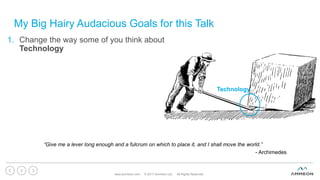
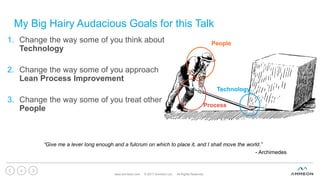
My Big Hairy Audacious Goals for this Talk
1. Change the way some of you think about
Technology
www.ammeon.com © 2017 Ammeon Ltd. All Rights Reserved.
2
Technology
“Give me a lever long enough and a fulcrum on which to place it, and I shall move the world.”
- Archimedes
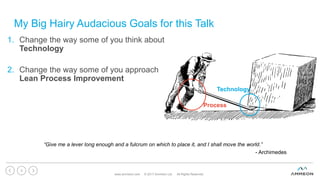
My Big Hairy Audacious Goals for this Talk
1. Change the way some of you think about
Technology
2. Change the way some of you approach
Lean Process Improvement
www.ammeon.com © 2017 Ammeon Ltd. All Rights Reserved.
3
Process
Technology
“Give me a lever long enough and a fulcrum on which to place it, and I shall move the world.”
- Archimedes
My Big Hairy Audacious Goals for this Talk
1. Change the way some of you think about
Technology
2. Change the way some of you approach
Lean Process Improvement
3. Change the way some of you treat other
People
www.ammeon.com © 2017 Ammeon Ltd. All Rights Reserved.
4
People
Process
Technology
“Give me a lever long enough and a fulcrum on which to place it, and I shall move the world.”
- Archimedes
Technology
Rob Healy
• 15 years developing, documenting,
testing and project managing software
• Lean Six Sigma Certified
• MBA, H. Dip Mgmt. B. Mech. Eng.
• CSM, CPO
• Founder member of the Agile Lean
Ireland Society
• Once organised an international
photography competition to be displayed
in Trafalgar Square, London
www.ammeon.com © 2017 Ammeon Ltd. All Rights Reserved.
6
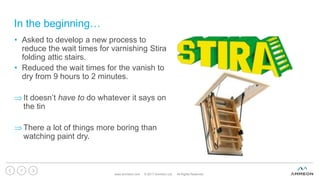
In the beginning…
www.ammeon.com © 2017 Ammeon Ltd. All Rights Reserved.
7
• Asked to develop a new process to
reduce the wait times for varnishing Stira
folding attic stairs.
• Reduced the wait times for the vanish to
dry from 9 hours to 2 minutes.
It doesn’t have to do whatever it says on
the tin
There a lot of things more boring than
watching paint dry.
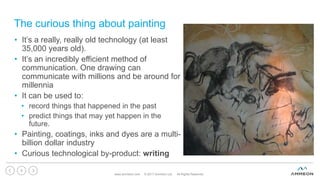
The curious thing about painting
www.ammeon.com © 2017 Ammeon Ltd. All Rights Reserved.
8
• It’s a really, really old technology (at least
35,000 years old).
• It’s an incredibly efficient method of
communication. One drawing can
communicate with millions and be around for
millennia
• It can be used to:
• record things that happened in the past
• predict things that may yet happen in the
future.
• Painting, coatings, inks and dyes are a multi-
billion dollar industry
• Curious technological by-product: writing
www.ammeon.com © 2017 Ammeon Ltd. All Rights Reserved.
9
A word
Writing
www.ammeon.com © 2017 Ammeon Ltd. All Rights Reserved.
10
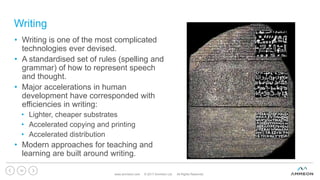
• Writing is one of the most complicated
technologies ever devised.
• A standardised set of rules (spelling and
grammar) of how to represent speech
and thought.
• Major accelerations in human
development have corresponded with
efficiencies in writing:
• Lighter, cheaper substrates
• Accelerated copying and printing
• Accelerated distribution
• Modern approaches for teaching and
learning are built around writing.
Deming – Godfather of Lean
www.ammeon.com © 2017 Ammeon Ltd. All Rights Reserved.
11
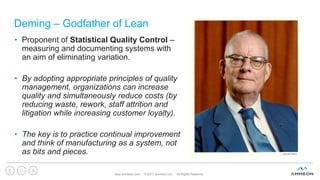
• Proponent of Statistical Quality Control –
measuring and documenting systems with
an aim of eliminating variation.
• By adopting appropriate principles of quality
management, organizations can increase
quality and simultaneously reduce costs (by
reducing waste, rework, staff attrition and
litigation while increasing customer loyalty).
• The key is to practice continual improvement
and think of manufacturing as a system, not
as bits and pieces.
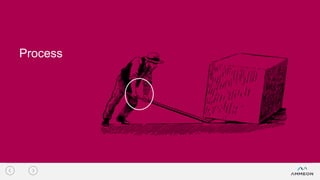
Process
Pin Factory
www.ammeon.com © 2017 Ammeon Ltd. All Rights Reserved.
13
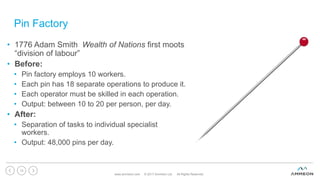
• 1776 Adam Smith Wealth of Nations first moots
“division of labour”
• Before:
• Pin factory employs 10 workers.
• Each pin has 18 separate operations to produce it.
• Each operator must be skilled in each operation.
• Output: between 10 to 20 per person, per day.
• After:
• Separation of tasks to individual specialist
workers.
• Output: 48,000 pins per day.
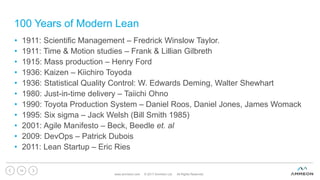
100 Years of Modern Lean
www.ammeon.com © 2017 Ammeon Ltd. All Rights Reserved.
14
• 1911: Scientific Management – Fredrick Winslow Taylor.
• 1911: Time & Motion studies – Frank & Lillian Gilbreth
• 1915: Mass production – Henry Ford
• 1936: Kaizen – Kiichiro Toyoda
• 1936: Statistical Quality Control: W. Edwards Deming, Walter Shewhart
• 1980: Just-in-time delivery – Taiichi Ohno
• 1990: Toyota Production System – Daniel Roos, Daniel Jones, James Womack
• 1995: Six sigma – Jack Welsh (Bill Smith 1985)
• 2001: Agile Manifesto – Beck, Beedle et. al
• 2009: DevOps – Patrick Dubois
• 2011: Lean Startup – Eric Ries
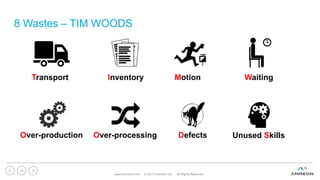
8 Wastes – TIM WOODS
www.ammeon.com © 2017 Ammeon Ltd. All Rights Reserved.
15
Transport Inventory Motion Waiting
Over-production Over-processing Defects Unused Skills
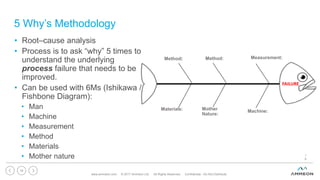
5 Why’s Methodology
• Root–cause analysis
• Process is to ask “why” 5 times to
understand the underlying
process failure that needs to be
improved.
• Can be used with 6Ms (Ishikawa /
Fishbone Diagram):
• Man
• Machine
• Measurement
• Method
• Materials
• Mother nature
www.ammeon.com © 2017 Ammeon Ltd. All Rights Reserved. Confidential - Do Not Distribute.
16
1
6
FAILURE
Method: Method: Measurement:
Machine:Mother
Nature:
Materials:
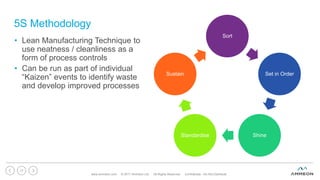
5S Methodology
• Lean Manufacturing Technique to
use neatness / cleanliness as a
form of process controls
• Can be run as part of individual
“Kaizen” events to identify waste
and develop improved processes
Sort
Set in Order
ShineStandardise
Sustain
www.ammeon.com © 2017 Ammeon Ltd. All Rights Reserved. Confidential - Do Not Distribute.
17
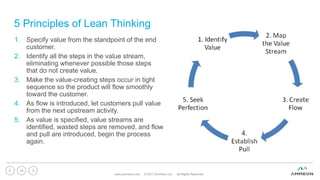
5 Principles of Lean Thinking
1. Specify value from the standpoint of the end
customer.
2. Identify all the steps in the value stream,
eliminating whenever possible those steps
that do not create value.
3. Make the value-creating steps occur in tight
sequence so the product will flow smoothly
toward the customer.
4. As flow is introduced, let customers pull value
from the next upstream activity.
5. As value is specified, value streams are
identified, wasted steps are removed, and flow
and pull are introduced, begin the process
again.
www.ammeon.com © 2017 Ammeon Ltd. All Rights Reserved.
18
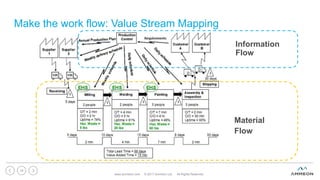
Make the work flow: Value Stream Mapping
www.ammeon.com © 2017 Ammeon Ltd. All Rights Reserved.
19
Material
Flow
Information
Flow
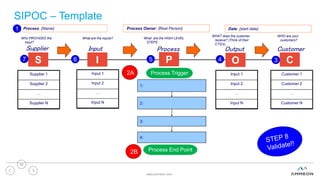
SIPOC – Template
www.ammeon.com
20
CustomerOutputProcessInputSupplier
WHO are your
customers?
WHAT does the customer
receive? (Think of their
CTQ’s)
What are the HIGH LEVEL
STEPS
What are the inputs?Who PROVIDES the
input?
1:
2:
3:
S
Supplier 1
Supplier 2
…
Supplier N
Process: {Name} Process Owner: {Real Person} Date: {start date}1
2A
34567
2B
I P O C
Process Trigger
Process End Point
4:
Input 1
Input 2
…
Input N
Input 1
Input 2
…
Input N
Customer 1
Customer 2
…
Customer N
Step 3:
Fix Defects
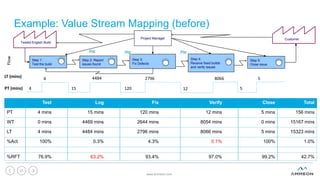
Example: Value Stream Mapping (before)
www.ammeon.com
21
21
Step 1:
Test the build
Step 2: Report
issues found
Step 4:
Receive fixed builds
and verify issues
Step 5:
Close issue
Test Log Fix Verify Close Total
PT 4 mins 15 mins 120 mins 12 mins 5 mins 156 mins
WT 0 mins 4469 mins 2644 mins 8054 mins 0 mins 15167 mins
LT 4 mins 4484 mins 2796 mins 8066 mins 5 mins 15323 mins
%Act 100% 0.3% 4.3% 0.1% 100% 1.0%
%RFT 76.9% 63.2% 93.4% 97.0% 99.2% 42.7%
Flow
LT (mins)
PT (mins) 4
4
15 120 12 5
4484 2796 8066 5
Tested English Build
CustomerProject Manager
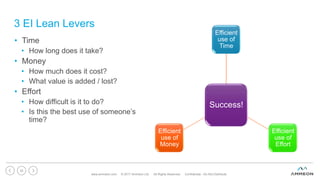
3 EI Lean Levers
• Time
• How long does it take?
• Money
• How much does it cost?
• What value is added / lost?
• Effort
• How difficult is it to do?
• Is this the best use of someone’s
time?
Success!
Efficient
use of
Time
Efficient
use of
Effort
Efficient
use of
Money
www.ammeon.com © 2017 Ammeon Ltd. All Rights Reserved. Confidential - Do Not Distribute.
22
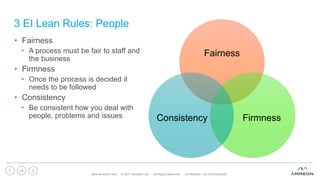
3 EI Lean Rules: People
• Fairness
• A process must be fair to staff and
the business
• Firmness
• Once the process is decided it
needs to be followed
• Consistency
• Be consistent how you deal with
people, problems and issues
Fairness
FirmnessConsistency
www.ammeon.com © 2017 Ammeon Ltd. All Rights Reserved. Confidential - Do Not Distribute.
23
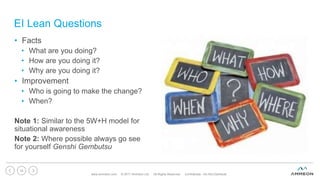
EI Lean Questions
• Facts
• What are you doing?
• How are you doing it?
• Why are you doing it?
• Improvement
• Who is going to make the change?
• When?
Note 1: Similar to the 5W+H model for
situational awareness
Note 2: Where possible always go see
for yourself Genshi Gembutsu
www.ammeon.com © 2017 Ammeon Ltd. All Rights Reserved. Confidential - Do Not Distribute.
24
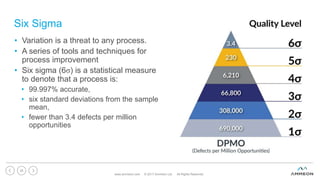
Six Sigma
• Variation is a threat to any process.
• A series of tools and techniques for
process improvement
• Six sigma (6σ) is a statistical measure
to denote that a process is:
• 99.997% accurate,
• six standard deviations from the sample
mean,
• fewer than 3.4 defects per million
opportunities
www.ammeon.com © 2017 Ammeon Ltd. All Rights Reserved.
25
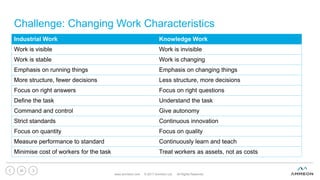
Challenge: Changing Work Characteristics
www.ammeon.com © 2017 Ammeon Ltd. All Rights Reserved.
26
Industrial Work Knowledge Work
Work is visible Work is invisible
Work is stable Work is changing
Emphasis on running things Emphasis on changing things
More structure, fewer decisions Less structure, more decisions
Focus on right answers Focus on right questions
Define the task Understand the task
Command and control Give autonomy
Strict standards Continuous innovation
Focus on quantity Focus on quality
Measure performance to standard Continuously learn and teach
Minimise cost of workers for the task Treat workers as assets, not as costs
Challenge: Rapidly Changing Customer Requirements
www.ammeon.com © 2017 Ammeon Ltd. All Rights Reserved.
27
Credit: Al Goerner [1]
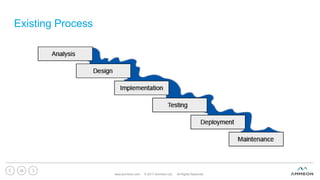
Existing Process
www.ammeon.com © 2017 Ammeon Ltd. All Rights Reserved.
28
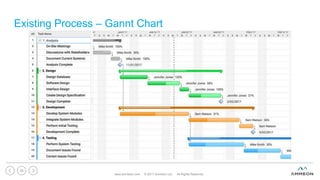
Existing Process – Gannt Chart
www.ammeon.com © 2017 Ammeon Ltd. All Rights Reserved.
29
Handoff
www.ammeon.com © 2017 Ammeon Ltd. All Rights Reserved.
30
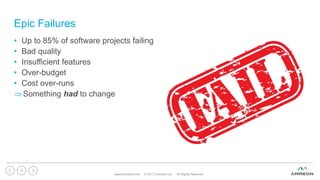
Epic Failures
• Up to 85% of software projects failing
• Bad quality
• Insufficient features
• Over-budget
• Cost over-runs
Something had to change
www.ammeon.com © 2017 Ammeon Ltd. All Rights Reserved.
31
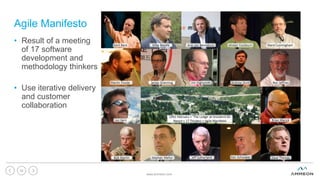
Agile Manifesto
www.ammeon.com
32
• Result of a meeting
of 17 software
development and
methodology thinkers
• Use iterative delivery
and customer
collaboration
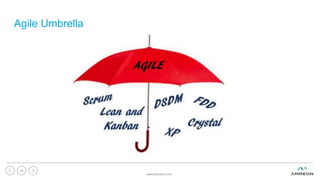
Agile Umbrella
www.ammeon.com
33
4 Values of Agile
We are uncovering better ways of developing software by doing it and helping
others do it. Through this work we have come to value:
• Individuals and interactions over processes and tools
• Working software over comprehensive documentation
• Customer collaboration over contract negotiation
• Responding to change over following a plan
That is, while there is value in the items on the right, we value the items on the
left more.
www.ammeon.com
34
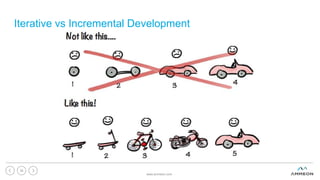
Iterative vs Incremental Development
www.ammeon.com
35
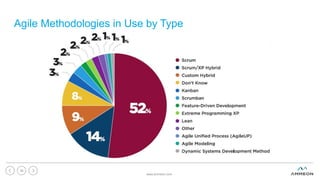
Agile Methodologies in Use by Type
www.ammeon.com
36
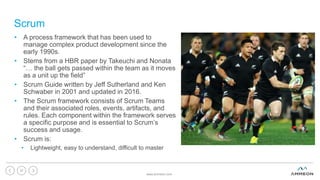
Scrum
• A process framework that has been used to
manage complex product development since the
early 1990s.
• Stems from a HBR paper by Takeuchi and Nonata
“… the ball gets passed within the team as it moves
as a unit up the field”
• Scrum Guide written by Jeff Sutherland and Ken
Schwaber in 2001 and updated in 2016.
• The Scrum framework consists of Scrum Teams
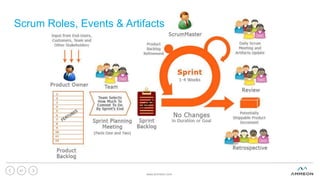
and their associated roles, events, artifacts, and
rules. Each component within the framework serves
a specific purpose and is essential to Scrum’s
success and usage.
• Scrum is:
• Lightweight, easy to understand, difficult to master
www.ammeon.com
37
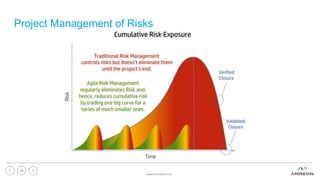
Project Management of Risks
www.ammeon.com
38
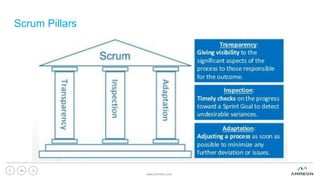
Scrum Pillars
www.ammeon.com
39
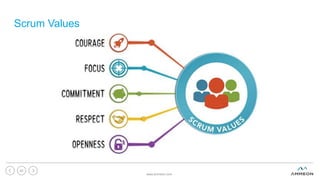
Scrum Values
www.ammeon.com
40
Scrum Roles, Events & Artifacts
www.ammeon.com
41
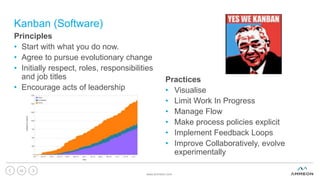
Kanban (Software)
Principles
• Start with what you do now.
• Agree to pursue evolutionary change
• Initially respect, roles, responsibilities
and job titles
• Encourage acts of leadership
www.ammeon.com
42
Practices
• Visualise
• Limit Work In Progress
• Manage Flow
• Make process policies explicit
• Implement Feedback Loops
• Improve Collaboratively, evolve
experimentally
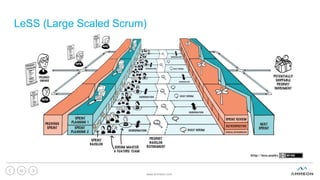
LeSS (Large Scaled Scrum)
www.ammeon.com
43
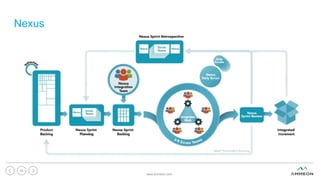
Nexus
www.ammeon.com
44
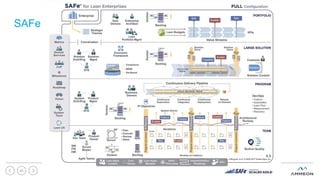
SAFe
www.ammeon.com
45
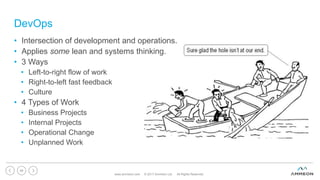
DevOps
• Intersection of development and operations.
• Applies some lean and systems thinking.
• 3 Ways
• Left-to-right flow of work
• Right-to-left fast feedback
• Culture
• 4 Types of Work
• Business Projects
• Internal Projects
• Operational Change
• Unplanned Work
www.ammeon.com © 2017 Ammeon Ltd. All Rights Reserved.
46
www.ammeon.com
47
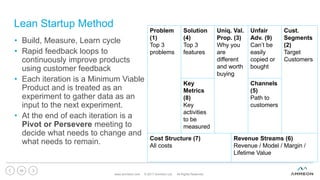
Lean Startup Method
• Build, Measure, Learn cycle
• Rapid feedback loops to
continuously improve products
using customer feedback
• Each iteration is a Minimum Viable
Product and is treated as an
experiment to gather data as an
input to the next experiment.
• At the end of each iteration is a
Pivot or Persevere meeting to
decide what needs to change and
what needs to remain.
www.ammeon.com © 2017 Ammeon Ltd. All Rights Reserved.
48
Problem
(1)
Top 3
problems
Solution
(4)
Top 3
features
Uniq. Val.
Prop. (3)
Why you
are
different
and worth
buying
Unfair
Adv. (9)
Can’t be
easily
copied or
bought
Cust.
Segments
(2)
Target
Customers
Key
Metrics
(8)
Key
activities
to be
measured
Channels
(5)
Path to
customers
Cost Structure (7)
All costs
Revenue Streams (6)
Revenue / Model / Margin /
Lifetime Value
Where Next For Agile
www.ammeon.com © 2017 Ammeon Ltd. All Rights Reserved.
49
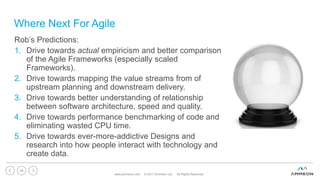
Rob’s Predictions:
1. Drive towards actual empiricism and better comparison
of the Agile Frameworks (especially scaled
Frameworks).
2. Drive towards mapping the value streams from of
upstream planning and downstream delivery.
3. Drive towards better understanding of relationship
between software architecture, speed and quality.
4. Drive towards performance benchmarking of code and
eliminating wasted CPU time.
5. Drive towards ever-more-addictive Designs and
research into how people interact with technology and
create data.
People
Fundamental Attribution Error
www.ammeon.com © 2017 Ammeon Ltd. All Rights Reserved.
51
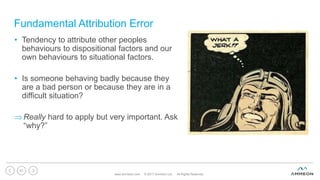
• Tendency to attribute other peoples
behaviours to dispositional factors and our
own behaviours to situational factors.
• Is someone behaving badly because they
are a bad person or because they are in a
difficult situation?
Really hard to apply but very important. Ask
“why?”
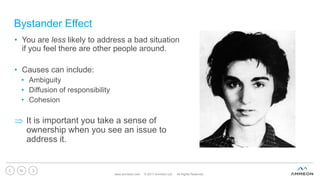
Bystander Effect
www.ammeon.com © 2017 Ammeon Ltd. All Rights Reserved.
52
• You are less likely to address a bad situation
if you feel there are other people around.
• Causes can include:
• Ambiguity
• Diffusion of responsibility
• Cohesion
 It is important you take a sense of
ownership when you see an issue to
address it.
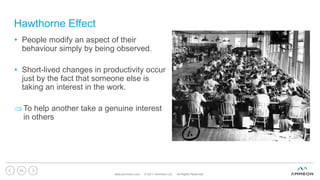
Hawthorne Effect
www.ammeon.com © 2017 Ammeon Ltd. All Rights Reserved.
53
• People modify an aspect of their
behaviour simply by being observed.
• Short-lived changes in productivity occur
just by the fact that someone else is
taking an interest in the work.
To help another take a genuine interest
in others
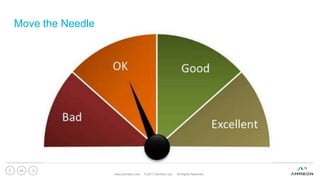
Move the Needle
www.ammeon.com © 2017 Ammeon Ltd. All Rights Reserved.
54
www.ammeon.com Ammeon@ammeon
Thank You
www.ammeon.com © 2017 Ammeon Ltd. All Rights Reserved.
55
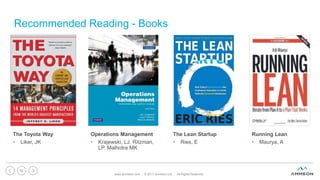
Recommended Reading - Books
The Toyota Way
• Liker, JK
Operations Management
• Krajewski, LJ. Ritzman,
LP. Malhotra MK
The Lean Startup
• Ries, E
Running Lean
• Maurya, A
www.ammeon.com © 2017 Ammeon Ltd. All Rights Reserved.
56
Recommended Reading - Books
The Goal
• Goldratt, EM. Cox, J
The Phoenix Project
• Kim, G. Behr, K.
Spafford G
www.ammeon.com © 2017 Ammeon Ltd. All Rights Reserved.
57
Thinking Fast & Slow
• Kahneman, D.
Scrum
• Sutherland J.
Sutherland J.J.
Recommended Reading - Books
Wealth of Nations
• Smith, A.
www.ammeon.com © 2017 Ammeon Ltd. All Rights Reserved.
58
The Decision Book
• Krogerus, M.
Tschappler, R.
Learning to See
• Rother, M. Shook, J.
Social Psychology
• Hogg, M. Vaughan, G
Meetup / Networking / Support Community
www.ammeon.com
59
Recommended Reading - Websites
• http://planet-lean.com/
• https://www.enterprise-ireland.com/en/Productivity/Lean-Business-Offer/
• https://www.wit.ie/research/centres_and_groups/research_groups/business/lean
_enterprise_excellence_group#tab=panel-team
• https://www.lean.org
• http://agilemanifesto.org/
www.ammeon.com © 2017 Ammeon Ltd. All Rights Reserved.
60

Continuous Improvement in Lean

  • 1.
  • 2.
    My Big HairyAudacious Goals for this Talk 1. Change the way some of you think about Technology www.ammeon.com © 2017 Ammeon Ltd. All Rights Reserved. 2 Technology “Give me a lever long enough and a fulcrum on which to place it, and I shall move the world.” - Archimedes
  • 3.
    My Big HairyAudacious Goals for this Talk 1. Change the way some of you think about Technology 2. Change the way some of you approach Lean Process Improvement www.ammeon.com © 2017 Ammeon Ltd. All Rights Reserved. 3 Process Technology “Give me a lever long enough and a fulcrum on which to place it, and I shall move the world.” - Archimedes
  • 4.
    My Big HairyAudacious Goals for this Talk 1. Change the way some of you think about Technology 2. Change the way some of you approach Lean Process Improvement 3. Change the way some of you treat other People www.ammeon.com © 2017 Ammeon Ltd. All Rights Reserved. 4 People Process Technology “Give me a lever long enough and a fulcrum on which to place it, and I shall move the world.” - Archimedes
  • 5.
  • 6.
    Rob Healy • 15years developing, documenting, testing and project managing software • Lean Six Sigma Certified • MBA, H. Dip Mgmt. B. Mech. Eng. • CSM, CPO • Founder member of the Agile Lean Ireland Society • Once organised an international photography competition to be displayed in Trafalgar Square, London www.ammeon.com © 2017 Ammeon Ltd. All Rights Reserved. 6
  • 7.
    In the beginning… www.ammeon.com© 2017 Ammeon Ltd. All Rights Reserved. 7 • Asked to develop a new process to reduce the wait times for varnishing Stira folding attic stairs. • Reduced the wait times for the vanish to dry from 9 hours to 2 minutes. It doesn’t have to do whatever it says on the tin There a lot of things more boring than watching paint dry.
  • 8.
    The curious thingabout painting www.ammeon.com © 2017 Ammeon Ltd. All Rights Reserved. 8 • It’s a really, really old technology (at least 35,000 years old). • It’s an incredibly efficient method of communication. One drawing can communicate with millions and be around for millennia • It can be used to: • record things that happened in the past • predict things that may yet happen in the future. • Painting, coatings, inks and dyes are a multi- billion dollar industry • Curious technological by-product: writing
  • 9.
    www.ammeon.com © 2017Ammeon Ltd. All Rights Reserved. 9 A word
  • 10.
    Writing www.ammeon.com © 2017Ammeon Ltd. All Rights Reserved. 10 • Writing is one of the most complicated technologies ever devised. • A standardised set of rules (spelling and grammar) of how to represent speech and thought. • Major accelerations in human development have corresponded with efficiencies in writing: • Lighter, cheaper substrates • Accelerated copying and printing • Accelerated distribution • Modern approaches for teaching and learning are built around writing.
  • 11.
    Deming – Godfatherof Lean www.ammeon.com © 2017 Ammeon Ltd. All Rights Reserved. 11 • Proponent of Statistical Quality Control – measuring and documenting systems with an aim of eliminating variation. • By adopting appropriate principles of quality management, organizations can increase quality and simultaneously reduce costs (by reducing waste, rework, staff attrition and litigation while increasing customer loyalty). • The key is to practice continual improvement and think of manufacturing as a system, not as bits and pieces.
  • 12.
  • 13.
    Pin Factory www.ammeon.com ©2017 Ammeon Ltd. All Rights Reserved. 13 • 1776 Adam Smith Wealth of Nations first moots “division of labour” • Before: • Pin factory employs 10 workers. • Each pin has 18 separate operations to produce it. • Each operator must be skilled in each operation. • Output: between 10 to 20 per person, per day. • After: • Separation of tasks to individual specialist workers. • Output: 48,000 pins per day.
  • 14.
    100 Years ofModern Lean www.ammeon.com © 2017 Ammeon Ltd. All Rights Reserved. 14 • 1911: Scientific Management – Fredrick Winslow Taylor. • 1911: Time & Motion studies – Frank & Lillian Gilbreth • 1915: Mass production – Henry Ford • 1936: Kaizen – Kiichiro Toyoda • 1936: Statistical Quality Control: W. Edwards Deming, Walter Shewhart • 1980: Just-in-time delivery – Taiichi Ohno • 1990: Toyota Production System – Daniel Roos, Daniel Jones, James Womack • 1995: Six sigma – Jack Welsh (Bill Smith 1985) • 2001: Agile Manifesto – Beck, Beedle et. al • 2009: DevOps – Patrick Dubois • 2011: Lean Startup – Eric Ries
  • 15.
    8 Wastes –TIM WOODS www.ammeon.com © 2017 Ammeon Ltd. All Rights Reserved. 15 Transport Inventory Motion Waiting Over-production Over-processing Defects Unused Skills
  • 16.
    5 Why’s Methodology •Root–cause analysis • Process is to ask “why” 5 times to understand the underlying process failure that needs to be improved. • Can be used with 6Ms (Ishikawa / Fishbone Diagram): • Man • Machine • Measurement • Method • Materials • Mother nature www.ammeon.com © 2017 Ammeon Ltd. All Rights Reserved. Confidential - Do Not Distribute. 16 1 6 FAILURE Method: Method: Measurement: Machine:Mother Nature: Materials:
  • 17.
    5S Methodology • LeanManufacturing Technique to use neatness / cleanliness as a form of process controls • Can be run as part of individual “Kaizen” events to identify waste and develop improved processes Sort Set in Order ShineStandardise Sustain www.ammeon.com © 2017 Ammeon Ltd. All Rights Reserved. Confidential - Do Not Distribute. 17
  • 18.
    5 Principles ofLean Thinking 1. Specify value from the standpoint of the end customer. 2. Identify all the steps in the value stream, eliminating whenever possible those steps that do not create value. 3. Make the value-creating steps occur in tight sequence so the product will flow smoothly toward the customer. 4. As flow is introduced, let customers pull value from the next upstream activity. 5. As value is specified, value streams are identified, wasted steps are removed, and flow and pull are introduced, begin the process again. www.ammeon.com © 2017 Ammeon Ltd. All Rights Reserved. 18
  • 19.
    Make the workflow: Value Stream Mapping www.ammeon.com © 2017 Ammeon Ltd. All Rights Reserved. 19 Material Flow Information Flow
  • 20.
    SIPOC – Template www.ammeon.com 20 CustomerOutputProcessInputSupplier WHOare your customers? WHAT does the customer receive? (Think of their CTQ’s) What are the HIGH LEVEL STEPS What are the inputs?Who PROVIDES the input? 1: 2: 3: S Supplier 1 Supplier 2 … Supplier N Process: {Name} Process Owner: {Real Person} Date: {start date}1 2A 34567 2B I P O C Process Trigger Process End Point 4: Input 1 Input 2 … Input N Input 1 Input 2 … Input N Customer 1 Customer 2 … Customer N
  • 21.
    Step 3: Fix Defects Example:Value Stream Mapping (before) www.ammeon.com 21 21 Step 1: Test the build Step 2: Report issues found Step 4: Receive fixed builds and verify issues Step 5: Close issue Test Log Fix Verify Close Total PT 4 mins 15 mins 120 mins 12 mins 5 mins 156 mins WT 0 mins 4469 mins 2644 mins 8054 mins 0 mins 15167 mins LT 4 mins 4484 mins 2796 mins 8066 mins 5 mins 15323 mins %Act 100% 0.3% 4.3% 0.1% 100% 1.0% %RFT 76.9% 63.2% 93.4% 97.0% 99.2% 42.7% Flow LT (mins) PT (mins) 4 4 15 120 12 5 4484 2796 8066 5 Tested English Build CustomerProject Manager
  • 22.
    3 EI LeanLevers • Time • How long does it take? • Money • How much does it cost? • What value is added / lost? • Effort • How difficult is it to do? • Is this the best use of someone’s time? Success! Efficient use of Time Efficient use of Effort Efficient use of Money www.ammeon.com © 2017 Ammeon Ltd. All Rights Reserved. Confidential - Do Not Distribute. 22
  • 23.
    3 EI LeanRules: People • Fairness • A process must be fair to staff and the business • Firmness • Once the process is decided it needs to be followed • Consistency • Be consistent how you deal with people, problems and issues Fairness FirmnessConsistency www.ammeon.com © 2017 Ammeon Ltd. All Rights Reserved. Confidential - Do Not Distribute. 23
  • 24.
    EI Lean Questions •Facts • What are you doing? • How are you doing it? • Why are you doing it? • Improvement • Who is going to make the change? • When? Note 1: Similar to the 5W+H model for situational awareness Note 2: Where possible always go see for yourself Genshi Gembutsu www.ammeon.com © 2017 Ammeon Ltd. All Rights Reserved. Confidential - Do Not Distribute. 24
  • 25.
    Six Sigma • Variationis a threat to any process. • A series of tools and techniques for process improvement • Six sigma (6σ) is a statistical measure to denote that a process is: • 99.997% accurate, • six standard deviations from the sample mean, • fewer than 3.4 defects per million opportunities www.ammeon.com © 2017 Ammeon Ltd. All Rights Reserved. 25
  • 26.
    Challenge: Changing WorkCharacteristics www.ammeon.com © 2017 Ammeon Ltd. All Rights Reserved. 26 Industrial Work Knowledge Work Work is visible Work is invisible Work is stable Work is changing Emphasis on running things Emphasis on changing things More structure, fewer decisions Less structure, more decisions Focus on right answers Focus on right questions Define the task Understand the task Command and control Give autonomy Strict standards Continuous innovation Focus on quantity Focus on quality Measure performance to standard Continuously learn and teach Minimise cost of workers for the task Treat workers as assets, not as costs
  • 27.
    Challenge: Rapidly ChangingCustomer Requirements www.ammeon.com © 2017 Ammeon Ltd. All Rights Reserved. 27 Credit: Al Goerner [1]
  • 28.
    Existing Process www.ammeon.com ©2017 Ammeon Ltd. All Rights Reserved. 28
  • 29.
    Existing Process –Gannt Chart www.ammeon.com © 2017 Ammeon Ltd. All Rights Reserved. 29
  • 30.
    Handoff www.ammeon.com © 2017Ammeon Ltd. All Rights Reserved. 30
  • 31.
    Epic Failures • Upto 85% of software projects failing • Bad quality • Insufficient features • Over-budget • Cost over-runs Something had to change www.ammeon.com © 2017 Ammeon Ltd. All Rights Reserved. 31
  • 32.
    Agile Manifesto www.ammeon.com 32 • Resultof a meeting of 17 software development and methodology thinkers • Use iterative delivery and customer collaboration
  • 33.
  • 34.
    4 Values ofAgile We are uncovering better ways of developing software by doing it and helping others do it. Through this work we have come to value: • Individuals and interactions over processes and tools • Working software over comprehensive documentation • Customer collaboration over contract negotiation • Responding to change over following a plan That is, while there is value in the items on the right, we value the items on the left more. www.ammeon.com 34
  • 35.
    Iterative vs IncrementalDevelopment www.ammeon.com 35
  • 36.
    Agile Methodologies inUse by Type www.ammeon.com 36
  • 37.
    Scrum • A processframework that has been used to manage complex product development since the early 1990s. • Stems from a HBR paper by Takeuchi and Nonata “… the ball gets passed within the team as it moves as a unit up the field” • Scrum Guide written by Jeff Sutherland and Ken Schwaber in 2001 and updated in 2016. • The Scrum framework consists of Scrum Teams and their associated roles, events, artifacts, and rules. Each component within the framework serves a specific purpose and is essential to Scrum’s success and usage. • Scrum is: • Lightweight, easy to understand, difficult to master www.ammeon.com 37
  • 38.
    Project Management ofRisks www.ammeon.com 38
  • 39.
  • 40.
  • 41.
    Scrum Roles, Events& Artifacts www.ammeon.com 41
  • 42.
    Kanban (Software) Principles • Startwith what you do now. • Agree to pursue evolutionary change • Initially respect, roles, responsibilities and job titles • Encourage acts of leadership www.ammeon.com 42 Practices • Visualise • Limit Work In Progress • Manage Flow • Make process policies explicit • Implement Feedback Loops • Improve Collaboratively, evolve experimentally
  • 43.
    LeSS (Large ScaledScrum) www.ammeon.com 43
  • 44.
  • 45.
  • 46.
    DevOps • Intersection ofdevelopment and operations. • Applies some lean and systems thinking. • 3 Ways • Left-to-right flow of work • Right-to-left fast feedback • Culture • 4 Types of Work • Business Projects • Internal Projects • Operational Change • Unplanned Work www.ammeon.com © 2017 Ammeon Ltd. All Rights Reserved. 46
  • 47.
  • 48.
    Lean Startup Method •Build, Measure, Learn cycle • Rapid feedback loops to continuously improve products using customer feedback • Each iteration is a Minimum Viable Product and is treated as an experiment to gather data as an input to the next experiment. • At the end of each iteration is a Pivot or Persevere meeting to decide what needs to change and what needs to remain. www.ammeon.com © 2017 Ammeon Ltd. All Rights Reserved. 48 Problem (1) Top 3 problems Solution (4) Top 3 features Uniq. Val. Prop. (3) Why you are different and worth buying Unfair Adv. (9) Can’t be easily copied or bought Cust. Segments (2) Target Customers Key Metrics (8) Key activities to be measured Channels (5) Path to customers Cost Structure (7) All costs Revenue Streams (6) Revenue / Model / Margin / Lifetime Value
  • 49.
    Where Next ForAgile www.ammeon.com © 2017 Ammeon Ltd. All Rights Reserved. 49 Rob’s Predictions: 1. Drive towards actual empiricism and better comparison of the Agile Frameworks (especially scaled Frameworks). 2. Drive towards mapping the value streams from of upstream planning and downstream delivery. 3. Drive towards better understanding of relationship between software architecture, speed and quality. 4. Drive towards performance benchmarking of code and eliminating wasted CPU time. 5. Drive towards ever-more-addictive Designs and research into how people interact with technology and create data.
  • 50.
  • 51.
    Fundamental Attribution Error www.ammeon.com© 2017 Ammeon Ltd. All Rights Reserved. 51 • Tendency to attribute other peoples behaviours to dispositional factors and our own behaviours to situational factors. • Is someone behaving badly because they are a bad person or because they are in a difficult situation? Really hard to apply but very important. Ask “why?”
  • 52.
    Bystander Effect www.ammeon.com ©2017 Ammeon Ltd. All Rights Reserved. 52 • You are less likely to address a bad situation if you feel there are other people around. • Causes can include: • Ambiguity • Diffusion of responsibility • Cohesion  It is important you take a sense of ownership when you see an issue to address it.
  • 53.
    Hawthorne Effect www.ammeon.com ©2017 Ammeon Ltd. All Rights Reserved. 53 • People modify an aspect of their behaviour simply by being observed. • Short-lived changes in productivity occur just by the fact that someone else is taking an interest in the work. To help another take a genuine interest in others
  • 54.
    Move the Needle www.ammeon.com© 2017 Ammeon Ltd. All Rights Reserved. 54
  • 55.
    www.ammeon.com Ammeon@ammeon Thank You www.ammeon.com© 2017 Ammeon Ltd. All Rights Reserved. 55
  • 56.
    Recommended Reading -Books The Toyota Way • Liker, JK Operations Management • Krajewski, LJ. Ritzman, LP. Malhotra MK The Lean Startup • Ries, E Running Lean • Maurya, A www.ammeon.com © 2017 Ammeon Ltd. All Rights Reserved. 56
  • 57.
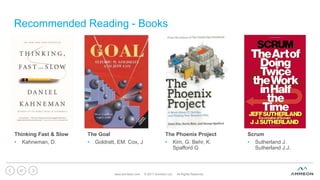
    Recommended Reading -Books The Goal • Goldratt, EM. Cox, J The Phoenix Project • Kim, G. Behr, K. Spafford G www.ammeon.com © 2017 Ammeon Ltd. All Rights Reserved. 57 Thinking Fast & Slow • Kahneman, D. Scrum • Sutherland J. Sutherland J.J.
  • 58.
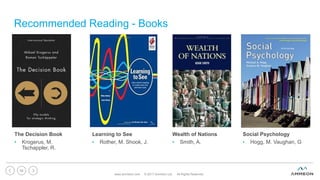
    Recommended Reading -Books Wealth of Nations • Smith, A. www.ammeon.com © 2017 Ammeon Ltd. All Rights Reserved. 58 The Decision Book • Krogerus, M. Tschappler, R. Learning to See • Rother, M. Shook, J. Social Psychology • Hogg, M. Vaughan, G
  • 59.
    Meetup / Networking/ Support Community www.ammeon.com 59
  • 60.
    Recommended Reading -Websites • http://planet-lean.com/ • https://www.enterprise-ireland.com/en/Productivity/Lean-Business-Offer/ • https://www.wit.ie/research/centres_and_groups/research_groups/business/lean _enterprise_excellence_group#tab=panel-team • https://www.lean.org • http://agilemanifesto.org/ www.ammeon.com © 2017 Ammeon Ltd. All Rights Reserved. 60