1
Lean-Insight.com
Lean Six Sigma
Black Belt Training
Part 2
Training Location: Bangalore / Bengaluru
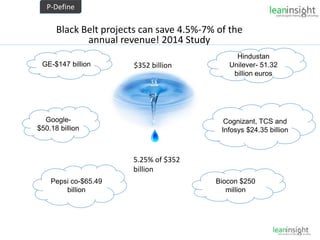
Black Belt projects can save 4.5%-7% of the
annual revenue! 2014 Study
GE-$147 billion
Hindustan
Unilever- 51.32
billion euros
Biocon $250
million
Google-
$50.18 billion
Pepsi co-$65.49
billion
Cognizant, TCS and
Infosys $24.35 billion
$352 billion
5.25% of $352
billion
P-Define
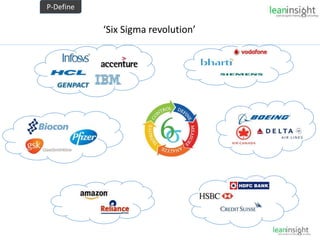
‘Six Sigma revolution’
P-Define
4
What is Six Sigma?
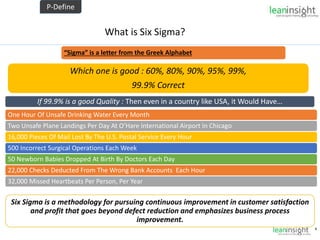
“Sigma” is a letter from the Greek Alphabet
One Hour Of Unsafe Drinking Water Every Month
Two Unsafe Plane Landings Per Day At O’Hare International Airport In Chicago
16,000 Pieces Of Mail Lost By The U.S. Postal Service Every Hour
500 Incorrect Surgical Operations Each Week
50 Newborn Babies Dropped At Birth By Doctors Each Day
22,000 Checks Deducted From The Wrong Bank Accounts Each Hour
32,000 Missed Heartbeats Per Person, Per Year
If 99.9% is a good Quality : Then even in a country like USA, it Would Have…
Which one is good : 60%, 80%, 90%, 95%, 99%,
99.9% Correct
Six Sigma is a methodology for pursuing continuous improvement in customer satisfaction
and profit that goes beyond defect reduction and emphasizes business process
improvement.
P-Define
5
What is Six Sigma?
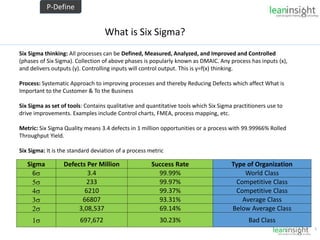
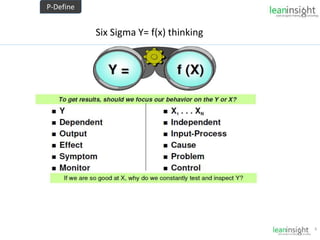
Six Sigma thinking: All processes can be Defined, Measured, Analyzed, and Improved and Controlled
(phases of Six Sigma). Collection of above phases is popularly known as DMAIC. Any process has inputs (x),
and delivers outputs (y). Controlling inputs will control output. This is y=f(x) thinking.
Process: Systematic Approach to improving processes and thereby Reducing Defects which affect What is
Important to the Customer & To the Business
Six Sigma as set of tools: Contains qualitative and quantitative tools which Six Sigma practitioners use to
drive improvements. Examples include Control charts, FMEA, process mapping, etc.
Metric: Six Sigma Quality means 3.4 defects in 1 million opportunities or a process with 99.99966% Rolled
Throughput Yield.
Six Sigma: It is the standard deviation of a process metric
Sigma Defects Per Million Success Rate Type of Organization
6s 3.4 99.99% World Class
5s 233 99.97% Competitive Class
4s 6210 99.37% Competitive Class
3s 66807 93.31% Average Class
2s 3,08,537 69.14% Below Average Class
1s 697,672 30.23% Bad Class
P-Define
6
Meaning of Six Sigma?
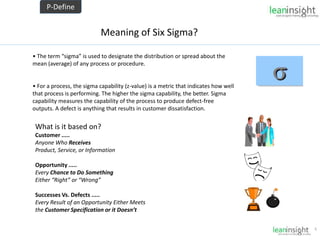
• The term “sigma” is used to designate the distribution or spread about the
mean (average) of any process or procedure.
• For a process, the sigma capability (z-value) is a metric that indicates how well
that process is performing. The higher the sigma capability, the better. Sigma
capability measures the capability of the process to produce defect-free
outputs. A defect is anything that results in customer dissatisfaction.
What is it based on?
Customer .....
Anyone Who Receives
Product, Service, or Information
Opportunity .....
Every Chance to Do Something
Either “Right” or “Wrong”
Successes Vs. Defects .....
Every Result of an Opportunity Either Meets
the Customer Specification or it Doesn’t
P-Define
7
Goal of Six Sigma & Strategy
•
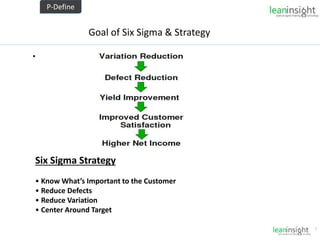
Six Sigma Strategy
• Know What’s Important to the Customer
• Reduce Defects
• Reduce Variation
• Center Around Target
P-Define
8
Six Sigma Y= f(x) thinking
•
P-Define
9
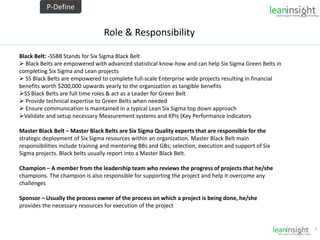
Role & Responsibility
Black Belt: -SSBB Stands for Six Sigma Black Belt
 Black Belts are empowered with advanced statistical know-how and can help Six Sigma Green Belts in
completing Six Sigma and Lean projects
 SS Black Belts are empowered to complete full-scale Enterprise wide projects resulting in financial
benefits worth $200,000 upwards yearly to the organization as tangible benefits
SS Black Belts are full time roles & act as a Leader for Green Belt
 Provide technical expertise to Green Belts when needed
 Ensure communication is maintained in a typical Lean Six Sigma top down approach
Validate and setup necessary Measurement systems and KPIs (Key Performance Indicators
Master Black Belt – Master Black Belts are Six Sigma Quality experts that are responsible for the
strategic deployment of Six Sigma resources within an organization. Master Black Belt main
responsibilities include training and mentoring BBs and GBs; selection, execution and support of Six
Sigma projects. Black belts usually report into a Master Black Belt.
Champion – A member from the leadership team who reviews the progress of projects that he/she
champions. The champion is also responsible for supporting the project and help it overcome any
challenges
Sponsor – Usually the process owner of the process on which a project is being done, he/she
provides the necessary resources for execution of the project
P-Define
10
Lean-Insight.com
If you are looking for Lean Six Sigma (Black Belt) training in Bangalore along with
certification visit:
http://lean-insight.com/six-sigma-training-bangalore/

Lean Six Sigma Black Belt Training Part 2

  • 1.
    1 Lean-Insight.com Lean Six Sigma BlackBelt Training Part 2 Training Location: Bangalore / Bengaluru
  • 2.
    Black Belt projectscan save 4.5%-7% of the annual revenue! 2014 Study GE-$147 billion Hindustan Unilever- 51.32 billion euros Biocon $250 million Google- $50.18 billion Pepsi co-$65.49 billion Cognizant, TCS and Infosys $24.35 billion $352 billion 5.25% of $352 billion P-Define
  • 3.
  • 4.
    4 What is SixSigma? “Sigma” is a letter from the Greek Alphabet One Hour Of Unsafe Drinking Water Every Month Two Unsafe Plane Landings Per Day At O’Hare International Airport In Chicago 16,000 Pieces Of Mail Lost By The U.S. Postal Service Every Hour 500 Incorrect Surgical Operations Each Week 50 Newborn Babies Dropped At Birth By Doctors Each Day 22,000 Checks Deducted From The Wrong Bank Accounts Each Hour 32,000 Missed Heartbeats Per Person, Per Year If 99.9% is a good Quality : Then even in a country like USA, it Would Have… Which one is good : 60%, 80%, 90%, 95%, 99%, 99.9% Correct Six Sigma is a methodology for pursuing continuous improvement in customer satisfaction and profit that goes beyond defect reduction and emphasizes business process improvement. P-Define
  • 5.
    5 What is SixSigma? Six Sigma thinking: All processes can be Defined, Measured, Analyzed, and Improved and Controlled (phases of Six Sigma). Collection of above phases is popularly known as DMAIC. Any process has inputs (x), and delivers outputs (y). Controlling inputs will control output. This is y=f(x) thinking. Process: Systematic Approach to improving processes and thereby Reducing Defects which affect What is Important to the Customer & To the Business Six Sigma as set of tools: Contains qualitative and quantitative tools which Six Sigma practitioners use to drive improvements. Examples include Control charts, FMEA, process mapping, etc. Metric: Six Sigma Quality means 3.4 defects in 1 million opportunities or a process with 99.99966% Rolled Throughput Yield. Six Sigma: It is the standard deviation of a process metric Sigma Defects Per Million Success Rate Type of Organization 6s 3.4 99.99% World Class 5s 233 99.97% Competitive Class 4s 6210 99.37% Competitive Class 3s 66807 93.31% Average Class 2s 3,08,537 69.14% Below Average Class 1s 697,672 30.23% Bad Class P-Define
  • 6.
    6 Meaning of SixSigma? • The term “sigma” is used to designate the distribution or spread about the mean (average) of any process or procedure. • For a process, the sigma capability (z-value) is a metric that indicates how well that process is performing. The higher the sigma capability, the better. Sigma capability measures the capability of the process to produce defect-free outputs. A defect is anything that results in customer dissatisfaction. What is it based on? Customer ..... Anyone Who Receives Product, Service, or Information Opportunity ..... Every Chance to Do Something Either “Right” or “Wrong” Successes Vs. Defects ..... Every Result of an Opportunity Either Meets the Customer Specification or it Doesn’t P-Define
  • 7.
    7 Goal of SixSigma & Strategy • Six Sigma Strategy • Know What’s Important to the Customer • Reduce Defects • Reduce Variation • Center Around Target P-Define
  • 8.
    8 Six Sigma Y=f(x) thinking • P-Define
  • 9.
    9 Role & Responsibility BlackBelt: -SSBB Stands for Six Sigma Black Belt  Black Belts are empowered with advanced statistical know-how and can help Six Sigma Green Belts in completing Six Sigma and Lean projects  SS Black Belts are empowered to complete full-scale Enterprise wide projects resulting in financial benefits worth $200,000 upwards yearly to the organization as tangible benefits SS Black Belts are full time roles & act as a Leader for Green Belt  Provide technical expertise to Green Belts when needed  Ensure communication is maintained in a typical Lean Six Sigma top down approach Validate and setup necessary Measurement systems and KPIs (Key Performance Indicators Master Black Belt – Master Black Belts are Six Sigma Quality experts that are responsible for the strategic deployment of Six Sigma resources within an organization. Master Black Belt main responsibilities include training and mentoring BBs and GBs; selection, execution and support of Six Sigma projects. Black belts usually report into a Master Black Belt. Champion – A member from the leadership team who reviews the progress of projects that he/she champions. The champion is also responsible for supporting the project and help it overcome any challenges Sponsor – Usually the process owner of the process on which a project is being done, he/she provides the necessary resources for execution of the project P-Define
  • 10.
    10 Lean-Insight.com If you arelooking for Lean Six Sigma (Black Belt) training in Bangalore along with certification visit: http://lean-insight.com/six-sigma-training-bangalore/