Six Sigma
 The often-used Six Sigma is a set of tools and
strategies for process improvement originally
developed by Motorola in 1985.
 Six Sigma became well known after Jack Welch
made it a central focus of his business strategy at
General Electric in 1995,and today it is used in
different sectors of industry.
 Six Sigma seeks to improve the quality of process
outputs by identifying and removing the causes of
defects (errors) and minimizing variability in
manufacturing and business processes.
 It uses a set of quality management methods,
including statistical methods, and creates a
special infrastructure of people within the
organization ("Champions", "Black Belts", "Green
Belts" etc.) who are experts in these very
complex methods.
 Each Six Sigma project carried out within an
organization follows a defined sequence of steps
and has quantified financial targets (cost
reduction and/or profit increase).
 The term Six Sigma originated from terminology
associated with manufacturing, specifically
terms associated with statistical modeling of
manufacturing processes.
 The maturity of a manufacturing process can be
described by a sigma rating indicating its yield or
the percentage of defect-free products it creates.
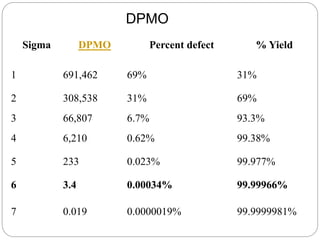
 A six sigma process is one in which 99.99966%
of the products manufactured are statistically
expected to be free of defects (3.4 defects per
million).
 Motorola set a goal of "six sigma" for all of its
manufacturing operations, and this goal became
a byword for the management and engineering
practices used to achieve it.
Six Sigma
 Continuous efforts to achieve stable and
predictable process results (i.e., reduce process
variation) are of vital importance to business
success.
 Manufacturing and business processes have
characteristics that can be measured, analyzed,
controlled and improved.
Features
 A clear focus on achieving measurable and
quantifiable financial returns from any Six Sigma
project.[5]
 An increased emphasis on strong and passionate
management leadership and support.[5]
 A special infrastructure of "Champions", "Master
Black Belts", "Black Belts", "Green Belts", etc. to
lead and implement the Six Sigma approach.[5]
 A clear commitment to making decisions on the
basis of verifiable data and statistical methods,
rather than assumptions and guesswork.[5]
Lean Six Sigma
 In recent years, some practitioners have
combined Six Sigma ideas with lean
manufacturing to create a methodology named
Lean Six Sigma.
 The Lean Six Sigma methodology views lean
manufacturing, which addresses process flow
and waste issues, and Six Sigma, with its focus
on variation and design, as complementary
disciplines aimed at promoting "business and
operational excellence".
Sigma DPMO Percent defect % Yield
1 691,462 69% 31%
2 308,538 31% 69%
3 66,807 6.7% 93.3%
4 6,210 0.62% 99.38%
5 233 0.023% 99.977%
6 3.4 0.00034% 99.99966%
7 0.019 0.0000019% 99.9999981%
DPMO
Methods
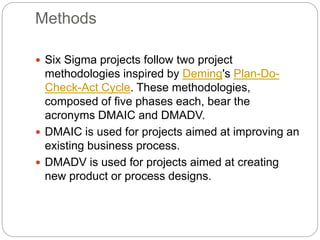
 Six Sigma projects follow two project
methodologies inspired by Deming's Plan-Do-
Check-Act Cycle. These methodologies,
composed of five phases each, bear the
acronyms DMAIC and DMADV.
 DMAIC is used for projects aimed at improving an
existing business process.
 DMADV is used for projects aimed at creating
new product or process designs.
DMAIC
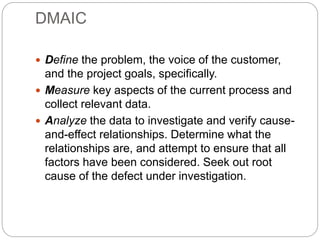
 Define the problem, the voice of the customer,
and the project goals, specifically.
 Measure key aspects of the current process and
collect relevant data.
 Analyze the data to investigate and verify cause-
and-effect relationships. Determine what the
relationships are, and attempt to ensure that all
factors have been considered. Seek out root
cause of the defect under investigation.
DMAIC
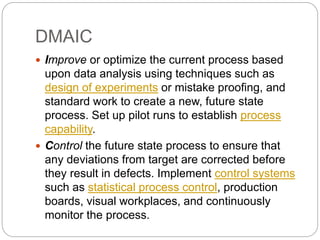
 Improve or optimize the current process based
upon data analysis using techniques such as
design of experiments or mistake proofing, and
standard work to create a new, future state
process. Set up pilot runs to establish process
capability.
 Control the future state process to ensure that
any deviations from target are corrected before
they result in defects. Implement control systems
such as statistical process control, production
boards, visual workplaces, and continuously
monitor the process.
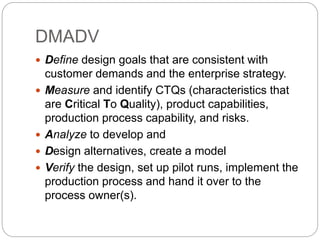
DMADV
 Define design goals that are consistent with
customer demands and the enterprise strategy.
 Measure and identify CTQs (characteristics that
are Critical To Quality), product capabilities,
production process capability, and risks.
 Analyze to develop and
 Design alternatives, create a model
 Verify the design, set up pilot runs, implement the
production process and hand it over to the
process owner(s).
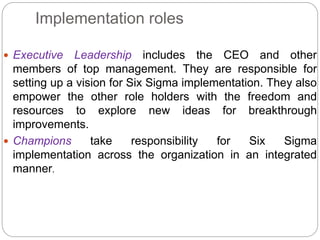
Implementation roles
 Executive Leadership includes the CEO and other
members of top management. They are responsible for
setting up a vision for Six Sigma implementation. They also
empower the other role holders with the freedom and
resources to explore new ideas for breakthrough
improvements.
 Champions take responsibility for Six Sigma
implementation across the organization in an integrated
manner.
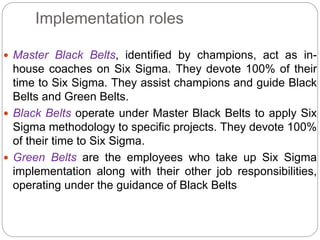
Implementation roles
 Master Black Belts, identified by champions, act as in-
house coaches on Six Sigma. They devote 100% of their
time to Six Sigma. They assist champions and guide Black
Belts and Green Belts.
 Black Belts operate under Master Black Belts to apply Six
Sigma methodology to specific projects. They devote 100%
of their time to Six Sigma.
 Green Belts are the employees who take up Six Sigma
implementation along with their other job responsibilities,
operating under the guidance of Black Belts
Application
 IBM
 GE
 MOTOROLA

six sigma in supply chain management

  • 1.
  • 2.
     The often-usedSix Sigma is a set of tools and strategies for process improvement originally developed by Motorola in 1985.  Six Sigma became well known after Jack Welch made it a central focus of his business strategy at General Electric in 1995,and today it is used in different sectors of industry.
  • 3.
     Six Sigmaseeks to improve the quality of process outputs by identifying and removing the causes of defects (errors) and minimizing variability in manufacturing and business processes.  It uses a set of quality management methods, including statistical methods, and creates a special infrastructure of people within the organization ("Champions", "Black Belts", "Green Belts" etc.) who are experts in these very complex methods.
  • 4.
     Each SixSigma project carried out within an organization follows a defined sequence of steps and has quantified financial targets (cost reduction and/or profit increase).  The term Six Sigma originated from terminology associated with manufacturing, specifically terms associated with statistical modeling of manufacturing processes.  The maturity of a manufacturing process can be described by a sigma rating indicating its yield or the percentage of defect-free products it creates.
  • 5.
     A sixsigma process is one in which 99.99966% of the products manufactured are statistically expected to be free of defects (3.4 defects per million).  Motorola set a goal of "six sigma" for all of its manufacturing operations, and this goal became a byword for the management and engineering practices used to achieve it.
  • 6.
    Six Sigma  Continuousefforts to achieve stable and predictable process results (i.e., reduce process variation) are of vital importance to business success.  Manufacturing and business processes have characteristics that can be measured, analyzed, controlled and improved.
  • 7.
    Features  A clearfocus on achieving measurable and quantifiable financial returns from any Six Sigma project.[5]  An increased emphasis on strong and passionate management leadership and support.[5]  A special infrastructure of "Champions", "Master Black Belts", "Black Belts", "Green Belts", etc. to lead and implement the Six Sigma approach.[5]  A clear commitment to making decisions on the basis of verifiable data and statistical methods, rather than assumptions and guesswork.[5]
  • 8.
    Lean Six Sigma In recent years, some practitioners have combined Six Sigma ideas with lean manufacturing to create a methodology named Lean Six Sigma.  The Lean Six Sigma methodology views lean manufacturing, which addresses process flow and waste issues, and Six Sigma, with its focus on variation and design, as complementary disciplines aimed at promoting "business and operational excellence".
  • 9.
    Sigma DPMO Percentdefect % Yield 1 691,462 69% 31% 2 308,538 31% 69% 3 66,807 6.7% 93.3% 4 6,210 0.62% 99.38% 5 233 0.023% 99.977% 6 3.4 0.00034% 99.99966% 7 0.019 0.0000019% 99.9999981% DPMO
  • 10.
    Methods  Six Sigmaprojects follow two project methodologies inspired by Deming's Plan-Do- Check-Act Cycle. These methodologies, composed of five phases each, bear the acronyms DMAIC and DMADV.  DMAIC is used for projects aimed at improving an existing business process.  DMADV is used for projects aimed at creating new product or process designs.
  • 11.
    DMAIC  Define theproblem, the voice of the customer, and the project goals, specifically.  Measure key aspects of the current process and collect relevant data.  Analyze the data to investigate and verify cause- and-effect relationships. Determine what the relationships are, and attempt to ensure that all factors have been considered. Seek out root cause of the defect under investigation.
  • 12.
    DMAIC  Improve oroptimize the current process based upon data analysis using techniques such as design of experiments or mistake proofing, and standard work to create a new, future state process. Set up pilot runs to establish process capability.  Control the future state process to ensure that any deviations from target are corrected before they result in defects. Implement control systems such as statistical process control, production boards, visual workplaces, and continuously monitor the process.
  • 13.
    DMADV  Define designgoals that are consistent with customer demands and the enterprise strategy.  Measure and identify CTQs (characteristics that are Critical To Quality), product capabilities, production process capability, and risks.  Analyze to develop and  Design alternatives, create a model  Verify the design, set up pilot runs, implement the production process and hand it over to the process owner(s).
  • 14.
    Implementation roles  ExecutiveLeadership includes the CEO and other members of top management. They are responsible for setting up a vision for Six Sigma implementation. They also empower the other role holders with the freedom and resources to explore new ideas for breakthrough improvements.  Champions take responsibility for Six Sigma implementation across the organization in an integrated manner.
  • 15.
    Implementation roles  MasterBlack Belts, identified by champions, act as in- house coaches on Six Sigma. They devote 100% of their time to Six Sigma. They assist champions and guide Black Belts and Green Belts.  Black Belts operate under Master Black Belts to apply Six Sigma methodology to specific projects. They devote 100% of their time to Six Sigma.  Green Belts are the employees who take up Six Sigma implementation along with their other job responsibilities, operating under the guidance of Black Belts
  • 16.