1
Lean-Insight.com
Lean Six Sigma Training
Part 14
Training Centers: Bangalore, Chennai and Hyderabad
2
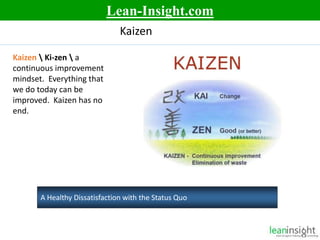
Kaizen  Ki-zen  a
continuous improvement
mindset. Everything that
we do today can be
improved. Kaizen has no
end.
A Healthy Dissatisfaction with the Status Quo
Kaizen
Lean-Insight.com
3
Kaizen – Continual Improvement
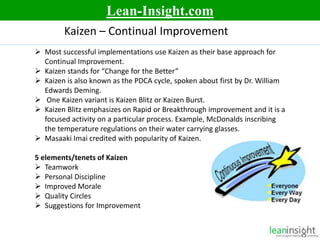
 Most successful implementations use Kaizen as their base approach for
Continual Improvement.
 Kaizen stands for “Change for the Better”
 Kaizen is also known as the PDCA cycle, spoken about first by Dr. William
Edwards Deming.
 One Kaizen variant is Kaizen Blitz or Kaizen Burst.
 Kaizen Blitz emphasizes on Rapid or Breakthrough improvement and it is a
focused activity on a particular process. Example, McDonalds inscribing
the temperature regulations on their water carrying glasses.
 Masaaki Imai credited with popularity of Kaizen.
5 elements/tenets of Kaizen
 Teamwork
 Personal Discipline
 Improved Morale
 Quality Circles
 Suggestions for Improvement
Lean-Insight.com
4
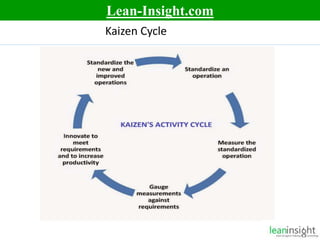
Kaizen Cycle
Lean-Insight.com
5
Kaizen & Kaizen Blitz
Kaizen is a Japanese term made famous by Massaki Imai in his book Kaizen: The
key to Japan’s competitive success(1986) It refers to a mind-set in which all
employee are responsible for making continuous incremental improvements to
the functions they perform. The aggregate effect of this approach is the cost
effective and practical improvements that have instant buy-in by those who use
them.
Kaizen is an approach to process and enterprise management that
recognizes the importance of each employee creative ability & interest in
continuous improvement. Barrier includes adversarial attitude & feeling that “its
not my job to make my job better”. In some situation this may be overcome by
demonstrating successful kaizen blitz events.
A Kaizen Blitz is performed by a team in a short amount of time, usually a few
days. The Team focuses on a specific work area with the intent of making low
cost improvement that are easy to implement & are often installed during the
Blitz.
Lean-Insight.com
6
Kaizen & Kaizen Blitz (contin..)
The Team should consist of people from the work area, others from similar work
areas, technical support, supervisory personnel with decision making
responsibilities, and outsiders who can see with “ Fresh Eyes”.
The Blitz begin with some training & team building activities and quickly proceeds
to the work area where each function is observed & explained in detail. A side
benefit of blitz events is that employees begin to see that their input is valuable &
valued, which may lead to more support for the incremental kaizen mindset.
The term Kaizen is used to describe the gradual but continuous improvement
process that extends overtime. It has been found to improve processes, products &
morale.
Kaizen Blitz describes a short term event design to make quick & easy
improvement & set the stage for the mindset require for the long term Kaizen
approach.
Lean-Insight.com
7
Mistake proofing (POKA YOKE)
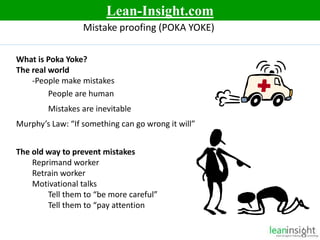
What is Poka Yoke?
The real world
-People make mistakes
People are human
Mistakes are inevitable
Murphy’s Law: “If something can go wrong it will”
The old way to prevent mistakes
Reprimand worker
Retrain worker
Motivational talks
Tell them to “be more careful”
Tell them to “pay attention
Lean-Insight.com
8
Mistake proofing (POKA YOKE) Conti.
A better way to prevent mistakes
Remove the opportunity for error
Improve the process
Make wrong actions more difficult
If you can’t remove the opportunity for error
Make it easier to discover the errors that do occur
Shigeo Shingo invented the Japanese concept called Poka-Yoke (pronounced
POH-kah YOH-kay) Poka-Yoke means to mistake proof the process
The essential idea of poka-yoke is to design
your process so that mistakes are impossible
or at least easily detected and corrected
Lean-Insight.com
9
• SPC (Statistical Process Control)
• SPC is the use of control charts with statistically derived response limits.
• It is better than inspection in that it provides insights into trends and
process variation.
• SPC’s effectiveness is lessened when management will not empower
workers to stop for investigation.
• Effective SPC requires proper training in how to interpret and act on the
charted information. Else, we are just creating wallpaper.
• Inspection
• Inspection is never perfect in that some defects go undetected and slip
through.
Mistake Proofing – SPC & Inspection
Lean-Insight.com
10
Mistake proofing (First Poka-Yoke Device)
Shingo suggested a solution that became the first Poka-Yoke
device
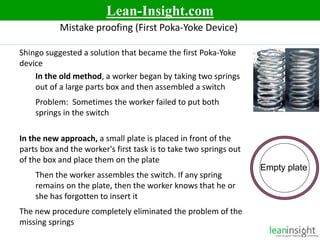
In the old method, a worker began by taking two springs
out of a large parts box and then assembled a switch
Problem: Sometimes the worker failed to put both
springs in the switch
In the new approach, a small plate is placed in front of the
parts box and the worker's first task is to take two springs out
of the box and place them on the plate
Then the worker assembles the switch. If any spring
remains on the plate, then the worker knows that he or
she has forgotten to insert it
The new procedure completely eliminated the problem of the
missing springs
Empty plate
Lean-Insight.com
11
Mistake proofing (Categories of Poka-Yoke)
Poka-yoke devices fall into two major categories:
Prevention
Detection
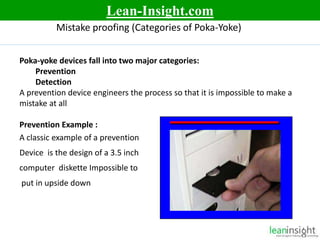
A prevention device engineers the process so that it is impossible to make a
mistake at all
Prevention Example :
A classic example of a prevention
Device is the design of a 3.5 inch
computer diskette Impossible to
put in upside down
Lean-Insight.com
12
Lean-Insight.com
If you are looking for Six Sigma Course training in Bangalore along with certification
visit:
http://lean-insight.com/six-sigma-training-bangalore/

Lean Six Sigma Course Training Part 14

  • 1.
    1 Lean-Insight.com Lean Six SigmaTraining Part 14 Training Centers: Bangalore, Chennai and Hyderabad
  • 2.
    2 Kaizen Ki-zen a continuous improvement mindset. Everything that we do today can be improved. Kaizen has no end. A Healthy Dissatisfaction with the Status Quo Kaizen Lean-Insight.com
  • 3.
    3 Kaizen – ContinualImprovement  Most successful implementations use Kaizen as their base approach for Continual Improvement.  Kaizen stands for “Change for the Better”  Kaizen is also known as the PDCA cycle, spoken about first by Dr. William Edwards Deming.  One Kaizen variant is Kaizen Blitz or Kaizen Burst.  Kaizen Blitz emphasizes on Rapid or Breakthrough improvement and it is a focused activity on a particular process. Example, McDonalds inscribing the temperature regulations on their water carrying glasses.  Masaaki Imai credited with popularity of Kaizen. 5 elements/tenets of Kaizen  Teamwork  Personal Discipline  Improved Morale  Quality Circles  Suggestions for Improvement Lean-Insight.com
  • 4.
  • 5.
    5 Kaizen & KaizenBlitz Kaizen is a Japanese term made famous by Massaki Imai in his book Kaizen: The key to Japan’s competitive success(1986) It refers to a mind-set in which all employee are responsible for making continuous incremental improvements to the functions they perform. The aggregate effect of this approach is the cost effective and practical improvements that have instant buy-in by those who use them. Kaizen is an approach to process and enterprise management that recognizes the importance of each employee creative ability & interest in continuous improvement. Barrier includes adversarial attitude & feeling that “its not my job to make my job better”. In some situation this may be overcome by demonstrating successful kaizen blitz events. A Kaizen Blitz is performed by a team in a short amount of time, usually a few days. The Team focuses on a specific work area with the intent of making low cost improvement that are easy to implement & are often installed during the Blitz. Lean-Insight.com
  • 6.
    6 Kaizen & KaizenBlitz (contin..) The Team should consist of people from the work area, others from similar work areas, technical support, supervisory personnel with decision making responsibilities, and outsiders who can see with “ Fresh Eyes”. The Blitz begin with some training & team building activities and quickly proceeds to the work area where each function is observed & explained in detail. A side benefit of blitz events is that employees begin to see that their input is valuable & valued, which may lead to more support for the incremental kaizen mindset. The term Kaizen is used to describe the gradual but continuous improvement process that extends overtime. It has been found to improve processes, products & morale. Kaizen Blitz describes a short term event design to make quick & easy improvement & set the stage for the mindset require for the long term Kaizen approach. Lean-Insight.com
  • 7.
    7 Mistake proofing (POKAYOKE) What is Poka Yoke? The real world -People make mistakes People are human Mistakes are inevitable Murphy’s Law: “If something can go wrong it will” The old way to prevent mistakes Reprimand worker Retrain worker Motivational talks Tell them to “be more careful” Tell them to “pay attention Lean-Insight.com
  • 8.
    8 Mistake proofing (POKAYOKE) Conti. A better way to prevent mistakes Remove the opportunity for error Improve the process Make wrong actions more difficult If you can’t remove the opportunity for error Make it easier to discover the errors that do occur Shigeo Shingo invented the Japanese concept called Poka-Yoke (pronounced POH-kah YOH-kay) Poka-Yoke means to mistake proof the process The essential idea of poka-yoke is to design your process so that mistakes are impossible or at least easily detected and corrected Lean-Insight.com
  • 9.
    9 • SPC (StatisticalProcess Control) • SPC is the use of control charts with statistically derived response limits. • It is better than inspection in that it provides insights into trends and process variation. • SPC’s effectiveness is lessened when management will not empower workers to stop for investigation. • Effective SPC requires proper training in how to interpret and act on the charted information. Else, we are just creating wallpaper. • Inspection • Inspection is never perfect in that some defects go undetected and slip through. Mistake Proofing – SPC & Inspection Lean-Insight.com
  • 10.
    10 Mistake proofing (FirstPoka-Yoke Device) Shingo suggested a solution that became the first Poka-Yoke device In the old method, a worker began by taking two springs out of a large parts box and then assembled a switch Problem: Sometimes the worker failed to put both springs in the switch In the new approach, a small plate is placed in front of the parts box and the worker's first task is to take two springs out of the box and place them on the plate Then the worker assembles the switch. If any spring remains on the plate, then the worker knows that he or she has forgotten to insert it The new procedure completely eliminated the problem of the missing springs Empty plate Lean-Insight.com
  • 11.
    11 Mistake proofing (Categoriesof Poka-Yoke) Poka-yoke devices fall into two major categories: Prevention Detection A prevention device engineers the process so that it is impossible to make a mistake at all Prevention Example : A classic example of a prevention Device is the design of a 3.5 inch computer diskette Impossible to put in upside down Lean-Insight.com
  • 12.
    12 Lean-Insight.com If you arelooking for Six Sigma Course training in Bangalore along with certification visit: http://lean-insight.com/six-sigma-training-bangalore/