Six Sigma
By
Cathy Hiatt
Boise State University
October 9, 2001
Overview:
• Six Sigma Defined
• The Statistical Tools of Six Sigma
• The Components of Six Sigma
• Corporations practicing Six Sigma
and a specific success story
• An exercise opportunity
• Summary
Six Sigma Defined:
 Quality management program developed by
Motorola in the 1980s.
 Management philosophy focused on business
process improvements to:
• Eliminate waste, rework, and mistakes
• Increase customer satisfaction
• Increase profitability and competitiveness
 Statistical measure to objectively evaluate
processes.
GOAL: Reach Six Sigma Quality
Six Sigma
List some ways this program can be
used in your organization.
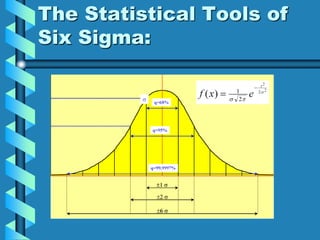
The Statistical Tools of
Six Sigma:
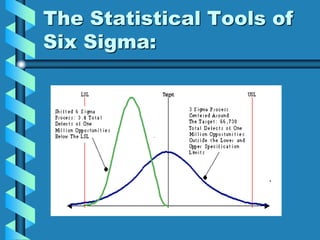
The Statistical Tools of
Six Sigma:
The Statistical Tools of
Six Sigma
Another way to look at it:
1. Clearly define the customer’s explicit
requirements--CTQ
2. Count the number of defects that occur.
3. Determine the yield-- percentage of items
without defects.
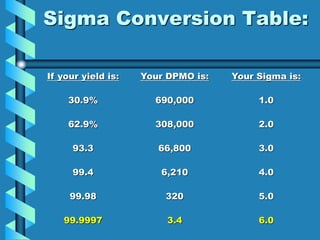
4. Use the conversion chart to determine
DPMO and Sigma.
Sigma Conversion Table:
If your yield is: Your DPMO is: Your Sigma is:
30.9% 690,000 1.0
62.9% 308,000 2.0
93.3 66,800 3.0
99.4 6,210 4.0
99.98 320 5.0
99.9997 3.4 6.0
The Components of Six
Sigma:
• People Power
• Process Power
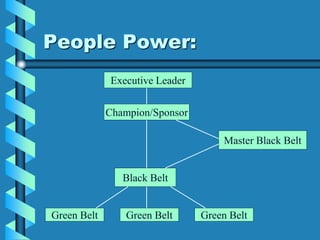
People Power:
Executive Leader
Champion/Sponsor
Master Black Belt
Black Belt
Green Belt Green Belt Green Belt
Executive Leader Roles:
• High Level Executive committed to
Six Sigma Success
• Knowledgeable in Six Sigma Process
• Assign key individuals to the
Champion/Sponsor Position.
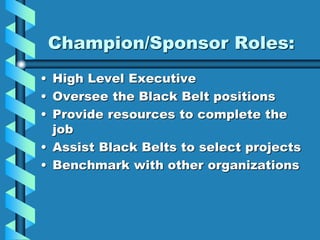
Champion/Sponsor Roles:
• High Level Executive
• Oversee the Black Belt positions
• Provide resources to complete the
job
• Assist Black Belts to select projects
• Benchmark with other organizations
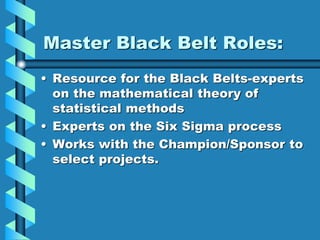
Master Black Belt Roles:
• Resource for the Black Belts-experts
on the mathematical theory of
statistical methods
• Experts on the Six Sigma process
• Works with the Champion/Sponsor to
select projects.
Black Belt Roles:
• Leaders of the Six Sigma process
• Management and technical skills
• Bring the project vision to reality
• Solely dedicated to Six Sigma
Program
• Oversee Green Belts
Green Belt Roles:
• Project Leaders
• Support the Black Belt to complete
the project
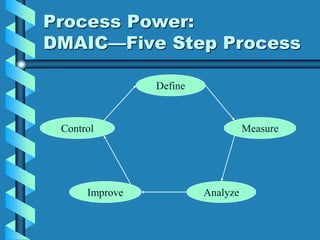
Process Power:
DMAIC—Five Step Process
Define
Measure
Analyze
Improve
Control
Define:
• Clearly identify the problem
• Utilize numerical definition
• Focus on process that creates the
problem not on the outcome
Measure:
• Benchmark
• Capability of a given process
• Focus on CTQ
Analyze:
• Current process results
• What is possible compared to what
the competition is doing
Improve:
• Implement changes
• Be creative to find new ways to do
things better, cheaper, or faster
Control:
• Lock in successes
• Implement measures to keep
variables within the new operating
limits
Corporations Practicing
Six Sigma:
• General Electric
• Motorola
• Allied Signal
• Sony
• Polaroid
Specific Success Story:
GE
• 1995 Operating margin—13.5%
• 1998 Operating margin—16.7%
• Result: $600million bonus
“The most important initiative GE
has ever undertaken”
--Jack Welch, CEO General Electric
Exercise
You have just completed all your training sessions
for the valued Black Belt role. Currently your
organization is operating at a 2 sigma level and your
Champion wants this to improve using the Six
Sigma process. It seems that although production
is high, the defect levels are too high for the
production of your leading line of products, Sticky
Buns. This has significantly cut into profits almost
to the point of dropping the line. Customer surveys
indicate there is a demand for Sticky Buns so you
are handed the challenging task of improving this
process using the Six Sigma DMAIC approach.
Summary:
• Management philosophy of quality
• Statistical target of six sigma or 3.4
defects in one million opportunities
• Components of Six Sigma are people power
and process power
– Executive Leader, Champion, Master
Black Belt, Black Belt, and Green Belt
– Define, Measure, Analyze, Improve,
Control
• Customer focus
Bibliography
• Chowdhury, S. The Power of Six Sigma. Chicago: Dearborn
Trade, 2001
• Pande, P. S., Neuman, R. P., Cavanaugh, R. R. The Six Sigma Way
How GE, Motorola, and Other Top Companies Are Honing Their
Performance. New York: McGraw-Hill, 2000
• Normal Distribution Bell Curve:
Six Sigma IT Concepts Kurt Haubner HomePage:
http://www.sixsigma.de/english/images/sixsigma/gauss_kurve.gif
• Six Sigma Process Graph:
http://www.isixsigma.com/me/six_sigma/

Six Sigma.ppt

  • 1.
    Six Sigma By Cathy Hiatt BoiseState University October 9, 2001
  • 2.
    Overview: • Six SigmaDefined • The Statistical Tools of Six Sigma • The Components of Six Sigma • Corporations practicing Six Sigma and a specific success story • An exercise opportunity • Summary
  • 3.
    Six Sigma Defined: Quality management program developed by Motorola in the 1980s.  Management philosophy focused on business process improvements to: • Eliminate waste, rework, and mistakes • Increase customer satisfaction • Increase profitability and competitiveness  Statistical measure to objectively evaluate processes. GOAL: Reach Six Sigma Quality
  • 4.
    Six Sigma List someways this program can be used in your organization.
  • 5.
    The Statistical Toolsof Six Sigma:
  • 6.
    The Statistical Toolsof Six Sigma:
  • 7.
    The Statistical Toolsof Six Sigma Another way to look at it: 1. Clearly define the customer’s explicit requirements--CTQ 2. Count the number of defects that occur. 3. Determine the yield-- percentage of items without defects. 4. Use the conversion chart to determine DPMO and Sigma.
  • 8.
    Sigma Conversion Table: Ifyour yield is: Your DPMO is: Your Sigma is: 30.9% 690,000 1.0 62.9% 308,000 2.0 93.3 66,800 3.0 99.4 6,210 4.0 99.98 320 5.0 99.9997 3.4 6.0
  • 9.
    The Components ofSix Sigma: • People Power • Process Power
  • 10.
    People Power: Executive Leader Champion/Sponsor MasterBlack Belt Black Belt Green Belt Green Belt Green Belt
  • 11.
    Executive Leader Roles: •High Level Executive committed to Six Sigma Success • Knowledgeable in Six Sigma Process • Assign key individuals to the Champion/Sponsor Position.
  • 12.
    Champion/Sponsor Roles: • HighLevel Executive • Oversee the Black Belt positions • Provide resources to complete the job • Assist Black Belts to select projects • Benchmark with other organizations
  • 13.
    Master Black BeltRoles: • Resource for the Black Belts-experts on the mathematical theory of statistical methods • Experts on the Six Sigma process • Works with the Champion/Sponsor to select projects.
  • 14.
    Black Belt Roles: •Leaders of the Six Sigma process • Management and technical skills • Bring the project vision to reality • Solely dedicated to Six Sigma Program • Oversee Green Belts
  • 15.
    Green Belt Roles: •Project Leaders • Support the Black Belt to complete the project
  • 16.
    Process Power: DMAIC—Five StepProcess Define Measure Analyze Improve Control
  • 17.
    Define: • Clearly identifythe problem • Utilize numerical definition • Focus on process that creates the problem not on the outcome
  • 18.
    Measure: • Benchmark • Capabilityof a given process • Focus on CTQ
  • 19.
    Analyze: • Current processresults • What is possible compared to what the competition is doing
  • 20.
    Improve: • Implement changes •Be creative to find new ways to do things better, cheaper, or faster
  • 21.
    Control: • Lock insuccesses • Implement measures to keep variables within the new operating limits
  • 22.
    Corporations Practicing Six Sigma: •General Electric • Motorola • Allied Signal • Sony • Polaroid
  • 23.
    Specific Success Story: GE •1995 Operating margin—13.5% • 1998 Operating margin—16.7% • Result: $600million bonus “The most important initiative GE has ever undertaken” --Jack Welch, CEO General Electric
  • 24.
    Exercise You have justcompleted all your training sessions for the valued Black Belt role. Currently your organization is operating at a 2 sigma level and your Champion wants this to improve using the Six Sigma process. It seems that although production is high, the defect levels are too high for the production of your leading line of products, Sticky Buns. This has significantly cut into profits almost to the point of dropping the line. Customer surveys indicate there is a demand for Sticky Buns so you are handed the challenging task of improving this process using the Six Sigma DMAIC approach.
  • 25.
    Summary: • Management philosophyof quality • Statistical target of six sigma or 3.4 defects in one million opportunities • Components of Six Sigma are people power and process power – Executive Leader, Champion, Master Black Belt, Black Belt, and Green Belt – Define, Measure, Analyze, Improve, Control • Customer focus
  • 26.
    Bibliography • Chowdhury, S.The Power of Six Sigma. Chicago: Dearborn Trade, 2001 • Pande, P. S., Neuman, R. P., Cavanaugh, R. R. The Six Sigma Way How GE, Motorola, and Other Top Companies Are Honing Their Performance. New York: McGraw-Hill, 2000 • Normal Distribution Bell Curve: Six Sigma IT Concepts Kurt Haubner HomePage: http://www.sixsigma.de/english/images/sixsigma/gauss_kurve.gif • Six Sigma Process Graph: http://www.isixsigma.com/me/six_sigma/