1
Lean-Insight.com
Lean Six Sigma
Black Belt Training
Part 3
Training Location: Bangalore / Bengaluru
2
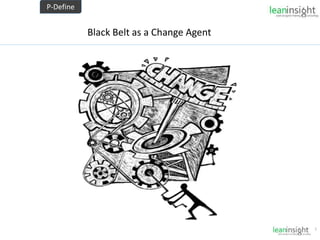
Black Belt as a Change Agent
P-Define
3
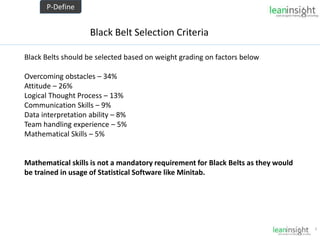
Black Belt Selection Criteria
P-Define
Black Belts should be selected based on weight grading on factors below
Overcoming obstacles – 34%
Attitude – 26%
Logical Thought Process – 13%
Communication Skills – 9%
Data interpretation ability – 8%
Team handling experience – 5%
Mathematical Skills – 5%
Mathematical skills is not a mandatory requirement for Black Belts as they would
be trained in usage of Statistical Software like Minitab.
4
Roadblock for Six Sigma Implementation
 Six Sigma is too statistical
 Individual has fear of change. Why should I change?
No co-operation of employee and wrong team member or selection
Knowledge & attitude of Black Belt & others
If System may require many signature for expenditures, discourage changes or delay
improvement, particularly when signatories are busy in travel frequently
Managers are not properly trained as change agent
Inadequate, improper communication of change. Change management without resource
preparation
Step for improvement:-
Communicate a view of future state with change, establish short term & long term goal.
Identify & reduce barriers for change. Lock in improvement. Communicate the need of
change, eg market share, competition, prospects for expansion & benchmarking etc.
We need to make them realize that they wouldn’t be penalized for their mistake. We should
foster them with Move ahead approach. Show mutual benefit to stakeholders. MBB need to
ensure all employees as convinced not forced.
No use of force tactics for employee support We need to choose team member based on
their capacity, capability, ability & willingness. We should not have duplicate skill set in team.
P-Define
5
Change Roadblock
Looking at his curve, which area you would like to focus
first?
Every organization or team split into 15% Supportive, 70% Neutral and
15% Resistant:-
Don’t bother about 15% Supportive as they would support change
anyways
Don’t bother about 15% Resistant as they would resist change
anyways
Spending any time with the resistant population is a Waste.
Common Resistance Area
 Ignore the new process or the change
Fail to understand
Disagree with the validity of the benefits
Criticize new set of tools or applications
Delay the implementation
P-Define
6
Continuous Improvement
 Continual Improvement Process or CIP is a steady effort made to improve
existing processes, products or services.
 Delivery processes are evaluated against Efficiency, Effectiveness and
Flexibility.
 William Edwards Deming quotes, “CIP is a part of the system, where
feedback from the process and the customers are evaluated against
organizational goals.”
 Principle of CIP is Feedback.
 Purpose of CIP is to identify, reduce and eliminate below optimal
processes.
 Emphasis of CIP is to take gradual and incremental steps.
P-Define
7
Continuous versus Continual Improvement
 The word Continuous per English linguistic prescription, should be used
for things that are continuous in the literal or figurative sense.
 The word Continual should be used when events happen in a continuous
fashion in discrete jumps.
 By convention, usage of the word continuous improvement is more
popular. Experts and businesses though have started to use the word
continual improvement.
 Imp – Use the term continual improvement of processes and continuous
improvement in data trends.
P-Define
8
Kaizen – Continual Improvement
 Most successful implementations use Kaizen as their base approach for
Continual Improvement.
 Kaizen stands for “Change for the Better”
 Kaizen is also known as the PDCA cycle, spoken about first by Dr. William
Edwards Deming.
 One Kaizen variant is Kaizen Blitz or Kaizen Burst.
 Kaizen Blitz emphasizes on Rapid or Breakthrough improvement and it is a
focused activity on a particular process. Example, McDonalds inscribing
the temperature regulations on their water carrying glasses.
 Masaaki Imai credited with popularity of Kaizen.
5 elements/tenets of Kaizen
 Teamwork
 Personal Discipline
 Improved Morale
 Quality Circles
 Suggestions for Improvement
P-Define
9
Continuous Improvement
The Kaizen Cycle
 Standardize the operation and activities
 Measure the operation
 Compare measurement to requirements
 Innovate to meet requirements
 Standardize new operations and continue the cycle ad infinitum
P-Define
10
Lean-Insight.com
If you are looking for Lean Six Sigma Black Belt training in Bangalore / Bengaluru
along with certification visit:
http://lean-insight.com/six-sigma-training-bangalore/

Lean Six Sigma Black Belt Training Part 3

  • 1.
    1 Lean-Insight.com Lean Six Sigma BlackBelt Training Part 3 Training Location: Bangalore / Bengaluru
  • 2.
    2 Black Belt asa Change Agent P-Define
  • 3.
    3 Black Belt SelectionCriteria P-Define Black Belts should be selected based on weight grading on factors below Overcoming obstacles – 34% Attitude – 26% Logical Thought Process – 13% Communication Skills – 9% Data interpretation ability – 8% Team handling experience – 5% Mathematical Skills – 5% Mathematical skills is not a mandatory requirement for Black Belts as they would be trained in usage of Statistical Software like Minitab.
  • 4.
    4 Roadblock for SixSigma Implementation  Six Sigma is too statistical  Individual has fear of change. Why should I change? No co-operation of employee and wrong team member or selection Knowledge & attitude of Black Belt & others If System may require many signature for expenditures, discourage changes or delay improvement, particularly when signatories are busy in travel frequently Managers are not properly trained as change agent Inadequate, improper communication of change. Change management without resource preparation Step for improvement:- Communicate a view of future state with change, establish short term & long term goal. Identify & reduce barriers for change. Lock in improvement. Communicate the need of change, eg market share, competition, prospects for expansion & benchmarking etc. We need to make them realize that they wouldn’t be penalized for their mistake. We should foster them with Move ahead approach. Show mutual benefit to stakeholders. MBB need to ensure all employees as convinced not forced. No use of force tactics for employee support We need to choose team member based on their capacity, capability, ability & willingness. We should not have duplicate skill set in team. P-Define
  • 5.
    5 Change Roadblock Looking athis curve, which area you would like to focus first? Every organization or team split into 15% Supportive, 70% Neutral and 15% Resistant:- Don’t bother about 15% Supportive as they would support change anyways Don’t bother about 15% Resistant as they would resist change anyways Spending any time with the resistant population is a Waste. Common Resistance Area  Ignore the new process or the change Fail to understand Disagree with the validity of the benefits Criticize new set of tools or applications Delay the implementation P-Define
  • 6.
    6 Continuous Improvement  ContinualImprovement Process or CIP is a steady effort made to improve existing processes, products or services.  Delivery processes are evaluated against Efficiency, Effectiveness and Flexibility.  William Edwards Deming quotes, “CIP is a part of the system, where feedback from the process and the customers are evaluated against organizational goals.”  Principle of CIP is Feedback.  Purpose of CIP is to identify, reduce and eliminate below optimal processes.  Emphasis of CIP is to take gradual and incremental steps. P-Define
  • 7.
    7 Continuous versus ContinualImprovement  The word Continuous per English linguistic prescription, should be used for things that are continuous in the literal or figurative sense.  The word Continual should be used when events happen in a continuous fashion in discrete jumps.  By convention, usage of the word continuous improvement is more popular. Experts and businesses though have started to use the word continual improvement.  Imp – Use the term continual improvement of processes and continuous improvement in data trends. P-Define
  • 8.
    8 Kaizen – ContinualImprovement  Most successful implementations use Kaizen as their base approach for Continual Improvement.  Kaizen stands for “Change for the Better”  Kaizen is also known as the PDCA cycle, spoken about first by Dr. William Edwards Deming.  One Kaizen variant is Kaizen Blitz or Kaizen Burst.  Kaizen Blitz emphasizes on Rapid or Breakthrough improvement and it is a focused activity on a particular process. Example, McDonalds inscribing the temperature regulations on their water carrying glasses.  Masaaki Imai credited with popularity of Kaizen. 5 elements/tenets of Kaizen  Teamwork  Personal Discipline  Improved Morale  Quality Circles  Suggestions for Improvement P-Define
  • 9.
    9 Continuous Improvement The KaizenCycle  Standardize the operation and activities  Measure the operation  Compare measurement to requirements  Innovate to meet requirements  Standardize new operations and continue the cycle ad infinitum P-Define
  • 10.
    10 Lean-Insight.com If you arelooking for Lean Six Sigma Black Belt training in Bangalore / Bengaluru along with certification visit: http://lean-insight.com/six-sigma-training-bangalore/