Improvement of a Tender Management Process 
Annalisa Caponerahttp://ie.linkedin.com/pub/annalisa-caponera/31/253/8ba/ 
Lean 
Project 
6σ
Statementbefore improvement (from the project Chart) 
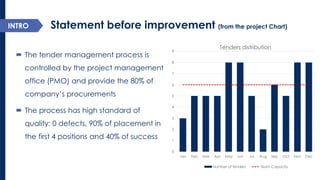
The tender management process is controlled by the project management office (PMO) and provide the 80% of company’s procurements 
The process has high standard of quality: 0 defects, 90% of placement in the first 4 positions and 40% of success 
INTRO 
Jan 
Feb 
Mar 
Apr 
May 
Jun 
Jul 
Aug 
Sep 
Oct 
Nov 
Dec 
0 
1 
2 
3 
4 
5 
6 
7 
8 
9 
Tenders distribution 
Number of tenders 
Team Capacity
Problem Statement (from the project Chart) 
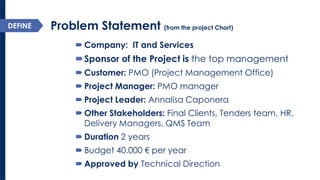
Company: IT and Services 
Sponsor of the Project is the top management 
Customer: PMO (Project Management Office) 
Project Manager: PMO manager 
Project Leader: Annalisa Caponera 
Other Stakeholders: Final Clients, Tenders team, HR, Delivery Managers, QMS Team 
Duration2 years 
Budget 40.000 €per year 
Approved by Technical Direction 
DEFINE
Problem Statement: VoC 
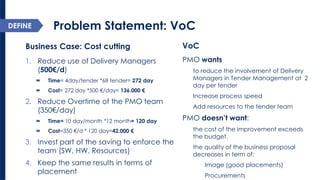
Business Case: Cost cutting 
1.Reduce use of Delivery Managers (500€/d) 
Time= 4day/tender *68 tender=272 day 
Cost= 272 day *500 €/day= 136.000 € 
2.Reduce Overtime of the PMO team (350€/day) 
Time= 10 day/month *12 month= 120 day 
Cost=350 €/d * 120 day=42.000 € 
3.Invest part of the saving to enforce the team (SW, HW, Resources) 
4.Keep the same results in terms of placement 
VoC 
PMO wants 
to reduce the involvement of Delivery Managers in Tender Management at 2 day per tender 
Increase process speed 
Add resources to the tender team 
PMO doesn’t want: 
the cost of the improvement exceeds the budget. 
the quality of the business proposal decreases in term of: 
Image (good placements) 
Procurements 
DEFINE
CTQSMART GOALS 
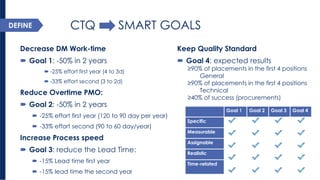
Decrease DM Work-time 
Goal 1: -50% in 2 years 
-25% effort first year (4 to 3d) 
-33% effort second (3 to 2d) 
Reduce Overtime PMO: 
Goal 2: -50% in 2 years 
-25% effort first year (120 to 90 day per year) 
-33% effort second (90 to 60 day/year) 
Increase Process speed 
Goal 3: reduce the Lead Time: 
-15% Lead time first year 
-15% lead timethe second year 
Goal 1 
Goal 2 
Goal 3 
Goal 4 
Specific 
Measurable 
Assignable 
Realistic 
Time-related 
DEFINE 
Keep Quality Standard 
Goal 4: expected results 
≥90% of placements in the first 4 positions General 
≥90% of placements in the first 4 positions Technical 
≥40% of success (procurements)
SIPOC 
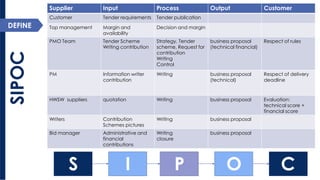
Supplier 
Input 
Process 
Output 
Customer 
Customer 
Tender requirements 
Tender publication 
Top management 
Margin and availability 
Decision and margin 
PMO Team 
TenderScheme 
Writing contribution 
Strategy, Tender scheme, Request for contribution 
Writing 
Control 
business proposal 
(technical financial) 
Respect of rules 
PM 
Informationwriter contribution 
Writing 
business proposal 
(technical) 
Respect of delivery deadline 
HWSW suppliers 
quotation 
Writing 
business proposal 
Evaluation: technical score+ financial score 
Writers 
Contribution 
Schemes pictures 
Writing 
business proposal 
Bidmanager 
Administrative and financial contributions 
Writing 
closure 
business proposal 
DEFINE 
S 
I 
O 
P 
C
VSM (present) 
MEASURE 
Customer 
Approval 
Brainstorming 
RFI 
Draft 
Editing 
parts 
Merge 
Control 
Closure 
Delivery 
IN 
IN 
IN 
DM 
P/T 2h 
W/T --- 
FTQ 100% 
4 
P/T 4h 
W/T --- 
FTQ 100% 
6 
P/T 2days 
W/T --- 
FTQ 50% 
2 
P/T 1d 
W/T ---- 
FTQ 100% 
1 
P/T3d 
W/T 1d 
FTQ 80% 
2 
P/T 1d 
W/T 1d 
FTQ 100% 
2 
P/T 4 h 
W/T --- 
FTQ 100% 
2 
P/T 4h 
W/T --- 
FTQ 100% 
2 
P/T 2h 
W/T --- 
FTQ 100% 
1 
68 
3 days 
3 days 
3 days 
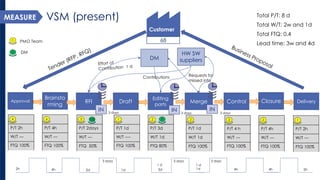
Total P/T: 8 d 
Total W/T: 2w and 1d 
Total FTQ: 0.4 
Lead time: 3w and 4d 
2h 
3days 
3 days 
3 days 
4h 
2d 
1d 
3d 
1d 
4h 
4h 
2h 
1 d 
1 d 
1 
1 
PMO Team 
DM 
1 
Requests for missed info 
HW SW suppliers 
Contributions 
1/2
Customer 
Approval 
Brainstorming 
RFI 
Draft 
Editing 
parts 
Merge 
Control 
Closure 
Delivery 
IN 
IN 
IN 
DM 
P/T 2h 
W/T --- 
FTQ 100% 
4 
P/T 4h 
W/T --- 
FTQ 100% 
6 
P/T 2days 
W/T --- 
FTQ 50% 
2 
P/T 1d 
W/T ---- 
FTQ 100% 
1 
P/T3d 
W/T 1d 
FTQ 80% 
2 
P/T 1d 
W/T 1d 
FTQ 100% 
2 
P/T 4 h 
W/T --- 
FTQ 100% 
2 
P/T 4h 
W/T --- 
FTQ 100% 
2 
P/T 2h 
W/T --- 
FTQ 100% 
1 
68 
3 days 
3 days 
3 days 
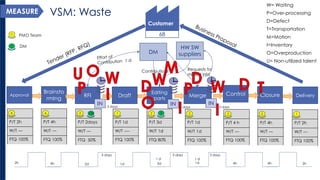
W= Waiting 
P=Over-processing 
D=Defect 
T=Transportation 
M=Motion 
I=Inventory 
O=Overproduction 
U= Non-utilizedtalent 
2h 
3days 
3 days 
3 days 
4h 
2d 
1d 
3d 
1d 
4h 
4h 
2h 
1 d 
1 d 
1 
1 
PMO Team 
DM 
1 
Requests for missed info 
HW SW suppliers 
Contributions 
1/2 
MEASURE 
VSM: Waste
Brainstorming 
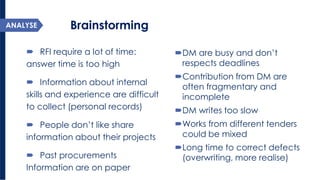
RFI require a lot of time: answer time is too high 
Information about internal skills and experience are difficult to collect (personal records) 
People don’t like share information about their projects 
Past procurements Information are on paper 
DM are busy and don’t respects deadlines 
Contribution from DM are often fragmentary and incomplete 
DM writes too slow 
Works from different tenders could be mixed 
Long time to correct defects (overwriting, more realise) 
ANALYSE
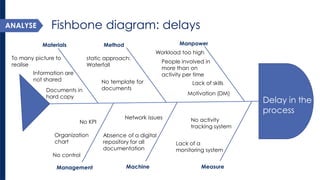
Fishbone diagram: delays 
Delay in the process 
Materials 
Method 
Manpower 
Management 
Machine 
Measure 
Workload too high 
Lack of skills 
No control 
Lack of a monitoring system 
Information are not shared 
Organization chart 
static approach: Waterfall 
Absence of a digital repository for all documentation 
No activity tracking system 
No KPI 
Documents in hard copy 
Network issues 
No template for documents 
Motivation (DM) 
To many picture to realise 
People involved in more than on activity per time 
ANALYSE
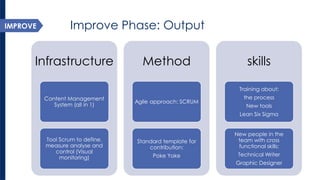
Improve Phase: Output 
Infrastructure 
Content Management System (all in 1) 
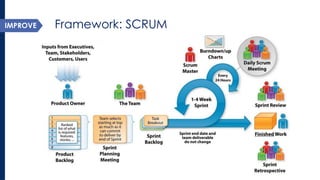
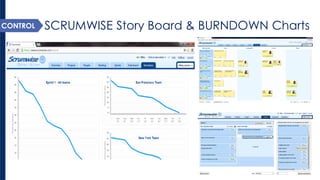
Tool Scrum to define, measure analyse and control (Visual monitoring) 
Method 
Agile approach: SCRUM 
Standard template for contribution: 
Poke Yoke 
skills 
Training about: 
the process 
New tools 
Lean Six Sigma 
New people in the team with cross functional skills: 
Technical Writer 
Graphic Designer 
IMPROVE
Customer 
Approval 
Planning Tasks 
RFI 
Editing 
Task 
Merge 
Control 
Closure 
Delivery 
P/T 2h 
W/T --- 
FTQ 100% 
4 
P/T 1d 
W/T --- 
FTQ 100% 
6 
P/T 1d 
W/T --- 
FTQ 90% 
2 
P/T2d 
W/T --- 
FTQ 80% 
5 
P/T 1d 
W/T 1d 
FTQ 100% 
2 
P/T 4 h 
W/T --- 
FTQ 100% 
2 
P/T 4h 
W/T --- 
FTQ 100% 
2 
P/T 2h 
W/T --- 
FTQ 100% 
1 
68 
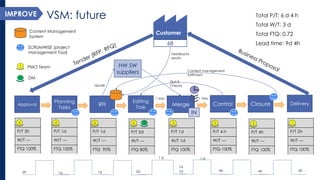
Total P/T: 6 d 4 h 
Total W/T: 3 d 
Total FTQ: 0.72 
Lead time: 9d 4h 
Quote 
1 day 
1day 
1 
HW SW suppliers 
1 
1 
PMO Team 
DM 
IN 
2h 
2h 
1d 
1d 
2d 
1d 
4h 
4h 
1 d 
1 d 
1d 
Quick Checks 
Content management fulfilment 
SCRUMWISE (project management Tool) 
Content Management System 
Feedbacks results 
VSM: future 
IMPROVE
Framework: SCRUM 
MEASURE 
IMPROVE
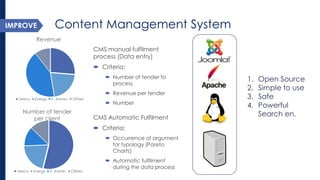
Content Management System 
MEASURE 
IMPROVE 
CMS manual fulfilment process (Data entry) 
Criteria: 
Number of tender to process 
Revenue per tender 
Number 
Revenue 
Teleco 
Energy 
P. Admin. 
Others 
Number of tender per client 
Teleco 
Energy 
P. Admin. 
Others 
CMS Automatic Fulfilment 
Criteria: 
Occurrence of argument for typology (Pareto Charts) 
Automatic fulfilment during the data process 
1.Open Source 
2.Simple to use 
3.Safe 
4.Powerful Search en.
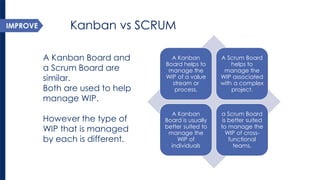
Kanban vs SCRUM 
A Kanban Board helps to manage the WIP of a value stream or process. 
A Scrum Board helps to manage the WIP associated with a complex project. 
A Kanban Board is usually better suited to manage the WIP of individuals 
a Scrum Board is better suited to manage the WIP of cross- functional teams. 
IMPROVE 
MEASURE 
IMPROVE 
A Kanban Board and a Scrum Board are similar. 
Both are used to help manage WIP. 
However the type of WIP that is managed by each is different.
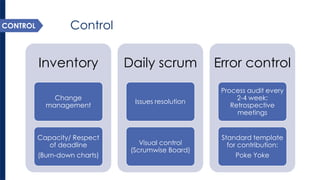
Control 
Inventory 
Change management 
Capacity/ Respect of deadline 
(Burn-down charts) 
Daily scrum 
Issues resolution 
Visual control (Scrumwise Board) 
Error control 
Process audit every 2-4 week: Retrospective meetings 
Standard template for contribution: 
Poke Yoke 
CONTROL
SCRUMWISE Story Board & BURNDOWN Charts 
IMPROVE 
CONTROL
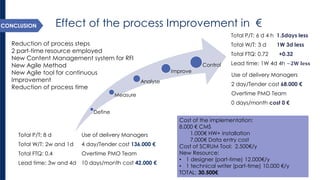
Effect of the process Improvement in € 
Define 
Measure 
Analyse 
Improve 
Control 
Total P/T: 8 d 
Total W/T: 2w and 1d 
Total FTQ: 0.4 
Lead time: 3w and 4d 
Total P/T: 6 d 4 h 1.5days less 
Total W/T: 3 d 1W 3d less 
Total FTQ: 0.72 +0.32 
Lead time: 1W4d 4h ~ퟐ퐖퐥퐞퐬퐬 
Use of delivery Managers 
2 day/Tender cost 68.000 € 
Overtime PMO Team 
0days/month cost 0 € 
Use of delivery Managers 
4 day/Tender cost 136.000 € 
Overtime PMO Team 
10days/month cost 42.000 € 
Reduction of process steps 
2 part-time resource employed 
New Content Management system for RFI 
New Agile Method 
New Agile tool for continuous Improvement 
Reduction of process time 
Cost of the implementation: 
8.000 €CMS 
1.000€HW+ installation 
7.000€Data entry cost 
Cost of SCRUM Tool: 2.500€/y 
New Resource: 
•1 designer (part-time) 12.000€/y 
•1 technical writer (part-time) 10.000 €/y 
TOTAL: 30.500€ 
CONCLUSION
Effect of the process Improvement in QA 
Define 
Measure 
Analyse 
Improve 
Control 
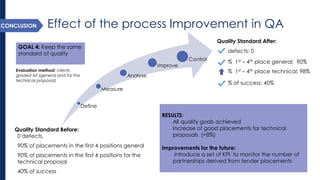
RESULTS: 
All quality goals achieved 
Increase of good placements for technical proposals (+8%) 
Improvements for the future: 
introduce a set of KPI to monitor the number of partnerships derived from tender placements 
Quality Standard Before: 
0 defects, 
90% of placements in the first 4 positions general 
90% of placements in the first 4 positions for the technical proposal 
40% of success 
Quality Standard After: 
defects: 0 
% 1st–4thplace general: 90% 
% 1st–4thplace technical: 98% 
% of success: 40% 
GOAL 4: Keep the same standard of quality 
Evaluation method: clients graded list (general and for the technical proposal) 
CONCLUSION
“The journeyof athousand miles beginswith one step” 
Thanks for your attention! 
Lao Tzu -604 BC

Lean Six Sigma project Caponera

  • 1.
    Improvement of aTender Management Process Annalisa Caponerahttp://ie.linkedin.com/pub/annalisa-caponera/31/253/8ba/ Lean Project 6σ
  • 2.
    Statementbefore improvement (fromthe project Chart) The tender management process is controlled by the project management office (PMO) and provide the 80% of company’s procurements The process has high standard of quality: 0 defects, 90% of placement in the first 4 positions and 40% of success INTRO Jan Feb Mar Apr May Jun Jul Aug Sep Oct Nov Dec 0 1 2 3 4 5 6 7 8 9 Tenders distribution Number of tenders Team Capacity
  • 3.
    Problem Statement (fromthe project Chart) Company: IT and Services Sponsor of the Project is the top management Customer: PMO (Project Management Office) Project Manager: PMO manager Project Leader: Annalisa Caponera Other Stakeholders: Final Clients, Tenders team, HR, Delivery Managers, QMS Team Duration2 years Budget 40.000 €per year Approved by Technical Direction DEFINE
  • 4.
    Problem Statement: VoC Business Case: Cost cutting 1.Reduce use of Delivery Managers (500€/d) Time= 4day/tender *68 tender=272 day Cost= 272 day *500 €/day= 136.000 € 2.Reduce Overtime of the PMO team (350€/day) Time= 10 day/month *12 month= 120 day Cost=350 €/d * 120 day=42.000 € 3.Invest part of the saving to enforce the team (SW, HW, Resources) 4.Keep the same results in terms of placement VoC PMO wants to reduce the involvement of Delivery Managers in Tender Management at 2 day per tender Increase process speed Add resources to the tender team PMO doesn’t want: the cost of the improvement exceeds the budget. the quality of the business proposal decreases in term of: Image (good placements) Procurements DEFINE
  • 5.
    CTQSMART GOALS DecreaseDM Work-time Goal 1: -50% in 2 years -25% effort first year (4 to 3d) -33% effort second (3 to 2d) Reduce Overtime PMO: Goal 2: -50% in 2 years -25% effort first year (120 to 90 day per year) -33% effort second (90 to 60 day/year) Increase Process speed Goal 3: reduce the Lead Time: -15% Lead time first year -15% lead timethe second year Goal 1 Goal 2 Goal 3 Goal 4 Specific Measurable Assignable Realistic Time-related DEFINE Keep Quality Standard Goal 4: expected results ≥90% of placements in the first 4 positions General ≥90% of placements in the first 4 positions Technical ≥40% of success (procurements)
  • 6.
    SIPOC Supplier Input Process Output Customer Customer Tender requirements Tender publication Top management Margin and availability Decision and margin PMO Team TenderScheme Writing contribution Strategy, Tender scheme, Request for contribution Writing Control business proposal (technical financial) Respect of rules PM Informationwriter contribution Writing business proposal (technical) Respect of delivery deadline HWSW suppliers quotation Writing business proposal Evaluation: technical score+ financial score Writers Contribution Schemes pictures Writing business proposal Bidmanager Administrative and financial contributions Writing closure business proposal DEFINE S I O P C
  • 7.
    VSM (present) MEASURE Customer Approval Brainstorming RFI Draft Editing parts Merge Control Closure Delivery IN IN IN DM P/T 2h W/T --- FTQ 100% 4 P/T 4h W/T --- FTQ 100% 6 P/T 2days W/T --- FTQ 50% 2 P/T 1d W/T ---- FTQ 100% 1 P/T3d W/T 1d FTQ 80% 2 P/T 1d W/T 1d FTQ 100% 2 P/T 4 h W/T --- FTQ 100% 2 P/T 4h W/T --- FTQ 100% 2 P/T 2h W/T --- FTQ 100% 1 68 3 days 3 days 3 days Total P/T: 8 d Total W/T: 2w and 1d Total FTQ: 0.4 Lead time: 3w and 4d 2h 3days 3 days 3 days 4h 2d 1d 3d 1d 4h 4h 2h 1 d 1 d 1 1 PMO Team DM 1 Requests for missed info HW SW suppliers Contributions 1/2
  • 8.
    Customer Approval Brainstorming RFI Draft Editing parts Merge Control Closure Delivery IN IN IN DM P/T 2h W/T --- FTQ 100% 4 P/T 4h W/T --- FTQ 100% 6 P/T 2days W/T --- FTQ 50% 2 P/T 1d W/T ---- FTQ 100% 1 P/T3d W/T 1d FTQ 80% 2 P/T 1d W/T 1d FTQ 100% 2 P/T 4 h W/T --- FTQ 100% 2 P/T 4h W/T --- FTQ 100% 2 P/T 2h W/T --- FTQ 100% 1 68 3 days 3 days 3 days W= Waiting P=Over-processing D=Defect T=Transportation M=Motion I=Inventory O=Overproduction U= Non-utilizedtalent 2h 3days 3 days 3 days 4h 2d 1d 3d 1d 4h 4h 2h 1 d 1 d 1 1 PMO Team DM 1 Requests for missed info HW SW suppliers Contributions 1/2 MEASURE VSM: Waste
  • 9.
    Brainstorming RFI requirea lot of time: answer time is too high Information about internal skills and experience are difficult to collect (personal records) People don’t like share information about their projects Past procurements Information are on paper DM are busy and don’t respects deadlines Contribution from DM are often fragmentary and incomplete DM writes too slow Works from different tenders could be mixed Long time to correct defects (overwriting, more realise) ANALYSE
  • 10.
    Fishbone diagram: delays Delay in the process Materials Method Manpower Management Machine Measure Workload too high Lack of skills No control Lack of a monitoring system Information are not shared Organization chart static approach: Waterfall Absence of a digital repository for all documentation No activity tracking system No KPI Documents in hard copy Network issues No template for documents Motivation (DM) To many picture to realise People involved in more than on activity per time ANALYSE
  • 11.
    Improve Phase: Output Infrastructure Content Management System (all in 1) Tool Scrum to define, measure analyse and control (Visual monitoring) Method Agile approach: SCRUM Standard template for contribution: Poke Yoke skills Training about: the process New tools Lean Six Sigma New people in the team with cross functional skills: Technical Writer Graphic Designer IMPROVE
  • 12.
    Customer Approval PlanningTasks RFI Editing Task Merge Control Closure Delivery P/T 2h W/T --- FTQ 100% 4 P/T 1d W/T --- FTQ 100% 6 P/T 1d W/T --- FTQ 90% 2 P/T2d W/T --- FTQ 80% 5 P/T 1d W/T 1d FTQ 100% 2 P/T 4 h W/T --- FTQ 100% 2 P/T 4h W/T --- FTQ 100% 2 P/T 2h W/T --- FTQ 100% 1 68 Total P/T: 6 d 4 h Total W/T: 3 d Total FTQ: 0.72 Lead time: 9d 4h Quote 1 day 1day 1 HW SW suppliers 1 1 PMO Team DM IN 2h 2h 1d 1d 2d 1d 4h 4h 1 d 1 d 1d Quick Checks Content management fulfilment SCRUMWISE (project management Tool) Content Management System Feedbacks results VSM: future IMPROVE
  • 13.
  • 14.
    Content Management System MEASURE IMPROVE CMS manual fulfilment process (Data entry) Criteria: Number of tender to process Revenue per tender Number Revenue Teleco Energy P. Admin. Others Number of tender per client Teleco Energy P. Admin. Others CMS Automatic Fulfilment Criteria: Occurrence of argument for typology (Pareto Charts) Automatic fulfilment during the data process 1.Open Source 2.Simple to use 3.Safe 4.Powerful Search en.
  • 15.
    Kanban vs SCRUM A Kanban Board helps to manage the WIP of a value stream or process. A Scrum Board helps to manage the WIP associated with a complex project. A Kanban Board is usually better suited to manage the WIP of individuals a Scrum Board is better suited to manage the WIP of cross- functional teams. IMPROVE MEASURE IMPROVE A Kanban Board and a Scrum Board are similar. Both are used to help manage WIP. However the type of WIP that is managed by each is different.
  • 16.
    Control Inventory Changemanagement Capacity/ Respect of deadline (Burn-down charts) Daily scrum Issues resolution Visual control (Scrumwise Board) Error control Process audit every 2-4 week: Retrospective meetings Standard template for contribution: Poke Yoke CONTROL
  • 17.
    SCRUMWISE Story Board& BURNDOWN Charts IMPROVE CONTROL
  • 18.
    Effect of theprocess Improvement in € Define Measure Analyse Improve Control Total P/T: 8 d Total W/T: 2w and 1d Total FTQ: 0.4 Lead time: 3w and 4d Total P/T: 6 d 4 h 1.5days less Total W/T: 3 d 1W 3d less Total FTQ: 0.72 +0.32 Lead time: 1W4d 4h ~ퟐ퐖퐥퐞퐬퐬 Use of delivery Managers 2 day/Tender cost 68.000 € Overtime PMO Team 0days/month cost 0 € Use of delivery Managers 4 day/Tender cost 136.000 € Overtime PMO Team 10days/month cost 42.000 € Reduction of process steps 2 part-time resource employed New Content Management system for RFI New Agile Method New Agile tool for continuous Improvement Reduction of process time Cost of the implementation: 8.000 €CMS 1.000€HW+ installation 7.000€Data entry cost Cost of SCRUM Tool: 2.500€/y New Resource: •1 designer (part-time) 12.000€/y •1 technical writer (part-time) 10.000 €/y TOTAL: 30.500€ CONCLUSION
  • 19.
    Effect of theprocess Improvement in QA Define Measure Analyse Improve Control RESULTS: All quality goals achieved Increase of good placements for technical proposals (+8%) Improvements for the future: introduce a set of KPI to monitor the number of partnerships derived from tender placements Quality Standard Before: 0 defects, 90% of placements in the first 4 positions general 90% of placements in the first 4 positions for the technical proposal 40% of success Quality Standard After: defects: 0 % 1st–4thplace general: 90% % 1st–4thplace technical: 98% % of success: 40% GOAL 4: Keep the same standard of quality Evaluation method: clients graded list (general and for the technical proposal) CONCLUSION
  • 20.
    “The journeyof athousandmiles beginswith one step” Thanks for your attention! Lao Tzu -604 BC