
“Lean” Product ManagementCan Product Management benefit from Lean Startup practices?
2Thank You to Our Sponsors
About Me: Shardul MehtaProduct management & marketing professionalEarly career: software developerDid my first start-up in 2000Yes, I was a dot-commer!Small business, family business, enterprise, B2C, B2B, SaaS, web apps, healthcare, retail services, financial servicesMBA, Tepper Business School, Carnegie MellonB.S., Computer & Information SciencesTwitter: @shardulmehtawww.linkedin.com/in/shardulmehtahttp://streetsmartproductmanager.com
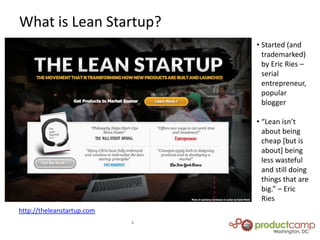
What is Lean Startup?Started (and trademarked) by Eric Ries – serial entrepreneur, popular blogger
“Lean isn’t about being cheap [but is about] being less wasteful and still doing things that are big.” – Eric Ries http://theleanstartup.com4
What is Lean Startup?+Eliminate WasteNew Product or ServiceLow burn startupSpeed of iterations is key to successSlideshare presentation “Building a Lean Startup” by Ash Mauryahttp://www.slideshare.net/ashmaurya/building-a-lean-startup
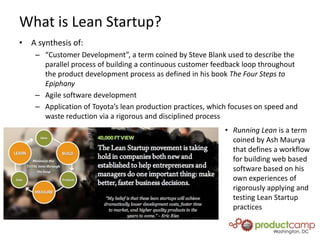
A synthesis of:“Customer Development”, a term coined by Steve Blank used to describe the parallel process of building a continuous customer feedback loop throughout the product development process as defined in his book The Four Steps to EpiphanyAgile software developmentApplication of Toyota’s lean production practices, which focuses on speed and waste reduction via a rigorous and disciplined processWhat is Lean Startup?Running Lean is a term coined by Ash Maurya that defines a workflow for building web based software based on his own experiences of rigorously applying and testing Lean Startup practicesPrinciples of Lean StartupValidated LearningLean Startup is about a methodology of learningA culture of discovery and validated learning is needed to truly have new product developmentLearning can be validated scientifically by running experiments that allow us to test each element of our visionInnovation accountingTo improve outcomes and hold entrepreneurs accountable, we need to focus on the boring stuff: how to measure progress, how to set up milestones, how to prioritize workBuild-Measure-Learn
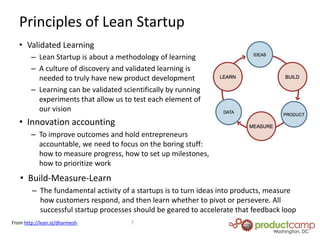
The fundamental activity of a startups is to turn ideas into products, measure how customers respond, and then learn whether to pivot or persevere. All successful startup processes should be geared to accelerate that feedback loop7From http://lean.st/dharmesh
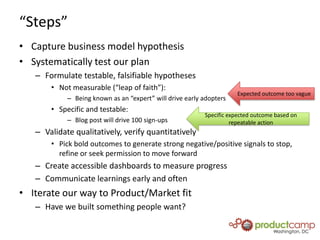
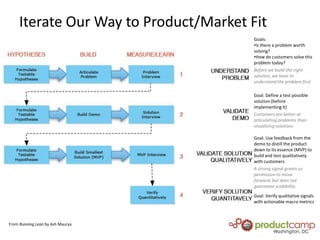
Capture business model hypothesisSystematically test our planFormulate testable, falsifiable hypothesesNot measurable (“leap of faith”):Being known as an “expert” will drive early adoptersSpecific and testable:Blog post will drive 100 sign-upsValidate qualitatively, verify quantitativelyPick bold outcomes to generate strong negative/positive signals to stop, refine or seek permission to move forwardCreate accessible dashboards to measure progressCommunicate learnings early and oftenIterate our way to Product/Market fitHave we built something people want?“Steps”Expected outcome too vagueSpecific expected outcome based on repeatable action
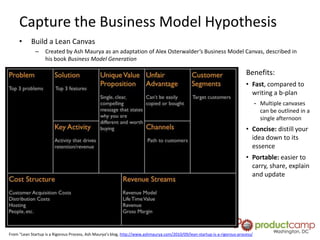
Build a Lean CanvasCreated by Ash Maurya as an adaptation of Alex Osterwalder’s Business Model Canvas, described in his book Business Model GenerationCapture the Business Model HypothesisBenefits:Fast, compared to writing a b-plan
Multiple canvases can be outlined in a single afternoon
Concise: distill your idea down to its essence
Portable: easier to carry, share, explain and updateFrom “Lean Startup is a Rigorous Process, Ash Maurya’s blog, http://www.ashmaurya.com/2010/09/lean-startup-is-a-rigorous-process/
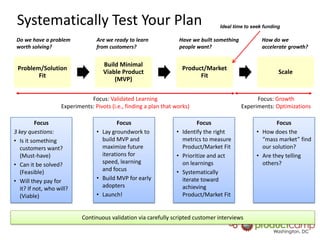
Systematically Test Your PlanIdeal time to seek fundingDo we have a problem worth solving?Have we built something people want?How do we accelerate growth?Are we ready to learn from customers?Focus: Validated LearningExperiments: Pivots (i.e., finding a plan that works)Focus: GrowthExperiments: OptimizationsFocus3 key questions:Is it something customers want? (Must-have)

"Lean" Product Management

  • 1.
    “Lean” Product ManagementCanProduct Management benefit from Lean Startup practices?
  • 2.
    2Thank You toOur Sponsors
  • 3.
    About Me: ShardulMehtaProduct management & marketing professionalEarly career: software developerDid my first start-up in 2000Yes, I was a dot-commer!Small business, family business, enterprise, B2C, B2B, SaaS, web apps, healthcare, retail services, financial servicesMBA, Tepper Business School, Carnegie MellonB.S., Computer & Information SciencesTwitter: @shardulmehtawww.linkedin.com/in/shardulmehtahttp://streetsmartproductmanager.com
  • 4.
    What is LeanStartup?Started (and trademarked) by Eric Ries – serial entrepreneur, popular blogger
  • 5.
    “Lean isn’t aboutbeing cheap [but is about] being less wasteful and still doing things that are big.” – Eric Ries http://theleanstartup.com4
  • 6.
    What is LeanStartup?+Eliminate WasteNew Product or ServiceLow burn startupSpeed of iterations is key to successSlideshare presentation “Building a Lean Startup” by Ash Mauryahttp://www.slideshare.net/ashmaurya/building-a-lean-startup
  • 7.
    A synthesis of:“CustomerDevelopment”, a term coined by Steve Blank used to describe the parallel process of building a continuous customer feedback loop throughout the product development process as defined in his book The Four Steps to EpiphanyAgile software developmentApplication of Toyota’s lean production practices, which focuses on speed and waste reduction via a rigorous and disciplined processWhat is Lean Startup?Running Lean is a term coined by Ash Maurya that defines a workflow for building web based software based on his own experiences of rigorously applying and testing Lean Startup practicesPrinciples of Lean StartupValidated LearningLean Startup is about a methodology of learningA culture of discovery and validated learning is needed to truly have new product developmentLearning can be validated scientifically by running experiments that allow us to test each element of our visionInnovation accountingTo improve outcomes and hold entrepreneurs accountable, we need to focus on the boring stuff: how to measure progress, how to set up milestones, how to prioritize workBuild-Measure-Learn
  • 8.
    The fundamental activityof a startups is to turn ideas into products, measure how customers respond, and then learn whether to pivot or persevere. All successful startup processes should be geared to accelerate that feedback loop7From http://lean.st/dharmesh
  • 9.
    Capture business modelhypothesisSystematically test our planFormulate testable, falsifiable hypothesesNot measurable (“leap of faith”):Being known as an “expert” will drive early adoptersSpecific and testable:Blog post will drive 100 sign-upsValidate qualitatively, verify quantitativelyPick bold outcomes to generate strong negative/positive signals to stop, refine or seek permission to move forwardCreate accessible dashboards to measure progressCommunicate learnings early and oftenIterate our way to Product/Market fitHave we built something people want?“Steps”Expected outcome too vagueSpecific expected outcome based on repeatable action
  • 10.
    Build a LeanCanvasCreated by Ash Maurya as an adaptation of Alex Osterwalder’s Business Model Canvas, described in his book Business Model GenerationCapture the Business Model HypothesisBenefits:Fast, compared to writing a b-plan
  • 11.
    Multiple canvases canbe outlined in a single afternoon
  • 12.
    Concise: distill youridea down to its essence
  • 13.
    Portable: easier tocarry, share, explain and updateFrom “Lean Startup is a Rigorous Process, Ash Maurya’s blog, http://www.ashmaurya.com/2010/09/lean-startup-is-a-rigorous-process/
  • 14.
    Systematically Test YourPlanIdeal time to seek fundingDo we have a problem worth solving?Have we built something people want?How do we accelerate growth?Are we ready to learn from customers?Focus: Validated LearningExperiments: Pivots (i.e., finding a plan that works)Focus: GrowthExperiments: OptimizationsFocus3 key questions:Is it something customers want? (Must-have)