Lean Startup Basics
Outcome
Test if your intuition is solid enough to build a business
around it
Test with experiments your assumptions.
Measure your progress
Make decisions based on numbers
Reduce uncertainty
What is Lean Startup?
“The Lean Startup method teaches
you how to drive a startup-how to
steer, when to turn, and when to
persevere-and grow a business
with maximum acceleration.”
Origins
Origins
• Lean Manufacturing (Toyota): Systematically eliminate waste,
continuously improve
• Agile Software Development: Deliver often, deliver early, rapid
iterations
• Customer Development: test & validate your assumptions
Why
• Eliminate uncertainty with tools that help you test
your vision continuously
• Human beings suck at predicting what customers
will buy
The right question
Can we build this product?
VS
Should we build this product?
End Game
• Find your market before you run out of resources
• Building a product is the easy part
• Don’t build a solution and then search for a
problem
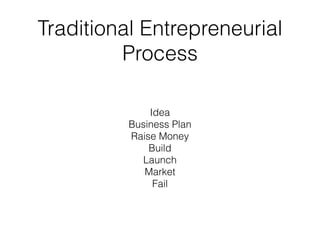
Traditional Entrepreneurial
Process
Idea
Business Plan
Raise Money
Build
Launch
Market
Fail
Issues with Traditional Path
• Feedback from customers begins once product is
launched, making changes often impossible
• No way to track success
Forget the business plan
• They don’t survive the talk with the first customer
(S. Blank)
• projections based on nothing
Customer Development
Framework for:
• Discover & Validate right market for your idea
• Build right product features to solve customer
needs
• Test correct way to acquire and convert customers
• Deploy right organisation and resources to scale
Objectives
• Problem/Solution fit (Customer Discovery): Find a
problem big enough customers will pay for your solution
• Product/Market fit (Customer Validation): Build the
product with only features that deliver value to the customer
• Scale (Company Building): Increase exponentially your user/
customer base
Tools
• Business Model/Lean/Value Proposition Canvas
• Javelin Board
• Lean Stack
• Lean Launchpad
Test your assumptions:
Experiments
• Turn a hypothesis into a measurable outcome
• Identify riskiest assumption
• Define Success Metrics
• Run the Experiment
• Pivot or Persevere
Experiment Objective
• Make your build, measure, learn loop faster all the
time
Build
• MVP = Minimum Viable Product
• Easiest/Fastest way to deliver value to your
customer
• Not perfect
If you are not embarrassed by the first version of your product, you’ve launched too late. Reidd
Hoffman - Linkedin
MVP Types
• Discovery Interviews
• Landing Page
• Concierge
• Mockup
Measure
• Qualitative not quantitative
• Do things that don’t scale
• Focus on important metrics: AARRR (Lean
Marketing Funnel)
Learn
• Change hypothesis
• Proceed if hypothesis is validated
• Discover new problems to solve
Pivot
• Structured course correction to test new
fundamental hypothesis
• A change in your plan in the process of finding a
repeatable and scalable business model
• Based on data
Grow
• Do things that scale
• Use best performing tested channels
• Build infrastructure needed to scale
Get Out Of The Building
• Talk face to face with customers
• Best way to focus on qualitative data
• Avoid engineering approach
Case Studies
Books
• The Entrepreneur’s Guide to Customer
Development - Brant Cooper, Patrick Vlaskovits
• Running Lean - Ash Maurya
• Lean Customer Development - Cindy Alvarez
• Value Proposition Design - Alexander Osterwalder
stevenballiano.com
steven.balliano@gmail.com
@SJBalliano

Lean Startup Basics

  • 1.
  • 2.
    Outcome Test if yourintuition is solid enough to build a business around it Test with experiments your assumptions. Measure your progress Make decisions based on numbers Reduce uncertainty
  • 3.
    What is LeanStartup? “The Lean Startup method teaches you how to drive a startup-how to steer, when to turn, and when to persevere-and grow a business with maximum acceleration.”
  • 4.
  • 5.
    Origins • Lean Manufacturing(Toyota): Systematically eliminate waste, continuously improve • Agile Software Development: Deliver often, deliver early, rapid iterations • Customer Development: test & validate your assumptions
  • 6.
    Why • Eliminate uncertaintywith tools that help you test your vision continuously • Human beings suck at predicting what customers will buy
  • 7.
    The right question Canwe build this product? VS Should we build this product?
  • 8.
    End Game • Findyour market before you run out of resources • Building a product is the easy part • Don’t build a solution and then search for a problem
  • 9.
  • 10.
    Issues with TraditionalPath • Feedback from customers begins once product is launched, making changes often impossible • No way to track success
  • 11.
    Forget the businessplan • They don’t survive the talk with the first customer (S. Blank) • projections based on nothing
  • 12.
    Customer Development Framework for: •Discover & Validate right market for your idea • Build right product features to solve customer needs • Test correct way to acquire and convert customers • Deploy right organisation and resources to scale
  • 13.
    Objectives • Problem/Solution fit(Customer Discovery): Find a problem big enough customers will pay for your solution • Product/Market fit (Customer Validation): Build the product with only features that deliver value to the customer • Scale (Company Building): Increase exponentially your user/ customer base
  • 14.
    Tools • Business Model/Lean/ValueProposition Canvas • Javelin Board • Lean Stack • Lean Launchpad
  • 15.
    Test your assumptions: Experiments •Turn a hypothesis into a measurable outcome • Identify riskiest assumption • Define Success Metrics • Run the Experiment • Pivot or Persevere
  • 16.
    Experiment Objective • Makeyour build, measure, learn loop faster all the time
  • 17.
    Build • MVP =Minimum Viable Product • Easiest/Fastest way to deliver value to your customer • Not perfect If you are not embarrassed by the first version of your product, you’ve launched too late. Reidd Hoffman - Linkedin
  • 18.
    MVP Types • DiscoveryInterviews • Landing Page • Concierge • Mockup
  • 19.
    Measure • Qualitative notquantitative • Do things that don’t scale • Focus on important metrics: AARRR (Lean Marketing Funnel)
  • 20.
    Learn • Change hypothesis •Proceed if hypothesis is validated • Discover new problems to solve
  • 21.
    Pivot • Structured coursecorrection to test new fundamental hypothesis • A change in your plan in the process of finding a repeatable and scalable business model • Based on data
  • 22.
    Grow • Do thingsthat scale • Use best performing tested channels • Build infrastructure needed to scale
  • 23.
    Get Out OfThe Building • Talk face to face with customers • Best way to focus on qualitative data • Avoid engineering approach
  • 24.
  • 25.
    Books • The Entrepreneur’sGuide to Customer Development - Brant Cooper, Patrick Vlaskovits • Running Lean - Ash Maurya • Lean Customer Development - Cindy Alvarez • Value Proposition Design - Alexander Osterwalder
  • 26.