Joe Weiss Skills Overview  November 2008 Management By Objective Confrontation Skills Training Lean Manufacturing and Kaizen Experience
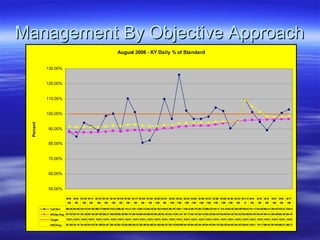
Management By Objective Approach
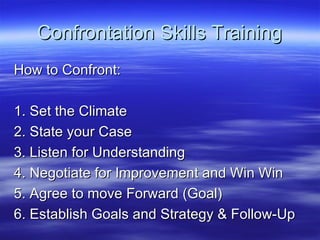
Confrontation Skills Training How to Confront: 1. Set the Climate 2. State your Case 3. Listen for Understanding 4. Negotiate for Improvement and Win Win  5. Agree to move Forward (Goal)  6. Establish Goals and Strategy & Follow-Up
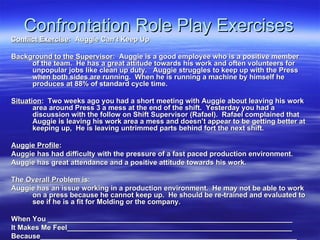
Confrontation Role Play Exercises Conflict Exercise :  Auggie Can’t Keep Up Background to the Supervisor :  Auggie is a good employee who is a positive member of the team.  He has a great attitude towards his work and often volunteers for unpopular jobs like clean up duty.  Auggie struggles to keep up with the Press when both sides are running.  When he is running a machine by himself he produces at 88% of standard cycle time.  Situation :  Two weeks ago you had a short meeting with Auggie about leaving his work area around Press 3 a mess at the end of the shift.  Yesterday you had a discussion with the follow on Shift Supervisor (Rafael).  Rafael complained that Auggie is leaving his work area a mess and doesn’t appear to be getting better at keeping up,  He is leaving untrimmed parts behind fort the next shift.  Auggie Profile : Auggie has had difficulty with the pressure of a fast paced production environment. Auggie has great attendance and a positive attitude towards his work. The Overall Problem is : Auggie has an issue working in a production environment.  He may not be able to work on a press because he cannot keep up.  He should be re-trained and evaluated to see if he is a fit for Molding or the company. When You ______________________________________________________________ It Makes Me Feel_________________________________________________________ Because_________________________________________________________________
 
Kaizen is: Get a Cross Functional Team together. Give them some training on the Cellular Manufacturing Principles. Give them the autonomy to make business change. Present what they come up with, and Celebrate Success.
Goal of Lean is to Eliminate Waste Manufacturing Waste Examples Wasted Time Materials (Scrap) Walking Red Tape Double Handling
Waste In An Office Setting Anything  that does not add value to the product or service. Customer on hold or told to call back Documents waiting on approval or signatures Product in queue due to batch operations Waiting for information Sorting, rearranging, prioritizing, excess handling Planning repetitive tasks Mistakes
Kaizen  is the  means  to eliminate waste!
Our Vision We are a courageous organization. We are the leader in all our markets. We are obsessed with meeting our commitments. We respect and challenge each other and confront issues with a sense of urgency. Our 150-year heritage, values, creative passion and respect for our world are the heart of our organization.  We create compelling value for customers, employees, and shareholders.
ORBIS Vision Customers love us because we are the best at packaging it right!! We have fun providing creative packaging solutions that enhance our environment and reduce costs to consumers. ORBIS has the absolute best people radiating confidence, energy and passion. We aggressively capture new markets and customers to create compelling value. We relentlessly keep our commitments!!
Cellular Manufacturing Principles Continuous Improvement (Kaizen) Employee Involvement One Piece Flow Visual Management  Total Quality Management Kanban
Foundation Elements of Kaizen Everything an organization does is a process to be standardized, controlled, and continuously improved. Continuous improvement requires employee involvement.
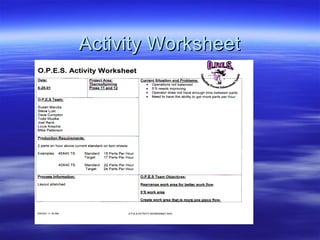
Activity Worksheet
Changing the Workplace Kaizen Workshops should focus on a specific task. Customer request, order, set-up etc. Defeat traditional boundaries, functions, departments (attempt to achieve flow without interruption). Solve/eliminate work practices, rework, approvals etc.
The Rules Of Kaizen Keep an open mind to change. Maintain a positive attitude. Never leave a silent disagreement. Create a blameless environment. Treat others as you would like to be treated. One person, one vote – no position/rank. No such thing as a dumb question. No magic wand – just work smarter.
Leadership A facilitator is assigned to provide the Cellular Manufacturing Training and help the group when it becomes stuck. A Team Leader is assigned to insure that everyone contributes and to provide basic leadership through the exercise.
Final Presentation The team presents their findings and action plans in a final presentation. Introduction Team name & Participants Team Objectives Results Achieved Action Plans Follow-Up Meeting (30, 60, 90 days)
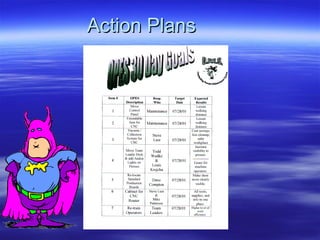
Action Plans
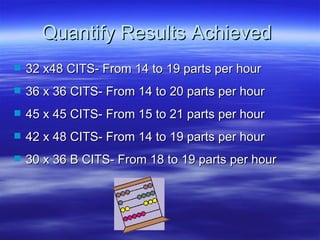
Quantify Results Achieved  32 x48 CITS- From 14 to 19 parts per hour  36 x 36 CITS- From 14 to 20 parts per hour  45 x 45 CITS- From 15 to 21 parts per hour  42 x 48 CITS- From 14 to 19 parts per hour  30 x 36 B CITS- From 18 to 19 parts per hour
Quantify Results Achieved  45 x 45 CITS Pallet = $2.15 per pallet 32 x48 CITS Pallet = $1.87 per pallet 36 x 36 CITS Pallet = $ 2.12 per pallet 42 x 48 CITS Pallet = $ 1.86 per pallet 30 x 36 B CITS Pallet = $0.29 per pallet
Aftermath Celebrate! Follow-Up to insure timely completion of action plans. Don’t be afraid to revisit OPES Workshops if you don’t get the desired results.
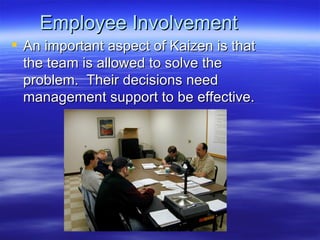
Employee Involvement An important aspect of Kaizen is that the team is allowed to solve the problem.  Their decisions need management support to be effective.
Employee Involvement Some of the best results come from a cross functional team.  A broad perspective helps you see the forest through the trees. Make participation in the workshops sought after.  Bring in lunch, celebrate successes etc.
Total Quality Management Establish a standard for each task. Create an Operational Method Sheet.  Where there is no standard, there will be no improvement. Poke-Yoke (mistake proofing). Design the process so it can only be done correctly. Color Code Size to fit only one way. Irregularly punched holes match only one file.
Operational Method Sheets Shows the standard procedure for performing a task or operation Includes: Elements from previous operations that need to be checked The work content of the task or operation The elements that need to be verified Materials and equipment that are required to complete the task
Total Quality Management Use Do-Check-Verify for critical tasks. Check previous tasks, do your work the same each time, check critical elements upon completion. Do checks across departmental boundaries.
U Shaped One Piece Flow Materials, equipment, and functions arranged in order of use Steps completed in sequence without waste  One piece flow -  no batching ! Supplies and materials at point of use (KANBAN) Visual Management (flexible employees) Five S used and maintained Total Quality Control (Do-Check-Verify)
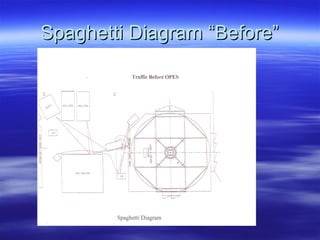
Spaghetti Diagram “Before”
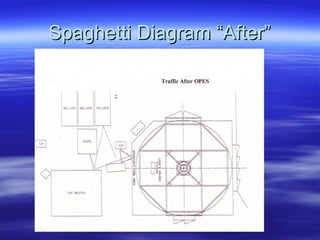
Spaghetti Diagram “After”
Visual Management A philosophy ingrained in our work environment that  visually  tells us what we need to know without verbal communication.
No adult should need to ask another adult what to do! All information should be visible All employees should be empowered to take action Employees will make as good or better decisions as management, given the same information
Visual Management Continued Create a system that gives cell members all the information needed to serve the customer.  Examples include: Designated storage areas for a pallet jack. 5S Improvement Idea Board Takt Boards Andon Lights
The 5 S’s Sort – clearly distinguishing between what is needed and what is not Set In Order – Organizing the way needed things are kept so that anyone can find them easily Shine – Sweeping floors and keeping things looking good Standardize – Sort, Set In Order, and Shine are being maintained Sustain – Always following specified procedures
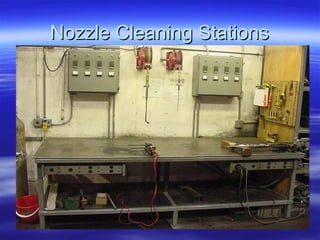
Nozzle Cleaning Stations
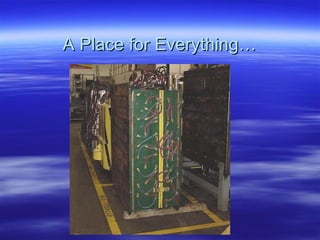
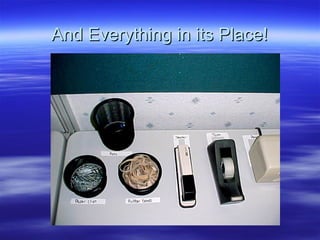
A Place for Everything…
And Everything in its Place!
SMED The theory and techniques for performing set-up operations in under ten minutes.  The goal is to eliminate waste associated with set-up and reduce overall set-up time.  There are three stages to SMED: Separate External and Internal set-up elements. Convert Internal to External set-up elements. Streamline all aspects of the set-up operation.
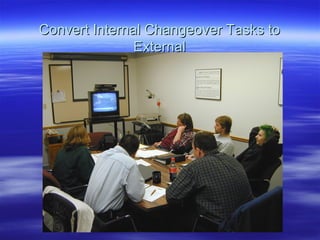
Convert Internal Changeover Tasks to External
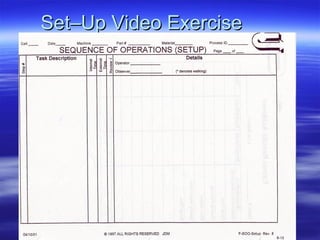
Set–Up Video Exercise
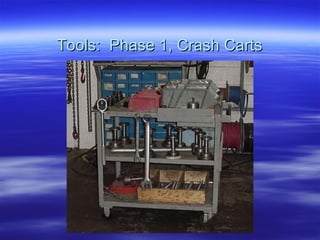
Tools:  Phase 1, Crash Carts
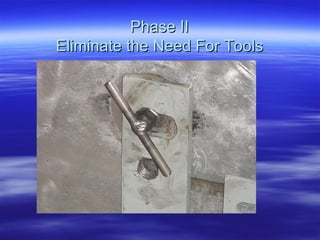
Phase II Eliminate the Need For Tools
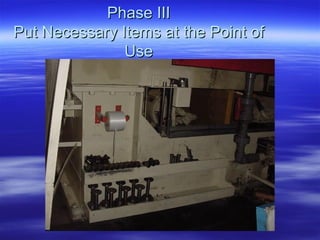
Phase III Put Necessary Items at the Point of Use
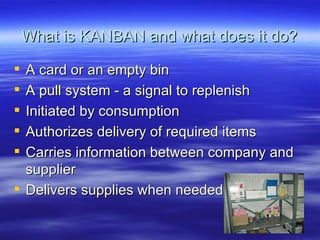
What is KANBAN and what does it do? A card or an empty bin A pull system - a signal to replenish Initiated by consumption Authorizes delivery of required items Carries information between company and supplier Delivers supplies when needed
KANBAN Inventory Control by Visual Records General Rules All containers must have KANBAN cards or labels (green only) No less than two containers of each item Empty containers or KANBAN cards are the only authorization to re-supply Material is held at the supply or producing center until needed Standard containers are always used and filled to the required quantity
KANBAN PULL Inventory Control by Visual Records Example:  Bread in the grocery store The supplier delivers the product to the point of use Re-supply is initiated by the customer Empty space is a KANBAN request to re-fill Visual management signals the supplier to fill the KANBAN Fluctuations (spikes) in demand are addressed by the system  Low inventories and high “turns” insure fresh bread The “process” manages the daily routine –grocer manages the exceptions (visual management)
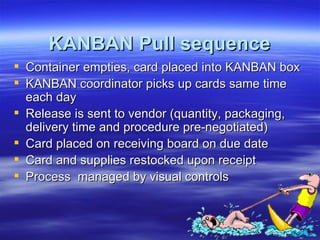
KANBAN Pull sequence Container empties, card placed into KANBAN box KANBAN coordinator picks up cards same time each day Release is sent to vendor (quantity, packaging, delivery time and procedure pre-negotiated)  Card placed on receiving board on due date Card and supplies restocked upon receipt Process  managed by visual controls
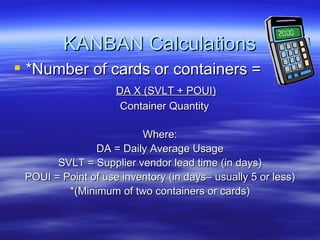
KANBAN Calculations *Number of cards or containers = DA X (SVLT + POUI) Container Quantity Where: DA = Daily Average Usage SVLT = Supplier vendor lead time (in days) POUI = Point of use inventory (in days– usually 5 or less) *(Minimum of two containers or cards)
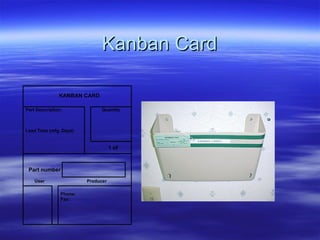
Kanban Card
Questions?

Joe Weiss 2008 Presentation

  • 1.
    Joe Weiss SkillsOverview November 2008 Management By Objective Confrontation Skills Training Lean Manufacturing and Kaizen Experience
  • 2.
  • 3.
    Confrontation Skills TrainingHow to Confront: 1. Set the Climate 2. State your Case 3. Listen for Understanding 4. Negotiate for Improvement and Win Win 5. Agree to move Forward (Goal) 6. Establish Goals and Strategy & Follow-Up
  • 4.
    Confrontation Role PlayExercises Conflict Exercise : Auggie Can’t Keep Up Background to the Supervisor : Auggie is a good employee who is a positive member of the team. He has a great attitude towards his work and often volunteers for unpopular jobs like clean up duty. Auggie struggles to keep up with the Press when both sides are running. When he is running a machine by himself he produces at 88% of standard cycle time. Situation : Two weeks ago you had a short meeting with Auggie about leaving his work area around Press 3 a mess at the end of the shift. Yesterday you had a discussion with the follow on Shift Supervisor (Rafael). Rafael complained that Auggie is leaving his work area a mess and doesn’t appear to be getting better at keeping up, He is leaving untrimmed parts behind fort the next shift. Auggie Profile : Auggie has had difficulty with the pressure of a fast paced production environment. Auggie has great attendance and a positive attitude towards his work. The Overall Problem is : Auggie has an issue working in a production environment. He may not be able to work on a press because he cannot keep up. He should be re-trained and evaluated to see if he is a fit for Molding or the company. When You ______________________________________________________________ It Makes Me Feel_________________________________________________________ Because_________________________________________________________________
  • 5.
  • 6.
    Kaizen is: Geta Cross Functional Team together. Give them some training on the Cellular Manufacturing Principles. Give them the autonomy to make business change. Present what they come up with, and Celebrate Success.
  • 7.
    Goal of Leanis to Eliminate Waste Manufacturing Waste Examples Wasted Time Materials (Scrap) Walking Red Tape Double Handling
  • 8.
    Waste In AnOffice Setting Anything that does not add value to the product or service. Customer on hold or told to call back Documents waiting on approval or signatures Product in queue due to batch operations Waiting for information Sorting, rearranging, prioritizing, excess handling Planning repetitive tasks Mistakes
  • 9.
    Kaizen isthe means to eliminate waste!
  • 10.
    Our Vision Weare a courageous organization. We are the leader in all our markets. We are obsessed with meeting our commitments. We respect and challenge each other and confront issues with a sense of urgency. Our 150-year heritage, values, creative passion and respect for our world are the heart of our organization. We create compelling value for customers, employees, and shareholders.
  • 11.
    ORBIS Vision Customerslove us because we are the best at packaging it right!! We have fun providing creative packaging solutions that enhance our environment and reduce costs to consumers. ORBIS has the absolute best people radiating confidence, energy and passion. We aggressively capture new markets and customers to create compelling value. We relentlessly keep our commitments!!
  • 12.
    Cellular Manufacturing PrinciplesContinuous Improvement (Kaizen) Employee Involvement One Piece Flow Visual Management Total Quality Management Kanban
  • 13.
    Foundation Elements ofKaizen Everything an organization does is a process to be standardized, controlled, and continuously improved. Continuous improvement requires employee involvement.
  • 14.
  • 15.
    Changing the WorkplaceKaizen Workshops should focus on a specific task. Customer request, order, set-up etc. Defeat traditional boundaries, functions, departments (attempt to achieve flow without interruption). Solve/eliminate work practices, rework, approvals etc.
  • 16.
    The Rules OfKaizen Keep an open mind to change. Maintain a positive attitude. Never leave a silent disagreement. Create a blameless environment. Treat others as you would like to be treated. One person, one vote – no position/rank. No such thing as a dumb question. No magic wand – just work smarter.
  • 17.
    Leadership A facilitatoris assigned to provide the Cellular Manufacturing Training and help the group when it becomes stuck. A Team Leader is assigned to insure that everyone contributes and to provide basic leadership through the exercise.
  • 18.
    Final Presentation Theteam presents their findings and action plans in a final presentation. Introduction Team name & Participants Team Objectives Results Achieved Action Plans Follow-Up Meeting (30, 60, 90 days)
  • 19.
  • 20.
    Quantify Results Achieved 32 x48 CITS- From 14 to 19 parts per hour 36 x 36 CITS- From 14 to 20 parts per hour 45 x 45 CITS- From 15 to 21 parts per hour 42 x 48 CITS- From 14 to 19 parts per hour 30 x 36 B CITS- From 18 to 19 parts per hour
  • 21.
    Quantify Results Achieved 45 x 45 CITS Pallet = $2.15 per pallet 32 x48 CITS Pallet = $1.87 per pallet 36 x 36 CITS Pallet = $ 2.12 per pallet 42 x 48 CITS Pallet = $ 1.86 per pallet 30 x 36 B CITS Pallet = $0.29 per pallet
  • 22.
    Aftermath Celebrate! Follow-Upto insure timely completion of action plans. Don’t be afraid to revisit OPES Workshops if you don’t get the desired results.
  • 23.
    Employee Involvement Animportant aspect of Kaizen is that the team is allowed to solve the problem. Their decisions need management support to be effective.
  • 24.
    Employee Involvement Someof the best results come from a cross functional team. A broad perspective helps you see the forest through the trees. Make participation in the workshops sought after. Bring in lunch, celebrate successes etc.
  • 25.
    Total Quality ManagementEstablish a standard for each task. Create an Operational Method Sheet. Where there is no standard, there will be no improvement. Poke-Yoke (mistake proofing). Design the process so it can only be done correctly. Color Code Size to fit only one way. Irregularly punched holes match only one file.
  • 26.
    Operational Method SheetsShows the standard procedure for performing a task or operation Includes: Elements from previous operations that need to be checked The work content of the task or operation The elements that need to be verified Materials and equipment that are required to complete the task
  • 27.
    Total Quality ManagementUse Do-Check-Verify for critical tasks. Check previous tasks, do your work the same each time, check critical elements upon completion. Do checks across departmental boundaries.
  • 28.
    U Shaped OnePiece Flow Materials, equipment, and functions arranged in order of use Steps completed in sequence without waste One piece flow - no batching ! Supplies and materials at point of use (KANBAN) Visual Management (flexible employees) Five S used and maintained Total Quality Control (Do-Check-Verify)
  • 29.
  • 30.
  • 31.
    Visual Management Aphilosophy ingrained in our work environment that visually tells us what we need to know without verbal communication.
  • 32.
    No adult shouldneed to ask another adult what to do! All information should be visible All employees should be empowered to take action Employees will make as good or better decisions as management, given the same information
  • 33.
    Visual Management ContinuedCreate a system that gives cell members all the information needed to serve the customer. Examples include: Designated storage areas for a pallet jack. 5S Improvement Idea Board Takt Boards Andon Lights
  • 34.
    The 5 S’sSort – clearly distinguishing between what is needed and what is not Set In Order – Organizing the way needed things are kept so that anyone can find them easily Shine – Sweeping floors and keeping things looking good Standardize – Sort, Set In Order, and Shine are being maintained Sustain – Always following specified procedures
  • 35.
  • 36.
    A Place forEverything…
  • 37.
  • 38.
    SMED The theoryand techniques for performing set-up operations in under ten minutes. The goal is to eliminate waste associated with set-up and reduce overall set-up time. There are three stages to SMED: Separate External and Internal set-up elements. Convert Internal to External set-up elements. Streamline all aspects of the set-up operation.
  • 39.
    Convert Internal ChangeoverTasks to External
  • 40.
  • 41.
    Tools: Phase1, Crash Carts
  • 42.
    Phase II Eliminatethe Need For Tools
  • 43.
    Phase III PutNecessary Items at the Point of Use
  • 44.
    What is KANBANand what does it do? A card or an empty bin A pull system - a signal to replenish Initiated by consumption Authorizes delivery of required items Carries information between company and supplier Delivers supplies when needed
  • 45.
    KANBAN Inventory Controlby Visual Records General Rules All containers must have KANBAN cards or labels (green only) No less than two containers of each item Empty containers or KANBAN cards are the only authorization to re-supply Material is held at the supply or producing center until needed Standard containers are always used and filled to the required quantity
  • 46.
    KANBAN PULL InventoryControl by Visual Records Example: Bread in the grocery store The supplier delivers the product to the point of use Re-supply is initiated by the customer Empty space is a KANBAN request to re-fill Visual management signals the supplier to fill the KANBAN Fluctuations (spikes) in demand are addressed by the system Low inventories and high “turns” insure fresh bread The “process” manages the daily routine –grocer manages the exceptions (visual management)
  • 47.
    KANBAN Pull sequenceContainer empties, card placed into KANBAN box KANBAN coordinator picks up cards same time each day Release is sent to vendor (quantity, packaging, delivery time and procedure pre-negotiated) Card placed on receiving board on due date Card and supplies restocked upon receipt Process managed by visual controls
  • 48.
    KANBAN Calculations *Numberof cards or containers = DA X (SVLT + POUI) Container Quantity Where: DA = Daily Average Usage SVLT = Supplier vendor lead time (in days) POUI = Point of use inventory (in days– usually 5 or less) *(Minimum of two containers or cards)
  • 49.
  • 50.

Editor's Notes

  • #2 Joe Weiss Skills Presentation 11/4/08