6.Mechanical Springs
D. NarendraVarma,
Assistant Professor,
Mechanical Engineering Dept.,
Miracle Educational society Group of Institutions.
Syllabus
▪ Introduction
▪ Stresses and Deflection of Helical springs
▪ Extension springs
▪ Compression springs
▪ Springs of Fatigue Loading
▪ Energy Storage Capacity
▪ Helical torsional springs
▪ Coaxial springs , Leaf springs
Introduction
▪ A spring is defined as an elastic body, which deflects under
the action of load and returns to its original shape when the
load is removed.The various important applications of
springs are as follows:
1.To cushion, absorb or control energy due to either shock or
vibration as in car springs, railway buffers, air-craft landing
gears, shock absorbers and vibration dampers.
2.To apply forces, as in brakes, clutches and spring loaded
valves.
3.To control motion by maintaining contact between two
elements as in cams and followers.
4.To measure forces, as in spring balances and engine
indicators.
5.To store energy, as in watches, toys, etc.
Types of springs:
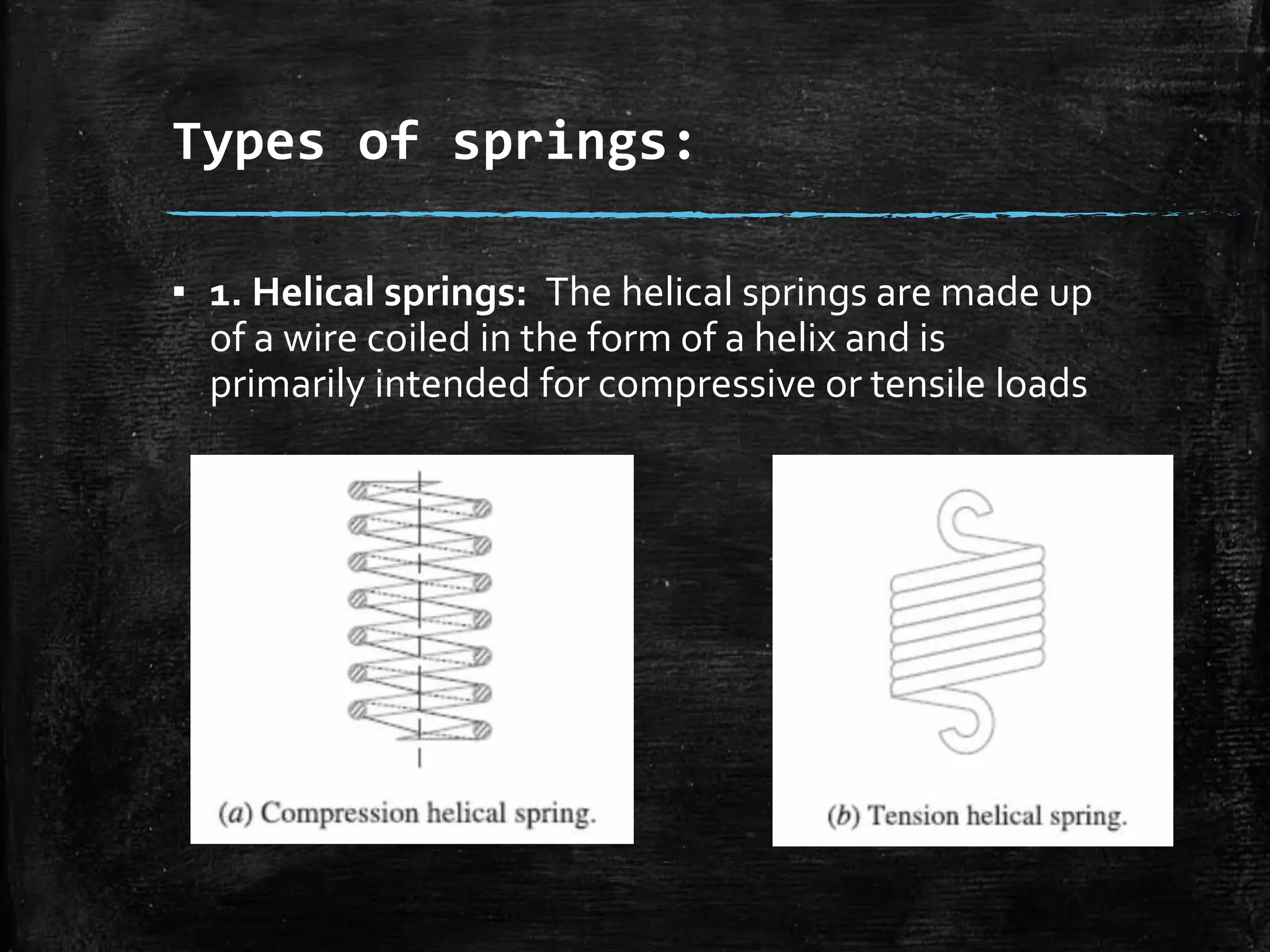
▪ 1. Helical springs: The helical springs are made up
of a wire coiled in the form of a helix and is
primarily intended for compressive or tensile loads
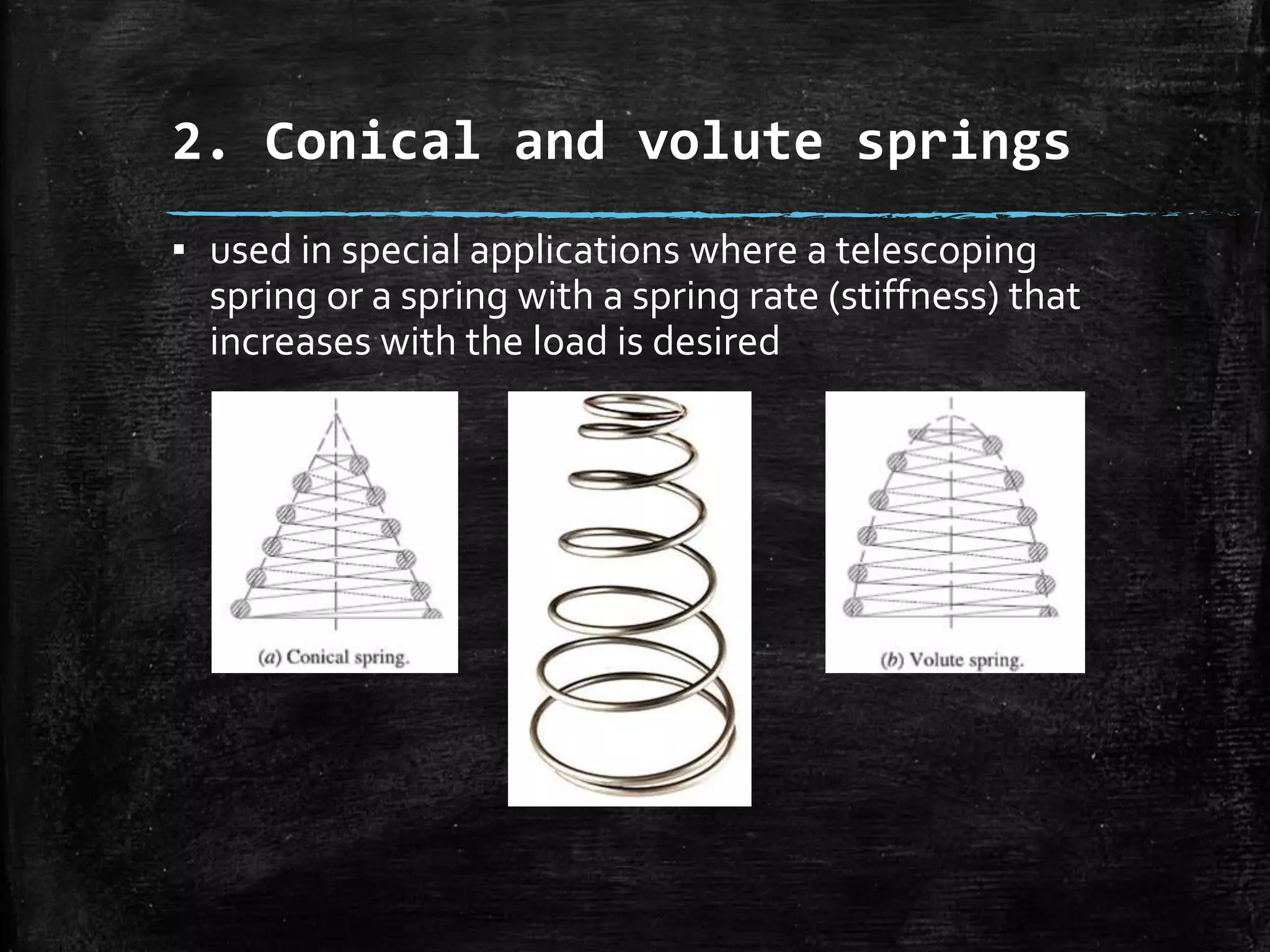
2. Conical and volute springs
▪ used in special applications where a telescoping
spring or a spring with a spring rate (stiffness) that
increases with the load is desired
Volute springs
3. Torsion springs:
helical type may be used only in applications
where the load tends to wind up the spring and
are used in various electrical mechanisms
Helical Torsional spring –
Battery lid of a camera , mouse
trap
4. Laminated or leaf springs
▪ The laminated or leaf spring (also known as flat
spring) consists of a number of flat plates (known
as leaves) of varying lengths held together by
means of clamps and bolts.
5. Disc or bellevile springs.
▪ These springs consist of a number of conical discs
held together against slipping by a central bolt or
tube.
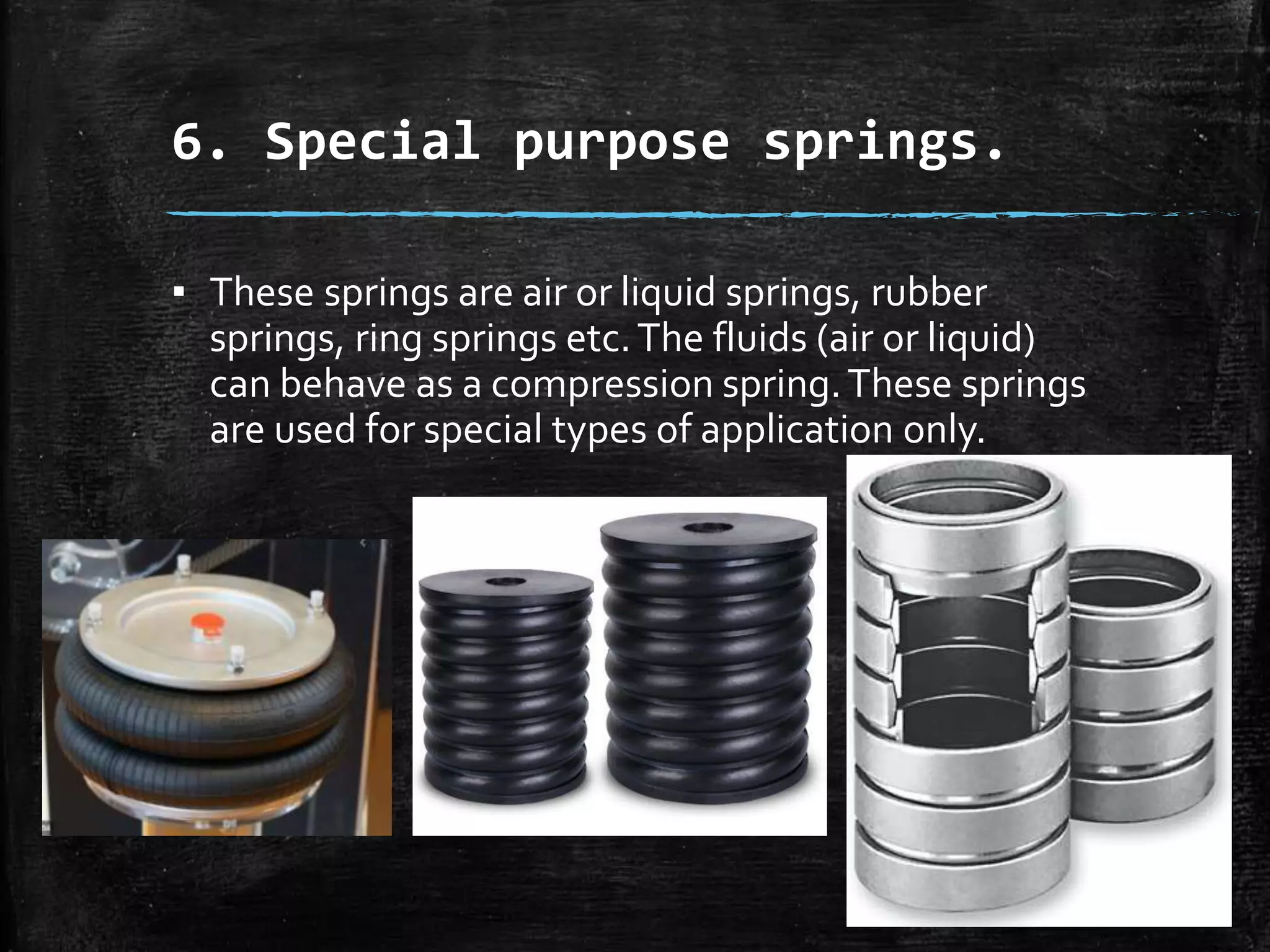
6. Special purpose springs.
▪ These springs are air or liquid springs, rubber
springs, ring springs etc.The fluids (air or liquid)
can behave as a compression spring.These springs
are used for special types of application only.
Terms used in Compression Springs
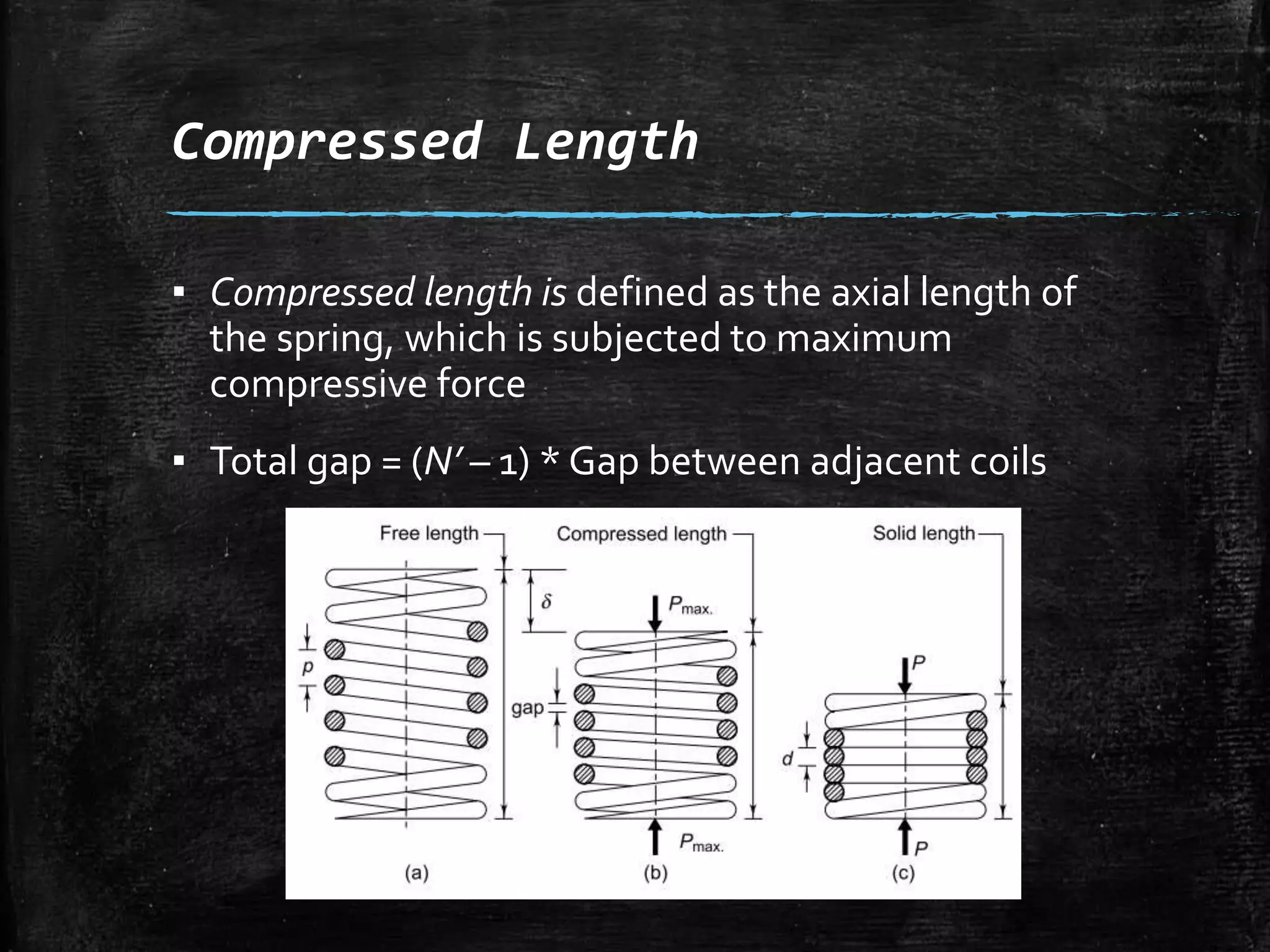
▪ Solid length: When the compression spring is
compressed until the coils come in contact with
each other, then the spring is said to be Solid
Solid length of the spring, Ls = n'.d
where n' =Total number of coils, and d = Diameter of
the wire.
▪ Free length: The free length of a compression
spring, is the length of the spring in the free or
unloaded condition.
Compressed Length
▪ Compressed length is defined as the axial length of
the spring, which is subjected to maximum
compressive force
▪ Total gap = (N’ – 1) * Gap between adjacent coils
Free Length & Spring index
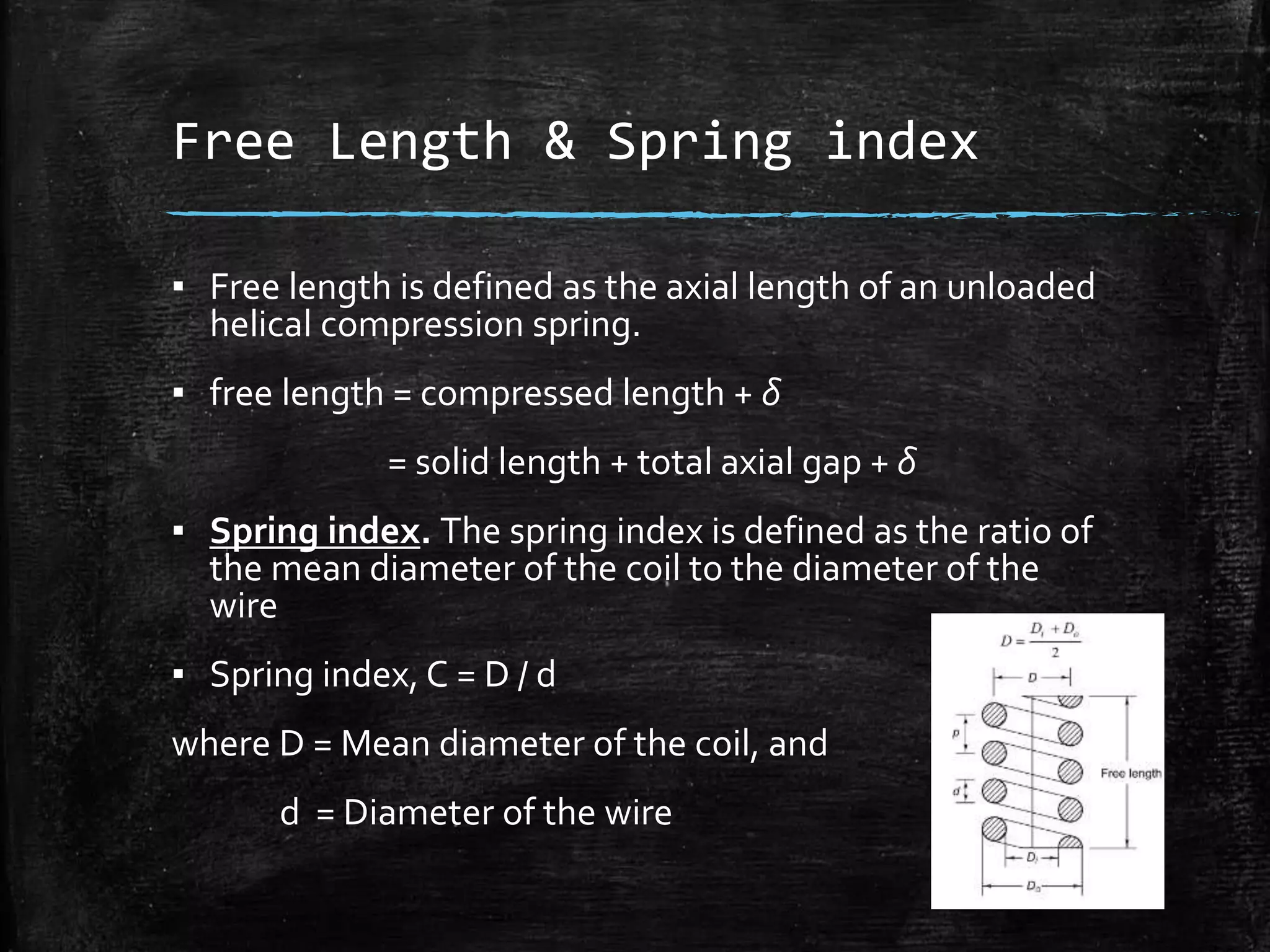
▪ Free length is defined as the axial length of an unloaded
helical compression spring.
▪ free length = compressed length + δ
= solid length + total axial gap + δ
▪ Spring index. The spring index is defined as the ratio of
the mean diameter of the coil to the diameter of the
wire
▪ Spring index, C = D / d
where D = Mean diameter of the coil, and
d = Diameter of the wire
Spring Rate & Pitch
▪ Spring rate: The spring rate (or stiffness or spring
constant) is defined as the load required per unit
deflection of the spring. Mathematically,
▪ Spring rate, k =W / d
whereW = Load, and d = Deflection of the spring.
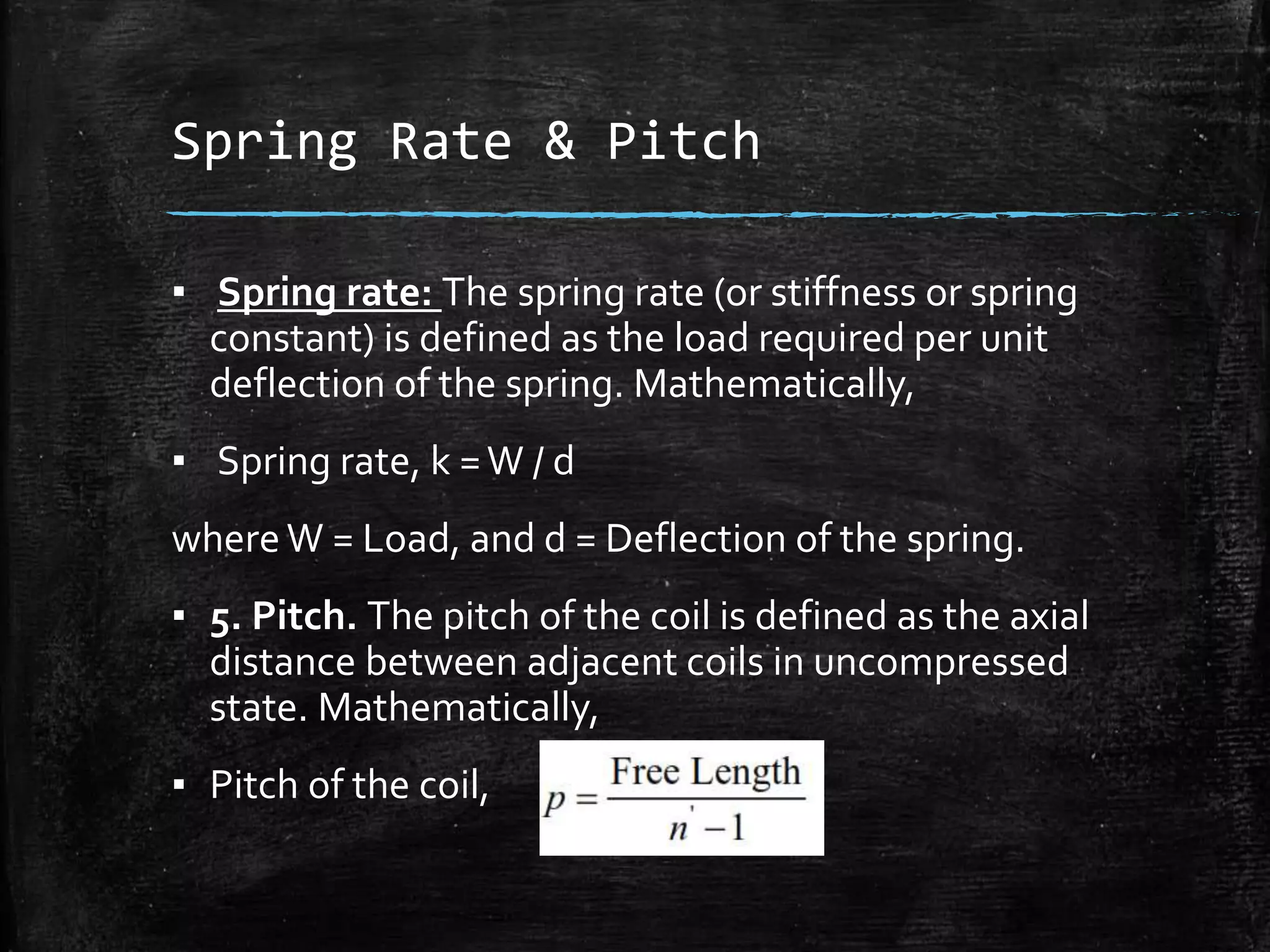
▪ 5. Pitch. The pitch of the coil is defined as the axial
distance between adjacent coils in uncompressed
state. Mathematically,
▪ Pitch of the coil,
References
1. Machine Design –V.B.Bhandari .
2. Machine Design – R.S. Khurmi
3. Design Data hand Book - S.Md.Jalaludeen

6 Mechanial springs Introduction

  • 1.
    6.Mechanical Springs D. NarendraVarma, AssistantProfessor, Mechanical Engineering Dept., Miracle Educational society Group of Institutions.
  • 2.
    Syllabus ▪ Introduction ▪ Stressesand Deflection of Helical springs ▪ Extension springs ▪ Compression springs ▪ Springs of Fatigue Loading ▪ Energy Storage Capacity ▪ Helical torsional springs ▪ Coaxial springs , Leaf springs
  • 3.
    Introduction ▪ A springis defined as an elastic body, which deflects under the action of load and returns to its original shape when the load is removed.The various important applications of springs are as follows: 1.To cushion, absorb or control energy due to either shock or vibration as in car springs, railway buffers, air-craft landing gears, shock absorbers and vibration dampers. 2.To apply forces, as in brakes, clutches and spring loaded valves. 3.To control motion by maintaining contact between two elements as in cams and followers. 4.To measure forces, as in spring balances and engine indicators. 5.To store energy, as in watches, toys, etc.
  • 4.
    Types of springs: ▪1. Helical springs: The helical springs are made up of a wire coiled in the form of a helix and is primarily intended for compressive or tensile loads
  • 5.
    2. Conical andvolute springs ▪ used in special applications where a telescoping spring or a spring with a spring rate (stiffness) that increases with the load is desired
  • 6.
  • 7.
    3. Torsion springs: helicaltype may be used only in applications where the load tends to wind up the spring and are used in various electrical mechanisms
  • 8.
    Helical Torsional spring– Battery lid of a camera , mouse trap
  • 9.
    4. Laminated orleaf springs ▪ The laminated or leaf spring (also known as flat spring) consists of a number of flat plates (known as leaves) of varying lengths held together by means of clamps and bolts.
  • 10.
    5. Disc orbellevile springs. ▪ These springs consist of a number of conical discs held together against slipping by a central bolt or tube.
  • 11.
    6. Special purposesprings. ▪ These springs are air or liquid springs, rubber springs, ring springs etc.The fluids (air or liquid) can behave as a compression spring.These springs are used for special types of application only.
  • 12.
    Terms used inCompression Springs ▪ Solid length: When the compression spring is compressed until the coils come in contact with each other, then the spring is said to be Solid Solid length of the spring, Ls = n'.d where n' =Total number of coils, and d = Diameter of the wire. ▪ Free length: The free length of a compression spring, is the length of the spring in the free or unloaded condition.
  • 13.
    Compressed Length ▪ Compressedlength is defined as the axial length of the spring, which is subjected to maximum compressive force ▪ Total gap = (N’ – 1) * Gap between adjacent coils
  • 14.
    Free Length &Spring index ▪ Free length is defined as the axial length of an unloaded helical compression spring. ▪ free length = compressed length + δ = solid length + total axial gap + δ ▪ Spring index. The spring index is defined as the ratio of the mean diameter of the coil to the diameter of the wire ▪ Spring index, C = D / d where D = Mean diameter of the coil, and d = Diameter of the wire
  • 15.
    Spring Rate &Pitch ▪ Spring rate: The spring rate (or stiffness or spring constant) is defined as the load required per unit deflection of the spring. Mathematically, ▪ Spring rate, k =W / d whereW = Load, and d = Deflection of the spring. ▪ 5. Pitch. The pitch of the coil is defined as the axial distance between adjacent coils in uncompressed state. Mathematically, ▪ Pitch of the coil,
  • 16.
    References 1. Machine Design–V.B.Bhandari . 2. Machine Design – R.S. Khurmi 3. Design Data hand Book - S.Md.Jalaludeen