PRESENTATION
ON
GOVERNOR
By-
Amit Yadav
131mc00301
CONTENT
• Introduction
• Types of governors
• force analysis of Porter and Hartnell governors
• Controlling force
• Stability
• Sensitiveness
• Isochronisms
• effort and power
Introduction
• The function of a governor is to regulate the mean
speed of an engine, when there are variations in the load
• For example, when the load on an engine increases, its
speed decreases, therefore it becomes necessary to
increase the supply of working fluid.
• On the other hand, when the load on the engine
decreases, its speed increases and thus less working
fluid is required.
• The governor automatically controls the supply of
working fluid to the engine with the varying load
conditions and keeps the mean speed within
certain limits.
• A little consideration will show that, when the
load increases, the configuration of the governor
changes and a valve is moved to increase the
supply of the working fluid ; conversely, when the
load decreases, the engine speed increases and
the governor decreases the supply of working
fluid.
Types of Governors
• The governors may, broadly, be classified as
1. Centrifugal governors
2. Inertia governors.
Centrifugal Governors
• The centrifugal governors are based on the balancing of centrifugal
force on the rotating balls by an equal and opposite radial force,
known as the controlling force.
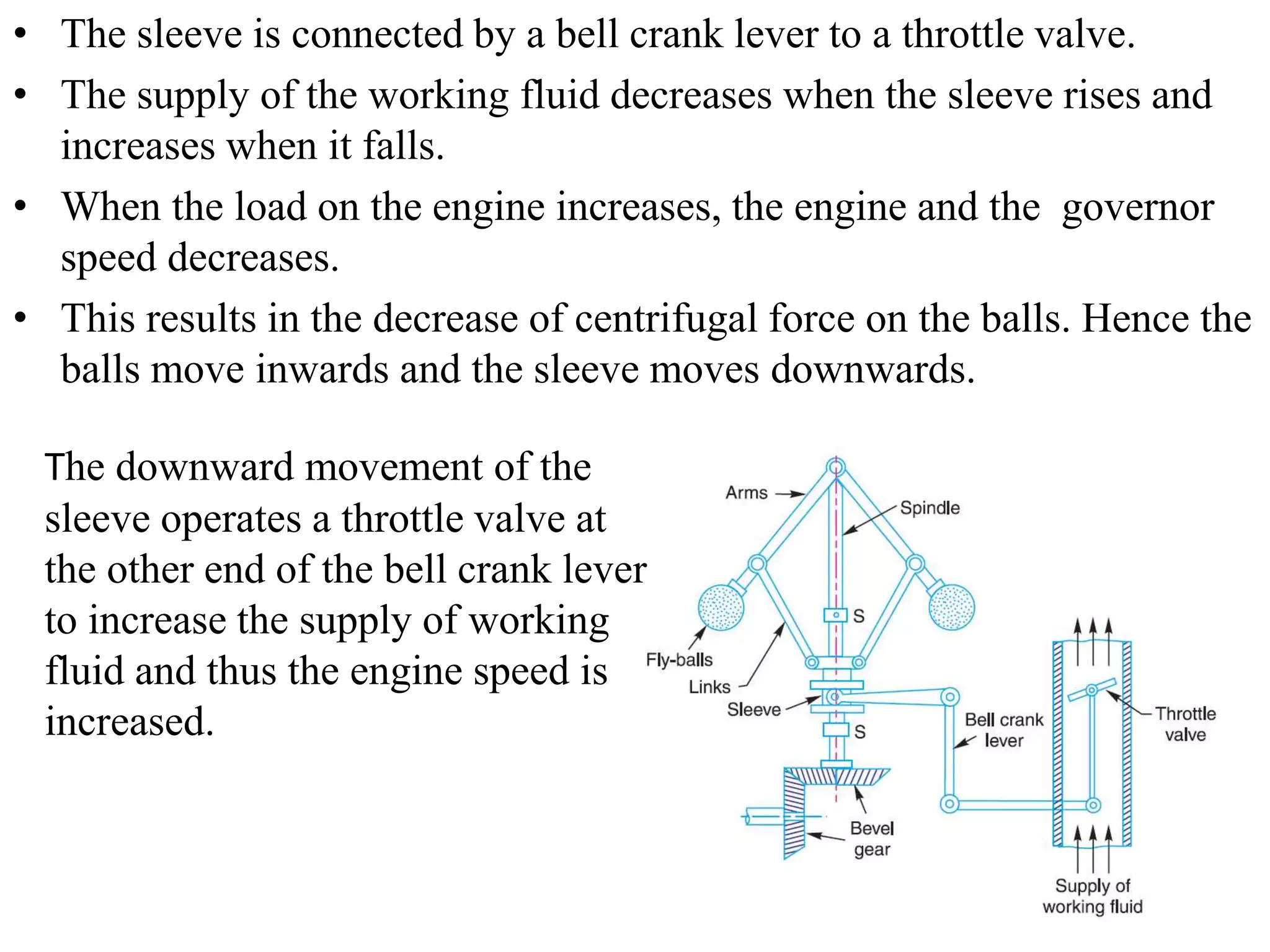
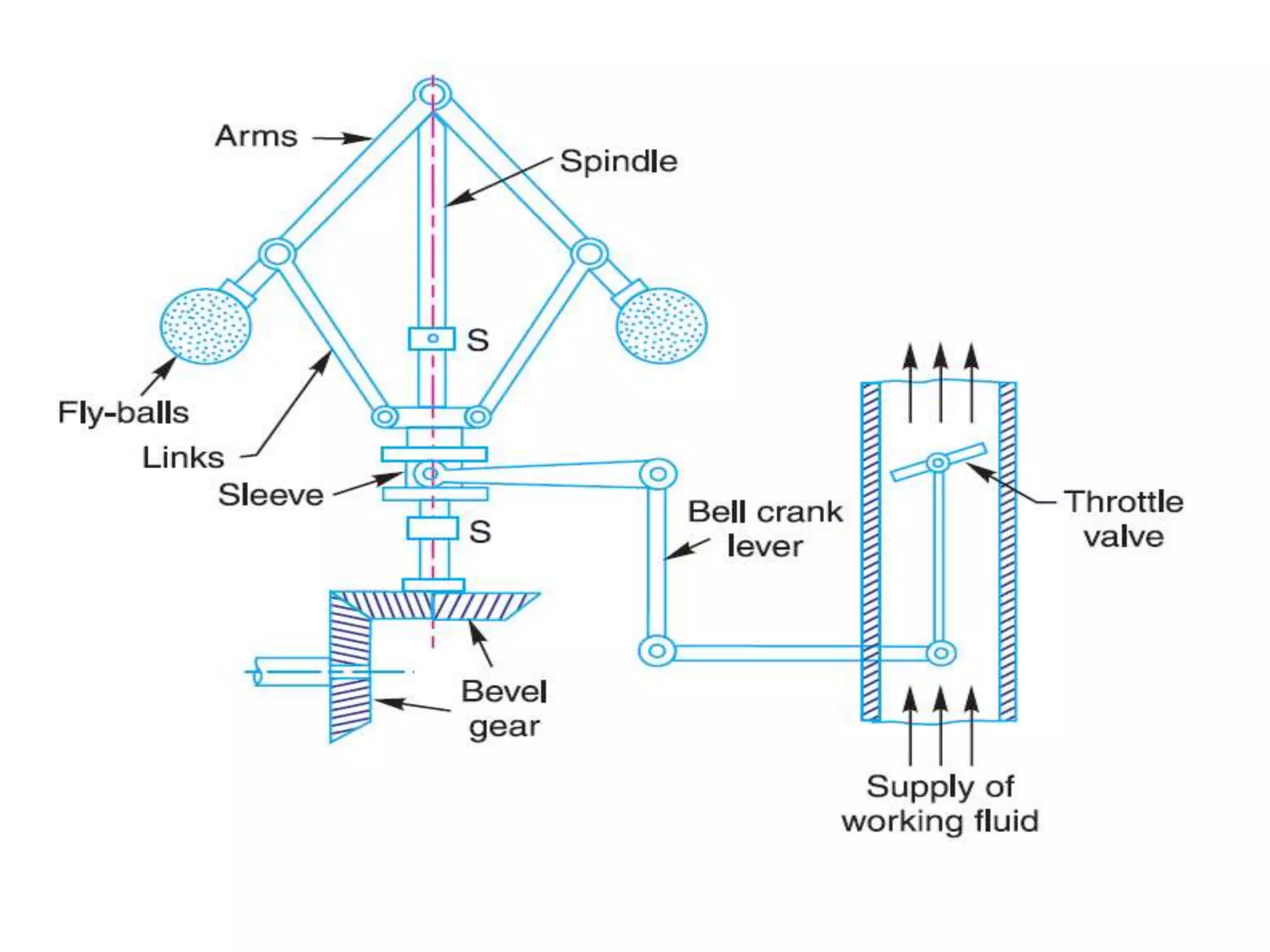
• It consists of two balls of equal mass, which are attached to
the arms as shown in Fig.
• These balls are known as governor balls or fly balls. The
balls revolve with a spindle, which is driven by the engine
through bevel gears.
• The upper ends of the arms are pivoted to the spindle, so
that the balls may rise up or fall down as they revolve about
the vertical axis.
• The arms are connected by the links to a sleeve, which is
keyed to the spindle. This sleeve revolves with the spindle ;
but can slide up and down
• The arms are connected by the links to a sleeve, which is keyed to the
spindle. This sleeve revolves with the spindle ; but can slide up and
down.
• The balls and the sleeve rises when the spindle speed increases, and
falls when the speed decreases.
In order to limit the travel of the
sleeve in upward and downward
directions, two stops S, S are
provided on the spindle.
• The sleeve is connected by a bell crank lever to a throttle valve.
• The supply of the working fluid decreases when the sleeve rises and
increases when it falls.
• When the load on the engine increases, the engine and the governor
speed decreases.
• This results in the decrease of centrifugal force on the balls. Hence the
balls move inwards and the sleeve moves downwards.
The downward movement of the
sleeve operates a throttle valve at
the other end of the bell crank lever
to increase the supply of working
fluid and thus the engine speed is
increased.
• When the load on the engine decreases, the engine and the governor
speed increases, which results in the increase of centrifugal force on
the balls.
• Thus the balls move outwards and the sleeve rises upwards.
• This upward movement of the sleeve reduces the supply of the
working fluid and hence the speed is decreased. In this case, the
power output is reduced.
Terms Used in Governors
• The following terms used in governors are important from the
subject point of view ;
1. Height of a governor. It is the vertical distance from the centre
of the ball to a point where the axes of the arms (or arms
produced) intersect on the spindle axis. It is usually denoted by h.
2. Equilibrium speed. It is the speed at which the governor balls,
arms etc., are in complete equilibrium and the sleeve does not
tend to move upwards or downwards.
3. Mean equilibrium speed. It is the speed at the mean position of
the balls or the sleeve.
4. Maximum and minimum equilibrium speeds. The speeds at the
maximum and minimum radius of rotation of the balls, without
tending to move either way are known as maximum and
minimum equilibrium speeds respectively.
5. Sleeve lift. It is the vertical distance which the sleeve travels due
to change in equilibrium speed.
Porter Governor
• In Porter governor central load is
attached to the sleeve as shown in Fig .
• The load moves up and down the central
spindle. This additional downward force
increases the speed of revolution required
to enable the balls to rise to any
predetermined level.
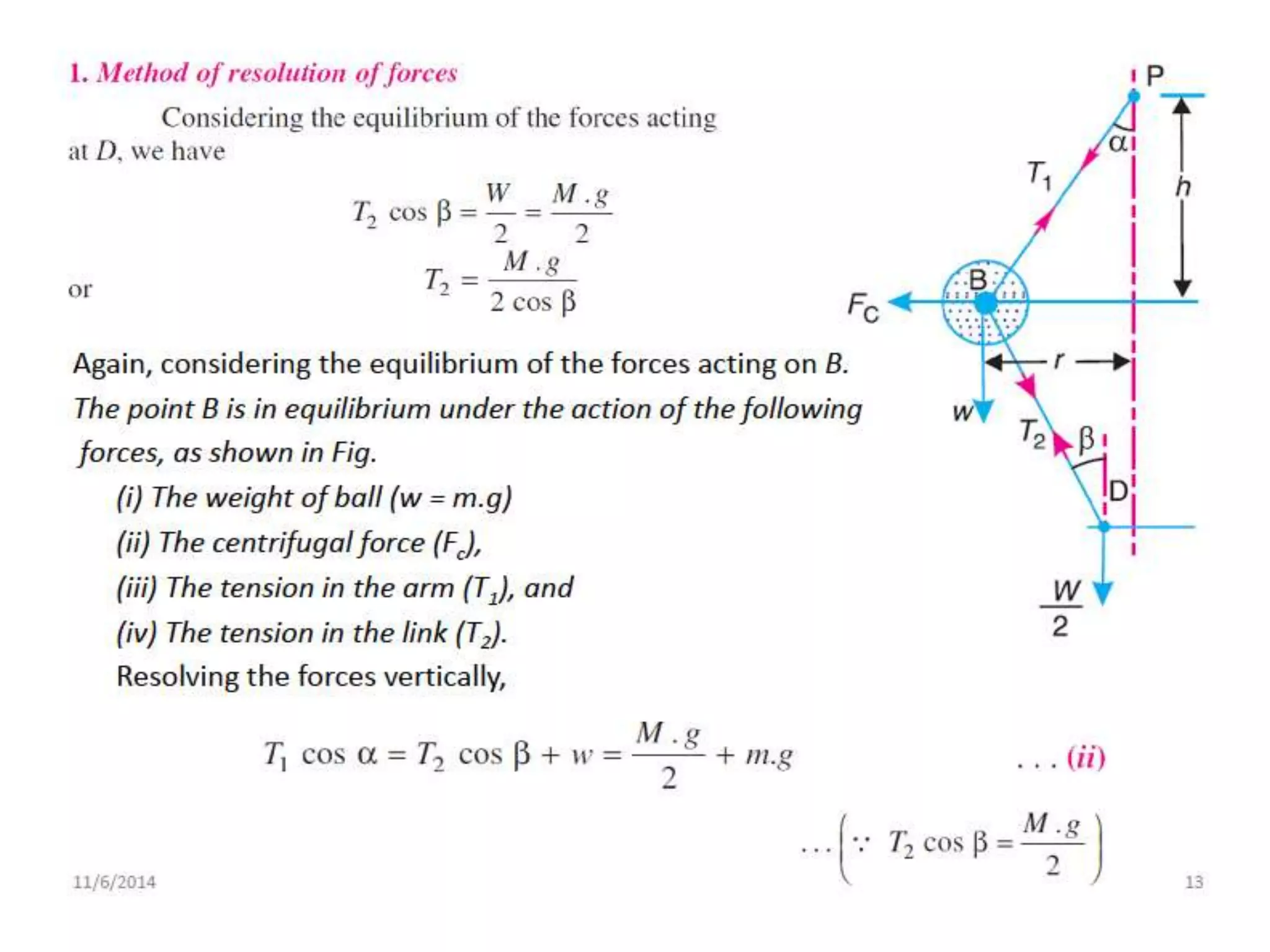
• Consider the forces acting on one-half of
the governor as shown in Fig.
4/8/2016
Though there are several ways of
determining the relation between the
height of the governor (h) and the angular
speed of the balls (ω), yet the following
two methods are important from the
subject point of view :
1. Method of resolution of forces ; and
2. Instantaneous centre method.
4/8/2016
Hareesha N G, Dept of Aero Engg, DSCE,
Blore
15
4/8/2016
Hareesha N G, Dept of Aero Engg, DSCE,
Blore
16
4/8/2016
Hareesha N G, Dept of Aero Engg, DSCE,
Blore
17
Hartnell Governor
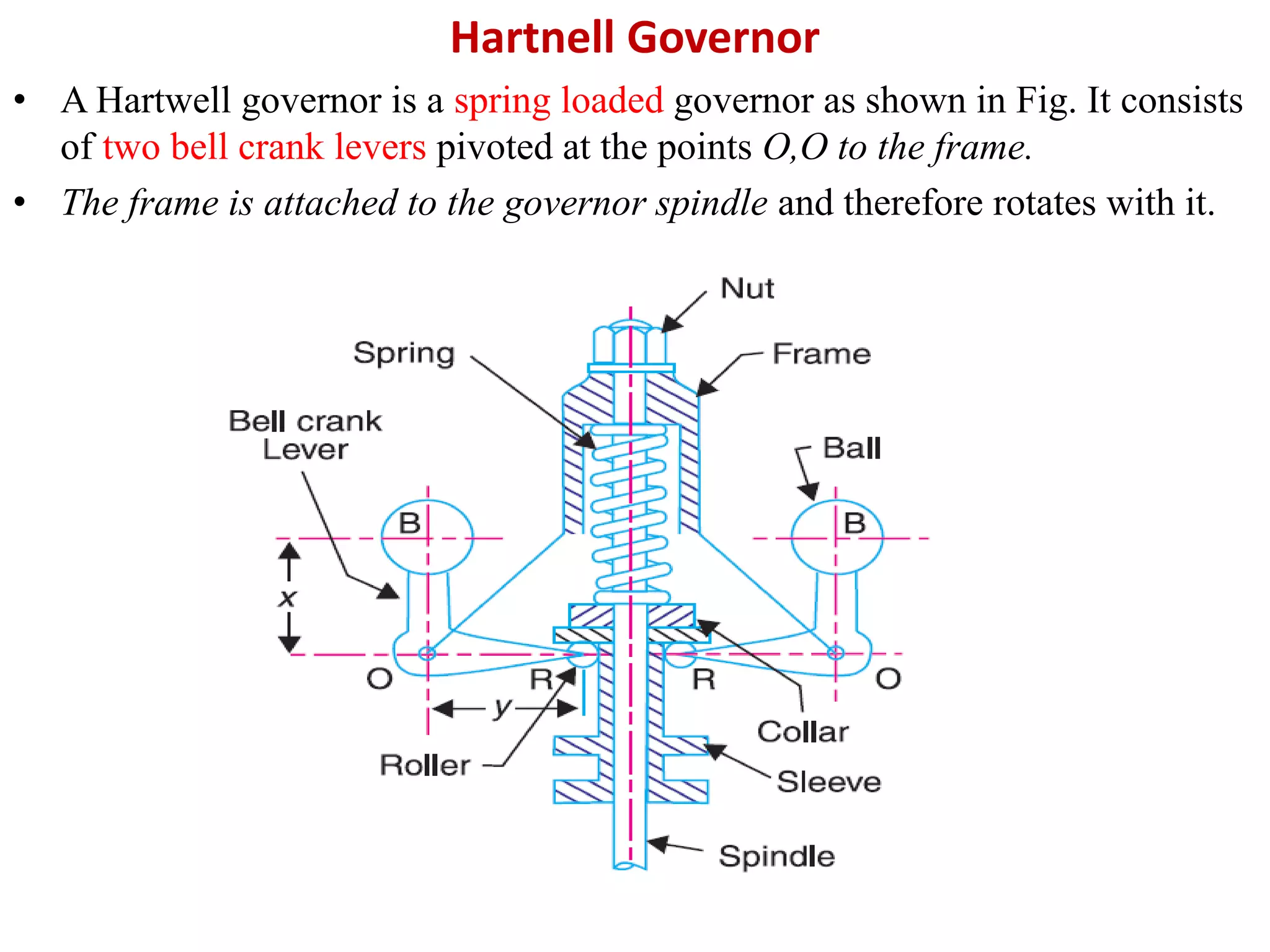
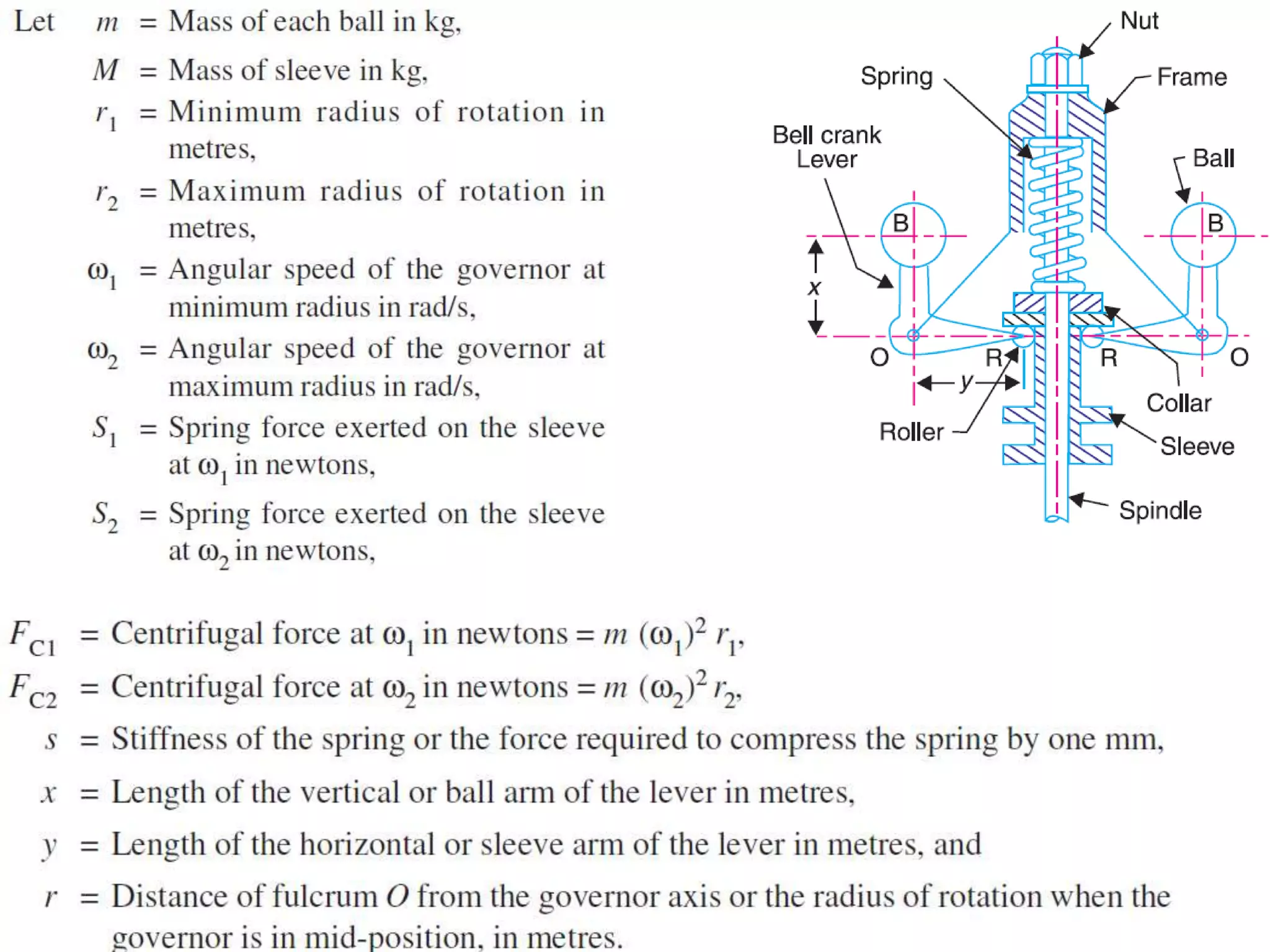
• A Hartwell governor is a spring loaded governor as shown in Fig. It consists
of two bell crank levers pivoted at the points O,O to the frame.
• The frame is attached to the governor spindle and therefore rotates with it.
• Each lever carries a ball at the end of the
vertical arm OB and a roller at the end of the
horizontal arm OR.
• A helical spring in compression provides equal
downward forces on the two rollers through a
collar on the sleeve.
• The spring force may be adjusted by screwing
a nut up or down on the sleeve.
4/8/2016 Hareesha N G, Dept of Aero Engg, DSCE, Blore
Controlling Force
• We know that when a body rotates in a circular path, there is
an inward radial force or centripetal force acting on it.
• In case of a governor running at a steady speed, the inward
force acting on the rotating balls is known as controlling force.
• It is equal and opposite to the centrifugal reaction.
• The controlling force is provided by the weight of the sleeve
and balls as in Porter governor and by the spring and weight as
in Hartnell governor (or spring controlled governor).
Stability of Governors
• A governor is said to be stable when for every speed within the
working range there is a definite configuration i.e. there is
only one radius of rotation of the governor balls at which the
governor is in equilibrium.
• For a stable governor, if the equilibrium speed increases, the
radius of governor balls must also increase.
• Note : A governor is said to be unstable, if the radius of
rotation decreases as the speed increases.
Governor Effort and Power
Governor effort and power can be used to compare the effectiveness of
different type of governors.
Governor Effort :
It is defined as the mean force exerted on the sleeve during a
given change in speed. When governor speed is constant the net force at
the sleeve is zero. When governor speed increases, there will be a net
force on the sleeve to move it upwards and sleeve starts moving to the
new equilibrium position where net force becomes zero.
It is defined as the work done at the sleeve for a given change in speed.
Therefore,
Power of governor = Governor effort x Displacement of sleeve
Characteristics of Governors
Different governors can be compared on the basis of following
characteristics :
1.Stability :
A governor is said to be stable when there is one radius of rotation of
the balls for each speed which is within the speed range of the governor.
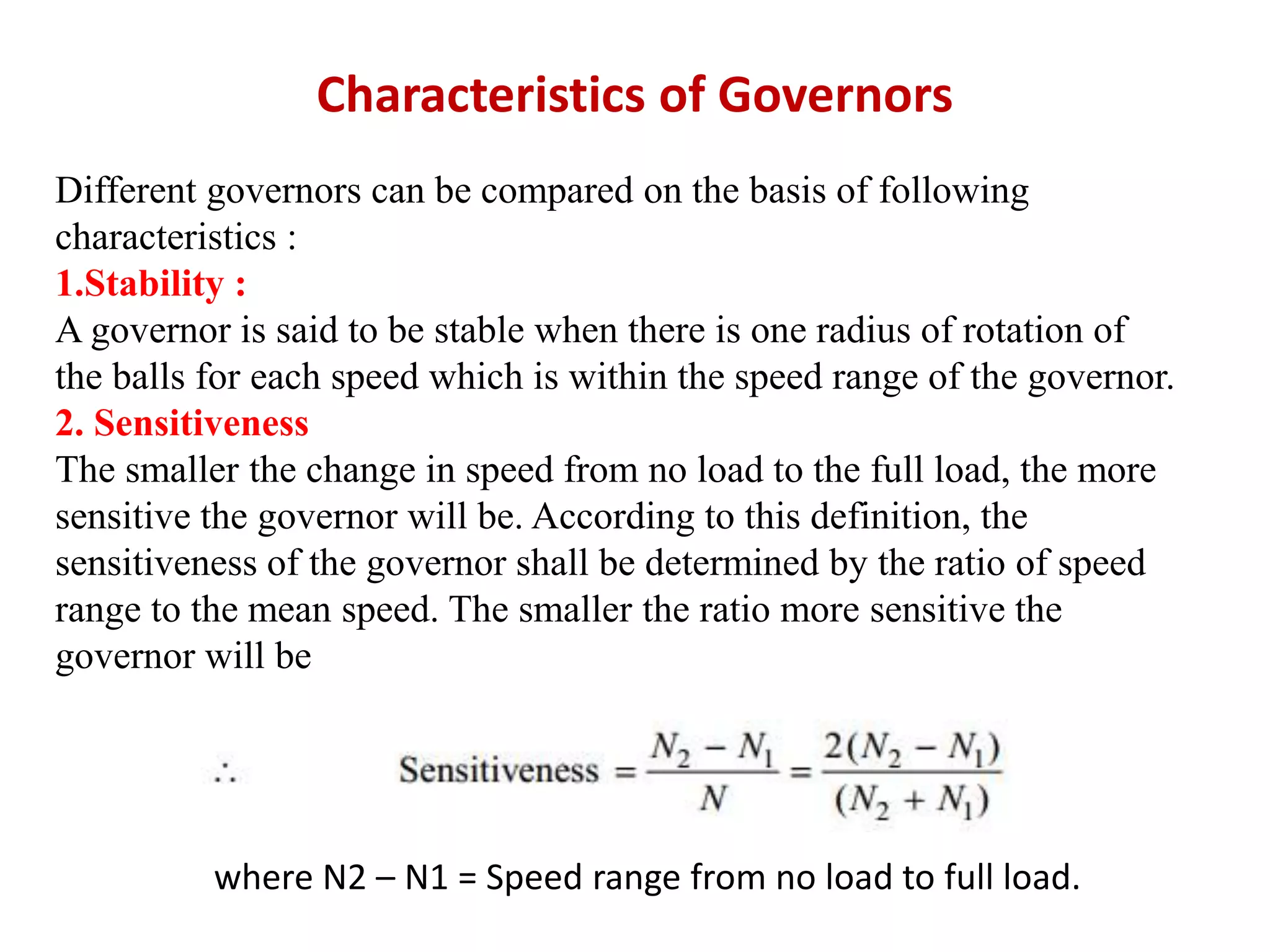
2. Sensitiveness
The smaller the change in speed from no load to the full load, the more
sensitive the governor will be. According to this definition, the
sensitiveness of the governor shall be determined by the ratio of speed
range to the mean speed. The smaller the ratio more sensitive the
governor will be
where N2 – N1 = Speed range from no load to full load.
3.Isochronism
A governor is said to be isochronous if equilibrium speed is
constant for all the radii of rotation in the working range. Therefore, for an
isochronous governor the speed range is zero and this type of governor
shall maintain constant speed.
4.Hunting
Whenever there is change in speed due to the change in load on
the engine, the sleeve moves towards the new position but because of
inertia if overshoots the desired position. Sleeve then moves back but
again overshoots the desired position due to inertia. This results in setting
up of oscillations in engine speed. If the frequency of fluctuations in
engine speed coincides with the natural frequency of oscillations of the
governor, this results in increase of amplitude of oscillations due to
resonance. The governor, then, tends to intensity the speed variation
instead of controlling it. This phenomenon is known as hunting of the
governor. Higher the sensitiveness of the governor, the problem of hunting
becomes more acute.
THANK
YOU

Governor

  • 1.
  • 2.
    CONTENT • Introduction • Typesof governors • force analysis of Porter and Hartnell governors • Controlling force • Stability • Sensitiveness • Isochronisms • effort and power
  • 3.
    Introduction • The functionof a governor is to regulate the mean speed of an engine, when there are variations in the load • For example, when the load on an engine increases, its speed decreases, therefore it becomes necessary to increase the supply of working fluid. • On the other hand, when the load on the engine decreases, its speed increases and thus less working fluid is required.
  • 4.
    • The governorautomatically controls the supply of working fluid to the engine with the varying load conditions and keeps the mean speed within certain limits. • A little consideration will show that, when the load increases, the configuration of the governor changes and a valve is moved to increase the supply of the working fluid ; conversely, when the load decreases, the engine speed increases and the governor decreases the supply of working fluid.
  • 5.
    Types of Governors •The governors may, broadly, be classified as 1. Centrifugal governors 2. Inertia governors.
  • 6.
    Centrifugal Governors • Thecentrifugal governors are based on the balancing of centrifugal force on the rotating balls by an equal and opposite radial force, known as the controlling force.
  • 7.
    • It consistsof two balls of equal mass, which are attached to the arms as shown in Fig. • These balls are known as governor balls or fly balls. The balls revolve with a spindle, which is driven by the engine through bevel gears. • The upper ends of the arms are pivoted to the spindle, so that the balls may rise up or fall down as they revolve about the vertical axis. • The arms are connected by the links to a sleeve, which is keyed to the spindle. This sleeve revolves with the spindle ; but can slide up and down
  • 8.
    • The armsare connected by the links to a sleeve, which is keyed to the spindle. This sleeve revolves with the spindle ; but can slide up and down. • The balls and the sleeve rises when the spindle speed increases, and falls when the speed decreases. In order to limit the travel of the sleeve in upward and downward directions, two stops S, S are provided on the spindle.
  • 9.
    • The sleeveis connected by a bell crank lever to a throttle valve. • The supply of the working fluid decreases when the sleeve rises and increases when it falls. • When the load on the engine increases, the engine and the governor speed decreases. • This results in the decrease of centrifugal force on the balls. Hence the balls move inwards and the sleeve moves downwards. The downward movement of the sleeve operates a throttle valve at the other end of the bell crank lever to increase the supply of working fluid and thus the engine speed is increased.
  • 10.
    • When theload on the engine decreases, the engine and the governor speed increases, which results in the increase of centrifugal force on the balls. • Thus the balls move outwards and the sleeve rises upwards. • This upward movement of the sleeve reduces the supply of the working fluid and hence the speed is decreased. In this case, the power output is reduced.
  • 11.
    Terms Used inGovernors • The following terms used in governors are important from the subject point of view ; 1. Height of a governor. It is the vertical distance from the centre of the ball to a point where the axes of the arms (or arms produced) intersect on the spindle axis. It is usually denoted by h. 2. Equilibrium speed. It is the speed at which the governor balls, arms etc., are in complete equilibrium and the sleeve does not tend to move upwards or downwards. 3. Mean equilibrium speed. It is the speed at the mean position of the balls or the sleeve. 4. Maximum and minimum equilibrium speeds. The speeds at the maximum and minimum radius of rotation of the balls, without tending to move either way are known as maximum and minimum equilibrium speeds respectively. 5. Sleeve lift. It is the vertical distance which the sleeve travels due to change in equilibrium speed.
  • 13.
    Porter Governor • InPorter governor central load is attached to the sleeve as shown in Fig . • The load moves up and down the central spindle. This additional downward force increases the speed of revolution required to enable the balls to rise to any predetermined level. • Consider the forces acting on one-half of the governor as shown in Fig.
  • 14.
    4/8/2016 Though there areseveral ways of determining the relation between the height of the governor (h) and the angular speed of the balls (ω), yet the following two methods are important from the subject point of view : 1. Method of resolution of forces ; and 2. Instantaneous centre method.
  • 15.
    4/8/2016 Hareesha N G,Dept of Aero Engg, DSCE, Blore 15
  • 16.
    4/8/2016 Hareesha N G,Dept of Aero Engg, DSCE, Blore 16
  • 17.
    4/8/2016 Hareesha N G,Dept of Aero Engg, DSCE, Blore 17
  • 18.
    Hartnell Governor • AHartwell governor is a spring loaded governor as shown in Fig. It consists of two bell crank levers pivoted at the points O,O to the frame. • The frame is attached to the governor spindle and therefore rotates with it.
  • 19.
    • Each levercarries a ball at the end of the vertical arm OB and a roller at the end of the horizontal arm OR. • A helical spring in compression provides equal downward forces on the two rollers through a collar on the sleeve. • The spring force may be adjusted by screwing a nut up or down on the sleeve.
  • 20.
    4/8/2016 Hareesha NG, Dept of Aero Engg, DSCE, Blore
  • 21.
    Controlling Force • Weknow that when a body rotates in a circular path, there is an inward radial force or centripetal force acting on it. • In case of a governor running at a steady speed, the inward force acting on the rotating balls is known as controlling force. • It is equal and opposite to the centrifugal reaction. • The controlling force is provided by the weight of the sleeve and balls as in Porter governor and by the spring and weight as in Hartnell governor (or spring controlled governor).
  • 22.
    Stability of Governors •A governor is said to be stable when for every speed within the working range there is a definite configuration i.e. there is only one radius of rotation of the governor balls at which the governor is in equilibrium. • For a stable governor, if the equilibrium speed increases, the radius of governor balls must also increase. • Note : A governor is said to be unstable, if the radius of rotation decreases as the speed increases.
  • 23.
    Governor Effort andPower Governor effort and power can be used to compare the effectiveness of different type of governors. Governor Effort : It is defined as the mean force exerted on the sleeve during a given change in speed. When governor speed is constant the net force at the sleeve is zero. When governor speed increases, there will be a net force on the sleeve to move it upwards and sleeve starts moving to the new equilibrium position where net force becomes zero. It is defined as the work done at the sleeve for a given change in speed. Therefore, Power of governor = Governor effort x Displacement of sleeve
  • 24.
    Characteristics of Governors Differentgovernors can be compared on the basis of following characteristics : 1.Stability : A governor is said to be stable when there is one radius of rotation of the balls for each speed which is within the speed range of the governor. 2. Sensitiveness The smaller the change in speed from no load to the full load, the more sensitive the governor will be. According to this definition, the sensitiveness of the governor shall be determined by the ratio of speed range to the mean speed. The smaller the ratio more sensitive the governor will be where N2 – N1 = Speed range from no load to full load.
  • 25.
    3.Isochronism A governor issaid to be isochronous if equilibrium speed is constant for all the radii of rotation in the working range. Therefore, for an isochronous governor the speed range is zero and this type of governor shall maintain constant speed. 4.Hunting Whenever there is change in speed due to the change in load on the engine, the sleeve moves towards the new position but because of inertia if overshoots the desired position. Sleeve then moves back but again overshoots the desired position due to inertia. This results in setting up of oscillations in engine speed. If the frequency of fluctuations in engine speed coincides with the natural frequency of oscillations of the governor, this results in increase of amplitude of oscillations due to resonance. The governor, then, tends to intensity the speed variation instead of controlling it. This phenomenon is known as hunting of the governor. Higher the sensitiveness of the governor, the problem of hunting becomes more acute.
  • 26.