3/21/2010


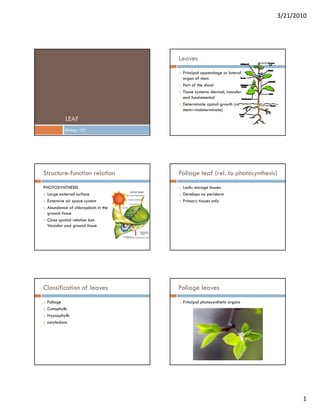
                                      Leaves
                                       Principal appendage or lateral
                                       organ of stem
                                       Part of the shoot
                                       Tissue systems: dermal vascular
                                                       dermal,
                                       and fundamental
                                       Determinate apical growth (vs.
                                       stem—indeterminate)

            LEAF
            Biology 101


Structure-function relation           Foliage leaf (rel. to photosynthesis)
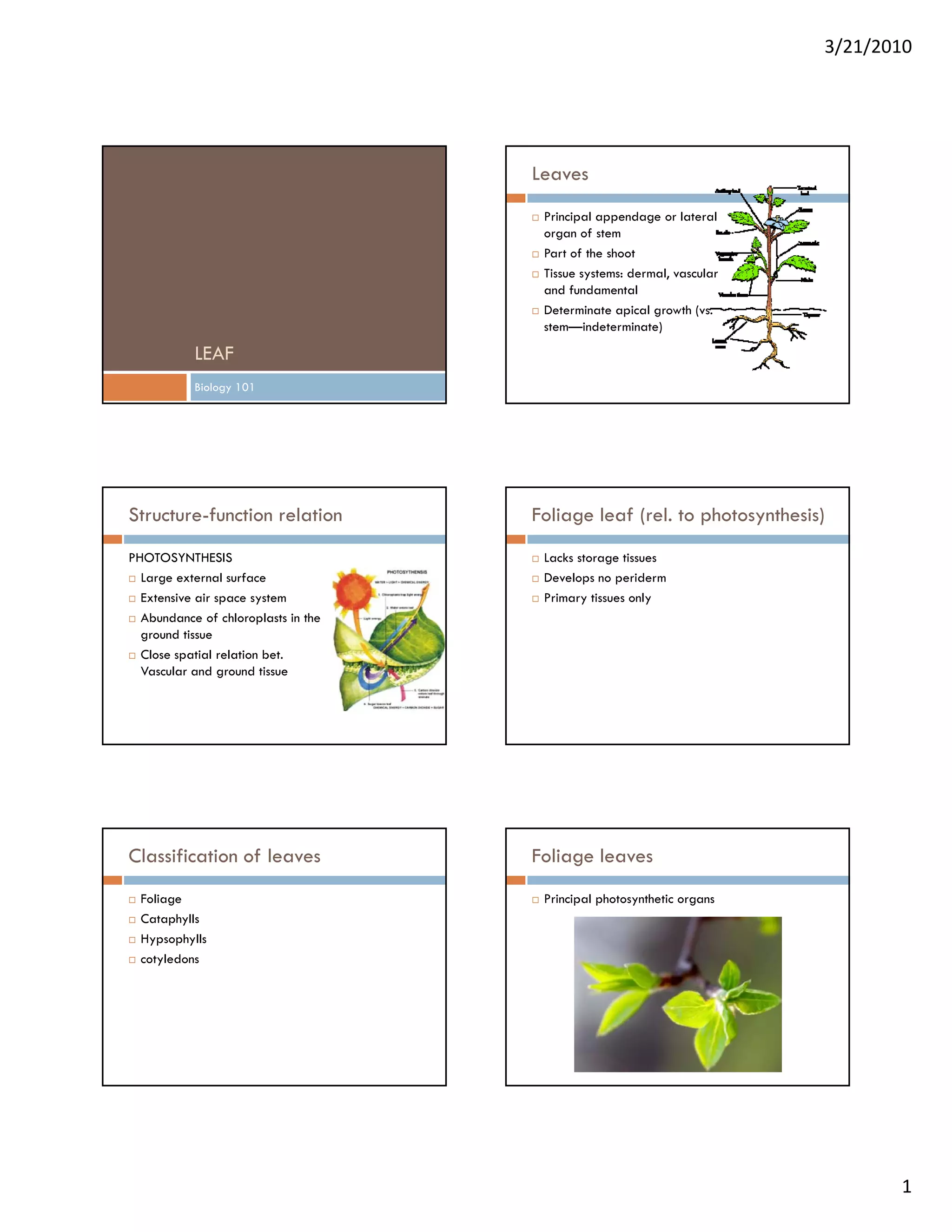
PHOTOSYNTHESIS                         Lacks storage tissues
  Large external surface               Develops no periderm
  Extensive air space system           Primary tissues only
  Abundance of chloroplasts i th
  Ab d          f hl     l t in the
  ground tissue
  Close spatial relation bet.
  Vascular and ground tissue


Classification of leaves              Foliage leaves
  Foliage                              Principal photosynthetic organs
  Cataphylls
  Hypsophylls
  cotyledons
    t l d


                                                                                 1
3/21/2010


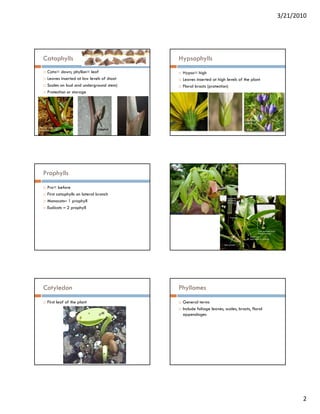
Cataphylls                                Hypsophylls
 Cata= down; phyllon= leaf                 Hypso= high
 Leaves inserted at low levels of shoot    Leaves inserted at high levels of the plant
 Scales on bud and underground stem)       Floral bracts (protection)
 Protection or storage


Prophylls
 Pro= before
 First cataphylls on lateral branch
 Monocots– 1 prophyll
 Eudicots
 E di t – 2 prophyllh ll


Cotyledon                                 Phyllomes
 First leaf of the plant                   General terms
                                           Include foliage leaves, scales, bracts, floral
                                           appendages


                                                                                                   2
3/21/2010


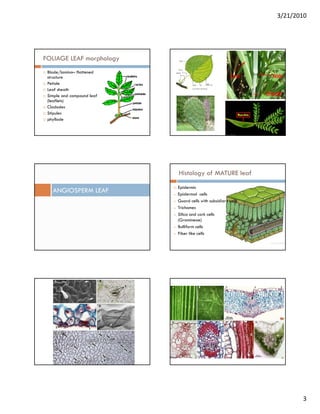
FOLIAGE LEAF morphology
 Blade/lamina– flattened
 structure
 Petiole
 Leaf sheath
 Simple and compound leaf
 (leaflets)
 Cladodes
 Stipules
 phyllode


                            Histology of MATURE leaf
                            Epidermis
   ANGIOSPERM LEAF          Epidermal cells
                            Guard cells with subsidiary cells
                            Trichomes
                            Ti h
                            Silica and cork cells
                            (Gramineae)
                            Bulliform cells
                            Fiber like cells


                                                                       3
3/21/2010


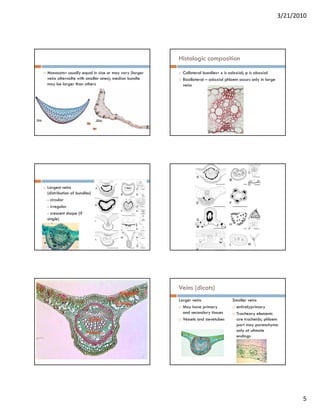
Epidermis                                        Wall structure of epidermis
 Terrestrial                                        Presence of cutin in the outer walls
 Living tissue                                   a. Thin – mesophytes and water plants
 No well differentiated chloroplasts             b. thick, lignified – xerophytes
                                                 c. Sili ifi d – grasses and allies
                                                    Silicified             d lli
 Aquatic
 May show more abundant chloroplasts


Mesophyll
 Mesos= in the middle
 Living, lacunose parenchyma with chloroplasts
 Mesophyte Dicots– palisade and spongy
 Palisade-- development is affected by light
 P li d d l              t i ff t d b li ht
           -- more chloroplasts
 (sun vs. shade plants)


                                                 Vascular system
                                                   Vascular bundles or group of it = veins
                                                   Single vein– conifers, Equisetum
                                                   Dicot– largest vein occur in median position
                                                   (midvein) with
                                                   (midvein)—with rib


                                                                                                         4
3/21/2010


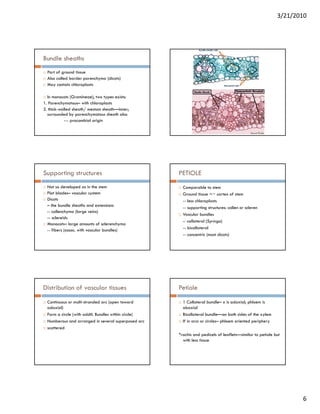
                                                      Histologic composition
Monocots– usually equal in size or may vary (larger     Collateral bundles– x is adaxial; p is abaxial
veins alternalte with smaller ones); median bundle      Bicollateral – adaxial phloem occurs only in large
may be larger than others                               veins


Largest veins
(distribution of bundles)
- circular
- irregular
- crescent shape (if
single)


                                                      Veins (dicots)
                                                      Larger veins                Smaller veins
                                                        May have primary            entirelyprimary
                                                        and secondary tissues       Tracheary elements
                                                        Vessels and sievetubes      are tracheids; phloem
                                                                                    part may parenchyma
                                                                                    only at ultmate
                                                                                    endings


                                                                                                                    5
3/21/2010


Bundle sheaths
  Part of ground tissue
  Also called border parenchyma (dicots)
  May contain chloroplasts

  In monocots (Gramineae), two types exists:
1. Parenchymatous– with chloroplasts
2. thick-walled sheath/ mestom sheath—inner;
  surrounded by parenchymatous sheath also
           --- procambial origin


Supporting structures                                 PETIOLE
 Not so developed as in the stem                        Comparable to stem
 Flat blades– vascular system                           Ground tissue =~ cortex of stem
 Dicots                                                 -- less chloroplasts
 – the bundle sheaths and extensions                    -- supporting structures: collen or scleren
                                                                   ti   t t         ll        l
 -- collenchyma (large veins)
                                                        Vascular bundles
 -- sclereids
                                                        -- collateral (Syringa)
 Monocots– large amounts of sclerenchyma
 -- fibers (assoc. with vascular bundles)               -- bicollateral
                                                        -- concentric (most dicots)


Distribution of vascular tissues                      Petiole
  Continuous or multi-stranded arc (open toward         1 Collateral bundle– x is adaxial; phloem is
  adaxial)                                              abaxial
  Form a circle (with addtl. Bundles within circle)     Bicollateral bundle—on both sides of the xylem
  Numberous and arranged in several superposed arc      If in arcs or circles– phloem oriented periphery
                                                                      circles
  scattered
                                                      *rachis and pedicels of leaflets—similar to petiole but
                                                        with less tissue


                                                                                                                  6
3/21/2010


                                                              Pinus leaf
                                                               Xeromorphic
    GYMNOSPERM LEAF                                            Low ratio of surface to volume
                                                               Epidermis heavily cuticularized/ thick-walled
    Pinus leaf
                                                               Presence of hypodermis—thick wall; compact
                                                                             yp                     ;   p
                                                               (except with stoma)
                                                               Guard cells sunken (overtopped by subsidiary cells)
                                                               Vascular bundles surrounded by transfusion and
                                                               endodermis respectively
                                                               mesophyll not differentiated


                                                              Other features
                                                               Resin ducts
                                                               Vascular bundles– x adaxial side; p abaxial side
                                                               Xylem is endarch


Transfusion tissue
 2 kinds of cells: a] living parenchyma cells with non-
 lignified walls and b] thin-walled but lignified tracheids      Development of the leaf
 with bordered pits
 Parenchyma cells- deeply staining
 Tracheids (near xylem)
 Albuminous cells (near phloem) – dense cytoplasm and
 prominent nuclei
 Universally present in gymnos
 Function: water storage or auxiliary conducting system


                                                                                                                         7
3/21/2010


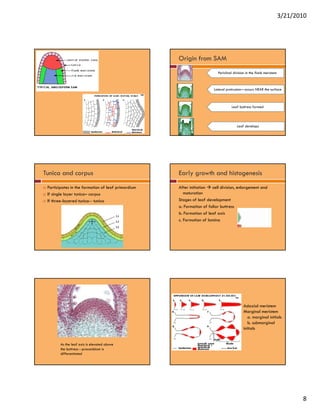
                                                    Origin from SAM
                                                                         Periclinal division in the flank meristem


                                                                      Lateral protrusion—occurs NEAR the surface


                                                                                  Leaf buttress formed


                                                                                      Leaf develops


Tunica and corpus                                   Early growth and histogenesis
 Participates in the formation of leaf primordium   After initiation  cell division, enlargement and
 If single layer tunica– corpus                        maturation
 If three-layered tunica-- tunica                   Stages of leaf development
                                                    a.
                                                    a Formation of foliar buttress
                                                    b. Formation of leaf axis
                                                    c. Formation of lamina


                                                                                          Adaxial meristem
                                                                                          Marginal meristem
                                                                                             a. marginal initials
                                                                                             b. b
                                                                                             b submarginal
                                                                                                       i l
                                                                                          initials


        As the leaf axis is elevated above
        the buttress---procambium is
        differentiated


                                                                                                                            8
3/21/2010


  Vascularization                                       Leaf abscission
    Procambium of midvein differentiates first in the     Separation of leaf from the stem without injury to
    leaf axis                                             the living tissues
    As the lamina is formed, the procambium               While giving protection to newly exposed surface
    differentiates in the middle layers
                                   y                      from dessication and infection
    The development progresses BASIPETALLY                Occurs in abscission zone


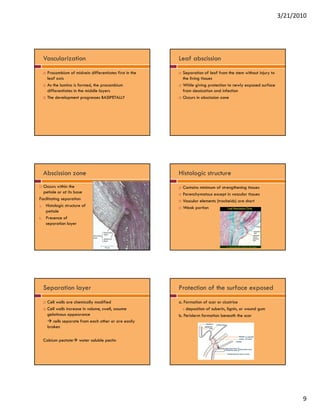
  Abscission zone                                       Histologic structure
   Occurs within the                                      Contains minimum of strengthening tissues
   petiole or at its base                                 Parenchymatous except in vascular tissues
Facilitating separation                                   Vascular elements (tracheids) are short
a.  Histologic structure of
            g                                             Weak
                                                          W k portion
                                                                    ti
    petiole
b.  Presence of
    separation layer


  Separation layer                                      Protection of the surface exposed
    Cell walls are chemically modified                  a. Formation of scar or cicatrice
    Cell walls increase in volume, swell, assume          - deposition of suberin, lignin, or wound gum
    gelatinous appearance                               b. Periderm formation beneath the scar
       cells separate from each other or are easily
    broken

  Calcium pectate      water soluble pectin


                                                                                                                      9

Leaf

  • 1.
    3/21/2010 Leaves Principal appendage or lateral organ of stem Part of the shoot Tissue systems: dermal vascular dermal, and fundamental Determinate apical growth (vs. stem—indeterminate) LEAF Biology 101 Structure-function relation Foliage leaf (rel. to photosynthesis) PHOTOSYNTHESIS Lacks storage tissues Large external surface Develops no periderm Extensive air space system Primary tissues only Abundance of chloroplasts i th Ab d f hl l t in the ground tissue Close spatial relation bet. Vascular and ground tissue Classification of leaves Foliage leaves Foliage Principal photosynthetic organs Cataphylls Hypsophylls cotyledons t l d 1
  • 2.
    3/21/2010 Cataphylls Hypsophylls Cata= down; phyllon= leaf Hypso= high Leaves inserted at low levels of shoot Leaves inserted at high levels of the plant Scales on bud and underground stem) Floral bracts (protection) Protection or storage Prophylls Pro= before First cataphylls on lateral branch Monocots– 1 prophyll Eudicots E di t – 2 prophyllh ll Cotyledon Phyllomes First leaf of the plant General terms Include foliage leaves, scales, bracts, floral appendages 2
  • 3.
    3/21/2010 FOLIAGE LEAF morphology Blade/lamina– flattened structure Petiole Leaf sheath Simple and compound leaf (leaflets) Cladodes Stipules phyllode Histology of MATURE leaf Epidermis ANGIOSPERM LEAF Epidermal cells Guard cells with subsidiary cells Trichomes Ti h Silica and cork cells (Gramineae) Bulliform cells Fiber like cells 3
  • 4.
    3/21/2010 Epidermis Wall structure of epidermis Terrestrial Presence of cutin in the outer walls Living tissue a. Thin – mesophytes and water plants No well differentiated chloroplasts b. thick, lignified – xerophytes c. Sili ifi d – grasses and allies Silicified d lli Aquatic May show more abundant chloroplasts Mesophyll Mesos= in the middle Living, lacunose parenchyma with chloroplasts Mesophyte Dicots– palisade and spongy Palisade-- development is affected by light P li d d l t i ff t d b li ht -- more chloroplasts (sun vs. shade plants) Vascular system Vascular bundles or group of it = veins Single vein– conifers, Equisetum Dicot– largest vein occur in median position (midvein) with (midvein)—with rib 4
  • 5.
    3/21/2010 Histologic composition Monocots– usually equal in size or may vary (larger Collateral bundles– x is adaxial; p is abaxial veins alternalte with smaller ones); median bundle Bicollateral – adaxial phloem occurs only in large may be larger than others veins Largest veins (distribution of bundles) - circular - irregular - crescent shape (if single) Veins (dicots) Larger veins Smaller veins May have primary entirelyprimary and secondary tissues Tracheary elements Vessels and sievetubes are tracheids; phloem part may parenchyma only at ultmate endings 5
  • 6.
    3/21/2010 Bundle sheaths Part of ground tissue Also called border parenchyma (dicots) May contain chloroplasts In monocots (Gramineae), two types exists: 1. Parenchymatous– with chloroplasts 2. thick-walled sheath/ mestom sheath—inner; surrounded by parenchymatous sheath also --- procambial origin Supporting structures PETIOLE Not so developed as in the stem Comparable to stem Flat blades– vascular system Ground tissue =~ cortex of stem Dicots -- less chloroplasts – the bundle sheaths and extensions -- supporting structures: collen or scleren ti t t ll l -- collenchyma (large veins) Vascular bundles -- sclereids -- collateral (Syringa) Monocots– large amounts of sclerenchyma -- fibers (assoc. with vascular bundles) -- bicollateral -- concentric (most dicots) Distribution of vascular tissues Petiole Continuous or multi-stranded arc (open toward 1 Collateral bundle– x is adaxial; phloem is adaxial) abaxial Form a circle (with addtl. Bundles within circle) Bicollateral bundle—on both sides of the xylem Numberous and arranged in several superposed arc If in arcs or circles– phloem oriented periphery circles scattered *rachis and pedicels of leaflets—similar to petiole but with less tissue 6
  • 7.
    3/21/2010 Pinus leaf Xeromorphic GYMNOSPERM LEAF Low ratio of surface to volume Epidermis heavily cuticularized/ thick-walled Pinus leaf Presence of hypodermis—thick wall; compact yp ; p (except with stoma) Guard cells sunken (overtopped by subsidiary cells) Vascular bundles surrounded by transfusion and endodermis respectively mesophyll not differentiated Other features Resin ducts Vascular bundles– x adaxial side; p abaxial side Xylem is endarch Transfusion tissue 2 kinds of cells: a] living parenchyma cells with non- lignified walls and b] thin-walled but lignified tracheids Development of the leaf with bordered pits Parenchyma cells- deeply staining Tracheids (near xylem) Albuminous cells (near phloem) – dense cytoplasm and prominent nuclei Universally present in gymnos Function: water storage or auxiliary conducting system 7
  • 8.
    3/21/2010 Origin from SAM Periclinal division in the flank meristem Lateral protrusion—occurs NEAR the surface Leaf buttress formed Leaf develops Tunica and corpus Early growth and histogenesis Participates in the formation of leaf primordium After initiation cell division, enlargement and If single layer tunica– corpus maturation If three-layered tunica-- tunica Stages of leaf development a. a Formation of foliar buttress b. Formation of leaf axis c. Formation of lamina Adaxial meristem Marginal meristem a. marginal initials b. b b submarginal i l initials As the leaf axis is elevated above the buttress---procambium is differentiated 8
  • 9.
    3/21/2010 Vascularization Leaf abscission Procambium of midvein differentiates first in the Separation of leaf from the stem without injury to leaf axis the living tissues As the lamina is formed, the procambium While giving protection to newly exposed surface differentiates in the middle layers y from dessication and infection The development progresses BASIPETALLY Occurs in abscission zone Abscission zone Histologic structure Occurs within the Contains minimum of strengthening tissues petiole or at its base Parenchymatous except in vascular tissues Facilitating separation Vascular elements (tracheids) are short a. Histologic structure of g Weak W k portion ti petiole b. Presence of separation layer Separation layer Protection of the surface exposed Cell walls are chemically modified a. Formation of scar or cicatrice Cell walls increase in volume, swell, assume - deposition of suberin, lignin, or wound gum gelatinous appearance b. Periderm formation beneath the scar cells separate from each other or are easily broken Calcium pectate water soluble pectin 9