MANAGERIAL EFFECTIVENESS
RESHMA RAMESH
RAJADHANI BUSINESS SCHOOL
Managerial Effectiveness
Managerial effectives means performing managerial activities effectively.
An effective manager performs activities effectively and efficiently. This
means doing the right things and doing these right. Many people believe that
successful managers are intelligent, imaginative and knowledgeable.
However, only effectiveness translates the intelligence, imagination and
knowledge into results and makes a manager successful.
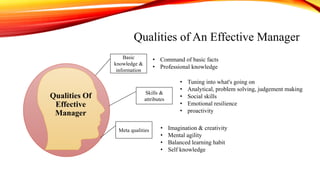
Qualities of An Effective Manager
Qualities Of
Effective
Manager
Basic
knowledge &
information
Skills &
attributes
Meta qualities
• Command of basic facts
• Professional knowledge
• Tuning into what's going on
• Analytical, problem solving, judgement making
• Social skills
• Emotional resilience
• proactivity
• Imagination & creativity
• Mental agility
• Balanced learning habit
• Self knowledge
According to Peter Ducker, Effective managers follows five basic practices:
1. They know how they spend their time. They stay in control of time and effective
time managers.
2. They focus on their contribution to the organization. They focus on achieving
results rather than simply working with tools and techniques.
3. They build on strength. They empower the organisation with the strength of the
staffs, their superior and themselves.
4. They concentrate on one activity at a time to produce effective results.
5. They take decision after systematic analysis of fact and information.
BASIC MANAGERIAL SKILLS
Top level
Middle level
Lower (supervisory) level
CONCEPTUAL SKILLS
• Ability to visualize
• Includes creativity, analytical and innovative skills
• Identifying the problems in organisation
• Helps manager to fix goals
• Conceptual skill is more required to top level management because they spend more
time in planning, organising and solving problems.
HUMAN RELATIONSHIP SKILLS
• Also known as interpersonal skill
• Ability to work with people
• Helps managers to understand, communicate and work with others
• It helps the managers to motivate, lead and develop team spirit
• Required at all level of management
• Required by managers to interact
TECHNICAL SKILLS
• Ability of the managers to make use of equipment, machinery and techniques
• Required more at operational level of management
• It is connected with performing specific task
MANAGERIAL SKILLS REQUIRED FOR A MANAGER
• Communication skills
• Leadership skills
• Decision making skills
• Problem solving skills
• Administrative skills
INTERPERSONAL SKILLS
• Interpersonal skills are also crucial soft skill
• Required for effective social communication
• Johnson defines interpersonal skills as the “ sum total of your ability to interact with
other people”.
• Characteristics traits like
Manners, attitude, courtesy, habits, behaviour and appearance which helps us to
communicate and maintain relationship with others
ORGANIZATIONAL CONTEXT
The organizational context of how interpersonal skills are used can be shown by the vast
number of interpersonal interaction.
• Interpersonal skills while working
Effective relationships within the organization
Effective relationship with suppliers
Effective relationship with competitors
• Internally
In teams
Across teams
Within and between departments and business units
• Externally
With suppliers
With customers
To get real competitive advantage through such relationships in the long team is dependent
upon your level of interpersonal skills.
WHY INTERPERSONAL SKILL IS NEEDED?
To improve :
Relationship
Working environment
Leadership skills
Productivity
All round success
Linking by others
FORMAL INTERPERSONAL SKILLS
• Greeting
• Enquiry
• Demonstrating respect
• Acknowledgement
• Active listening
• Bring people together
• Resolve conflicts
• Empathy/see it on their side
HOW TO DEVELOP INTERPERSONAL SKILLS
• Recognise and appreciate differences
• Empathise
• Be an active listener
• Ensure harmony among various communication elements.
• Learn some managing tactics
• Start taking responsibilities
• Don’t complain
• Develop social and general awareness about things in organisation
TRANSACTIONAL ANALYSIS
• Transactional Analysis was founded by Eric Berne, during late 1950’s
• Transactional analysis is a technique used to help people better understand their own and
others behaviour, especially in interpersonal relationships.
• This analysis deals with understanding, predicting and controlling interpersonal relationship.
• It offers a model of personality and the dynamics of self and its relationship to others that
makes possible a clear and meaningful discussion of behaviour
Transactional analysis is primarily concerned with following:
o Analysis of self awareness
o Analysis of ego states
o Analysis of transactions
o Script analysis
o Games analysis
o Analysis of life position
oStroking
ANALYSIS OF SELF
AWARENESS
OPEN
(known to
others and
also self)
BLIND
(unknown to
self but
known to
others)
HIDDEN
(known to
self but
unknown to
others)
UNKNOWN
(Unknown to
self and
unknown to
others)
• The interpersonal relationships are
composed of interself.
• Self awareness is an important
concept, it describes the self in
term of image, both conscious and
unconscious.
• Joseph Luft and Harrington have
developed a diagram to look at
ones personality including
behaviours and attitudes that can be
known and unknown to self and
others,
• This diagram is known as JOHARI
WINDOW.
JOHARI WINDOW
ANALSIS OF EGO
STATES
• The ego plays an important role in human
behaviour.
• People interact with each other in terms of
psychological positions or behavioural
patterns known as ego states.
• Ego states are persons way of thinking, feeling
and behaving at any time
• There are 3 important ego states: parent, adult
and child
• A person of any age have these ego states in
varying degrees.
• A healthy person is able to move from one ego
state to another,
THE EGO STATES
• Behaviors, thoughts and
feelings copied from parent
or parent figures.
PARENT
EGO
STATES
• Behaviors, thoughts and
feelings which are direct
Reponses to here and now.
ADULT
EGO
STATES
• Behaviors, thoughts and
feelings replayed from
childhood.
CHILD
EGO
STATES
ANALYSIS OF TRANSACTION
• Describing what happened between two or more people. Thus where a verbal or stimulus or
non verbal stimulus from one person is being responded by another person a transaction
occurs.
• Transactional analysis can help to determine which ego state is most heavily influencing our
behaviour and the behaviour of the other people with whom we connect
• Depending on ego states of the persons involved in transactions, there may be three type of
transactions:
 complementary transaction
Crossed transaction
Ulterior transaction
SCRIPT ANALYSIS
• Understanding the life plan that an individual is following.
• In transactional analysis a person’s life is compared to a play and the script is the text
of the play.
GAME ANALYSIS
• Understanding transactions between individual that lead to bad feelings. when people
fail to get enough strokes at work they try a variety of things.
• One of the most important is psychological games. A psychological game is a set of
transaction with three characteristics
The transaction tend to be repeated
They make sense on superficial or social level
One or more transactions is ulterior
ANALYSIS OF LIFE POSITION
• In the process of growing up people make basic assumption about their own self
worth as well as about worth of significant people in their environment.
• Transactional analysis constructs the following classification of the four possible life
positions or psychological positions:
I am ok, you are ok
I am ok, you are not ok
I am not ok, you are ok
I am not ok, you are not ok
STROKING
• Stroking is an important aspect of transactional analysis. The term stroke refers to
“giving some kind of recognition to others.”
• People need strokes for their sense of survival and well being on their job. Lack of
stroking can have negative consequences on both on physiological and psychological
well being of a person.
• There are three types of strokes:
Positive stroke- the stroke one feel good. e.g.; recognition, approval etc.
Negative stroke – the stroke one feel bad, e.g.; hurt physically or psychologically
Mixed stroke
MANAGERIAL EFFECTIVENESS

MANAGERIAL EFFECTIVENESS

  • 1.
  • 2.
    Managerial Effectiveness Managerial effectivesmeans performing managerial activities effectively. An effective manager performs activities effectively and efficiently. This means doing the right things and doing these right. Many people believe that successful managers are intelligent, imaginative and knowledgeable. However, only effectiveness translates the intelligence, imagination and knowledge into results and makes a manager successful.
  • 3.
    Qualities of AnEffective Manager Qualities Of Effective Manager Basic knowledge & information Skills & attributes Meta qualities • Command of basic facts • Professional knowledge • Tuning into what's going on • Analytical, problem solving, judgement making • Social skills • Emotional resilience • proactivity • Imagination & creativity • Mental agility • Balanced learning habit • Self knowledge
  • 4.
    According to PeterDucker, Effective managers follows five basic practices: 1. They know how they spend their time. They stay in control of time and effective time managers. 2. They focus on their contribution to the organization. They focus on achieving results rather than simply working with tools and techniques. 3. They build on strength. They empower the organisation with the strength of the staffs, their superior and themselves. 4. They concentrate on one activity at a time to produce effective results. 5. They take decision after systematic analysis of fact and information.
  • 5.
    BASIC MANAGERIAL SKILLS Toplevel Middle level Lower (supervisory) level
  • 6.
    CONCEPTUAL SKILLS • Abilityto visualize • Includes creativity, analytical and innovative skills • Identifying the problems in organisation • Helps manager to fix goals • Conceptual skill is more required to top level management because they spend more time in planning, organising and solving problems.
  • 7.
    HUMAN RELATIONSHIP SKILLS •Also known as interpersonal skill • Ability to work with people • Helps managers to understand, communicate and work with others • It helps the managers to motivate, lead and develop team spirit • Required at all level of management • Required by managers to interact
  • 8.
    TECHNICAL SKILLS • Abilityof the managers to make use of equipment, machinery and techniques • Required more at operational level of management • It is connected with performing specific task
  • 9.
    MANAGERIAL SKILLS REQUIREDFOR A MANAGER • Communication skills • Leadership skills • Decision making skills • Problem solving skills • Administrative skills
  • 10.
    INTERPERSONAL SKILLS • Interpersonalskills are also crucial soft skill • Required for effective social communication • Johnson defines interpersonal skills as the “ sum total of your ability to interact with other people”. • Characteristics traits like Manners, attitude, courtesy, habits, behaviour and appearance which helps us to communicate and maintain relationship with others
  • 11.
    ORGANIZATIONAL CONTEXT The organizationalcontext of how interpersonal skills are used can be shown by the vast number of interpersonal interaction. • Interpersonal skills while working Effective relationships within the organization Effective relationship with suppliers Effective relationship with competitors • Internally In teams Across teams Within and between departments and business units
  • 12.
    • Externally With suppliers Withcustomers To get real competitive advantage through such relationships in the long team is dependent upon your level of interpersonal skills.
  • 13.
    WHY INTERPERSONAL SKILLIS NEEDED? To improve : Relationship Working environment Leadership skills Productivity All round success Linking by others
  • 14.
    FORMAL INTERPERSONAL SKILLS •Greeting • Enquiry • Demonstrating respect • Acknowledgement • Active listening • Bring people together • Resolve conflicts • Empathy/see it on their side
  • 15.
    HOW TO DEVELOPINTERPERSONAL SKILLS • Recognise and appreciate differences • Empathise • Be an active listener • Ensure harmony among various communication elements. • Learn some managing tactics • Start taking responsibilities • Don’t complain • Develop social and general awareness about things in organisation
  • 16.
    TRANSACTIONAL ANALYSIS • TransactionalAnalysis was founded by Eric Berne, during late 1950’s • Transactional analysis is a technique used to help people better understand their own and others behaviour, especially in interpersonal relationships. • This analysis deals with understanding, predicting and controlling interpersonal relationship. • It offers a model of personality and the dynamics of self and its relationship to others that makes possible a clear and meaningful discussion of behaviour
  • 17.
    Transactional analysis isprimarily concerned with following: o Analysis of self awareness o Analysis of ego states o Analysis of transactions o Script analysis o Games analysis o Analysis of life position oStroking
  • 18.
    ANALYSIS OF SELF AWARENESS OPEN (knownto others and also self) BLIND (unknown to self but known to others) HIDDEN (known to self but unknown to others) UNKNOWN (Unknown to self and unknown to others) • The interpersonal relationships are composed of interself. • Self awareness is an important concept, it describes the self in term of image, both conscious and unconscious. • Joseph Luft and Harrington have developed a diagram to look at ones personality including behaviours and attitudes that can be known and unknown to self and others, • This diagram is known as JOHARI WINDOW. JOHARI WINDOW
  • 19.
    ANALSIS OF EGO STATES •The ego plays an important role in human behaviour. • People interact with each other in terms of psychological positions or behavioural patterns known as ego states. • Ego states are persons way of thinking, feeling and behaving at any time • There are 3 important ego states: parent, adult and child • A person of any age have these ego states in varying degrees. • A healthy person is able to move from one ego state to another, THE EGO STATES • Behaviors, thoughts and feelings copied from parent or parent figures. PARENT EGO STATES • Behaviors, thoughts and feelings which are direct Reponses to here and now. ADULT EGO STATES • Behaviors, thoughts and feelings replayed from childhood. CHILD EGO STATES
  • 20.
    ANALYSIS OF TRANSACTION •Describing what happened between two or more people. Thus where a verbal or stimulus or non verbal stimulus from one person is being responded by another person a transaction occurs. • Transactional analysis can help to determine which ego state is most heavily influencing our behaviour and the behaviour of the other people with whom we connect • Depending on ego states of the persons involved in transactions, there may be three type of transactions:  complementary transaction Crossed transaction Ulterior transaction
  • 21.
    SCRIPT ANALYSIS • Understandingthe life plan that an individual is following. • In transactional analysis a person’s life is compared to a play and the script is the text of the play. GAME ANALYSIS • Understanding transactions between individual that lead to bad feelings. when people fail to get enough strokes at work they try a variety of things. • One of the most important is psychological games. A psychological game is a set of transaction with three characteristics The transaction tend to be repeated They make sense on superficial or social level One or more transactions is ulterior
  • 22.
    ANALYSIS OF LIFEPOSITION • In the process of growing up people make basic assumption about their own self worth as well as about worth of significant people in their environment. • Transactional analysis constructs the following classification of the four possible life positions or psychological positions: I am ok, you are ok I am ok, you are not ok I am not ok, you are ok I am not ok, you are not ok
  • 23.
    STROKING • Stroking isan important aspect of transactional analysis. The term stroke refers to “giving some kind of recognition to others.” • People need strokes for their sense of survival and well being on their job. Lack of stroking can have negative consequences on both on physiological and psychological well being of a person. • There are three types of strokes: Positive stroke- the stroke one feel good. e.g.; recognition, approval etc. Negative stroke – the stroke one feel bad, e.g.; hurt physically or psychologically Mixed stroke