Addis Ababa medical and business college
department of information technology
Occupation : ITHNS
LEVEL : III
Unit of competency lead small team
pre. By instr. Jaleto S.
Course outline
 Leadership
>Leaders v/s Managers
> Qualities of a good leader
> Teams
>Methods to develop effective teams
introduction
 Today in an environment that is highly competitive, and
driven by considerations of technology, innovation,
quality, cost effectiveness, timeliness and excellence in
service delivery, Government organisations cannot afford
to lag behind
leadership
 Leadership can be viewed as a dynamic process, which
involves a number of combined factors and phenomena,
and the outcomes of effective leadership are behaviours
and achievements that are in line with the vision and
strategies of the organisation
 Leadership is the ability of an individual or a group of
individuals to influence and guide followers or other
members of an organization.
Cont…
 Leadership involves making sound -- and sometimes
difficult -- decisions, creating and articulating a clear
vision, establishing achievable goals and providing
followers with the knowledge and tools necessary to
achieve those goals.
 Leaders are found and required in most aspects of
society, from business to politics to region to
community-based organization
Team
Cont…
 is defined as a group of people who perform
interdependent tasks to work toward accomplishing a
common mission or specific objective.
 A group of people with different skills and different
tasks, who work together on a common project,
service, or goal, with a meshing of functions and
mutual support.
Cont…
 Here are a few qualities that a successful team
possesses.
 1) They communicate well with each other. ...
 2) They focus on goals and results. ...
 3) Everyone contributes their fair share. ...
 4) They offer each other support. ...
 5) Team members are diverse. ...
 6) Good leadership. ...
 7) They're organized. ...
 8) They have fun.
Leadership variables
 There are five main variables that can influence
leadership behaviour:
1.The tasks and goal of the organisation
2.The leader’s knowledge, skills & attitudes
3.The followers skills, attitudes & motivation
4.The context or situation
5.The resources available
Leadership can be
 Honest — Display sincerity, integrity, and candor in all
your actions.
 Competent — Base your actions on reason and moral
principles
 Inspiring — Display confidence in all that you do
 Intelligent — Read, study, and seek challenging
assignments
 Imaginative — Make timely and appropriate changes in
your thinking, plans, and methods.
Cont….
 innovative
 Active listening
 Self confidence
 Strong communicator
 Decision making skill
 Problem solving skill
 Supportive
Leader and manager
 Manager – An employee of the organization,
responsible for its management.
 Leader – A person who leads, guides, and directs
others. There is always a buzz when we talk about the
terms leader and manager.
Cont…
 Managers Manage the Tasks at Hand.
 Leaders Lead Towards the Future.
 Leaders are unique,
 managers copy
 Leaders take risks,
 managers control risk .
 Leaders are in it for the long term,
 managers think short-term.
Style theories:
a. Autocratic style
b. Democratic style
c. Laissez faire style
Autocratic style
 Autocratic leadership, also known as authoritarian
leadership, is a leadership style characterized by
individual control over all decisions and little
input from group members.
 Autocratic leaders typically make choices based on
their ideas and judgments and rarely accept advice
from followers.
Democratic style
 Democratic leadership, also known as participative
leadership or shared leadership, is a type of
leadership style in which members of the group take
a more participative role in the decision-making
process.
Laissez faire style
 The combination of both (autocratic and democratic
styles)
 Laissez-faire leaders have an attitude of trust and
reliance on their employees. They don't
micromanage or get too involved, they don't give too
much instruction or guidance. ... They give guidance
and take responsibility where needed, but this
leadership style means that subordinates and team
members have the real lead
Cont…
Team development stages
 Forming: This is where team members first meet. It’s
important for team leaders to facilitate the introductions
and highlight each person’s skills and background. Team
members are also given project details and the opportunity
to organize their responsibilities.
 Storming: At this stage, team members openly share ideas
and use this as an opportunity to stand out and be accepted
by their peers. Team leaders help teams in this stage by
having a plan in place to manage competition among team
members, make communication easier, and make sure
projects stay on track.
Cont…
 Norming: By now, teams have figured out how to work together.
There’s no more internal competition, and responsibilities and goals
are clear. Each person works more efficiently because he or she has
learned how to share their ideas and listen to feedback while working
toward a common goal.
 Performing: There’s a high level of cohesion and trust between team
members. Teams are functioning at peak efficiency with less oversight
from team leaders. Issues still come up, but at this point, teams have
strategies for resolving problems without compromising timelines and
progress.
 Adjourning: Teams complete their project and debrief on what went
well and what could be improved for future projects. Afterwards, team
members move on to new projects. Now let’s look at how to use this
model to amplify the strengths within your remote marketing team so
that projects are successful and completed on time.
Good communication for team
 A team is able to work well together through good
communication. If communication between team
members is poor, there is likely to unnecessary tension
and anxiety. This is one of the most important reasons
why businesses should encourage their employees to
clearly communicate with one another when working
together.

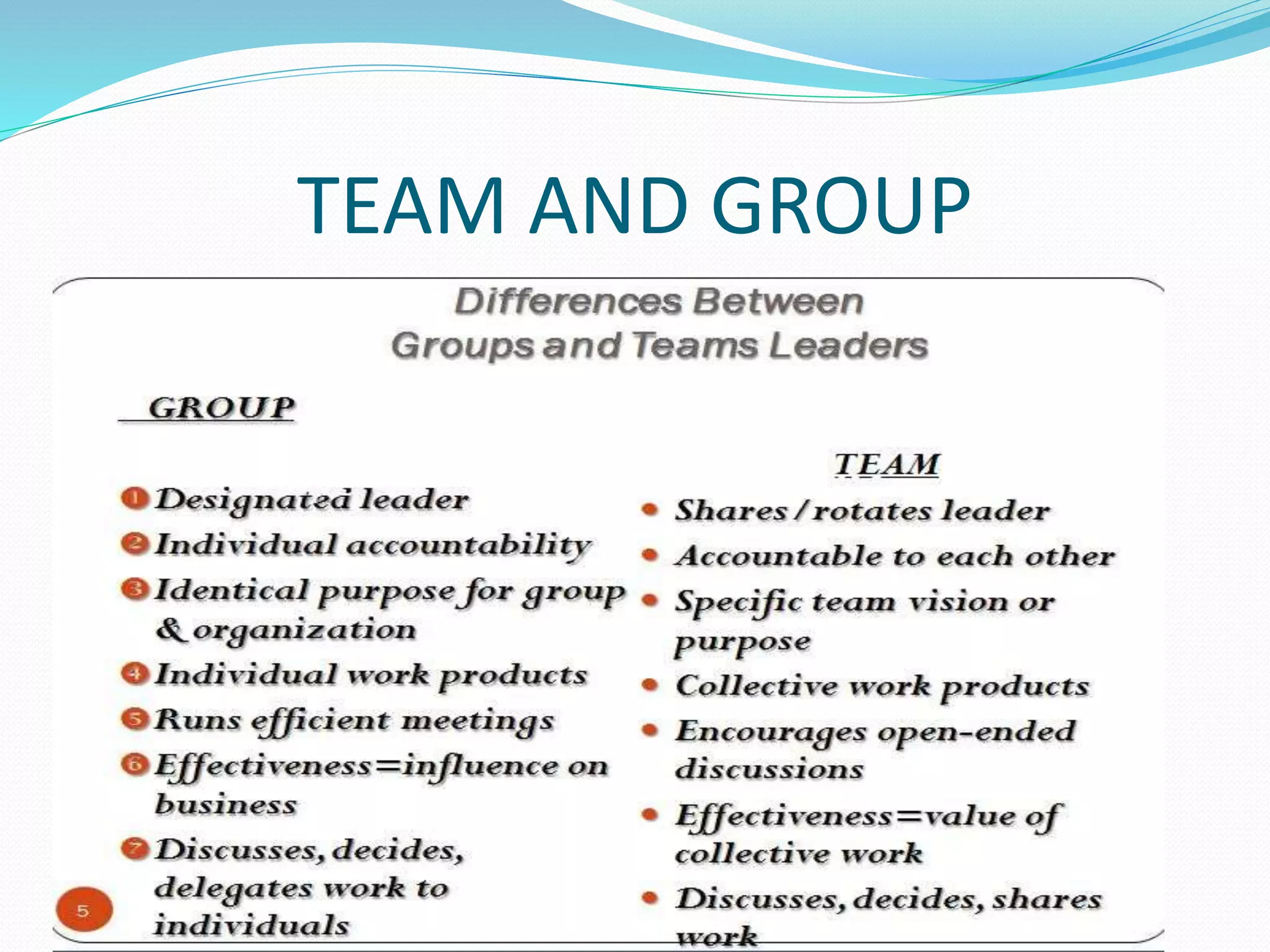
TEAM AND GROUP
Types of team
 Vertical - composed of a manager and
subordinates, sometimes called functional or
command teams.
 Horizontal - composed of employees from the
same hierarchical level but from different areas of
expertise
 Special-Purpose - created outside the formal
organization for special projects and disband once
project is completed.
Teams in the New Workplace
 Virtual teams- consist of geographically or
organizationally dispersed members linked
via technology
 Global teams- cross-border teams made up
of members from different nationalities.
Develop the effective team
 Effective work teams do not just happen miraculously;
they are the result of careful planning and preparation.
 The need for:
 Preparing the work environment
 Preparing you: the Leader
 Preparing team members
Preparing the work environment
1. Identify the department’s purpose that explains clearly
(as a whole) what the department is supposed to do
2. Each employee in the department has clearly defined
job tasks with defined performance levels
3. Ensure that every person/supervisor at every level in
the department demonstrates daily:
a. Leadership skills
b. Work assessment skills
Cont…
Communication
 Communication process
 Types/forms of communication
 Flow/channels of communication
 Effective communication
 Barriers to effective communication
Cont…
 Motivation:- Physiological-Safety-Social-Self esteem-Self
actualisation
 Personality, Perception & D. Making
 Personality types: Extroversion v/s Introversion
 Making judgment on others
 Group/team decision making proc
The end!

Lead small team

  • 1.
    Addis Ababa medicaland business college department of information technology Occupation : ITHNS LEVEL : III Unit of competency lead small team pre. By instr. Jaleto S.
  • 2.
    Course outline  Leadership >Leadersv/s Managers > Qualities of a good leader > Teams >Methods to develop effective teams
  • 3.
    introduction  Today inan environment that is highly competitive, and driven by considerations of technology, innovation, quality, cost effectiveness, timeliness and excellence in service delivery, Government organisations cannot afford to lag behind
  • 4.
    leadership  Leadership canbe viewed as a dynamic process, which involves a number of combined factors and phenomena, and the outcomes of effective leadership are behaviours and achievements that are in line with the vision and strategies of the organisation  Leadership is the ability of an individual or a group of individuals to influence and guide followers or other members of an organization.
  • 5.
    Cont…  Leadership involvesmaking sound -- and sometimes difficult -- decisions, creating and articulating a clear vision, establishing achievable goals and providing followers with the knowledge and tools necessary to achieve those goals.  Leaders are found and required in most aspects of society, from business to politics to region to community-based organization
  • 6.
  • 7.
    Cont…  is definedas a group of people who perform interdependent tasks to work toward accomplishing a common mission or specific objective.  A group of people with different skills and different tasks, who work together on a common project, service, or goal, with a meshing of functions and mutual support.
  • 8.
    Cont…  Here area few qualities that a successful team possesses.  1) They communicate well with each other. ...  2) They focus on goals and results. ...  3) Everyone contributes their fair share. ...  4) They offer each other support. ...  5) Team members are diverse. ...  6) Good leadership. ...  7) They're organized. ...  8) They have fun.
  • 9.
    Leadership variables  Thereare five main variables that can influence leadership behaviour: 1.The tasks and goal of the organisation 2.The leader’s knowledge, skills & attitudes 3.The followers skills, attitudes & motivation 4.The context or situation 5.The resources available
  • 10.
    Leadership can be Honest — Display sincerity, integrity, and candor in all your actions.  Competent — Base your actions on reason and moral principles  Inspiring — Display confidence in all that you do  Intelligent — Read, study, and seek challenging assignments  Imaginative — Make timely and appropriate changes in your thinking, plans, and methods.
  • 11.
    Cont….  innovative  Activelistening  Self confidence  Strong communicator  Decision making skill  Problem solving skill  Supportive
  • 12.
    Leader and manager Manager – An employee of the organization, responsible for its management.  Leader – A person who leads, guides, and directs others. There is always a buzz when we talk about the terms leader and manager.
  • 13.
    Cont…  Managers Managethe Tasks at Hand.  Leaders Lead Towards the Future.  Leaders are unique,  managers copy  Leaders take risks,  managers control risk .  Leaders are in it for the long term,  managers think short-term.
  • 14.
    Style theories: a. Autocraticstyle b. Democratic style c. Laissez faire style
  • 15.
    Autocratic style  Autocraticleadership, also known as authoritarian leadership, is a leadership style characterized by individual control over all decisions and little input from group members.  Autocratic leaders typically make choices based on their ideas and judgments and rarely accept advice from followers.
  • 16.
    Democratic style  Democraticleadership, also known as participative leadership or shared leadership, is a type of leadership style in which members of the group take a more participative role in the decision-making process.
  • 17.
    Laissez faire style The combination of both (autocratic and democratic styles)  Laissez-faire leaders have an attitude of trust and reliance on their employees. They don't micromanage or get too involved, they don't give too much instruction or guidance. ... They give guidance and take responsibility where needed, but this leadership style means that subordinates and team members have the real lead
  • 18.
  • 19.
    Team development stages Forming: This is where team members first meet. It’s important for team leaders to facilitate the introductions and highlight each person’s skills and background. Team members are also given project details and the opportunity to organize their responsibilities.  Storming: At this stage, team members openly share ideas and use this as an opportunity to stand out and be accepted by their peers. Team leaders help teams in this stage by having a plan in place to manage competition among team members, make communication easier, and make sure projects stay on track.
  • 20.
    Cont…  Norming: Bynow, teams have figured out how to work together. There’s no more internal competition, and responsibilities and goals are clear. Each person works more efficiently because he or she has learned how to share their ideas and listen to feedback while working toward a common goal.  Performing: There’s a high level of cohesion and trust between team members. Teams are functioning at peak efficiency with less oversight from team leaders. Issues still come up, but at this point, teams have strategies for resolving problems without compromising timelines and progress.  Adjourning: Teams complete their project and debrief on what went well and what could be improved for future projects. Afterwards, team members move on to new projects. Now let’s look at how to use this model to amplify the strengths within your remote marketing team so that projects are successful and completed on time.
  • 21.
    Good communication forteam  A team is able to work well together through good communication. If communication between team members is poor, there is likely to unnecessary tension and anxiety. This is one of the most important reasons why businesses should encourage their employees to clearly communicate with one another when working together. 
  • 22.
  • 23.
    Types of team Vertical - composed of a manager and subordinates, sometimes called functional or command teams.  Horizontal - composed of employees from the same hierarchical level but from different areas of expertise  Special-Purpose - created outside the formal organization for special projects and disband once project is completed.
  • 24.
    Teams in theNew Workplace  Virtual teams- consist of geographically or organizationally dispersed members linked via technology  Global teams- cross-border teams made up of members from different nationalities.
  • 25.
    Develop the effectiveteam  Effective work teams do not just happen miraculously; they are the result of careful planning and preparation.  The need for:  Preparing the work environment  Preparing you: the Leader  Preparing team members
  • 26.
    Preparing the workenvironment 1. Identify the department’s purpose that explains clearly (as a whole) what the department is supposed to do 2. Each employee in the department has clearly defined job tasks with defined performance levels 3. Ensure that every person/supervisor at every level in the department demonstrates daily: a. Leadership skills b. Work assessment skills
  • 27.
    Cont… Communication  Communication process Types/forms of communication  Flow/channels of communication  Effective communication  Barriers to effective communication
  • 28.
    Cont…  Motivation:- Physiological-Safety-Social-Selfesteem-Self actualisation  Personality, Perception & D. Making  Personality types: Extroversion v/s Introversion  Making judgment on others  Group/team decision making proc
  • 29.