8/19/2023 1
LEADERSHIP & TEAM
BUILDING
MR B.TANDARAYEN
BEng, Msc (HRM)
2
8/19/2023
Course outline
Leadership
>Leaders v/s Managers
> Theories of Leadership
> Qualities of a good leader
>Leadership Issues
Team Building
> Group dynamics & Group Develop.
> Teams: Influence of team at the work
place
>Methods to develop effective teams
3
8/19/2023
Introduction
Today in an environment that is highly
competitive, and driven by considerations
of technology, innovation, quality, cost
effectiveness, timeliness and excellence in
service delivery, Government
organisations cannot afford to lag behind
4
8/19/2023
Leadership
Leadership can be viewed as a dynamic
process, which involves a number of
combined factors and phenomena, and
the outcomes of effective leadership are
behaviours and achievements that are in
line with the vision and strategies of the
organisation
5
8/19/2023
Definition: Leadership
“ The ability to influence a group toward
the achievement of goals”
Robbins & Coulter(1999)
6
8/19/2023
Leadership variables
There are five main variables that can
influence leadership behaviour:
1.The tasks and goal of the organisation
2.The leader’s knowledge, skills & attitudes
3.The followers skills, attitudes & motivation
4.The context or situation
5.The resources available
7
8/19/2023
Leaders & Managers
Leadership is a function above
management
A good manager is well organized and
works efficiently
Leaders agitate for change and new
approaches, managers advocate stability
and the status quo
8
8/19/2023
Cont.
But a good leader together with the above,
is someone who encourages others to do
better
Leadership is one of the most important
issues and is quite scarce in the
organisation.
9
8/19/2023
Theories of Leadership
1. Contemporary Theories:
a. Attribution Theory: It is based on the concept of
cause and effect relationship. Leaders are
characterise as having a number of traits:
intelligence, outgoing personality, strong verbal
skills, aggressiveness & understanding.
➢ A good leader is considered to be someone who
pays high attention to production/tasks as well
as people/relationship, irrespective of situation
10
8/19/2023
Cont.
b. Charismatic Theory
➢Charismatic leaders possess certain
personal qualities that they use to exercise
profound and extraordinary impact upon
their follower.
➢These are: Ability to command respect,
inspire pride and faith
➢They have a strong sense of mission and
purpose and are able to articulate a clear
vision to their followers
11
8/19/2023
Cont.
c. Transactional & Transformational Leadership
➢Transactional leader uses position power and
the followers are motivated by self-interests
➢ Transformational Leadership is more
strongly correlated to lower turnover rates,
higher productivity and higher employee
satisfaction
12
8/19/2023
Theories of Leadership
2. Style theories:
a. Autocratic style
b. Democratic style
c. Laissez faire style
13
8/19/2023
Cont.
3. Contingency Theories
These theories take a more contextual view
and focus on the importance of situation in
which leadership is exercised.
They are based on the belief that there is no
single style of leadership appropriate to all
situations
14
8/19/2023
Cont.
a. The contingency theory (Fielder’s) of
leadership takes into account both the
leader’s personality and the complexities
of situation. The following are
encouraged:
> Good leader-member relations, high task
structure and high position power
15
8/19/2023
Cont.
b. Contingency theory (Path-goal): The
leadership style is adapted to the
characteristics of the followers and the
environment in which they are employed
16
8/19/2023
c. Situational Theory: It suggests that leader
behaviour needs to be adjusted to the
maturity level of the followers i.e degree of
motivation, experience and interest
17
8/19/2023
Qualities of a good leader
Trust
Determination – Initiative & perseverance
Humility – modesty; with focus on
collective rather than personal
recognition/achievement
Honesty & Integrity
Competence & Initiative
Sense of responsibility & Forward-looking
18
8/19/2023
LEADERSHIP ISSUES
Leadership & Gender: The gender issue
needs to be examined objectively and
stereotyping needs to be avoided
Leadership & cultural factors: Cultural
factors have the potential of impacting
upon leadership behaviours. So both the
value systems of leaders and followers
can shape the leadership relationships in
given contexts
19
8/19/2023
Cont.
Leadership and organisational life cycle:
The leadership behaviour will have to take
into consideration the demands of the
specific stages of the organisational life
cycle and adopt the leadership style that is
most suitable
Leadership & globalisation: Organisations
will have to train leaders for global
operations by focussing on cross-cultural
and language skills
20
8/19/2023
TEAM BUILDING
Today with the growing complexity of
society and the continuing development of
technological capability, more
organisational life will revolve around
group and team structures
The contribution of teams and groups will
find accrued importance in the decision
making process
21
8/19/2023
Group Development
Forming stage: is characterised by the
development of interpersonal
relationships, identification of goals and
the establishment of behaviour norms
among the members
22
8/19/2023
Cont.
Storming stage: is characterised by intra-
group conflict. e.g conflict over leadership,
goals etc
Norming stage: is where members of the
group understand what is expected of
them and where the leadership structure is
clear
23
8/19/2023
Cont.
Performing stage: This stage results in an
effective well-integrated group that
performs the required task effectively &
efficiently
Adjourning stage: When the task is
completed, the group prepares for its
winding up.
24
8/19/2023
Teams
The team based structures approach is in
line with the human aspect of
management that has sought to
encourage and sustain motivation and
commitment of staff as a way of enhancing
and advancing the cause of both
productivity for the organisation and
providing a satisfying environment for
employees
25
8/19/2023
Definition of Team
“a small number of people with
complementary skills who are committed
to a common purpose, performance, goal
and approach for which they hold
themselves mutually accountable”
26
8/19/2023
Preparation for effective
Team Building
Effective work teams do not just happen
miraculously; they are the result of careful
planning and preparation.
The need for:
➢Preparing the work environment
➢Preparing you: the Leader
➢Preparing team members
27
8/19/2023
Preparing the work environment
1. Identify the department’s purpose that explains
clearly (as a whole) what the department is
supposed to do
2. Each employee in the department has clearly
defined job tasks with defined performance
levels
3. Ensure that every person/supervisor at every
level in the department demonstrates daily:
a. Leadership skills
b. Work assessment skills
28
8/19/2023
Cont.
4. Make sure that:
a. There is proper delegation at every level
b. There is chance for creativity, innovation
& decision making by the employee
c. Much emphasis is laid on employee
coaching, training and development at all
levels
29
8/19/2023
Preparing you: The Leader
1. Make sure that all new employee have
completed a measurable and
documented orientation and basic
training program in their new job within
the department
2. Ensure good communication and
discussion with your staff:
30
8/19/2023
a. To identify work related strengths and
performance improvement needs of each
of them
b. To identify non-budgetary reward that
could have value for each of them
c. So that you and your staff are in regular
agreement on the priority
31
8/19/2023
3. The need to identify potential team
leaders and identify additional training or
experience opportunities that will help
them in their development
4. The need to identify to your satisfaction,
the limits of authority you will be willing
exert
5. Discussing with the potential team leaders
to help them see through your eyes
32
8/19/2023
6. The need to develop: “ Team code of
conduct” in conjunction with your potential
team leaders that will be observed when
you begin the creation of work teams
33
8/19/2023
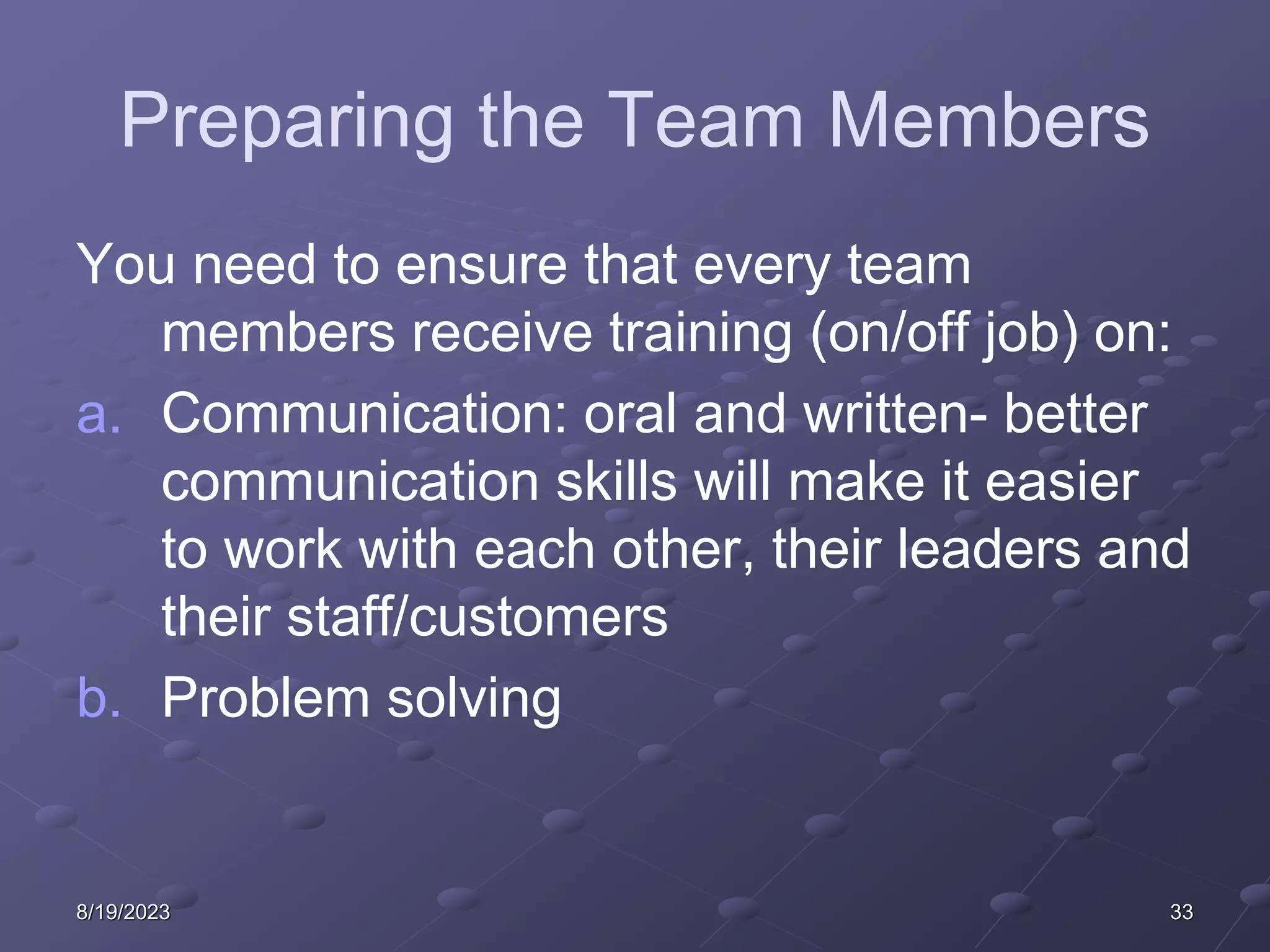
Preparing the Team Members
You need to ensure that every team
members receive training (on/off job) on:
a. Communication: oral and written- better
communication skills will make it easier
to work with each other, their leaders and
their staff/customers
b. Problem solving
34
8/19/2023
Cont.
c. Conducting effective meeting: Allowing
them to lead departmental meetings to
develop their skills and confidence, take
some work load off their leader, and spot
future talent
d. Any kind of training to help them increase
their value to the organisation
35
8/19/2023
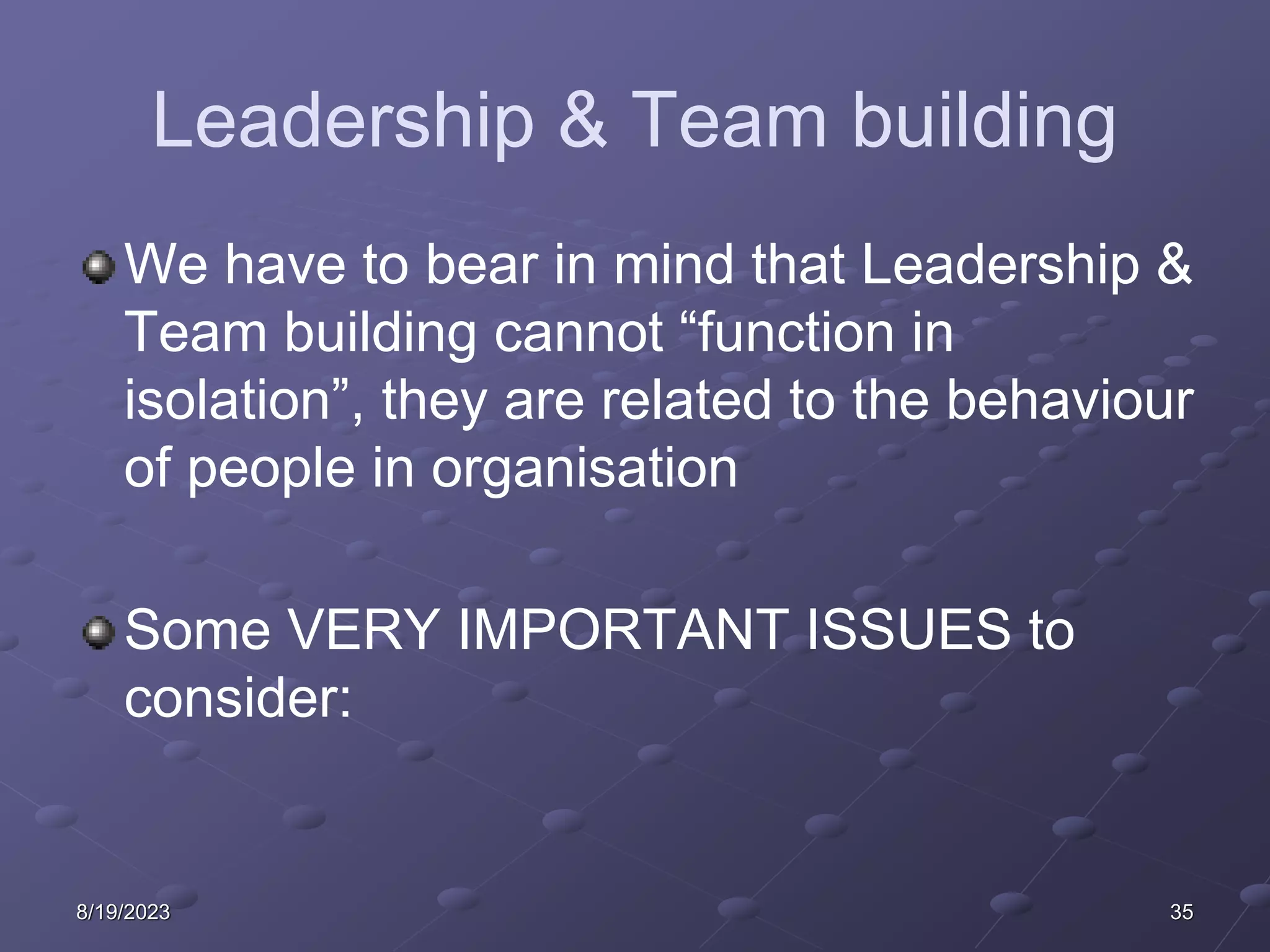
Leadership & Team building
We have to bear in mind that Leadership &
Team building cannot “function in
isolation”, they are related to the behaviour
of people in organisation
Some VERY IMPORTANT ISSUES to
consider:
36
8/19/2023
VI Issues in Organisation
Communication
Motivation
Personality, perception & decision making
Learning & learning organisation
Values, attitude & job satisfaction
Conflict management
37
8/19/2023
Communication
Communication process
Types/forms of communication
Flow/channels of communication
Effective communication
Barriers to effective communication
38
8/19/2023
Motivation
Intrinsic/extrinsic motivation
Maslow’s Theory of needs:
Physiological-Safety-Social-Self esteem-Self
actualisation
Theory X & Theory Y
39
8/19/2023
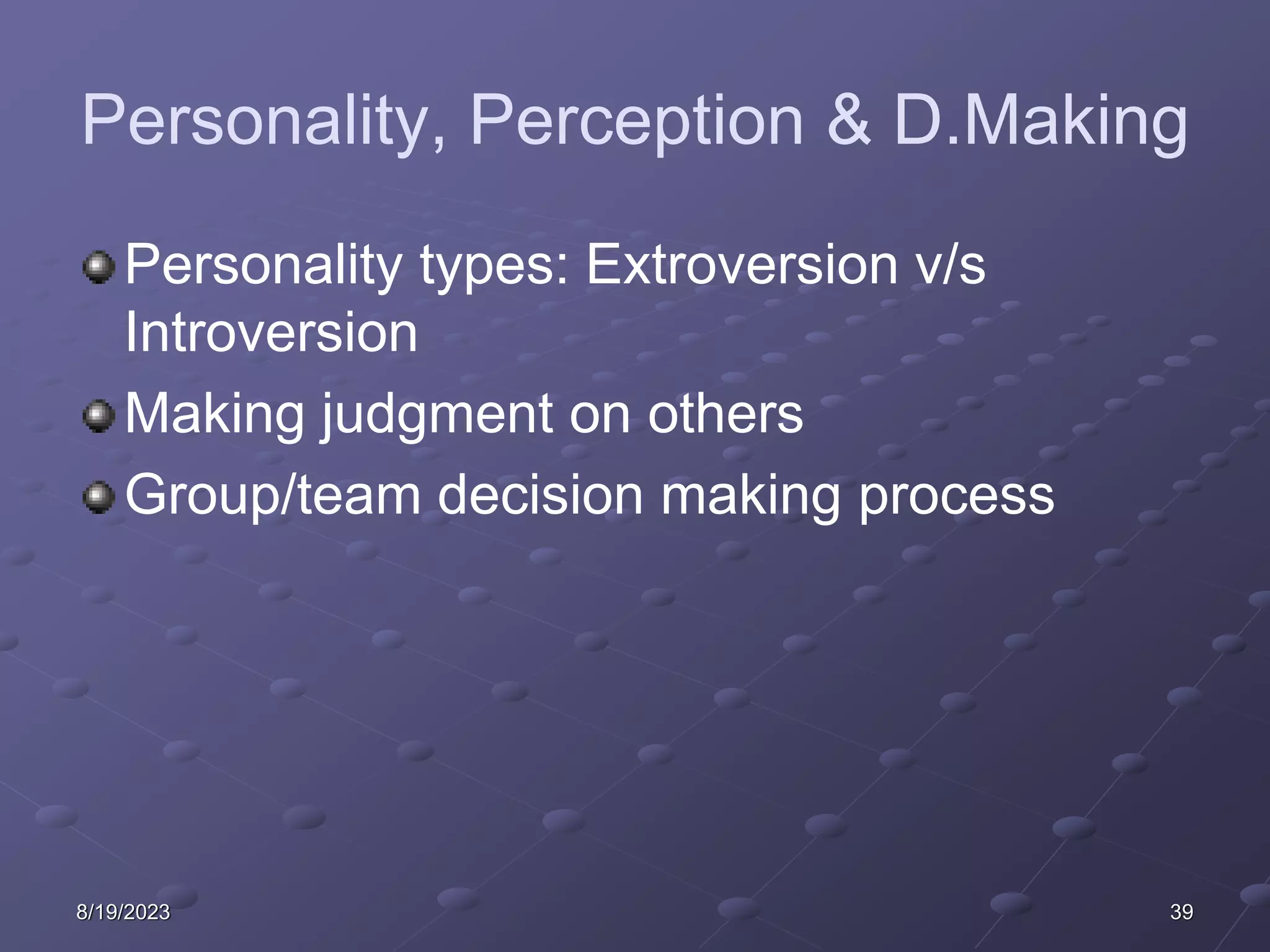
Personality, Perception & D.Making
Personality types: Extroversion v/s
Introversion
Making judgment on others
Group/team decision making process
40
8/19/2023
Learning & Learning organisation
Importance of learning in organisation
“Learning is living; learning is growing”
Learning organisation moving towards
Knowledge Management
41
8/19/2023
Values, Attitude & J.Satisfaction
Values: Importance
Attitudes at work & towards work
Factors leading to Job satisfaction:
challenging work, rewards, work
environment & work condition etc
42
8/19/2023
Conflict Management
Strategies for managing conflict:
➢Communication
➢Compromise
➢Authoritative command
➢Negotiation
43
8/19/2023
END OF SESSION
44
8/19/2023
Contact Details
MR B.TANDARAYEN
Engineer
Ministry of Agro-Industry & Food Security
Coromandel
Tel:233 5044, 233 0030
Fax: 233 4779
Email: btandarayen@mail.gov.mu
45
8/19/2023
Recommended Reading
Seven Habits of highly effective people,
S.Covey
Greatness guide I & II, R.Sharma
Leadership & Motivation, J.Adair
Organisational Behaviour, Robbins
Human Resource Management
Handbook, Armstrong

LEADERSHIP & TEAM BUILDING.pdf

  • 1.
    8/19/2023 1 LEADERSHIP &TEAM BUILDING MR B.TANDARAYEN BEng, Msc (HRM)
  • 2.
    2 8/19/2023 Course outline Leadership >Leaders v/sManagers > Theories of Leadership > Qualities of a good leader >Leadership Issues Team Building > Group dynamics & Group Develop. > Teams: Influence of team at the work place >Methods to develop effective teams
  • 3.
    3 8/19/2023 Introduction Today in anenvironment that is highly competitive, and driven by considerations of technology, innovation, quality, cost effectiveness, timeliness and excellence in service delivery, Government organisations cannot afford to lag behind
  • 4.
    4 8/19/2023 Leadership Leadership can beviewed as a dynamic process, which involves a number of combined factors and phenomena, and the outcomes of effective leadership are behaviours and achievements that are in line with the vision and strategies of the organisation
  • 5.
    5 8/19/2023 Definition: Leadership “ Theability to influence a group toward the achievement of goals” Robbins & Coulter(1999)
  • 6.
    6 8/19/2023 Leadership variables There arefive main variables that can influence leadership behaviour: 1.The tasks and goal of the organisation 2.The leader’s knowledge, skills & attitudes 3.The followers skills, attitudes & motivation 4.The context or situation 5.The resources available
  • 7.
    7 8/19/2023 Leaders & Managers Leadershipis a function above management A good manager is well organized and works efficiently Leaders agitate for change and new approaches, managers advocate stability and the status quo
  • 8.
    8 8/19/2023 Cont. But a goodleader together with the above, is someone who encourages others to do better Leadership is one of the most important issues and is quite scarce in the organisation.
  • 9.
    9 8/19/2023 Theories of Leadership 1.Contemporary Theories: a. Attribution Theory: It is based on the concept of cause and effect relationship. Leaders are characterise as having a number of traits: intelligence, outgoing personality, strong verbal skills, aggressiveness & understanding. ➢ A good leader is considered to be someone who pays high attention to production/tasks as well as people/relationship, irrespective of situation
  • 10.
    10 8/19/2023 Cont. b. Charismatic Theory ➢Charismaticleaders possess certain personal qualities that they use to exercise profound and extraordinary impact upon their follower. ➢These are: Ability to command respect, inspire pride and faith ➢They have a strong sense of mission and purpose and are able to articulate a clear vision to their followers
  • 11.
    11 8/19/2023 Cont. c. Transactional &Transformational Leadership ➢Transactional leader uses position power and the followers are motivated by self-interests ➢ Transformational Leadership is more strongly correlated to lower turnover rates, higher productivity and higher employee satisfaction
  • 12.
    12 8/19/2023 Theories of Leadership 2.Style theories: a. Autocratic style b. Democratic style c. Laissez faire style
  • 13.
    13 8/19/2023 Cont. 3. Contingency Theories Thesetheories take a more contextual view and focus on the importance of situation in which leadership is exercised. They are based on the belief that there is no single style of leadership appropriate to all situations
  • 14.
    14 8/19/2023 Cont. a. The contingencytheory (Fielder’s) of leadership takes into account both the leader’s personality and the complexities of situation. The following are encouraged: > Good leader-member relations, high task structure and high position power
  • 15.
    15 8/19/2023 Cont. b. Contingency theory(Path-goal): The leadership style is adapted to the characteristics of the followers and the environment in which they are employed
  • 16.
    16 8/19/2023 c. Situational Theory:It suggests that leader behaviour needs to be adjusted to the maturity level of the followers i.e degree of motivation, experience and interest
  • 17.
    17 8/19/2023 Qualities of agood leader Trust Determination – Initiative & perseverance Humility – modesty; with focus on collective rather than personal recognition/achievement Honesty & Integrity Competence & Initiative Sense of responsibility & Forward-looking
  • 18.
    18 8/19/2023 LEADERSHIP ISSUES Leadership &Gender: The gender issue needs to be examined objectively and stereotyping needs to be avoided Leadership & cultural factors: Cultural factors have the potential of impacting upon leadership behaviours. So both the value systems of leaders and followers can shape the leadership relationships in given contexts
  • 19.
    19 8/19/2023 Cont. Leadership and organisationallife cycle: The leadership behaviour will have to take into consideration the demands of the specific stages of the organisational life cycle and adopt the leadership style that is most suitable Leadership & globalisation: Organisations will have to train leaders for global operations by focussing on cross-cultural and language skills
  • 20.
    20 8/19/2023 TEAM BUILDING Today withthe growing complexity of society and the continuing development of technological capability, more organisational life will revolve around group and team structures The contribution of teams and groups will find accrued importance in the decision making process
  • 21.
    21 8/19/2023 Group Development Forming stage:is characterised by the development of interpersonal relationships, identification of goals and the establishment of behaviour norms among the members
  • 22.
    22 8/19/2023 Cont. Storming stage: ischaracterised by intra- group conflict. e.g conflict over leadership, goals etc Norming stage: is where members of the group understand what is expected of them and where the leadership structure is clear
  • 23.
    23 8/19/2023 Cont. Performing stage: Thisstage results in an effective well-integrated group that performs the required task effectively & efficiently Adjourning stage: When the task is completed, the group prepares for its winding up.
  • 24.
    24 8/19/2023 Teams The team basedstructures approach is in line with the human aspect of management that has sought to encourage and sustain motivation and commitment of staff as a way of enhancing and advancing the cause of both productivity for the organisation and providing a satisfying environment for employees
  • 25.
    25 8/19/2023 Definition of Team “asmall number of people with complementary skills who are committed to a common purpose, performance, goal and approach for which they hold themselves mutually accountable”
  • 26.
    26 8/19/2023 Preparation for effective TeamBuilding Effective work teams do not just happen miraculously; they are the result of careful planning and preparation. The need for: ➢Preparing the work environment ➢Preparing you: the Leader ➢Preparing team members
  • 27.
    27 8/19/2023 Preparing the workenvironment 1. Identify the department’s purpose that explains clearly (as a whole) what the department is supposed to do 2. Each employee in the department has clearly defined job tasks with defined performance levels 3. Ensure that every person/supervisor at every level in the department demonstrates daily: a. Leadership skills b. Work assessment skills
  • 28.
    28 8/19/2023 Cont. 4. Make surethat: a. There is proper delegation at every level b. There is chance for creativity, innovation & decision making by the employee c. Much emphasis is laid on employee coaching, training and development at all levels
  • 29.
    29 8/19/2023 Preparing you: TheLeader 1. Make sure that all new employee have completed a measurable and documented orientation and basic training program in their new job within the department 2. Ensure good communication and discussion with your staff:
  • 30.
    30 8/19/2023 a. To identifywork related strengths and performance improvement needs of each of them b. To identify non-budgetary reward that could have value for each of them c. So that you and your staff are in regular agreement on the priority
  • 31.
    31 8/19/2023 3. The needto identify potential team leaders and identify additional training or experience opportunities that will help them in their development 4. The need to identify to your satisfaction, the limits of authority you will be willing exert 5. Discussing with the potential team leaders to help them see through your eyes
  • 32.
    32 8/19/2023 6. The needto develop: “ Team code of conduct” in conjunction with your potential team leaders that will be observed when you begin the creation of work teams
  • 33.
    33 8/19/2023 Preparing the TeamMembers You need to ensure that every team members receive training (on/off job) on: a. Communication: oral and written- better communication skills will make it easier to work with each other, their leaders and their staff/customers b. Problem solving
  • 34.
    34 8/19/2023 Cont. c. Conducting effectivemeeting: Allowing them to lead departmental meetings to develop their skills and confidence, take some work load off their leader, and spot future talent d. Any kind of training to help them increase their value to the organisation
  • 35.
    35 8/19/2023 Leadership & Teambuilding We have to bear in mind that Leadership & Team building cannot “function in isolation”, they are related to the behaviour of people in organisation Some VERY IMPORTANT ISSUES to consider:
  • 36.
    36 8/19/2023 VI Issues inOrganisation Communication Motivation Personality, perception & decision making Learning & learning organisation Values, attitude & job satisfaction Conflict management
  • 37.
    37 8/19/2023 Communication Communication process Types/forms ofcommunication Flow/channels of communication Effective communication Barriers to effective communication
  • 38.
    38 8/19/2023 Motivation Intrinsic/extrinsic motivation Maslow’s Theoryof needs: Physiological-Safety-Social-Self esteem-Self actualisation Theory X & Theory Y
  • 39.
    39 8/19/2023 Personality, Perception &D.Making Personality types: Extroversion v/s Introversion Making judgment on others Group/team decision making process
  • 40.
    40 8/19/2023 Learning & Learningorganisation Importance of learning in organisation “Learning is living; learning is growing” Learning organisation moving towards Knowledge Management
  • 41.
    41 8/19/2023 Values, Attitude &J.Satisfaction Values: Importance Attitudes at work & towards work Factors leading to Job satisfaction: challenging work, rewards, work environment & work condition etc
  • 42.
    42 8/19/2023 Conflict Management Strategies formanaging conflict: ➢Communication ➢Compromise ➢Authoritative command ➢Negotiation
  • 43.
  • 44.
    44 8/19/2023 Contact Details MR B.TANDARAYEN Engineer Ministryof Agro-Industry & Food Security Coromandel Tel:233 5044, 233 0030 Fax: 233 4779 Email: btandarayen@mail.gov.mu
  • 45.
    45 8/19/2023 Recommended Reading Seven Habitsof highly effective people, S.Covey Greatness guide I & II, R.Sharma Leadership & Motivation, J.Adair Organisational Behaviour, Robbins Human Resource Management Handbook, Armstrong