DEPARTMENT OF COMMERCE AND
MANAGEMENT
SHIVAJI UNIVERSITY KOLHAPUR.
PRESENTATION
ON
“EFFECTIVE COMMUNICATION SKILLS,
INTRODUCTION, UNDERSTANDING
COMMUNICATION AND COMMUNICATION
PROCESS”
PRESENTED BY
MR. HARSHAL D. PATIL
UNDER THE GUIDANCE OF
MRS. RENUKA S. TURAMBEKAR
CONTENT
 Introduction of effective communication skill
• Definition and meaning
• Uses of effective communication skills
• Importance of effective communication skills
• Ten consideration of effective communication
 Understanding of effective communication
• Characteristics of communication
 Process of effective communication
• Purpose of effective communication
INTRODUCTION
 Meaning
Effective communication is a two way process – sending the right message
and to the right person.
It is important to know the psychology of the people you are interacting
with for communication to be effective.
For communication to be effective it is necessary to know the
circumstances of the counter entity.
Effective communication includes all the aspects of visual, authority and
kinesthetic language to appeal the listener.
 Definition
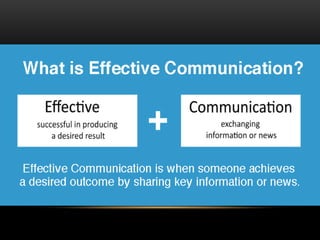
“Effective communication is the communication which produces intended
or desired result”
USES OF EFFECTIVE COMMUNICATION
SKILLS
 Effective communication helps to understand a person or situation in
a better way.
 It enables us to solve the differences, build trust and respect in the
organization.
 Sometimes our message is misunderstood or we misunderstand the
received message, effective communication helps us to resolve
problems with both point of view.
 Effective communication helps us to connect well with kids, spouse,
boss, colleagues, etc.
 It help us in decision making.
IMPORTANCE OF EFFECTIVE
COMMUNICATION
 No matter how brilliant and invaluable your idea, it is worthless unless
you can share it with others.
 Effective communication is crucial at every level of an organization.
 Builds up mutual trust and confidence.
 Helps in achieving increased productivity at lower cost.
 Binds people together.
 Improves the moral in an organization.
 Forms the basis for the decision making.
 Helps in proper planning and co-ordination.
 Helps in efficient running of an organization.
TEN CONSIDERATION OF EFFECTIVE
COMMUNICATION
 Seek to clarify your ideas before communicating.
 Examine the true purpose of communication.
 Consider the total physical and human setting.
 Consult with others in planning communication.
 Be mindful of the overtones as well as the basic content of your
message.
UNDERSTANDING COMMUNICATION
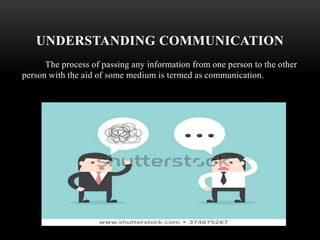
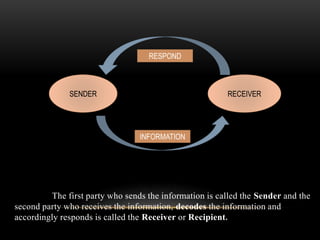
The process of passing any information from one person to the other
person with the aid of some medium is termed as communication.
The first party who sends the information is called the Sender and the
second party who receives the information, decodes the information and
accordingly responds is called the Receiver or Recipient.
SENDER RECEIVER
RESPOND
INFORMATION
CHARACTERISTIC OF COMMUNICATION
 Interchange Information
 Continuous process
 Mutual Understanding
 Response or reaction
 Universal function
 Social activity
 Use of words as well as symbols
1. Interchange information –
 Exchange information
 It is a two way process
2. Continuous process
 Communication is a continuous process
 It is not static
 It is constantly subject to change and is dynamic.
3. Mutual Understanding
 To create understanding in others.
4. Response or reaction
 Communication always leads to some response or reaction.
5. Universal function
 Communication is a universal function
6. Social Activity
 Relationship of sharing, information, feelings or emotions.
7. Use of words as well as symbols
 Symbolic nature of communication.
PROCESS OF EFFECTIVE
COMMUNICATION
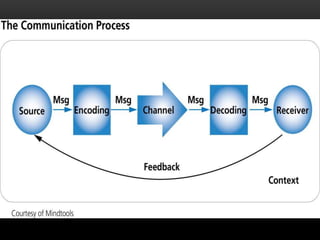
 The process of communication involves seven elements –
1. Sender
2. Message
3. Encoding
4. Channel
5. Receiver
6. Decoding
7. Feedback
8. Noise
1. SENDER
The sender is the person who transmits a message. He is the communicator. He
is the one who gets the entire process of communication started. He wants to get
his opinions, ideas, facts, thoughts or information across to the receiver. He is,
therefore, also said to be transmitter of a message.
2. MESSAGE
A massage is the actual information that has to be conveyed. Communication is
unthinkable without a message. A message triggers a response from the
receiver. Message can broadly be divided into verbal and non verbal. The
message must be clear, complete, unambiguous and courteous.
3. ENCODING
The process of converting thoughts into suitable words, charts, symbols or any
other form in which they can be understood by the receiver is called encoding.
4. CHANNEL
Communication is achieved through the channel. The channel can be letter,
a fax, a telephone or memos, reports, bulletins, posters and manual. The
choice of the channel depends on the relationship between sender and the
receiver as well as on the message that has to be communicated.
5. RECEIVER
The person who receive the message, decodes it and understands it or
attaches some meaning to it is the receiver.
The receiver has to perform 3 functions:
a) Receptions of the message : This is the stage when a message send by
the sender is sensorily taken in by the receiver.
b) Decoding the message : After receiving the message, the receiver has to
attach some meaning to it.
c) Understanding the message : He then has interpret it in the same way
and in the same sense as the sender meant it.
6. FEEDBACK
The return of communication from the receiver to the sender is known as
feedback. It is the response, reaction or reply to the communication. It is
always directed towards the sender.
This completes cycle of the communication. Thus, in feedback receiver
sends his reply or response to the sender, indicating that he has
understood the message received.
In Face to face communication the feedback is quicker than in written
communication.
7. NOISE
Noise is the interference which produces disturbance in the
communication process.
Noise may be at receiver level, sender lever or message.
PURPOSE OF COMMUNICATION
1. To inform
2. To reassure
3. To teach
4. To deliver news, whether good or bad
5. To understand
6. To explain
7. To persuade
8. To organize
9. To control
10. To co-ordinate
11.To direct

effective communication

  • 1.
    DEPARTMENT OF COMMERCEAND MANAGEMENT SHIVAJI UNIVERSITY KOLHAPUR. PRESENTATION ON “EFFECTIVE COMMUNICATION SKILLS, INTRODUCTION, UNDERSTANDING COMMUNICATION AND COMMUNICATION PROCESS” PRESENTED BY MR. HARSHAL D. PATIL UNDER THE GUIDANCE OF MRS. RENUKA S. TURAMBEKAR
  • 2.
    CONTENT  Introduction ofeffective communication skill • Definition and meaning • Uses of effective communication skills • Importance of effective communication skills • Ten consideration of effective communication  Understanding of effective communication • Characteristics of communication  Process of effective communication • Purpose of effective communication
  • 3.
    INTRODUCTION  Meaning Effective communicationis a two way process – sending the right message and to the right person. It is important to know the psychology of the people you are interacting with for communication to be effective. For communication to be effective it is necessary to know the circumstances of the counter entity. Effective communication includes all the aspects of visual, authority and kinesthetic language to appeal the listener.  Definition “Effective communication is the communication which produces intended or desired result”
  • 5.
    USES OF EFFECTIVECOMMUNICATION SKILLS  Effective communication helps to understand a person or situation in a better way.  It enables us to solve the differences, build trust and respect in the organization.  Sometimes our message is misunderstood or we misunderstand the received message, effective communication helps us to resolve problems with both point of view.  Effective communication helps us to connect well with kids, spouse, boss, colleagues, etc.  It help us in decision making.
  • 6.
    IMPORTANCE OF EFFECTIVE COMMUNICATION No matter how brilliant and invaluable your idea, it is worthless unless you can share it with others.  Effective communication is crucial at every level of an organization.  Builds up mutual trust and confidence.  Helps in achieving increased productivity at lower cost.  Binds people together.  Improves the moral in an organization.  Forms the basis for the decision making.  Helps in proper planning and co-ordination.  Helps in efficient running of an organization.
  • 7.
    TEN CONSIDERATION OFEFFECTIVE COMMUNICATION  Seek to clarify your ideas before communicating.  Examine the true purpose of communication.  Consider the total physical and human setting.  Consult with others in planning communication.  Be mindful of the overtones as well as the basic content of your message.
  • 8.
    UNDERSTANDING COMMUNICATION The processof passing any information from one person to the other person with the aid of some medium is termed as communication.
  • 9.
    The first partywho sends the information is called the Sender and the second party who receives the information, decodes the information and accordingly responds is called the Receiver or Recipient. SENDER RECEIVER RESPOND INFORMATION
  • 10.
    CHARACTERISTIC OF COMMUNICATION Interchange Information  Continuous process  Mutual Understanding  Response or reaction  Universal function  Social activity  Use of words as well as symbols
  • 11.
    1. Interchange information–  Exchange information  It is a two way process 2. Continuous process  Communication is a continuous process  It is not static  It is constantly subject to change and is dynamic. 3. Mutual Understanding  To create understanding in others.
  • 12.
    4. Response orreaction  Communication always leads to some response or reaction. 5. Universal function  Communication is a universal function 6. Social Activity  Relationship of sharing, information, feelings or emotions. 7. Use of words as well as symbols  Symbolic nature of communication.
  • 13.
    PROCESS OF EFFECTIVE COMMUNICATION The process of communication involves seven elements – 1. Sender 2. Message 3. Encoding 4. Channel 5. Receiver 6. Decoding 7. Feedback 8. Noise
  • 15.
    1. SENDER The senderis the person who transmits a message. He is the communicator. He is the one who gets the entire process of communication started. He wants to get his opinions, ideas, facts, thoughts or information across to the receiver. He is, therefore, also said to be transmitter of a message. 2. MESSAGE A massage is the actual information that has to be conveyed. Communication is unthinkable without a message. A message triggers a response from the receiver. Message can broadly be divided into verbal and non verbal. The message must be clear, complete, unambiguous and courteous. 3. ENCODING The process of converting thoughts into suitable words, charts, symbols or any other form in which they can be understood by the receiver is called encoding.
  • 16.
    4. CHANNEL Communication isachieved through the channel. The channel can be letter, a fax, a telephone or memos, reports, bulletins, posters and manual. The choice of the channel depends on the relationship between sender and the receiver as well as on the message that has to be communicated. 5. RECEIVER The person who receive the message, decodes it and understands it or attaches some meaning to it is the receiver. The receiver has to perform 3 functions: a) Receptions of the message : This is the stage when a message send by the sender is sensorily taken in by the receiver. b) Decoding the message : After receiving the message, the receiver has to attach some meaning to it. c) Understanding the message : He then has interpret it in the same way and in the same sense as the sender meant it.
  • 17.
    6. FEEDBACK The returnof communication from the receiver to the sender is known as feedback. It is the response, reaction or reply to the communication. It is always directed towards the sender. This completes cycle of the communication. Thus, in feedback receiver sends his reply or response to the sender, indicating that he has understood the message received. In Face to face communication the feedback is quicker than in written communication. 7. NOISE Noise is the interference which produces disturbance in the communication process. Noise may be at receiver level, sender lever or message.
  • 18.
    PURPOSE OF COMMUNICATION 1.To inform 2. To reassure 3. To teach 4. To deliver news, whether good or bad 5. To understand 6. To explain 7. To persuade 8. To organize 9. To control 10. To co-ordinate 11.To direct